I. INTRODUCTION
Supercapacitor, also known as electrochemical capacitor, was a new type of capacitor between the traditional capacitor and the secondary battery, with higher power density than the secondary batteries and larger energy density than the traditional capacitor. In addition, the supercapacitor was also environmentally friendly, with high security, rapid charge–discharge rate, and excellent cycle stability, and has a wide range of applications in electric vehicles, portable electrical equipment, storage devices, and other fields.Reference Yan, Wang, Wei and Fan1,Reference Han, Wu, Li, Zhang and Feng2 But improving the power characteristics and increasing the energy density of the supercapacitor were of great practical significance for alleviating the energy crisis. At present, three types of electrode materials have been widely used for supercapacitors: metal oxides/hydroxides,Reference Wang, Hao, Zhao, Lai and Xu3 carbonaceous materials,Reference Zhu, Murali, Stoller, Ganesh, Cai, Ferreira, Pirkle, Wallace, Cychosz, Thommes, Su, Stach and Ruoff4 and conducting polymers.Reference Wang, Hao, Yang, Lu and Wang5 Carbonaceous materials were the most widely used electrode active materials based on its excellent physical and chemical properties, such as high conductivity, large specific surface area, well-developed pore structure, and stable chemistry. Carbonaceous materials could be available for storage and release of energy, mainly by the reversible adsorption and desorption of electrolyte ions on the surface of the electrode material, which were derived from the low energy density because of the inherent limitation of the electrostatic surface charging mechanism.Reference Deng, Yu, Cheng, Lin, Sun, Ye and Li6 In contrast, metal oxides/hydroxides and conducting polymers conduct fast and reversible faradaic reactions at the interface of the electrode and the electrolyte, which leads to better supercapacitive properties than carbonaceous materials. However, long-term charge and discharge of the conductive polymer often caused volume expansion and contraction, resulting in poor cycle stability. To improve the performance of energy storage and conversion devices, more and more researchers dedicated to developing advanced faradaic pseudocapacitance material based on transition metal oxides/hydroxides.
The graphene quantum dots (GQDs) were a new type of carbon nanomaterials with dimensions below 10 nm, which not only had various properties of graphene, such as high electron and hole mobility, high electron emission, fast electron transport speed, and large theoretical surface area, but also had good biocompatibility, photoluminescent properties, chemical inertness, and the particularly remarkable quantum confinement effect and boundary effect.Reference Zhang, Zhang, Chen and Qu7,Reference Shen, Zhu, Yang and Li8 These features made GQDs popular with researchers in recent years, including bioimaging,Reference Zhu, Zhang, Qiao, Tang, Li, Yuan, Li, Tian, Liu, Hu, Gao, Wei, Zhang, Sun and Yang9,Reference Peng, Gao, Gupta, Liu, Romero-Aburto, Ge, Song, Alemany, Zhan, Gao, Vithayathil, Kaipparettu, Marti, Hayashi, Zhu and Ajayan10 heavy metal ion detection,Reference Li, Ji, Fei, Wang, Lu, Zhang, Jiang and Zhu11 optoelectronic devices,Reference Li, Hu, Zhao, Shi, Deng, Hou and Qu12,Reference Gupta, Chaudhary, Srivastava, Sharma, Bhardwaj and Chand13 biosensors,Reference Zhao, Chen, Zhu and Li14 photocatalysis,Reference Zhuo, Shao and Lee15 and fuel cells.Reference Hou, Li and Zhao16 Although GQDs have been discovered for almost a decade, the related research on GQDs in supercapacitors was still in its infancy. At present, there were still many defects in the preparation methods of GQDs, such as low yield, small scale, and uneven size. And GQDs materials showed the actual capacitance far below the theoretical value resulting from the particle aggregation, which deteriorated the supercapacitive performance.
Layered double hydroxides (LDHs), which contained hydrotalcite and hydrotalcite-like compounds, were nonpolar functional materials formed by ordered assembly of positively charged host hydroxide layers and guest anions. LDHs can be expressed by a general chemical formula of [M2+1−xM3+x(OH)2]x+(An−)x/n·mH2O, where M2+ and M3+ were divalent and trivalent cations and An− is charge-balancing anions of n valance.Reference Valente, Sánchez-Cantú, Lima and Figueras17,Reference Wang and O’Hare18 LDHs were considered very good supercapacitor electrode materials because of its intercalated ion exchangeability, chemical composition controllability, highly redox active nature, low-cost thermal stability, structure memory effect and environmentally benign nature.Reference Huang, Lei, Wei, Liu, Liu, Cao, Yin and Wang19–Reference Chen, Hu, Chen, Yan and Wu22 However, the pure NiAl-LDH had the disadvantages of easy reunion and poor conductivity, so that when it was charged and discharged under a large current, it may have poor stability.
To overcome these disadvantages, in this work, a layered composite of GOQDs@NiAl-LDH was fabricated using graphene oxide quantum dots (GOQDs) and two-dimensional nanosheets of NiAl-LDH by a layer-by-layer self-assembly method. First, GQDs were prepared using hexachlorobenzene by ball milling. Then, NiAl-LDH was made from nickel nitrate and aluminum nitrate by refluxing at 75 °C. This NiAl-LDH material was combined with GOQDs oxidized by GQDs. In this design, GOQDs and NiAl-LDH nanosheets were assembled into a hierarchical structure, which not only minimized the aggregation of both GOQDs and Ni–Al LDHs but also improved the electrical conductivity of the LDHs. The experimental results showed that when the GOQD content was 10%, the composite material had the largest capacitance and excellent high-current charge–discharge characteristics. The specific capacitance was 869 F/g at a current density of 1 A/g. On the cycling of the electrode at a current density of 1 A/g, the specific capacitance maintained 69.6% of the initial capacitance after 2000 cycles. This composite material exhibited high specific capacity and excellent cycle stability.
II. EXPERIMENTAL METHODS
A. Synthesis of GQDs
GQDs were synthesized by mechanical ball milling method. First, a certain amount of hexachlorobenzene and magnesium powder was placed in a ball mill. And then the magnesium stearate, which contains 1% of magnesium powder, was added in the ball mill as a grinding aid to the ball mill. After running for the appropriate time, the ball mill cans were open for one day. Then 100 mL of 10% of HNO3 was added. The resulting mixture was further stirred for another 6 h at room temperature. After that, the solution was filtered and the filtrate was diluted into a 250-mL volumetric flask. Then a certain amount of toluene solution was added to the solid precipitate. The resulting mixture was stirred and refluxed for 2 h to remove hexachlorobenzene that did not participate in the reaction. And then the solution was purified by centrifugal washing with the ethanol and water and dried in air at 60 °C for 10 h.
B. Preparation of the GOQDs
GOQDs were fabricated in which 50 mg of GQDs was preoxidized in a 40 mL solution that concentrated 30 mL H2SO4(98%) and 10 mL HNO3(65%) for 1 h under ultrasonication. After preoxidation, the mixture was refluxed at 60 °C under the oil bath for 1 h. The mixture was cooled and washed by centrifugation (8000 rpm). Then the solid precipitate was dried in air at 60 °C.
C. Synthesis of NiAl-LDH
To form salt solution A, 7.44 g of nickel nitrate and 2.40 g of aluminum nitrate were mixed so that the total amount of metal ions was 0.0032 mol. To form solution B, 2.32 g of sodium nitrate and 1.60 g sodium hydroxide were mixed. To form solution C, 100 mL of isooctane, 2.16 g of sodium dodecyl sulfate (SDS), and 1.51 g of n-butanol were mixed. And then solution C was stirred under ultrasounds to make the SDS completely dissolve. Then, 1.71 g of solution A was added to the solution C under stirring. After the solution became clear, the solution B was slowly added dropwise and made the pH of the mixed solution equal to 11. And the mixture was stirred for 1 h under reflux for 24 h. Finally, the mixture was purified by reflux washing with the ethanol and acetone for 8 h and dried in air at 60 °C.
D. Synthesis of GOQDs@NiAl-LDH
NiAl-LDH was dissolved in formamide to form a 1 g/L dispersion, which was dispersed under ultrasonication and continuously agitated to peel off the laminate into a lesser or monolayer dispersion. At the same time, 100 mg of the as-prepared GOQDs were dissolved in 100 mL formamide solution, and the solution was peeled off under ultrasonication for several times. Then the as-prepared NiAl-LDH and the GOQDs dispersions were mixed for 1 h in a volume ratio of 1:1, 3:1, 6:1, 9:1, and 12:1 and allowed to naturally settle for 12 h. After that, the solution was washed by centrifugation (8000 rpm) with ethanol and deionized (DI) water before drying in air at 80 °C. The resulting composites were designated as OGL1, OGL3, OGL6, OGL9, and OGL12, respectively.
III. RESULTS AND DISCUSSION
A. Structural and morphological characterization
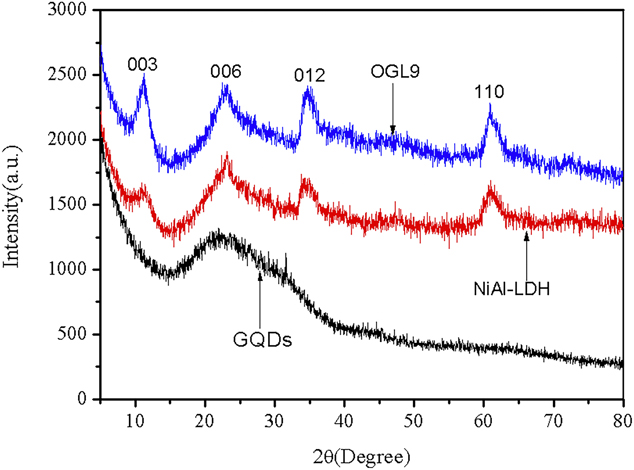
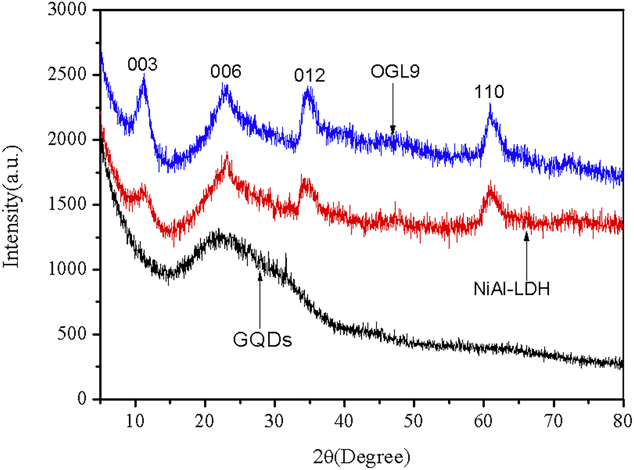
X-ray diffraction (XRD) was conducted to characterize the phase structures of the as-synthesized materials. Figure 1 showed the XRD patterns of GQDs, NiAl-LDH, and OGL9. The diffraction pattern of GQDs exhibits a peak centered at 2θ = 22°, which corresponds to the (002) reflection of graphite.Reference Karimi and Ramezanzadeh23 This basically coincided with the characteristic diffraction peaks appearing in the reported GQDs. The pure NiAl-LDH sample exhibited several characteristic diffraction peaks at 2θ of 11.3°, 22.8°, 34.6°, and 61.8°, which could be indexed to the (003), (006), (012), and (110) planes of hydrotalcite-like LDH phase.Reference Gao, Wang, Li, Yang, Wang, Hou, He, Liu, Mann, Yang, Zhang and Liu24–Reference Faour, Mousty, Prevot, Devouard, De Roy, Bordet, Elkaim and Taviot-Gueho26 The XRD pattern of OGL9 composite was similar to that of the GQDs and pure NiAl-LDH, revealing the existence of GQDs and NiAl-LDH in the composite. And each peak was enhanced because the free-dispersed nanostructures of GQDs and NiAl-LDH were self assembled to restore the layered structure by electrostatics.
XRD patterns of GQDs, NiAl-LDH, and OGL9.
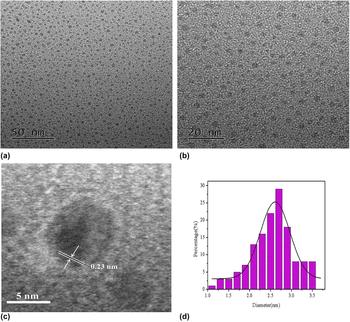
The morphology and microstructure of GQDs, NiAl-LDH, and OGL9 were characterized by transmission electron microscopy (TEM). Figure 2 represented the high-resolution TEM images of GQDs. The uniform distribution of the particle size of the images suggested that the prepared GQDs dispersed well in ethanol and the shape of them were spherical-like nanoparticles. The clear lattice fringes suggested the high crystallinity of the GQDs, and the interplanar spacings of 0.23 nm matched well with the (100) lattice planes of graphite.Reference Sun, Qian, Jiao, Liu, Xi and Dong27 As shown in Fig. 2(d), the particle size distribution of these GQDs was mainly distributed between 2 and 3 nm, with an average particle size of 2.5 nm with 140 GQDs particles were counted.
(a, b) TEM images of GQDs; (c) high-resolution TEM image of GQDs; (d) particle size distribution of GQDs.
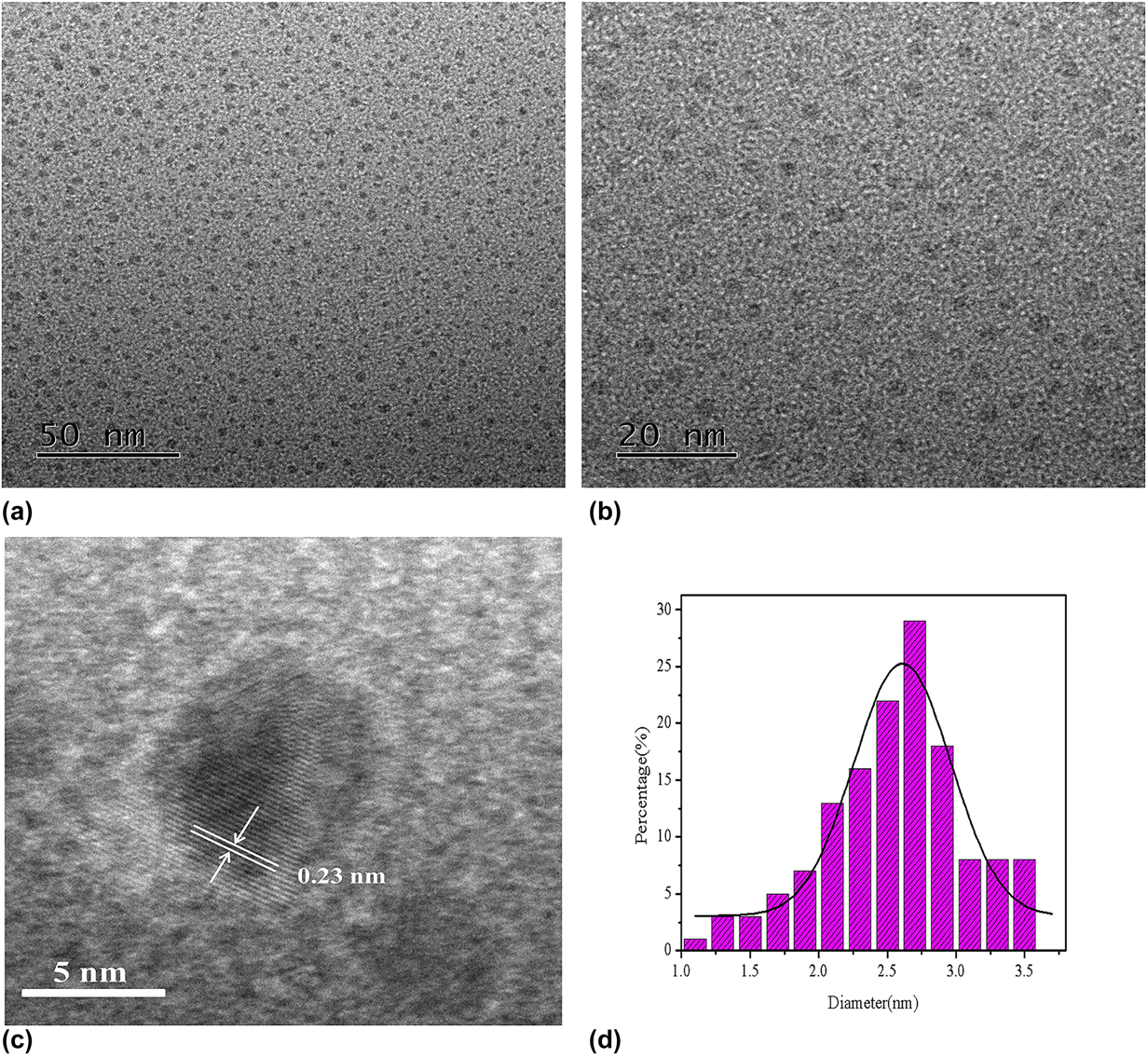
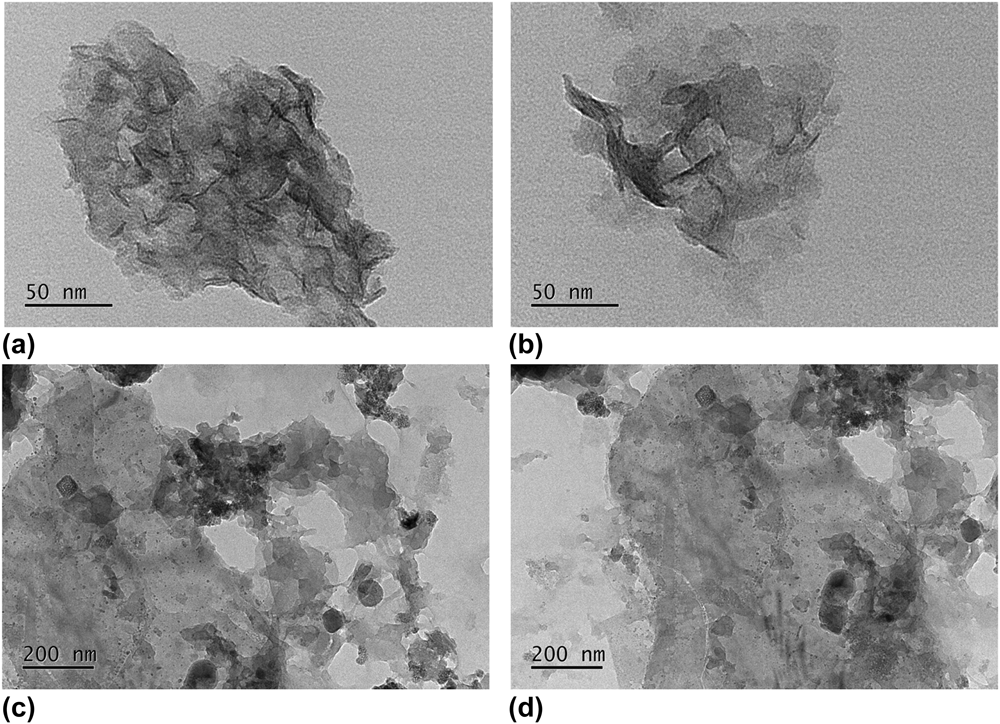
Figure 3 represented the TEM images of pure NiAl-LDH and OGL9 composite. From Figs. 3(a) and 3(b), it could be seen that the nanosheets are relatively dispersed, and the loose sheet-like structure that NiAl-LDH own could be seen. However, in the pure NiAl-LDH sample, the NiAl-LDH nanosheets showed a small fraction of agglomeration, indicating poor dispersion of the NiAl-LDH during ultrasonication. Figures 3(c) and 3(d) revealed the perfect combination of NiAl-LDH and GQDs by layer-by-layer self-assembly, in which GQDs were uniformly attached to the plate-like NiAl-LDH.
TEM images of (a, b) NiAl-LDH and (c, d) OGL9.

The Fourier transformed infrared (FT-IR) spectra of GQDs, NiAl-LDH, and OGL9 were shown in Fig. S1. As expected, the FT-IR spectrum of GQDs revealed the presence of oxygen-containing functional groups. In detail, the absorption band at 3400 cm−1 belonged to the O–H or N–H stretching vibration. The absorption bands at 2922 and 2851 cm−1 could be assigned to the stretching vibration and deformation vibration of C–H of –CH, –CH2, or –CH3. The strong absorption peak at 1705 cm−1 was caused by the vibration of C=O in carboxylic acid group and lactone group. The stretching vibration peaks of C–OH and –COO were observed at 1344 cm−1 and 1187 cm−1, respectively. In addition, the band at 1187 cm−1 was derived from the stretching vibration of the C–O in CH2–O–CH2. These groups confirmed that the surface of GQDs may contain carboxyl, ester, hydroxyl, and other functional groups. In the spectra of NiAl-LDH, the absorption peak at 3400–3600 cm−1 was due to the stretching vibration of O–H of water molecules, the absorption peaks at 2921 and 2846 cm−1 could be ascribed to the stretching vibration of methyl and methylene, the absorption peaks at 1213 and 1050 cm−1 were caused by the absorption of S=O shear vibration in lauryl sulfate, and the absorption peak at 605 cm−1 was attributed to the unique M–OH (M represents Ni or Al) vibration absorption peak on the hydrotalcitelaminae. In the spectra of OGL9, the absorption peaks at 3400–3600 cm−1 and 605 cm−1 were also due to the stretching vibration of O–H of water molecules and the unique M–OH (M represents Ni or Al) vibration absorption peak on the hydrotalcitelaminae, respectively. However, the absorption peak at 1680 cm−1 corresponded to the stretching vibration absorption peak at C=O, and the absorption peak at 1388 cm−1 was the in-plane bending vibrational peak at OH. Comparing with GQDs, it could be seen that the carboxyl absorption peak intensity and the C–OH absorption peak intensity of the composite decreased. This was because the oxygen-containing functional groups on the surface of GQDs lost H+ and were negatively charged during the formation of the composite materials. And during self-assembly with positively charged NiAl-LDH nanosheets, a large number of oxygen-containing functional groups on the surface of GQDs were reduced. Compared with NiAl-LDH, there was almost no S=O shear vibration absorption peak in the composite material, which indicated that NiAl-LDH was closely linked with the layers of GQDs and lauryl sulfate ions did not get into the interlayer.
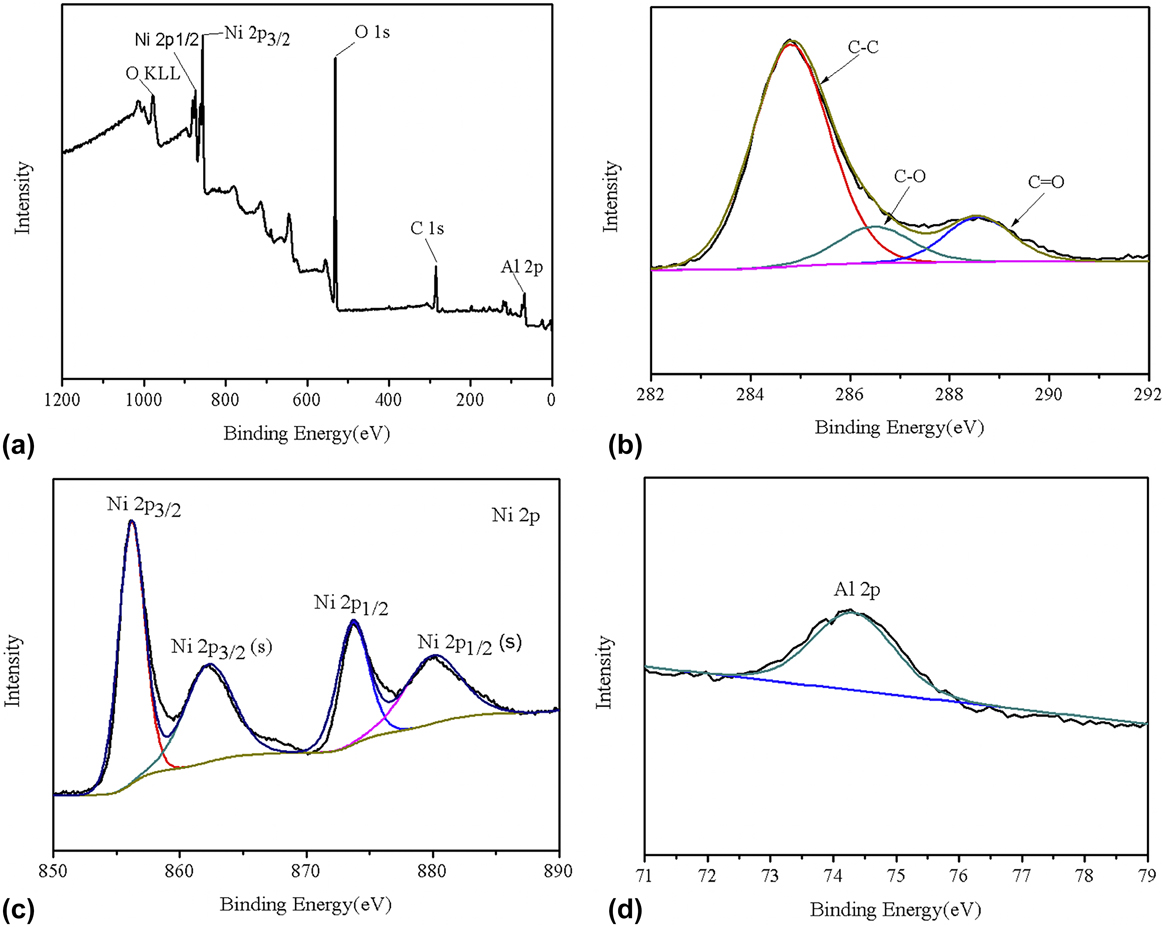
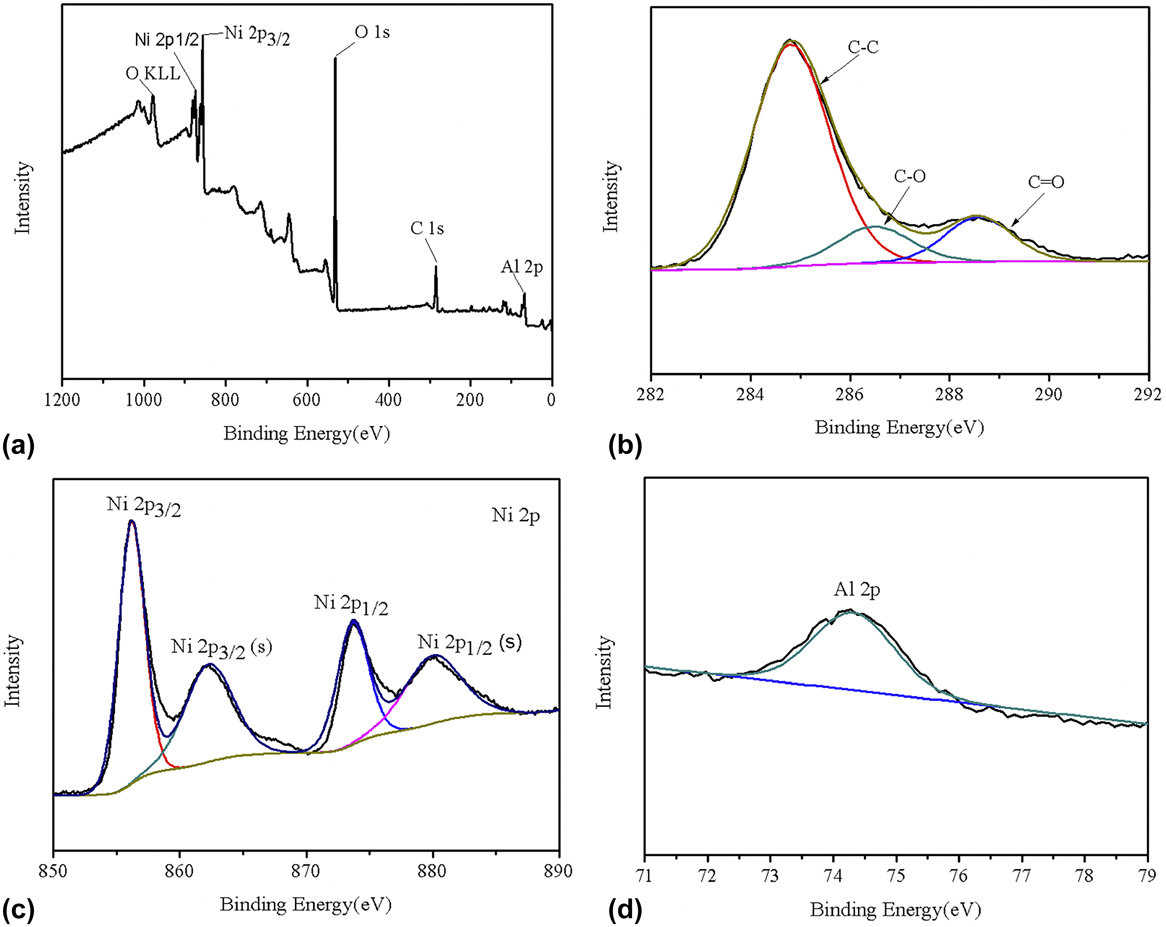
The chemical composition and surface chemical state of the OGL9 composite were investigated by X-ray photoelectron spectroscopy (XPS) technique. The XPS survey spectrum of the OGL9 composite not only exhibited C 1s and O 1s peaks but also showed the peaks corresponding to Ni 2p and Al 2p [Fig. 4(a)], well consistent with the composition of GOQDs@NiAl-LDH. The C 1s XPS spectrum [Fig. 4(b)] could be deconvoluted into three different peaks centered at 286.5, 286.1, and 288.6 eV, corresponding to C–C, C–O, and C=O groups, respectively. Figure 4(c) showed the Ni 2p XPS spectra, two major peaks at 856.2 and 873.7 eV, were corresponded to Ni 2p 3/2 and Ni 2p 1/2, respectively. The spin-energy separation of 17.5 eV was characteristic of Ni2+ in Ni(OH)2.Reference He, Hu, Liu, Guo, Zhang, Liu and Xie28 According to the Al 2p spectrum, there was a major peak at 73.4 eV, corresponding to Al 2p, which indicated that the aluminum in the composite existed in the form Al3+.
(a) XPS survey spectrum, (b) C 1s, (c) Ni 2p, and (d) Al 2p for OGL9.
The typical Raman spectra of GQDs and OGL9 composite are shown in Fig. S2. Both of GQDs and OGL9 samples displayed two prominent peaks at 1350 and 1580 cm−1, which could be ascribed to the well-documented D and G bands, respectively. The integrated intensity ratio of D to G band (I D/I G) reflected the order degree of carbon atoms in the material and the size of sp 2 hybrid region. The higher the ratio, the smaller the sp 2 hybrid region of carbon atoms in the material and the lower the order degree. From Fig. S2, an increment in I D/I G (0.99) was obtained for OGL9 as compared with that of GQDs (0.91), indicating that the sp 2 hybrid region of composite OGL9 was smaller than that of GQDs. This was because a part of the oxidation groups was reduced by NiAl-LDH, during the composite process, so that the carbon atoms bound to the oxidation groups were transformed into sp 3 hybrids, resulting in the decrease of the in-plane sp 2 region.
The thermogravimetric analysis of GQDs, pure NiAl-LDH, and the OGL9 composite, respectively, is shown in Fig. S3. The thermogravimetric profile of GQDs had three weight losses. The first stage was related to the loss of oxygen-containing groups, i.e., hydroxyl groups. The second stage (160–320 °C) showed decomposition of the more stable oxygen-containing groups, i.e., carboxyl groups and epoxies. The third stage was attributed to the decomposition of the carbon skeleton of GQDs.Reference Peng, Gao, Gupta, Liu, Romero-Aburto, Ge, Song, Alemany, Zhan, Gao, Vithayathil, Kaipparettu, Marti, Hayashi, Zhu and Ajayan10,Reference Liu, Na, Liu, Chen and Su29,Reference Abdullah-Al, Lee, In, Lee, Lee, Jeong and Park30 Pure Ni–Al LDH showed a thermogravimetric profile with consecutive weight loss because of removal of adsorbed water (30–150 °C) and interlayer water (150–220 °C) and the dehydration of hydroxyl groups on the surface of NiAl-LDH (220–400 °C). The thermogravimetric curves of more than 400 °C tended to be stable, which indicated that NiAl-LDH was converted to layered double oxide (LDO). The thermogravimetric analysis (TGA) curve of the OGL9 composite showed the three weight losses: the removal of adsorbed water in the material and the loss of interlayer water of NiAl-LDH(30–220 °C), the dehydration of hydroxyl groups on the NiAl-LDH surface (220–400 °C), and the separation of GQDs (400–600 °C). This TGA result suggested that the OGL9 composite had higher thermal stability than GQDs and NiAl-LDH.
B. Electrochemical properties of the GOQDs@NiAl-LDH composites
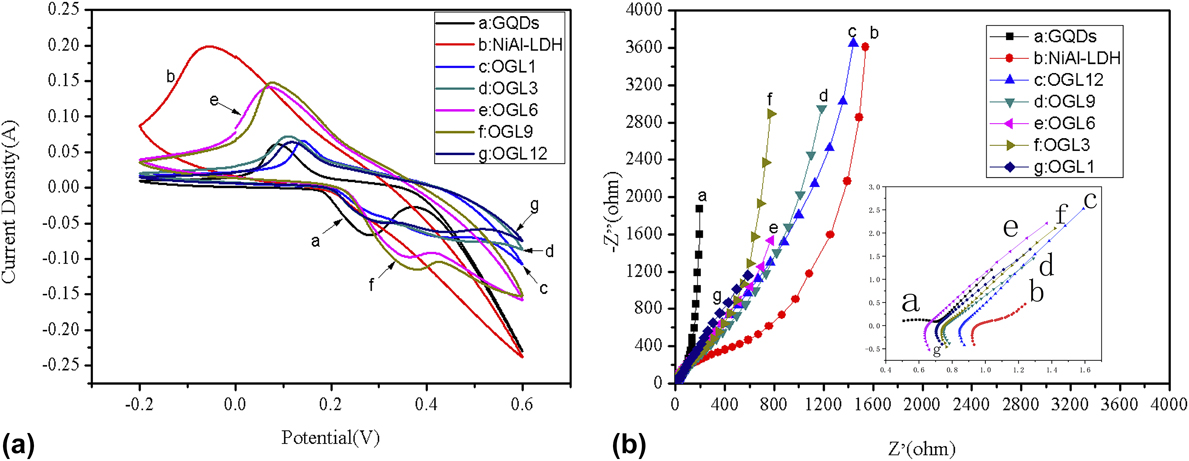
To explore the capacitive properties of GOQDs@NiAl-LDH composites, we conducted electrochemical characterization by cyclic voltammetry (CV), electrochemical impedance spectroscopy (EIS), galvanostatic charge discharge measurements, and electrochemical stability testing. We first performed the CV measurements in a three-electrode system with 6.0 M KOH aqueous solution as the electrolyte, the calomel electrode as the reference electrode, and the platinum electrode as the counter electrode. According to CV curve, not only the storage mechanism of the electrode material could be judged but also the electrochemical reaction occurring in the electrode system and the reversibility of the electrode process could be studied. Figure 5(a) showed the CV curves of the GQDs, NiAl-LDH, and GOQDs@NiAl-LDH composites at a scan rate of 100 mV/s. It could be seen that the CV curves of the composites were similar and consist of a pair of redox peaks, indicating that the electrode material is mainly stored with pseudocapacitance. On the electrode surface, the following redox reactions occurred: Ni (OH)2 + OH− = NiOOH + H2O + e−.Reference Xia, Yang and Shao31 And the mathematic areas of the CV curves of OGL9 electrode were larger than that of other electrode, indicating that the OGL9 electrode possesses higher specific capacitance. With the increase of the content of GOQDs, the area of CV curve first increased and then decreased. When the content of GOQDs was 10%, the obtained composite had the best capacitance performance. All composite materials had obvious oxidation peaks and reduction peaks, indicating that the complex mainly relies on pseudocapacitive energy storage. The redox potential difference reflected the reversibility of the Faraday reaction on the electrode. The redox potential difference of OGL1, OGL3, OGL6, OGL9, and OGL12 at the scan rate of 100 mV/s is 0.203 V, 0.278 V, 0.286 V, 0.30 V, and 0.295 V, respectively. This suggested that as the content of GOQDs increased, the redox potential difference increased, indicating that the conductivity of GOQDs was higher than that of NiAl-LDH. With the increase of the content of GOQDs, the electron conductivity of the composites increased and the reversibility increased.
(a) CV curves of GQDs, NiAl-LDH, and GOQDs@NiAl-LDH composite electrodes at scan rate of 100 mV/s. (b) EIS of GQDs, NiAl-LDH, and GOQDs@NiAl-LDH composite electrodes.

EIS included an arc in the high-frequency region followed by a linear part in the low-frequency region. The semicircular pattern in the high-frequency region was related to the charge transfer resistance. The impedance in low-frequency region was called the Warburg impedance that pertained to the frequency dependence of the ion diffusion and transport in the electrode. Impedance reduces the potential range in which the capacitor could store charge and reduces the capacitor’s ability to store charge. Therefore, the frequency response of the electrode material was of critical importance for the study of capacitor storage performance. Figure 5(b) showed the resistance characteristics of GQDs, NiAl-LDH, and GOQDs@NiAl-LDH composite electrodes investigated by EIS measurements. The impedance of NiAl-LDH, OGL1, OGL3, OGL6, OGL9, OGL12, and GQDs could be obtained as 2.8 Ω, 0.1 Ω, 0.3 Ω, 1.2 Ω, 1.6 Ω, 2.0 Ω, and 0.05 Ω, respectively. Compared with NiAl-LDH, the conductivity of composites increases obviously. As the content of GOQDs increased, the impedance of the composite material decreased accordingly. The existence of GOQDs made the conductivity of NiAl-LDH increase, which will enable a faster Faraday reaction for the composite material.
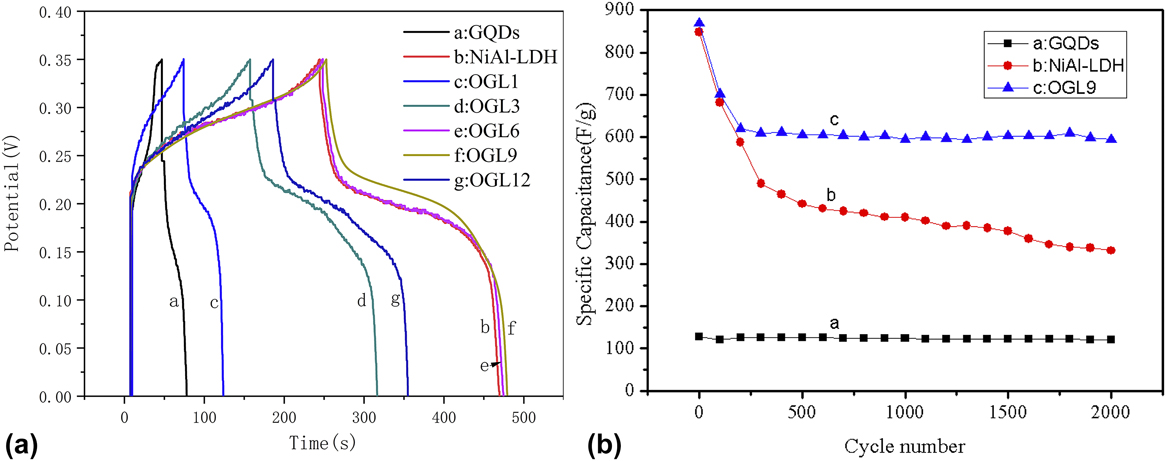
To further investigate the electrochemical performance of the as-prepared electrodes, galvanostatic charge–discharge measurements were conducted at the current density of 1.0 A/g. The specific capacitance, C sp (F/g), was calculated by the equations,
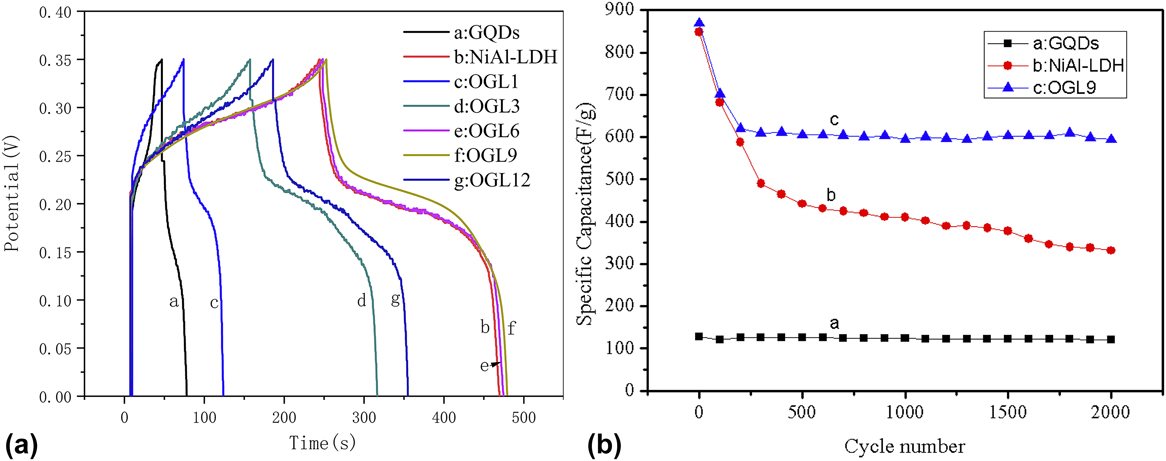
C sp = IΔt/(mΔV), where I (A) was the constant discharging current, t (s) was the discharge time, m (g) was the mass of active material, and V (V) was the potential difference after a full discharge. Figure 6(a) presented the typical charge–discharge curves of the GQDs, NiAl-LDH, and GOQDs@NiAl-LDH composite electrodes at the current density of 1.0 A/g. It could be seen that all the discharge processes of composite materials were divided into the slow discharge process caused by Faraday’s slow discharge and the rapid discharge process caused by the electrode internal resistance. The discharge capacity mainly came from the Faraday current reaction of NiAl-LDH. At the same current density, composite OGL9 had the longest discharge time, which showed that OGL9 had the highest capacitance. When the content of GOQDs reached 10%, the composite OGL9 had the highest specific capacitance, which was consistent with the CV and the highest capacitance retention of 72%. The reason may be that the composite material mainly relies on pseudocapacitive energy storage. When the content of GOQDs was less than 10%, the surface of NiAL-LDH was agglomerated due to too few GOQDs, resulting in a reduction of the active site and a decrease of the specific capacitance. When the content of GOQDs was higher than 10%, with the increase of the content of GOQDs, the Ni2+ involved in pseudocapacitive storage energy decreased continuously, resulting in the reduction of specific capacitance. When the content of GOQDs was 10%, the formed composite had a regular structure. Figure 6(b) shows the cyclic performances of the GQDs, NiAl-LDH, and OGL9 electrodes examined by galvanostatic charge–discharge tests for 2000 cycles at a constant current density of 1 A/g. The GQDs electrode has been in a steady state after 2000 continuous cycles and was maintained at 128 F/g. Corresponding to the specific capacitance of 102 F/g of the carbon materials and graphene materials in the relevant electrolyte reported in the literature.Reference Stoller, Park, Zhu, An and Ruoff32 However, the stability of pure NiAl-LDH was relatively poor, and it gradually became stable at 700 cycles. There was only 50.1% capacitance retention, which was approximately 420 F/g for the NiAl-LDH electrode. On the cycling of the electrode, the specific capacitance of OGL9 electrode decreased by 30.4% around 300 test cycles and maintained 605 F/g, which was 69.6% of the initial capacitance after 2000 cycles. Comparing with pure NiAl-LDH, the stability of the composites was greatly improved because of the presence of GOQDs, and the specific capacitance at the beginning of the stabilization was approximately 605 F/g and greater than NiAl-LDH (420 F/g). In general, the prepared electrode material is stored by Faraday reaction, and the fast Faraday reaction is not completely reversible, so capacitance decreases in recycling. And the capacitance of this material decreased rapidly in the initial cycles. The same problem has mentioned by Zhang et al.Reference Zhang, Yao, Li, Sun, Liu, Dong, Wang, Li, Wu, Zhang and Zhao33 This might be due to the wet preparation of the electrode, which caused the active material to fall off during the initial cycles. Composite materials have high specific capacitance that cannot be achieved by pure NiAl-LDH, and at the same time, they have excellent stability so they are ideal electrode materials.
(a) Charge–discharge curves of GQDs, NiAl-LDH, and GOQDs@NiAl-LDH composite electrodes at the current density of 1.0 A/g. (b) The cycling performances of GQDs, NiAl-LDH, and OGL9 electrodes at a constant current density of 1 A/g.
IV. CONCLUSIONS
In this paper, a novel bottom-up mechanical ball milling method was developed to prepare GQDs with hexachlorobenzene as the carbon source. The method produces relatively uniform sized GQDs under relatively mild conditions, the process flow is simple, the working conditions are mild, and the batch preparation of GQD is realized. Based on this, a generation of supercapacitor electrode material GOQDs@NiAl-LDH between Ni–Al LDH and GOQDs had been successfully fabricated by the layer-by-layer self-assembly method. The as-synthesized GOQDs@NiAl-LDH composites exhibited high specific capacitance, good current charge and discharge characteristics, and excellent cycle stability. The results showed that two favorable conditions could realize electrochemical energy storage capacity in GOQDs@NiAl-LDH composite: (i) GOQDs have enhanced the conductivity and dispersity of NiAl-LDH, which would allow the composite to perform faradaic reactions faster; and the reason may be due to the synergistic effect of incorporating pseudocapacitive NiAl-LDH with conductive GOQDs, which have high conductivity; (ii) the appropriate amounts of doped GOQDs prevent NiAl-LDH from restacking, resulting in a regular structure of the composite materials, which leads to an increase in the active sites. Overall, the results demonstrated that the GOQDs@NiAl-LDH composite with high electrochemical performance could be a promising electrode material for supercapacitor applications. And the findings in this work are also meaningful for understanding the mechanical ball milling method of preparing GQDs and self-assembly process of LDH and may provide a direction for the synthesis of other GQDs-based composite materials.
Supplementary Material
To view supplementary material for this article, please visit https://doi.org/10.1557/jmr.2018.424.