BACKGROUND
Psychosocial oncology addresses the psychological, behavioral, and social reactions of patients, family members, and health professionals to cancer diagnosis and treatment (Holland & Weiss, Reference Holland, Weiss and Holland2010). Psychosocial oncologists experience frequent exposure to death, grief, and intense emotional responses (Le Blanc et al., Reference Le Blanc, Bakker and Peeters2001); therefore, the risk of burnout may be high for these professionals.
“Burnout” was originally defined as a psychological syndrome of emotional exhaustion (EE), depersonalization (DP), and (reduced) personal accomplishment (PA) (Maslach et al., Reference Maslach, Jackson and Leiter2001a). Empirical research has suggested that PA is an independent construct, showing weak relationships with EE and DP, thus PA was excluded from later definitions (Bakker et al., Reference Bakker, Demerouti and Verbeke2004). Burnout has been associated with poor organizational outcomes, including decreased job performance and increased job withdrawal, health problems, and reduced patient satisfaction (Maslach et al., Reference Maslach, Jackson and Leiter2001a; Alacacioglu et al., Reference Alacacioglu, Yavuzsen and Dirioz2009). In oncology, 8–51% of health professionals report burnout, with overall EE and DP prevalence rates found to be 36 and 34%, respectively (Trufelli et al., Reference Trufelli, Bensi and Garcia2008). General factors (work/time overload and pressure, a lack of control in decision making, and interpersonal conflict within the workplace; Dollard et al., Reference Dollard, LaMontagne and Caulfield2007; Michie & Williams, Reference Michie and Williams2003), and oncology-specific factors (exposure to fatal illnesses, difficult doctor–patient relationships and dealing with patients' families; Trufelli et al., Reference Trufelli, Bensi and Garcia2008; Sherman et al., Reference Sherman, Edwards and Simonton2006) have been shown to increase the risk of burnout in these populations.
“Work engagement,” an ongoing positive motivational state of fulfillment composed of vigor, dedication, and absorption, may counteract risks for burnout (Schaufeli et al., Reference Schaufeli, Salanova and González-Romá2002) and has been associated with higher levels of employee and patient satisfaction and productivity (Albrecht, Reference Albrecht and Albrecht2010). While employee work engagement and commitment is considered generally high in healthcare (Mauno et al., Reference Mauno, Kinnunen and Ruokolainen2007), the only study exploring work engagement in oncology to date (Poulsen et al., Reference Poulsen, Poulsen and Khan2011) identified that only 35% of Australian oncology workers were highly engaged in their work. Engaged workers were in better health, were more likely to independently create their own job/personal resources, and to transfer their work engagement to others.
Only three studies have investigated the work experiences of psychosocial oncologists (Wiener et al., Reference Wiener, Oppenheim and Breyer2012; Breen et al., Reference Breen, O'Conner and Hewitt2014; Crowley, Reference Crowley2012); however, none of these adopted a theoretical framework for occupational well-being, nor did they report prevalence rates for burnout or work engagement. There is a clear need for further, theoretically driven research in this population.
The job demands–resources model (JD–R) proposes that every occupation has job demands that deplete employees' resources and lead to burnout, and job resources that have intrinsic and extrinsic motivational potential and lead to high work engagement (Demerouti et al., Reference Demerouti, Bakker and Nachreiner2001). Furthermore, job resources can buffer the potentially negative effects of excessive job demands on employee well-being (Bakker & Demerouti, Reference Bakker and Demerouti2007), with high demands and high resources being associated with the highest levels of work engagement.
This study aimed to determine the degree and prevalence of burnout and work engagement among an international sample of psychosocial-oncology clinicians, as well as associations between job-specific characteristics and psychosocial oncologist well-being. As per the JD–R model (Demerouti et al., Reference Demerouti, Bakker and Nachreiner2001), the following hypotheses were posited:
1. In comparison with established norms, both burnout (EE and DP) and work engagement will be high among psychosocial oncologists.
2. Job demands will be positively associated with burnout (EE and DP) and negatively associated with work engagement.
3. Job resources will be negatively associated with burnout (EE and DP) and positively associated with work engagement.
4. The positive effect of job demands on burnout (EE and DP) will be moderated by the level of job resources.
5. The positive effect of job resources on work engagement will be moderated by the level of job demands.
METHODS
Participants
The eligibility criteria for the study were: (1) having a psychosocial-oncology clinical position as a psychologist, psychiatrist, counselor, or social worker; and (2) currently seeing patients in that role. The exclusion criteria were: (1) not being proficient in English and (2) not being qualified to practice independently (e.g., students).
Procedure
Approval for the study was granted by the University of Sydney Human Research Ethics Committee (HREC). The sample was recruited via email invitations from 10 international and national psychosocial-oncology societies. The email invitation contained an embedded link to the anonymous web-based questionnaire, which was administered remotely using the Qualtrics software system (Qualtrics, 2015). Participants were sent a reminder email to maximize response rates across the three-month data-collection period.
MEASURES
Demographics
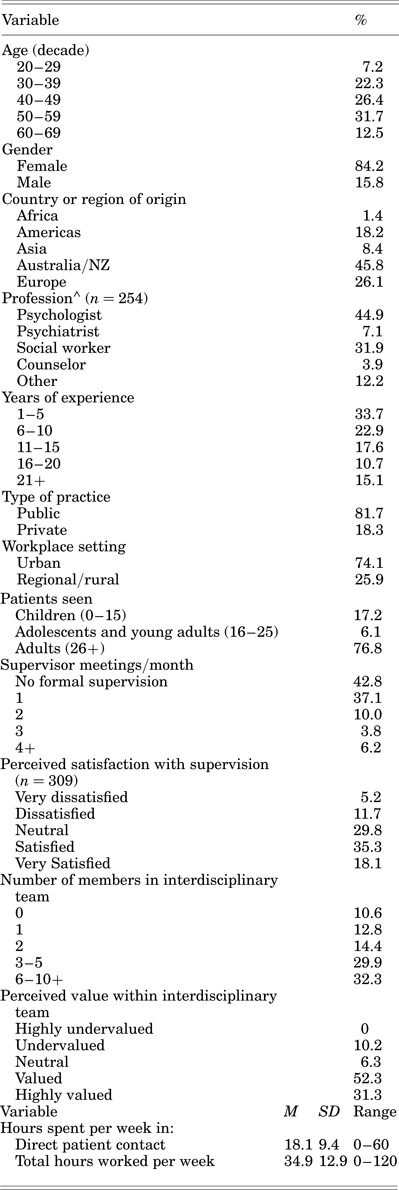
A total of 22 items assessed personal and professional demographic characteristics, as described in Table 1. Work role was initially omitted from the questionnaire, so that data are available for only half the sample.
Personal and professional demographics (N = 417)

Note. ∧Represents a subset of participants as early responders who were not asked this question.
Burnout
Burnout was assessed using the Maslach Burnout Inventory Human Services Survey (MBI–HSS) (Maslach et al., Reference Maslach, Schaufeli and Leiter2001b). Higher scores on the EE (nine items) and DP (five items) subscales indicate greater burnout. Cutoffs for high EE (>21) and DP (>8) are provided in the MBI–HSS manual (Maslach et al., Reference Maslach, Schaufeli and Leiter2001b).
Work Engagement
Work engagement was assessed using the nine-item Utrecht Work Engagement Scale (UWES-9) (Schaufeli & Bakker, Reference Schaufeli and Bakker2003). The total work engagement score was the mean of all nine items, with a range of 0–6. The cutoff for a high level of work engagement (>4.67) is provided in the UWES-9 manual (Schaufeli & Bakker, Reference Schaufeli and Bakker2003).
Job Demands
Standardized scores (z scores) of mental workload, emotional demands, and work–family conflict scales were summed to measure “job demands” (Diamantopoulos & Winklhofer, Reference Diamantopoulos and Winklhofer2001; Bollen & Bauldry, Reference Bollen and Bauldry2011).
Mental Workload
“Mental workload” was assessed by the five recommended items of the Psychological Demands subscale of Karasek's Job Content Questionnaire (Karasek, Reference Karasek1985). This scale included items referring to the perceived quantitative, demanding aspects of workload, such as time pressure, job complexity, and role conflict. Scores ranged from 12 to 48.
Emotional Demands
“Emotional demands” were assessed by six items used in related oncology settings (Le Blanc et al., Reference Le Blanc, Bakker and Peeters2001; de Jonge et al., Reference de Jonge, Le Blanc and Peeters2008; Herschbach, Reference Herschbach1992). Items assessed the extent to which respondents are confronted with demands such as death, suffering and expectations of patients and families; and emotionally distressing relationships with patients. Scores ranged from 0 to 6.
Work–family conflict was assessed using eight items from the measure developed by Houkes et al. (Reference Houkes, Winants and Twellaar2008), which was adapted from previous scales (Kopelman et al., Reference Kopelman, Greenhaus and Connolly1983; Netemeyer et al., Reference Netemeyer, Boles and McMurrian1996). Items assessed respondents' beliefs of an inter-role conflict, whereby the general demands of time devoted to, and strain created by, the job, interfere with performing family-related responsibilities and vice versa. Scores ranged from 1 to 5.
Job Resources
Standardized scores (z scores) of job control and social support subscales were summed to measure “job resources” (Diamantopoulos & Winklhofer, Reference Diamantopoulos and Winklhofer2001; Bollen & Bauldry, Reference Bollen and Bauldry2011). “Job control” was assessed by the three-item Decision Authority subscale of the Job Content Questionnaire (Karasek, Reference Karasek1985), with scores ranging from 3 to 12. Items assessed the perceived freedom to make decisions at work. “Social support” was assessed by the six-item Coworker Support subscale of the Job Content Questionnaire. with scores ranging from 6–24. Items assessed participants' perception of both instrumental and socioemotional forms of support from colleagues.
Demands and resources subscales were calculated such that higher scores indicated a higher prevalence of the corresponding construct.
Statistical Methods
Summary statistics were calculated for demographic and work characteristics data. Confidence interval estimates were used to compare EE, DP, and work engagement sample means with established norms. Hierarchical linear regression analyses were used to assess factors associated with EE and work engagement. An observed floor effect of DP (mean = 2.43) meant that this variable was dichotomized into low and average/high DP according to the MBI–HSS established clinical cutoffs, and logistic regression was used to explore associations with this variable. The variables of age, gender, and direct patient contact (DPC) were included as potential covariates due to their correlation with at least one component of burnout and work engagement in the current dataset, and associated literature (Maslach et al., Reference Maslach, Jackson and Leiter2001a; Reference Maslach, Schaufeli and Leiter2001b; Girgis et al., Reference Girgis, Hansen and Goldstein2009).
RESULTS
Sample
Participating societies emailed 3,445 study invitations to members. Many recipients were ineligible and/or were affiliated with multiple societies; therefore, an overall response rate could not be determined. Of the 454 individuals who initially expressed interest, 417 met the eligibility criteria. The demographic and work characteristics of the 417 participants (84% female, 58% aged 40–59 years) are presented in Table 1.
Prevalence of Burnout and Work Engagement
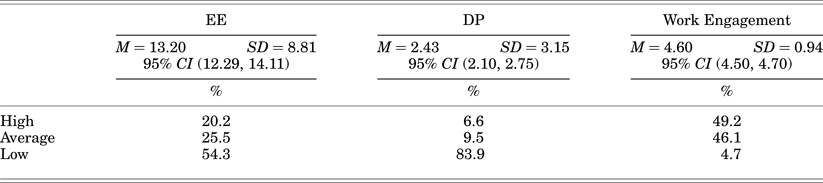
According to MBI–HSS clinical cutoff scores for mental health occupations, 25.5% of the sample reported average and 20.2% reported high levels of EE, and 9.5% reported average and 6.6% reported high levels of DP (see Table 2). The mean levels of EE and DP were 13.20 (SD = 8.81) and 2.43 (SD = 3.15) respectively, which, contrary to expectations, were significantly lower than mental health occupations' normative scores for EE (M = 16.89, SD = 8.90) and DP (M = 5.72, SD = 4.62) in the MBI–HSS (Maslach et al., Reference Maslach, Schaufeli and Leiter2001b).
Prevalence and degree of burnout and work engagement
Note. CI = confidence interval.
According to the UWES-9 clinical cutoff scores for a heterogeneous sample of occupations (N = 12,631), 46.1% of the sample reported average and 49.2% reported high levels of work engagement (see Table 2). The mean level of Work Engagement was 4.60 (SD = 0.94), which was significantly higher than the norms (M = 4.05, SD = 1.19) (Schaufeli & Bakker, Reference Schaufeli and Bakker2003)
Predictors of Burnout and Work Engagement
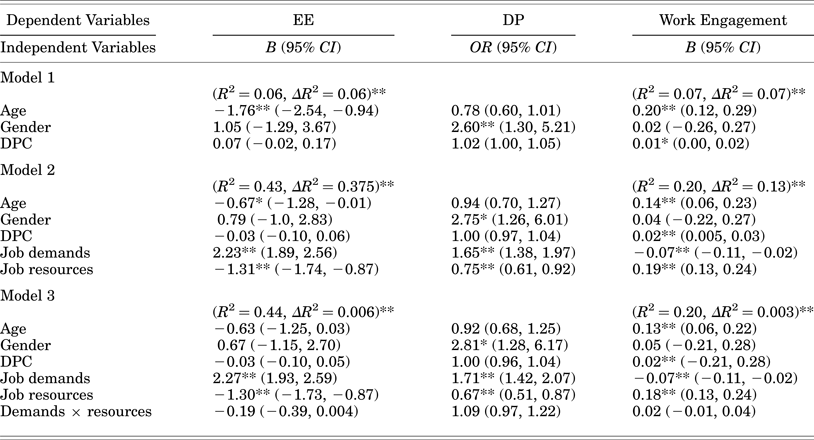
To assess the combined effects of job demands and job resources on EE, DP, and WE, controlling for covariates, three three-block regression analyses were conducted. In all analyses, the three covariates were entered in the first block, followed by the two job demands and job resources composites in the second block, and the job demands × job resources interaction in the final block. As the interaction term was nonsignificant in all three analyses, model 2 was chosen for interpretation in each case. Table 3 summaries the regression results for EE, DP, and work engagement.
Summary of three block regression analyses predicting EE and DP and work engagement
Note. *p < 0.05; **p < 0.01; OR = odds ratio; CI = confidence interval; DPC = direct patient contact.
Emotional Exhaustion
Model 2 was significant, accounting for 43.4% of EE variance (F(5, 345) = 52.63, p < 0.001) (see Table 3). Controlling for other variables, both job demands and job resources were significant predictors of EE, accounting for an additional 37.5% of the variance over model 1, (ΔF(2, 343) = 113.69, p < 0.001). For every additional score in job demands, there was on average a 2.23 increase in EE scores (t(343) = 13.26, p < 0.001), and for every additional score in job resources, there was on average a 1.31 decrease in EE scores (t(343) = –5.94, p < 0.001). Age was also a significant predictor of EE, such that for every 10-year increase in age there was a 0.67 unit decrease in EE scores (t(343) = –2.04, p = 0.04). All other covariates were nonsignificant.
Depersonalization
Model 2 was significant (χ2(5, N = 349) = 60.29, p < 0.001). Controlling for other variables, both job demands and job resources were significant predictors of DP (see Table 3). The odds of having average/high DP are 65% higher for every extra job demands score (Wald = 30.37, p < 0.001). In contrast, the odds of having average/high DP are 25% lower for every additional job resources score (Wald = 7.78, p = 0.005). Gender was a significant predictor of DP, such that the odds of having average/high DP are 75% higher for males than for females (Wald = 6.42, p = 0.01), controlling for other variables.
Work Engagement
Model 2 was significant for WE (see Table 3), accounting for 19.7% of WE variance, (F(5, 343) = 16.83, p < 0.001). Controlling for other variables, both job demands and job resources were significant predictors of WE, accounting for an additional 13.2% of the variance over model 1, (ΔF(2, 343) = 28.30, p < 0.001). For every additional job demands score, there was on average a 0.07 decrease in WE scores (t(343) = –3.06, p = .002), whereas for every additional job resources score, there was on average a 0.19 increase in WE scores (t(343) = 6.57, p < 0.001). Age (t(343) = 3.24, p = 0.001) and hours of direct patient contact (DPC) (t(343) = 3.39, p = 0.001) were also significant predictors of WE, such that for every 10-year increase in age, there was on average a 0.14 increase in WE scores, while for every extra hour of DPC there was on average a 0.02 increase in WE scores.
Additional Analyses
The same regression models predicting EE, DP, and work engagement as above were rerun; however, instead of entering the composite variables, the five individual job demands and job resources constructs were entered in the second block. All three job demands constructs and social support were significant predictors of EE (smallest t(340) = 2.55, p < 0.02). Only emotional demands (Wald = 17.14, p < 0.001) and work–family conflict (Wald = 17.80, p < 0.001) were significant predictors of DP. Only work–family conflict (t(340) = –3.32, p = 0.001), emotional demands (t(340) = –1.99, p = 0.048), and social support (t(340) = 5.24, p < 0.001) were significant predictors of WE.
CONCLUSIONS
Prevalence of Burnout and Work Engagement
Average to high levels of work engagement were reported in 95.3% of the sample, indicating a sample of predominantly highly energetic, self-efficacious individuals, who perceive the role of psychosocial oncology as a significant and meaningful pursuit. Higher mean engagement levels were unsurprising given that healthcare staff are generally engaged and committed to their work, as are oncology professionals (Mauno et al., Reference Mauno, Kinnunen and Ruokolainen2007; Poulsen et al., Reference Poulsen, Poulsen and Khan2011). Unexpectedly, the sample reported lower mean levels of burnout than that of mental health norms (Maslach et al., Reference Maslach, Jackson and Leiter2001a), and than both oncology professionals (Trufelli et al., Reference Trufelli, Bensi and Garcia2008; Girgis et al., Reference Girgis, Hansen and Goldstein2009) and mental health workers (Leiter & Harvie, Reference Leiter and Harvie1996). This may reflect fewer stressors within psychosocial oncology, or perhaps the buffering impact of psychosocial oncology–specific job resources. Within oncology, professional supervision is unique to psychosocial oncologists; though not all enjoy this resource (formal supervision was reported by 57.1% of our sample). Formal supervision has been linked to reduced supervisee anxiety, enhanced confidence in clinical practice, and enhanced job commitment (Bambling et al., Reference Bambling, King and Raue2006; O'Donovan et al., Reference O'Donovan, Halford and Walters2011). The primarily emotional content of supervision for mental health professionals could be a moderator of distress, though this is not proven here.
The very low mean levels and prevalence of DP in this sample are particularly surprising in comparison with the oncology literature (Trufelli et al., Reference Trufelli, Bensi and Garcia2008). Leiter's model of burnout posits that DP develops in response to high levels of EE; thus defining DP as a coping mechanism (Leiter, Reference Leiter1991). While some restraint from emotionally engaging with patients may be necessary for sustaining impartiality and objectivity and to protect medical professionals from burnout (Kumar, Reference Kumar2011), maintaining empathy is essential for psychosocial-oncology work given its emotional focus. Therefore, DP is unlikely to be an effective coping strategy for psychosocial oncologists, and is perhaps a less relevant measure of work-related coping in this population.
Despite low mean levels of EE and DP, 20.2% of the sample reported high EE and 6.6% high DP. EE is often considered the core element and first indicator of burnout (Maslach et al., Reference Maslach, Jackson and Leiter2001a). Since individuals still physically and emotionally healthy enough to work are generally recruited to burnout studies (Barr et al., Reference Barr, Spitzmuller and Stuebing2009), this may represent an underestimation. Thus, burnout remains a concern for this profession, requiring further understanding of the specific factors leading to burnout.
JD–R Model
The JD–R model was partially supported. Consistent with the literature (Bakker et al., Reference Bakker, Demerouti and Taris2003; Schaufeli & Bakker, Reference Schaufeli and Bakker2004), more job demands and fewer job resources were associated with higher EE and DP, while more job resources were associated with higher work engagement. These results provide support for the JD–R dual process assumption, that two different underlying psychological processes play a role in the development of job strain and motivation. An effort-driven process, initiated by job demands, results in impaired health outcomes (e.g., EE); and a motivational process, driven by job resources, results in work engagement (Bakker et al., Reference Bakker, Demerouti and Taris2003). Our results suggest that workplace interventions need to focus on both reducing demands and increasing resources within the workplace.
Inconsistent with the literature (Demerouti et al., Reference Demerouti, Bakker and Nachreiner2001; Bakker et al., Reference Bakker, Demerouti and Taris2003; Hu et al., Reference Hu, Schaufeli and Taris2011), support was not obtained for the job demands × job resources interaction (Demerouti et al., Reference Demerouti, Bakker and Nachreiner2001), implying that job resources do not buffer the impact of job demands. However, earlier studies reported only weak effects, never accounting for more than 2% of the variance above and beyond the main effects, suggesting that such modification has little practical and clinical relevance.
Psychosocial Oncology–Specific Predictors
Work–family conflict was found to be associated with burnout and engagement, consistent with meta-analytic findings (Allen et al., Reference Allen, Herst and Bruck2000; Halbesleben, Reference Halbesleben, Bakker and Leiter2010). Work schedule flexibility has been found to have positive effects on employee outcomes (Beutell, Reference Beutell2010), suggesting this may be one way to relieve burnout.
Consistent with earlier research among oncology nurses (Le Blanc et al., Reference Le Blanc, Bakker and Peeters2001), emotional demands were significantly associated with burnout and engagement; however, reported levels of emotional demands were low. Perhaps emotional demands are considered inherent to the work, unavoidable, and potentially less emotionally distressing to psychosocial oncologists (Peeters & Le Blanc, Reference Peeters and Le Blanc2001). Mental workload was also relatively weakly associated with EE, and not associated with either DP or work engagement. The mental workload measure utilized in this study may not have been sufficiently sensitive. Alternatively, workload in this context may not be so unmanageable as to detrimentally impact burnout. Interestingly, work engagement increased with more hours spent in direct patient contact. These findings, in combination with the low DP scores, suggest that perhaps the ongoing relationships mental health personnel have with their patients are sustaining and foster feelings of value and importance in staff. Importantly, these findings highlight the need for positive rewards and resources.
In relation to the specific job resources investigated, colleague social support was significantly associated with both work engagement and EE levels, consistent with meta-analytic findings (Halbesleben, Reference Halbesleben, Bakker and Leiter2010; Dollard et al., Reference Dollard, LaMontagne and Caulfield2007). Future research could investigate different sources of formal and informal support. Unexpectedly, job control was not associated with engagement, DP, or EE, which is inconsistent with previous findings (Halbesleben, Reference Halbesleben, Bakker and Leiter2010), particularly within healthcare workers (Mauno et al., Reference Mauno, Kinnunen and Ruokolainen2007). In comparison with other health professionals, perhaps psychosocial oncologists have greater flexibility and control over their time, as they are less restricted in their work environments, often traveling between clinics and offices.
Finally, older participants reported lower EE and higher work engagement, and were therefore at lower risk of developing burnout compared to younger, less experienced participants. This challenges the notion that burnout is a cumulative process. Perhaps more experienced clinicians have developed better management strategies (Ramirez et al., Reference Ramirez, Graham and Richards1995) or are more likely to participate in supervision and other tasks to alleviate the burden associated with patient care. Alternatively, older clinicians experiencing burnout may have already left the profession, with those that stay over the long term being more resilient. Interestingly, males were significantly more likely than females to report average/high DP. Studies evaluating the impact of gender on burnout reveal conflicting results; however, some support has been found for this result (Maslach et al., Reference Maslach, Schaufeli and Leiter2001b).
Importantly, the predictors chosen for our study do not represent an exhaustive list of possible antecedents of burnout and work engagement for psychosocial oncologists. For example, research into personality traits predisposing individuals to burnout and work engagement is yet to be conducted.
LIMITATIONS
A cross-sectional design was used; therefore, causation cannot be inferred. Our study employed a convenience sample that was self-selecting and, as such, it is unclear how representative the sample is of the international psychosocial-oncology population. Initial omission of participant profession from the questionnaire prevented comparative analysis between psychosocial-oncology professions. Participant numbers from the 41 included countries varied, making international comparison meaningless. It is recommended that future research explore larger samples across representative cultures, as there are probable international differences, especially across different healthcare systems, in the well-being of psychosocial oncologists.
The study mainly utilized established standardized measures from the occupational health literature, which may not have been sensitive to issues specific to this population. It is recommended that measures of work-related demands and resources specific to the psychosocial-oncology environment be developed.
CLINICAL IMPLICATIONS
Our current findings highlight a substantial risk of emotional exhaustion in psychosocial oncologists, with one in five reporting high levels, despite high work engagement. Routine screening to identify those at risk of burnout would enable early intervention and ensure that psychosocial treatment of cancer care is optimized, especially among less-experienced workers. These findings suggest that increasing job resources may be as important as reducing job demands in optimizing employee well-being. Particularly, the job resource of psychological supervision may prove invaluable as a protective factor against burnout and should perhaps be mandated. Future research is needed to develop and evaluate targeted intervention programs for this population.
ACKNOWLEDGMENTS
We would like to thank the International Psycho-Oncology Society, International Society of Paediatric Oncology, American Psychosocial Oncology Society, British Psychosocial Oncology Society, Canadian Association of Psychosocial Oncology, Dutch Society for Psychosocial Oncology, Oncology Social Work Australia, Australian Psychosocial Oncology Society, Australian Psycho-Oncology Co-Operative Research Group, and the British Faculty for Oncology and Palliative Care for their support of this study.