


1. Introduction
When banks issue deposits backed by productive assets, information about those assets can trigger liquidity crises—even when the information is socially uninformative. This paper studies how interest-bearing central bank money can mitigate such crises. Entrepreneurs pledge future output as collateral to obtain bank loans, and banks create deposits against this collateral. When adverse news arrives about future productivity, collateral values decline, borrowing constraints tighten, and banks restrict deposit creation. The resulting contraction in inside money generates a liquidity shortage that depresses consumption and output below efficient levels.
The central insight of the paper is that interest-bearing money provides a policy instrument beyond conventional money growth. By allowing banks to hold interest-bearing reserves as insurance against productivity shocks, the central bank stabilizes deposit creation and relaxes household liquidity constraints. This mechanism permits the implementation of welfare-improving policies that feature positive inflation and strictly positive nominal interest rates, departing from the Friedman rule.
Understanding the interaction between information frictions and banking is important for both historical and contemporary reasons. Private currencies facilitated exchange long before central bank-issued fiat money, from ancient Mesopotamian banking arrangements to the Free Banking era in the United States (1837–1863) (see, for example, Davies (Reference Davies2010); Champ (Reference Champ2011)). While these systems were successful in some regions, they were often unstable, particularly in early U.S. banking history.Footnote 1 Today, technological advances in private money—including platform-based payment systems, stored-value instruments, and cryptocurrencies—have revived concerns about privately issued, information-sensitive currency.
The theoretical foundation for such fragility traces back to Hirshleifer (Reference Hirshleifer1971), who shows that public information is not invariably socially beneficial because it can eliminate insurance opportunities. Building on this insight, a large literature studies how privately produced money is designed to be information-insensitive and how informational shocks can endogenously generate fragility in collateralized private money markets (see, for example, Andolfatto (Reference Andolfatto2010); Dang et al. (Reference Dang, Gorton, Holmström and Ordonez2017); Gorton and Ordonez (Reference Gorton and Ordonez2014, Reference Gorton and Ordonez2020)). A parallel literature analyzes how information disclosure and monetary policy announcements affect allocations in monetary environments (see, for example, Andolfatto and Martin (Reference Andolfatto and Martin2013); Andolfatto et al. (Reference Andolfatto, Berentsen and Waller2014); Gu et al. (Reference Gu, Han and Wright2020); Choi and Liang (Reference Choi and Liang2023)). Yet relatively little attention has been paid to productivity or technological uncertainty in environments where banks perform essential asset transformation and liquidity provision. This paper fills that gap.
To do so, I extend the framework of Andolfatto and Martin (Reference Andolfatto and Martin2013) by incorporating an active banking sector and interest-bearing money into an environment with information frictions. I build on Chiu et al. (Reference Chiu, Davoodalhosseini, Jiang and Zhu2023), who extend the unified framework of Lagos and Wright (Reference Lagos and Wright2005) by introducing imperfect banking and inside money creation. In my model, households—comprising consumers and producers—use exchange media to realize intertemporal gains from trade in the absence of commitment. Banks intermediate between entrepreneurs and households by issuing loans backed by pledged output and by creating deposits that circulate as media of exchange. Banks are therefore essential: without deposit creation, the gains from intertemporal trade would not be realized.
To highlight the role of liquidity in asset pricing, I introduce heterogeneity in consumer preferences. Two types of consumers differ in their marginal utility of consumption, generating endogenous liquidity premia. Bank deposits trade at a premium precisely when agents with high marginal utility face urgent consumption needs. This microfoundation makes explicit how deposit pricing reflects liquidity conditions and how news shocks propagate through bank balance sheets.
The paper makes three main contributions. First, I show how banking intermediaries transmit and amplify information-driven liquidity shocks. Unlike Andolfatto and Martin (Reference Andolfatto and Martin2013), where agents hold productive assets directly, I model banks as essential intermediaries that issue deposits backed by firm output. Productivity news therefore affects the value of private currency through bank balance sheets, making portfolio and funding decisions central to liquidity provision. This mechanism complements models in which informational shocks about collateral underpin crises in markets for private safe assets (see, for example, Gorton and Ordonez (Reference Gorton and Ordonez2014, Reference Gorton and Ordonez2020)).
Second, I demonstrate that interest-bearing money provides an effective policy tool to address liquidity shortages arising from instability in private currencies. Under observable preferences, type-contingent transfers financed with interest-bearing money implement the efficient allocation while requiring a positive inflation rate and strictly positive nominal interest rate. This result departs from the Friedman rule. Rather than assuming lump-sum taxation and zero-interest fiat money, the central bank issues interest-bearing money that serves as a payment instrument Andolfatto (Reference Andolfatto2010). In this sense, interest-bearing money in the model can be interpreted as a weak form of central bank digital currency (CBDC) (see, for example, Andolfatto (Reference Andolfatto2021); Keister and Sanches (Reference Keister and Sanches2023); Monnet et al. (Reference Monnet, Petursdottir and Rojas-Breu2019)).
Third, I study an extension with private information about consumption needs. Following the literature on illiquid bonds (see, for example, Kocherlakota (Reference Kocherlakota2003); Andolfatto (Reference Andolfatto2011)), I show that an illiquid government bond facilitates sorting across consumer types: consumers with high marginal utility sell bonds to those with lower marginal utility, transferring liquidity while preserving anonymity. In this environment, government debt becomes essential even when type-contingent transfers are infeasible. I also obtain a counterintuitive result: imposing a cash-in-advance constraint on bank deposits can improve welfare by preventing destabilizing arbitrage and supporting the stable coexistence of money, bonds, and bank deposits in equilibrium.
I calibrate the model to the U.S. economy to quantify these mechanisms. The quantitative analysis yields three main findings. First, interest-bearing money generates a welfare gain of 2.54% relative to the news economy without policy intervention. Second, the welfare cost of deviating from the Friedman rule is modest: under the optimal transfer, increasing the nominal interest rate to 9.1% raises the welfare cost by only 0.137 percentage points of GDP, while operating with a suboptimal transfer at the Friedman rule generates a welfare cost of 1.83 percentage points—an order of magnitude larger. Third, the welfare gains from interest-bearing money scale linearly with the probability of adverse news and are highly convex in preference heterogeneity, implying that the policy is most valuable precisely when liquidity frictions are most severe.
This paper contributes to the New Monetarist literature with financial intermediation. Berentsen et al. (Reference Berentsen, Camera and Waller2007) first incorporated money and banking into the Lagos and Wright (Reference Lagos and Wright2005) framework. In my model, the banking sector is perfectly competitive but subject to news shocks and consumer heterogeneity. Related work studies CBDC competition with deposits Keister and Sanches (Reference Keister and Sanches2023), optimal reserve remuneration Hu (Reference Hu2021), and inherent instability in banking Gu et al. (Reference Gu, Monnet, Nosal and Wright2023). Because interest-bearing money in my model closely resembles CBDC, the analysis also connects to the broader literature on CBDC and banking (see, for example, Andolfatto (Reference Andolfatto2021); Williamson (Reference Williamson2022); Monnet et al. (Reference Monnet, Petursdottir and Rojas-Breu2019); Rahman and Wang (Reference Rahman and Wang2026); Brunnermeier and Niepelt (Reference Brunnermeier and Niepelt2019)), as well as to research on monetary transmission through banks and liquidity provision more generally (see, for example, Bernanke et al. (Reference Bernanke, Gertler and Gilchrist1999); Drechsler et al. (Reference Drechsler, Savov and Schnabl2017); Kiyotaki and Moore (Reference Kiyotaki and Moore2019)).
The remainder of the paper proceeds as follows. Section 2 presents the environment. Sections 3 and 4 analyze equilibria in a private economy and in an economy with interest-bearing money. Section 5 presents the calibration. Section 6 develops the extension with illiquid bonds and private information and studies the coexistence of money, bonds, and deposits. Section 7 concludes.
2. Environment
Time is discrete and continues forever. Each time period
 $t$
is divided into two subperiods: day and night. There are four types of agents in the economy: a unit measure of infinitely-lived households, evenly divided between consumers and producers; a continuum of entrepreneurs with measure one; and a continuum of bankers with measure one. All agents reside in centralized locations in both subperiods (there are no search frictions).
Households belong to one of two permanent groups: Group 1 and Group 2. Each group is of equal measure. Denote by
 $A$
and
 $B$
the set of Group 1 and Group 2, respectively. All households have common preferences and have the ability to produce and consume the day output. Let
 $x_{t}(i) \in \mathbb{R}$
denote household consumption (production, if negative) of output (or good) during the day by household
 $i \in A \cup B$
at date
 $t$
. Preferences are linear in
 $x_{t}(i)$
, which implies that utility is transferable.
At the beginning of the night, households experience an idiosyncratic shock that determines whether they are consumers or producers with equal probability. The shock is i.i.d. across households and time. Consumer heterogeneity is realized at the beginning of each night after another shock, which occurs with equal probability. Let
 $\omega _{t}(i)$
denote the shock on consumer type, where
 $\omega _{t}(i) \in \left \{ \omega _{l}=1, \omega _{h}=\delta \right \}$
and
 $\delta \gt 1$
.Footnote
2
This shock is i.i.d. across consumers within each group and across time. I will consider both public and private information structures by imposing assumptions on whether or not
 $\omega _{t}(i)$
is observable.
Denote by
 $ \{ c_{t}(i),y_{t}(i) \} \in \mathbb{R}_{+}^{2}$
the consumption and production, respectively, of the night good by household
 $i \in A \cup B$
at date
 $t$
. The utility associated from consumption at night is given by
 $\omega _{t}(i) u(c_{t}(i))$
, where
 $u''\lt 0\lt u'$
,
 $u'(0)=\infty$
and
 $u(0)=0$
. The utility associated from production at night is given by
 $v(y_{t}(i))$
, where
 $v'\gt 0$
for
 $y\gt 0$
,
 $v''\geq 0$
and
 $v(0)=0$
. Households discount utility payoffs across periods with the discount factor
 $\beta \in (0,1)$
; so that the utility function for household
 $i$
can be represented by
 \begin{equation} \begin{aligned} E_{0}\sum _{t=0}^{\infty }\beta ^{t} \{ x_{t}(i) + \omega _{t}(i)u(c_{t}(i)) - v(y_{t}(i)) \}. \end{aligned} \end{equation}
In the spirit of Kocherlakota (Reference Kocherlakota2003), a spatial structure is imposed at night with two spatially separated locations: location 1 and location 2. Subsequent to the realization of consumer types, consumers of group 1(2) households move to location 1(2) for consumption of the night output, while producers of group 2(1) households move to location 1(2) for production of the night output. This ensures that the two locations are symmetric in terms of the composition of preference types at night. Moreover, households cannot consume their own output at night as a consequence of this spatial structure.
Entrepreneurs live for two periods and can only participate in the day subperiod. Each day, a generation of young entrepreneurs is born who can consume only in old age and then die in the following day. A young entrepreneur is endowed with an investment opportunity that transforms
 $x$
units of day output at date
 $t$
to
 $zf(x)$
units of day output in date
 $t+1$
, where
 $0\lt z\lt \infty$
denotes a productivity parameter and
 $f''\lt 0 \lt f'$
,
 $f'(0)=\infty$
, and
 $f'(\infty )=0$
. The entrepreneur then consumes
 $x$
in date
 $t+1$
when he becomes old.
Productivity evolves stochastically over time and follows a Markov process,
 $Pr[z_{t+1}\leq z^{+}|\eta _{t} = \eta ] = G(z^{+}|\eta )$
; where
 $G$
is a cumulative distribution function conditional on information
 $\eta _{t}$
(news) at the beginning of each night. Following Andolfatto and Martin (Reference Andolfatto and Martin2013), I assume that news can be classified into two categories: good news and bad news; so that
 $\eta _{t} \in \left \{ b,g \right \}$
and denote
 $\pi \equiv Pr[\eta _{t} = b]$
. Define
 $z(\eta )=\int z^{+}dG(z^{+}|\eta )$
and assume that
 $G(z^{+}|g) \leq G(z^{+}|b)$
which implies
 $z(b) \leq z(g)$
. In particular, news
 $\eta _{t}$
received at the beginning of the night is a short-term conditional forecast of next day’s productivity.Footnote
3
Moreover, good news first-order stochastically dominates bad news. In contrast,
 $z^e \equiv \pi z(b) + (1-\pi ) z(g)$
, is a long-term forecast of productivity that extends to infinite horizons, where
 $E_{t}z_{t+1} = z^{e}$
for all
 $t$
.
Given the perishability of the day and the night output along with the spatial structure, the resource constraints are as follows
 \begin{equation} \begin{aligned} \int _{A \cup B}^{} x_{t}(i)di + x_{t+1}\leq z_{t}f(x_{t}) , \end{aligned} \end{equation}
 \begin{equation} \begin{aligned} \begin{matrix} \int _{A}^{} c_{t}(i)di \leq \int _{B}^{} y_{t}(i)di &\quad \text{and} &\quad \int _{B}^{} c_{t}(i)di \leq \int _{A}^{} y_{t}(i)di \end{matrix} . \end{aligned} \end{equation}
The planner weights all agents equally and maximizes the aggregate welfare,
 \begin{equation} \begin{aligned} E_{0}\sum _{t=0}^{\infty }\beta ^{t} \{ x_{t}(i) + \omega _{t}(i)u(c_{t}(i)) - v(y_{t}(i)) \}, \end{aligned} \end{equation}
subject to the resource constraints (2) and (3). Note that the symmetry in location means that the night resource constraint (3) can also be expressed as
 $0.25 c_{l} + 0.25 c_{h} = 0.5 y$
, with measure
 $0.25$
of type
 $l$
consumers, measure
 $0.25$
of type
 $h$
consumers, and measure
 $0.5$
of producers. Because of linear utility in
 $x$
, the first-best allocation must be consistent with any lottery scheme in
 $ \{ x_{t}(i) \}$
satisfying the expected value
 $z_{t}f'(x_{t})-x_{t+1}$
.Footnote
4
Assume, without loss of generality, that for the solution of the first-best allocation, the planner may assign
 $x_{t+1}=x^{*}$
for all
 $t$
; where
 \begin{equation} \begin{aligned} \beta z^{e}f'(x^{*}) = 1 . \end{aligned} \end{equation}
Given the strict concavity of
 $u$
and strict convexity of
 $v$
, the first-best allocation is characterized by
 \begin{equation} \begin{aligned} \begin{matrix} u'\big(c_{l}^{*}\big)=\delta u'\big(c_{h}^{*}\big),\\u'\big(c_{l}^{*}\big)=v'(y^{*}), \\c_{l}^{*} + c_{h}^{*} = 2y^{*}. \end{matrix} \end{aligned} \end{equation}
Note that the first-best allocation is independent of news by construction; see Proposition1 in Andolfatto and Martin (Reference Andolfatto and Martin2013). Throughout this paper, news
 $\eta$
is publicly observable to all agents and the central bank upon realization. The implicit assumption is that nondisclosure of news is infeasible—society does not have the power to hide bad news from individuals.Footnote
5
3. Private economy with banking
I refer to private economy as a competitive equilibrium free of central bank intervention in which bank deposits can be used to facilitate intertemporal exchange. Similar to the entrepreneurs, bankers live for two periods and can only participate during the day. A generation of young bankers is born in the day, but die in the next day after becoming old. Unlike entrepreneurs and households, bankers can commit and are able to enforce repayment of debt at no cost. This allows the banks (owned by bankers) to act as financial intermediaries between the entrepreneurs and households.
As in Chiu et al. (Reference Chiu, Davoodalhosseini, Jiang and Zhu2023), banks want to fund investment projects by issuing liquid deposits which can be used as a means of payment by households in the day market. In this private economy, suppose for now that banks do not receive anything in exchange from households for the deposits issued. Money is thus created ex nihilo in the private economy when banks issue deposits to the households. Banks also make loans to entrepreneurs in the form of deposits, which the entrepreneurs use to purchase output
 $x$
from households for investment. The investment of the entrepreneurs is subject to productivity shocks mentioned earlier. In the night market, households use deposits to trade goods. In the next day, entrepreneurs and households settle their debt by repaying loans and deposits, respectively. After selling some of their investment for deposits to settle bank loans, entrepreneurs can retain the leftover output for their own consumption. Bankers collect loan repayments and redeem deposits held by households. The banking sector is assumed to be perfectly competitive with free entry; so that banks make zero profit. Figure 1 illustrates the timeline of the model.
Timeline.

In what follows, I will characterize a competitive equilibrium in which bank deposits are circulated as exchange media.
3.1 Decision-making of banks and entrepreneurs
I examine the optimization problems faced by banks and entrepreneurs, respectively. Their respective optimization problems will determine the demand and supply of loans and deposits in the equilibrium.
3.1.1 Entrepreneurs
Consider the entrepreneurs who take the loan rate
 $R^{L}(z)$
as given to maximize consumption,
 $zf(p)$
, in the second period of life (that is, day consumption when old); where
 $p$
denotes loans. When borrowing from the bank, he/she faces a pledgeability constraint,
 $p \leq zf(p)$
; see Rocheteau et al. (Reference Rocheteau, Wright and Zhang2018). That is, the entrepreneur pledges the entirety of their output from investment to obtain loans from the bank.Footnote
6
Since banks can enforce repayments, I am assuming that the debt owed by the entrepreneurs can be recovered fully in the event of default.
Formally, the entrepreneur solves the following maximization problem:
 \begin{equation} \begin{aligned} \max _{p} \quad & \{ zf(p)-R^{L}(z)p \}\\ \textrm {s.t. } \quad & p \leq zf(p).\\ \end{aligned} \end{equation}
There are two cases to consider. First, if the pledgeability constraint is slack, the entrepreneur borrows until the marginal product equals the loan rate, so
 $p=p^{*}$
where
 $zf'(p^{*})=R^{L}(z)$
. Second, if the pledgeability constraint binds, then the entrepreneur is constrained to borrow
 $p=\bar {p}\lt p^{*}$
, where
 $\bar {p}$
solves
 $\bar {p}=zf(\bar {p})$
. By concavity of
 $f$
, we have
 $zf'(\bar {p})\gt zf'(p^{*})=R^{L}(z)$
; that is, the marginal product of investment exceeds the loan rate at the constrained allocation, reflecting unexploited gains from additional borrowing.
The pledgeability constraint is more likely to bind when productivity
 $z$
is low, as low productivity reduces the pledgeable value of output
 $zf(p)$
for any given loan level. When the constraint binds, entrepreneurs cannot borrow as much as they would like, and the lending market operates below the efficient level. Next, I examine the bank’s problem.
3.1.2 Banks
Banks issue deposits
 $d$
to households and invest in loans
 $p$
offered to the entrepreneurs. Let
 $\psi _{1}(z)$
denote the price of deposits at the end of each day. Competitive markets imply that banks take the deposit price
 $\psi _{1}(z)$
and the lending rate
 $R^{L}(z)$
as given. The pledgeability constraint of the entrepreneurs now translates to a lending constraint for the bankers:
 $p \leq zf(p)$
. Banks also face a balance sheet constraint,
 $p=d$
, where the right-hand side is the liability and the left-hand side is the asset. In this case, the loans represented by
 $p$
constitute the bank’s assets, while the issued bank deposits, denoted by
 $d$
, serve as the liabilities. The constraint is the balance sheet identity of the bank. The bank’s maximization problem can then be written as
 \begin{equation} \begin{aligned} \max _{p,d} \quad & \{ R^{L}(z)p - \psi _{1}(z)d \}\\ \textrm {s.t.} \quad & p=d,\\ &p\leq zf(p). \\ \end{aligned} \end{equation}
Substitute out
 $d$
using the balance sheet identity and rewrite the bank’s maximization problem as
 \begin{equation} \begin{aligned} \max _{p} \quad & \{ R^{L}(z)p - \psi _{1}(z)p \}\\ \textrm {s.t.} \quad & p\leq zf(p).\\ \end{aligned} \end{equation}
Once again there are two cases to consider. First, if the lending and pledgeability constraints are slack, then
 $p=p^{*}$
where
 $\psi _{1}(z)=R^{L}(z)=zf'(p^{*})$
. Second, if the lending and pledgeability constraints bind, then
 $p=\bar {p}\lt p^{*}$
where
 $zf'(\bar {p})\gt R^{L}(z)$
. In the constrained case, banks may earn a liquidity premium on deposits, so that
 $\psi _{1}(z)\gt R^{L}(z)$
, reflecting the scarcity value of the liquid deposits they create.
This pattern emerges from the interaction of productivity and pledgeability. When productivity
 $z$
is low, entrepreneurs can pledge less output, tightening the lending constraint. Banks respond by restricting lending to
 $\bar {p}\lt p^{*}$
, and the marginal product of investment
 $zf'(\bar {p})$
exceeds the loan rate
 $R^{L}(z)$
, indicating foregone surplus from the binding constraint. The deposit price
 $\psi _{1}(z)$
can exceed the loan rate when deposits are scarce relative to demand, as households value the liquidity services that deposits provide.
3.2 Decision-making of households
I now examine the household maximization problem for the day market, and then describe the producer’s problem and the consumer’s problem for the night market.
3.2.1 The day market
At the beginning of the day, each household enters with
 $d$
real deposits priced at
 $\psi _{1}(z)$
. Let
 $s\geq 0$
denote the real deposits carried forward into the night market. The day-market budget constraint can then be written as
 \begin{equation} \begin{aligned} x = \psi _{1}(z)d - \psi _{1}(z)s. \end{aligned} \end{equation}
Let
 $W(d,z)$
denote the utility value of a household beginning the day with
 $d$
real deposits when the productivity shock is
 $z$
; let
 $V(s,\eta )$
denote the utility value associated with entering the night market with
 $s$
real deposits conditional on news
 $\eta$
. These two value functions must satisfy the following recursive relationship:
 \begin{equation} \begin{aligned} W ( d, z ) \equiv \max _{s \geq 0} & \{ \psi _{1}(z)d - \psi _{1}(z)s + E_{\eta } V ( s, \eta ) \}, \end{aligned} \end{equation}
where
 $V$
satisfies
 $\frac {\partial ^2 V}{\partial s^2} \leq 0 \lt \frac {\partial V}{\partial s}$
. The demand for real deposits can then be characterized by the first-order condition:
 \begin{equation} \begin{aligned} \psi _{1}(z) = E_{\eta } \frac {\partial V(s,\eta )}{\partial s}. \end{aligned} \end{equation}
Notice that the optimal choice of
 $s$
is identical across all households entering the night market. This is because the demand for real deposits is independent of initial deposit holdings
 $d$
. Furthermore, the envelope condition yields
 \begin{equation} \begin{aligned} \psi _{1}(z) = \frac {\partial W(d,z)}{\partial d}. \end{aligned} \end{equation}
The above condition implies that
 $W$
is quasilinear in
 $d$
and given stochastic productivity, the deposit price is time-invariant; that is,
 $\psi _{1}(z)=\psi _{1}^{+}(z)$
.
3.2.2 The night market
At the beginning of the night, households realize whether they are consumers or producers. Consumer preference shock is also realized at the beginning of the night. Then the consumers of type
 $j \in \{ l,h \}$
and the producers in households separate to travel to different locations, as in Xiang (Reference Xiang2013). A household makes the consumption and production decisions ex ante on behalf of the type
 $j$
consumer and the producer; instructions of each household are simply carried out by the producers and consumers.Footnote
7
News about the entrepreneurs’ productivity is also revealed at the beginning of the night.
Let
 $ c_{j} = c_{j}^{d}$
represent the total purchases of output by a type
 $ j$
consumer using bank deposits, and
 $ y_{j} = y_{j}^{d}$
denote the total amount of output produced where deposits are accepted as payments. Because of limited commitment and lack of record keeping, each consumer with realized type
 $j$
of a household faces a deposit constraintFootnote
8
 \begin{equation} \begin{aligned} c_{j} \leq \psi _{2}(\eta )s. \end{aligned} \end{equation}
The price of deposits at night is influenced by news. Denote by
 $\psi _{2}(\eta )$
the price of deposits at night paid by a household with realized consumer type
 $j$
. The price is paid to purchase output
 $y_{j}$
for consumption
 $c_{j}$
. Accordingly, the future deposit balances are given by
 \begin{align*} d_{j}^{+}= s + \frac {1}{\psi _{2}(\eta )} ( y_{j} - c_{j} ). \end{align*}
The choice problem for a household with realized consumer type
 $j \in \{l,h\}$
can be expressed as
 \begin{equation} V_{j}(s,z) \equiv \max _{c_{j},y_{j}} \left \{\omega _{j}u(c_{j}) - v(y_{j}) + \beta \,\mathbb{E}\left [{ W\!\left .\left (s + \frac {1}{\psi _{2}(\eta )} ( y_{j} - c_{j} ), z^{+}\right ) \right | \eta }\right ]\right \}. \end{equation}
Since a producer has the desire to accumulate deposit balances for future consumption, the deposit constraint
 $d_{j}^{+} \geq 0$
will not bind. Independent of household types, all producers produce output
 $y$
; so that the supply of output
 $y$
at night is characterized by
 \begin{equation} \begin{aligned} v'(y(\eta ))=\beta \frac {\psi _{1}(z(\eta ))}{\psi _{2}(\eta )}. \end{aligned} \end{equation}
The consumption of output
 $c_{j}$
at night will depend on whether or not the deposit constraint for type
 $j$
binds. By applying (13), the desired consumption
 $c_{j}$
at night is characterized by
 \begin{equation} \begin{matrix} \omega _{j}u'(c_{j}(\eta )) = \beta \frac {\psi _{1}(z(\eta ))}{\psi _{2}(\eta )} & &\text{if }\psi _{2}(\eta )s \geq c_{j}(\eta ) \\ c_{j}(\eta )=\psi _{2}(\eta )s & & \text{otherwise. } \end{matrix} \end{equation}
Moreover, the envelope condition in either case is
 \begin{equation} \begin{aligned} \frac {\partial V_{j}(s,z)}{\partial s} = \psi _{2}(\eta ) \omega _{j}u'(c_{j}(\eta )). \end{aligned} \end{equation}
3.3 Equilibrium
Denoting the total supply of deposits by
 $S$
, the loan demand and loan supply by
 $p^{d}$
and
 $p^{s}$
, respectively, market-clearing conditions imply
 \begin{equation} \begin{aligned} \begin{matrix} s=S,\\0.25c_{l}(\eta ) + 0.25c_{h}(\eta ) = 0.5y(\eta ), \\p^{s}=p^{d}. \end{matrix} \end{aligned} \end{equation}
Condition (19) states that in each period, the deposit and the loan markets must clear along with the competitive spot markets in the day and night.
To solve for the equilibrium allocation, four cases must be considered.
Case 1.
Both the deposit constraints for type
 $h$
and type
 $l$
consumers remain slack, that is,
 $\psi _{2}(\eta )s \geq c_{h}(\eta )$
and
 $\psi _{2}(\eta )s \geq c_{l}(\eta )$
.
Case 2.
The deposit constraint for type
 $h$
consumers remains slack while it binds for type
 $l$
, that is,
 $\psi _{2}(\eta )s \geq c_{h}(\eta )$
and
 $\psi _{2}(\eta )s = c_{l}(\eta )$
.
Case 3.
The deposit constraint for type
 $l$
consumers remains slack while it binds for type
 $h$
, that is,
 $\psi _{2}(\eta )s \geq c_{l}(\eta )$
and
 $\psi _{2}(\eta )s = c_{h}(\eta )$
.
Case 4.
Both the deposit constraints for type
 $h$
and type
 $l$
consumers bind, that is,
 $\psi _{2}(\eta )s = c_{h}(\eta )$
and
 $\psi _{2}(\eta )s = c_{l}(\eta )$
.
Considering Case1, by (17) one obtains
 \begin{equation} \begin{aligned} u'(c_{l}(\eta )) = \beta \frac {\psi _{1}(z(\eta ))}{\psi _{2}(\eta )} = \delta u'(c_{h}(\eta )). \end{aligned} \end{equation}
By applying the market clearing conditions, both Cases2 and 3 imply
 \begin{equation} \begin{aligned} \begin{matrix} u'(c_{h}(\eta )) = \dfrac {\beta }{\delta } \dfrac {\psi _{1}(z(\eta ))}{\psi _{2}(\eta )} &\quad \text{and}&\quad c_{l}(\eta ) =\psi _{2}(\eta )S,\\[12pt] u'(c_{l}(\eta )) = \beta \dfrac {\psi _{1}(z(\eta ))}{\psi _{2}(\eta )} &\quad \text{and} &\quad c_{h}(\eta ) =\psi _{2}(\eta )S, \end{matrix} \end{aligned} \end{equation}
respectively. Applying the market-clearing conditions, Case4 leads to
 \begin{equation} \begin{aligned} \psi _{2}(\eta )S = y(\eta ) \lt y^{*}. \end{aligned} \end{equation}
On the other hand, applying the market-clearing conditions for Case1 results in
 \begin{equation} \begin{aligned} \psi _{2}(\eta )S \geq y(\eta ) = y^{*}. \end{aligned} \end{equation}
For cases in which the deposit constraint for type
 $l$
consumers does not bind, applying (16) yields
 \begin{equation} \begin{aligned} u'(c_{l}(\eta )) = \beta \frac {\psi _{1}(z(\eta ))}{\psi _{2}(\eta )} = v'(y(\eta )). \end{aligned} \end{equation}
Similarly, a slack deposit constraint for type
 $h$
implies
 $u'(c_{h}(\eta )) = {v'(y(\eta ))}/{\delta }$
. Note that
 ${\partial V(s,z)}/{\partial s} = 0.5 {\partial V_{l}(s,z)}/{\partial s} + 0.5 {\partial V_{h}(s,z)}/{\partial s}$
. Appealing to (13), the following equilibrium restriction must be true,
 \begin{equation} \begin{aligned} \psi _{1}(z^{e}) = \frac {\pi \psi _{2}(b)}{2}\left [ u'(c_{l}(b)) + \delta u'(c_{h}(b)) \right ] + \frac {(1-\pi )\psi _{2}(g)}{2}\left [ u'(c_{l}(g)) + \delta u'(c_{h}(g)) \right ]. \end{aligned} \end{equation}
The term
 $u'(c_{l}(\eta )) + \delta u'(c_{h}(\eta ))$
can be interpreted as a liquidity factor that measures the marginal value of an additional unit of deposits. At the efficient allocation characterized by (6), where both deposit constraints are slack, we have
 $u'(c_{l}^{*}) = \delta u'(c_{h}^{*}) = v'(y^{*})$
, so this liquidity factor equals
 $2v'(y^{*})$
.
When the deposit constraints bind for both consumer types (Case4), households are forced to pool at a common consumption level
 $c_{l}(\eta ) = c_{h}(\eta ) = y(\eta ) \lt y^{*}$
. In this case, the liquidity factor becomes
 $u'(y(\eta )) + \delta u'(y(\eta )) = (1+\delta )u'(y(\eta ))$
. To characterize equilibrium in this binding case, I define the liquidity premium function
 \begin{equation} \begin{aligned} A(y)\equiv 0.5\left [\frac {\delta u'(y)}{v'(y)} + 1 \right ]\!. \end{aligned} \end{equation}
This function captures the extent to which the marginal value of liquidity exceeds its efficient level.Footnote
9
Notice that
 $A'(y) \lt 0$
given the strict concavity of
 $u$
and the convexity of
 $v$
. Moreover,
 $A(y^{*}) = 1$
at the efficient allocation, since by construction the liquidity premium vanishes when constraints do not bind.
Assuming that the deposit constraint for type
 $l$
consumers is slack (so that
 $u'(c_{l}(\eta )) = v'(y(\eta ))$
from the producer’s first-order condition), condition (25) may be rewritten as
 \begin{equation} \begin{aligned} \psi _{1}(z^{e}) = \pi \psi _{2}(b)v'(y(b))A(y(b)) + (1-\pi )\psi _{2}(g)v'(y(g))A(y(g)), \end{aligned} \end{equation}
where I have used the fact that when type
 $l$
is slack and type
 $h$
is constrained at the pooling allocation, the liquidity factor
 $v'(y) + \delta u'(y) = 2v'(y)A(y)$
.
Next, from the respective maximization problems of the entrepreneurs and banks, one can derive the deposit-price function
 \begin{equation} \begin{aligned} \psi _{2}(\eta ) = \beta \frac {z(\eta )f'(p)}{v'(y(\eta ))} = \beta \frac {R^{L}(z^{e})}{v'(y(\eta ))}, \end{aligned} \end{equation}
by assuming that the pledgeability and lending constraints of the entrepreneurs and banks, respectively, are slack. The equilibrium allocation
 $( c_{l}(\eta ),c_{h}(\eta ),y(\eta ))$
at night in which only bank deposits is used as a medium of exchange is characterized by the conditions (22), (23), (27) and (28). Next, I consider cases in which news may or may not be of importance in this private economy.
3.3.1 Equilibrium with no news
In this section, I examine the competitive equilibrium where news is of no importance. This means
 $z(\eta )=z^{e}$
for
 $\eta \in \{ b,g \}$
with the implication that
 $y(\eta )=y$
and
 $\psi _{2}(\eta )=\psi _{2}$
.
I now seek to solve for
 $\psi _{1}$
. Notice that with no news,
 \begin{equation} \begin{aligned} \psi _{2} = \beta \frac {z^{e}f'(p)}{v'(y)} = \beta \frac {R^{L}}{v'(y)}. \end{aligned} \end{equation}
Combining (27) with (28) yields the following expression for the deposit day-price
 \begin{equation} \begin{aligned} \psi _{1} = \beta z^{e}f'(p) A(y) = \beta R^{L} A(y) \gt 0. \end{aligned} \end{equation}
Condition (30) states the rate of return on bank deposits must compensate for discounting across time by the loan rate or by the expected marginal product of the day output. Following Andolfatto and Martin (Reference Andolfatto and Martin2013), I refer to this condition as the “fundamental” price of deposits, as this reflects the average price relative to extreme price fluctuations. Given the strict concavity of
 $u$
, from an ex ante perspective, society prefers average prices to extremes to smooth out consumption over time. Note that the deposit price also depends on the preference parameter
 $\delta$
. We have the following proposition.
Proposition 1.
 $\psi _{1}$
is strictly increasing in
 $\delta$
.
Proof. See Appendix
The interpretation of Proposition1 is as follows. Since all consumption in the night market must be purchased by using deposits, the consumer preference shock can be interpreted as a liquidity shock; where
 $\delta$
measures the magnitude of this shock. An increase in the magnitude of this liquidity shock is reflected in a higher deposit price during the day in the form of a liquidity premium.Footnote
10
This is due to the high demand from type
 $h$
consumers for the night output as
 $\delta$
gets larger and also because of the usefulness of bank deposits as a means of payment. Moreover, given that
 $A(y^{*})=1$
and using the restriction
 $\beta z^{e} f'(p^{*}) = 1$
(from the solution to the planner’s problem in (5)), it follows that
 $\psi _{1}^{*}=1$
and
 $p=p^{*}$
. At the efficient allocation, the loan rate satisfies
 $R^{L} = z^{e}f'(p^{*}) = \beta ^{-1} \gt 1$
.
Next, I verify the conditions under which the deposit constraint for either type of consumers will not bind, that is,
 $\psi _{2}S \geq y^{*}$
. First, suppose that both the pledgeability constraint and the lending constraint from the entrepreneur’s and the bank’s optimization problems are slack, that is,
 $p \leq zf(p)$
. This implies
 $p=p^{*}$
. Using (29), condition
 $\psi _{2}S \geq y^{*}$
can be expressed in terms of parameters,
 \begin{equation} \begin{aligned} \beta \geq \frac {y^{*}v'(y^{*})}{Sz^{e}f'(p^{*})} = \frac {y^{*}v'(y^{*})}{SR^{L}}. \end{aligned} \end{equation}
Now define
 \begin{equation} \begin{aligned} \beta ^{*}(z^{e},R^{L}) \equiv \frac {y^{*}v'(y^{*})}{Sz^{e}f'(p^{*})} = \frac {y^{*}v'(y^{*})}{SR^{L}}, \end{aligned} \end{equation}
as the equilibrium object corresponding to the efficient level of production
 $y^{*}$
. Then liquidity shock has no influence on the parameters for which the efficient allocation can be implemented. Observe that
 $\beta ^{*}(z^{e},R^{L})$
is strictly decreasing in
 $z^{e}$
and
 $R^{L}$
. When productivity
 $z$
is low, the pledgeability constraint tightens, restricting bank lending to firms. In this case, the deposit price can exceed the loan rate (
 $\psi _{1}(z^{e}) \gt R^{L}$
), reflecting a liquidity premium on deposits. This is up to the point where the pledgeability constraint and the lending constraint for both the firms and banks may bind, that is,
 $p = zf(p)$
. When binding, the loan rate satisfies
 $R^{L} \lt z^{e}f'(p) \lt 1$
, so that entrepreneurs face a marginal product exceeding the loan rate—indicating unexploited gains from additional borrowing. The efficient allocation is only implementable for patient economies—that is, for economies with sufficiently high
 $\beta$
—and up to the point on which the set of economies can be expanded. Beyond this point, an efficient allocation is no longer feasible.
A liquidity shortage arises for impatient economies—that is, for the case when
 $\beta \in ( 0, \beta ^{*}(z^{e}, R^{L}) ]$
and
 $p = zf(p)$
—in the sense of Caballero (Reference Caballero2006); see also Proposition2 in Andolfatto and Martin (Reference Andolfatto and Martin2013) for an analogous result. Since entrepreneurs pledge their future output as collateral to the banks, limited commitment means that liquidity is in short supply. Owing to a lack of commitment from the entrepreneurs, there is a liquidity shortage when the pledgeable future output is subject to binding constraints as a result of technological uncertainty. Hence, deposits are in short supply, creating a liquidity shortage. This makes the deposit constraints for both type
 $l$
and type
 $h$
consumers to bind tightly; so that
 $\psi _{2}(\eta )S = y(\eta ) \lt y^{*}$
.
When deposit constraints bind for both consumer types, combined with the restrictive lending constraints of the banks and the pledgeability constraints of the entrepreneurs, the deposit-price function (30) indicates an overvaluation of the bank deposit compared to its fundamental value. Though household members wish to borrow money from banks overnight, restrictions imposed by both the banks and entrepreneurs from the previous day hinder this possibility. Entrepreneurs, eager to secure loans from banks, find themselves constrained, leading to banks’ reluctance to lend. Since
 $A(y)\gt 1$
, the expected rate of return on deposit is
 \begin{equation*} \begin{aligned} \frac {\psi _{1}}{\beta } \gt \psi _{1} \gt z^{e}f'(p) \gt R^{L} \gt 0, \end{aligned} \end{equation*}
which suggests that the effect of a liquidity shortage is to confer a liquidity premium on the price of deposit when bank deposit is used as a medium of exchange. The chain of inequalities reflects the binding pledgeability constraint: entrepreneurs face a marginal product
 $z^{e}f'(p)$
that exceeds the loan rate
 $R^{L}$
, indicating unexploited gains from additional borrowing, while the deposit price
 $\psi _{1}$
commands a premium above unity due to the scarcity of liquid assets. The implication of this liquidity premium is that the deposits will earn a lower expected rate of return, as originally highlighted in Lagos and Rocheteau (Reference Lagos and Rocheteau2008).
3.3.2 Equilibrium with news
I now consider the case when news is of importance. This means that
 $z(b) \lt z^{e} \lt z(g)$
. Following Andolfatto and Martin (Reference Andolfatto and Martin2013), I fix a pair
 $\beta (z^{e},R^{L})$
so that the competitive equilibrium barely implements the efficient allocation when there is no news. I perform a mean-preserving spread over the short-run conditional forecast of the entrepreneur’s future productivity. Specifically, I keep
 $z^{e}$
fixed and increase the variance of the short-run forecast around this mean. I find that good news slackens a weakly binding constraint while bad news induces the deposit constraints of both type
 $l$
and type
 $h$
consumers to bind tightly. Despite potential fluctuations in deposit prices during short-term news events related to entrepreneurs’ productivity, bank deposits can still function as exchange media, as long as efficiency can be maintained. The implementation of an efficient allocation is possible if consumers of both types are not debt-constrained in either news state, which will correspond to the case when the entrepreneurs’ pledgeability constraint and the bank’s lending constraint are not binding.
This implies
 $\psi _{2}(b)S = y(b) \lt \psi _{2}(g)S = y(g) = y^{*}$
. Combining (27) with (28), we have the price of deposits in the day
 \begin{align*} \psi _{1} = \beta R^{L} [ \pi A(y(b)) + (1-\pi ) A(y(g))] \end{align*}
Note that the above equation reduces to (30) when
 $y(b) = y^{*}$
. Since
 $\psi _{1} \gt 0$
and
 $\psi _{1} = \beta R^{L} \lt 1$
when
 $y(b) = y(g) = y^{*}$
, we have the following restriction that characterizes the equilibrium
 \begin{equation} \begin{aligned} \frac {\psi _{1}}{R^{L}} = \beta [ \pi A(y(b)) + (1-\pi ) A(y(g)) ]. \end{aligned} \end{equation}
The implication of (33) is that information itself will carry a premium in the day-deposit price. Due to uncertainty, banks will raise their deposit rate, so that
 $\psi _{1} \gt \psi _{1}^{*} \gt R^{L}$
as opposed to the no-news case. Here, information itself carries a premium in how the deposit prices will be set by the banks. The high deposit price means that bank lending in the news economy may be suboptimal, that is,
 $p^{*} \gt p$
.
As for the equilibrium price of deposits at night, once again recalling condition (28)
 \begin{align*} \psi _{2}(b) = \beta \frac {z(b)f'(p)}{v'(y(b))} = \beta \frac {R^{L}}{v'(y(b))}, \end{align*}
and
 \begin{align*} \psi _{2}(g) = \beta \frac {z(g)f'(p^{*})}{v'(y^{*})} = \beta \frac {R^{L}}{v'(y^{*})}. \end{align*}
We have
 $\psi _{2}(g) \gt \psi _{2}(b)$
due to the deposit constraints for both types becoming slack in the good-news state and binding in the bad-news state, and also when
 $v$
is linear (a special case).
Next, I examine how central bank intervention with interest-bearing money can coexist with bank deposits. More specifically, I explore whether interest-bearing money can help overcome the liquidity shortage in the news economy when
 $\beta \in ( 0, \beta ^{*}(z^{e}, R^{L}) ]$
.Footnote
11
4. Bank deposits and interest-bearing money
The central bank intervenes at the night market after the realization of agents’ types. I assume that
 $\omega _{t}(i)$
is publicly observable upon realization. This assumption implies that the central bank can operate on a type-contingent transfer policy by observing household types. The type-contingent transfer policy is introduced along the lines of Andolfatto (Reference Andolfatto2011). Lump-sum taxation in the day market is ruled out and assume money as a divisible object. Let
 $ \{ c,p \}$
denote the household types, which are categorized into consumers and producers. The central bank’s policy rule is to make lump-sum transfers of money
 $T_{j}^{\iota } \geq 0$
at each night after observing these household types, where
 $\iota \in \{ c,p \}$
. The central bank also pays a positive nominal interest rate
 $R^{M} \geq 1$
on money balances. Banks are required by the central bank to hold a fraction
 $\rho$
of their deposits as currency reserves.
Banks now issue deposits to households in exchange for interest-bearing money which can be retained as bank reserves. Banks still make loans to entrepreneurs in the form of deposits. Loans and deposits are settled in the following day. Entrepreneurs use either deposits or interest-bearing money to purchase the day good from households. Households use a combination of bank deposits and interest-bearing money to trade goods in the night market. The process is the same as described earlier other than interest-bearing money now coexisting with deposits.
Denote by
 $\left ( \phi _{1},\phi _{2} \right )$
the value of money in the day and night markets, respectively. Let
 $M$
denote the total stock of money at the beginning of the day; with
 $M^{+}$
denoting the “next” period’s money supply. Assume that this stock evolves at the constant gross rate
 $\mu \geq 1$
, so that
 $M^{+} = \mu M$
. Since the central bank makes lump-sum transfers and also pays a nominal interest rate, the central bank budget constraint must satisfy
 $\left ( R^{M} - 1 \right )M = M^{+} - M + 0.25 T_{l}^{c} + 0.25 T_{h}^{c} + 0.5 T^{p}$
, where
 $(R^{M} - 1)$
is the central bank’s aggregate interest obligation. Suppose
 $T_{l}^{c}=T^{p}=0$
. Then,
 $T_{h}^{c} = 4\left ( \frac {R^{M}}{\mu } - 1 \right )M^{+}$
, or in real terms can be expressed by
 \begin{equation} \begin{aligned} \tau _{h}^{c} = 4\left ( \frac {R^{M}}{\mu } - 1 \right )\phi _{1}M^{+}, \end{aligned} \end{equation}
where
 $\tau _{j}^{c} \equiv \phi _{1}T_{j}^{c}$
. Note that linearity restricts the transfers to be proportional.
4.1 Decision-making of banks with interest-bearing money
Note that the optimization problem of the entrepreneurs stays the same as before. I now examine the optimization problem of banks when they have the option of investing in government-issued interest-bearing reserves.
4.1.1 Banks
Banks now issue deposits
 $d$
to households and invest in loans
 $p$
and interest-bearing money
 $m_{1}$
issued by the central bank, where
 $m_{1} \geq 0$
is the nominal money balances during the day. Banks acquire the real quantity of outside interest-bearing money,
 $a \equiv \phi _{1}m_{1}$
, and earn interest
 $R^{M}$
. Both the deposit market and the loan market are competitive as before. Banks also face a reserve requirement. At the end of each date, the bank’s beginning-of-the-day real money balances,
 $a$
, must be at least
 $\rho$
fraction of the total deposits, that is,
 $\rho d \leq a$
, where
 $\rho$
is a policy parameter set by the central bank. The bank solves the following maximization problem:
 \begin{equation} \begin{aligned} \max _{p,d,a} \quad & \left \{ R^{L}(z)p + R^{M}a - \psi _{1}(z)d \right \}\\ \textrm {s.t.} \quad & p + a =d,\\ & \rho d \leq a, \\ & p\leq zf(p). \\ \end{aligned} \end{equation}
Once again, substitute out
 $d$
using the balance sheet identity and rewrite the bank’s maximization problem as
 \begin{equation} \begin{aligned} \max _{p,d} \quad & \left \{ \left ( R^{L}(z)-R^{M} \right )p + \left ( R^{M}-\psi _{1}(z) \right )d \right \}\\ \textrm {s.t.} \quad & p \leq (1-\rho )d,\\ & p\leq zf(p). \\ \end{aligned} \end{equation}
Suppose that the reserve requirement for the bank binds when
 $\rho \gt \bar {\rho }$
and it is slack when
 $\rho \leq \bar {\rho }$
. There are several cases to consider.
For the first case, suppose that the reserve requirement, the lending and the pledgeability constraints are all slack. Then
 $p=p^{*}$
when
 $zf'(p) = R^{L}(z) = R^{M} = \psi _{1}(z)$
. When the marginal benefit of investing in loans equals the marginal benefit of investing in interest-bearing money, the bank is indifferent between these two assets since both yield identical returns.
For the second case, suppose that the reserve requirement is slack (
 $\rho \leq \bar {\rho }$
) but the lending and pledgeability constraints bind. Then
 $p=\bar {p}\lt p^{*}$
and concavity of
 $f$
implies
 $zf'(p) \gt R^{L}(z)$
; that is, entrepreneurs face a marginal product exceeding the loan rate, reflecting unexploited gains from additional borrowing. With slack reserve requirements, banks are indifferent at the margin between loans and reserves, so
 $R^{M} = \psi _{1}(z)$
. However, the binding pledgeability constraint restricts lending, and deposits command a liquidity premium:
 $\psi _{1}(z) \gt R^{L}(z)$
. Banks reduce lending and increase reserve holdings as insurance against the limited commitment friction of entrepreneurs.
If the reserve requirement binds (
 $\rho \gt \bar {\rho }$
) along with binding pledgeability and lending constraints, then
 $p=\bar {p}\lt p^{*}$
with
 $zf'(p) \gt R^{L}(z)$
, and
 $\psi _{1}(z) \gt R^{M} \gt R^{L}(z)$
. In this scenario, banks must charge deposit rates exceeding the interest earned on reserves to compensate for their exposure to productivity risk through entrepreneurs’ collateral. The binding reserve requirement forces banks to hold more reserves than they would optimally choose, creating an additional wedge between the deposit rate and the nominal interest rate. Entrepreneurs, constrained by pledgeability, face a marginal product that exceeds the loan rate, indicating foregone surplus from the lending restriction.
4.2 Decision-making of households
In this section, I examine the household maximization problem for the day market, and then describe the producer’s problem and the consumer’s problem for the night market when interest-bearing money and bank deposits may coexist as exchange media.
4.2.1 The day market
A household enters the day with
 $m_{1}$
nominal money balance. Let
 $m_{2}$
denote the nominal money balance taken by this household into the night market. Recall that we already defined the real money balance at the beginning of the day as
 $a \equiv \phi _{1}m_{1}$
in the bank’s maximization problem. Define the real money balance carried forward into the night
 $q \equiv \phi _{1}m_{2}$
. The day budget constraint of a household is now given by
 \begin{equation} \begin{aligned} x = \psi _{1}(z)d - \psi _{1}(z)s + R^{M}a - q. \end{aligned} \end{equation}
Analogous to (11), the choice problem in the day is
 \begin{equation} \begin{aligned} W( d, a, z ) \equiv \max _{s \geq 0, q \geq 0} & \{ \psi _{1}(z)d - \psi _{1}(z)s + R^{M}a - q + E_{\eta } V( s, q, \eta ) \}. \end{aligned} \end{equation}
The demand for real deposits and real money, respectively, must satisfy
 \begin{equation} \begin{aligned} \psi _{1}(z) = E_{\eta } \frac {\partial V(s,q,\eta )}{\partial s}, \end{aligned} \end{equation}
 \begin{equation} \begin{aligned} 1 = E_{\eta } \frac {\partial V(s,q,\eta )}{\partial q}. \end{aligned} \end{equation}
The envelope conditions are
 \begin{equation} \begin{aligned} \psi _{1}(z) = \frac {\partial W(d,a,z)}{\partial d}, \end{aligned} \end{equation}
 \begin{equation} \begin{aligned} R^{M} = \frac {\partial W(d,a,z)}{\partial a}. \end{aligned} \end{equation}
Note that the conditions above imply that both
 $\psi _{1}(z)$
and
 $\phi _{1}$
are invariant over time in a stationary equilibrium.
4.2.2 The night market
Households take portfolio
 $( s,q )$
into the night market, when the news is
 $\eta$
. Consumers and producers separate and move to their respective locations. A type
 $j$
consumer receives a lump-sum transfer of money
 $T_{j}^{c}$
, and travels to another location with real money balances
 $q+\tau _{j}^{c}$
. Denote by
 $c_{j}=c_{j}^{d} + c_{j}^{m}$
the total real purchases of output of a type
 $j$
consumer with deposits and cash, where
 $c_{j}^{d}$
is the output purchased by using deposits and
 $c_{j}^{m}$
is the output purchased by using interest-bearing fiat money. Also denote by
 $y_{j}=y_{j}^{d} + y_{j}^{m}$
the amount of the output produced where a combination of deposits and money is accepted for purchase, with
 $y_{j}^{d}$
as the amount of output that can be purchased by using deposits and
 $y_{j}^{m}$
as the amount of output that can be purchased by using money. In addition to the deposit constraint (14), each consumer type
 $j$
now faces a cash constraint
 \begin{equation} \begin{aligned} c_{j}^{m} \leq \frac {\phi _{2}(\eta )}{\phi _{1}}\big ( q + \tau _{j}^{c} \big ), \end{aligned} \end{equation}
respectively. The combined deposit and cash constraints can be viewed as a single consumer debt-constraint, defined as
 \begin{align*} c_{j} \leq \psi _{2}(\eta )s + \frac {\phi _{2}(\eta )}{\phi _{1}}\big ( q + \tau _{j}^{c} \big ). \end{align*}
The nominal money balances brought forward by a household into the next day are
 $m_{1}^{+}(j) = m_{2} + T_{j}^{c} + {1}/{\phi _{2}(\eta )} ( y_{j}^{m} - c_{j}^{m} )$
, which can be expressed in real terms,Footnote
12
 \begin{align*} a_{j}^{+}=\frac {\phi _{1}^{+}}{\phi _{1}}\left ( q + \tau _{j}^{c} + \frac {\phi _{1}}{\phi _{2}(\eta )} \big ( y_{j}^{m} - c_{j}^{m} \big) \right ). \end{align*}
The choice problem for a household with realized consumer type
 $j \in \left \{ l,h \right \}$
can be stated as
 \begin{align} V_{j} ( s,q,z ) &\equiv {\max _{c_{j}^{d}, c_{j}^{m},y_{j}^{d},y_{j}^{m}}} \biggl \{ \, \omega _{j} u(c_{j}) - v(y_{j}) \nonumber\\ &\qquad\qquad+ \beta \mathrm{E} \biggl [\, W \biggl ( s + \frac {1}{\psi _{2}(\eta )} \big ( y_{j}^{d} - c_{j}^{d} \big ), \nonumber\\ &\qquad\qquad\qquad\qquad \frac {\phi _{1}^{+}}{\phi _{1}}\bigg ( q + \tau _{j}^{c} + \frac {\phi _{1}}{\phi _{2}(\eta )} \big ( y_{j}^{m} - c_{j}^{m} \big ) \bigg ) , z^{+} \biggr ) \biggm |\eta \,\biggr ] \biggr \}. \end{align}
I want to restrict attention to equilibria in which bank deposits and interest-bearing money coexist. For both of these two assets to be accepted as payment, their expected rate of return from the night to the next day (conditional on news
 $\eta$
) must be equal. That is, the following no-arbitrage condition must hold:
 \begin{align} \frac {\psi _{1}(z(\eta ))}{\psi _{2}(\eta )} = \frac {R^{M} \phi _{1}^{+}}{\phi _{2}(\eta )}. \end{align}
Following similar steps as before, the total supply of output
 $y$
at night is characterized by
 \begin{equation} \begin{aligned} v'(y(\eta ))= \frac {\beta R^{M}\phi _{1}^{+}}{\phi _{2}(\eta )}. \end{aligned} \end{equation}
Applying (39) and (40), the total consumption of output
 $c_{j}$
at night is characterized by
 \begin{equation} \begin{aligned} \begin{matrix} \omega _{j}u'(c_{j}(\eta )) = \dfrac {\beta R^{M}\phi _{1}^{+}}{\phi _{2}(\eta )} & &\text{if } \psi _{2}(\eta )s + \dfrac {\phi _{2}(\eta )}{\phi _{1}}\big ( q + \tau _{j}^{c} \big) \geq c_{j}(\eta ) \\[12pt] c_{j}(\eta )=\psi _{2}(\eta )s + \dfrac {\phi _{2}(\eta )}{\phi _{1}}\big ( q + \tau _{j}^{c} \big )& & \text{otherwise. } \end{matrix} \end{aligned} \end{equation}
In either case, the envelope conditions are
 \begin{equation} \begin{aligned} \frac {\partial V_{j}(s,q,z)}{\partial s} = \psi _{2}(\eta ) \omega _{j}u'(c_{j}(\eta )), \end{aligned} \end{equation}
 \begin{equation} \begin{aligned} \frac {\partial V_{j}(s,q,z)}{\partial q} = \frac {\phi _{2}(\eta )}{\phi _{1}} \omega _{j}u'(c_{j}(\eta )). \end{aligned} \end{equation}
4.3 Equilibrium
Denoting the supply of money by
 $Q$
and defining
 $\phi _{1} M^{+} \equiv Q$
, the market-clearing conditions in a monetary equilibrium now imply
 \begin{equation} \begin{aligned} \begin{matrix} s=S,\\ q=Q,\\ 0.25c_{l}(\eta ) + 0.25c_{h}(\eta ) = 0.5y(\eta ), \\p^{s}=p^{d}. \end{matrix} \end{aligned} \end{equation}
Note that (34) and the money-market clearing condition,
 $q=Q$
, together can be used to express the lump-sum transfers received by type
 $h$
consumers as shown below
 \begin{equation} \begin{aligned} \tau _{h}^{c} = 4\left ( \frac {R^{M}}{\mu } - 1 \right )Q. \end{aligned} \end{equation}
In a stationary equilibrium all the real variables are constant over time, so that
 $S=S^{+}$
and
 $Q=Q^{+}$
. It follows that
 ${\phi _{1}^{+}}/{\phi _{1}}={1}/{\mu }$
.
As before, the four cases will still apply. That is, with market-clearing, conditions (20), (21), (22), and (23) can be restated as
 \begin{equation} \begin{aligned} u'(c_{l}(\eta )) = \frac {\beta R^{M}\phi _{1}}{\phi _{2}(\eta )} = \delta u'(c_{h}(\eta )), \end{aligned} \end{equation}
 \begin{equation} \begin{aligned} \begin{matrix} u'(c_{h}(\eta )) = \dfrac {\beta R^{M}\phi _{1}}{\phi _{2}(\eta )} &\quad \text{and} & \!\!\!\!\!\!\!\!\!\!\!\!\!c_{l}(\eta ) =\psi _{2}(\eta )S + \dfrac {\phi _{2}(\eta )}{\phi _{1}} Q ,\\[10pt] u'(c_{l}(\eta )) = \dfrac {\beta R^{M}\phi _{1}}{\phi _{2}(\eta )} &\quad \text{and} &\quad c_{h}(\eta ) =\psi _{2}(\eta )S + \dfrac {\phi _{2}(\eta )}{\phi _{1}}\left ( Q + \tau _{h}^{c} \right ), \end{matrix} \end{aligned} \end{equation}
 \begin{equation} \begin{aligned} \psi _{2}(\eta )S + \dfrac {\phi _{2}(\eta )}{\phi _{1}} Q + 0.5 \tau _{h}^{c} = y(\eta ) \lt y^{*}, \end{aligned} \end{equation}
 \begin{equation} \begin{aligned} \psi _{2}(\eta )S + \frac {\phi _{2}(\eta )}{\phi _{1}} Q + 0.5 \tau _{h}^{c} \geq y(\eta ) = y^{*}. \end{aligned} \end{equation}
Once again, invoking the envelope conditions allows us to get an equivalent condition to (27) that may characterize the monetary equilibrium. Following similar steps, condition (40) may be stated as
 \begin{equation} \begin{aligned} \phi _{1} = \frac {\pi \phi _{2}(b)}{2}\left [ u'(c_{l}(b)) + \delta u'(c_{h}(b)) \right ] + \frac {(1-\pi ) \phi _{2}(g)}{2}\left [ u'(c_{l}(g)) + \delta u'(c_{h}(g)) \right ], \end{aligned} \end{equation}
which by assuming that the type
 $l$
deposit constraint is slack can be rewritten as
 \begin{equation} \begin{aligned} \phi _{1} = \pi \phi _{2}(b)v'(y(b))A(y(b)) + (1-\pi )\phi _{2}(g)v'(y(g))A(y(g)). \end{aligned} \end{equation}
Note that deposit price is still characterized by condition (28). In fact, in a monetary economy, the deposit price can also be expressed as a function of nominal interest rate,
 \begin{equation} \begin{aligned} \psi _{2}(\eta ) = \frac {\beta R^{M}}{v'(y(\eta ))}, \end{aligned} \end{equation}
when considering slack reserve requirement and lending constraints.
Condition (59) shows a channel through which a policy of paying interest on money can influence asset prices. We want to derive an analogous condition for the value of money at night. From condition (47) describing the optimal behavior of the household, we can derive the expression
 \begin{equation} \begin{aligned} \phi _{2}(\eta ) = \frac {\beta R^{M}\phi _{1}}{\mu v'(y(\eta ))}. \end{aligned} \end{equation}
Conditions (55), (56), (58) and (60), together with conditions (22), (23), (27) and (28) derived earlier, characterize the competitive equilibrium allocation at night in which both bank deposits and interest-bearing money are valued. Furthermore, after some manipulation, condition (57) may be rewritten as
 \begin{equation} \begin{aligned} \frac {\mu }{R^{M}} = \beta [ \pi A(y(b)) + (1-\pi ) A(y(g)) ]. \end{aligned} \end{equation}
Note that a stationary monetary equilibrium will concurrently require the equilibrium price of deposit
 $0 \lt \psi _{1}(z) \lt \infty$
to satisfy the restriction in (33). This gives rise to the following proposition.
Proposition 2.
i) In a news economy with bank deposits and interest-bearing money, the type-contingent transfer policy
 $R^{{M{*}}} = \beta ^{-1}\gt \mu ^{*} = 1$
,
 $\tau _{h}^{c*} = 4\left ( \frac {1-\beta }{\beta } \right )Q \gt 0$
, and
 $\tau _{l}^{c*} = \tau ^{p*} = 0$
implements the efficient allocation
 $y^{*}$
. The lending market may be suboptimal with
 $p\lt p^{*}$
when
 ${\rho \gt \bar {\rho }}$
.
ii) In a no-news economy, there does not exist a monetary equilibrium when
 $R^{{M{*}}} = \mu ^{*} \geq 1$
and
 $p=p^{*}$
given
 $\rho \leq \bar {\rho }$
.
Proof. See Appendix
Note that with interest-bearing money, the implementation of an efficient allocation is independent of parameters
 $\beta$
and
 $z^{e}$
. Since I have assumed that a lump-sum tax instrument is not available to the central bank, the standard Friedman rule of setting
 $\left (R^{M},\mu \right ) = \left ( 1,\beta \right )$
is not feasible. Hence, deflation is not optimal. Taxes cannot be collected by the central bank to finance a deflationary policy. Instead, running an inflationary policy can help overcome a liquidity shortage with a positive nominal interest rate on money. This is because
 $\beta$
is strictly decreasing in
 $R^{M}$
; so that a higher nominal interest rate and positive inflation expands the set of economies for which the efficient allocation is achievable. This result is in contrast to Andolfatto and Martin (Reference Andolfatto and Martin2013), where a stationary monetary equilibrium does not coexist with another asset when there is a constant supply of fiat money, namely,
 $\mu \geq 1$
(see Proposition5 in Andolfatto and Martin (Reference Andolfatto and Martin2013)). Here, paying nominal interest rates and positive inflation rate makes up for the lack of power to lump-sum tax, which in turn may prevent the liquidity shortage that arises as a result of the technological uncertainty faced by the entrepreneurs with limited commitment.
The central bank possesses the capacity to generate assets from the day good
 $x$
through the issuance of an interest-bearing debt instrument. By investing in interest-bearing reserves, banks can insure against the volatility associated with technological risks in entrepreneurial ventures. However, the lending market may still be suboptimal due to the uncertain nature of information and also due to the short supply of commitment from the entrepreneurs. The crucial assumption used here is that the central bank can observe consumer-type preferences, which allows for the type-contingent transfers conditional on consumer types. The main goal of these type-contingent transfers is to redistribute the purchasing power of households in a manner that is socially desirable.
Not surprisingly, money introduced in this manner cannot coexist with bank deposits in a no-news economy. This is because in the no-news case, bank deposits operating as the sole medium of exchange can achieve the first-best solution. Since there is no benefit from introducing an asset that is dominated in the rate of return, interest-bearing money is not valued and is therefore redundant. After all, if the economy is functioning to its best capacity with private money then why would there be any reason for the central bank or the government to intervene? Outside money in this case is not essential, as money creation does not improve ex ante welfare relative to what can be achieved with private money.Footnote 13
One advantage of including interest-bearing money in this manner is that it does not require us to artificially impose a cash-in-advance constraint on bank deposits to essentially evade the price volatility in deposits. That is, imposing the constraint of
 $s=0$
, so that individuals can only use money to settle their debt in the night market does not confer any substantial welfare gains. Even though money is affected by news, the nominal interest rate
 $R^{M}$
is an additional policy tool (apart from the money growth rate
 $\mu$
) that makes money less sensitive to news. This is considering that the economy experiences the adverse effects of excessive price sensitivity of bank deposits due to information frictions, and particularly when commitment in financial markets is limited.
To see how an additional policy tool
 $R^{M}$
can be beneficial even in the deposit market, referring to (59) results in the following proposition.
Proposition 3.
In a news economy,
 $\psi _{2}(\eta )$
is increasing in
 $R^{M}$
.
The proposition above asserts that interest-bearing money can provide an additional policy tool to alleviate depressed asset prices. Since
 $\psi _{2}(b)\lt \psi _{2}(g)={\beta {R^{M}}^{*}}/{v'(y^{*})}$
, raising the interest rate on bank reserves during tougher economic times may provide relief and help the economy recover by relaxing the debt constraints of the banks and consumers. With the intended policy design of promoting financial intermediation, undervalued real deposit prices can reach their long-run fundamental value. In practical terms, this could also be a motivation for introducing interest-bearing CBDC, although this paper only studies a weak form of CBDC.Footnote
14
To summarize, this section establishes three main results. First, interest-bearing money provides an effective policy tool for addressing liquidity shortages caused by news-driven volatility in bank deposits (Proposition2). Unlike traditional monetary policy operating solely through money growth, interest-bearing reserves allow banks to insure against productivity shocks, enabling welfare-improving policies that require positive inflation and nominal interest rates—a departure from the Friedman rule. Second, interest-bearing money cannot coexist with bank deposits in the absence of news shocks, since private money alone achieves efficiency when there is no informational friction. Third, the nominal interest rate on reserves influences deposit prices through an investment channel (Proposition3), a prediction consistent with the empirical relationship documented in Figure 2.Footnote 15 These results rely on the assumption that consumer preference types are publicly observable. The next section calibrates the model to quantify the welfare gains from interest-bearing money.
Interest rates.Source: Federal Reserve Board and Chiu et al. (Reference Chiu, Davoodalhosseini, Jiang and Zhu2023).

5. Quantitative analysis
In this section, I calibrate the theoretical model to the US economy to quantify the welfare effects of interest-bearing money. The quantitative analysis is designed to discipline the key theoretical mechanisms developed in the paper, namely the role of interest-bearing money in relaxing deposit constraints, preventing inefficient consumption pooling across heterogeneous consumers, and providing insurance against adverse news realizations.
The structure of the quantitative analysis follows the approach in Kang et al. (Reference Kang, Li, Liang and Marchesiani2025), who calibrate their model once and conduct counterfactual experiments without re-calibration. This strategy isolates the structural effects of policy interventions from changes in parameter values.
5.1 Calibration
I consider the following functional forms throughout the paper. The utility functions
 $u(c) = [(c+\varepsilon )^{1-\sigma }-\varepsilon ^{1-\sigma }]/(1-\sigma )$
in the night market, where
 $\sigma \gt 0$
and
 $\varepsilon \gt 0$
is a utility normalization parameter set to 0.001. Production disutility takes the form
 $v(y) = y^2/2$
, while the day-market output is specified as
 $f(p) = A p^{\theta }$
, where
 $A$
is a productivity parameter.
The calibration procedure consists of ten parameters:
 $\{A, \beta , \sigma , \delta , \theta , \varepsilon , \pi , z(b), z(g), \rho \}$
. Eight parameters are set externally based on standard values in the literature or direct data targets, while two parameters
 $\{\sigma , A\}$
are calibrated internally to match the level and interest sensitivity of US money demand. I use the new M1 series from Lucas and Nicolini (Reference Lucas and Nicolini2015) and exclude the post-financial-crisis period due to structural changes in the money demand following Chiu et al. (Reference Chiu, Davoodalhosseini, Jiang and Zhu2023) and Kang et al. (Reference Kang, Li, Liang and Marchesiani2025). I also use several time series on macro variables and reserves from the Federal Reserve Economic Data (FRED) database.
I parameterize the news process by setting the good-news productivity to
 $z(g) = 1$
as a normalization, and the bad-news productivity to
 $z(b) = 0.95$
, representing a 5% productivity decline when adverse news arrives. I set the probability of bad news to
 $\pi = 0.25$
, implying that binding deposit constraints occur in one quarter of periods on average. Table 1 reports the calibrated parameter values.
Calibration results

Table 1. Long description
A table titled Calibration results with three columns: Parameters, Notation, Value, and Calibration targets. The table has 10 rows, including a header row. The parameters are divided into two groups: Calibrated externally and Calibrated internally. Row 1: Parameters, Notation, Value, Calibration targets. Row 2: Discount factor, beta, 0.96, Standard in literature. Row 3: Preference heterogeneity, delta, 1.50, Set directly. Row 4: Production elasticity, theta, 0.66, Set directly. Row 5: Probability of bad news, pi, 0.25, Business cycle frequency. Row 6: Bad state productivity, z(b), 0.95, 5% productivity decline. Row 7: Good state productivity, z(g), 1.00, Normalization. Row 8: Reserve requirement, rho, 0.056, Chiu et al. (2023). Row 9: Risk aversion, sigma, 0.229, Money demand curve. Row 10: Productivity scale, A, 0.349, Money demand curve.
The nominal interest rate captures the opportunity cost of holding money and has been calculated using the average annual rates on 3-month Treasury bills. With the money supply growing at the constant gross rate
 $\mu$
and reserves earning the gross nominal return
 $R^{M}$
, equilibrium implies the Fisher style relation
 \begin{equation*} i=\frac {1}{\beta }-\frac {R^{M}}{\mu }. \end{equation*}
The above relationship implies that the nominal interest rate is zero when
 ${R^{M}}/{\mu }= {1}/{\beta }$
, corresponding to the Friedman rule. In the quantitative analysis, I consider values of
 ${R^{M}}/{\mu }$
ranging from 0.95 to 1.10, which spans from positive nominal interest rates through the Friedman rule at zero nominal interest rate.
When the deposit constraint binds, consumption is determined by available liquidity. Household optimality conditions then imply an equilibrium money demand relationship given by
 \begin{equation} MD(i)=\frac {A}{y^{\ast }}(1+i)^{-1/\sigma }, \end{equation}
where
 $y^{\ast }$
denotes equilibrium night output. Importantly,
 $y^{\ast }$
depends only on preference parameters and is independent of the productivity scale parameter
 $A$
. This structure implies that the curvature parameter
 $\sigma$
governs the interest elasticity of money demand, while
 $A$
affects only its level.
This separation underlies the calibration strategy. The parameters
 $(\sigma ,A)$
are chosen to minimize the sum of squared deviations between model implied and observed money demand, measured by the M1 to GDP ratio across interest rate observations. Variation in interest rates disciplines
 $\sigma$
through the slope of the money demand relationship, while the average level of M1 relative to GDP identifies
 $A$
. Figure 3 shows that the model-implied money demand closely matches the observed money demand, with a root mean squared error of 0.016. The average M1-to-GDP ratio in the data is 0.232, and the model predicts an average of 0.231—a difference of less than half a percentage point.
Model fit.

5.2 Welfare Benchmarks
I evaluate welfare under three benchmarks: the first-best in a no-news economy, the equilibrium of a news economy without interest-bearing money, and the equilibrium of a news economy under interest-bearing money with policy parameters
 $(\tau _{h}^{c}, R^{M}/\mu )$
. The first benchmark is independent of news; the second isolates the welfare cost of news-driven liquidity frictions when the central bank has no policy instrument; the third quantifies how much of that cost interest-bearing money can recover.
No-news first-best. The first-best allocation
 $(c_{l}^{*}, c_{h}^{*}, y^{*}, p^{*})$
solves the planner’s problem and is independent of news realizations by construction. Welfare under this benchmark is
 \begin{equation*} \text{Wel}^{\text{FB}} \;=\; f(p^{*}) - p^{*} + \tfrac {1}{2}\bigl [u(c_{l}^{*}) + \delta \,u(c_{h}^{*})\bigr ] - v(y^{*}). \end{equation*}
This is the welfare the planner would achieve with perfect monitoring, full commitment, and no informational frictions. It serves as the upper bound for all subsequent comparisons.
News economy without interest-bearing money. When news shocks tighten the entrepreneurs’ pledgeability constraint and the consumers’ deposit constraint, type-
 $h$
consumers cannot access sufficient liquidity to attain
 $c_{h}^{*}$
. In the bad-news state, both consumer types pool at the constrained allocation
 $c_{l}(b) = c_{h}(b) = y(b) \lt y^{*}$
. Expected welfare without interest-bearing money is
 \begin{equation*} \text{Wel}^{\text{News}} \;=\; f(p^{*}) - p^{*} + \pi \, U_{b}^{\text{News}} + (1-\pi )\, U_{g}^{\text{News}}, \end{equation*}
where
 $U_{\eta }^{\text{News}} = \tfrac {1}{2}\bigl [u(c_{l}(\eta )) + \delta \,u(c_{h}(\eta ))\bigr ] - v(y(\eta ))$
and the consumption levels
 $(c_{l}(\eta ), c_{h}(\eta ), y(\eta ))$
are determined in equilibrium by the binding deposit constraint. This benchmark measures the welfare cost of operating in a news economy when the central bank has no policy instrument to address liquidity shortages.
News economy with interest-bearing money. Under interest-bearing money, expected welfare is a function of the policy parameters
 $(\tau _{h}^{c}, R^{M}/\mu )$
:
 \begin{equation*} \text{Wel}^{\text{IBM}}(\tau _{h}^{c}, R^{M}/\mu ) \;=\; f(p^{*}) - p^{*} + \pi \, U_{b}^{\text{IBM}} + (1-\pi )\, U_{g}^{\text{IBM}}, \end{equation*}
where
 $U_{\eta }^{\text{IBM}}$
depends on the consumption and output allocations supported by the policy parameters. By Proposition2, the optimal policy
 $(\tau _{h}^{c*}, R^{M*}/\mu ^{*}) = \bigl (4\tfrac {1-\beta }{\beta }Q,\, 1/\beta \bigr )$
implements the efficient allocation in the news economy, so
 \begin{equation*} \text{Wel}^{\text{IBM}}\big(\tau _{h}^{c*}, R^{M*}/\mu ^{*}\big) \;=\; \text{Wel}^{\text{FB}}. \end{equation*}
For any other policy choice, the deposit constraint is incompletely relaxed and
 $\text{Wel}^{\text{IBM}} \lt \text{Wel}^{\text{FB}}$
.
The role of interest-bearing money. News shocks create a wedge between the no-news first-best and the news economy:
 $\text{Wel}^{\text{FB}} - \text{Wel}^{\text{News}} \gt 0$
. Interest-bearing money is the policy instrument that closes this wedge. The welfare gain from introducing optimal interest-bearing money is
 \begin{equation*} \Delta \text{Wel} \;=\; \text{Wel}^{\text{IBM}}\big(\tau _{h}^{c*}, R^{M*}/\mu ^{*}\big) - \text{Wel}^{\text{News}} \;=\; \text{Wel}^{\text{FB}} - \text{Wel}^{\text{News}}, \end{equation*}
which is the entire wedge. Suboptimal policy parameters close only part of the wedge, and the next section quantifies the welfare cost of operating away from
 $(\tau _{h}^{c*}, R^{M*}/\mu ^{*})$
.
5.3 Welfare comparison across monetary regimes
I compare welfare across three benchmarks: the no-news first-best, the news economy without interest-bearing money, and the news economy under interest-bearing money with policy parameters
 $(\tau _h^c, {R^M}/{\mu })$
. The first benchmark is independent of news; the second isolates the welfare cost of news-driven liquidity frictions when the central bank has no policy instrument; the third quantifies how much of that cost interest-bearing money can recover. Under the calibrated parameters, no-news first-best welfare is
 ${\text{Wel}}^{\text{FB}} = 1.26$
, while the news economy without IBM delivers
 ${\text{Wel}}^{\text{News}} = 1.23$
. By Proposition2, the optimal interest-bearing money policy implements the efficient allocation in the news economy, so expected welfare attains the no-news first-best benchmark:
 ${\text{Wel}}^{\text{IBM}}(\tau _h^{c*}, {R^{M*}}/{\mu ^*}) = {\text{Wel}}^{\text{FB}} = 1.26$
.
The welfare gain from introducing optimal interest-bearing money is
 $\Delta \text{Wel} = 0.03$
, or 2.54% of baseline welfare. This gain measures the entire wedge that news shocks open between the no-news first-best and the unregulated news economy. The mechanism is the type-contingent transfer: with
 $\tau _h^{c*}$
in place, the deposit constraint is relaxed sufficiently in both news states for the efficient consumption allocation to be implemented, restoring efficient consumption dispersion and reallocating resources toward high-marginal-utility consumers. Suboptimal policy parameters close only part of the wedge, and the welfare cost of operating away from
 $(\tau _h^{c*}, {R^{M*}}/{\mu ^*})$
is quantified below. Table 2 summarizes the results.
Welfare comparison across benchmarks

Table 2. Long description
A table comparing welfare across different economic regimes. The table has four rows and three columns. The columns are labeled ’Regime’, ’Welfare’, and ’Percent of first-best’. The rows are labeled as follows: First-best (no-news benchmark) with Welfare 1.26 and Percent of first-best 100%, News economy (no IBM) with Welfare 1.23 and Percent of first-best 97.5%, News economy with optimal IBM with Welfare 1.26 and Percent of first-best 100%, Welfare gain from IBM with Welfare 0.03 and Percent of first-best 2.54%.
Welfare cost (%)

Table 3. Long description
A table titled Welfare cost (%) presents a comparison of welfare metrics across different regimes. The table has four rows and five columns. The column headers are R M over mu, i (percent), tau sub h with c equals 0.167, and tau sub h with c equals 0.1. The row labels are 0.95, 1.04, and two rows for Welfare gain from IBM. Row 1: 0.95, 9.1, 0.137, 1.91. Row 2: 1.04, 0.0, 0.00, 1.83. The table provides specific values for each regime, highlighting the differences in welfare cost percentages.
5.3.1 Welfare cost of suboptimal policy
The optimal policy attains
 ${\text{Wel}}^{\text{IBM}} = {\text{Wel}}^{\text{FB}}$
. I now quantify the welfare cost of operating under suboptimal policy parameters. Following Lucas (Reference Lucas2000), the welfare cost is expressed as a percentage of steady-state output:
 \begin{equation*} \text{Welfare Cost}\big(\tau _h^c, {R^M}/{\mu }\big) = \frac {{{\text{Wel}}^{\text{FB}}} - {\text{Wel}}^{\text{IBM}}\big(\tau _h^c, {R^M}/{\mu }\big)}{y^*} \times 100\%. \end{equation*}
The welfare cost is zero at
 $(\tau _h^{c*}, 1/\beta )$
and strictly positive elsewhere. Table 3 reports the welfare cost under two transfer levels and three values of
 ${R^M}/{\mu }$
that span positive nominal interest rates through the Friedman rule: the optimal type-contingent transfer
 $\tau _h^{c*} = 4(1/\beta - 1)Q = 0.167$
and a suboptimal transfer
 $\tau _h^c = 0.1$
.Footnote
16
At the Friedman rule with the optimal transfer, the welfare cost is zero: the policy attains
 ${\text{Wel}}^{\text{FB}}$
. Departures from the optimal transfer or from the Friedman rule generate a strictly positive welfare cost, which Table 3 quantifies.
The welfare cost of implementing the suboptimal transfer
 $\tau _h^c = 0.1$
rather than
 $\tau _h^{c*}$
is 1.83 percentage points of GDP at the Friedman rule. This is a substantial cost, reflecting the foregone gains from incomplete risk-sharing across heterogeneous consumers. With the optimal transfer in place, households achieve efficient risk-sharing in both news states, with high-marginal-utility types (
 $\delta \gt 1$
) receiving appropriately larger consumption allocations.
When the optimal transfer is in place, the marginal welfare cost of departing from the Friedman rule is remarkably small. Moving from the Friedman rule to a nominal interest rate of approximately 9.1% increases the welfare cost by only 0.137 percentage points (from 0.00% to 0.137% of GDP). This finding echoes the classic result of Lucas (Reference Lucas2000) that the welfare cost of inflation is quantitatively small, while highlighting that the transfer policy matters far more than achieving the Friedman rule in this environment.
The welfare cost of suboptimal transfers (1.83% of GDP) dwarfs the marginal welfare cost of moderate inflation (0.137% of GDP)—an order-of-magnitude difference. This has practical relevance for central banks that pay interest on reserves: the precise level of
 $R^M$
relative to
 $\mu$
matters less than ensuring the transfer mechanism functions effectively to facilitate risk-sharing across heterogeneous households. Figure 4 summarizes the results by illustrating the welfare cost at
 $\tau _{h}^{c} = 0.1$
and
 $\tau _{h}^{c} = 0.167$
, respectively, as a function of
 ${R^{M}}/{\mu }$
.
Welfare cost: Changes in
 ${R^{M}}/{\mu }$
and nominal interest rate.

Welfare gain from interest-bearing money across probability of bad news (
 $\pi$
) and preference heterogeneity (
 $\delta$
).

5.3.2 Sensitivity to news risk and preference heterogeneity
Next, I examine how the welfare gain from interest-bearing money varies with two key parameters: the probability of bad news
 $\pi$
and preference heterogeneity
 $\delta$
. Figure 5 displays the results.
The left panel shows that the welfare gain is linear in
 $\pi$
. When
 $\pi = 0$
, bad news never occurs, deposit constraints never bind, and interest-bearing money provides no additional value. As
 $\pi$
increases, the welfare gain grows proportionally: at
 $\pi = 0.25$
, the gain is 3.19%; at
 $\pi = 0.50$
, the gain doubles to 6.26%. This linear relationship reflects the insurance interpretation: each additional unit of news risk generates a constant marginal benefit from interest-bearing money.
The right panel displays the welfare gain as a function of
 $\delta$
. The relationship is highly convex: at
 $\delta = 1$
(homogeneous consumers), the gain is negligible at 0.305%; at the baseline
 $\delta = 1.5$
, the gain is 3.45%; at
 $\delta = 3$
, the gain rises to 30.8%. The convexity arises because greater heterogeneity magnifies the misallocation cost of pooling. When
 $\delta = 1$
, all consumers have identical marginal utility, so pooling causes no misallocation—the only welfare loss comes from output distortions. When
 $\delta \gt 1$
, pooling forces high-type consumers to consume far below their efficient level. The gap between
 $c_h^{\ast }$
and
 $y$
widens with
 $\delta$
, and due to the concavity of utility, the welfare loss accelerates.
6. Extension: Bank deposits, interest-bearing money, and an illiquid bond market
In this section, I assume that the shock on consumer type,
 $\omega _{t}(i)$
, is not publicly observable upon realization. In other words, household types are private information. Since there is no record-keeping, a welfare-improving transfer policy is infeasible, as type
 $l$
consumers will misrepresent themselves as type
 $h$
consumers. The optimal transfer policy would then essentially be a zero transfer (Andolfatto (Reference Andolfatto2011)). In what follows, I introduce an illiquid bond in the monetary economy, that is subject to news shocks.
The central bank now issues two intrinsically worthless tokens, money and bonds, denoted by
 $M$
and
 $O$
, respectively. During the day, new bonds are issued at the discount price
 $0 \lt \alpha \leq 1$
. Bonds are redeemed at par for money on the following day, and hence represent risk-free claims to future money. Since bonds are illiquid, they cannot be used to make payments. Instead, they can be exchanged for money in a secondary market at a competitive price
 $\alpha _{2}$
. I assume that this secondary market opens and closes before the news shock is realized, so that
 $\alpha _{2}$
is independent of
 $\eta$
. I also assume that this market opens right after the shock on consumer preferences is realized and closes before households travel to their respective locations.Footnote
17
Money supply now evolves according to the central bank budget constraint,
 $M^{+} - R^{M} M = O - \alpha O^{+}$
. By assuming a constant bond-money ratio
 $\chi \equiv O/M \gt 0$
, the budget constraint can be expressed as
 \begin{equation} \begin{aligned} \mu = \frac {R^{M}+\chi }{1+\alpha \chi }. \end{aligned} \end{equation}
Clearly, a zero discount policy (
 $\alpha =1$
) and zero nominal interest rate on money (
 $R^{M}=1$
) imply
 $\mu =1$
. In what follows, I will describe the respective optimization problems of the household for the day and the night.
6.1 Decision-making of households
As before, the entrepreneur’s problem is unaffected. Since all bonds issued during the day will be redeemed into money at par, the composition of a money-bond portfolio during the day is irrelevant. This implies that the bank’s problem remains unaffected, as total real money balances is all that really matters.
6.1.1 The day market
Let
 $o$
denote the real bond holdings purchased by a household during the day. The household’s day problem extends (38) to include bond holdings
 $o$
purchased at discount price
 $\alpha$
(see Appendix B for the full Bellman equation). The same first-order conditions as (39) and (40) apply for deposits and money, while the bond demand satisfies
 \begin{equation} \begin{aligned} \alpha = E_{\eta } \frac {\partial V(s,q,\eta )}{\partial o}. \end{aligned} \end{equation}
6.1.2 The night market
Households enter the night market carrying a portfolio
 $(s,q,o)$
from the day. The timing within the night proceeds as follows. First, the consumer preference shock is realized, determining whether the household member is type
 $l$
or type
 $h$
. Second, the secondary bond market opens, where households can trade bonds at the competitive price
 $\alpha _2$
. Third, the bond market closes and the news shock
 $\eta \in \{b, g\}$
is realized. Finally, the goods market opens, where consumption and production take place given the realized news. Because the secondary bond market closes before the news shock is realized, the bond price
 $\alpha _2$
is independent of
 $\eta$
. Let
 $o_{j}$
denote the quantity of real bonds sold (where
 $o_{j} \lt 0$
denotes a purchase of real bonds) by a type
 $j$
household in the bond market. Because the quantity of bonds sold cannot exceed the quantity available, there is a trading restriction on bond sales; in particular,
 \begin{equation} \begin{aligned} o_{j} \leq o. \end{aligned} \end{equation}
After the news shock
 $\eta$
is realized, consumers with liquidity needs may only purchase output by using either money or deposits. The deposit constraint (14) remains unaffected, but each consumer now faces the following cash constraint:
 \begin{equation} \begin{aligned} c_{j}^{m} \leq \frac {\phi _{2}(\eta )}{\phi _{1}} ( q + \alpha _{2} o_{j} ). \end{aligned} \end{equation}
The consolidated consumer debt-constraint now becomes
 \begin{align} c_{j} \leq \psi _{2}(\eta )s + \frac {\phi _{2}(\eta )}{\phi _{1}} ( q + \alpha _{2}o_{j} ), \end{align}
where
 $\varepsilon _{j} \geq 0$
and
 $\lambda _{j}(\eta ) \geq 0$
are the Lagrange multipliers associated with the bond-sales constraint (65) and the consolidated debt-constraint (67), respectively. Note that while bond trades
 $o_j$
are determined before
 $\eta$
is realized, the debt-constraint and consumption decisions are made after observing
 $\eta$
. The household maximizes over consumption using deposits and money, subject to these constraints. The full Bellman equation and the first-order conditions are provided in Appendix B.
Once again, assuming the no-arbitrage condition, the total supply of output at night is characterized by (47).
6.2 Equilibrium
In addition to the market-clearing conditions in (51), the bond market-clearing conditions are
 \begin{equation} \begin{aligned} \begin{matrix} o=\chi q\,\\ o_{l} + o_{h} = 0. \end{matrix} \end{aligned} \end{equation}
Note that
 ${\partial V(s,q,o,z)}/{\partial o} = 0.5 {\partial V_{l}(s,q,o,z)}/{\partial o} + 0.5 {\partial V_{h}(s,q,o,z)}/{\partial o}$
. The latter expression combined with condition (64) imply that
 $\alpha _{2}=\alpha$
. Moreover, using the envelope condition (84), once again we have the same restriction as (57). It can be easily shown that type
 $l$
households will use their money to buy bonds and type
 $h$
households will sell their bonds for money; that is,
 $o_{l}\lt 0\lt o_{h}$
. If the consolidated debt-constraint for type
 $l$
consumers is slack (so that
 $\lambda _{l}(\eta )=0$
), then
 $u'(c_{l}(\eta ))=v'(y(\eta ))$
. Combining this with a slack bond-sales constraint for type
 $l$
consumers (
 $\varepsilon _{l}=0$
) and applying the first-order conditions derived in Appendix B yields
 \begin{equation} \begin{aligned} \frac {\phi _{2}(\eta )}{\phi _{1}} \alpha u'(c_{l}(\eta )) = v'(y(\eta )) = \beta R^{M}\frac {\phi _{1}^{+}}{\phi _{2}(\eta )}. \end{aligned} \end{equation}
Assuming stationarity, combining the latter expression with (57) leads to
 \begin{equation} \begin{aligned} \frac {\alpha \mu }{R^{M}} = \beta [ \pi A(y(b)) + (1-\pi ) A(y(g)) ]. \end{aligned} \end{equation}
Note the similarity between the above expression and condition (61).
Condition (70) and (27) derived earlier, characterize the competitive equilibrium in which bank deposits, interest-bearing money, and illiquid bond are valued. Also, from condition (70), implementation of a first-best allocation will require a policy that satisfies
 $\alpha \mu = \beta R^{M}$
. This is a case when the bond market supplies the agents with sufficient liquidity, as the ability of the government to repay its debt means that bonds may generally be accepted in exchange for money to meet the different liquidity needs of agents. Agents adjust their asset portfolio and liquidity is channeled from bond buyers (type
 $l$
consumers) to bond sellers (type
 $h$
consumers). Assuming that the policy
 $\alpha \mu = \beta R^{M}$
is satisfied, then together with the central bank budget constraint (63), implies
 \begin{equation} \begin{aligned} \mu = R^{M} + (1-\beta R^{M})\chi . \end{aligned} \end{equation}
Observe that the implied inflation rate is strictly positive for any
 $\chi \gt 0$
and
 $R^{M} \geq 1$
. Clearly, this policy restriction requires the discount rate
 $\alpha = {\beta R^{M}}/{\mu } \lt 1$
. Furthermore, an increase in the bond-money ratio is associated with a higher nominal interest rate.
I will now check if the bond-sales constraint for type
 $h$
consumers will bind or not.
Contrary to the literature, since the consumer debt-constraint is influenced by news, the question of whether this constraint binds or not is not entirely determined by the bond discount price
 $\alpha$
or the nominal interest rate. Suppose the debt-constraint for type
 $h$
consumers is slack. Then
 $\delta u'(c_{h}(\eta )) = {\beta R^{M}\phi _{1}^{+}}/{\phi _{2}(\eta )}$
. If type-
 $h$
bond-sales constraint (65) is also slack then this together requires
 $\phi _{1} \leq \phi _{2}(\eta )$
for
 $\alpha \leq 1$
.
First, consider the case
 $o_{h}=o$
and suppose the debt-constraint for type
 $h$
binds, that is,
 $\lambda _{h}\gt 0$
. Invoking (68) and assuming a binding debt-constraint for type
 $l$
, we can use the market-clearing conditions to express consumption as a function of the policy variables
 $\alpha$
and
 $\chi$
(see Appendix B for the derivation):
 \begin{equation} \begin{aligned} c_{h}(\eta ) = (1 + \alpha \chi )y(\eta ) - \alpha \chi \psi _{2}(\eta )S. \end{aligned} \end{equation}
Note that in equilibrium, type
 $l$
households buy bonds while type
 $h$
households sell them, so
 $o_{l}\lt 0\lt o_{h}$
. Since the bond-sales constraint is
 $o_{j} \leq o$
with
 $o = \chi q \gt 0$
, the constraint is always slack for type
 $l$
(as
 $o_l \lt 0 \lt o$
), implying
 $\varepsilon _{l}=0$
. For type
 $h$
, the constraint
 $o_h \leq o$
may or may not bind. The following lemma establishes that in a news economy, the bond-sales constraint for type
 $h$
cannot bind tightly.
Lemma 1.
The bond-sales constraint for type
 $h$
consumers cannot bind tightly in a news economy.
Proof. See Appendix
Now, consider the case
 $o_{h}\lt o$
. Then the slack bond-sales constraint for type
 $h$
consumers means
 $\varepsilon _{h}=0$
. If
 $\varepsilon _{h}=\varepsilon _{l}=0$
, then
 $u'(c_{l}(\eta )) = \delta u'(c_{h}(\eta ))$
. Owing to
 $\lambda _{l}=0$
yields
 $\delta u'(c_{h}(\eta )) = v'(y(\eta ))$
. Clearly,
 $A(y^{*})=1$
entails a policy that satisfies
 $\alpha \mu = \beta R^{M}$
. Substituting
 $\alpha = {\beta R^{M}}/{\mu }$
into (72), where
 $\mu$
is given by (71), leads to an expression (see Appendix B) implying that there exists a
 $\chi ^{*} \gt 0$
,
 $R^{{M{*}}}\gt 1$
, and
 $\mu ^{*}\gt 1$
that can implement the first-best allocation
 $y^{*}$
, so that the bond-sales constraint of type
 $h$
consumers remains slack. We have the following proposition.
Proposition 4.
i) In a news economy with bank deposits, interest-bearing money, and illiquid bonds, if
 $\phi _{1} \lt \phi _{2}(\eta )$
then the efficient allocation is implementable for any bond-money ratio
 $0 \lt \chi ^{*} \leq \chi \lt \infty$
and money growth rate
 $\mu ^{*} = R^{M} + (1-\beta R^{M})\chi \gt 1$
, with an associated nominal interest rate
 $R^{{M{*}}} = \beta ^{-1} \gt 1$
and a discount rate
 $\alpha ^{*}\lt 1$
. The lending market may remain suboptimal with
 $p\lt p^{*}$
when
 $\rho \gt \bar {\rho }$
.
ii) In a no-news economy, there is no monetary equilibrium when policy is restricted to
 $0 \lt \chi ^{*} \leq \chi \lt \infty$
,
 $\mu ^{*} = R^{M} + (1-\beta R^{M})\chi \gt 1$
, with an associated
 $R^{{M{*}}} = \beta ^{-1} \gt 1$
and
 $\alpha ^{*}\lt 1$
; most importantly, when
 $p=p^{*}$
given
 $\rho \leq \bar {\rho }$
.
Proof. See Appendix
Having a limit on bond holdings for type
 $h$
consumers means that type
 $h$
cannot get sufficient liquidity on bond sales. An optimal allocation of liquidity between the two types of consumers requires the bond market to generate sufficient liquidity against news shocks. Insufficient liquidity from bond sales is infeasible, especially with news shocks creating an additional liquidity shortage. As a consequence, the coexistence of government debt instruments with other private assets requires sufficient liquidity provision. With the exception of strictly positive inflation with illiquid bonds, Proposition4, by and large, replicates the result achieved by the optimal type-contingent transfer policy described in Proposition2. The illiquid bond helps achieve socially desirable allocations, even though the consumer preference shocks are unknown to the central bank. The lending market may still remain suboptimal for the same aforementioned reasons.
However, illiquid bonds and interest-bearing money cannot coexist with bank deposits in the no-news case under the policy described in Proposition4. To understand why, recall that the role of illiquid bonds in this environment is to facilitate sorting between consumer types when preference shocks are private information. Type
 $h$
consumers, who have higher liquidity needs, sell bonds to obtain additional purchasing power, while type
 $l$
consumers buy bonds. This sorting mechanism is valuable precisely because news shocks cause deposit constraints to bind, creating a wedge between the liquidity needs of the two types. In the absence of news shocks, deposit constraints remain slack, and both consumer types can achieve their desired consumption levels using deposits alone. Without binding constraints, there is no need for the sorting mechanism that illiquid bonds provide, and households have no incentive to hold government bonds at a positive price. The bond market therefore unravels.
This result parallels the finding in Section 4: without news-driven liquidity shortages, government intervention is inessential because private money can implement the constrained-efficient allocation on its own.Footnote 18
In the next subsection, I investigate the possibility of rendering the short-run rate of return on interest-bearing money insensitive to news by restricting the use of bank deposits as private money.
6.3 Illiquid bank deposits
I now assume that bank deposits are illiquid, that is, they cannot be used to make payments at night. In this case, only interest-bearing money can be used to make payments at night. This type of cash-in-advance constraint is frequently imposed in the literature. I will show how a cash-in-advance constraint of this form is welfare-enhancing.Footnote 19
The choice problem of the agents in the day is unaffected, but the decisions on consumption and production at night will clearly change. The supply of night output
 $y$
is still characterized by condition (47). However, the no-arbitrage condition (46) is not relevant in this case, as fiat money can only be used for the purchase of goods in the night. Adding the constraint
 $s=0$
means that the desired consumption at night is characterized by
 \begin{equation} \begin{aligned} \begin{matrix} \omega _{j}u'(c_{j}(\eta )) = \dfrac {\beta R^{M}\phi _{1}^{+}}{\phi _{2}(\eta )} + \lambda _{j}(\eta ) & &\text{if } \dfrac {\phi _{2}(\eta )}{\phi _{1}} ( q + \alpha _{2}o_{j} ) \geq c_{j}(\eta ) \\[12pt] c_{j}(\eta )=\dfrac {\phi _{2}(\eta )}{\phi _{1}}( q + \alpha _{2}o_{j} )& & \text{otherwise. } \end{matrix} \end{aligned} \end{equation}
I anticipate that the cash-in-advance constraint will bind for a growing supply of money (
 $\mu \geq 1$
), a positive interest rate
 $R^{M} \geq 1$
, a bond-money ratio
 $\chi \gt 0$
, and a bond discount price
 $\alpha \leq 1$
. Applying the market-clearing conditions and combining (51) and (81), the equilibrium value of money in the night is expressed as
 \begin{equation*} \begin{aligned} \phi _{2}(\eta ) = \frac {\phi _{1}y(\eta )}{Q} -2 \phi _{1}\left ( \frac {R^{M}}{\mu } - 1 \right )\!. \end{aligned} \end{equation*}
Together, these restrictions lead to
 \begin{equation*} \begin{aligned} v'(y(\eta )) = \frac {\beta R^{M} \phi _{1}}{\mu \left [ \frac {y(\eta )}{M^{+}} - 2\phi _{1}\left ( \frac {R^{M}}{\mu } -1 \right ) \right ]}. \end{aligned} \end{equation*}
Clearly, this implies that the equilibrium level of night output is independent of news, that is,
 $y=y(\eta )$
. This is because payments at night are now solely made with a risk-free asset. Solving for
 $\phi _{1}$
results in the equilibrium restriction
 \begin{equation} \begin{aligned} \phi _{1} = \frac {{\mu v'(y) y}/{M^{+}}}{\beta R^{M} + 2\mu v'(y) \left ( \frac {R^{M}}{\mu } -1 \right )}. \end{aligned} \end{equation}
Substituting the value of money in the day and night into (57), we have the equilibrium restriction
 \begin{equation} \begin{aligned} \frac {\alpha \mu }{R^{M}} = \beta A(y). \end{aligned} \end{equation}
Conditions (74) and (75) characterize the equilibrium pair
 $\left ( \phi _{1},y \right )$
. Furthermore, we can achieve a first-best allocation with the policy described below.
Proposition 5.
In a no-news economy, rendering bank deposits illiquid by imposing a cash-in-advance constraint at night improves welfare with the given policy
 $\alpha \mu = \beta R^{M}$
. Interest-bearing money and an illiquid bond can coexist with bank deposits when
 $p=p^{*}$
given
 $\rho \leq \bar {\rho }$
.
Proof. See Appendix.
Proposition5 establishes that imposing a cash-in-advance constraint on bank deposits improves welfare relative to the no-news, private-information baseline in which deposits alone provide liquidity. In the baseline equilibrium, deposit constraints are slack and government bonds are not valued. The CIA constraint creates a demand for money and bonds by restricting the liquidity of deposits, and the resulting equilibrium achieves more efficient sorting across consumer types. Thus, while illiquid bonds are inessential in a no-news economy with liquid deposits, they become essential—and welfare-improving—when CIA constraints limit the use of private money.
In contrast to Andolfatto and Martin (Reference Andolfatto and Martin2013), this paper finds that imposing a cash-in-advance constraint on bank deposits enhances social welfare in the absence of news. Their study shows that such constraints diminish welfare when there is no news, which creates an apparent discrepancy.
This difference arises from a key modeling distinction: the treatment of private information about consumer types. In my model, private information about consumer liquidity shocks makes illiquid bonds essential for broadening welfare-improving trades. The cash-in-advance constraint serves as a welfare-enhancing trading restriction on bank deposits, consistent with findings by Andolfatto (Reference Andolfatto2011) and Kocherlakota (Reference Kocherlakota2003) who show that restricting bond liquidity improves allocative efficiency.
Without private information frictions, cash-in-advance constraints may indeed restrict beneficial trading opportunities, explaining the discrepancy with Andolfatto and Martin (Reference Andolfatto and Martin2013). However, when private information about consumer preferences exists, such constraints eliminate lending market suboptimality that would otherwise persist under news shocks, achieving
 $p = p^*$
when the reserve requirement is slack.
The mechanism works by restricting bank deposits as payment media, which reduces currency competition and decouples fiat money from private money through arbitrage conditions. Consequently, interest-bearing money becomes insensitive to news shocks, maintaining a stable average rate of return independent of information flows. Most importantly, this allows interest-bearing money and illiquid bonds to coexist with bank deposits even in the absence of news shocks.
7. Conclusion
This paper develops a model where banks issue deposits backed by firm output as collateral, with deposits circulating as currency. I show that adverse news about firm productivity—even when socially uninformative—can trigger binding debt constraints and deposit volatility, creating liquidity shortages that depress economic activity. Interest-bearing central bank money provides an effective policy tool to address these shortages. Unlike traditional monetary policy operating through money growth, interest-bearing money influences asset prices through an investment channel: banks hold reserves as insurance against productivity shocks. This enables welfare-improving policies requiring positive inflation and nominal interest rates—a departure from the Friedman rule. Calibrating the model to the US economy confirms that interest-bearing money generates welfare gains relative to the news economy without policy intervention, with the welfare cost of inflation being modest compared to the gains from optimal transfers.
As an extension, I examine how government and private currencies can coexist under private information about household consumption needs. Illiquid bonds serve as a sorting mechanism that enables efficient allocation when type-contingent transfers are infeasible, making government debt essential. Remarkably, imposing cash-in-advance constraints on bank deposits can improve welfare by preventing destabilizing arbitrage that amplifies news-driven volatility. These findings carry important implications for contemporary monetary policy, particularly as central banks worldwide explore central bank digital currencies. The analysis suggests that interest-bearing government money can effectively compete with private bank deposits while providing additional policy flexibility.
The framework opens several avenues for future research, including bank default and deposit insurance, equity finance, moral hazard in bank project selection, and market power in banking. Ultimately, this paper demonstrates that the design of monetary systems must carefully balance efficiency gains from private sector innovation against the stability concerns that arise when currencies are backed by volatile productive assets. As financial technology continues to evolve, understanding these trade-offs becomes increasingly crucial for maintaining stable and efficient payment systems.
Supplementary material
The supplementary material for this article can be found at https://.doi.org/10.1017/S1365100526101187.
Acknowledgements
I thank the editor, William Barnett, an associate editor, and an anonymous referee for their valuable comments, which greatly improved the paper. I am also grateful to Liang Wang, Miroslav Gabrovski, Fan Liang, and Michael Choi for their helpful feedback and insightful discussions. I used ChatGPT 5.5 by OpenAI and Claude 4.6 by Anthropic to check spelling and grammar and to improve the language and readability of the manuscript. After using these tools, I reviewed and edited the content as needed and take full responsibility for the content of the publication.
Appendix A. Omitted proofs
Proof of Proposition 1 . Using the definition of the deposit-day price, the equilibrium deposit price can be written as
 \begin{equation*} \psi _{1} = \frac {\beta z^{e} f'(p)\left [\delta u'(y)+v'(y)\right ]}{2v'(y)} = \frac {\beta R^{L}\left [\delta u'(y)+v'(y)\right ]}{2v'(y)}. \end{equation*}
Differentiating with respect to
 $\delta$
yields
 \begin{equation*} \frac {\partial \psi _{1}}{\partial \delta } = \frac {\beta R^{L}u'(y)}{2v'(y)} \gt 0, \end{equation*}
which establishes that
 $\psi _{1}$
is strictly increasing in
 $\delta$
.
Proof of Proposition
2
. Since the efficient allocation satisfies
 $A(y^*)=1$
, condition (61) reduces to
 \begin{equation*} \frac {\mu ^*}{R^{M*}}=\beta . \end{equation*}
Thus the optimal policy sets
 $R^{M*}=\beta ^{-1}$
with
 $\mu ^*=1$
. To support positive money balances, the transfer
 $\phi _1$
must be finite. Substituting the optimal transfer into the government budget constraint implies
 \begin{equation*} \phi _1 \ge \frac {y^*v'(y^*)-\beta R^{L}S}{\beta R^{M*}Q}. \end{equation*}
When
 $y^*v'(y^*)\gt \beta R^{L}S$
, a finite
 $\phi _1$
exists and the efficient allocation is implementable.
In a no-news economy,
 $y^*v'(y^*)=\beta R^{L}S$
, implying that
 $\phi _1\to \infty$
is required to support positive money balances. Hence, no monetary equilibrium exists without news.
Proof of Proposition 3 . From the deposit pricing condition,
 \begin{equation*} \psi _{2}(\eta )=\frac {\beta R^{M}}{\mu }A(y(\eta )). \end{equation*}
Since higher
 $R^{M}$
relaxes the reserve constraint, equilibrium output
 $y(\eta )$
weakly increases in
 $R^{M}$
. Because
 $A'(y)\lt 0$
, this implies that
 $\psi _{2}(\eta )$
is increasing in
 $R^{M}$
.
Proof of Lemma
1
. Suppose the bond-sales constraint for type
 $h$
consumers binds so that
 $\varepsilon _h\gt 0$
. Then the first-order conditions imply
 \begin{equation*} \delta u'(c_h(\eta ))\gt u'(c_l(\eta )). \end{equation*}
If the bond constraint of type
 $l$
consumers is slack, then
 $u'(c_l(\eta ))=v'(y(\eta ))$
, implying
 $A(y(\eta ))\gt 1$
. Condition (70) would then require
 $\alpha \gt 1$
, violating feasibility. Therefore, the bond-sales constraint for type
 $h$
consumers cannot bind in equilibrium.
Proof of Proposition
4
. Since
 $A(y^*)=1$
, condition (70) implies
 \begin{equation*} \alpha ^*\mu ^*=\beta R^{M*}. \end{equation*}
Substituting the efficient allocation into the bond market clearing condition yields
 \begin{equation*} o \ge \frac {\mu ^*}{\beta R^{M*}} \left [y^*v'(y^*)-\beta R^{L}S\right ]. \end{equation*}
As long as
 $y^*v'(y^*)\gt \beta R^{L}S$
, bond holdings remain strictly positive and the efficient allocation is implementable. If equality holds, feasibility is violated.
Proof of Proposition
5
. When bank deposits are illiquid, agents are unable to reallocate across states using deposit claims. As a result, equilibrium allocations are invariant to news realizations. Since the efficient allocation satisfies
 $A(y^*)=1$
, setting
 $\alpha \mu =\beta R^{M}$
restores efficiency. Thus, rendering deposits illiquid improves welfare in a no-news economy.
Appendix B. Supplementary equations with illiquid bonds
This appendix collects the Bellman equations, first-order conditions, and intermediate derivations for Section 6 that parallel the structure of Sections 3–4.
Day market Bellman equation. With bond holdings
 $o$
purchased at discount price
 $\alpha$
, the household’s day problem is
 \begin{equation} \begin{aligned} W\left ( d, a, z \right ) \equiv \max _{s \geq 0, q \geq 0, o \geq 0} & \left \{ \psi _{1}(z)d - \psi _{1}(z)s + R^{M}a - (q + \alpha o) + E_{\eta } V ( s, q, o, \eta ) \right \}. \end{aligned} \end{equation}
The first-order conditions for deposit demand
 $s$
and money demand
 $q$
are identical to the baseline case:
 \begin{equation} \begin{aligned} \psi _{1}(z) = E_{\eta } \frac {\partial V(s,q,\eta )}{\partial s}, \end{aligned} \end{equation}
 \begin{equation} \begin{aligned} 1 = E_{\eta } \frac {\partial V(s,q,\eta )}{\partial q}. \end{aligned} \end{equation}
Night market Bellman equation. The evolution of real balances is given by
 \begin{align*} a_{j}^{+}=\frac {\phi _{1}^{+}}{\phi _{1}}\left ( q + \alpha _{2}o_{j} + \frac {\phi _{1}}{\phi _{2}(\eta )} \big( y_{j}^{m} - c_{j}^{m} + o - o_{j} \big) \right ). \end{align*}
For a household with realized consumer type
 $j \in \left \{ l,h \right \}$
, the full choice problem is
 \begin{align} V_{j} ( s,q,o,z ) &\equiv {\max _{c_{j}^{d}, c_{j}^{m},y_{j}^{d},y_{j}^{m}}} \biggl \{ \, \omega _{j} u(c_{j}) - v(y_{j}) \nonumber\\ &\qquad\qquad+ \beta \mathrm{E} \biggl [\, W \biggl ( s + \frac {1}{\psi _{2}(\eta )} \big ( y_{j}^{d} - c_{j}^{d} \big ) , \nonumber\\ &\qquad\qquad\qquad\frac {\phi _{1}^{+}}{\phi _{1}}\left ( q + \alpha _{2}o_{j} + \frac {\phi _{1}}{\phi _{2}(\eta )} \big ( y_{j}^{m} - c_{j}^{m} + o - o_{j} \big) \right ) , z^{+} \biggr ) \biggm |\eta \,\biggr ] \nonumber\\ &\qquad\qquad\qquad+ \varepsilon _{j}(o-o_{j}) \nonumber\\ &\qquad\qquad\qquad+ \lambda _{j}(\eta )\left [ \frac {\phi _{2}(\eta )}{\phi _{1}}(q + \alpha _{2}o_{j}) + \psi _{2}(\eta )s - \big(c_{j}^{d} + c_{j}^{m}\big) \right ]\biggr \}\,, \end{align}
where
 $\varepsilon _{j} \geq 0$
is the Lagrange multiplier on the bond-sales constraint (65) and
 $\lambda _{j}(\eta ) \geq 0$
is the multiplier on the consolidated debt-constraint (67).
First-order and envelope conditions. The total consumption at night is characterized by
 \begin{equation} \begin{aligned} \begin{matrix} \omega _{j}u'(c_{j}(\eta )) = \dfrac {\beta R^{M}\phi _{1}^{+}}{\phi _{2}(\eta )} + \lambda _{j}(\eta ) & &\text{if } \psi _{2}(\eta )s + \dfrac {\phi _{2}(\eta )}{\phi _{1}} ( q + \alpha _{2}o_{j} ) \geq c_{j}(\eta ) \\[12pt] c_{j}(\eta )=\psi _{2}(\eta )s + \dfrac {\phi _{2}(\eta )}{\phi _{1}}( q + \alpha _{2}o_{j} )& & \text{otherwise. } \end{matrix} \end{aligned} \end{equation}
The first-order condition with respect to unsold bond holdings yields
 \begin{equation} \begin{aligned} \beta R^{M}\left [ \frac {\phi _{1}^{+}}{\phi _{1}}\alpha _{2} - \frac {\phi _{1}^{+}}{\phi _{2}(\eta )} \right ] + \alpha _{2}\frac {\phi _{2}(\eta )}{\phi _{1}}\lambda _{j}(\eta ) = \varepsilon _{j}. \end{aligned} \end{equation}
 \begin{equation} \begin{aligned} \varepsilon _{j} = \frac {\phi _{2}(\eta )}{\phi _{1}}\alpha _{2}\omega _{j}u'(c_{j}(\eta )) - \beta R^{M}\frac {\phi _{1}^{+}}{\phi _{2}(\eta )}. \end{aligned} \end{equation}
An additional envelope condition, beyond (49) and (50), is
 \begin{equation} \begin{aligned} \frac {\partial V_{j}(s,q,o,z)}{\partial o} = \frac {\phi _{2}(\eta )}{\phi _{1}} \alpha _{2} \omega _{j}u'(c_{j}(\eta )). \end{aligned} \end{equation}
Derivation of the
 $c_{h}(\eta )$
expressions. Consider the case
 $o_{h}=o$
with a binding debt-constraint for type
 $h$
(
 $\lambda _{h}\gt 0$
). Invoking market clearing (68) yields
 $c_{h}(\eta ) = \psi _{2}(\eta )s + \frac {\phi _{2}(\eta )}{\phi _{1}} (q + \alpha \chi q)$
. Assuming a binding debt-constraint for type
 $l$
and using the market-clearing conditions to solve for
 $q$
gives equation (72) in the main text.
Substituting
 $\alpha = {\beta R^{M}}/{\mu }$
into (72), where
 $\mu$
is given by (71), leads to
 \begin{equation} \begin{aligned} c_{h}(\eta ) = \frac {(R^{M} + \chi )y(\eta ) - \beta R^{M}\chi \psi _{2}(\eta )S}{R^{M} + (1-\beta R^{M})\chi }. \end{aligned} \end{equation}
The expression above implies that there exists a
 $\chi ^{*} \gt 0$
,
 $R^{{M{*}}}\gt 1$
, and
 $\mu ^{*}\gt 1$
that can implement the first-best allocation
 $y^{*}$
, so that the bond-sales constraint of type
 $h$
consumers remains slack.





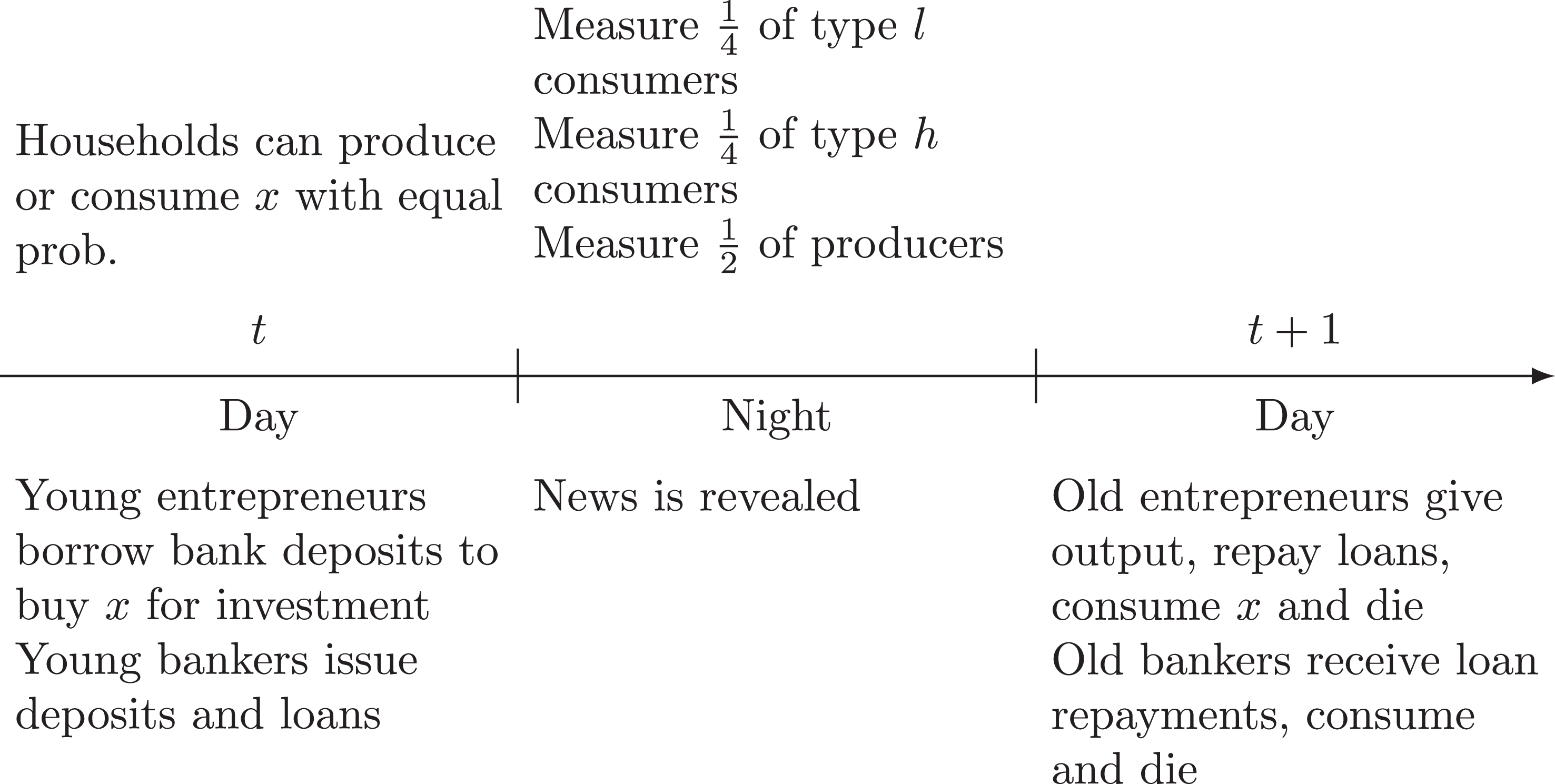
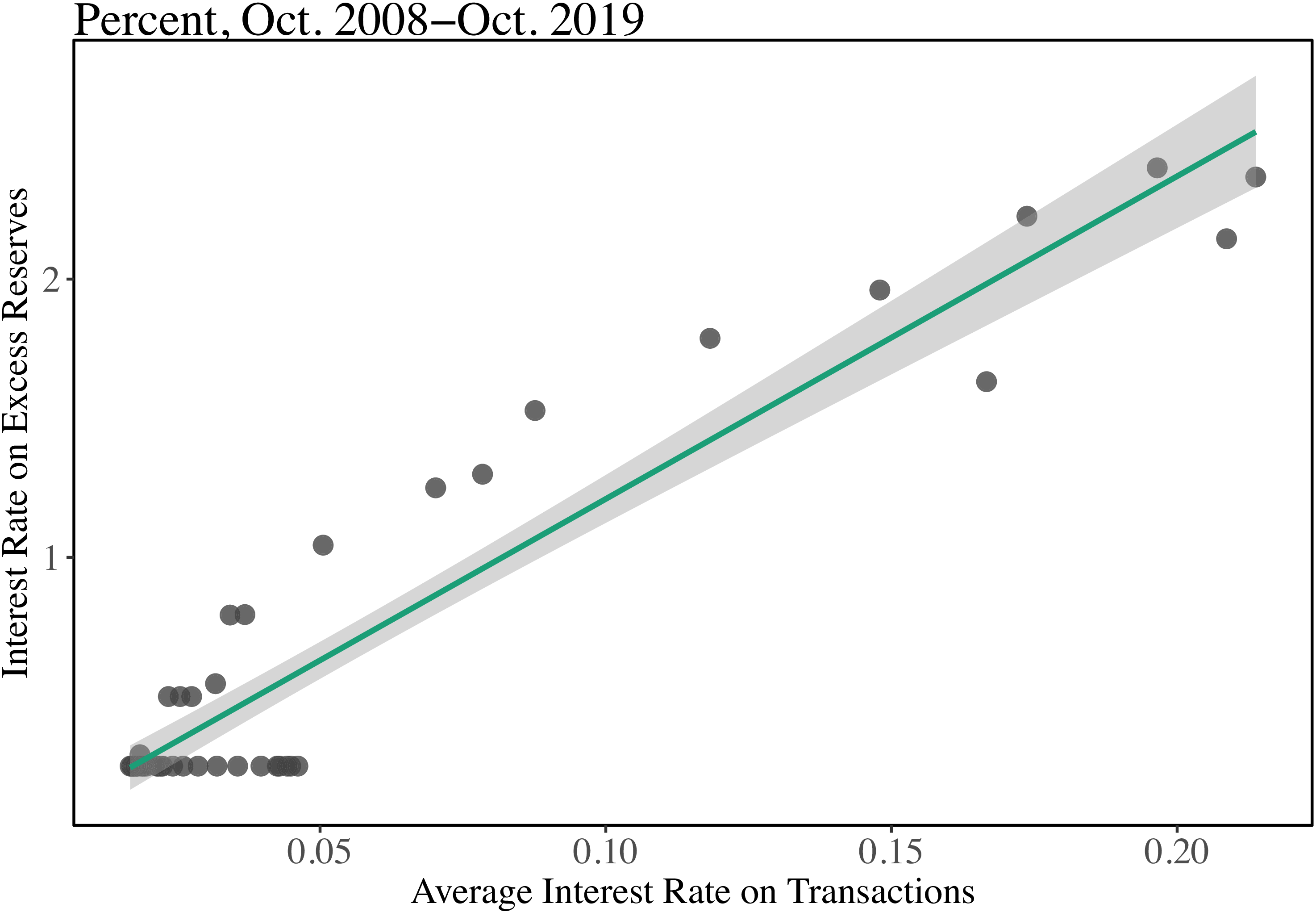
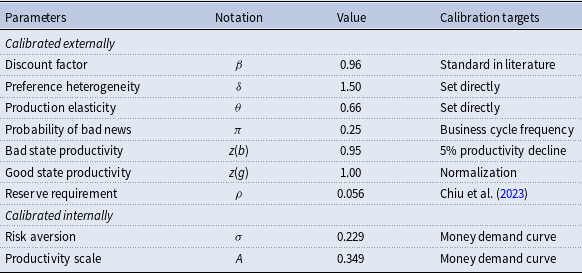

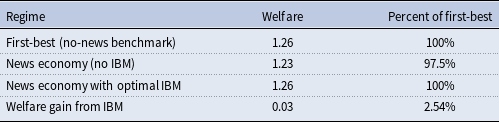
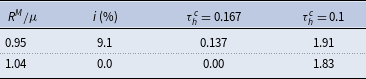

 RM/μ

 π
 δ



