A working day is ending at the place of a traditional therapist, Fahra, as she wraps up the first treatment for the last of today's patients, a law student and the student's mother. The therapy went fairly well. Fahra diagnosed the two women as suffering nervousness (nervoza) and treated them for traces of envy by close friends. She taught the younger, carefully made-up woman a fast and simple remedy for the effects of envious onlookers, uroci. The bejeweled mother, on the other hand, will continue to need professional help: wealth inspires malice more efficaciously than does beauty. Fahra divined further information in a bowl, in patterns formed when molten lead she had placed in it solidified in contact with water. In this way she found that the younger woman was likely to win over the heart of her sweetheart, and so conclude their long-distance love affair with a transnational marriage. He was a Bosnian diaspora man, while she had been an eastern Bosnian refugee in Germany but has now resettled to the northeastern regional capital, Tuzla. Since Fahra found no sihiri, sorcery, on either woman, she told them that their anxiety symptoms should be simple to remedy, provided that they returned for two more sessions to complete the treatment.
Fahra's daughter and ten-year-old grandson, who live in a hamlet east of Tuzla built entirely by refugees from eastern Bosnia since the 1990s war, drop in for a visit in the midst of the strava session. When they enter Fahra's small living room, she interrupts the proceedings to kiss and hug them, but noticing the boy is drinking a cold Coca-Cola on a hot day, thereby, according to the local humoral commonsense, risking a cold, she snatches the Coke bottle from him to warm it on the woodstove that still burns with the ritual fire. The boy settles into a game of “Chicken Space Invaders” at the computer by the stove, and Fahra returns her attention to the bowl, discarding the lead and bottling the water for future use. In each subsequent treatment she will add the previously used strava water to a bowl freshly filled. She will then treat it anew with whispered incantations, suras (Koranic verses) appropriate to the ailment, her wishes for the patient, and a wish that the patient will make and blow onto the water surface. Upon completing the therapy, the patient receives recycled strava water, to bathe in, sprinkle onto a meal, or stir into a drink for protracted treatment. Or they may spray the water onto the clothes of an unsuspecting patient who does not believe in strava or is unwilling to seek a cure, on whose behalf family members have contracted the treatment at a distance.
Fahra pours the older woman's strava water into a not-quite-empty Coke bottle and I resist the urge to stop her. The leftover soda fizzles out and drowns in the carefully treated, magically potent “fears water.” I have seen such a muddle before, when another therapist similarly mixed the two liquids and laughed off the patient's attempt to prevent it with the comment, “It doesn't matter; it will only be sweeter.”
THERAPEUTIC CLAIMS AND ACCIDENTS
In what follows, I examine the healing practice of strava, which has a long history in Bosnia but has been particularly popular since the end of socialism and the 1990s war. I have opened the paper with an ordinary incident of therapeutic mixing to raise questions about efficacy. To address these questions I will employ what perhaps seems an unlikely mix of theoretical insights, combining older theories of sympathetic magic with Bruno Latour's more recent thinking on action. I want to show the implications of Latour's concept of “practical metaphysics” for the social study of medicine in general and strava in particular. I do so by teasing out historical and ethnographic details of strava in order to paint the practice differently from the usual portrayals of healing as concerned with signification. Following Latour, we can appreciate strava, not as a symbolic practice, as medical anthropology typically treats healing, and as previous accounts of strava suggest it is, but rather as a medical intervention, which it claims to be, in competition with psycho-pharmaceutical treatments of anxiety disorders and depression. Classic studies of sympathy and magic not only intellectually precede Latour's investigation of curious agency, but they also come to our rescue when, following Latour's advice to expand our notion of reality in the direction of native explanations of what acts, we arrive at an infinitely animated social field. As I will show, symmetrical investigation animates equally both magical things and plain commodities, such as Coca-Cola. On the other hand, contiguity in classic theories of magic tends to be precisely delimited, even if it is not immune to categorical confusions.
Because strava also intervenes into illnesses that local knowledge attributes to the disorders of the new market, we must wonder why only strava water—carefully prepared with prayers and handled by the therapist's and the patient's wishing breaths—should be potent, while Coca-Cola remains ineffective. In the vein of another anti-fetishism, it is not so much Coke's “sweet” substance that renders it such a globally profitable, pervasive, and palatable commodity as it is properties imperceptible to the taste buds—the intangibles of abstract labor, valorized according to the global dynamic of capital, and its brand-name. Coca-Cola is in fact irresistible—it circulates in the impoverished Bosnian economy even though many people who have developed a taste for it have little disposable cash, and instead rely on intricate and intimate means of borrowing and lending money and capital to support their subsistence. Life is habitually “sweetened” with treats that, if we calculate average household incomes and expenditures, ought to be beyond people's means.
While Latour and Marcel Mauss push us far toward understanding agency in healing and political economy, they leave us with an unresolved problem that is evident in the case of strava. Strava treatment is often performed remotely, arranged by concerned intimates in the absence of patients who are elsewhere but whose health, subsistence, and existence are acted upon via the principle of sympathetic contiguity, by means of their names, clothing, or intended gifts of clothing not yet or never received. More significantly, strava always presupposes some degree of distance since the therapist rarely touches the body at hand. This pushes us to think through the power of contiguity in healing as a quotidian contact between the tangible and the intangible that becomes the object of precisely orchestrated exchange.
PRACTICAL METAPHYSICS
In Re-assembling the Social, Latour questions the authority vested in social scientists to define reality. While anthropologists have traditionally attended to native notions of action that jar the cosmopolitan sense of the real, their patience for peoples' “wild beliefs,” Latour writes, has rested on an implicit confidence that, while culture lends itself to multiple representations, nature is essentially one reality, which is knowable only by means of the natural sciences. Latour calls for inclusion of all kinds of alien agents, from virgins and fetishes to laboratory instruments, and cultures that social scientists have granted only a symbolic existence. The idea of agency in social theory must extend accordingly to include, as Latour puts it, “many metaphysical shades between full causality and sheer inexistence” (Reference Latour2005: 72). If we accept that being compelled, urged, authorized, or enticed to act are so many ways of making a difference in the world, the intentional subject no longer appears as the sole source of action amidst inert non-physical entities, nonhumans, and objects (ibid.: 61). Agency, instead, is an uncertain outcome of a multiplicity of agentive potentials (ibid.: 44–46).
Latour places his provocations of social scientific realism under the rubric of “metaphysics,” which is a philosophical concern with the nature of reality, being (both physical and non-physical), and causation. As such, metaphysics overlaps with problems of not only ontology but also epistemology, given that every description of the world, including (social) scientific ones, presupposes some structure of reality. Metaphysical investigations are regularly carried out at the limits of what is empirically verifiable, since the metaphysical transcends human experience (of self or God) or occupies the domain of popular belief (say, spirits or magic). “Practical” or “empirical metaphysics” is Latour's term for actors' insistent multiplication of the number of agents in the world. Instead of policing the idea of what really is and really acts, social scientists, Latour asserts, ought to engage with philosophical investigations and vernacular imaginations of agentive potential (ibid.: 51–53). He realizes that one reason for social scientific reluctance to redefine the taken-for-granted reality is the sheer difficulty of sorting through and keeping up with the production and demotion of agents.
I am inspired by Latour to take strava seriously as a practice that is decisively non-symbolic, neither performative of some communal or hybrid identity nor expressive of some greater historical forces at work. Strava is, instead, concerned with bodily disorders and effectively competes with pharmaceutical, clinical, and alternative medical treatments of anxiety and depression.
Interpretation of ritual symbols has been a staple of studies of healing. Victor Turner's ethnography of Ndembu (Reference Turner1968) and Claude Lévi-Strauss' “Effectiveness of Symbols” (Reference Lévi-Strauss1976) exemplify the anthropological insight that digs through native rites in search of a deeper reservoir of symbolic meaning. For Turner, symbols are powerful “codes” that embody societal beliefs, which lend them efficacy (Reference Turner1968: 8). Healing rituals recruit symbols to restate or restore coherence of individual or collective meaning (ibid.: 22). And while Turner posits an irreconcilable epistemological split between natives, who take the truth of symbols for granted, and social scientists, who grant the spirits and witches a symbolic reality, Lévi-Strauss searches for the universal principles of efficacy in the unconscious. Shamanic rites or their modern equivalent, psychoanalysis, probe this human terrain to unleash the therapeutic power of symbols (Reference Lévi-Strauss1976: 200). In Lévi-Strauss' explanation of efficacy at a distance, physical effects are achieved by purely psychological means.
Later symbolic anthropologists similarly engaged healing as a matter of collective or oppositional idiom, meaning, and belief (e.g., Danforth Reference Danforth1989; Boddy Reference Boddy1989). Others analyzed afflictions as illuminating the relations between biographical events and historical contradictions (Comaroff Reference Comaroff, John and Jean1992; Reference Comaroff1980), or plumbed competing medical claims for expressions of something more broadly significant: growing class inequalities, neoliberal consumer choices, or alternative modernities (e.g., Napolitano Reference Napolitano2002). Regarding postsocialist Europe, a recently edited volume by Lūse and Lázár (Reference Lūse and Lázár2007) reads the emergent medical pluralism and alternative spiritualities there as people's attempts to make sense of historical changes. The contributors tend to translate their interlocutors' pragmatism, which treats ailments literally (at the level of flesh, not meaning) into cosmological worldviews (e.g., ibid.: 101). Strava women's concern with particular points of the body rather than the presumed substance of identity or psychology, and their matter-of-fact tone, I propose, discourages symbolic interpretations.
IN THERAPY
You can “pour out” (izlit, salit) your fears by appointment, phoning ahead, or you can drop in on the practitioner unannounced, especially when visiting for the first time one who has been recommended by friends, kin, chance interlocutors, or other health practitioners. Treatments take place by a woodstove in the therapist's living room or, when warm enough, in the summer kitchen or by an open fire in their backyard, out of sight of curious passersby. But a strava session is no private affair. Patients in treatment or waiting their turn often witness someone else's fears being poured out and discussed.Footnote 1 In the name of Allah, nena (“grandma,” a common term of endearment for elderly women in Bosnia) approaches a patient who is draped from head to toe in a red sheet that is pockmarked by a history of stray lead drops. Near four points of the body—head, chest, knees, and feet—nena ladles the molten lead into a bowl of water held below. A small explosion quiets to a fizzle as the lead runs into the water and sinks, settling into a figure legible to nena. The patient takes off the sheet while the therapist places another piece of lead into a ladle and over the fire, and collects the lead from the bowl for examination. The procedure moves between ladling molten lead at the level of but away from said points of the patient's body, and melting lead in the woodstove for the next pouring. A casual conversation unfolds during these pauses, but pauses while the therapist pours and examines the lead. The setting is intimate. The therapist might recount particularly interesting cases, often including details such as names, addresses, and occupations of past or regular patients, while patients swap health histories and evaluate different therapists and remedies: alternative, traditional, pharmaceutical, or biomedical.
Whatever is the matter with a patient unfolds in the course of the pouring and lead examination when nena investigates or patients volunteer descriptions of other aspects of their lives, be they herbal, pharmaceutical, or dietary regimens, family fortunes, or affairs of the heart. Therapists' and patients' concerns rest with bodily organs, functions, and quotidian habits, but a patient's health and wealth are neither discrete nor separable domains in this practice, or in Bosnia generally (see Jasarevic Reference Jasarevic2010). In one session that a worried wife contracted on behalf of her husband in his absence (see below), nena moved swiftly from questions about the man's spending habits, which turned out to be bringing the family and family business to ruin, to the details of his mixing of alcohol and tranquilizers. She finally asked, with eyes fixed on the lead, “Does he have hemorrhoids?” The wife responded: “He does, he does. They subside but as soon as he drinks again or eats something spicy, they come back. I find his underwear all bloody. He says that I spend everything, but there's nothing in the house.” She then reported on her husband's diet: “Yesterday, he came home to eat, I cooked meat, and two potatoes; there just wasn't any tomato.” She also reported on his stool.
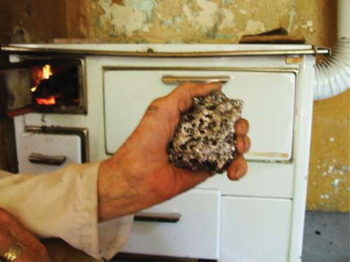
Therapists examine solidified lead for both its texture and images. Needle-like formations, for instance, indicate nervousness (nervoza), while mossy, crumbling strava (“negative particles,” as one therapist explains them) point to an anxiety that has spread through the body, causing organ lesions. Strava images are simple—say, tears for crying, a road for a trip or a visit, or a heap for wealth—and for the most part they are shared with local practices of divination conducted with coffee cups, beans, and dreams. Thus therapists can assume that their patients are fluent in the basic lead signs. Strava women also creatively expand upon received imagery, as for example when the therapist Fahra discerned in the lead a figure of a dinosaur and concluded that the child being treated must have seen one on television and suffered a fright. The treatment is considered successful if in the course of the sessions strava emerges smooth and shiny.
As should be clear by now, my interest in strava's quotidian, bodily, and pragmatic concerns departs from previous accounts of healing in the region. Early twentieth-century writers searched quaint folk traditions for symbolism of a vanishing world, while one ethnographic study of folk medicine within Yugoslav socialism highlighted the importance of ethnic identity in healing and religious rituals.
Nena Mevlija here holds lead, already read and ready for another melting. Author's photo.

FOLK CULTURE
The earliest published mentions of strava in the local language are closely tied to the colonial cultural policies of the Austro-Hungarian administration, and then to the annexation of Bosnia and Herzegovina in the 1880s. The period's museum collection and exhibition policies, and academic and popular publications of ethnological materials served the imperial design to build a properly Bosnian, multiethnic culture and thereby counteract the nationalist pretensions of neighboring Serbia and Croatia and their influence on the local Serbs and Croats. The National Museum was established in Bosnia's capital of Sarajevo, and articles published in its journal included colorful reports on folk medicine, magic, sorcery, superstition, and beliefs, strava among them. The pedagogical aim of the National Museum's Glasnik (Herald) was to compel young people of Bosnia, whether Muslims, Catholics, Orthodox Christians, or Jews, to explore their country (Lipa Reference Lipa2004). The texts on healing spoke to the existence of the very phenomenon that Austrian-Hungarian officials hoped to formalize: a folk culture shared across the confessional communities. What emerged from the descriptions of strange beliefs and practices was a Folk that believed in many of the same wondrous things and treated illnesses and misfortunes by common means.
Such writing about culture had a further effect: the contributors, collecting with haste the lore threatened by the spread of modernization, education, and urbanization, became a distant elite, which half-lamented and half-urged the cultural changes taking place. They were urban, often well traveled through the empires, and educated in Vienna or Istanbul. They wrote of “our people,” often warmly so, expressing a closeness, but at the same time their rationalizing or exoticizing tone removed them from those they portrayed as superstitious, lice-infected, talisman-protected,Footnote 2 sorcery-suspecting peoples. For example, they wrote of the latter's wonderfully tattooed bodies, while suspecting that with each prick of the needle, dipped in charcoal and the spit of the tattooing woman, syphilis was spread.
Karl Steiner, in an article entitled “Bosnian Folk Medicine” (Reference Steiner1903), compared Bosnians to the primitives (Naturvolk) of the Americas, whose childlike imaginations naturally led to the spread of folk medicine, sorcery, and superstition. He asserted that the uncivilized character of the Ottoman imperialism maintained a low degree of cultural development. Furthermore, Steiner wrote, because of people's “movingly trusting” nature, their nonsensical and repulsive procedures often bore enviable results. Efficacy in curing, he claimed, was brought about by means of sympathy or, more precisely, by suggestion, much as was the case in medical swindles that were ongoing in Germany. Steiner's observing gaze removed him from the people whose physiognomy, physique, and temperament he carefully recorded, while his rhetorical gestures such as his references to “our women” (who “fade so quickly”) placed him squarely with the folk. The simultaneity of distance and closeness legible in his texts was also the condition of data collection in the field. Glück's 1890 article, for example, drew partly on his experience as a medical doctor who found his patients, stripped in examination, wearing medicinal amulets and talismans, regardless of their confession or condition.Footnote 3
These writers bunch together divination (gatanje), superstition (praznovjerje), and mundane prescriptions and prohibitions; magic, sorcery, and simple, self-help magic (magija, čaranje and bajanje); and folk medicine (narodno liječenje), including herbal remedies, stomach massage (struna), and bone-setting. We get a sense of some universally magical locations and elements—crossroads, thresholds, footprints, knots, and cemetery soil—and of a sympathetic logic of contiguity and similarity at work. In Truhelka's Reference Truhelka1889 account, for example, strava is a folk illness that harks back to the “primitive,” pre-Christian beliefs in an evil spirit (zloduh), whose animal shape the simple people “divine” (nagadja) from the shapes that molten lead takes when poured into water, and expel with garlic as they do other illness spirits. An article by a sharia judge named Sadik Ugljen is remarkable for its detailed description of the healing rite, and for its matter-of-fact recommendation of strava as an “excellent medicine” for fear, “the remedy for which illness” he writes, “cannot be found even in contemporary pharmacies” (1893: 168). According to Ugljen, people used lead for strava throughout Bosnia-Herzegovina, with the exception of an Orthodox community near Mostar.
COMMUNAL MAGIC
Another notable mention of strava comes from an entirely different historical period. Tone Bringa (Reference Bringa1995) includes strava among “faith healing” and “divining” practices of the central Bosnian Muslims with whom she studied in the late 1980s. According to Bringa, strava intervenes in disorders with “sinister sources”: attacks by malevolent spirits, sorcery, and the “evil eye.” Based on occasional observations, she describes strava as a practice that requires a rudimentary religious education. Middle-aged women, she writes, use Koranic suras, “believed to help define the problem and thereby alleviate the anxiety,” and always the same “lump of lead,” which is passed on through a line of healers, and in the course of the ritual, melted and poured into water to reveal causes of disorder in solidified lead images (ibid.: 215, 216). The cause of strava most frequently cited by Bringa's informants, however, is sikiranje, which she translates as “something having upset a person,” assuming thereby cosmological origins of illness, uneasily confessed or poorly understood (ibid.: 177–78). A better translation would be “worrying yourself sick,” which expresses a more ordinary form of anxiety. In contemporary Bosnia, people are “worried sick” over mundane emergencies: a salary being late when debt repayments are overdue, or news of an accident or poor health. Bringa lists her interlocutors' similarly prosaic complaints: of anxiety, depression, marital problems, a death, or a dispute in the family (ibid.: 216).Footnote 4
In place of the “Folk” in the older sources, whose magic and medicine, including strava, are comparable across confessional lines, Bringa's ethnography describes an ethno-national community, habitually and ritually preoccupied with affirming their essential religious difference from neighboring Others. Therefore, like other religious rituals, strava appears as a Muslim and exclusionary practice. Bringa writes, “Muslims believe that only Islamic knowledge and those who possess such knowledge—whom they therefore see as agents of divine power—can counteract malevolent influences” (ibid.: 184). Only a few pages later, however, she tells of Bosnian Muslims who use Christian “blessed water” for medicinal purposes, to tend to the maladies of livestock caused by sorcery, sihir. There are similar reports of an interethnic market for medicine, for instance that people of all backgrounds regularly visit regional Sufi healers, famous for their medicinal inscriptions (ibid.: 218). Bringa explains these away by distinguishing between magic and religion—it is the pragmatic orientation of the former, she suggests, that allows “syncretistic” mixing. This exemplifies a fairly common assumption that religious rituals presume subjects with coherent collective identities, while magic is a messy practice of people too alarmed about their health or wealth to worry about theoretical inconsistencies.
Bringa describes strava as a disappearing practice. One healer was repeatedly pressured to discontinue what her adult children considered a “primitive superstition” (see also Vlahović Reference Vlahović1972; Radenković Reference Radenković1996). Other forms of “faith healing,” such as medicinal inscriptions and talismans were also on the wane because, as Bringa quotes a local imam: “There are more doctors around, so fewer people come to us…” (1995: 217). Conversely, she proposes that the growing popularity of Sufi healers is a “reaction to the severe economic and political crisis in the country in the late 1980s and people's increased insecurity and distrust of authority. Seeking help from non-state-approved sources may thus be interpreted as an expression of popular distrust of state institutions” (ibid.: 217). We are left with a contradiction: state institutions, such as the public health system, are both more accessible and authoritative, and are displacing traditional healing, and yet they are also less trustworthy, which inspires informal and oppositional pursuits of alternative forms of health care.
Some three decades later, strava is hugely popular in Bosnia. It attracts patients of all three nationalities, and inspires travels across the ethno-nationally divided political and administrative entities of the new Bosnian state. Even patients from the wider ex-Yugoslav region, from Slovenia to Montenegro, travel to Bosnia for traditional medical therapy. Strava also draws people for whom national markers are not simplifying communal loyalties, including the ethnically mixed, ethnically indifferent, and nonaligned; communists, atheists, and anarchists; and the growing minorities of Hare Krishnas, Sai Babbans, and Buddhists.
Strava treatment today is not reproducing the “ethno-national differences” that in the region are inseparable from the cultures of Islam, Orthodoxy, and Catholicism, nor is it creating new “Yugonostalgic” hybrid identities. Contemporary strava therapy is not about “identity” any more than it is about a set of communal or religious “beliefs.” Take for an example the Slovenian businessman who asked his local partner (who, by the way, is a pharmaceutical wholesaler in Tuzla), for the favor of being put in touch with a certain imam of great regional reputation for medicinal inscriptions (zapisi) and talismans (hamajlije). His concern with their reputed efficacy and his symmetrical medical literacy in the global medicines and the local, marginal, and magically endowed Bosnian tradition are far more pertinent to understanding his practice than are questions of identity or belief—it is claims to efficacy that compel people to seek strava. Experimentation is the metaphysics of popular practice, which tests reality, and people's understanding of it, every time strava works or fails.
DAILY ANXIETY
People with all kinds of health disorders and a broad range of symptoms seek out strava: a teenage girl who secretly suffered sexual violence and came on the insistence of her high school teacher, women and men with marital grievances, or survivors of car accidents or the 1990s concentration camps. There are students with test anxieties, and young people who are shy or listless, unemployed or struggling with school, heartbroken, or dependent upon parents who indulge them but can scarcely afford to. We find among strava clients people who are in mourning, patients released from hospitals, or those lately of psychiatric wards who are schizophrenic, epileptic, homicidal, suicidal, or suffer panic disorders. Then there are the bankrupt, the indebted, the impoverished masses, and the few who are newly rich. Strava, in other words, intervenes in a host of disorders that people around the world relate to the troubles of everyday living (Farquhar Reference Farquhar2002; Danforth Reference Danforth1989; Kleinman Reference Kleinman1980), except that everyday life in Bosnia since the end of socialism and the war is generally thought of as an ongoing emergency that people are barely “surviving” (preživljavaju).
Although socialist Bosnia was among the least developed republics of the Federal Yugoslavia, Bosnians did enjoy the relatively good life promoted under that exceptional socialist state. From the 1950s until the economic crisis of early 1980s, the state provisioned for its citizens by means of extensive industrial growth, which slowed after the 1960s, and with substantial foreign grants and loans (Woodward Reference Woodward, Dyker and Vejvoda1996). Yugoslavia served all three markets of the Cold War. To the West, it sold everything from Boeing parts, to chocolate Christmas Santas (not a great success), to beef. To the socialist East it exported consumer goods and technology, and to its non-aligned counterparts in the global South it provided both military and civilian engineering services (Lampe, Prickett, and Adamović Reference Lampe, Prickett and Adamović1990). Though socialist unemployment in the 1980s was at 25 percent and the reforms imposed by the International Monetary Fund in the 1980s were harsh (Woodward Reference Woodward1995; Plestina Reference Plestina1992), various forms of social care considerably cushioned people's standard of living. Since the 1990s, the war industry has either collapsed or been ruinously privatized, and the open market has rendered local agriculture unviable. Estimated formal unemployment hovers at 60 percent, and the GDP per capita is only 50 percent of the southeast European average and less than half of Bosnia's own pre-war figure (Pugh Reference Pugh2005: 453; Stites et al. Reference Elizabeth, Lautze, Mazurana and Anic2005: 52). Local livelihoods are largely dependent on remittances from Bosnians displaced or resettled abroad and on incomes from sales in the exploding formal and informal markets.
This is the historical backdrop of the perceived outbreak of nervous disorders. Among strava patients, the majority of bodily ailments are related to quotidian, existential uncertainties, although plenty of consultations concern the effects of regional forms of sorcery (sihiri), spirit intrusion (ogramak, džinsko kolo), and “war trauma.” People manage stress with a daily regimen of tranquilizers, but regularly worry about the side effects and inadequacy of psycho-pharmaceuticals. These popular concerns imbue strava and other traditional and alternative medical practice with a particular urgency.
Strava therapists insist that they improve upon biomedical and pharmaceutical interventions, which they say are particularly useless in treating stress, discontent, insomnia, nervousness, and depression. In Fahra's words, “All that [doctors] can do is prescribe medicine, and they give you the worst kind, those that kill nerves. Medicines provide temporary relief only.” Strava therapy takes time and gives a comforting sense that the ailments are only comprehensible in the light of the rest of the patients' lives and that no life is so disordered as to be hopeless.
In global clinical practice, strava symptoms would be related to psychological, affective, or nervous disorders under the general rubrics of anxiety or depression. The twentieth-century bourgeois experience of anxiety evolved as a global category of psychiatric disorder through the entanglement of national regulatory agencies, medical and clinical professionals, and the world's most powerful transnational vested interests—those of the pharmaceutical industry (Medawar and Hardon Reference Medawar and Hardon2004; Petryna, Lakoff, and Kleinman Reference Petryna, Lakoff and Kleinman2006).Footnote 5 In Bosnia, the local clinical term ankcioznost is almost never used outside of psychiatric institutions and the small field of psychotherapy. Instead, medical professionals share strava idioms for nervous disorders. The newness of the health experience of depression, on the other hand, is legible in the fact that the term depresija is used in both clinical and folk contexts to describe a disorder that the local pharmaceutical industry, like its global counterparts, is working hard to publicize (Healy Reference Healy1997; Reference Healy, Petryna, Lakoff and Kleinman2006; Medawar and Hardon Reference Medawar and Hardon2004). Against biomedical assumptions, but long taught by medical anthropology, illness is not only biological but also a cultural, local, and historical entity (Good Reference Good1994; Lock and Gordon Reference Lock and Gordon1988; Farquhar Reference Farquhar2002). Strava therapists are well versed in antidepressants, which unlike tranquilizers are not familiar to the public at large, and the therapists agree that depression is a more stubborn case of fears, though the boundary between fear and depression is as fluid here as in the international diagnostic and statistical manuals.
A strava therapist in Tuzla explained to me that strava treats cases “when nothing matters, when everything is unimportant.” Her granddaughter, a student at the local medical university who sat with us over coffee, commented: “That's depression.” “Depression,” I was told, can happen to anyone, regardless of their living circumstances. Fahra recalled one unlikely sufferer, a young man: “He has money but told me, ‘my life is not dear to me, I wake up in the morning and don't want to go to a café, nor to find a girlfriend.’ He showed that he had some discontent (nezadovoljstvo) here [pointing to her chest]. He came to me three times, and then again a month later. After that he was a different man. He gave me a 100 konvertible marks [KM]!”Footnote 6 Fahra also treated a wealthy trader, a refugee from eastern Bosnia, who “has money, an estate, a large house, land, all sorts of things, but has no will. Nothing aches, just something urges her to cry. Doctors gave her Seroxat [an SSRI antidepressant]. She didn't want to use it. She says, ‘I would give KM 10,000, money means nothing to me, just to be better.’”
In the midst of contemporary political-economic transformations, affairs of both health and wealth are regularly underwritten by principles of gift exchange and expectations of generosity that have been reinvented as the new market has emerged.
DYING PRACTICE, BUSTLING BUSINESS
“This knowledge is dying out,” says nena Fahra. Strava therapists are generally post-menopausal women who acquired their knowledge from having observed the practice since childhood, and then received the gift of healing from a practicing family member, usually a paternal grandmother on her deathbed. There are other stories of initiation. Some women received their knowledge as a gift in dreams, or were taught when awake by incorporeal voices, or by a familiar specter of some dead dear one such as a daughter or grandmother. Fahra's complaint conveys her real difficulty in finding an heir. To take over from her will be no small feat considering that she “has to have faith,” to know therapeutic efficacies of particular suras, and, still more, to have something—obvious to those who can “see” what lies beyond the phenomenal—that predisposes her for the gift of healing. Strava therapists agree: “Not just anyone can do this.”
Although strava is often said to be a “dying practice” in these postsocialist times, in fact it remains a bustling business. Never before has the region seen so many strava practices advertised in the media, or on business cards or urban announcement boards. Nor have strava practitioners ever been so often casually recommended in the informal, intimate circulation of referrals that help people navigate the treacherous market for medical and magical services (see Jasarevic Reference Jasarevic2011 entirely). Alternatives to clinical medicine were stigmatized and practiced in relative secrecy throughout the period of scientific socialism, when Yugoslavia's modernization ideology and efficient public health system popularized the biomedical definitions of health, illness, and body. Since the 1990s war and subsequent peace, medical services have proliferated and entered the marketplace. The popularity of strava does not simply express a general mistrust in the authority of the new state, which compared to the previous, socialist state evinces little biopolitical interest in its population.
Bosnians today scrutinize with equal attention all forms of health care, from biomedical, to private and public, to alternative and traditional, all of which are feared to be subject to rampant marketization. Many private pharmacies and clinics have opened, and professionals in the public health system offer increasingly expensive care, with the gifts or payments they expect for their services more or less openly quoted. Judging by numerous accounts and also my own observations of health centers and clinics in northeastern Bosnia since 2006, clinical encounters with physicians are for the most part superficial exercises in the prescription of drugs that many patients simply cannot afford.
Amidst the diversity of the medical and magic markets circulate stories of professional malpractice and medical scams, exuberant costs, frightening health histories, flawed technologies, and forged, black market professional degrees. One hears of a “genuine” Gypsy spell-maker, “devout” village imam, or clairvoyant once revived from near death, whose claims are said to be based on invented genealogies or alternative epistemologies. When people evaluate competing recommendations, promises, and claims they rely on a popular conviction that healers who are “for real” (pravi), and true doctors, have no price. And in fact a basic economic principle that strava women inherit with their practice is: never deny a treatment or name a price.
Money nevertheless changes hands in strava, and considering Bosnia's present demonetized economy, a substantial amount of it is invested in health care. Fahra, a refugee from eastern Bosnia who has practiced in Tuzla since the 1990s, used gifts of money that she received as both payments and alms to build two houses in a newly constructed refugee neighborhood, for herself and her adult son and daughter. She also furnished a house in Tuzla where she lived with her youngest daughter and practiced strava. In addition, Fahra financed a hajj and brought back KM 4,000 worth of gifts (about US$2,700 in 2007) for family, friends, and acquaintances (including her doctors and nurses in the health center). She lends money to her children whenever an unexpected need or want arises—the visit that I described at the beginning of this paper was not an entirely pleasant surprise for Fahra since her daughter asked her for a KM 6,000 loan so she could connect to the communal water supply.
Another therapist, named Mevlija, runs the most efficient strava practice; she posts business hours and charges a nonnegotiable, inflated price. She has earned enough for her family to buy a restaurant and a shop next door to her office. In a controversial move that, due her charm and healing reputation, people have forgiven if not forgotten, Mevlija has chosen and trained apprentices rather than properly recognizing and initiating an heir. She recruited her young (that is, menstruating) daughter-in-law into a jointly run strava business. She has also introduced innovations that save her time and labor and increase her price per session. These include the sale of towels that, as she impatiently and inconsistently explains, treat anxiety at a distance. But people wonder.
Then again, there is Zejneba, who passes onward in gifts all that she receives for healing, and Sabaha, another refugee resettled to Tuzla, who barely makes ends meet on her late husband's police pension. Sabaha's clients today, many of them professionals who drop in on their lunch breaks, give her only promises of payment, which is continuously deferred, as are so many intimate debts in Bosnia's new economy (see Jasarevic Reference Jasarevic2010). Strava, a folk practice that was in the later twentieth century marginalized by modernist and biomedical ideals of health and body, has now migrated to the city centers with rural, refugee, or recently urban therapists who have moved there, and has become an indispensable part of people's health care repertoires.
WISHING
Strava begins with a nena linking her patient's body with lead and water. On behalf of the patient, referred to by their full name (and sometimes also their mother's name), she first treats the water and lead by reciting over them incantations in Bosnian, and particular Arabic dove (sing. dova)—prayers for help and guidance recommended by the Prophet and comprising Koranic suras appropriate to given disorders. To further relate the water, lead, and the patient's body, she has the patient swallow some of the treated water. Fahra does this while gently stroking the surface of water passages, the throat, chest, and stomach, but not all strava women touch their patients, and in fact distance tends to be an underlying theme of strava. In any case, whether the patient is within reach or far away, the therapist reaches for the viscera while pouring lead slightly away from the surfaces of the body. Next, she circles the lead around the person's head, shoulders, and arms (first folded and then extended into a square), then across the chest, stomach, knees, and toes. She touches the lead to the body after each of three circles, and then touches it to the ground or to wood.
Prayers are whispered to the lead and the water, more or less fervently: Zejneba's is the lengthiest, most trance-like praying that I have seen, while Mevlija's is a brief, casual, and confident address, uttered between cigarette puffs and chatter. The dova ends with the healer loudly exhaling, followed at the end of the preparations by the patient, at the healer's urging, blowing their wish. Their breath delivers intentions and wishes, granting them extensity and so a form of body, incorporeal but nevertheless tangible inasmuch as it offers a point of intervention. Similarly, it is not the body alone that contacts the ritual implements. The therapist calls out the patient's name, as the property of their singular person (see also Taussig Reference Taussig1980), and the patient blows breath onto the water and lead, extending their particular desires. The incorporeal—biographical, wanting, thinking, feeling singularity—is thus brought forward, to the outside, where it intersects with the physical body. This is a site of specific metaphysical, physical existence, always already a plural entity, comprised of both the touchable and the intangible.
In health care or market exchanges, wishes are exchanged compulsively, sometimes absentmindedly and at other times ardently. They prevent the closure of a transacting relationship after a deal has been made, and invite a return: of a gift, another wish, or a future exchange. In one municipal town pharmacy I often heard patients, after paying for their medicine or putting it on a tab, wish the pharmacist to be “healthy and alive.” A market vendor, having sold a woman clothes for her newborn, wished good health and life to the infant, and the client seemed moved and, in turn, wished the vendor an unspecified abundance. Wishes can also mitigate an exchange that one of the parties deems unfair. For example, an elderly couple negotiated with a taxi driver a bargain for a ride, but the driver was unhappy, called it blackmail, and complained the whole way. Upon arrival, the couple took his leave with best wishes for his health and fortune, and said: “May it be that no hard feelings remain,” compelling him to wish the same to them.
Wishing, then, can solicit an action—in the last case, forgiving—and it often can solicit giving, or at least attempt to (for wishes can fail). And wishing ill, too, is suspected to have potency. I once heard a beggar shout after a woman who passed without giving: “May God give to you so that you always have this much (dabogda uvijek ovako imala).” This made her pause, if only briefly, and justify herself aloud: “And I used to give.” His wish reminded her of the local belief that “having” hinges on generosity, meaning that withholding a gift (or alms) not only jeopardizes one's hold on the wealth one has but also precludes generating or accumulating more. If the woman does not have enough money to spare, the man is wishing her everlasting scarcity.
Furthermore, in Bosnia wealth and health are inseparable (as is also true elsewhere; e.g., Klima Reference Klima, Inda and Rosaldo2008; Weiss Reference Weiss1998). As already mentioned, strava is employed to treat a number of ailments brought about by envious looks (uroci), cast longingly after the property of another, or by forceful and frustrated desires that have instigated contracted sorcery, sihir. Strava therapists often prescribe to ailing or unfortunate patients that they give money, food, or clothes to the poor, or to any of the shrines (turbe) found across the Bosnian landscape.
A Strava treatment is complete only when the patient has bathed at home from head to toe with the bottled “fears water,” reciting wishes for recovery as the strava woman has instructed. The water, which in the course of the treatment received wishes (both the therapist's and patient's), prayers, and multiple dunks of molten lead that absorbed fears, remains linked with the affairs of the treated body, and must be used therapeutically or disposed of carefully (see Grdić-Bjelokosić Reference Grdić-Bjelokosić1896; Trivković Reference Trivković1886; Ugljen Reference Ugljen1893).
CONTAGION
Action at a distance is unique neither to strava nor to Bosnia (Lindquist Reference Lindquist2005; Winkelman and Peek Reference Winkelman and Philip2004; Neumann-Fridman Reference Neumann-Fridman, Winkelman and Peek2004; Farquhar Reference Farquhar1994). However, since the early writings on magic by James Frazer and Edward Tylor, anthropologists have been far more interested in ritual meanings than in the mechanics of action and bodily implications implicit in ritual, with notable exceptions (Taussig Reference Taussig1980; Reference Taussig1987; Klima Reference Klima, Inda and Rosaldo2008; Favret-Saada Reference Favret-Saada1980). With the problem of action in mind, I want to revisit Mauss' famous critique of the classic theories of sympathetic magic. He gives us two insights: that sympathy relies largely on contact, and that sympathy alone does not explain the efficacy of magical phenomena. Mauss revisits Frazer's and Tylor's comparative studies of sympathyFootnote 7 as the property that interconnects persons and objects in a dense reality susceptible to change by obscure, invisible, or intangible means, and he proposes three laws: of contiguity, similarity, and opposition. The latter two laws, according to Mauss, are only “mimetically sympathetic,” or properly speaking symbolic, because they posit conventional relations between objects or subjects otherwise neither obviously alike nor organically connected. But the law of contiguity begins with the idea of physical proximity. Material connection is crucial to the idea that a part is like the whole, that touch results in contagion, and that there exist similarity and continuity between one thing and its class, one person and their species.
The uses of the contact principle in black magic and healing are remarkably similar from Native American to Melanesian societies, and to Bosnia-Herzegovina at the time of early ethnological writings in Glasnik. Tylor himself compared the imitative magical rites of birthing in ancient India, Greece, and contemporary Bosnia. So, for instance, bodily bits such as hair or nail clippings remain connected to persons who shed them, and can be used to harm them. Likewise, leftover food is linked to the belly of the person who consumed the rest of the meal. Properties of matter are contagious to the point that each of a corpse's bones contains death, each spark a fire (Mauss Reference Mauss and Brain2001 [1902]: 80).
I suggest that Mauss privileges contact in his understandings of the workings of sympathetic magic. He nonetheless recognizes, as did Tylor and Frazer, that magic, a “gigantic variation on the theme of the principle of causality” (ibid.: 78), is a messy field in practice, which constantly mixes the mimetic, symbolic, and tactile principles. Michael Taussig paid special attention to the tactile when he updated the “primitivist” ideas of sympathy for his theory of a thoroughly modern magic, by means of which natural faculties, bodily properties, and material connections render drug-induced or mechanically produced images powerful and efficacious, no less than they do commodities (1980). The magic of similarity, Taussig writes, is only one instance of the magic of contact (ibid.: 58), in which the tangible and the incorporeal intertwine (ibid.; 1987). Taussig is interested in the sensuous body involved in physical contact across distance, and he shifts analytical attention away from conventional ties between signs and things. He is interested less in the visual experience that presupposes separation between observed object and the observing subject than he is in the physiognomic effect that an object has on the viewing eye, in vomiting induced by shamanic visions, or in therapeutics of a sand painting on a Navajo body (ibid.: 54; 1987: 395–96, 420).
Taussig presents a case from a Bolivian mining town of do-it-yourself love magic, liga, which a disgruntled woman uses to bring back her unfaithful lover. Taussig describes a confusion of principles of sympathetic similarity and contact whereby material and ontic connections lend efficacy to symbolic objects. The woman burns her lover's pubic hair with a cigarette lit by a candle, both of which are best purchased with the man's own money. Smoking and calling out his name, she superimposes her breath and wishes (“Venite hijeputa; parete hijeputa”) onto signs—money, part-for-the-whole body, and the man's name—turning them into indices of the lover's labor, sexuality, and unique person (1987; 1980: 55–56).
Strava is regularly poured on behalf of others, at a distance. A person may be troubled but too far away to come for treatment (the Bosnian diaspora reaches from Germany to Australia, and Bosnians are working for U.S. military contractors from Afghanistan to Iraq), or simply too busy to come in person, and so send their complaints and some clothes with relatives to a nena. Concerned kin might also mobilize to intervene in disorders and misfortunes of loved ones who deny they have a problem, refuse treatment, or mistrust an “old women's remedy.” Names and clothes—socks, underwear, or shirts—of unwilling, unaware patients are entered into therapy and tucked under the red cloth. A bowl of water is set on the cloth, and lead is poured on the imagined points of the body of the client, who though absent is rendered palpable through his clothes, name, and sometimes a photograph. Strava proceedings render the patient knowable as the lead reveals the history of his disorders.
Significantly, a person can be brought to treatment even without his belongings: relatives can bring instead clothes purchased for but not yet given to the patient. Whether the patient ever receives them is irrelevant—the intended gift has already indebted its would-be receiver because, pace Derrida (Reference Derrida1992), debt does not annihilate the gift for Bosnians and others raised with what Bourdieu (Reference Bourdieu and Alan1997) calls a generous disposition. Indeed, it is precisely indebtedness that marks a gift, that makes an exchange event feel like a gift, and that effectively relates people. An intended gift of clothing entered into strava therapy establishes a series of relationships. First, there is the relationship of the gift, a commodity that was likely purchased at a marketplace because boutiques are expensive and everyone knows the goods there are the same anyway—made in China and brought to Bosnia from Hungary or Turkey. Second, there is the relationship between the patient and his concerned, generous relatives. This brings me back to Mauss' point that there is more to sympathy than contiguity.
IN THE BUSINESS OF THE SOCIAL
Magic for Mauss is a priori of human understanding, and as such it precedes and frames the experience of the magical phenomena. But unlike the categories of space and time, magic is a social faculty. What lends experiential power to magic is a force, state, and potential of social origin reproduced within forms of ritual and habitual exchange. Mauss leans on the Melanesian concept of mana, as the “marvelous, invisible, spiritual force that contains all life” (2001: 137) that both inspires social belief in magic and renders the magical action and ritual setting infinitely creative and effective. Mauss therefore conceives of sympathy as only a channel for the power that exceeds it and that always already animates relations between subjects and objects. In positing mana as the quality that resides in all things and beings, Mauss is effectively substituting the social essence for the natural one that has always been presumed, in European antiquity and the Renaissance, to be at work in sympathy (see Thorndike Reference Thorndike1905; Walker Reference Walker2000). As I read Mauss, he says that contagion is the original condition of existence. “Social” is indicative of a plural ontological condition of being a human being, or in Mauss' words, being a “man as a community.”
It is the always already assembled “social” that Latour objects to, although Mauss cannot be easily accused of stifling the definition of the socially real. After all, Mauss has always tested social scientific patience with native ideas about agency and unruly entities, such as mana, or still more famously, hau, the Maori “spirit of the gift.” Nevertheless, at the heart of Mauss' thought is the idea of a disposition to sociality, the draw of one being toward another, “an instinct” that is universal but, since social, also historically contingent. This is why the gift is at stake in Mauss' early twentieth-century France, and why magic is limited to the masses who gawk at sleights of hand at country fairs (2001: 169). The magic of a magician, therefore, is only the act of specially appropriating the emotional force that tugs at the hearts of others, who are already inextricably linked.
But because distance does not interrupt contact, and because all persons, all objects, and all persons and objects are so thickly connected that qualities or states extend from and to each point along the webs of sympathy, magic would be impossible were it not exercised with precision, to cut the ties at just the right moment and thereby limit its effects to those targeted. This precision lies within the power of the magician, Mauss writes, to focus attention and convey volition and sentiment, and so determine a course of the ritual (ibid.: 83). While Latour's call for practical metaphysics is very much a reaction against the primacy of action traditionally granted to the intentional subject, Mauss credits the magician—a wishing subject—with a power to direct the flow of the social force.
The strava woman is similarly vested with a singular responsibility to manage people's anxiety and other ailments associated with living in the new political economy. She wishes on behalf of others and makes their wishes spread effectively onto the healing media and onwards onto the body. At the same time, she herself is at the crux of the local market condition, which tenaciously weds gift and commodity. Strava women both insist and depend upon gifting. They can name no price because they have inherited a practice with strict rules forbidding them to, and because people expect the “healers for real” to charge nothing. Nevertheless, clients feel indebted to them for the treatment and are compelled to give them something, even if only promises of future money. Like so many other Bosnians buying and selling in the new market, strava women are in the business of advance and deferral, and the debt they so wishfully administer is both the prescriptive form of being social, and the prime health risk to the human being. Put simply, while it is widely considered generous and proper to loan money and commodities, in the manner of gifts, which is to say without interest and without specified returns, people also consider indebtedness a form of health disorder manifested in a range of signs.
BACK TO THE INCIDENT
Why does it matter that strava women decide that a drop of Coca-Cola makes no difference? Why should the drops have interrupted the course of the ritual? According to Marx's old lessons of critical political economy, a commodity is a mysterious thing: a duality of the tangible and the intangible, of use value with particular, material qualities (here, Coke's fizz, sweetness, and phosphoric acidity), and the embodiment of temporal value, measured in hours of labor abstracted under the terms of historically specific social relations. It is this abstract value that determines the production of material wealth and the reproduction of human existence in capitalism.
Reading Moishe Postone (Reference Postone1993), I see the dynamic of material and temporal wealth, composed of abstract time within which historically particular labor is subsumed, as a form of social mediation that both travels via commodities across the global markets and acts at a distance. It is this dynamic that renders commodities contingent upon the given regime of capital accumulation and circulation and makes value “anachronistic,” as Postone puts it—value is constantly realigned with globally shifting norms of viable capital reinvestment and rates of profit. Given the ubiquity of the commodity form, capital mediates precisely through an interplay of closeness and distance: this commodity here on which my life depends, produced by who knows whose hands, under conditions that are discernable from the current trends of capital investment, is the site at which remote value determinations coincide with my existential circumstances. In the wake of value's withdrawal from the postsocialist, postcolonial, or for that matter, post-Fordist spaces of North America and Western Europe, the remoteness of action is even more patent. In the West, the bloated credit card and corporate lending industry obscures a yawning gap between capital absorbed in commodity production and surplus investment capital (Harvey Reference Harvey1991; Reference Harvey2010). In Bosnia, people schooled in Marxism are well aware that the country's present economic ills are partly due to the absence of production; an economy run on imports, remittances, sales, and consumption is seen to be unsustainable. What they are not always aware of is the extent to which the composition of global capital has changed since the 1980s, effecting the concentration of industrial production in offshore plants and certain national sites, and inspiring investment of surplus capital into financial instruments. The implication is that Bosnia's circulation- and consumption-centered economy cannot be fixed by any simple “return” to production.
Coca-Cola in Bosnia is contiguous with the terrain of bodily cravings and consuming passions that recall the good life of socialist Yugoslavia. Each purchase of the inexpensive drink with borrowed money is haunted by the post-socialist history of a loss. An almost-empty Coke bottle in the ritual is a container of value that haunts the local market, effectively emptied out of the valorization process. Coke here is iconic not only because it is a singularly successful global brand, but also because, like any commodity, it is, in Marx's words, a “sensuous non-sensuous” thing that is itself imbued with “metaphysical subtleties.” Read along with Latour, Marx's analysis is not simply an exposé of the fetishizing tendencies of political economists or commodity owners, but also a critique that hangs on the social reality—the efficacy—of the fetish.
This is why this exclusion of Coke in strava is a puzzle to begin with. We can start with Robert Foster's (Reference Foster2008) argument that the corporate and American provenance of Coke is not over-determining the commodity in its global travels and its particular local trajectories, and that Coke's meanings arise more from the interplay of corporate designs (that need not be read as intended) and infinitely creative acts of consumption. If we take this perspective, then the use and effects of Coke would be locally negotiable as a matter of course, as, for instance, when nena Fahra warms the beverage on her stove to prevent her grandson catching a cold—there is no blunder in strava ritual here to speak of. Foster's impressive study manages to embed Coke within the historical changes of transnational corporate business without resort to the concept of “value.” What the method of following things misses, however, is the metaphysics of capitalism that make capital a far more elusive and daunting presence than is obvious from a focus on politics of meaning, be it in brand-building or consumption. Because a commodity embodies a particular sort of social relations between people and things and because the nature of this relation is determined by the workings of industrial and financial capital, Coca-Cola's corporate managers are just as subject to the commodity's temporal dynamic as are Bosnians in their informal marketplaces.
Commodities and capital, however, also enter into local principles of exchange within intimate networks that provide interest-free loans. The circulation of money in Bosnia is substantially underwritten by debts that are contracted and extended much like gifts; everything from food to clothing is exchanged on the basis of deferred payments. These weigh as heavily on people as do unreciprocated gifts, and more often than not, a Bosnian will tell you, they ruin your health. If you consult a strava therapist for a market-related health disorder, you enter into a space within which wishes count. Her wishes imbue the ritual media with an exactness that blocks unwanted intrusions, within the context of an exchange that indebts as gifts do, forgivingly and, in the meantime, effectively. When a gift of clothing is used in a therapy at a distance, not only do clothes enter on behalf of the absent patient, but so does his indebtedness to the giver via the clothes. For the therapist, it is the same as if he was wearing or had worn the clothes: a gifting relation leaves an impression upon the clothes much as a body wearing them would. Of course, traces of a body in passing—from footprints to wrinkles in a vacated bed—are typical accessories of magics of contagion the world over.
In Bosnia, the spread of the new market after socialism reinvigorated gifting, partly because of the shortage of income and cash. Repayments of expensive institutional loans, from banks or micro-credit organizations, are managed through informal lending and borrowing that are based on expectations of generosity (Jasarevic Reference Jasarevic2012). Gifting has also been central to the explosion of conventional, traditional, and alternative medical practices, which has simultaneously undermined and reinforced the ideal that health care has no price. Strava, which safeguards the principles of gift exchange, is not a robust, moral island in Bosnia, but instead a bustling, more or less generous business. It is also a business of reassembling the power of the “social.” Sited squarely within the new market economy, its difference within the market economy is efficacious and as such it is not a lonely case of wishing that intersects powerfully and ritually with a national or global economy in a context of exchange (for comparison, see Klima Reference Klima, Inda and Rosaldo2008, on Thailand).
CONTIGUITY
I began this paper by describing a commonly occurring ritual accident in order to ask why traditional therapists were unfazed by the mixing of strava water and Coca-Cola. In posing that question, I took to heart Latour's advice that we take native models of agency seriously. I departed from earlier accounts of strava, and from symbolic interpretations of healing and magic ritual more generally, to explore some ways in which elements of strava—water, suras, lead, and wishes—could act effectively and at a distance. But I also took Latour's proposal for a symmetrical investigation at face value, to mean that we should examine not only native but also social scientific metaphysics as they play out in particular events. Latour, in this way, both opened the possibility of my investigation and foreclosed it, since I began my study where his call for an expanded conception of agency ran out of explanatory power: at the point where potentially infinitely animate matter was arrested and Coke was rendered inefficacious. Mauss' revisions of earlier theories of sympathetic magic, I have suggested, offer insights into magical efficacy: magicians channel sympathy precisely by means of wishing and intent. But sympathy itself is the force of the social that makes up the human fabric—desiring, gifting, indebting—and charges relations between material and incorporeal entities in the world.
A postsocialist therapy tends to the historically specific anxieties about the contiguity of embodied being and economic things. The conditions of the encounter are established outside of the ritual setting, but strava enacts a therapeutic exchange with a precision that is itself a form of practical metaphysics, a form of tactile power. The social, however, is constantly distended with new misfortunes, disorders, and income-making or money-losing opportunities, all of which are treated by strava specialists. Adding to this clutter are new objects whose efficacy is suspected and tested. The practical metaphysics of strava contact, in short, invite constant analysis, but if we are attentive to the practicalities of exchange and local concerns with efficacy, then we are rewarded with a genuine problem, and a challenge to our theories of the social, including Latour's proposition of the social in the process of assembly. With that in mind, I want to finish by looking at another muddling strava event.
MANDA IN LOVE
Nena Mevlija pours lead into water at the level of the head of a sulking woman in her fifties who is covered from head to toe in a red cloth. The sound of pouring is soft and hissing. “Uncover yourself, my Manda, breathe out. What are the tears for, my Manda?” “No reason,” says Manda, with tears welling up. “How long since you've been widowed? Forty years? And this man? What does he want with you?” asks Mevlija, pointing to the lead. “Is he joking or does he want someone to drink coffee with? If you were young I would say, fine. An adventure. Check him out, check him out.” “But how?” Manda asks, “I live alone, he lives away. How can I screen him?” “You can,” Mevlija responds, “When you're talking to him, listen to what he has to say.” “He says,” says Manda, “that we should go, find ourselves a flat and live together. His children will not let him be with me and he says he wants us to marry.” Mevlija: “Manda, who's got a flat? Not he! And you live in a house of your own? Listen to me, Manda, don't you think about leaving your house. He's lying to you, Manda, he's lying to you. He's like this now and like that later.” Manda: “He is, he is. His children won't let him.” Mevlija: “If they don't then they'll never accept you. Besides, is it easier to wash one piece of underwear or two?” Manda: “I've been alone my whole life. I found in him something I like.” Mevlija, looking at Manda, is amused. She smiles a little, and slowly gives up the attempt to reason with her. “Very well, Manda. Well then. You're tired of being alone, aren't you?”
Manda goes downstairs for a session with Mevlija's daughter-in-law (snaha), because Mevlija insists that patients alternate treatments between the two of them. When she returns, breathless after climbing so many stairs, Mevlija asks whether she has an extra piece of clothing to spare, to have the fears poured out on it. Learning that she has none, Mevlija asks: “Could you get a towel so that we can pour out [fears] on it?” Manda responds, “But where can I get a towel?” Mevlija tells her, “There are some, down there, in a shop.” The shop is run by Mevlija's daughter, and towels cost KM 10 a piece. Manda asks, “But why do I have to have it poured on a towel?” And indeed, I was wondering the same thing—since Manda is right there, why not just pour the lead at the level with her body instead of asking for a piece of clothing? Other therapists I worked with were shocked at this invention of Mevlija's. Mevlija says impatiently: “Because you've just been here and now I can't return you to the same spot.” Mevlija, however, regularly returns people to the same spot, to finish up the treatment of three sessions, the middle one of which is performed by her snaha.
Manda agrees, reluctantly, and Mevlija asks me to come along and chose a towel for Manda so as to spare her the trouble of climbing the stairs again. We go down to the shop to find Mevlija's daughter. Mevlija has me chose a towel—I choose a pink one, for Manda in love—and pay for it with Manda's money. Climbing back up the stairs I asked Mevlija how she knew that Manda was in love? “In love up to her ears!” she responds. “It's in her face, just look at her face, you can tell from it.” Having gazed at Manda later and seen no love, just the usual watery eyes and a red nose from crying, I asked Mevlija again later that day how she knew Manda was in love. “Well,” she answers, “You can tell in the eyes.” I thought that Mevlija would give me a theory of the gaze, a metaphysics of knowing the visible-invisible, the likes of love pain. But no, Mevlija just says: “They were watery. Remember I asked her where do these tears come from and she didn't know. She's in love.”
Back in the room with the pink towel, we find Manda frowning, and she asks, “So how much is all of that?” “Thirty marks, strava included,” says Mevlija. Manda is taken aback: “I paid for strava down there,” she says. But Mevlija tells her that this is just for the towel and strava up here. “We should have had you walk the stairs yourself, Manda,” says Mevlija in an unusually hostile tone—patients do not usually argue with Mevlija. Manda recalled that the last time she came, two years ago, she could have had all of her fears poured on her person, and that there was none of this towel business. Mevlija answers that this was never the case. She is visibly losing patience, but she sits down to prepare water and lead. With the pourings done, she asks Manda whether she will take the water, but Manda stays stubbornly silent, and Mevlija orders me to pour the water out. Manda stops me; she will take it after all. I fill up a plastic Coke bottle with strava water and Manda walks out, past a Gypsy family walking in, at the end of a busy day for the business of fears.