Introduction
Hallucinations, delusions and thought disturbances in the absence of diagnosable psychotic illness, referred to as psychotic experiences (PE), are frequent in the general population with a median prevalence estimated at around 7% (Linscott & Van Os, Reference Linscott and Van Os2013). PE are usually transitory, but longitudinal cohort studies have shown an association with later development of psychotic illness. Thus, PE may index psychometric risk for psychotic disorder (Poulton et al. Reference Poulton, Caspi, Moffitt, Cannon, Murray and Harrington2000; Kaymaz et al. Reference Kaymaz, Drukker, Lieb, Wittchen, Werbeloff, Weiser, Lataster and van Os2012; Kelleher et al. Reference Kelleher, Connor, Clarke, Devlin, Harley and Cannon2012; Linscott & Van Os, Reference Linscott and Van Os2013). However, it is unclear if PE are a specific risk factor for psychotic disorder or represent risk for psychopathology in general (Kounali et al. Reference Kounali, Zammit, Wiles, Sullivan, Cannon, Stochl, Jones, Mahedy, Gage, Heron and Lewis2014), as PE not only predict psychotic disorder, but also mark an increased risk for onset (Kaymaz et al. Reference Kaymaz, Drukker, Lieb, Wittchen, Werbeloff, Weiser, Lataster and van Os2012; Jeppesen et al. Reference Jeppesen, Clemmensen, Munkholm, Rimvall, Rask, Jorgensen, Larsen, Petersen, van Os and Skovgaard2015a ), as well as increased severity and poor prognosis of non-psychotic disorders (Kelleher et al. Reference Kelleher, Connor, Clarke, Devlin, Harley and Cannon2012; Wigman et al. Reference Wigman, van Nierop, Vollebergh, Lieb, Beesdo-Baum, Wittchen and van Os2012). Recent findings on the development of psychotic disorder suggest that the first stage may in fact be a diagnostically non-specific stage of potentially more severe psychopathology, which only later may acquire a degree of diagnostic specificity (Fusar-Poli et al. Reference Fusar-Poli, Yung, McGorry and van Os2014).
PE are found to share demographic, familial, and developmental risk factors with psychotic disorders (Kelleher & Cannon, Reference Kelleher and Cannon2011), including: family liability to mental disorders (Mortensen et al. Reference Mortensen, Pedersen and Pedersen2010; Polanczyk et al. Reference Polanczyk, Moffitt, Arseneault, Cannon, Ambler, Keefe, Houts, Odgers and Caspi2010; Jeppesen et al. Reference Jeppesen, Larsen, Clemmensen, Munkholm, Rimvall, Rask, van Os, Petersen and Skovgaard2015b ), involvement in bullying for both victims and perpetrators (Lataster et al. Reference Lataster, van Os, Drukker, Henquet, Feron, Gunther and Myin-Germeys2006; Kelleher et al. Reference Kelleher, Harley, Lynch, Arseneault, Fitzpatrick and Cannon2008; Schreier et al. Reference Schreier, Wolke, Thomas, Horwood, Hollis, Gunnell, Lewis, Thompson, Zammit, Duffy, Salvi and Harrison2009; Kelleher & Cannon, Reference Kelleher and Cannon2011), lower socio-economic background (Polanczyk et al. Reference Polanczyk, Moffitt, Arseneault, Cannon, Ambler, Keefe, Houts, Odgers and Caspi2010; Goldberg et al. Reference Goldberg, Fruchter, Davidson, Reichenberg, Yoffe and Weiser2011) and onset of puberty which is mediated in part by increased rate of emotional disorders (Jeppesen et al. Reference Jeppesen, Clemmensen, Munkholm, Rimvall, Rask, Jorgensen, Larsen, Petersen, van Os and Skovgaard2015a ). Early developmental problems (such as emotional problems and interpersonal difficulties as well as impairments in neuromotor and cognitive development) are also associated with both psychotic illness and PE (Cannon et al. Reference Cannon, Caspi, Moffitt, Harrington, Taylor, Murray and Poulton2002). As in schizophrenia (Buckley et al. Reference Buckley, Miller, Lehrer and Castle2009; Achim et al. Reference Achim, Maziade, Raymond, Olivier, Merette and Roy2011), concurrent mental illness is very common in PE in children. Diagnoses appear across the spectrum (Nishida et al. Reference Nishida, Tanii, Nishimura, Kajiki, Inoue, Okada, Sasaki and Okazaki2008; Scott et al. Reference Scott, Martin, Bor, Sawyer, Clark and McGrath2009; Polanczyk et al. Reference Polanczyk, Moffitt, Arseneault, Cannon, Ambler, Keefe, Houts, Odgers and Caspi2010; Jeppesen et al. Reference Jeppesen, Clemmensen, Munkholm, Rimvall, Rask, Jorgensen, Larsen, Petersen, van Os and Skovgaard2015a ) but, as we have previously shown with data from the same sample as the current study, anxiety and depression may be particularly frequent (Jeppesen et al. Reference Jeppesen, Clemmensen, Munkholm, Rimvall, Rask, Jorgensen, Larsen, Petersen, van Os and Skovgaard2015a ). Higher risk of PE in early adolescence has been reported in individuals with childhood neurodevelopmental non-psychotic disorder (ND) (Khandaker et al. Reference Khandaker, Stochl, Zammit, Lewis and Jones2014), which is also a frequent co-morbid disorder (Jeppesen et al. Reference Jeppesen, Clemmensen, Munkholm, Rimvall, Rask, Jorgensen, Larsen, Petersen, van Os and Skovgaard2015a ). Lower intelligence quotient (IQ) is associated with schizophrenia (Woodberry et al. Reference Woodberry, Giuliano and Seidman2008; Khandaker et al. Reference Khandaker, Barnett, White and Jones2011) and may also be associated with PE in both non-clinical adult (Cannon et al. Reference Cannon, Caspi, Moffitt, Harrington, Taylor, Murray and Poulton2002; Johns et al. Reference Johns, Cannon, Singleton, Murray, Farrell, Brugha, Bebbington, Jenkins and Meltzer2004) and child populations (Horwood et al. Reference Horwood, Salvi, Thomas, Duffy, Gunnell, Hollis, Lewis, Menezes, Thompson, Wolke, Zammit and Harrison2008; Polanczyk et al. Reference Polanczyk, Moffitt, Arseneault, Cannon, Ambler, Keefe, Houts, Odgers and Caspi2010). However, these risk factors are to a large extent non-specific, and evidence supporting predictions as to which vulnerable individuals will develop which cluster of mental symptoms is sparse (Kounali et al. Reference Kounali, Zammit, Wiles, Sullivan, Cannon, Stochl, Jones, Mahedy, Gage, Heron and Lewis2014).
A well-established risk factor for schizophrenia is impairments in theory-of-mind (ToM). However the nature (Bosco et al. Reference Bosco, Colle, De Fazio, Bono, Ruberti and Tirassa2009) and extent of the ToM impairments, and their role in the ontogenesis of psychosis, remain unclear. Furthermore, impairments in ToM are also prominent in patients across different diagnostic categories, including neurodevelopmental disorders, particularly autism spectrum disorder (ASD) (Brune, Reference Brune2005) and bipolar disorder (Russell et al. Reference Russell, Reynaud, Herba, Morris and Corcoran2006), suggesting that ToM impairments are not specific to schizophrenia (Marothi & Keri, Reference Marothi and Keri2014). ToM impairments are associated with PE in non-clinical adult (Versmissen et al. Reference Versmissen, Janssen, Myin-Germeys, Mengelers, Campo, van and Krabbendam2008; Langdon et al. Reference Langdon, Ward and Coltheart2010) and adolescent samples (Polanczyk et al. Reference Polanczyk, Moffitt, Arseneault, Cannon, Ambler, Keefe, Houts, Odgers and Caspi2010; Barragan et al. Reference Barragan, Laurens, Navarro and Obiols2011; Bartels-Velthuis et al. Reference Bartels-Velthuis, Blijd-Hoogewys and van Os2011; Clemmensen et al. Reference Clemmensen, van Os, Skovgaard, Vaever, Blijd-Hoogewys, Bartels-Velthuis and Jeppesen2014). Studies in both clinical and non-clinical adult and childhood populations have reported that ToM impairments may be associated with specific symptoms such as persecutory delusions rather than with diagnostic categories (Russell et al. Reference Russell, Reynaud, Herba, Morris and Corcoran2006; Barragan et al. Reference Barragan, Laurens, Navarro and Obiols2011).
Frith (Reference Frith1992, Reference Frith2004) introduced the distinction between over- and undermentalizing; also referred to as, respectively, hyper-theory-of-mind (HyperToM) and hypo-theory-of-mind (HypoToM) (Abu-Akel, Reference Abu-Akel1999). Whereas HyperToM can be defined as a social–cognitive process that involves making assumptions about other people's mental states that go so far beyond observable data that the average observer will struggle to see how they are justified (Frith, Reference Frith2004; Montag et al. Reference Montag, Dziobek, Richter, Neuhaus, Lehmann, Sylla, Heekeren, Heinz and Gallinat2011), HypoToM refers to the prediction of behaviour on the basis of the actual state of the world rather than on beliefs or intentions and mental states of other people (Frith, Reference Frith2004; Montag et al. Reference Montag, Dziobek, Richter, Neuhaus, Lehmann, Sylla, Heekeren, Heinz and Gallinat2011). This distinction between Hyper- and HypoToM is of potential importance (Fretland et al. Reference Fretland, Andersson, Sundet, Andreassen, Melle and Vaskinn2015), as it might be contrasting positive schizophrenia on the one hand and negative schizophrenia and autism on the other (Abu-Akel & Bailey, Reference Abu-Akel and Bailey2000). Both Hyper- and HypoToM can lead to errors on standard ToM tasks, but these different strategies would lead to different kinds of error (Frith, Reference Frith2004). According to the diametric model of the mind and mental illness, all mental disorders can be located along this dimension of ToM ranging from Hypo- to HyperToM (Crespi & Badcock, Reference Crespi and Badcock2008; Badcock, Reference Badcock2011). It has been hypothesized that individuals with ASD and individuals with psychosis spectrum disorders (PSD) may be located at the extreme ends (Ciaramidaro et al. Reference Ciaramidaro, Bolte, Schlitt, Hainz, Poustka, Weber, Bara, Freitag and Walter2015). Individuals with ASD have low ToM skills regarding, for example, inferring intention or understanding false belief. They therefore can be positioned at the HypoToM side of the continuum. On the other hand, individuals with PSD can be typified as having HyperToM: patients with paranoid schizophrenia, for example, symptomatically over-interpret intention either positively, for example in erotomania (delusions that others are in love with the person), or negatively, for example in delusions of persecution. They also may display bizarre false beliefs about themselves and others, and generally exhibit excessive mentalism (Badcock, Reference Badcock2011).
Studies in both clinical (Montag et al. Reference Montag, Dziobek, Richter, Neuhaus, Lehmann, Sylla, Heekeren, Heinz and Gallinat2011) and general population (Fyfe et al. Reference Fyfe, Williams, Mason and Pickup2008) adult samples support the theory presented above. Various studies reported an association between HypoToM and autism and negative symptoms on the one hand and between HyperToM and psychotic disorders, positive symptoms of schizophrenia and schizo-affective disorder (Montag et al. Reference Montag, Dziobek, Richter, Neuhaus, Lehmann, Sylla, Heekeren, Heinz and Gallinat2011; Fretland et al. Reference Fretland, Andersson, Sundet, Andreassen, Melle and Vaskinn2015) and delusions and paranoid delusions, in particular (Fyfe et al. Reference Fyfe, Williams, Mason and Pickup2008; Montag et al. Reference Montag, Dziobek, Richter, Neuhaus, Lehmann, Sylla, Heekeren, Heinz and Gallinat2011; Peyroux et al. Reference Peyroux, Strickland, Tapiero and Franck2014) on the other. One study (Russell et al. Reference Russell, Reynaud, Herba, Morris and Corcoran2006) found that among individuals with schizophrenia and non-clinical controls, the paranoid subgroup of the former group tended to use more mental state terms than other groups to describe the movements of triangles moving around a screen in ‘random’, ‘goal-directed’ or in ‘ToM’ conditions, the latter involving, for example, one triangle ‘hiding from’ or ‘tricking’ another. Patients with behavioural signs of schizophrenia and those with paranoid symptoms were poorer than patients with other symptoms, or controls, at describing the triangles’ movements in the ToM condition. In addition, these results are consistent with the notion that ToM difficulties in paranoid patients are related to HyperToM (Fyfe et al. Reference Fyfe, Williams, Mason and Pickup2008). Using a similar methodology, one study (Blakemore et al. Reference Blakemore, Sarfati, Bazin and Decety2003) found perception of contingency when there was none in the animate non-contingent condition was associated with delusions of persecution across groups of: (1) patients with a diagnosis of schizophrenia; (2) patients with affective disorders; and (3) normal control subjects. Overall, previous findings suggest that HyperToM is specifically associated with psychotic symptoms/experiences and not with the overall diagnosis of schizophrenia. However, studies on HyperToM and PE all concern adult populations, and none included children. In a recent general population study of Danish children, based on data from the same sample as the present study, we showedthat HyperToM was more strongly associated with PE than poor ToM in general, this being the case for paranoid ideation in particular (Clemmensen et al. Reference Clemmensen, van Os, Skovgaard, Vaever, Blijd-Hoogewys, Bartels-Velthuis and Jeppesen2014). Thus, while general impairments in ToM may be a vulnerability marker for psychotic disorder, more specific types of impairments such as HyperToM may be associated with development of specific psychotic symptoms such as paranoid delusions (Shamay-Tsoory et al. Reference Shamay-Tsoory, Shur, Barcai-Goodman, Medlovich, Harari and Levkovitz2007; Montag et al. Reference Montag, Dziobek, Richter, Neuhaus, Lehmann, Sylla, Heekeren, Heinz and Gallinat2011).
The aim of the current study was to further examine the association between HyperToM (Clemmensen et al. Reference Clemmensen, van Os, Skovgaard, Vaever, Blijd-Hoogewys, Bartels-Velthuis and Jeppesen2014) and PE by exploring developmental markers of PE in preadolescence with a particular focus on the role of HyperToM as a factor that specifically makes an impact on the risk of having PE. To this end the specificity of HyperToM as a correlate of PE as opposed to a correlate of any mental disorder was studied.
The following hypotheses were tested:
-
1. HyperToM is independently associated with PE. That is, after adjusting for well-known risk factors: familial liability, concurrent mental disorders and symptoms, and early developmental problems, HyperToM is still significantly associated with PE.
-
2. HyperToM is specifically associated with PE rather than with any Diagnostic and Statistical Manual of Mental Disorders, 4th edition (DSM-IV) non-psychotic mental health disorder.
-
3. HyperToM is not associated with either neurodevelopmental disorder, anxiety or depression.
Method
Sample
The current study was conducted as part of the 11- to 12-year follow-up of The Copenhagen Child Cohort 2000 (CCC2000). CCC2000 is a general population birth cohort, consisting of 6090 children born in 16 municipalities in the Copenhagen County in the year 2000, followed prospectively from birth (Skovgaard et al. Reference Skovgaard, Olsen, Houmann, Christiansen, Samberg, Lichtenberg and Jorgensen2005). The cohort comprises 9% of all children born in Denmark that year, and is overall representative for children born that year in Denmark (Olsen et al. Reference Olsen, Skovgaard, Weile and Jorgensen2007).
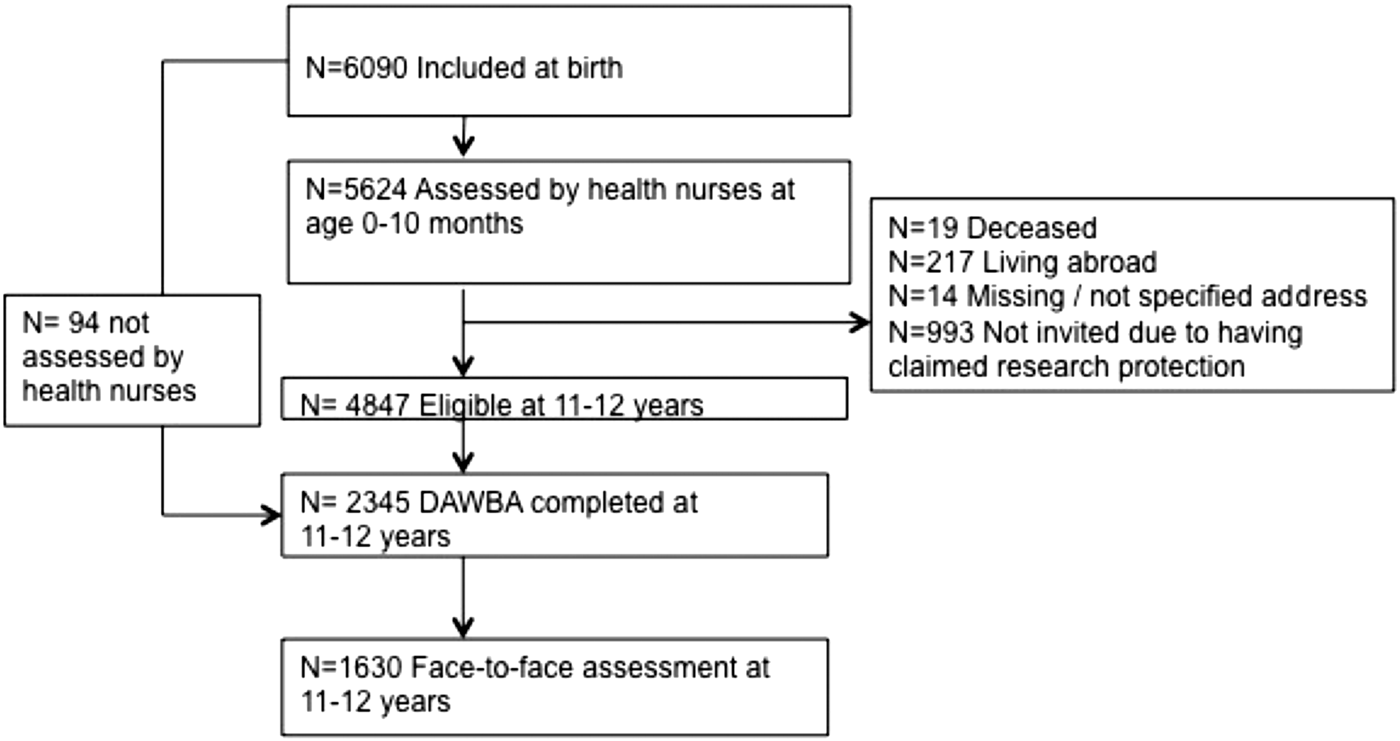
The study was conducted from 1 May 2011 to 1 October 2012. In all, 4847 children were eligible for follow-up at the age of 11 or 12 years (see Fig. 1 for details and Clemmensen et al. Reference Clemmensen, van Os, Skovgaard, Vaever, Blijd-Hoogewys, Bartels-Velthuis and Jeppesen2014). The current sampling frame comprised a sample of 1630 children who attended the assessment at age 11–12 years [mean age 11.6 (s.d. = 0.4) years; 34% of eligible children, 48% boys]. In the study of PE, participating children showed only minor differences on a number of sociodemographic and perinatal background characteristics compared with the rest of the cohort (those alive at age 11 years) with slightly lower frequencies of biological and psycho-social adversities among the participating children (Jeppesen et al. Reference Jeppesen, Clemmensen, Munkholm, Rimvall, Rask, Jorgensen, Larsen, Petersen, van Os and Skovgaard2015a ).
Flow chart of participation. DAWBA, Development and Well-being Assessment.

Instruments
An overview of the variables is presented in Table 1.
Overview of familial and developmental variables in the study

CCC2000, Copenhagen Child Cohort 2000; ICD, International Classification of Disease; BD, block design; WISC-III, Wechsler Intelligence Scale for Children; s.d., standard deviation; HyperToM, hyper-theory-of-mind; PE, psychotic experiences; K-SADS-PL, Schedule for Affective Disorders and Schizophrenia for School-age Children – Present and Lifetime Version; DSM-IV,Diagnostic and Statistical Manual of Mental Disorders, 4th edition; DAWBA, Development and Well-being Assessment.
Register data
Familial psychiatric liability and parental mental illness during early child development
Any diagnosed mental health disorder at any psychiatric hospital or centre in Denmark in any first-degree relative (including father, mother and siblings) was included from the Danish Psychiatric Central Register in order to detect a family history of mental health disorders. Details on included International Classification of Diseases (ICD)-8 and ICD-10 diagnoses are described elsewhere (Jeppesen et al. Reference Jeppesen, Larsen, Clemmensen, Munkholm, Rimvall, Rask, van Os, Petersen and Skovgaard2015b ).
Socio-economic status (SES)
Data on change in family income and on duration of mother's education were acquired from the Integrated Database for Labour Market Research and linked through the Danish Civil Registration System using the personal identification numbers of the CCC2000 children to describe SES. Low maternal education is consistently associated with poor mental health of the child (Boyle et al. Reference Boyle, Boulet, Schieve, Cohen, Blumberg, Yeargin-Allsopp, Visser and Kogan2011), and low family income is associated with several different lifetime mental disorders (Sareen et al. Reference Sareen, Afifi, McMillan and Asmundson2011). Change in family income was applied to best capture this condition over the full period with a single variable.
Assessment of early developmental problems
In Denmark, a community health nurse with specific training in infant health visits the same families regularly during the first year of life. For the CCC2000 study, a standardized record and manual were developed to record information on the health nurses’ assessments prospectively from birth at four scheduled home visits conducted when the children were at the ages 1–5 weeks (visit 1), 2–3 months (visit 2), 4–6 months (visit 3) and 8–10 months (visit 4). Data recorded included information from the parents as well as the results and conclusions based on the health nurse's observations and assessments of the child. At each visit, the health nurse recorded whether the development of the child was normal or not, on a range of domains (overall development, feeding and eating, sleep and other regulatory functions; social interaction and communication and mother–child relationship). The domains were selected to cover social–emotional, cognitive and neurological development and to make it possible to record whether the function in each domain was within the normal range or not. Details of the standardized record are described elsewhere (Skovgaard et al. Reference Skovgaard, Olsen, Houmann, Christiansen, Samberg, Lichtenberg and Jorgensen2005).
Face-to-face assessments at the clinic at age 11 or 12 years
Bullying, puberty and cognition
Bullying was assessed with the Olweus Bully/Victim Questionnaire (Gothwal et al. Reference Gothwal, Sumalini, Irfan, Giridhar and Bharani2013). Puberty was assessed by Tanner staging based on self-reports (Coleman & Coleman, Reference Coleman and Coleman2002). Performance on the block design (BD) subtest of the Wechsler Intelligence Scale for Children (WISC-III) was used as a proxy measure of children's general cognitive abilities. The BD subtest is highly correlated with full-scale IQ in the WISC-III (Kana et al. Reference Kana, Liu, Williams, Keller, Schipul, Minshew and Just2013).
PE
PE were assessed by a semi-structured interview using the Schedule for Affective Disorders and Schizophrenia for School-age Children – Present and Lifetime Version (K-SADS-PL) (Kaufman et al. Reference Kaufman, Birmaher, Brent, Rao, Flynn, Moreci, Williamson and Ryan1997) screening section and the supplement on psychotic symptoms. Each of the 22 items of PE was scored: absent, likely present, or definitively present. PE were rated present (yes/no) if at least one psychotic symptom was scored as ‘likely’ or ‘definitely’ present within the last month and/or lifetime. Trained professionals, including two psychologists, three medical doctors, one psychology graduate student and one medical student, performed the interviews. All interviewers were trained by the senior researcher (P.J.) and participated in regular training seminars supported by videotaped interviews, as well as group discussions and supervision. The target was to obtain high inter-rater reliability in the observer-based ratings of the presence and severity of PE while taking into account attributions of symptoms to sleep, somatic disorders or toxic influences. If there was a clear attribution explaining the experience, PE was rated conservatively as not present. Based on 75 randomly selected videotaped interviews, the inter-rater reliability was very good for the grouping of the children into those with and without PE (κ = 0.95).
HyperToM
The ToM Storybook Frederik (ToM-F) (Blijd-Hoogewys & Bartels-Velthuis, Reference Blijd-Hoogewys and Bartels-Velthuis2007) was used to assess ToM. ToM-F is the Danish version of the Dutch ToM Storybook Freek (Blijd-Hoogewys & Bartels-Velthuis, Reference Blijd-Hoogewys and Bartels-Velthuis2007), aiming to test the understanding of second-order false belief, white lie, irony, double bluff and ‘faux pas’ (a socially awkward or tactless act) in 10- to 14-year-old children. The children are asked to respond to a total of 24 questions while listening to the storybook read aloud and at the same time being presented 16 pictures.
The internal consistency of ToM-F was good (Cronbach's α = 0.7). The task consists of 16 ‘test’ and eight ‘justification’ questions. The test answers are scored 0 or 1; 1 is given for a correct understanding of the situation (range 0–16). The eight justification answers are classified according to 23 predefined categories (see Clemmensen et al. Reference Clemmensen, van Os, Skovgaard, Vaever, Blijd-Hoogewys, Bartels-Velthuis and Jeppesen2014 for the full set of categories) such as:
-
Desire: The answer refers to the protagonist's desire with respect to the situation. It involves wanting or desiring something.
-
Fact belief: The child refers to the protagonist's knowledge. It involves thinking, knowing, being sure of, expecting or recognizing.
-
Situational: Dwelling on the situation without reference to the mental state of the protagonist.
Based on these categories, the answers were scored (‘0’, ‘1’, ‘2’, and for some items ‘3’) on an ordinal scale predefined for each situation, resulting in a justification sum score (range 0–20), that was summed with the test score (‘0’ or ‘1’, range 0–16) to form the total scale score of ToM abilities (range 0–36). Scores on the justification items depend on the level and quality of references made to the thoughts, beliefs, feelings or intentions of the story characters or the child itself.
The eight justification answers were also scored on a dichotomous scale as a non-mentalizing (‘0’) or mentalizing (‘1’) type of answer, regardless of the classification of the answer as formally right or wrong in the context, resulting in a mentalizing scale score (range 0–8). Consistent with previous work, mentalizing answers were defined as those referring to beliefs, desires and similar inner states (Fyfe et al. Reference Fyfe, Williams, Mason and Pickup2008; Montag et al. Reference Montag, Neuhaus, Lehmann, Kruger, Dziobek, Heekeren, Heinz and Gallinat2012). Thus, the following 11 of the 23 categories were considered mentalizing: belief; desire; fact belief; value belief; mental state verb rest category; own frame of reference with mental state; emotion with empathy; emotion without empathy; perception with mental state; identification of first-order intention; identification of second-order intention (see Clemmensen et al. Reference Clemmensen, van Os, Skovgaard, Vaever, Blijd-Hoogewys, Bartels-Velthuis and Jeppesen2014 for a description of all categories). A high number of mentalizing answers (high mentalizing) was defined as total score above the median.
HyperToM was defined on the basis of (i) total ToM scale score below the median combined with (ii) number of mentalizing answers above the median. Both measures were taken into account, as the aim was to capture children that had a low level of overall ToM abilities while making mental attributions frequently. Taking into account both measures, a categorical variable was constructed, capturing children who were among the top 50% with regard to number of mentalizing answers, while, at the same time, among the lowest 50% with regard to overall ToM abilities measured by the total scale score. These children showed a tendency to exaggerate and give aberrant mentalizing explanations, labelled HyperToM, in contrast to the children without HyperToM. The phenotype should not be conceptualized as somewhere between high and low levels of overall ToM abilities, but as another dimension of ToM skills that was measured as a dichotomized variable. ToM ratings were carried out in close collaboration with the Dutch authors of ToM-F. An initial training seminar was conducted. Thereafter consensus ratings on a subsample of 200 children were carried out by a Danish rating group headed by the first author (L.C.), and subsequently the remaining children were rated by the first author under supervision of the Dutch authors. A sample of 50 children was rated separately by one member of the Danish research group in order to measure the inter-rater reliability for assignment of children to each ToM group. The inter-rater reliability (computed as Cohen's κ) was very good for the categorizing of children as HyperToM (κ = 0.81) (Altman & Gardner, Reference Altman and Gardner1991).
Web-based assessments
Psychiatric diagnoses
The Strengths and Difficulties Questionnaire (SDQ; Goodman, Reference Goodman2001) and the Development and Well-being Assessment (DAWBA; Goodman et al. Reference Goodman, Ford, Richards, Gatward and Meltzer2000) were completed by parents, children and, if possible, teachers. The SDQ (Goodman, Reference Goodman2001) consists of 25 items covering psychopathology followed by the impact (Goodman, Reference Goodman1999). The SDQ scores were an integrated part of the DAWBA used for diagnosis.
The DAWBA is a highly structured interview designed to generate psychiatric diagnoses in children and adolescents according to DSM-IV and ICD-10 and covers child development, psychiatric symptoms, distress and social impairment. A computer algorithm generated the preliminary diagnoses, and subsequent clinical review by senior child psychiatrists determined the final DSM-IV diagnoses (Goodman et al. Reference Goodman, Ford, Richards, Gatward and Meltzer2000). Inter-rater reliability of the DAWBA-based DSM-IV diagnoses indexed by Cohen's κ was examined in a sample of 100 children and found to be high for any DSM-IV diagnosis (κ = 0.81).
Illness category
Based on presence of PE (yes/no) and of any psychiatric diagnosis (yes/no), a variable ‘illness category’ was defined, consisting of the following four mutually exclusive groups: (1) no illness; (2) any psychiatric diagnosis (no PE); (3) PE (no psychiatric diagnosis); and (4) both (PE and a psychiatric diagnosis). This grouping enabled us to differentiate between associations to PE specifically, of any mental illness and of the combination. The category of ‘both’ may additionally be an expression of severity as having both PE and a psychiatric diagnosis may be considered more severe than having either (Kelleher et al. Reference Kelleher, Connor, Clarke, Devlin, Harley and Cannon2012; Wigman et al. Reference Wigman, van Nierop, Vollebergh, Lieb, Beesdo-Baum, Wittchen and van Os2012).
Statistical analysis
Analyses were carried out using Stata 12 software (StataCorp LP, USA). Associations between the family and developmental variables, and PE and HyperToM were tested using χ2 tests for categorical variables and independent t tests for continuous variables. Logistic regression analyses were conducted including PE as the dependent variable, and all other variables as independent variables. This was done in order to analyse the independent association with HyperToM when adjusted for all other predictive variables. In order to answer the research question on the specificity of HyperToM as an associated variable to PE, multinomial logistic regression analyses were performed with illness category as the dependent variable, and the remaining variables as independent variables. Finally, associations between HyperToM and ND, anxiety and depression were tested using logistic regression analyses. In all regression analyses, variables were entered simultaneously as no predictions were made about the inter-dependence of variables. Entering the variables simultaneously made it possible to test which variables were significantly associated with PE and illness category, respectively, when adjusting for all other included variables.
Due to missing data (between seven and 249 cases) in seven variables (changes in family structure; change in family income 2000–2010; length of mother's completed education 2010; family mental illness liability; infancy regulatory problems; mother–child relationship; and child contact problems) imputations were performed using the STATA multiple imputation suite of commands (mi). Data were assumed to be missing at random, and gender and age were used to impute the missing values. All variables were imputed 30 times. This enabled us to use the full sample (n = 1630) and not only the children without missing values (n = 1369).
Results
HyperToM and PE and other mental illness
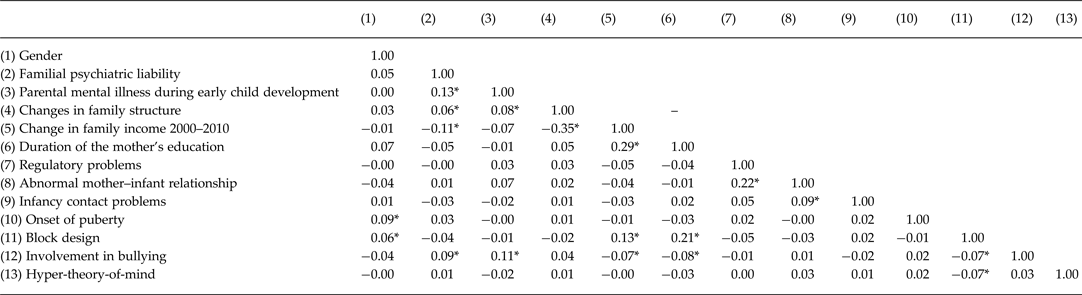
An overview of the correlations between all independent variables is shown in Table 2.
Zero-order correlations

* p < 0.05.
Familial risk and developmental variables: associations with PE and HyperToM
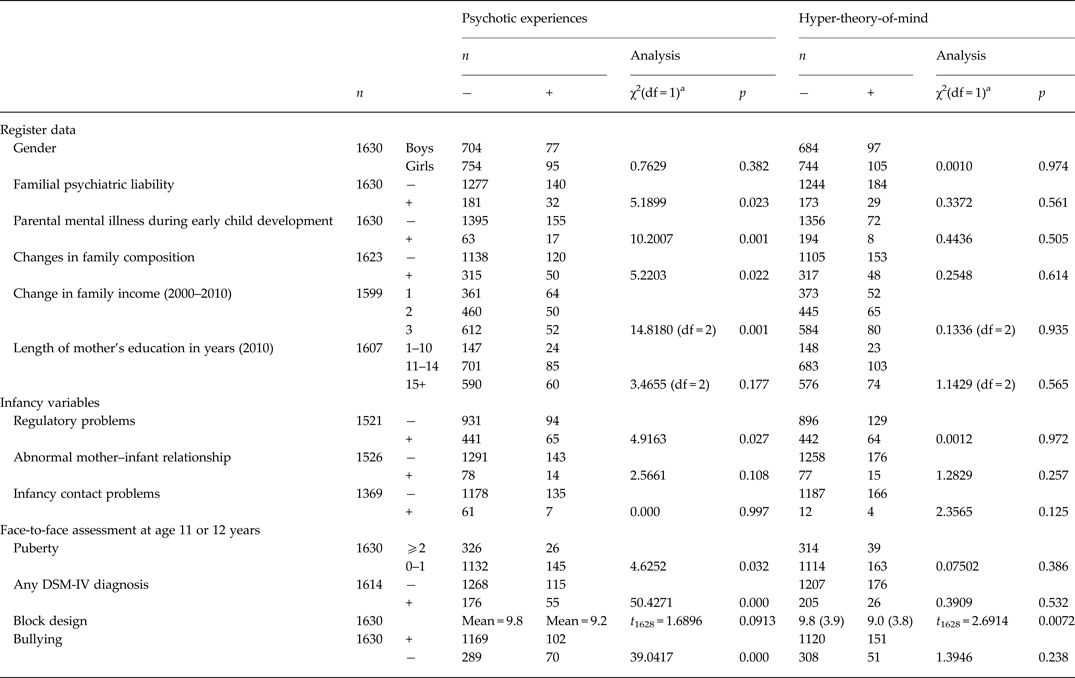
PE were significantly more prevalent in groups of children with: familial psychiatric liability (15.0% v. 9.8%); parental mental illness during early development (21.3% v. 10.0%); changes in family composition (13.7% v. 9.5%); change in family income (15.1% in the lowest tertile v. 9.8% in the middle and 7.8% in the highest tertile); regulatory problems (12.8% v. 9.2%); onset of puberty (11.4% v. 7.4%); having a psychiatric diagnosis (23.8% v. 8.3%); and being involved in bullying (19.5% v. 8.0%). None of these predictors of PE was associated with HyperToM. Only a low cognitive score on the WISC-III BD test was significantly associated with HyperToM (Table 3). This association could relate to not being autistic, rather than to low IQ. However excluding the participants with ASD from the analysis, BD score remained significantly lower in the group with HyperToM (mean = 9.0, s.d. 3.8) compared with the group without HyperToM (mean = 9.8, s.d. = 3.8, t 1589 = 2.6406, p = 0.0084).
Univariable analyses of the associations between each of the familial and developmental variables and (1) psychotic experiences and (2) hyper-theory-of-mind

df, Degrees of freedom; DSM-IV, Diagnostic and Statistical Manual of Mental Disorders, 4th edition.
a Unless otherwise specified.
Independency of association with HyperToM
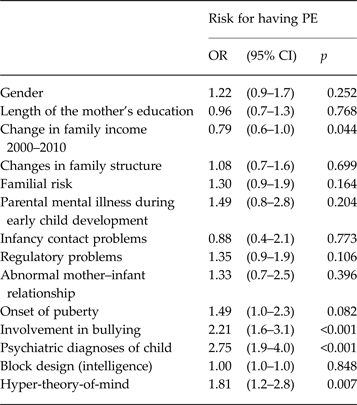
The regression analyses showed that HyperToM was significantly associated with PE after adjusting for all other included variables [odds ratio (OR) 1.81, 95% confidence interval (CI) 1.2–2.8, p = 0.007]. Apart from HyperToM, having a concurrent psychiatric diagnosis, being involved in bullying and lowest increase in family income remained significantly associated with PE (Table 4).
Multivariable regression analysis of the independent effects of the familial and developmental variables on risk of PE (n = 1630) a

PE, Psychotic experiences; OR, odds ratio, CI, confidence interval.
a This table shows the OR for each of the 14 variables for having PE when entered simultaneously in the model.
The specificity of the association of HyperToM with regard to PE v. other psychopathology
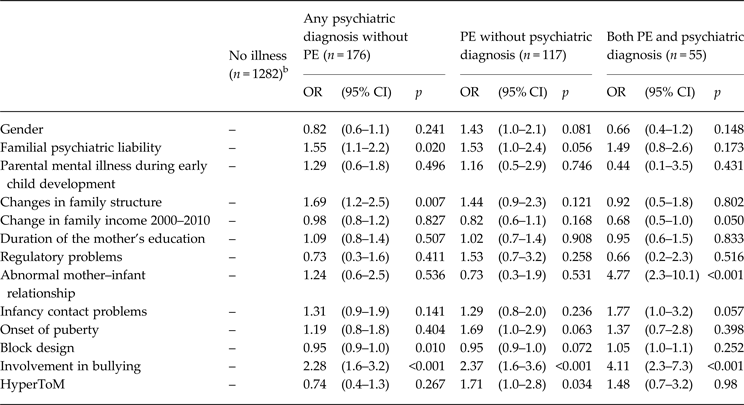
Multinomial regression analyses showed that HyperToM was the only variable exclusively associated with PE without concurrent mental illness (OR 1.71, 95% CI 1.0–2.8, p = 0.034) (Table 5). Involvement in bullying remained significantly associated with PE without mental illness (OR 2.37, 95% CI 1.6–3.7, p<0.001) in a model including HyperToM, but involvement in bullying was also significantly associated with having any psychiatric diagnosis (OR 2.28, 95% CI 1.6–3.2, p < 0.001), and with having both a psychiatric diagnosis and PE (OR 4.11, 95% CI 2.3–7.3, p < 0.001).
Mutinominal regression analysis of the independent effects of the familial and developmental variables on risk of any psychiatric diagnosis without PE, PE without psychiatric diagnosis and concurrent PE and psychiatric diagnosis by familial risk, developmental deficits and HyperToM a

PE, Psychotic experiences; HyperToM, hyper-theory-of-mind; OR, odds ratio; CI, confidence interval.
a The table shows the OR for each of the 13 (psychiatric diagnoses of child is dependent in this model) variables for having either psychiatric diagnoses without PE, PE without psychiatric diagnoses and concurrent PE and Psychiatric diagnosis by familial risk, developmental deficits and HyperToM compared with having no illness when adjusted for each other.
b Reference category.
Looking specifically at the most prevalent concurrent diagnoses, HyperToM was not associated with either ND (OR 0.9, 95% CI 0.5–1.7, p = 0.824), anxiety (OR 0.57, 95% CI 0.27–1.19, p 0.132) or depression (OR 1.66, 95% CI 0.72–3.83, p = 0.234).
Discussion
Hypothesis 1 on HyperToM being independently associated with PE was confirmed, as HyperToM was significantly associated with PE after adjusting for the following risk factors: gender; familial liability; having a concurrent mental disorder and parental mental illness during early child development; changes in family structure; change in family income 2000–2010; length of maternal education; regulatory problems; abnormal mother–infant relationship; infancy contact problems; onset of puberty; lower proxy measures of cognition and bullying. Hypothesis 2 was also confirmed, as HyperToM was exclusively associated with PE and not with either any psychiatric diagnosis (without PE) or with having both PE and a psychiatric diagnosis. HyperToM was the only variable being independently and specifically associated with PE. Bullying was associated with an increased risk of PE, but also with an increased risk of any mental disorder or problem including PE. This could indicate that bullying is a non-specific risk factor of general psychopathology, whereas HyperToM is a more specific index for psychosis proneness. HyperToM was also not associated with ND, anxiety or depression when these were examined seperately. The current findings suggest that whereas the majority of the investigated variables are associated with a risk for psychopathology in general, HyperToM appears to be associated with a risk for PE in particular.
HyperToM may be considered not so much as a deficit but rather as a cognitive strategy or style (Sharp et al. Reference Sharp, Pane, Ha, Venta, Patel, Sturek and Fonagy2011), that in part depends on brain maturation and learning (Abu-Akel, Reference Abu-Akel2003). As the great majority of the sample did not express HyperToM at age 11–12 years, this may indicate a maturational delay in the children who do express this alteration in ToM. Thus, HyperToM at this age may be an expression of minor developmental delay and may predict a less severe instance of mostly transitory PE. The fact that HyperToM was only associated with PE without any co-morbidity, and not with having any mental illness and PE in combination, which may be viewed as more severe, seems to indicate so. However, it is also possible that the combination of HyperToM and PE expresses a different pathway to mental illness. These findings need to be replicated in different age groups, but the fact that HyperToM was the only factor that specifically increased the risk of having PE when children with other mental illness were excluded points to a subgroup that follows a pathway that to a lesser extent is preceded by early alterations.
The interpretation why the group with only PE represents a different pathway from the group with both PE and mental illness is supported by the fact that the latter was significantly associated with change in family income 2000–2010, abnormal mother–infant relationship and involvement in bullying. PE in this group of children may to a greater extent be a result of the concurrent disorder and related distress.
Mentalizing has known neural correlates (Hamilton et al. Reference Hamilton, Wolpert and Frith2004) that may be affected more by environmental factors than previously assumed (Hughes et al. Reference Hughes, Jaffee, Happe, Taylor, Caspi and Moffitt2005). Whereas basic ToM skills may be more or less innate, later and more complex skills may be environmentally determined to a large extent (Hughes et al. Reference Hughes, Jaffee, Happe, Taylor, Caspi and Moffitt2005; Korver-Nieberg et al. Reference Korver-Nieberg, Fett, Meijer, Koeter, Shergill, de Haan and Krabbendam2013). Thus, exposure to chronic and episodic life stress as well as an invalidating, insecure context of attachment relationships may contribute to the development of HyperToM (Sharp & Venta, Reference Sharp, Venta, Midgley and Vrouva2012). Considering previous research showing that patients with a psychotic disorder are more reactive to stressors in normal daily life (Lardinois et al. Reference Lardinois, Lataster, Mengelers, Van Os and Myin-Germeys2011) and that an individual's sensitivity to everyday stressors (e.g. losing one's car keys) may be particularly important in the aetiology of psychosis (Palmier-Claus et al. Reference Palmier-Claus, Dunn and Lewis2012), a possibly productive future area of study is the relationship between HyperToM, stress reactivity and psychosis.
HyperToM does not necessarily constitute a problem in itself. However, in addition to an increased risk of PE, the presence of HyperToM may also increase the risk of persistence of PE over time. Following the proneness–persistence–impairment model of psychotic disorder (van Os et al. Reference van Os, Linscott, Myin-Germeys, Delespaul and Krabbendam2009), environmental risks for psychosis act additively in causing abnormal persistence which, in turn, increases the risk of subsequent transition to need for care (Cougnard et al. Reference Cougnard, Marcelis, Myin-Germeys, De Graaf, Vollebergh, Krabbendam, Lieb, Wittchen, Henquet, Spauwen and Van Os2007).
The present study confirmed that many predictors of schizophrenia are also associated with PE. In addition, regulatory problems in the first year of life were also associated with PE. The fact that schizophrenia and PE share risk factors does not necessarily mean that these are specific for psychotic illness as risk factors are also associated with other psychiatric outcomes (Van Os et al. Reference Van Os, Jones, Sham, Bebbington and Murray1998; Kounali et al. Reference Kounali, Zammit, Wiles, Sullivan, Cannon, Stochl, Jones, Mahedy, Gage, Heron and Lewis2014). However, our finding that HyperToM is more strongly associated with PE specifically than with any diagnosis supports the belief that HyperToM is aetiologically related to mechanisms underlying psychotic illness. In addition, the fact that HyperToM was only predicted by low IQ and not by any of the risk factors associated with PE indicates the possibility of a specific pathway to PE associated with HyperToM. Associations between childhood neurodevelopmental disorder, IQ and adolescent PE have been found (Khandaker et al. Reference Khandaker, Stochl, Zammit, Lewis and Jones2014). However, although HyperToM is associated with IQ in the present sample, there was no association with neurodevelopmental disorder. Thus this pathway may be different from the one leading to having both PE and a concurrent psychiatric diagnosis.
Strengths and limitations
A main strength of the study is the use of a large general population birth cohort sample with data from infancy to age 11–12 years. The data set included a broad range of variables from different sources.
However, the present study has several limitations. First, despite having data from the birth of the child until the age of 11–12 years, both HyperToM and PE were assessed cross-sectionally at age 11–12 years. Therefore, future longitudinal studies should further explore the causal and temporal relationships. Second, the psychometric properties of ToM-F have not yet been examined extensively. Nevertheless, the internal consistency of the task was found to be good. In addition, ToM-F is based on the ToM Storybooks for younger children, which have good psychometric qualities (Blijd-Hoogewys et al. Reference Blijd-Hoogewys, van Geert, Serra and Minderaa2008; Bulgarelli et al. Reference Bulgarelli, Testa and Molina2015). Finally, we were not able to control for general cognition with a measure of full IQ. Nevertheless, the BD test result, used as proxy measure of IQ, is strongly associated with full-scale IQ (Prifitera & Saklofske, Reference Prifitera and Saklofske1998). There is general consensus that neurocognition and social cognition (such as ToM) are related but different constructs, and there seems to be only a modest association between neurocognition and social cognition (Couture et al. Reference Couture, Penn and Roberts2006). Possibly, general cognitive abilities represent a necessary but not sufficient condition for adequate mentalization (Sprong et al. Reference Sprong, Schothorst, Vos, Hox and van Engeland2007).
Conclusion
This is the first study with data from infancy to age 11–12 years examining associations between HyperToM and PE, as well as other mental illness, familial liability to mental illness, demographic factors, and early developmental problems in preadolescent children from the general population. The findings suggest that a wide range of family and child variables are associated with psychopathology in general, whereas HyperToM is specifically associated with PE. These findings indicate that the construct of HyperToM may be useful in delineating differential pathways to psychopathological outcomes, and the study of HyperToM may help us to understand more about mechanisms in the aetiology of psychotic illness.
Acknowledgements
Support for the CCC2000 was provided by the Tryg Foundation (J. nr. 7-10-0189 and J. nr. 7-11-0341) and the Lundbeck Foundation (J. nr. R54-A5843). The study was supported in part by the European Community's Seventh Framework Programme under grant agreement no. HEALTH-F2-2009-241909 (project EU-GEI).
The following researchers and mental health professionals contributed to the data collection and logistical management of the CCC2000: psychology graduate student Anne Dorothee Müller, psychologist Maja Gregersen, Charlotte Eberhardt, M.D. and academic research manager Nina Ramskov Siegismund. Statistician Janne Tidselsbak Larsen constructed the register-based measure of the familial psychiatric liability.
Declaration of Interest
None.