INTRODUCTION
Skeletal remains of humans who lived in a region with aquatic food sources often are subject to reservoir effects. Organisms—like plants, fish, and shells—living in freshwater bodies contain less radiocarbon (14C) than contemporaneous terrestrial organisms, and therefore show apparent ages known as reservoir effects. Humans and animals consuming aquatic organisms may show reservoir effects as well. Chronologies of cultures in the Russian steppe based on bones of humans and animals living near rivers and lakes (Shishlina 2008; Schulting and Richards Reference Schulting and Richards2016) therefore need to be verified by dating terrestrial samples like charcoal, wood, or bones of herbivore fauna. Paired dating of terrestrial samples and samples influenced by aquatic components from the same archaeological context can be used to quantify the reservoir effect and verify the chronologies of cultures.
In addition, the stable isotopes of carbon and nitrogen (δ13C and δ15N) in skeletal material provide information on the food consumed during the life of the individual. In this context, two effects are to be considered: the trophic chain and aquatic food sources. In very general terms, the δ13C and δ15N values are enriched per trophic step by ca. 1‰ and 3–5‰, respectively (Bocherens and Drucker Reference Bocherens and Drucker2003; Hedges and Reynard Reference Hedges and Reynard2007). For organisms living in aquatic reservoirs, 15N is usually enriched. The δ15N values can be used to quantify the reservoir effect, based on food chain analysis (e.g. Cook et al. Reference Cook, Bonsall, Hedges, McSweeney, Boroneant, Bartosiewicz and Pettitt2002; Fischer et al. Reference Fischer, Olsen, Richards, Heinemeier, Sveinbjornsdottir and Bennike2007).
The magnitude of reservoir effects can be centuries, in rare cases even a millennium. Numerous publications (e.g. Lanting and van der Plicht Reference Lanting and van der Plicht1998; Arneborg et al. Reference Arneborg, Heinemeier, Lynnerup, Nielsen, Rud and Sveinbjörnsdottir1999; Cook et al. 2002; Philippsen Reference Philippsen2013; Shishlina et al. Reference Shishlina, Sevastyanov, Zazovskaya and van der Plicht2014; van der Plicht et al. Reference van der Plicht, Shishlina and Zazovskaya2016) describe comparative analyses of 14C ages of various carbon-containing samples coming from a synchronous context.
In this paper we discuss comparative analysis of 14C dating and isotopic data obtained for three samples from an important burial ground in the Middle Volga region of Russia: Lebyazhinka. Graves at this site are characterized by Eneolithic funeral rites and items. They were used to clarify the movements of the Eneolithic population across the forest-steppe zone of the Eastern Europe.
Human bones from graves 12 and 9 were dated in 1998 in the conventional radiocarbon laboratory in Kiev, Ukraine, by conventional 14C dating (Vasiliev and Ovchinnikova Reference Vasiliev and Ovchinnikova2000:220). We obtained new samples and performed accelerator mass spectrometry (AMS) dating and 13C and 15N stable isotope analysis on human, animal and fish bones from grave 12. We discuss their meaning for the chronology of Eneolithic (Copper Age) sites located in the steppe areas of Eastern Europe.
Archaeological Context
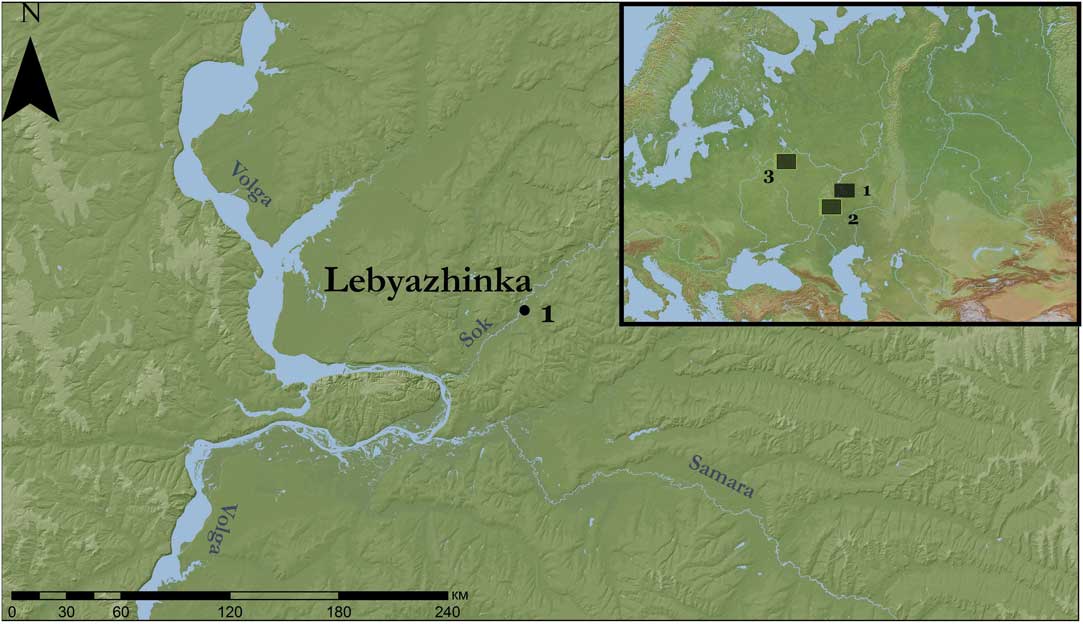
The Lebyazhinka V settlement was analyzed in 1997. The settlement is located near the Lebyazhinka farmstead of the Krasnoyarka district in the Samara region (53°40′43′′N 50°40′30′′E) (Figure 1). In the course of the excavations at the settlement, which yielded materials from the Neolithic to the late medieval period, Eneolithic graves (numbered 8, 9, and 12) were excavated. They were located in the southwestern part of the site and formed the most ancient stratigraphic layer 4 (Turetsky Reference Turetsky2000).
Map of European Russia: (1) the Lebyazhinka site; (2) Khvalynsk I and II site; and (3) Shagara site. Source: OpenStreetMap (OSM). SRTM data. Made in Quantum GIS 2.18.

Grave 9
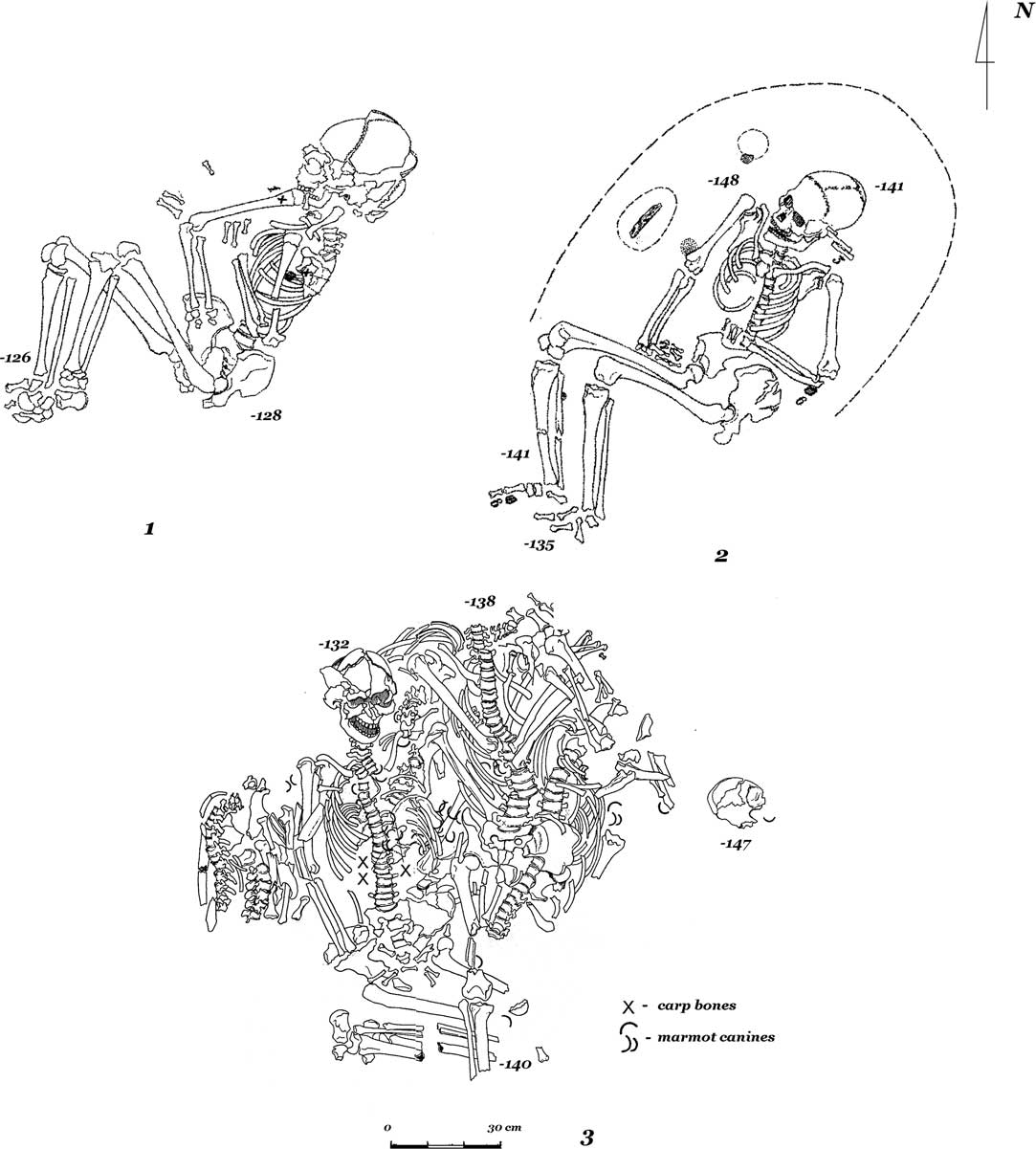
This grave contained a skeleton lying in a supine contracted posture collapsing to the right side, the head facing northeast. The right arm was extended along the body, the left arm was bent with the hand lying on the stomach. A fish vertebra was found near the shinbones of the left leg, and a flint flake was lying near the foot. Small fragments of ceramics were found under the elbow of the left arm and near the right shoulder. Small spots of ocher were observed around the deceased person. Organic decayed material of brown color, apparently from a mat, was identified under the skeleton (Figure 2: image 2). The buried individual was a 30–45-yr-old man (Khokhlov Reference Khokhlov2011:550).
Sketch of the burials from Lebyazhinka V: (1) grave 8; (2) grave 9; and (3) grave 12. After Vasiliev and Ovchinnikova (Reference Vasiliev and Ovchinnikova2000).

Grave 12
This grave contained the remains of five skeletons. We assume, according to the stratigraphy and planigraphy of the grave that all humans were buried simultaneously. The Late Bronze Age dwelling destroyed the southeastern part of the grave, which is why some bones were missing (Turetsky Reference Turetsky2000: Fig. 5). The burial rite of Eneolithic cultures of the forest-steppe region is characterized by multiple depositions of humans in one grave. The contours of the burial pit could not be traced. Rough boundaries of the grave were established based on the location of the skeletons. All deceased were buried using different rites. Skeleton 1 was lying in a small area placed in the western part as a pile-up of bones from the dismembered skeleton; the skull was missing. Most likely it was the skeleton of a woman of mature age. Skeleton 2 was lying east of skeleton 1 in a supine contracted posture, with its head facing north. The skull of skeleton 2 was present. It was established that it was a skeleton of a woman of 30–40-yr-old (Khokhlov Reference Khokhlov2011:550). Skeleton 3 was located east of skeleton 2 in a supine extended posture, with its head facing north. The skull was missing due to the Late Bronze Age dwelling. This skeleton belonged to a 35–40-yr-old man. Skeleton 4 was placed under skeleton 2 and skeleton 3. Judging by the position of the bones, we argue that the buried individual was lying on his or her stomach. The surviving bones include only the backbone, pelvic bones, and a few ribs. Other bones, including the skull, were missing. The orientation of the deceased could not be established. The skeleton belonged to a juvenile 15–17 years old. Skeleton 5 was partially located under skeleton 3. Several vertebrae, ribs, clavicles, the manubrium of a sternum, fragments of the left scapula, and the pelvis were preserved. Preserved long bones included the left humerus, the lower half of the right humerus, and bones of the right forearm. The skull was missing. Presumably the skeleton was lying in a supine extended posture, with the head of the deceased most likely facing north. The skeleton belonged to 20–30-yr-old man.
The funeral offerings in grave 12 included marmot canines, 100 carp pharyngeal teeth, one tubular flattened bead made from bone or shell, and two pieces of flint. Ocher was used in the burial rite. The largest number of these items was located near skeleton 4 and skeleton 5, with more marmot canines located near skeleton 4 and more fish teeth located near skeleton 5. The items from the funeral assemblage were placed in a certain pattern: the canines were placed on top of the pelvis area or on the waist while the fish bones were lying beneath the skeleton in the backbone area above the waist (Figure 2: image 3). Most likely, these items had been sewn on the clothing.
Grave 8
Besides these two burials, grave 8 is located 1.8 m northwest of grave 9, and very likely dates to the same period. The skeleton was placed in a supine contracted posture, collapsing to the right side, with its head facing northeast. Most likely, the skeleton belonged to a female 15–17 years old (Figure 2: image 1).
The cultural attribution of graves 9 and 12 from Lebyazhinka V generated heated debates. Most scholars agreed with the initial conclusion made by I B Vasiliev and N B Ovchinnikova, who in their first publication (Vasiliev and Ovchinnikova Reference Vasiliev and Ovchinnikova2000:219–20, Fig. 8) attributed these graves to the Eneolithic Mariupol type (5500–4700 cal BC), relying on the analysis of materials from the burial grounds of the Mariupol cultural and historical area (Telegin Reference Telegin1991). N M Malov, N L Morgunova, and A I Korolev attributed Lebyazhinka graves to the Samara culture or the Eneolithic culture of the Syezzheye type (named after the village of Syezzheye) and date them to 5300–4800 cal BC (Malov Reference Malov2008:60–61; Morgunova Reference Morgunova2009:10, Reference Morgunova2011:118–119; Korolev Reference Korolev2007:59, Reference Korolev2010:36; Korolev and Shalapinin Reference Korolev and Shalapinin2014:270). N S Kotova did not agree with this conclusion; in her view, grave 9 could be interpreted as an indication of an early arrival of the Khvalynsk population in the Middle Volga region (Kotova Reference Kotova2006:136–37). Describing grave 9, N S Kotova erroneously reported a presence of vessel sherds near the buried person. But this was not correct; two tiny fragments of ceramics that were found (one fragment lying under the elbow of the left arm, the other near the right shoulder) most likely got into the grave from settlement of the upper occupation layer. In addition, grave 9 of Lebyazhinka V was not made according to the Mariupol burial rite. It is more similar to Khvalynsk (4600–4200 cal BC) and Sredny Stog (5200–4200 cal BC) traditions, mainly because of the supine contracted posture of the deceased in graves 9 and 12. This makes these graves different from the Syezzheye type (5300–4800 cal BC) of the funeral rite when the dead were placed inside the grave in an extended posture.
Conventional 14C Dates
Two human bone samples from the excavation were 14C dated earlier in another study. This was done by the conventional method (liquid scintillation) in Kiev (code Ki), Ukraine (Vasiliev and Ovchinnikova Reference Vasiliev and Ovchinnikova2000:220). One bone originates from grave 9, and one from grave 12.
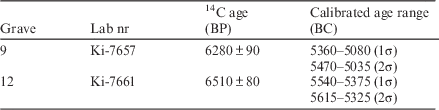
The results are shown in Table 1. The dates are reported in conventional 14C years (BP), and calibrated using the IntCal13 calibration curve (Reimer et al. Reference Reimer, Bard, Bayliss, Beck, Blackwell, Bronk Ramsey, Buck, Cheng, Edwards, Friedrich, Grootes, Guilderson, Haflidason, Hajdas, Christine Hatté, Heaton, Hoffmann, Hogg, Hughen, Kaiser, Kromer, Manning, Niu, Reimer, Richards, Scott, Southon, Staff, Turney and van der Plicht2013). The calibrated results are given as 1σ and 2σ age ranges, rounded to 5.
Results of conventional 14C dating of human bones from graves 9 and 12, Lebyazhinka V.

Unfortunately, it is not mentioned in the original publication which skeleton from grave 12 was dated; calibration of dates obtained was not provided (Vasiliev and Ovchinnikova Reference Vasiliev and Ovchinnikova2000). These conventional 14C dates of the human bones stretch far beyond the first half of the fifth millennium BC, to which the Khvalynsk culture is dated (Chernykh, Orlovskaya Reference Chernykh and Orlovskaya2010). It even reaches the second half of the sixth millennium BC. Thus, in order to recognize the Syezzheye graves as early Khvalynsk graves, a much older chronological boundary of the Khvalynsk burial grounds has to be accepted. Possible reservoir effects, when present, are not taken into account here (see discussion below).
The analysis of craniological materials from graves 9 and 12 enabled A A Khokhlov to conclude that a community of the Northern European origin inhabited the forest steppe areas of the Volga region during the Eneolithic period. There are morphological analogies to these materials identified among the craniological remnants of the Pit-comb Ware culture in the northern areas of Eastern Europe as well as among the remnants of the Novodanilovka culture (4500–3800 cal BC) (Khokhlov Reference Khokhlov2011:551–53). In the view of S V Bogdanov and A A Khokhlov, the shape of the occipital and parietal bone of the male skull from grave 9, shows similarities to cranial characteristics of the Mariupol communities inhabiting the forest steppe area of Eastern Europe during the Eneolithic period (Bogdanov and Khokhlov Reference Bogdanov and Khokhlov2012:212).
MATERIALS AND METHODS
For the bone samples, collagen was prepared based on the method developed by Longin (Reference Longin1971). The samples were decalcified with HCl, the insoluble material was then washed with NaOH, which was then removed with further HCl. This was followed by filtration and drying in a stove.
The prepared collagen was combusted using an elemental analyzer coupled to an isotope ratio mass spectrometer. This provides the stable isotope ratios δ13C and δ15N. In addition, CO2 was trapped cryogenically and converted to graphite by a reaction with H2 (Aerts et al. Reference Aerts-Bijma, van der Plicht and Meijer2001). The 14C/12C ratio in the graphite is measured by AMS in Groningen (code GrA). This AMS system is based on a 2.5 MV Tandetron (van der Plicht et al. Reference van der Plicht, Wijma, Aerts, Pertuisot and Meijer2000).
The 14C ages are reported by convention in BP which includes correction for isotope fractionation based on 13C, and using the Libby half-life value and oxalic acid as a reference (Mook and van der Plicht Reference Mook and van der Plicht1999).
The isotope ratios are reported in per mil notation relative to the international standards VPDB and AIR for δ13C and δ15N, respectively (Mook Reference Mook2006). Each sample was measured in triplicate and the standard deviation of repeated measurements was 0.2‰ and 0.2–0.3‰ for δ13C and δ15N, respectively. Collagen integrity was assessed by the C/N atomic ratio. All bone samples demonstrate well-preserved collagen.
RESULTS: AMS DATES AND STABLE ISOTOPES
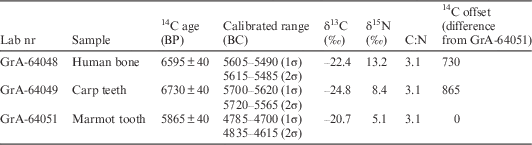
To adjust the 14C age of the individuals buried in grave 12 at Lebyazhinka V, AMS dating of samples of human bone (skeleton 4), two pharyngeal teeth of carp (Cyprinidae) and a marmot canine from the same context was done in Groningen. Both carp and marmot bone items were the decorations associated with the human skeleton 4. This time, the stable isotope ratios δ13C and δ15N of the dated bone samples was determined as well. The results are shown in Table 2.
Results of 14С AMS-dating and stable isotope measurements of human bones, pharyngeal teeth of carp and a marmot canine from grave 12, Lebyazhinka V.

It appears that the AMS date obtained for the human bone is consistent with the earlier obtained date for the human bones retrieved from the same grave (Ki-7661).
We see that the 14C age of the human turns out to be 730 14C yr older than the age of the marmot. The 14С age of the carp is greater than the human one. The difference between the age of the terrestrial sample and the aquatic sample is 865 14C yr. This is given as “offset” in Table 2.
Carp (Cyprinidae) is a species of freshwater fish found in large rivers and lakes in Europe and Asia. It is a demersal omnivore fish, feeding on plants and animals. The marmot is a herbivore rodent (Rodentia) of the squirrel family (Sciuridae).
Clearly, the dates from the human and fish show aquatic/reservoir effects. The marmot is 100% terrestrial, the carp 100% aquatic. Concerning the stable isotopes, the marmot shows herbivore values. The carp shows freshwater values for δ13C and δ15N, similar to values for other regions and other fishes (Fischer et al. Reference Fischer, Olsen, Richards, Heinemeier, Sveinbjornsdottir and Bennike2007; Robson et al. Reference Robson, Andersen, Clarke, Craig, Gron, Jones, Karsten, Milner, Price, Ritchie, Zabilska-Kunek and Heron2016). The δ15N value for the human bone is elevated, which testifies to a diet containing significant amounts of freshwater fish.
The 14C date for the marmot signifies a terrestrial date; the dates for the fish and human are subject to reservoir effects. The marmot 14C date calibrates to ca. 4750 BC (see Table 2). The 14C dates for the fish and human, both subject to reservoir effects cannot be calibrated in a straightforward way, i.e. without detailed knowledge of the size of the reservoir effect. Their interpretation in terms of calendar dates is discussed below.
DISCUSSION
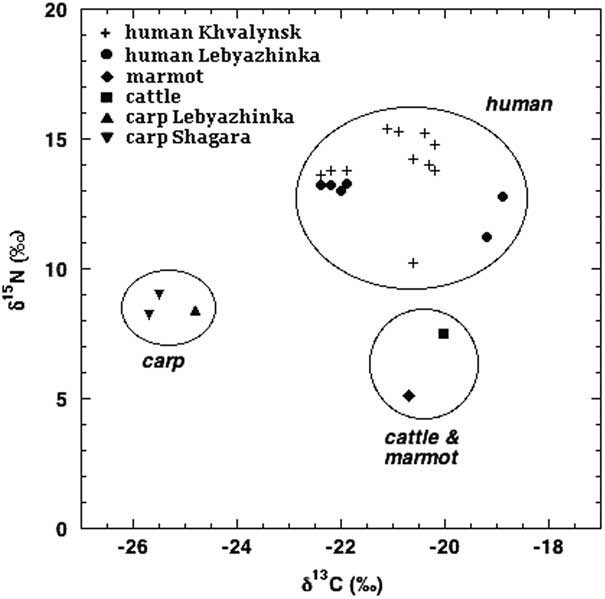
The stable isotope values (δ13C versus δ15N) are shown graphically in Figure 3. Added for comparison are other data, relevant for our research, i.e. a series of human bone samples from graves of the Khvalynsk I and II burial grounds (Shishlina et al. Reference Shishlina, Sevastyanov, Zazovskaya and van der Plicht2014), as well as a bone sample from a herbivore (cattle) from grave 10 of the Khvalynsk II and a carp from the Shagara settlement located near Lake Meshchera (Shishlina et al. Reference Shishlina, Kaverzneva, Fernandes, Sevastyanov, Roslyakova, Gimranov and Kuznetsova2016). Both Khvalynsk and Shagara date to the same chronological period (the Eneolithic) as the graves from Lebyazhinka V. The age difference between the cattle and human bones from grave 10 of the Khvalynsk II is 220 yr, the human bone being older because of the reservoir effect. The mean nitrogen isotope value (δ15N=13±0.8‰) for the individuals buried at Khvalynsk indicates a significant aquatic component in the dietary system of the ancient population (Shishlina Reference Shishlina2008).
Stable isotope ratios δ13C and δ15N for Lebyazhinka V compared with values from the literature for the sites Khvalynsk (Middle Volga region) (Shishlina Reference Shishlina2008; Schulting and Richards Reference Schulting and Richards2016) and Shagara (Ryazan region) (Shishlina et al. Reference Shishlina, Kaverzneva, Fernandes, Sevastyanov, Roslyakova, Gimranov and Kuznetsova2016).

The average values for the stable isotope ratios for humans from both sites (Lebyazhinka V and Khvalynsk II) together are δ13C=–21.5±1.0 and δ15N=14.3±0.9. This enabled Schulting and Richards (Reference Schulting and Richards2016: Table 7.2) to derive a multi-component dietary pattern of the Eneolithic population inhabiting the Middle Volga region, including fish.
As is shown in Figure 3, carp has a lower position in the food chain than humans. The data for the herbivore animals plot in a different part of the graph. This is an indication of a substantial portion of the fish component in the dietary system of the population inhabiting the Middle Volga region in the Eneolithic. Schulting and Richards (Reference Schulting and Richards2016) came to the same conclusion.
The humans and animals show different levels in the trophic chain. The humans are about 6‰ higher in δ15N than the herbivores, and about 4‰ higher than the fish (see Figure 3).
Following Cook et al. (2001), we assume a “linear mixing model” for δ15N and the amount of aquatic food for the humans of the site Lebyazhinka V. For reasonable endpoints for the mixing line, we took δ15N=8.1‰ for 100% terrestrial diet (thus 0% freshwater diet) and δ15N=15.4‰ for a 100% freshwater diet. The low endpoint is the value for the marmot plus 3–5‰ for the trophic step between herbivore and human, this corresponds to fraction 50–70% and it is not fraction of food, but protein component. The high endpoint is the highest value measured for the Lebyazhinka/Khvalynsk humans.
For GrA-64048, the human bone from Lebyazhinka V, the measured δ15N value is δ15N=13.2‰ (Table 2). This then corresponds to a freshwater fraction of the food of 70%. The 14C offset between this human (GrA-64048) and the marmot (GrA-64051) is 730 yr. Thus, for humans with a diet consisting for 100% of freshwater resources, the reservoir effect would be 1040 14C yr. This is consistent with the offset observed for the carp, which—based on the δ15N value—appears more than 1 trophic step lower than the human.
These compelling data demonstrate the importance of the fish component in the dietary system of Lebyazhinka V individuals and the Eneolithic Volga region population. It definitely influenced the 14C age of the dated human bones from grave 12. The age of the deceased turned out to be about 700 yr older than the age of an artifact made from a marmot canine used as a decoration of this individual’s outfit.
CONCLUSIONS
We present 14C dates for three samples from grave 12 of the Lebyazhinka V burial ground from the same context: a human bone, carp pharyngeal teeth, and a marmot canine. This helped determine the “apparent age” for three Eneolithic individuals buried in grave 12 and grave 9. The difference in the 14C age of the human bones from grave 12 and grave 9 and the 14C age of the marmot is large, 415 and 645 14C yr, respectively. The observed reservoir effect correction ranges from 415 to 730 yr. Historically, that would have been a very large interval, even for the Eneolithic; it is long enough for archaeological cultures to evolve and change. The older age of the human is caused by consumption of aquatic food. Fishing was one of the major components of the subsistence system during the Eneolithic in the studied region.
Our results demonstrate that 14C dates of human bones representing archaeological communities engaged in fishing as one of their main economic activities have to be investigated for reservoir effects and possibly need adjustment. If the 14C age of the individual is several hundred years older and the variation in the age obtained from the human bones and the terrestrial samples has a wide range, samples for 14C dating should be selected from carbon-containing materials other than bones, except for herbivorous animals.
The 14C age of the marmot canines narrows the gap between the timeline when Lebyazhinka V was in operation and the timeline of the Khvalynsk burial grounds. Therefore, Lebyazhinka V graves can be analyzed together with Khvalynsk burials within the same geographical, cultural and chronological contexts.
ACKNOWLEDGMENTS
This study has been conducted under Russian Fund for Basic Research (RFFI) Project No. 15-06-01291a.