Introduction
Engineering design idea generation for innovation traditionally relies on intuition, expertise, and cognitive capabilities, and subjects to high uncertainty. The uncertainty is even greater for inexperienced engineering designers and emerging technologies, such as 5G telecommunications, autonomous vehicles, and flying cars (Sun et al., Reference Sun, Yao and Carretero2014). To inspire design ideation, various data-driven methods and software tools have been introduced to explore and retrieve design precedents (patents, documents, etc.) and utilize them as design stimuli (Murphy et al., Reference Murphy, Fu, Otto, Yang, Jensen and Wood2014; Song et al., Reference Song, Srinivasan and Luo2017a). In general, the design stimuli have been retrieved as documents within a limited scope of specific domains. This study focuses on retrieving design information in a more granular level (i.e., words or phrases) in the total technology and engineering knowledge base to provide more nuanced, systematic, and rapid design inspiration.
Specifically, we present a methodology that leverages a Technology Semantic Network (TechNet) to infer generic and specific technical concepts beyond a focal design domain for potential syntheses into new design ideas with regards to the focal domain. The core of the methodology is the TechNet (Sarica et al., Reference Sarica, Luo and Wood2020), a large-scale network of technical terms that are retrieved from patent texts in all technology domains and associated according to pairwise semantic distances among them. In TechNet, the terms represent generic components, functions, structures, configurations, working principles, mechanisms, etc. in engineering and technology. Their semantic distances indicate the technical relevance of the technical concepts that the terms represent, and thus guide the inferences across concepts. This study contributes to the growing literature on methods and tools for data-driven design.
In this study, we employ the TechNet-based methodology to generate new flying car design ideas. Flying cars has attracted growing public attention in the past two decades (Gartner Identifies Five Emerging Technology Trends That Will Blur the Lines Between Human and Machine, 2018). Nonetheless, the existing flying car designs are still immature and far from the convergence to a dominant design (Suarez and Utterback, Reference Suarez and Utterback1995). The uncertainty and vast open design possibilities of flying cars present a suitable and interesting case for the application of our methodology for data-driven design. Furthermore, the research team also presents extensive background and experiences in automotive engineering.
In the next sections, the methodology is introduced after a review of the related literature. Then, the case application of our methodology to flying car design idea generation is presented, and followed by a discussion on its limitations and future research directions.
Related work
Our research is inspired by the prior literature on the data-driven design aids and intends to operationalize the comprehensive TechNet as an infrastructure for providing design inspiration. Thus, we review the related prior work on data-driven design aids and semantic networks.
Data-driven design aids
Various data-driven methods and tools have been introduced to support engineering design ideation. For instance, FuncSion (Chakrabarti and Tang, Reference Chakrabarti and Tang1996) generates solutions for a specific set of functional requirements, using its database of functional elements and their relations. VISUALIZEIT (English et al., Reference English, Naim, Lewis, Schmidt, Viswanathan, Linsey, McAdams, Bishop, Campbell, Popna, Stone and Orsborn2010) uses a database of component flow graphs, which are created by applying graph grammar rules to functional graph models, to support concept generation. AskNature (Deldin and Schuknecht, Reference Deldin, Schuknecht, Goel, McAdams and Stone2014) is a web-based database of biological systems, which are organized by their biomimicry taxonomy, for the interest of biologically inspired designs. IDEA-INSPIRE (Chakrabarti et al., Reference Chakrabarti, Sarkar, Leelavathamma and Nataraju2006) represents both natural and artificial systems based on the SAPPhIRE (State-Action-Part-Phenomenon-Input-oRgan-Effect) ontology to support the search for natural or artificial solutions to a given design problem.
A growing stream of research has proposed methods to represent and retrieve patent documents as potential sources of design inspiration. In particular, function-related representations have attracted the greatest attention. For instance, Russo et al. (Reference Russo, Montecchi and Liu2012) adopted the Function–Behavior–Structure ontology (Qian and Gero, Reference Qian and Gero1996) to construct systematic queries to retrieve state-of-the-art patents for a specific design problem using Subject–Action–Object (SAO) structures. Fu et al. (Reference Fu, Cagan, Kotovsky and Wood2013a) used latent semantic analysis (LSA) of function verbs in patent texts to associate patents in a Bayesian network to guide the selection of patents as design stimuli. Murphy et al. (Reference Murphy, Fu, Otto, Yang, Jensen and Wood2014) represented functional aspects of designs in patents using the Bag-of-Words approach and mapped them with a vector space model to aid the search for functionally analogical patents to a specific query. Likewise, Liu et al. (Reference Liu, Li, Xiong and Cavallucci2020a) proposed a framework of representing patents with a bag-of-words approach using functional categories and classifying them with respect to the topmost hierarchy of the functional-basis (Stone and Wood, Reference Stone and Wood2000).
Some other methods and tools represent patents beyond functions. Mukherjea et al. (Reference Mukherjea, Bamba and Kankar2005) introduced the BioMedical Patent Semantic Web by extracting the biological terminology in patent abstracts in the biomedical field and then associating patents by utilizing the knowledge from biomedical ontologies. Berduygina and Cavallucci (Reference Berduygina and Cavallucci2020) mined the dependency structures between individual patent claims and linguistic features in claim jargon to support the use of the theory of inventive problem solving (TRIZ) (Altshuller and Altov, Reference Altshuller and Altov1996). Lee et al. (Reference Lee, Kang and Shin2015) constructed a morphological matrix for a specific technology based on patent metadata and keywords to identify novel patents for uses in technology opportunity analysis. Song et al. (Reference Song, Kim and Lee2017b) focused on the classification labels of patents in the Japanese Patent Classification System to discern patents for technology opportunity discovery. InnoGPS (Luo et al., Reference Luo, Sarica and Wood2019) uses a technology domain network map based on the international patent classification system from information science research (Alstott et al., Reference Alstott, Triulzi, Yan and Luo2017; Yan and Luo, Reference Yan and Luo2017a) to guide the search and retrieval of design documents and concepts across domains to inspire creative design concept generation via design analogy and synthesis.
A growing number of design ideation methods and tools have utilized large public semantic networks, such as WordNet and ConceptNet, rather than patent databases, as the backend knowledge base. WordNet (Miller et al., Reference Miller, Beckwith, Fellbaum, Gross and Miller1990) has been the most popularly utilized. For instance, WordTree (Linsey et al., Reference Linsey, Markman and Wood2012) uses brainstorming sessions and the WordNet's hierarchical structure to populate a tree structure, in which functional aspects of the design problem are represented with new additional verbs, to further guide the search for analogical solutions. Yoon et al. (Reference Yoon, Park, Seo, Lee, Coh and Kim2015) proposed a method to discover patents according to their function similarity assessed by leveraging WordNet's hierarchical structure. Georgiev and Georgiev (Reference Georgiev and Georgiev2018) developed WordNet-based metrics to measure divergence, polysemy, and creativity of the ideas from concept generation sessions. Nomaguchi et al. (Reference Nomaguchi, Kawahara, Shoda and Fujita2019) proposed to evaluate the novelty of function combinations in design ideas based on semantic similarities in WordNet, a word2vec model trained on Wikipedia, and these two metrics together, and reported a negative correlation between the human evaluations of novelty and the semantic similarity of the combined functions.
Other than WordNet that was collectively built via direct human efforts, a few other free online knowledge bases have also been employed in new design ideation methods or tools. For example, Chen and Krishnamurthy (Reference Chen and Krishnamurthy2020) proposed an interactive procedure to retrieve words and terms in ConceptNet to inspire designers. ConceptNet (Speer et al., Reference Speer, Chin and Havasi2017) is a large public knowledge graph automatically extracted from Wikipedia, built and maintained at MIT Media Lab. Han et al. (Reference Han, Forbes, Shi, Hao and Schaefer2020a) also proposed to evaluate new ideas by measuring the semantic similarity between design concepts using ConceptNet. Camburn et al. (Reference Camburn, He, Raviselvam, Luo and Wood2020) proposed a set of new metrics for automatic evaluation of the natural language descriptions of a large number of crowdsourced design ideas, and their evaluation was based on the Freebase (Bollacker et al., Reference Bollacker, Evans, Paritosh, Sturge and Taylor2008), another large public structured knowledge database managed by Google.
The growing uses of such public semantic network databases in the development of design ideation support tools have inspired the development of semantic networks based on engineering data. For instance, Shi et al. (Reference Shi, Chen, Han and Childs2017) and Liu et al. (Reference Liu, Wang, Li and Liu2020b) proposed the use of semantic networks mined from scientific papers as sources of inspiration for design concept generation. Chen et al. (Reference Chen, Wang, Dong, Shi, Han, Guo, Childs, Xiao and Wu2019) utilized the semantic concept network from Shi et al. (Reference Shi, Chen, Han and Childs2017) to retrieve implicit and explicit design stimulation at the semantic level and supported these stimuli with image synthesis to stimulate designers in ideation sessions.
On the other hand, a few recent studies employed the whole patent database instead of focusing on a specific domain and generated network maps to resemble technology space where all patent classes in the existing patent classification system are operationalized as nodes (Alstott et al., Reference Alstott, Triulzi, Yan and Luo2017; Yan and Luo, Reference Yan and Luo2017b). However, these studies are limited by the structure of patent classification systems and patent metadata; thus, they can only support high-level inspirations (Luo et al., Reference Luo, Song, Blessing and Wood2018). Furthermore, the studies on providing semantic-level design stimulation and evaluation generally rely on common-sense knowledge bases, such as WordNet and ConceptNet, or language models not trained specifically for engineering. In fact, the engineers’ perception of technical terms is biased and represented better by knowledge bases that are specifically trained on technological knowledge (Sarica et al., Reference Sarica, Luo and Wood2020).
Semantic networks
We intend to use a semantic network of technical terms, which covers generic engineering design concepts in all domains of technology, to support technical design inferences for idea generation. The past two decades, but especially the last decade, witnessed great progress in natural language processing (NLP) that allows researchers to introduce a few large-scale semantic networks based on generic human knowledge. For instance, WordNet (Miller et al., Reference Miller, Beckwith, Fellbaum, Gross and Miller1990), ConceptNet (Speer et al., Reference Speer, Chin and Havasi2017), never-ending language learning (NELL; Mitchell et al., Reference Mitchell, Cohen, Hruschka, Talukdar, Yang, Betteridge, Carlson, Dalvi, Gardner, Kisiel, Krishnamurthy, Lao, Mazaitis, Mohamed, Nakashole, Platanios, Ritter, Samadi, Settles, Wang, Wijaya, Gupta, Chen, Saparov, Greaves and Welling1998), and Yago (Rebele et al., Reference Rebele, Suchanek, Hoffart, Biega, Kuzey and Weikum2016) are available for public uses and have enabled various applications, such as information retrieval, semantic analysis, knowledge exploration and discovery, and artificial intelligence (AI), in many different fields. These knowledge databases are often generated by linguistically and statistically learning the information in knowledge repositories such as Wiktionary and Wikipedia, and merging the knowledge entities, and relations based on readily available or collaboratively created ontologies.
Despite these efforts on creating large-scale semantic networks for generic uses, only a few engineering researchers have carried out the same task in the context of engineering. For instance, Shi et al. (Reference Shi, Chen, Han and Childs2017) mined and analyzed 20 years of publications, nearly 1 million engineering papers, from ScienceDirect and 1000 design posts from blogs and design websites to extract technical terms and construct a large-scale semantic network. Despite the great amount of data collected, it is unclear if their data of different types can resemble comprehensive engineering knowledge in all domains. Liu et al. (Reference Liu, Wang, Li and Liu2020b) proposed a method to create a concept network by mining the concepts from the technical documents related to a specific design problem and associating them via the vector representations of these concepts by utilizing a word-embedding algorithm and synset relations of the WordNet. For the same purpose of creating a large-scale semantic network in the context of engineering and technology, we directed our attention to the patent data that provide more comprehensive coverage of the engineering knowledge base.
Patents are reliable and rich sources of engineering design knowledge (World Intellectual Property Organization, 2004; Asche, Reference Asche2017) since they have been examined rigorously to ensure their adequateness on defining the invention, their novelty, and usefulness. These characteristics of the patent examination process assure the quality of the patent data and avoid redundant designs to be documented in the patent database. Particularly, United States Patent and Trademark Office (USPTO) patent database is one of the largest patent databases, publicly available, organized in systematic catalogues of the inventions, and continuously evolving as inventors file patent applications and new technologies emerge.
In our recent work (Sarica et al., Reference Sarica, Luo and Wood2020), we have constructed a TechNet that consists of more than 4 million technology-related terms, which represent technical concepts in all domains of technology, and their semantic distance. The complete digitalized USPTO patent database from 1976 to October 2017 was utilized to construct TechNet. The utilization of the complete patent database was aimed to ensure the comprehensiveness of TechNet and the balanced coverage of knowledge in all domains of technology. In a benchmark comparison with other existing semantic network databases including WordNet, ConceptNet, and B-link (Shi et al., Reference Shi, Chen, Han and Childs2017), TechNet presented superior performances in terms of retrieval and inference tasks in the specific context of technology and engineering (Sarica et al., Reference Sarica, Luo and Wood2020). TechNet has been utilized to augment patent search (Sarica et al., Reference Sarica, Song, Low and Luo2019a), technology forecasting (Sarica et al., Reference Sarica, Song, Luo and Wood2019b), and idea evaluation (Han et al., Reference Han, Forbes, Shi, Hao and Schaefer2020a, Reference Han, Sarica, Shi and Luo2020b).
To construct TechNet, we first mined the raw patent texts to exact the terms (words and phrases) that represent meaningful engineering concepts (e.g., functions, components, configurations, and working principles), using NLP techniques for phrasing, denoising, lemmatization, and so on. On this basis, word-embedding models were trained (also in the total database) to project the terms to vectors and form a unified vector space that would represent the total engineering knowledge space. Then, a large TechNet can be forged by associating the technical terms by pairwise vector cosine similarity. The TechNet construction procedure is data-driven and unsupervised and summarized in Figure 1. Interested readers can refer to our prior publication (Sarica et al., Reference Sarica, Luo and Wood2020) for further details.
A summary of the TechNet construction process (Sarica et al., Reference Sarica, Luo and Wood2020).

In the present paper, we introduce a methodology that utilizes the TechNet as a backend infrastructure to support idea generation. In contrast, prior studies have either used comprehensive common-sense knowledge databases or field-limited datasets to provide semantic-level aids for engineering design ideation generation. The novelty of the study is in the use of a comprehensive technology-focused semantic network trained from the technical patent database to aid in technical idea generation.
Methodology
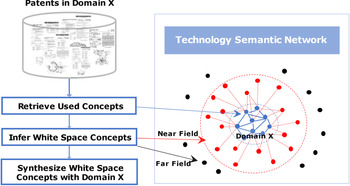
The spirit of our methodology is to infer new technical concepts from those already used in prior designs of a domain according to the term-to-term semantic distance in TechNet. Figure 2 depicts the methodology that includes three main steps: (1) retrieve used concepts within a focal design domain (or design object or interest), (2) infer new concepts beyond the domain (i.e., the white space concepts), and (3) relate and synthesize the white space concepts with the original design domain to generate new ideas. The following subsections describe the details of these steps.
The overall methodology.

Step 1: concept retrieval in a focal design domain
The first step is to use TechNetFootnote 1 to retrieve the terms in the technical documents representing the prior designs in a domain (i.e., identify the terms that are in both the technical documents and TechNet). These terms represent the technical concepts (e.g., functions, components, structures, and working principles) that have already been used in the designs of the focal domain to date. These prior documents need to be identified and curated first and have complete coverage of the prior designs of the domain. While we mine patent documents only in the case study of the present paper, other types of design documents (e.g., technical reports and engineering paper publications) may also be useful for the same purpose.
These concepts can be assessed according to their importance with regards to the focal design domain. For this purpose, we propose the following term-domain importance metric (tdi t) by considering both a term's occurrence frequency in the focal domain and its specificity to the domain:
 $$tdi_t = tf_{t, D}\ast ts_{t, D}$$
 $$tf_{t, D} = \displaystyle{{\vert {\{ {d\in D\colon t\in d} \} } \vert } \over {\vert {\{ {d\colon d\in D} \} } \vert }}$$
 $$ts_{t, D} = \displaystyle{{\mathop \sum \nolimits_{d\in D} {\rm count}( {t, \;d} ) } \over {\mathop \sum \nolimits_{d\in P} {\rm count}( {t, \;d} ) }}$$
where t refers to a single term, d refers to a patent document, P stands for the set of patents in the whole patent database, and D refers to the set of patents in a design domain. This metric favors the terms that are more common in the domain but not as common in the entire patent database.
Term-domain frequency (tf t,D) (0,1] is measured as the number of patents in the domain that contain the term relative to the total number of patents in the domain. It indicates how commonly a concept is used in the prior designs of the domain of interest. However, a commonly occurring concept in a domain might be a general one for all domains. Thus, we also incorporate the term specificity (ts t,D) (0,1] metric, which is measured as the count of the term in the patents in the domain relative to the total count of the term in the total database. High term specificity indicates that a concept is specific to the design domain and may contain domain-specific characteristic design information.Footnote 2
Step 2: concept inferences beyond the domain
The second step is to infer, according to the term-to-term semantic similarity information in TechNet, from the terms in the prior design documents of the focal domain to additional technical terms that have not appeared in the prior design documents of the focal domain. The total of these additional terms forms the total white space to the focal design domain. Hereafter, we call those terms outside the focal domain the white space terms and the concepts they represent the white space concepts. The white space concepts have varying latent relevance to those already used in the original design domain.
To measure such a technical relevance (R i), we assess the semantic relevance of the white space terms to those in the documents of the focal domain and calculate it as a potential white space term's weighted average semantic relevance to the terms in the focal domain:
 $$R_i = \displaystyle{1 \over n}\mathop \sum \limits_{t = 1}^n w_{i, t}tdi_t$$
 $$w_{i, t} = \displaystyle{{\mathop \sum \nolimits_{\,j = 1}^n v_{i, j}v_{t, j}} \over {\sqrt {\mathop \sum \nolimits_{\,j = 1}^n v_{i, j}^2 } \sqrt {\mathop \sum \nolimits_{\,j = 1}^n v_{t, j}^2 } }}$$
where n is the number of unique terms in the focal domain; w i,t is the semantic similarity between the ith new term and the tth domain term; v i is the vector representation of term i; and tdi t is the weighting factor, term-domain importance, defined by Eq. (1) above.
On this basis, we further standardize the R metric by the z-score formulation as follows:
 $$ZR_i = \displaystyle{{R_i-\mu _R} \over {\sigma _R}}$$
where μ R is the mean and σ R is the standard deviation of the relevance scores (R) of white space concepts. A negative ZR score of a concept implies that it is more distant to the focal design domain than average white space concepts; vice versa.
Step 3: idea generation
Then, it comes to the third step, in which the designers make attempts to relate the previously unused white space concepts with the original design domain to generate new design ideas. Since the white space concepts, by definition, have not been previously used in the designs of the focal domain, new ideas that relate and synthesize them with the focal domain naturally derive novelty. Therefore, our proposed procedure in principle ensures the novelty of new ideas when they are generated. In particular, the relevance score (R) or its normalized form (ZR) may further guide the search and retrieval of the white space concepts to relate to the focal design domain for potential syntheses into new design ideas.
According to the extensive design creativity literature (Gentner and Markman, Reference Gentner and Markman1997; Ward, Reference Ward, Holyoak, Gentner and Kokinov1998; Christensen and Schunn, Reference Christensen and Schunn2007; Tseng et al., Reference Tseng, Moss, Cagan and Kotovsky2008; Chan et al., Reference Chan, Fu, Schunn, Cagan, Wood and Kotovsky2011, Reference Chan, Dow and Schunn2015; Fu et al., Reference Fu, Chan, Cagan, Kotovsky, Schunn and Wood2013b; Chan and Schunn, Reference Chan and Schunn2015; Song et al., Reference Song, Srinivasan and Luo2017a; Srinivasan et al., Reference Srinivasan, Song, Luo, Subburaj, Elara, Blessing and Wood2018), near stimuli to the target design domain can stimulate more ideas and more feasible ideas (Gick and Holyoak, Reference Gick and Holyoak1980; Weisberg, Reference Weisberg2006; Fu et al., Reference Fu, Chan, Cagan, Kotovsky, Schunn and Wood2013b; Chan et al., Reference Chan, Dow and Schunn2015; Keshwani and Chakrabarti, Reference Keshwani and Chakrabarti2017; Srinivasan et al., Reference Srinivasan, Song, Luo, Subburaj, Elara, Blessing and Wood2018), whereas far stimuli may stimulate fewer ideas and ideas with high infeasibility and abstractness, but give rise to the novelty of the generated ideas (Gentner and Markman, Reference Gentner and Markman1997; Ward, Reference Ward, Holyoak, Gentner and Kokinov1998; Tseng et al., Reference Tseng, Moss, Cagan and Kotovsky2008; Srinivasan et al., Reference Srinivasan, Song, Luo, Subburaj, Elara, Blessing and Wood2018). Therefore, when searching and choosing white space concepts as potential design stimuli, one may focus on the near-field concepts with high R values (e.g., ZR > 0) for ideation productivity, but anticipate common and non-surprising ideas. Alternatively, one may focus on the far-field concepts with low R values (e.g., ZR < 0) for the interest of generating novel ideas, but expect a lower chance of idea generation success and infeasible or vague ideas. Likewise, newly generated ideas can be instantly evaluated and compared in terms of novelty and feasibility according to how distant the adopted white space concepts are from the original domain, following the theories.
In particular, TechNet serves as the knowledge base and digital infrastructure for the methodology and workflow above. TechNet used in this study has 4,038,924 technology-related terms and roughly 8 × 10¹² undirected quantified semantic relevance values between each possible pair of terms and is larger than WordNet of 155,236 entities and 647,964 relations and ConceptNet of 516,782 entities and 1.3 × 10¹¹ relations. To the best of our knowledge, it is the largest technology-related semantic network to date. TechNet terms cover all domains of engineering defined in the Cooperative Patent Classification System. In particular, the distribution of terms is highly correlated with the distribution of patents across different technology domains, suggesting proportional and balanced coverage of relatively large or small domains (Sarica et al., Reference Sarica, Luo and Wood2020).
Thus, for a specialized design domain, TechNet enables the exploration in a sufficiently wide engineering knowledge space beyond the focal domain itself for the discovery of white space concepts for creative synthesis with those within the domain. Now, we apply the TechNet-based methodology to generating flying car design ideas.
Case study: flying car design idea generation
A flying car/roadable aircraft is a hybrid of an automobile and an aircraft, which merges the advantage of an automobile for door-to-door transportation with less temporal and spatial restrictions and higher accessibility, and the advantage of an aircraft for faster transportation without bounding by road and traffic conditions, and geographical limitations (Crow, Reference Crow1997; Kim et al., Reference Kim, Hwang and Kim2013). The worsening traffic jam problems in megacities, complex and rapid emergency rescue needs, as well as growing public support on sustainability (lower carbon emissions) steer the public interest in designing flying cars for dual-medium (road-air) transportation (Follmann and da Cunha, Reference Follmann and da Cunha1997). The prospective advantages of flying cars have attracted the attention of several companies and motivated them to design, prototype, and test flying cars, even in the city environment.Footnote 3 Fundamentally, there are two main technical paths to design a flying car: designing an aircraft that is roadable or designing an automobile that is flyable. These paths are adopted by aircraft companies and the automobile manufacturers, respectively, prioritizing the fly mode and the drive mode, respectively.
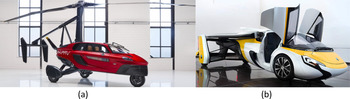
Even though public interest just increased recently, the flying car designs date back to 1917. Glenn Curtiss designed and prototyped the first flying car that could only hover (Stockbridge, Reference Stockbridge1927). This was followed by several attempts of specialized inventors such as Taylor Aerocar (Jensen, Reference Jensen1971) and Fulton Airphibian (Ziesloff, Reference Ziesloff1957), automobile manufacturers such as Carrozzeria Colli (Bridgman, Reference Bridgman1952) and Chrysler (Harding, Reference Harding1998), and aircraft manufacturers such as Curtiss-Wright (Harding, Reference Harding1998). These attempts resulted in several working prototypes, but none of them proceeded to mass production. On the other hand, the past two decades witnessed increasing public interest in flying cars, followed by the entrance of several companies into the domain, such as AeroMobil in Slovakia, Airbus in France, MetroSkyways in Israel, PAL-V in the Netherlands, and Terrafugia in the USA (Singh, Reference Singh2017). Figure 3 presents two prototypes of PAL-V and Aeromobil, taking two different approaches for shifting between the drive mode and the fly mode, vertical take-off and landing (VTOL), or short take-off and landing (STOL), respectively.
Examples of flying cars: (a) VTOL designed by PAL-VFootnote 4 and (b) STOL designed by AeromobilFootnote 5.

Retrieving used concepts in prior flying car designs
We conducted an exhaustive search for flying car patents in the USPTO patent database that resulted in a set of 164 flying car patents between 1974 and 2018. The exhaustive search process combined patent text mining, citation analysis, inventor, and classification relationships to retrieve relevant patents. In particular, the set of relevant patents was expanded by employing an iterative process involving heuristic learning from patents retrieved in each iteration. Each iteration involves validity checks and expands query keywords, the citation network, and the set of inventors until convergence to a fixed set of patents. Hence, the whole process ensures the completeness and accuracy of the retrieved patent set (Song and Luo, Reference Song and Luo2017).
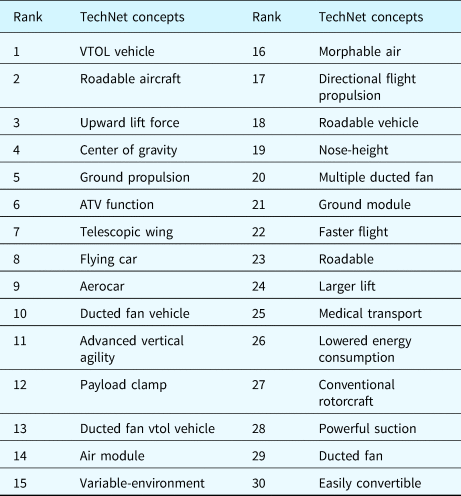
2396 unique technical terms in TechNet are retrieved from the titles and abstracts of the flying car patents. These retrieved terms cover various types of engineering concepts, such as working principles, main functions, sub-functions, structures, configurations, physical subsystems, modules, and components of prior flying car designs. Table 1 reports the top 30 terms with respect to tdi scores based on Eq. (1).
Top 30 concepts already used in existing flying car designs

Some of these terms are synonymous notions of the flying car such as “aerocar” and “roadable aircraft”, which directly indicate inventors’ design tendencies, for example, a car that can fly or a plane that can be driven on roads. A subset of terms refers to specific concepts that define the working principles of flying cars in both air and road environments, such as “upward lift force”, “variable-environment”, and “ground propulsion”. Such terms as “center of gravity”, “telescopic wing”, “nose-height”, and “directional flight propulsion” point out the problem or solution foci of designers. The “center of gravity” of the vehicle becomes a challenging issue for dual-mode operations. “Nose-height” is an important parameter in airplane docking systems, which will be also an issue for flying cars. “Directional flight propulsion” is a concept used in both VTOL and hovering. Moreover, many terms in the list refer to physical components (e.g., “payload clamp”, “multiple ducted fan”, and “ground module”) and desired functional performances (e.g., “lowered energy consumption”, “larger lift”, “powerful suction”, “faster flight”, “advanced vertical agility”, and “easily convertible”).
In brief, these terms allow us to develop a quick understanding of frequently used technical concepts in the existing designs of flying cars.Footnote 6 In other words, these terms succinctly describe a domain-specific concept space of prior flying car designs. They serve as the starting and reference point for the inferences to and selection and evaluation of other white space concepts beyond prior flying car designs for new flying car design ideation.
Retrieve white space concepts
There are more than 4 million technical concepts in TechNet, whereas 2396 of them have already been used in prior flying car designs. Thus, there still exist enormous design opportunities via the synthesis of white space concepts with flying cars. In the meantime, the large size of the white space also demands structured guidance for the search and retrieval of concepts. Here, we focus on semantic distance as the guiding variable to retrieve white space concepts from the near-field to far-field to prior flying car designs as potential ideation stimuli and make attempts to relate and synthesize them with flying cars as the way to generate new design ideas. Based on design creativity theories, white space concepts with relatively high latent relevance to flying car designs are more likely to stimulate ideas and more feasible ideas, whereas the far-field concepts are anticipated to be less effective in stimulating new ideas but may contribute to greater novelty of the new ideas once they are generated.
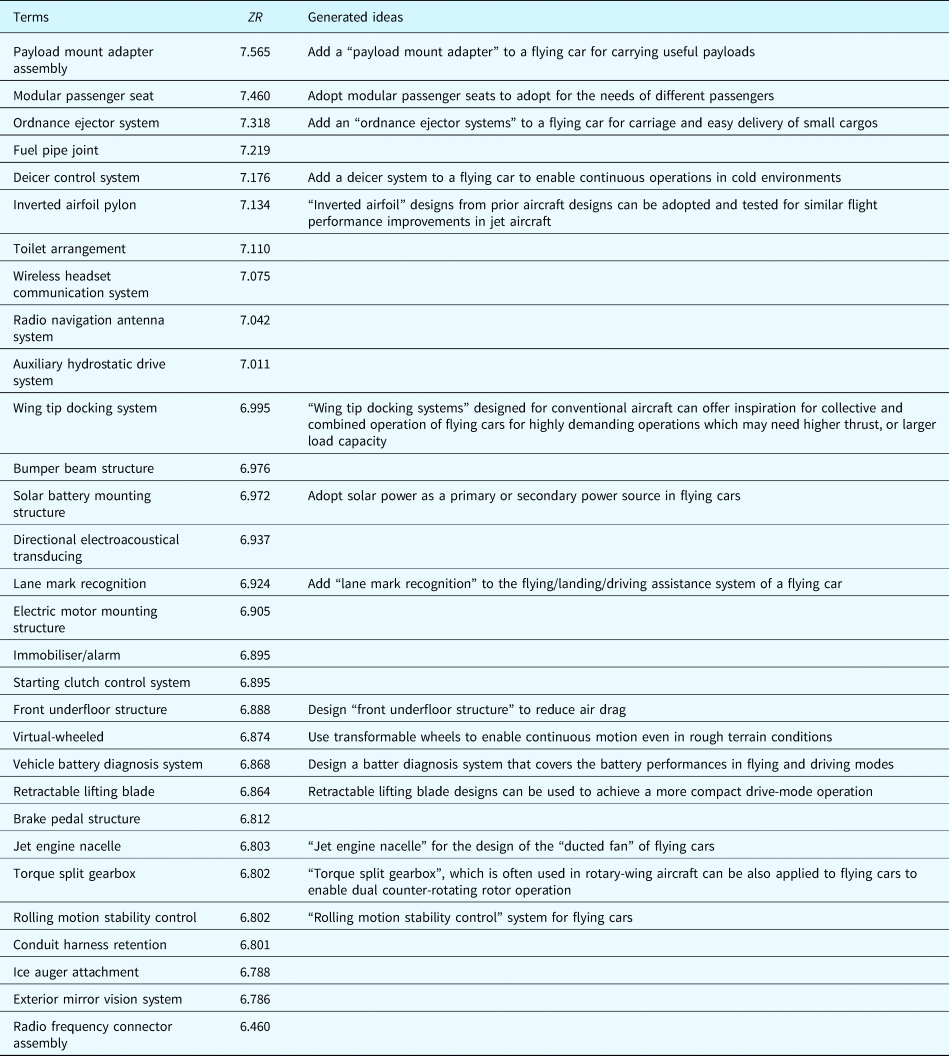
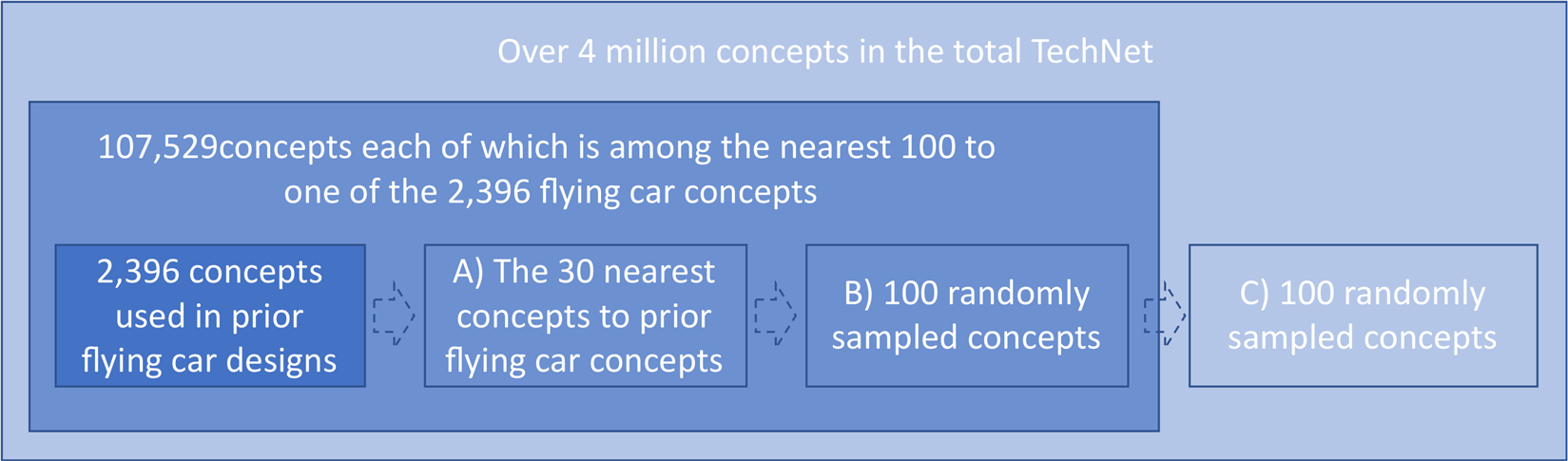
We first retrieve the top 100 most relevant white space terms to each of the 2396 terms in the flying car patent set. The total set consists of 107,529 unique terms.Footnote 7 The ZR scores of these terms lie in the range of [−4.449, 7.565] where 89% of them have ZR > 0. The ZR score of each term is calculated, based on Eq. (6), against a random sample of 100,000 white space terms with a mean (μ R = 0.2646) and standard deviation (σ R = 0.0660) in the distribution of their R i scores defined in Eq. (4). We consider this set of concepts approximate a relatively large and diverse but still confined “near-field” to the focal flying car design domain in the total TechNet. Note that, alternative white space term discovery methods can be adopted for this step as well.Footnote 8 Table 2 lists the top 30 white space concepts according to their ZR scores, which fall in the range of [6.460, 7.565]. We will use this set of concepts as the nearest stimuli for idea generation later.
The ideas generated with the nearest 30 concept stimuli surrounding prior flying car designs

The table is sorted according to the ZR scores of the stimuli, whereas the sequence of the provision of the concepts to the engineers was randomized during the ideation process.
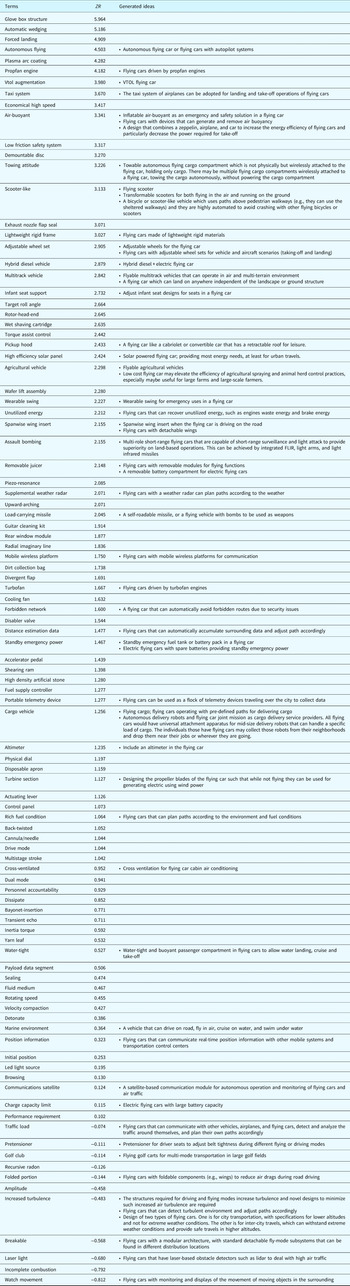
Next, we divide the total set of 107,529 terms into 10 equal-size quantiles from high to low ZR, and randomly sampled 10 terms in each quantile. This results in a set of 100 randomly selected near-field concepts in Table A1 in Appendix. This second set of white space concepts may provide a balanced coverage of a large and diverse near-field surrounding existing flying car designs. Their ZR scores lie in [−0.812, 5.964] and all are below the ZR scores of the nearest 30 concepts in the first stimuli set (Table 2).
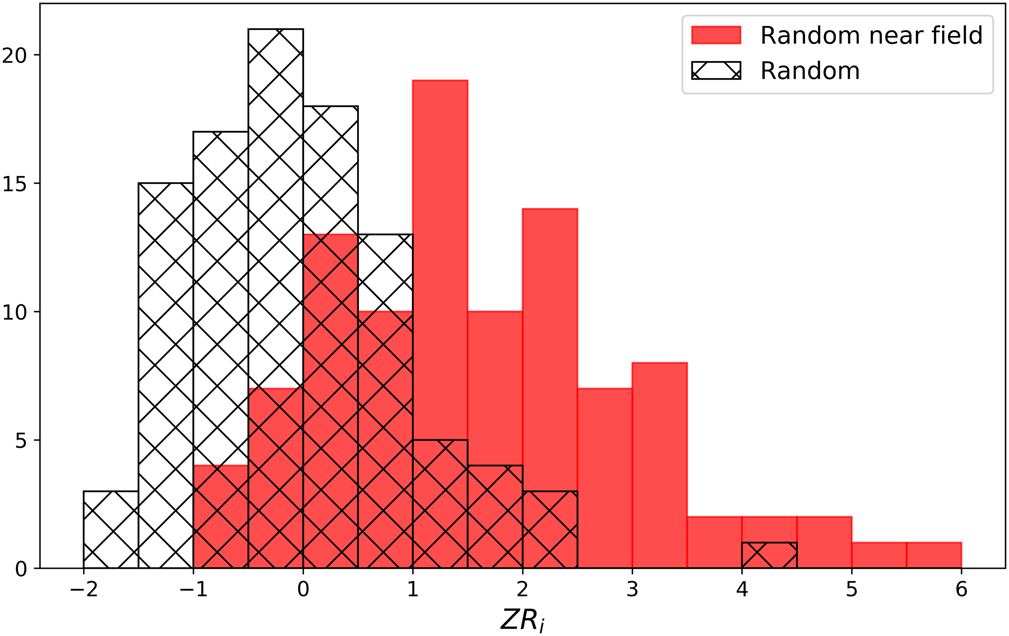
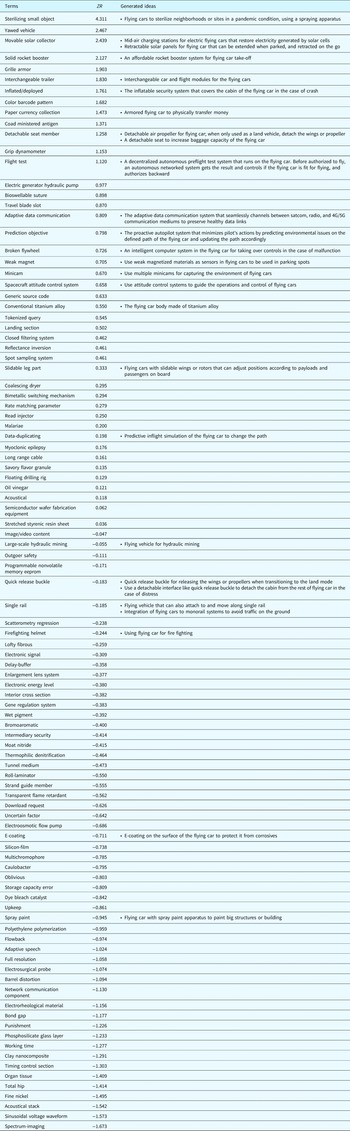
On this basis, we further randomly sample 100 concepts from the total TechNet regardless of their semantic distance to the flying car domain (Table A2 in Appendix). Their ZR scores range in [−1.673, 4.311]. Figure 4 compares the distributions of these two randomly sampled sets of 100 white space concepts by ZR scores. The mean ZR score of the 100 near-field random concepts is 1.6 and greater than 0, whereas the totally random concept set exhibits a nearly symmetrical distribution with a mean ZR of −0.04.
Distributions of the stimuli by semantic distance to existing flying car designs, including 100 concepts randomly selected from the nearest 107,529 concepts (red) and the 100 concepts randomly selected from the entire TechNet (textured).

In brief, the first two sets of white space concepts are retrieved by preferring technical concepts near those already used in existing flying cars, and many of them are from either car or aircraft domains (based on Tables 2 and Table A1 in Appendix). In contrast, the third set of white space concepts are retrieved without any constraint with regard to their semantic distance to flying cars and may come from any domain in the total technology space. Although the second set is also randomly sampled, the random draws were within a confined near-field. Figure 5 summarizes the relations of the three sets of white space concepts resulting from different retrieval strategies.
The three stimuli sets.

Idea generation with white space concepts as stimuli
Then, these three sets of 30, 100, and 100 white space concepts are used as inspirational stimuli for generating new flying car design ideas. Three of the four coauthors of the paper, with basic engineering knowledge of flying cars, went through each concept in the three stimuli sets one by one and made attempts to apply the ideation heuristic of relating and synthesizing each white space concept with flying cars to generate new design ideas. We spent 30–45 min on each set of stimuli to generate ideas individually.
Ideation with the nearest white space stimuli (30 concepts)
As reported in Table 2, we were able to generate new ideas that relate and synthesize 16 out of the 30 nearest stimuli with flying cars. For instance, the nearest white space concept “payload mount adapter assembly” (ZR = 7.565) is a normal one for the aircraft operation and can be transferred to flying car designs for payload management. “Ordnance ejector systems” (ZR = 7.318) are used in military aircraft and can also be used in flying cars for easy delivery of small cargos. A “deicer control system” (ZR = 7.18) can be employed for a flying car to enable continuous operation. “Inverted airfoil” (ZR = 7.176) designs that are common in aircraft can be adopted to enhance the flight performance of flying cars as well. A flying car may also include a “wing tip docking system” (ZR = 6.995) that is common in aircraft, for demanding operations, higher thrust, or larger loads.
The designs of current flying cars are generally more similar to airplane designs than car designs since the air drag issue in the fly mode is more challenging for fuel efficiency, travel range enhancements, and safety. But, to make the flying cars a real alternative in the current transportation system, the drive mode should also be considered fairly. For this purpose, some of the nearest concepts may provide inspiration. For instance, such concepts as “virtual-wheeled” (ZR = 6.874) using transformable wheels to enable continuous motion in rough terrain conditions, “front underfloor structure” (ZR = 6.888) that were developed to reduce the air resistance of land vehicles, and “lane mark recognition” (ZR = 6.924) which is a basic function in autonomous vehicles, are all potentially applicable and valuable to flying car designs.
In addition, “retractable lifting blade” (ZR = 6.864) designs can be used to achieve a more compact drive-mode operation. “Torque split gearbox” (ZR = 6.802) is used in rotary-wing aircraft to enable dual counter-rotating rotor operation and can also be used to introduce new propulsion solutions for flying cars. “Rolling motion stability control” (ZR = 6.802) is a cruise stability system that senses the possible rolling motion of a land vehicle and corrects it using break and acceleration controls. If flying cars are to become practical, industry standards such as stability control for automobiles will be eventually integrated into flying cars. Moreover, “solar battery mounting structure” (ZR = 6.972) suggests the adoption of solar power as a primary or secondary power source in flying cars, and the “vehicle battery diagnosis system” (ZR = 6.868) can be adopted for flying car battery management.
In principle, as long as an idea is generated via the synthesis of a white space concept with flying cars, its novelty is ensured. However, the novelty is a matter of degree and may correspond to the semantic distance of the specific stimulating concept from the white space to the original design domain. Particularly, most of the nearest white space concepts in Table 2 are from existing designs of either aircraft or automobiles and suggest straightforward flying car design opportunities by simply adopting them into flying cars. The ease to conceive these design ideas and the high feasibility to implement them is enabled by the high latent relevance of the stimuli to prior flying car designs. But, the novelty of such ideas is also naturally limited.
Ideation with random stimuli in a wider near-field (107,529 concepts)
To generate more novel design ideas, we explore more distant stimuli in the white space by focusing on the 100 randomly selected concepts in the near-field set. Since these concepts are among the nearest 100 concepts for some of the prior flying concepts, they define a large but still rather confined near-field to flying cars. With these 100 stimuli, the three engineers in our team generated 21, 30, and 34 ideas, respectively, in 30–45 min. Some of these ideas overlap and the integration of them leads to a set of 59 unique ideas, with inspiration from 46 white space concepts out of the set of 100, as reported in Table A1 in Appendix. The efficacy of this set of 100 concepts to inspire idea generation (46 of 100) is slightly lower than that of the case in A) above when we sought inspiration from the nearest 30 white space concepts (16 of 30). Meanwhile, we generated relatively more novel ideas.
For example, such concepts as “golf club” (ZR = −0.114) and “watch movement” (ZR = −0.812) are rather distant from flying cars, land vehicles, or aircraft, but inspired us to generate new ideas. One idea is the flyable golf cart that can transport golf clubs and/or even golfers across air on large golf fields. “Watch movement” (ZR = −0.812) semantically inspired us to generate the idea of incorporating the function of real-time monitoring and displaying the movement of a flying car itself and the moving objects in the surrounding. In another example, the relatively far “breakable” (ZR = −0.568) concept stimulated an abstract idea of a highly modular flying car architecture with breakable fly and drive modules. Such new ideas appear to be more novel but also less feasible or more abstract than those inspired by the nearest 30 white space concepts in the first stimuli set.
Among those inspirational concepts with positive ZR values, “marine environment” (ZR = 0.364) inspired all three engineers to generate the same idea of a vehicle that can fly in the air, drive on the land, and sail on water (and even underwater). Another interesting idea is a self-roadable missile or a flying vehicle with bombs to be used as weapons, stimulated by the white space concept “Load-carrying missile” (ZR = 2.045). “Removable juicer” (ZR = 2.148) invoked the idea of designing a modular subsystem for the flying mode that can be removed or detached when the flying car is driven on the ground. “Scooter-like” (ZR = 3.133) stimulated the idea of a flying scooter. “Air-buoyant” (ZR = 3.341) inspired all three engineers to generate new ideas, including one that combines a zeppelin, airplane, and car to increase the energy efficiency of the fly mode and assist take-off. These stimuli are neither related to aircraft nor cars and contribute to greater novelty in the resultant ideas than those in Table 2.
Meanwhile, this set of 100 near-field stimuli still includes some concepts from either land vehicle or aircraft design domains, such as “propfan engine”, “vtol augmentation”, “taxi system”, “hybrid diesel vehicle”, “agriculture vehicle”, “spanwise wing insert”, “supplemental weather radar”, and “altimeter”. Again, it is easy and straightforward to conceive their relevance to flying cars, but the synthesis only leads to ideas with limited novelty. For example, the “autonomous flying” (ZR = 4.503) stimulus invoked the idea of flying cars with autopilot systems. In general, the second sample of stimuli from a wider but still confined near-field provides more diverse inspiration to designers, and the resulting ideas are also more diverse in terms of their novelty and feasibility.
Ideation with random stimuli in the total TechNet (more than 4 million concepts)
To generate even more novel design ideas, we explore an even wider space of concepts in the total TechNet as potential stimuli. In this case, we focus on the third set of 100 stimuli that were randomly sampled from anywhere in TechNet, without any preference regarding semantic distance. Again, we attempted to relate and synthesize each of the 100 concepts with flying cars to generate new design ideas. In this run, the three engineers generated 11, 4, and 18 ideas, respectively. Some of these ideas are rather similar or overlapping. The integration of them leads to a set of 27 unique ideas, with inspiration from 23 white space concepts, as reported in Table A2 in Appendix. While this case shows that even purely randomly retrieved concepts from TechNet can inspire us for idea generation, the stimulation efficacy (23 of 100) is lower than those of the nearest concepts (16 of 30) and the random stimuli from a confined near-field (46 of 100).
As shown in Table A2 in Appendix, among this set of 100 random stimuli, the nearer stimuli inspired us to generate more ideas. We only made sense of a small portion of the 56 white space concepts with ZR < 0. Specifically, we were inspired by only two concepts with ZR < −0.244 and unable to obtain inspiration from any white space concept with ZR < −0.945. The ideas generated with far stimuli (which have ZR < 0) include using a flying car to spray paint on big structures or buildings, with the inspiration from the concept of “spray paint” (ZR = −0.945), applying “e-coating” (ZR = −0.711) technologies to coat flying car surfaces to prevent corrosives, using flying cars for “firefighting” (ZR = −0.244) and “large-scale hydraulic mining” (ZR = −0.055) with installing specialty apparatuses, operating flying vehicles along a “single rail” (ZR = −0.185) in the air, and using a “quick release buckle” (ZR = −0.183) to allow easily detaching the wings or propellers of a flying car when transitioning to the land driving mode. These ideas exhibit moderate novelty and feasibility.
The concepts with positive ZR scores lead to more ideas and higher feasibility of the generated ideas. For instance, the concept of “sterilizing small object” (ZR = 4.311) inspired one of the engineers to conceive the idea of using flying cars to sterilize neighborhoods or sites in a pandemic. This is a highly feasible and useful idea. In fact, after the COVID-19 outbreak in January 2020, helicopters and trucks had been used to spray disinfectants across several cities in China during the lockdown periods. The concept of “solid rocket booster” (ZR = 2.127) is from the domain of rocket engineering, and all three engineers easily related it to flying cars and generated the same idea of incorporating an affordable rocket booster to assist flying car take-off. The “inflated” concept (ZR = 1.761) invoked the idea of using an inflatable security system to cover the flying car cabin when crashing. “Paper currency collection” (ZR = 1.473) invoked the idea of using armored flying cars to physically transfer money, which is carried out by trucks or helicopters in bank operations today. “Adaptive data communication” (ZR = 0.809) can be adopted in a flying car to preserve effective data links between satcom, radio, and 4G/5G communication mediums. The concept “prediction objective” (ZR = 0.798) suggests a proactive autopilot system that is based on predicting environmental factors on the pre-defined path of the flying car for updating the path accordingly. Observing the “minicam” (ZR = 0.67) concept, we conceived the idea of using multiple minicams to capture and monitor the environment and surroundings of a flying car. “Conventional titanium alloy” (ZR = 0.55) may be used to make the flying car body and parts.
Summary of the case study
The three ideation runs demonstrate three different strategies to retrieve white space concepts as stimuli to inspire idea generation for a focal design domain. The first strategy favors the extremely nearest stimuli. The second strategy allows sampling a wider spectrum of stimuli in terms of their semantic distance to the focal domain, but still favors the near-field. The third strategy is a total random retrieval regardless of the semantic distance of stimuli to the focal design domain. The fact that these different strategies all retrieved inspirational stimuli shows the general effectiveness of the TechNet for idea generation.
At the same time, the idea generation efficacy, and the novelty and feasibility of the ideas generated vary with respect to the stimuli from different strategies. With the nearest stimuli, the first exercise had the highest stimulation efficacy, indicated by the portion of provided stimuli that invoked ideas. Both the first and second exercises favor near-field stimuli, despite the different extents present higher stimulation efficacies than the third exercise when the stimuli were randomly drawn from the large TechNet of more than 4 million concepts.
While almost all the ideas generated in the first exercise are highly feasible given the nearest stimuli that appear mostly from the car and aircraft domains, these ideas are also not surprising or novel. In contrast, by retrieving and providing stimuli with a wider range of semantic distance to the focal domain, the second and third exercises allowed us to generate more novel ideas with varied feasibility. In general, the ideas generated using highly relevant (i.e., positive and high ZR values) stimuli also appear to be highly feasible. While the ideas generated with semantically distant stimuli (i.e., negative and low ZR values) are naturally more novel, they also appear to be less feasible or more vague.
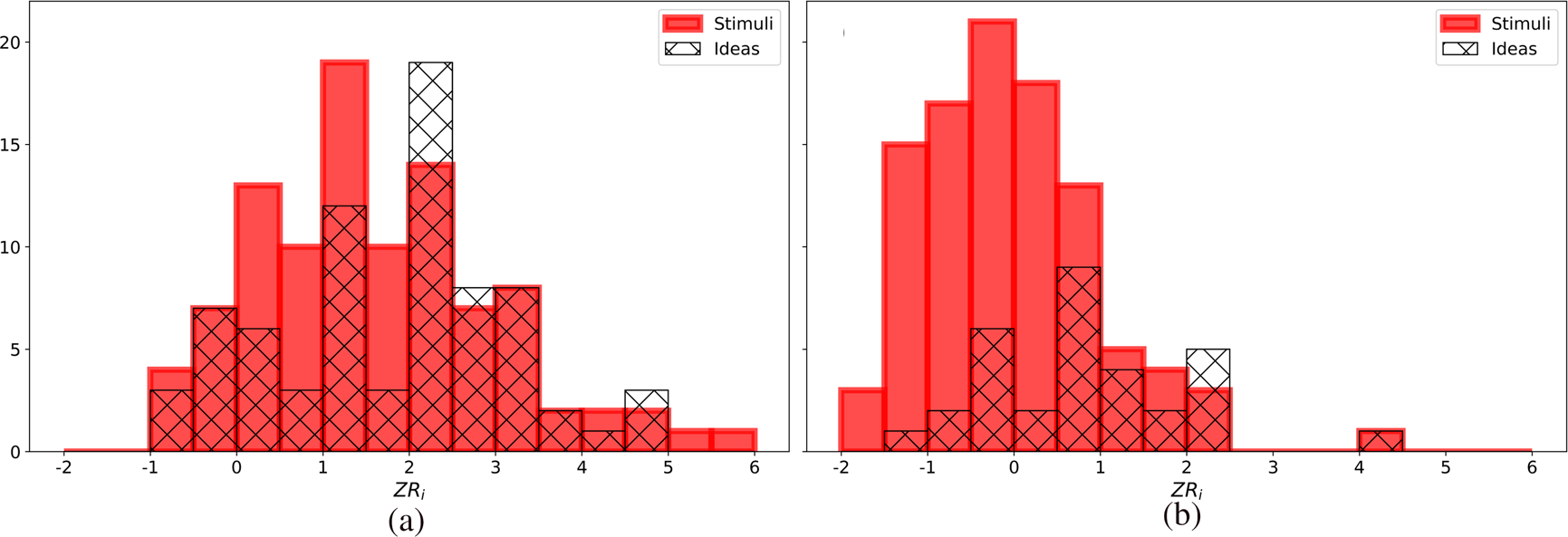
The stimuli set of the third exercise included farther stimuli and more stimuli with ZR < 0 than the stimuli set of the second exercise (Fig. 4). While the concepts from far fields may unleash the potential for novel idea generation, the engineers find it difficult to conceive their relevance to the original domain. As reported in Table A2 in Appendix, we attempted but failed to make sense of most of the far-field stimuli with ZR < 0. We were unable to obtain inspiration from any (and a large number) of far stimuli with ZR < −0.945 (Fig. 6b). By contrast, in the second exercise, we only retrieved a small number of far stimuli with ZR < 0 (with all of them having ZR > −0.815) but were able to find inspiration from most of them (Fig. 6a). These results suggest, despite the need to explore far stimuli for potential novel ideas, overly far concepts in the white space may be ineffective for idea stimulation. A balanced stimuli retrieval strategy with regards to the semantic distance from the stimuli to the original domain is needed.
Distribution of ZR i of white space stimuli in the (a) second and (b) third exercises. Red histograms denote the distribution of all stimuli retrieved and provided to engineers. Textured histograms represent the distribution of the effective stimuli that invoked ideas.

These findings from our case study resonate with the prior studies on design stimulation that have suggested near-field stimuli are more effective to inspire designers and produce more feasible ideas (Fu et al., Reference Fu, Chan, Cagan, Kotovsky, Schunn and Wood2013b; Chan et al., Reference Chan, Dow and Schunn2015; Srinivasan et al., Reference Srinivasan, Song, Luo, Subburaj, Elara, Blessing and Wood2018; Goucher-Lambert and Cagan, Reference Goucher-Lambert and Cagan2019), whereas far-field stimuli are less effective but may contribute to novelty of the ideas once they are generated (Gentner and Markman, Reference Gentner and Markman1997; Ward, Reference Ward, Holyoak, Gentner and Kokinov1998; Chan et al., Reference Chan, Dow and Schunn2015; Luo et al., Reference Luo, Song, Blessing and Wood2018; Srinivasan et al., Reference Srinivasan, Song, Luo, Subburaj, Elara, Blessing and Wood2018). Observing such tradeoffs, Fu et al. (Reference Fu, Cagan, Kotovsky and Wood2013a, Reference Fu, Chan, Cagan, Kotovsky, Schunn and Wood2013b) hypothesized that the stimuli from the “middle ground” may be desirable. He and Luo (Reference He and Luo2017) suggested that the most valuable inventions are based on mainly conventional combinations of prior work and a minor insertion of highly novel combinations.
In practice, different designers may follow these theoretical understandings to explore, retrieve, and mix design stimuli of varied semantic distance to a focal design domain according to their differed preferences in ideation effectiveness and idea feasibility versus idea novelty and radical innovation potential. In particular, the quantified semantic distance (R or ZR scores) between white space concepts and the focal design domain in the large TechNet provides a new basis for guiding the search, retrieval, and selection of near to far stimuli to support design idea generation and evaluation.
Summary and concluding remarks
In this paper, we have presented a methodology based on a large semantic network of technical terms (TechNet) for generating new design ideas. Specifically, the methodology infers new technical concepts away from the previously used ones in a focal design domain according to their semantic relevance in TechNet and synthesizes the new concepts in the white space with the original ones to generate new design ideas. Our case study, including three flying car idea generation exercises based on three white space concept retrieval strategies with varied preferences toward near to far stimuli, shows the general effectiveness of our methodology for simultaneous idea generation and evaluation, as well as varied ideation performances from different stimuli retrieval strategies.
The methodology focuses on white space inspiration and the use of semantic distance to guide stimuli retrieval in the total TechNet. By focusing on retrieving and synthesizing design stimuli from the white space to the original domain, the novelty (and patentability) of new ideas is naturally ensured when they are generated. Meanwhile, our metrics on the semantic distance of white space concepts to the focal domain can provide indications of both the novelty of a new idea and the feasibility of realizing the idea. Thus, the stimulation distance in the semantic network is the key variable to guide the retrieval of stimuli for different ideation performance tradeoffs (e.g., quantity, feasibility, and novelty) and to inform the instant evaluation and comparison of the ideas generated or to be generated. Moreover, we have developed a web-based interface (http://www.Tech-Net.org/) and public API (https://github.com/SerhadS/TechNet) to support the use of the proposed methodology for idea generation and evaluation with TechNet.
This study contributes to the growing literature on data-driven design (Altshuller and Altov, Reference Altshuller and Altov1996; Mukherjea et al., Reference Mukherjea, Bamba and Kankar2005; Chakrabarti et al., Reference Chakrabarti, Sarkar, Leelavathamma and Nataraju2006; Murphy et al., Reference Murphy, Fu, Otto, Yang, Jensen and Wood2014) and NLP-based design analytics (Mukherjea et al., Reference Mukherjea, Bamba and Kankar2005; Fu et al., Reference Fu, Cagan, Kotovsky and Wood2013a; Murphy et al., Reference Murphy, Fu, Otto, Yang, Jensen and Wood2014; Shi et al., Reference Shi, Chen, Han and Childs2017). Aside from design ideation support, the TechNet-based methodology can also be tweaked for an extensive range of applications, such as knowledge discovery, topic mapping, technology forecasting, innovation, and business intelligence. That is, TechNet may serve as an infrastructure for AI applications related to technology and engineering.
This research presents several limitations, which suggest future research opportunities and directions. First, there exist alternative semantic distance metrics and retrieval strategies than the ones covered in the present study and deserve further exploration. Second, TechNet consists of only one type of relation among terms and does not differentiate the type of terms, such as components, functions, structures, configurations, working principles, and mechanisms. Future development of TechNet may include different types of relations and also discern the relation and concept types during the retrieval process. Third, our proposed methodology starts with retrieving patents that can represent the focal domain (e.g., flying car). The completeness and the accuracy of the retrieved patent set bound the results. Hence, patent retrieval methods with high recall and precision rates need to be developed or adopted as complementary to this study (Benson and Magee, Reference Benson and Magee2013; Song and Luo, Reference Song and Luo2017).
Furthermore, we only conducted one case study with three engineers to demonstrate the effectiveness of the proposed methodology. More case studies, in diverse technical contexts and with more engineers of different experience levels and backgrounds, may allow us to discover other contextual factors on outcomes of the proposed methodology. Also, comparative evaluation against alternative methods that retrieve ideation stimuli from such semantic networks as WordNet and ConceptNet by semantic distance (Han et al., Reference Han, Sarica, Shi and Luo2020b) may further reveal the advantages and disadvantages of our methodology among the alternatives.
We hope the readers view this study as an invitation rather than the conclusion of the research efforts to construct, fine-tune, and apply the TechNet to data-driven design.
Competing interests
The authors declare no competing interests.
Serhad Sarica holds a PhD degree in Data-Driven Design from Singapore University of Technology and Design, and an MSc degree in Electrical & Electronics Engineering from Middle East Technical University. His research interests lay in the intersection of data science, engineering design, and network science fields. Specifically, he focuses on engineering and technology-related knowledge representation and organization in the form of comprehensive knowledge graphs and semantic networks to enable AI applications in engineering design, and quantitative and qualitative inference methods to utilize these knowledge repositories.
Binyang Song is a doctoral researcher in the School of Engineering Design, Technology, and Professional Programs at the Pennsylvania State University. She has interdisciplinary research interests in human-AI hybrid teaming and data-driven design. She aims to leverage the complementary strengths of humans and AI to solve complex problems. Specifically, she focuses on how working with AI reshapes the design process of human designers and human-AI interaction to augment human-AI collaboration. She also takes advantage of big data to advance engineering design through various data-driven design methodologies.
Jianxi Luo is an Associate Professor with SUTD, Director of Data-Driven Innovation Lab (https://ddi.sutd.edu.sg), and Director of SUTD Technology Entrepreneurship Programme. Prof. Luo holds a PhD in Engineering Systems and S.M. in Technology Policy from Massachusetts Institute of Technology. He was a faculty member at New York University and chair of INFORMS Technology Innovation Management & Entrepreneurship Section. He is on the editorial boards of Design Science (Associate Editor), Research in Engineering Design, and IEEE Transactions on Engineering Management. His research focuses on developing data science and AI for more creative engineering design and innovation.
Kristin L. Wood is a Senior Associate Dean of Innovation and Engagement at University of Colorado Denver. Dr. Wood completed his MS and PhD degrees in the Division of Engineering and Applied Science at the California Institute of Technology, where he was an AT&T Bell Laboratories PhD Scholar. After UT Austin, Dr. Wood was the Associate Provost for Graduate Studies, a Professor of Engineering and Product Development, founding EPD Head of Pillar, and Co-Director of the SUTD-MIT International Design Center at the Singapore University of Technology and Design. Dr. Wood has published more than 500 refereed articles and books, has received more than 100 national and international awards in design, research, and education, consulted with more than 100 companies and government organizations on Design Innovation and Design Thinking, and is a Fellow of the American Society of Mechanical Engineers.
Appendix: Ideas generated with stimuli randomly sampled from near-field and entire TechNet
The ideas generated with random concept stimuli from a confined near-field

The ideas generated with random concept stimuli from TechNet