1. Introduction
The stability of fluid films flowing down an inclined plane has been a subject of longstanding interest among fluid mechanics researchers. By solving the Orr–Sommerfeld equation, Yih (Reference Yih1963) derived the expression for the critical Reynolds number
 $\mathit{Re}_{c}=(5/6)\cot {\it\beta}$
for the surface mode (hereafter referred to as the SUM) in terms of the angle of inclination,
 ${\it\beta}$
, in the absence of surface tension. The same result has also been obtained by Benjamin (Reference Benjamin1957). The SUM comprises gravity waves that travel at phase speeds of nearly two times the surface speed and exhibit much longer wavelengths compared to the fluid layer depth. Later, Lin (Reference Lin1967) reported the presence of another mode which is basically the Tollmien–Schlichting shear wave (SHM) which travels at a phase speed that is less than the undisturbed surface speed with a wavelength of a few times the fluid layer depth. However, one of the boundary conditions used by Lin (Reference Lin1967) was erroneous; this was corrected later by De Bruin (Reference De Bruin1974).
However, the stability of a fluid film on a porous substrate has started to receive interest only recently. Pascal (Reference Pascal1999) was the first to consider the problem of a fluid layer flowing down an inclined permeable plane assuming long-wave disturbances, and found that the presence of the porous layer destabilizes the SUM. Further, Pascal (Reference Pascal1999) made the assumption that the characteristic length scale of the pore space is much smaller than the thickness of the fluid layer, thus decoupling the dynamics of flow in the fluid layer and porous substrate. The same assumption was used in later works by Pascal (Reference Pascal2006) investigating the instability of a non-Newtonian film on a porous inclined plane and by Sadiq & Usha (Reference Sadiq and Usha2008) considering a weakly nonlinear stability analysis of a thin Newtonian fluid layer flowing down a porous inclined plane. Liu & Liu (Reference Liu and Liu2009) and Kandel & Pascal (Reference Kandel and Pascal2013) did not use this assumption and solved the coupled porous–fluid system model for a falling film flowing on an impermeable wall to investigate the effect of various system parameters on the hydrodynamic stability. Numerous examples of such superposed fluid–porous systems can be found in nature (e.g. wind through plant foliage/city) as well as in technology (from cooling flow over electronic boards to fluidized beds and wire mesh reactors). Hence, it is of practical importance to understand the flow dynamics and instabilities in these systems to predict, for instance, the chemical imbibition of vegetation or chemical throughput in chemical reactors.
Many studies have been reported on the instability mechanisms of thermal convection in unstably stratified fluid–porous systems (see Nield & Bejan (Reference Nield and Bejan2006) for a review). The objective of the present study is to investigate the influence of anisotropy and inhomogeneity of the permeability of the underlying porous layer on the flow instabilities of the saturating and overlying fluid in the absence of heat transfer. The effect of anisotropic and inhomogeneous permeability in the context of convective instability has been previously studied by many investigators (Chen Reference Chen1992; Malashetty & Swamy Reference Malashetty and Swamy2010; Shivakumara, Lee & Chavaraddi Reference Shivakumara, Lee and Chavaraddi2011). However all of these studies, in order to avoid the complexities due to the interplay between the momentum balance and energy balance equations, assumed the undisturbed state of the fluid to be quiescent. Thus, in the current literature, no study has been reported on the effect of anisotropic and inhomogeneous permeability on pure hydrodynamic instabilities occurring in superposed fluid and porous layers. It is very easy to imagine many practical situations where a porous material will exhibit anisotropy and inhomogeneity in its permeability. For example, a geophysical system such as a ground structure generally consists of many strata with different permeabilities (Malashetty & Swamy Reference Malashetty and Swamy2010). The ‘mushy’ dendritic zone formed during the solidification of binary alloys can be regarded as a porous medium in which the permeability is anisotropic and inhomogeneous (Chen Reference Chen1992). Such kinds of variations in permeability can also be caused due to the asymmetric geometrical arrangement of the fibre material in an artificial porous matrix (Shivakumara et al. Reference Shivakumara, Lee and Chavaraddi2011).
2. Formulation of the problem
Consider a fluid film of mean thickness
 $d$
falling down a porous substrate of thickness
 $d_{m}$
inclined at an angle
 ${\it\beta}$
with the horizontal. The coordinate
 $x$
is in the direction of the mean flow and
 $z$
is measured from the fluid–porous interface. The governing equations in the fluid are
 $$\begin{eqnarray}\displaystyle & \displaystyle \frac{\partial u}{\partial x}+\frac{\partial w}{\partial z}=0, & \displaystyle\end{eqnarray}$$
 $$\begin{eqnarray}\displaystyle & \displaystyle \frac{\partial u}{\partial t}+u\frac{\partial u}{\partial x}+w\frac{\partial u}{\partial z}=-\frac{1}{{\it\rho}}\frac{\partial p}{\partial x}+g\sin {\it\beta}+{\it\nu}{\rm\Delta}u, & \displaystyle\end{eqnarray}$$
 $$\begin{eqnarray}\displaystyle & \displaystyle \frac{\partial w}{\partial t}+u\frac{\partial w}{\partial x}+w\frac{\partial w}{\partial z}=-\frac{1}{{\it\rho}}\frac{\partial p}{\partial z}-g\cos {\it\beta}+{\it\nu}{\rm\Delta}w, & \displaystyle\end{eqnarray}$$
 $u$
and
 $w$
represent the velocity of the fluid in the
 $x$
and
 $z$
directions,
 $p$
is the pressure,
 $g$
is the acceleration due to gravity,
 ${\it\nu}$
is the kinematic viscosity and
 ${\rm\Delta}$
is the Laplace operator.
The flow through the porous medium is assumed to be governed by the generalized Darcy’s law with a permeability tensor whose principal axes are aligned with the coordinate system. Recently, Camporeale, Mantelli & Manes (Reference Camporeale, Mantelli and Manes2013) pointed out the importance of including the convective terms in the porous region in problems similar to the present one. However, when inhomogeneity in the permeability is considered, it is not straightforward to obtain a closed-form solution for the basic state of the system if these terms are retained, and hence we used the classical Darcy’s equation in this study,
 $$\begin{eqnarray}\displaystyle & \displaystyle \frac{\partial u_{m}}{\partial x}+\frac{\partial w_{m}}{\partial z}=0, & \displaystyle\end{eqnarray}$$
 $$\begin{eqnarray}\displaystyle & \displaystyle \frac{1}{{\it\phi}}\frac{\partial u_{m}}{\partial t}=-\frac{1}{{\it\rho}}\frac{\partial p_{m}}{\partial x}-\frac{{\it\nu}}{K_{x}{\it\eta}_{x}(z/d_{m})}u_{m}+g\sin {\it\beta}, & \displaystyle\end{eqnarray}$$
 $$\begin{eqnarray}\displaystyle & \displaystyle \frac{1}{{\it\phi}}\frac{\partial w_{m}}{\partial t}=-\frac{1}{{\it\rho}}\frac{\partial p_{m}}{\partial z}-\frac{{\it\nu}}{K_{z}{\it\eta}_{z}(z/d_{m})}w_{m}-g\cos {\it\beta}, & \displaystyle\end{eqnarray}$$
 $m$
denotes the porous medium,
 ${\it\phi}$
is the porosity,
 $K_{x}$
and
 $K_{z}$
are the permeabilities in the
 $x$
and
 $z$
directions respectively and
 ${\it\eta}_{x}$
and
 ${\it\eta}_{z}$
denote the respective inhomogeneity functions. We also define the anisotropy parameter,
 ${\it\xi}=K_{x}/K_{z}$
.
The boundary conditions are as follows. At the bottom wall,
 $z=-d_{m}$
,
 $w_{m}=0$
(no penetration). At the free surface of the fluid,
 $z=d+h(x,t)$
, the kinematic condition is
 $w=(\partial h/\partial t)+u(\partial h/\partial x)$
. Assuming the ambient fluid above the liquid film to be passive, the shear and normal stress balances at the free surface give
 $(\partial w/\partial x)+(\partial u/\partial z)=0$
and
 $2{\it\mu}(\partial w/\partial z)-p=2{\it\gamma}H$
, where
 ${\it\mu}$
is the dynamic viscosity of the fluid,
 ${\it\gamma}$
is the surface tension and
 $H$
is the mean curvature defined by
 $2H=h_{xx}/(1+h_{x}^{2})^{3/2}$
(here, the subscript
 $x$
denotes partial differentiation with respect to
 $x$
).
Due to the first-order nature of Darcy’s equation, Beavers & Joseph (Reference Beavers and Joseph1967) experimentally proposed to replace the continuity of tangential velocity and tangential stress with a slip condition at the fluid–porous interface (
 $z=0$
). In our case, using the streamwise component of permeability at the interface (Chen Reference Chen1992), this can be written as
 $\partial u/\partial z=({\it\alpha}_{BJ}/\sqrt{K_{x}{\it\eta}_{x}(0)})(u-u_{m})$
, where
 ${\it\alpha}_{BJ}$
is the Beavers–Joseph coefficient. The other two conditions at the interface are the continuity of normal velocity and normal stress balance:
 $w=w_{m}$
and
 $p-2{\it\mu}(\partial w/\partial z)=p_{m}$
.
In the unperturbed state (
 $h=0$
), the above problem admits the following steady laminar solution cast in the non-dimensional form:
 $$\begin{eqnarray}\left.\begin{array}{@{}l@{}}\displaystyle {\bar{u}}(z)=-z^{2}+2z+\frac{2{\it\delta}}{{\it\alpha}_{BJ}\hat{d}}+2\frac{{\it\delta}^{2}}{\hat{d}^{2}}{\it\eta}_{x}(0),\quad \bar{w}=0,\ 0\leqslant z\leqslant 1,\\ \displaystyle {\bar{u}}_{m}(z_{m})=2{\it\delta}^{2}\hat{d}^{-2}{\it\eta}_{x}(z_{m}),\quad \bar{w}_{m}=0,\ -1\leqslant z_{m}\leqslant 0,\end{array}\right\}\end{eqnarray}$$
where the overbar indicates the basic solution,
 ${\it\delta}$
is the Darcy number, defined as
 $\sqrt{K_{x}}/d_{m}$
, and
 $\hat{d}$
is the depth ratio
 $d/d_{m}$
. In the above equation, the velocity scale chosen for normalization is the speed at the free surface of a liquid layer flowing down an impermeable plane, as given by
 $u_{0}=(d^{2}g\sin {\it\beta})/2{\it\nu}$
, while the length scales used are
 $d$
for the fluid layer and
 $d_{m}$
for the porous layer.
To carry out the stability analysis, we now introduce infinitesimal perturbations to the basic state. Only two-dimensional disturbances are considered due to the Squires theorem, from which it follows that two-dimensional waves exhibit a greater tendency towards instability than three-dimensional ones (Liu & Liu Reference Liu and Liu2009). In what follows, all the variables are non-dimensionalized using the same scales as employed by Liu & Liu (Reference Liu and Liu2009). In order to obtain the perturbation velocities in the fluid layer, we define the stream function
 ${\it\psi}$
as
 $({\tilde{u}},\tilde{w})=(\partial {\it\psi}/\partial z,-\partial {\it\psi}/\partial x)$
, where the tilde indicates perturbations. We further introduce the normal mode
 ${\it\psi}={\it\Phi}(z)\exp ({\it\sigma}t+\text{i}kx)$
, where
 ${\it\Phi}$
,
 ${\it\sigma}$
and
 $k$
denote the amplitude of the stream function, the complex time growth rate and the streamwise wavenumber respectively. A similar definition holds for
 ${\it\psi}_{m}$
. It should be noted that
 ${\it\sigma}={\it\sigma}_{m}(\hat{d}^{2}/\mathit{Re})$
and
 $k=k_{m}\hat{d}$
, where
 $\mathit{Re}$
denotes the Reynolds number defined as
 $\mathit{Re}=u_{0}d/{\it\nu}$
.
After the elimination of pressure, the linearized perturbation equations read
 $$\begin{eqnarray}\displaystyle & \displaystyle \frac{1}{\mathit{Re}}(\text{D}^{2}-k^{2})^{2}{\it\Phi}-\text{i}k{\bar{u}}(\text{D}^{2}-k^{2}){\it\Phi}+\text{i}k\frac{\text{d}^{2}{\bar{u}}}{\text{d}z^{2}}{\it\Phi}={\it\sigma}(\text{D}^{2}-k^{2}){\it\Phi}, & \displaystyle\end{eqnarray}$$
 $$\begin{eqnarray}\displaystyle & \displaystyle \frac{1}{{\it\delta}^{2}}\left[\frac{\text{D}_{m}^{2}{\it\Phi}_{m}}{{\it\eta}_{x}}-{\it\xi}\frac{k_{m}^{2}{\it\Phi}_{m}}{{\it\eta}_{z}}-\frac{\text{D}_{m}{\it\eta}_{x}\text{D}_{m}{\it\Phi}_{m}}{{\it\eta}_{x}^{2}}\right]=\frac{{\it\sigma}_{m}}{{\it\phi}}(\text{D}_{m}^{2}-k_{m}^{2}){\it\Phi}_{m}, & \displaystyle\end{eqnarray}$$
At the base of the porous layer
 $z_{m}=-1$
,
 ${\it\Phi}_{m}=0$
.
At the interface
 $z=z_{m}=0$
,
 $$\begin{eqnarray}\displaystyle & \displaystyle {\it\Phi}=\frac{1}{\mathit{Re}}{\it\Phi}_{m}, & \displaystyle\end{eqnarray}$$
 $$\begin{eqnarray}\displaystyle & \displaystyle \frac{1}{\mathit{Re}}\text{D}^{3}{\it\Phi}-\frac{3k^{2}}{\mathit{Re}}\text{D}{\it\Phi}+\text{i}k\frac{\text{d}{\bar{u}}}{\text{d}z}{\it\Phi}-\text{i}k{\bar{u}}\text{D}{\it\Phi}+\frac{\hat{d}^{3}}{{\it\delta}^{2}\mathit{Re}^{2}{\it\eta}_{x}(0)}\text{D}_{m}{\it\Phi}_{m} & \displaystyle \nonumber\\ \displaystyle & ={\it\sigma}\text{D}{\it\Phi}-{\it\sigma}_{m}\frac{\hat{d}^{3}}{{\it\phi}\mathit{Re}^{2}}\text{D}_{m}{\it\Phi}_{m}, & \displaystyle\end{eqnarray}$$
 $$\begin{eqnarray}\displaystyle & \displaystyle \text{D}^{2}{\it\Phi}=\frac{{\it\alpha}_{BJ}\hat{d}}{{\it\delta}\sqrt{{\it\eta}_{x}(0)}}\left(\text{D}{\it\Phi}-\frac{\hat{d}}{\mathit{Re}}\text{D}_{m}{\it\Phi}_{m}\right). & \displaystyle\end{eqnarray}$$
 $z=1$
,
 $$\begin{eqnarray}\displaystyle & -\text{i}k{\it\Phi}={\it\sigma}a+\text{i}k{\bar{u}}a, & \displaystyle\end{eqnarray}$$
 $$\begin{eqnarray}\displaystyle & \displaystyle (\text{D}^{2}+k^{2}){\it\Phi}+\frac{\text{d}^{2}{\bar{u}}}{\text{d}z^{2}}a=0, & \displaystyle\end{eqnarray}$$
 $$\begin{eqnarray}\displaystyle & \displaystyle \frac{1}{\mathit{Re}}\text{D}^{3}{\it\Phi}+\text{i}k\frac{\text{d}{\bar{u}}}{\text{d}z}{\it\Phi}-\text{i}k{\bar{u}}\text{D}{\it\Phi}-\frac{3}{\mathit{Re}}k^{2}\text{D}{\it\Phi}-\left(\text{i}k^{3}S+\frac{2}{\mathit{Re}}\text{i}k\cot {\it\beta}\right)a={\it\sigma}\text{D}{\it\Phi}. & \displaystyle\end{eqnarray}$$
 $\text{D}=(\text{d}/\text{d}z)$
,
 $\text{D}_{m}=(\text{d}/\text{d}z_{m})$
,
 $a$
denotes the amplitude of the free surface disturbance and
 $S={\it\gamma}/({\it\rho}u_{0}^{2}d)=\mathit{Re}^{-5/3}\left((3/2)\sin {\it\beta}\right)^{-1/3}{\it\zeta}$
, where
 ${\it\zeta}=\left(3{\it\rho}{\it\gamma}^{3}/g{\it\mu}^{4}\right)^{1/3}$
is the surface tension number (Floryan, Davis & Kelly Reference Floryan, Davis and Kelly1987).
3. Numerical results
This generalized eigenvalue problem is solved using the Chebyshev collocation method; the details of the implementation of the method for the present problem can be found in Liu & Liu (Reference Liu and Liu2009). To obtain the results, we choose
 ${\it\phi}=0.3$
,
 ${\it\alpha}_{BJ}=0.1$
,
 ${\it\delta}=0.001$
and
 ${\it\beta}=1^{\circ }$
, as used in previous studies (Chen Reference Chen1992; Chang Reference Chang2006; Liu & Liu Reference Liu and Liu2009). At the low inclination angle selected, both the SUM and the SHM are important (Floryan et al.
Reference Floryan, Davis and Kelly1987). At this point, it is appropriate to discuss the possibility of solving the problem theoretically, in particular, based on a long-wave assumption as employed in Kandel & Pascal (Reference Kandel and Pascal2013). Despite the fact that such theoretical results are generally applicable only to the SUM, due to the long-wave assumption, the theoretical results are valid only for small values of
 $k$
and
 $\mathit{Re}$
, as is evident from the fact that only values of
 $\mathit{Re}_{c}\sim O(1)$
are reported in Kandel & Pascal (Reference Kandel and Pascal2013). In comparison, in the present study, as will be shown later,
 $\mathit{Re}_{c}\sim O(10)$
for the SUM (this is expected, because the corresponding value for an impermeable wall is
 $(5/6)\cot {\it\beta}\approx 48$
). Hence, we resorted to numerical solution of the eigenvalue problem in this study. However, we acknowledge the many benefits of the theoretical approach, and such a theoretical study within a valid range of parameters for the present case will be presented in a future paper.
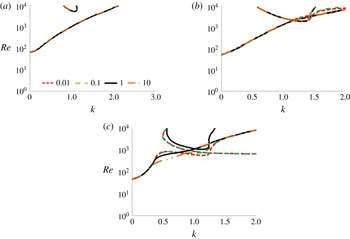
First, we examine the effect of the surface tension (figure 1
a) and the depth ratio (figure 1
b) on the stability characteristics of an isotropic and homogeneous system (hence
 ${\it\xi}={\it\eta}_{x}={\it\eta}_{z}=1$
). For each case, the lower and upper curves are the neutral stability curves (
 ${\it\sigma}=0$
) for the SUM and SHM respectively. Surface tension, as expected, is found to have an immense stabilizing effect on the SUM (its unstable region reduces with increase in
 ${\it\zeta}$
), while the SHM is almost insensitive to the change in the surface tension parameter,
 ${\it\zeta}$
, from 0 to 30 000. The physical nature of these modes explains this behaviour, as illustrated by the normalized amplitude of the eigenfunctions for the SUM and SHM at the critical conditions given in the inset to figure 1(a). As it comprises gravity waves, the SUM is more concentrated on the free surface of the fluid layer. In comparison, the SHM is prevalent in the entire bulk of the fluid layer because it is associated with the shear flow in the liquid. However, it should be noted that near the critical Reynolds number,
 $\mathit{Re}_{c}$
, the SUM is only weakly dependent on the surface tension parameter, a finding in accord with the observation made in the case of a fluid film on an impenetrable inclined wall (Floryan et al.
Reference Floryan, Davis and Kelly1987). For the rest of the paper, we assume
 ${\it\zeta}=4899.38$
, corresponding to water.
(a) Neutral curves at various values of
 ${\it\zeta}$
for the SUM and SHM at
 $\hat{d}=1$
. The inset shows the normalized eigenfunctions
 $\left|{\it\Phi}\right|$
and
 $\left|{\it\Phi}_{m}\right|$
at critical states for
 ${\it\zeta}=4899.38$
(indicated by the circles in (a)). (b) Neutral curves at various values of
 $\hat{d}$
for the SUM and SHM at
 ${\it\zeta}=4899.38$
. The inset shows the normalized eigenfunctions
 $\left|{\it\Phi}\right|$
and
 $\left|{\it\Phi}_{m}\right|$
of the SHM at critical states for
 $\hat{d}=0.1$
and 0.2 (indicated by the circles in (b)).

Figure 1(b) shows that a decrease in the depth ratio reduces the critical Reynolds number for the SUM, possibly due to the non-stabilizing effect on the gravity waves of a thinner fluid layer. For the SHM, as
 $\hat{d}$
reduces from 1 to 0.1 the unstable region in the
 $k{-}\mathit{Re}$
plane expands initially, making the system more unstable, and as
 $\hat{d}$
approaches 0.1 the unstable region shrinks. This non-monotonic variation of the SHM with the depth ratio has also been observed by Liu & Liu (Reference Liu and Liu2009) for a homogeneous and isotropic porous substrate; however, no physical reason was offered. It should be noted that the trend is monotonic in the case of convective instabilities with quiescent base flow conditions (Chen Reference Chen1992), where decreasing
 $\hat{d}$
in the same range always leads to higher stability. A thicker porous layer will normally offer more resistance to the flow and hence the system will be more stable. However, in our case, the basic flow is a gravity-generated shear flow which introduces an additional competing effect; a thinner fluid layer leads to higher shear and thus has a destabilizing effect on the SHM. The eigenfunctions at the critical state show that as the depth ratio reduces, the SHM slowly penetrates into the porous layer (for instance, as shown in the inset to figure 1(b), at
 $\hat{d}=1$
the SHM is a pure fluid mode, but at
 $\hat{d}=0.1$
the flow in the porous layer is appreciable). Hence, we speculate that for higher values of
 $\hat{d}$
the destabilizing effect of the shear flow dominates the stabilizing effect of the resistance offered by the porous layer (as the flow is more or less confined in the fluid layer). As
 $\hat{d}$
is reduced below a critical value, comparatively a larger fraction of the fluid is contained in the porous layer and hence the system becomes more stable, explaining the reversal in trend.
Neutral curves for various values of
 ${\it\xi}$
with (a)
 $\hat{d}=1$
, (b)
 $\hat{d}=0.3$
and (c)
 $\hat{d}=0.1$
.

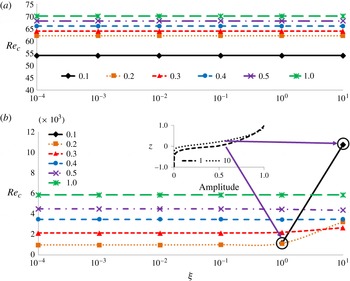
Effect of anisotropy on the critical Reynolds number for (a) the SUM and (b) the SHM. The inset to panel (b) shows the normalized eigenfunctions
 $\left|{\it\Phi}\right|$
and
 $\left|{\it\Phi}_{m}\right|$
of the SHM at critical states for
 ${\it\xi}=1$
and 10 at
 $\hat{d}=0.1$
(indicated by the circles in (b)).

3.1. Effect of anisotropy
In this section, we consider an anisotropic but homogeneous (
 ${\it\eta}_{x}={\it\eta}_{z}=1$
) porous medium. Figure 2 shows the neutral stability curves for the SUM and SHM at various values of the anisotropy parameter,
 ${\it\xi}$
, for three different selected depth ratios and figure 3 presents the critical (lowest) Reynolds number obtained from such marginal curves as a function of
 ${\it\xi}$
. The SUM is nearly insensitive to
 ${\it\xi}$
irrespective of the depth ratio. As it comprises gravity waves, this mode is not affected by the anisotropic change in permeability of the underlying porous layer. At a given
 ${\it\xi}$
, as already explained, with a decrease in
 $\hat{d}$
, the SUM becomes more unstable. The SHM also appears to be insensitive to
 ${\it\xi}$
for
 $\hat{d}>0.4$
. This is because, as shown already, for higher depth ratios, the flow is confined in the fluid layer, thus minimizing the anisotropic effect of the porous layer. However, when the depth ratio is below this value, the SHM is found to become more stable as
 ${\it\xi}$
is approximately greater than 1. A higher
 ${\it\xi}$
implies a decrease in the permeability in the
 $z$
direction (
 $K_{z}$
) relative to that in the
 $x$
direction (
 $K_{x}$
). This higher resistance to the flow explains the stabilizing effect of an increase in
 ${\it\xi}$
. The eigenfunctions shown as an inset to figure 3(b) at
 $\hat{d}=0.1$
corroborate this argument. Compared with the case of
 ${\it\xi}=10$
, the flow at
 ${\it\xi}=1$
shows more penetration into the porous layer due to the lower resistance. Since the depth ratio is the same, in a normalized sense, there is more fluid in the overall system and hence the flow is more susceptible to instabilities, as manifested by a drastic decrease in
 $\mathit{Re}_{c}$
. It should be noted that at
 $\hat{d}=0.1$
, for
 ${\it\xi}\leqslant 1$
, the SHM expands out to the higher wavenumber regime (see figure 2
c), and hence the critical conditions for these cases fall outside the range of
 $k$
considered here. However, it is clear that
 $\mathit{Re}_{c}$
for these cases is lower than it is for
 ${\it\xi}=1$
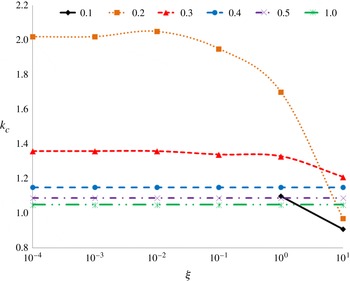
and hence the arguments made above still hold. As shown in figure 4, for the SHM, the critical streamwise wavenumber,
 $k_{c}$
, is found to decrease with
 ${\it\xi}$
at higher
 ${\it\xi}$
and at lower
 $\hat{d}$
, because as
 ${\it\xi}$
increases, the relative permeability in the
 $x$
direction increases, leading to a higher critical wavelength (or lower critical wavenumber). For the SUM,
 $k_{c}$
is always zero (cf. figure 2).
Effect of anisotropy on the critical wavenumber for the SHM.

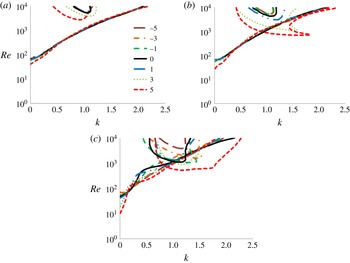
Neutral curves for various values of
 $A$
with (a)
 $\hat{d}=1$
, (b)
 $\hat{d}=0.5$
and (c)
 $\hat{d}=0.1$
.

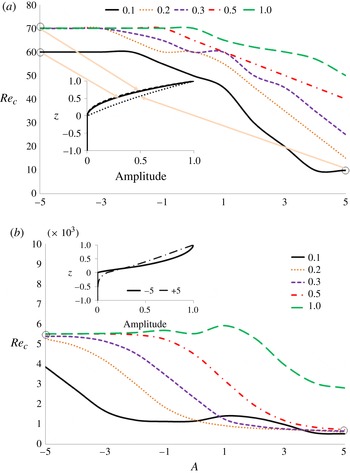
Effect of inhomogeneity on the critical Reynolds number for (a) the SUM and (b) the SHM. The inset to (a) shows the normalized eigenfunctions of the SUM at critical states for
 $A=-5$
(solid line) and 5 (dotted line) at
 $\hat{d}=0.1$
and
 $A=-5$
(dashed line) at
 $\hat{d}=1$
. The inset to (b) shows the normalized eigenfunctions of the SHM at critical states for
 $A=-5$
(solid line) and 5 (broken line) at
 $\hat{d}=0.3$
.

3.2. Effect of inhomogeneity
In order to investigate the effect of inhomogeneity alone, we now set
 ${\it\xi}=1$
(so that the porous medium is isotropic) and
 ${\it\eta}_{x}={\it\eta}_{z}=\text{e}^{A(1+z_{m})}$
, the same exponential inhomogeneity function as used by Chen (Reference Chen1992). At the bottom, the value of the permeability is the same as in the homogeneous case (as
 $z_{m}=-1$
), and with a positive (negative respectively) value of
 $A$
, the permeability increases (decreases respectively) in the
 $z$
direction. Figure 5 shows the neutral stability curves for the SUM and SHM at various values of
 $A$
for
 $\hat{d}=1$
, 0.5 and 0.1 and figure 6 presents the variation of
 $\mathit{Re}_{c}$
with
 $A$
. At a given
 $\hat{d}$
, as
 $A$
increases,
 $\mathit{Re}_{c}$
for both the modes decreases almost monotonically in a certain range of
 $A$
, outside of which
 $\mathit{Re}_{c}$
plateaus out. For the SUM, the destabilizing effect of increase in
 $A$
is observed at higher values of
 $A$
, and at lower values of
 $A$
the value of the critical Reynolds number is found to reach a steady value. On the other hand, for the SHM, there appears to be a higher limit to
 $\mathit{Re}_{c}$
at lower values of
 $A$
, and vice versa, with a gradual reduction in
 $\mathit{Re}_{c}$
for the intermediate range of
 $A$
. At lower depth ratios, the value of
 $A$
at which this transition occurs decreases because as
 $\hat{d}$
decreases, the flow penetrates more and more into the porous layer (see the inset to figure 1
b), thereby increasing the sensitivity of the stability characteristics to the inhomogeneous effects of the porous layer. The destabilizing effect of an increase in
 $A$
on the SHM is also intuitively reasonable, because the overall permeability of the porous layer increases, leading to lower resistance to the flow, as shown by the eigenfunctions (see the inset to figure 6(b) for
 $\hat{d}=0.3$
). A similar effect is observed in the case of the SUM, although the fluctuating stream function is always confined in the fluid layer (see the inset to figure 6
a); as
 $A$
increases at the same
 $\hat{d}$
, the flow is relatively more evenly distributed across the fluid layer. It can also be inferred from figure 5 that for the SHM the critical wavenumber shows no monotonic dependence on
 $A$
, as it does with
 ${\it\xi}$
in the case of anisotropy. Perhaps, the inhomogeneous variation of permeability in both the principal directions in the porous medium results in complicated fluctuating flow patterns which make the trend in critical wavelength with
 $A$
inconsistent across different depth ratios.
4. Concluding remarks
Linear stability analysis on a liquid layer flowing down an inclined porous substrate with anisotropic and inhomogeneous permeability is carried out. In all the cases considered, in terms of the critical Reynolds number, the SUM is found to dominate the system instability. The SUM is always a pure fluid mode, while the SHM penetrates into the porous layer at lower depth ratios. While the SUM is insensitive to the anisotropic variations in the permeability, increasing the permeability of the porous layer in the direction of basic flow relative to that in the cross-stream direction is found to have a stabilizing effect on the SHM at lower depth ratios. Therefore, in order to increase the stabilization effect induced by the anisotropic effects of the porous medium on the SHM, the depth ratio should be as low as possible. An exponentially decreasing inhomogeneity in the permeability of the porous medium in the cross-stream direction (
 $A<0$
) is found to have a stabilizing effect on both the SUM and the SHM. However, our results show that, unlike cases with buoyancy-driven instabilities with motionless steady flow (Chen Reference Chen1992), there is a limit to the stabilization effect that can be achieved by decreasing
 $A$
, because as
 $A$
decreases the critical Reynolds number is observed to plateau out.
Finally, we remark that a comprehensive parametric study was not the major focus of this paper, but we did perform a limited number of simulations to investigate the effect of the Darcy number by changing its value in the neighbourhood of the nominal value of 0.001. Generalizing these results, we draw conclusions similar to those reported by Liu & Liu (Reference Liu and Liu2009) in the case of constant permeability, and so, for brevity, the observations are not reported here. Suffice it to say that for any case, an increase in the Darcy number is found to destabilize both the modes (with the SHM being more sensitive than the SUM), an observation that is consistent with the physical picture presented above, as a higher Darcy number translates to a higher permeability.
Acknowledgements
This study was carried out with the financial support of the Solar Energy Research Institute in India and the United States (SERIIUS), under the Indo–US Joint Clean Energy Research and Development Center (JCERDC) programme. P.D. and S.D. gratefully acknowledge helpful discussions with Professor V. Kumaran. Computations were performed at the Supercomputer Education and Research Centre (SERC) at the Indian Institute of Science, Bangalore.