Based on material collected in Chile, Dodge (Reference Dodge1966) described a new lichen species, Medusulina chilena C. W. Dodge, with stellately branched, strongly carbonized lirellae and small, muriform ascospores, growing on rock. At that time, the concept of the genus Medusulina was based on Zahlbruckner's (Reference Zahlbruckner, Engler and Prantl1926) definition of a lirellate-stromatic genus in the Graphidaceae with carbonized ascomata, similar to Glyphis but with muriform ascospores. The type species of Medusulina, M. nitida (Eschw.) Müll. Arg., however, has non-carbonized ascomata and belongs in the genus Fissurina (Staiger Reference Staiger2002). The name Medusulina was hardly ever used after Zahlbruckner (Reference Zahlbruckner, Engler and Prantl1926) and only appears in the description of a new species from Paraguay (Redinger Reference Redinger1933) and the aforementioned M. chilena (Dodge Reference Dodge1966; Huneck & Follmann Reference Huneck and Follmann1967). Redón & Follmann (Reference Redón and Follmann1972) then transferred the latter to the genus Minksia in the Roccellaceae (deliberately changing the epithet to ‘chilensis' assuming that the spelling chilena was incorrect), where it has resided ever since.
Restudy of the type material of Medusulina (Minksia) chilena in FH showed that the species is not related to Arthoniales but belongs in Graphidaceae, based on hymenial and ascospore characters. Examination of type material of species described by Montagne in PC revealed an earlier name for this species, Opegrapha petraea Mont., also described from Chile (Montagne Reference Montagne and Gay1852). Unfortunately, that name is not only a later homonym of O. petraea Ach. but also of a name described by the same author, O. petraea Mont., established on material from Algeria. The name for the Chilean species was later recombined in Graphis by Nylander (Reference Nylander1855), as G. petraea (Mont.) Nyl., which would make the epithet available according to ICBN Art. 58, if G. petraea were not a later homonym of G. petraea (Ach.) Wallr. Therefore, the subsequent replacement name Graphis chilensis Zahlbr. (Zahlbruckner Reference Zahlbruckner1923) provides the correct epithet for this species.
Analysis of the type material of Opegrapha petraea Mont. (≡Graphis chilensis Zahlbr.) and of Medusulina chilena C. W. Dodge showed that the species is best placed in Carbacanthographis. The overall morphology is consistent with that genus and with Graphis (Lücking et al. Reference Lücking, Archer and Aptroot2009), but the ascospores (submuriform and 18–25×8–10 µm in size) are I− and the excipulum is overarching over the hymenium and produces short periphysoids. These are, however, not spinulose as in most other species of Carbacanthographis and also thicker (1·5–2·5 µm versus 1·0–1·5 µm in Carbacanthographis; see also Staiger & Kalb Reference Staiger, Kalb, Nash, Ryan, Diederich, Gries and Bungartz2004). The rather thick, saxicolous thallus produces norstictic acid in high concentrations. Another similar genus is Dyplolabia which, however, differs in the very thickly white-pruinose lirellae containing lecanoric acid and the laterally anastomosing paraphyses, as well as the dense thallus cortex, from Carbacanthographis (Staiger Reference Staiger2002).
Two other species of Carbacanthographis, C. saxiseda (Zahlbr.) Bungartz and C. saxorum (Egea & Torrente) Lücking & Bungartz (Bungartz et al. Reference Bungartz, Lücking and Aptroot2010), agree in the saxicolous growth habit on coastal rocks in dry areas and in the norstictic acid chemistry, but C. saxiseda has unbranched to irregularly branched lirellae, an apically to laterally carbonized excipulum, and slightly smaller and relatively broader, muriform ascospores (18–20×9–12 µm) with irregular lumina; C. saxorum differs in the more thallus-dominated lirellae and transversely septate ascospores (Egea & Torrente Reference Egea and Torrente1997; Staiger & Kalb Reference Staiger, Kalb, Nash, Ryan, Diederich, Gries and Bungartz2004).
The following combination is necessary, which incidentally coincides with the incorrect epithet applied by Redón & Follmann (Reference Redón and Follmann1972):
Carbacanthographis chilensis (Zahlbr.) Lücking comb. nov.
MycoBank No: MB 801340
Graphis chilensis Zahlbr., Cat. Lich. Univers. 2: 297 (1923); Opegrapha petraea Mont. in Gay, Hist. Fis. Politic. Chile, Bot.: 182 (1852) [non O. petraea Ach., Lich. Univ.: 674 (1810), nec O. petraea Mont. in Durieu, Fl. d'Algérie, Cryptog. 1: 278 (1846)]; Graphis petraea (Mont.) Nyl., Ann. Sci. Nat., Bot., Sér. 4 3: 186 (1855) [non G. petraea (Ach.) Wallr., Fl. Crypt. Germ. 1: 336 (1831)]; type: Chile, Gay s.n. (PC—holotype!).
Medusulina chilena C. W. Dodge, Nova Hedwigia 12: 322 (1966); Minksia chilena [as ‘chilensis'] (C.W. Dodge) Redón & Follmann, Philippia 1: 133 (1972); type: Chile, Follmann 14458-D (FH—holotype!).
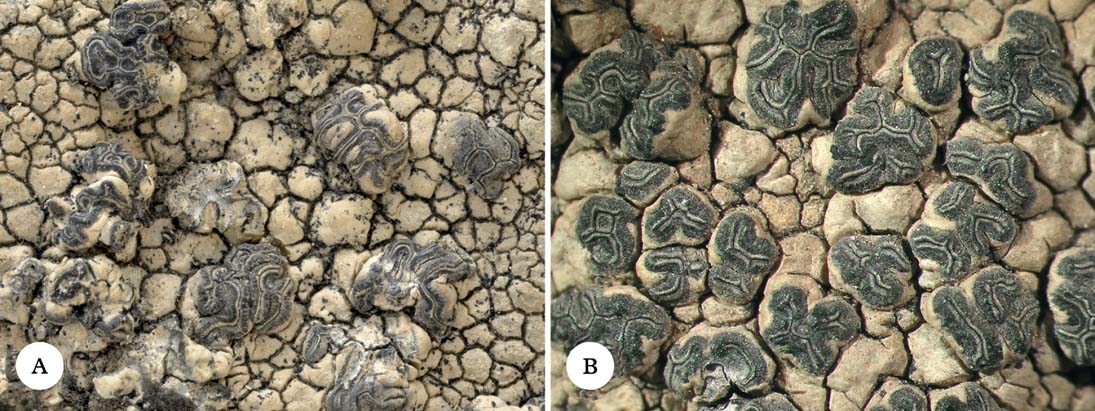
(Fig. 1)
Carbacanthographis chilensis, saxicolous thallus with stellately branched, prominent lirellae. A, holotype of Opegrapha petraea Mont. (≡Graphis chilensis Zahlbr.) in PC; B, holotype of Medusulina chilena C. W. Dodge in FH.
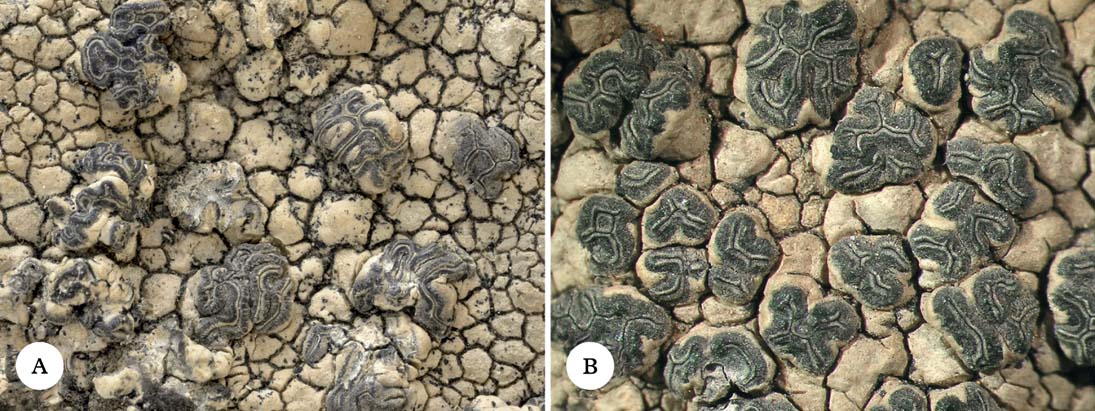
Thallus saxicolous, rather thick, areolate. Lirellae prominent, stellately branched and appearing in pseudostromatic clusters, with basal to lateral thalline margin. Excipulum completely carbonized, overarching over the hymenium and with short, smooth, relatively thick (1·5–2·5 µm) periphysoids above the hymenium. Hymenium clear, 100–120 µm high. Ascospores 8 per ascus, irregularly biseriate, ellipsoid, submuriform with 3–5 transverse and 0–2 longitudinal septa per segment, 18–25×8–10 µm, lacking perispore (due to the age of the material?), I−.
Secondary chemistry. Norstictic acid.
Notes. Carbacanthographis chilensis appears to be endemic to the dry coastal desert region of central and northern Chile (and southern Peru?). It is easily recognized by the stellate, pseudostromatic clusters of black, completely carbonized lirellae, in combination with submuriform ascospores and a norstictic acid chemistry. Carbacanthographis saxiseda occurs in the same area but has unbranched to irregularly branched, incompletely carbonized lirellae and relatively shorter and broader, muriform ascospores with irregularly arranged lumina.
This study was made possible by two grants provided by the United States National Science Foundation (NSF) to The Field Museum: “Neotropical Epiphytic Microlichens” (DEB 0715660; PI Lücking) and “ATM – Assembling a taxonomic monograph: The lichen family Graphidaceae” (DEB 1025861; PI Lumbsch, Co-PI Lücking). The curators at the herbaria in FH, PC, and W, Michaela Schmull, Bruno Dennetière, and Othmar Breuss, are warmly thanked for their assistance in examining the type material of Medusulina chilena, Opegrapha petraea, and Graphina saxiseda.