1. INTRODUCTION
Requirement planning is one of the most critical activities in the product development process. Engineering requirements describe the attributes, behaviors, and functionalities that a product has to possess in order to satisfy the needs of product stakeholders (Pahl et al., Reference Pahl, Beitz and Wallace1984). Despite its significant impact on the outcome of the design process, requirement planning, particularly in the early design stages, suffers from a lack of quantifiable measures for evaluating the quality of the generated requirements and also a lack of structure and formality in representing engineering requirements. The quality of the generated requirements in terms of clarity, specificity, feasibility, traceability, and completeness is often appraised on a consensual basis. In addition, requirements are usually represented informally in natural language without following any standard protocol or terminology. Even in the same company, different design teams may follow different methods and conventions for representing engineering requirements. Engineering requirements, represented in natural language, can be imprecise and ambiguous and contain contradictory information (Tseng & Jianxin, Reference Tseng and Jianxin1998). Resolving ambiguities and inconstancies may lead to costly engineering changes in later stages of product development. In the absence of formal methods and models for engineering requirement representation, management of requirements becomes inefficient and tedious especially when designing complex products with multiple subsystems.
There are multiple formal requirements models in the domain of software engineering developed with the objective of improving the process of requirement elicitation, analysis, communication, validation, control, and reuse (Jureta et al., Reference Jureta, Mylopoulos and Faulkner2009). However, there is no universally accepted standard or formalism for requirement modeling and representation in engineering design (Jianxin & Chun-Hsien, Reference Jianxin and Chun-Hsien2006). A formal standard for requirement representation assists designers in retrieving, reusing, updating, and sharing engineering requirements within and across design projects. Furthermore, it can be used for creating searchable requirement repositories that are directly linked to design solutions. Linking design solutions to engineering requirements enables traceability of design attributes to stakeholder needs. Finally, formal requirement models enable integration of requirement planning tools with computer-aided engineering and design tools to support objective evaluation of design alternatives early in the conceptual design phase.
The main objective of this research is to introduce a formal ontology for standard representation of engineering requirements. The particular focus is on the requirements, or “expectations,” that are generated in the early stages of the design process, and they are not translated into engineering attributes and product specifications yet. The proposed ontology uses explicit semantics that makes the ontology amenable to automated reasoning. The most obvious benefit of a shared ontology is streamlined information exchange across the product value chain at a semantic level. Through using well-defined syntax and semantics, onotologies help avoid ambiguity and divergent semantic interpretation. However, this paper explores other utilities of a formal ontology beyond information sharing and semantic interoperability. More specifically, ontology-enabled requirement analysis is the main focus of this paper. To demonstrate how the proposed ontology can support requirement analysis, three possible services enabled by the proposed ontology are introduced in this paper. These services are information content measurement, specificity and completeness analysis, and requirement classification. Information-content measurement service can be used for quantifying the rate of uncertainty reduction, or information gain, throughout a design project. Because design is essentially an information transformation and generation process, it can be argued that an information-based metric can better reflect the progress of the design process compared to other indirect measures such as cost or time. Specificity and completeness analysis service can help designers evaluate the developed requirement in terms of the level of details incorporated in formulating the requirement. Too much specificity in requirement planning reduces designers' freedom during the ideation process, thus hindering innovation. Conversely, generic requirements cannot effectively define the feasible design space. Finally, requirement classification service can enable more effective design search and retrieval because design solutions are oftentimes attributed to a set of recurring requirements. Through automated classification of requirements, a designer can more readily search for design solutions that are associated with certain classes of requirements such as safety or durability.
The paper is divided into the following sections. Section 2 provides a discussion of the related works. The requirement ontology is described later with detailed examples and protocols related to converting requirement statements into ontological representation. In the latter sections of the paper, ontological analysis of requirements is introduced in three areas, namely, information content measurement, specificity analysis, and requirement classification. The paper ends with a conclusion and the outline for further work.
2. RELATED WORKS
Requirement modeling and representation is more rigorously studied in the software engineering domain, and several models and methods for structured and formal representation of requirements have been proposed and implemented (Schatz et al., Reference Schatz, Fleischmann, Geisberger and Pister2005; Kossmann et al., Reference Kossmann, Odeh, Wong and Gillies2008; Jureta et al., Reference Jureta, Mylopoulos and Faulkner2009; Mir et al., Reference Mir, Agarwal and Iqbal2011; Qureshi et al., Reference Qureshi, Jureta and Perini2011). The main objective of requirement engineering in the software development domain is to materialize the vision for self-adaptive systems, the systems that can continuously adapt their behavior at runtime in response to changing user's requirements, operating contexts, and resource availability. Mir et al. (Reference Mir, Agarwal and Iqbal2011) proposed an ontology based on SysML for seamless integration of requirement model and system model in software development. Zhang and Zhang (Reference Zhang and Zhang2007) developed an ontology based on description logic for capturing and maintaining requirement-related knowledge in software engineering.
The body of research work in requirements representation and modeling in engineering design has been rather sparse. Yannou (Reference Yannou2012) introduced a model-based approach using UML and SysML for requirement representation. In this work, property-based requirement theory (Micouin, Reference Micouin2008) was used to provide the underlying formalism of the requirement model. This work addresses “well-formed” requirements that are distinguished from “expectations.” A well-formed requirement is defined as “a constraint applied to a property of an object (or system) when a condition is occurred (event) or is achieved (state).” Well-formed requirements are typically generated in the latter stages of design. In early stages, however, when requirements are still in the form of expectations, the proposed approach is not applicable.
Lamar and Mocko (Reference Lamar and Mocko2010) studied engineering requirements from a linguistic perspective and proposed a formalized syntax for requirement representation based on parts of speech, grammatical functions, and sentence structure. This study decomposes a requirement statement into four syntactical elements, namely, artifact, necessity, function, and condition. Using the proposed syntax and its associated analysis methods, one can assess the quality of requirement statements with respect to completeness, unambiguity, and traceability.
Morkos et al. (Reference Morkos, Shankar and Summers2012) developed a computational reasoning tool to help designers predict change propagation in the engineering domain. This tool uses the syntactical elements of requirements to build relationships between requirements. The syntactical elements used in Morkos' model include subject, modifier, verb (modal and transitive), object, and condition.
Lin et al. (Reference Lin, Fox and Bilgic1996) proposed an ontology for representing requirements that supports a generic requirements management process in engineering design. First-order logic is used as the knowledge representation formalism. In this ontology, engineering requirements are classified into four main categories: physical, structural, functional, and cost. The proposed ontology can be used for checking completeness, consistency, and satisfiability of engineering requirements.
Darlington and Culley (Reference Darlington and Culley2008) proposed an ontology for organizing the terms used for capturing design requirements. The objective of this ontology is to eliminate the ambiguity about various concepts related to engineering requirements such as target market, requirement resource, stakeholder, and the like. The envisioned applications for this ontology include streamlining communication among design engineers, supporting software application development (in particular, developing case-based reasoning systems for engineering requirements), and improving the performance of search engines. This ontology, however, is high level and cannot be used for breaking down requirement statements into their elemental components. Other related works in requirement representation include the requirement taxonomy (Hauge & Stauffer, Reference Hauge and Stauffer1993), the customer attribute hierarchy (Yan et al., Reference Yan, Chen and Khoo2001), and the functional requirement topology (Tseng & Jianxin, Reference Tseng and Jianxin1998).
The literature study reveals that, despite some efforts for structured representation of engineering requirement, there is still a wide gap to be filled before requirement modeling can be fully formalized and integrated with other phases of the engineering design process. This work attempts to partially fill the gap through providing a formal ontology for representing top-level requirements, or expectations, that are directly elicited from customer need statements. The developed ontology provides a smooth transition between textual representation and model-based representation of engineering requirements.
3. REQUIREMENT ONTOLOGY (ReqOn)
ReqOn is a formal ontology aimed at representation of engineering requirements generated during the requirement planning phase when design concepts are not conceived yet. Due to its formal semantics, ReqOn is amenable to automated reasoning and machine processing. Therefore, it could be used for automation of requirement management. A linguistic and grammatical approach is adopted for ontology conceptualization (Morkos et al., Reference Morkos, Shankar and Summers2012). Accordingly, parts of speech (verbs and nouns) and grammatical functions (subject, object, complement, and adjuncts) define the core classes of the ontology. The scope of ReqOn is currently limited to consumer products with medium complexity. However, the core classes of ReqOn are designed such that it can be evolved into a comprehensive requirements ontology that covers a wider range of artifacts. Web Ontology Language (OWL) is used as the ontology language of ReqOn.
3.1. ReqOn classes and properties
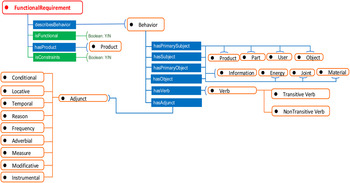
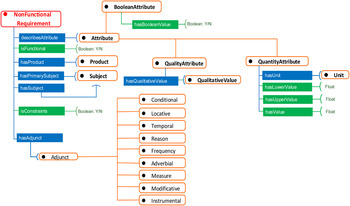
In ReqOn, each requirement statement is represented by the Requirement class, which has two disjoint subclasses: FunctionalRequirement and NonFunctionalRequirement. A functional requirement is related to the use of a product and describes the necessary task, activity, or action that should be accomplished. For example, “The electric kettle boils water quickly” is a functional requirement because it pertains to the action of boiling water. Nonfunctional requirements describe the attributes of the product such as size, color, recyclability, or ease of repair. The requirement “The electric kettle is light” is an example of a nonfunctional requirement. The concept diagrams in Figure 1 and Figure 2 show the properties of the FunctionalRequirement and NonFunctionalRequirement classes, respectively.
Concept diagram for the FunctionalRequirement class.

Concept diagram for the NonFunctionalRequirement class.

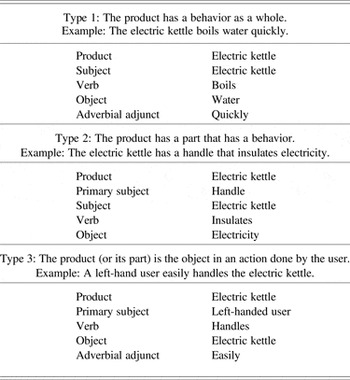
Both types of requirements inherit hasProduct and isFunctional properties from their common superclass (i.e., Requirement). The property hasProduct refers to the product to which the requirement statement applies, and its range is limited to instances of the Product class. Each requirement statement has exactly one instance of the Product class associated with it. The property isFunctional is a Boolean property used for indicating whether or not the requirement is functional. describesBehavior is a property specific to the FunctionalRequirement class, and its range is limited to instances of the class Behavior. The behavior of a product describes the casual process through which the function is achieved (Sen et al., Reference Sen, Caldwell, Summers and Mocko2010). The Behavior class in the ontology is designed such that a series of subjects and objects that are involved in delivering the function can be linked to the behavior. Each behavior has exactly one action verb, either transitive or nontransitive. Because the functional basis (FB; Hirtz et al., Reference Hirtz, Stone, McAdams, Szykman and Wood2002) provides a widely accepted functional schema in the engineering design community, this schema is adopted in ReqOn for breaking down the Verb class into more specific subclasses such as Connect, Convert, Support, and Branch. There are three possible types of functional requirements that can be modeled in ReqOn. Type 1 functional requirement describes the behavior of a product as a whole, Type 2 functional requirement describes the behavior of a part of a product, and Type 3 functional requirement describes the expected behavior of a product when it is the object of an action performed by the user.
Table 1 provides examples of different types of requirements that can be modeled in ReqOn. A functional requirement with a transitive verb has a primary subject and may have one or more secondary subjects. For example, if a functional requirement describes the behavior of the wheel of a bicycle, then the wheel is the primary subject and the bicycle is the secondary subject, because the requirement directly applies to the wheel and not to the bicycle itself. The requirement statements that have a transitive verb must have a primary object and may have one or more secondary objects. For example, in the requirement “The electric wok has a lid that can be flipped easily” the verb flip is TransitiveVerb, the noun lid is PrimaryObject, and the noun electric wok is Object. Both object and subject can have different types such as user, product, part, material, energy, or signal. For instance, in the requirement “A left-hand user easily handles the electric kettle,” the user is the primary subject. The taxonomy of the material, energy, and signal classes are directly imported from the FB. It is important to incorporate various class hierarchies in ReqOn because it allows for more accurate evaluation of the information content based on the depth of classes in the hierarchy.
Different types of functional requirements

The specificity of functional requirements can be improved by using adjuncts. An adjunct usually modifies a verb and indicates the time, manner, place, frequency, reason, degree, or condition pertaining to the requirement. For example, in the requirement statement “the hand truck holds boxes securely on steep slopes,” securely is an Adverbial Adjunct while on steep slopes is a Locative Adjunct. As the requirements evolve, designers add more details to the requirement through introducing various types of adjuncts.
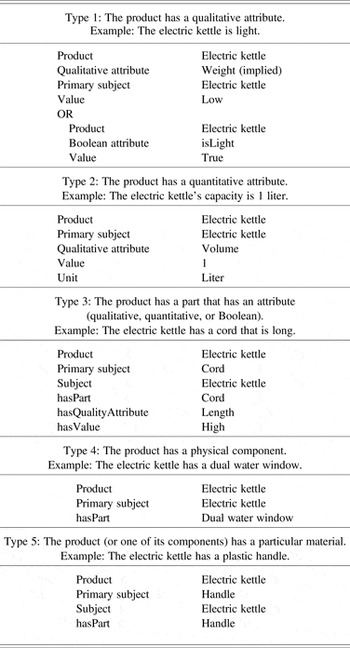
A NonFunctionalRequirement uses describesAttribute property to describe the attributes of the product. There are three subclasses for the Attribute class in the requirements ontology, namely, BooleanAttribute, QualityAttribute, and QuantityAttribute. For example, in the requirement “the phone is small in size,” size is the quality attribute, with small as its value. Grammatically, small is the subject complement in this example. However, if the actual dimensions, or ranges, are given for the size of the phone, then size can be regarded as a quantity attribute. A Boolean attribute is used for indicating if a product possesses a certain property. For example, in the requirement the printer is easy to repair, ease of repair can be treated as a Boolean attribute with a true value. Table 2 describes five possible types of nonfunctional requirement that can be represented in ReqOn. It should be noted that requirements that are developed at the early stages of the conceptual design phase are expected to be form-free to avoid premature anchoring of suboptimal solutions. Some of the example requirements provided in Table 2 contain solution-specific nouns such as cord, handle, and window. Those requirements are representative of the later stages of design when some solution fragments are identified.
Different types of nonfunctional requirements

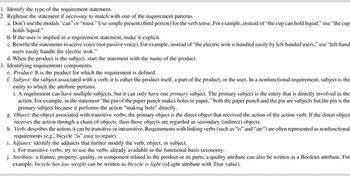
Table 3 describes the protocol for identifying different components of natural language requirement statements and converting them into ontological representation.
Protocol for creating requirement in ReqOn

3.2. ReqOn editor
ReqOn instances can be created and edited through Protégé ontology editor. However, working with Protégé requires OWL modeling knowledge that is a barrier for its widespread use. To facilitate ReqOn instance creations and manipulation, a Java-based tool was developed that uses OWL application program interface for interacting with the ontology.
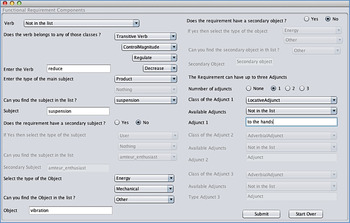
The tool provides two different interactive user interfaces for functional and nonfunctional requirements. Figure 3 shows the functional requirement editor. The user simply has to identify the grammatical components of the requirement statement such as subject, object, verb, and adjunct. The user is encouraged to reuse the existing verbs in the provided verb taxonomy. However, if the appropriate verb cannot be found in the taxonomy, the tool can accept new verbs introduced by the user. In this way, the ontology evolves as new instances of requirements are added to the ontology. The tool and the ontology were validated through creating more than 300 instances of both functional and nonfunctional requirements related to about 20 products. The students from a senior design course participated in the test and validation process.
Screenshot of the requirement editor for functional requirement.

4. INFORMATION CONTENT MEASUREMENT
One metric for evaluating the performance of engineering design organizations is information generation and transformation rate (Collopy & Eames, Reference Collopy and Eames2001). A design project results in generation of different types of artifacts that embody design information. Hence, in order to study information transformation rate, first, the information content of the created artifacts should be objectively measurable so that given a step, where, say, requirements are transformed into function models, the amount of information input to and output from the step could be measured. Design artifacts are represented in various forms, such as text, sketch, or graphs (Chandrasegaran et al., Reference Chandrasegaran, Ramani, Sriram, Horváth, Bernard, Harik and Gao2013). This research is based on the premise that information is a form-neutral entity, and therefore, a design artifact such as a requirement statement, conveys the same amount of information to the designer irrespective of its form such as text or sketch, and that this amount could be measured. ReqOn provides a form-neutral and formal representation that is amenable to automated information content measurement. It exposes various parts of speech in the requirement statement as ontological classes that can be contemplated as containers of information. Because requirements typically evolve during the lifetime of a design project, it is useful to monitor the growth of information content of requirements as a way for evaluating the performance of the design team. It should be noted that maximizing the information content of requirements, particularly in the early stages of design, is undesirable because it could prevent creative thinking. However, as designers gain more insight into customer needs, both explicit and implicit, and learn about internal and external constraints, design requirements are typically loaded with more information.
The proposed information content measurement technique in this work is based on the entropy metric used in Shannon's information theory (Shannon, Reference Shannon1948). In information theory, entropy is the measure of uncertainty in a model. Shannon's metric measures information contained in a finite message composed of discrete symbols drawn from a finite vocabulary, such as the dots and dashes in a telegraph message (Shannon, Reference Shannon1948). According to this theory, the entropy of a discrete random variable X with a probability distribution p(x) is defined by
 $$H\left( X \right) \equiv - \mathop \sum \limits_{x \in X} p\left( x \right)\log _2p\left( x \right).$$
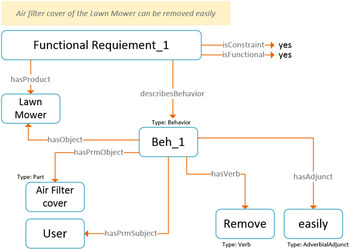
Values of X with higher likelihood of occurrence have lower entropy according to this definition. Shannon's metric intends to measure the information content of a message in terms of the size of the unique vocabulary that the message is drawn from. In the context of measuring the information content of engineering requirements, each requirement statement can be treated as a finite message, composed of distinct terms drawn from a finite vocabulary such as ReqOn. The ReqOn representation of a requirement statement is essentially a graph in which graph nodes are the ontological instances and the arcs are the relationships between those instances. Figure 4 show a graph associated with a functional requirement. Measuring the information content of a requirement statement entails measuring the information content of the nodes of this graph.
Graph associated with an example functional requirement.

Each node of the graph can be treated as a variable. The proposed information content measurement method is based on the assumption that the value of each design variable is selected from a set of known and finite options defined by the ontology. To assign a value to the variable, the type (class) of value should be determined and then a particular value needs to be selected from the set of possible values for that particular class. The first selection requires traversing the class structure and arriving at a particular type (node), and the second selection entails exploring the solution space for the selected class. Because the information content of each node is a function of the inherent uncertainty (or entropy) of the node, the underlying probability distribution of each node has to be known. A uniform probability distribution is assumed for the leaf classes of the ontology. In this way, the probability of an upper level class can be calculated through aggregation of the probabilities of its direct and indirect subclasses. The uniform probability is based on the assumption that all classes in the reference vocabulary can be encountered with equal likelihood. This assumption makes sense in the context of conceptual design because designers are usually encourages to avoid any bias in favor of any particular design idea during the ideation process.
The entropy associated with the structure of a class is referred to as taxonomy entropy in this work, and the entropy attributed to the number of direct class instances is called size entropy. The classes that have more complex subclass structure introduce more uncertainty. In addition, the classes that are instantiated more frequently have higher entropy because the probability of encountering a particular instance would be low. The taxonomy entropy of a class is based on the probability that a particular class is selected when traversing the class structure, and the size entropy is based on the probability that the selected class assumes a certain value. The total entropy of a class (Ec i ) is calculated as the summation of taxonomy entropy (TEc i ) and size (SEc i ) entropy.
 $$Ec_{i} = {\rm TE}c_{i} + {\rm SE}c_{i}. $$
4.1. Calculating taxonomy entropy
The following steps are used for calculating the taxonomy entropy of a class. The Verb class is used as an example here. The hierarchical structure of Verb is shown later in Eq. (5).
-
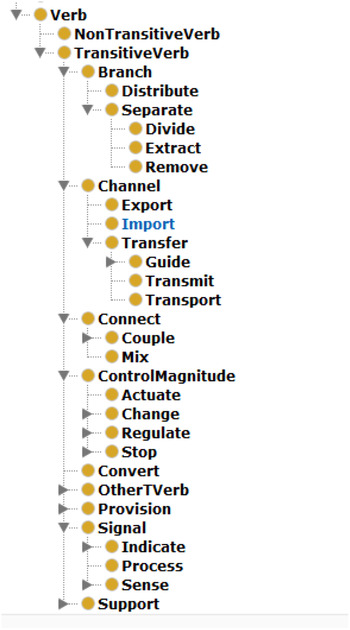
• Count the number of leaf classes under each parent class (N). A leaf class is one that does not have any subclasses. For example NonTransitiveVerb , Divide , and Import are examples of leaf classes. In Figure 5, parent class Verb has 36 leaves.
-
• Assign a probability of (1/number of leaf under parent class = 1/N) to each leaf. For example, assign probability of 1/36 to NonTransitiveVerb , Divide , and Import . It is assumed that all leaf nodes have equal likelihood of occurrence (uniform probability distribution).
-
• For the rest of the subclasses under the parent class, count the number of leaves (n) under them. For example, the count of leaves under class Branch is n = 4.
-
• Probability of all subclasses other than leaf is the number of leaf nodes under the selected class divided by the total number of leaf nodes under its parent class (n/N). For example, probability of occurrence of class Branch = 4/36.
-
• After determining the probability of occurrence of the class, the entropy measure is applied for calculating the taxonomy entropy of the class.
Hierarchical structure of the verb class.

 $${\rm TE}c_{i} = - \log _2\left( {Pc_i} \right) $$
where TEc i is the taxonomy entropy of the ith class c i and Pc i is the probability of occurrence of class c i . For example, the TE of class Branch (TEbranch) is calculated as follows:
 $${\rm T}{\rm E}_{{\rm Branch}} = - \log _2P_{{\rm Branch}} = - \log _2\displaystyle{4 \over {36}} \approx 2.97\; {\rm bits}. $$
4.2. Calculating size entropy
The size of a class refers to the number of individuals, or instances, of the class at any given time. The size entropy of class c i is calculated using Eq. (5).
 $${\rm SE}c_{i} = - \log _2\left( {\displaystyle{1 \over {Nc_i}}} \right)\comma $$
where Nc i is the number of instances for class c i . For example, if there are nine instances under the class Material, then
 $${\rm SE}c_{{\rm material}} = - \log _2\displaystyle{1 \over 9} = 2.197\; {\rm bits}.$$
For compound classes such as Behavior, size and taxonomy entropy are measured through summation of the entropies associated with the constituting classes, namely, Subject, PrimarySubject, Object, PrimaryObject, Verb, and Adjunct.
 $$E_{{\rm Behavior} } = E_{{\rm Subject}} + E_{{\rm PrimarySubject}} + E_{{\rm Object}} + E_{{\rm PrimaryObject}} + E_{{\rm Verb}} + E_{{\rm Adjunct}}. $$
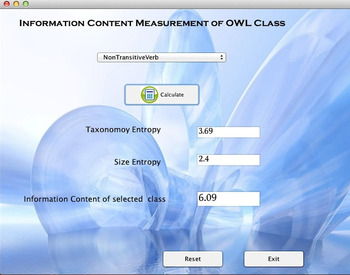
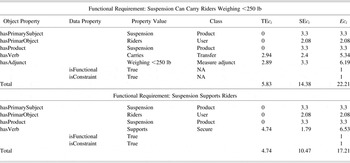
A Java-based tool was developed based on the proposed algorithm. The tool measures the information content of the requirements represented ontologically. The developed tool uses OWL application program interface for interacting with the ontology. The user needs to translate the engineering requirements written in natural language into ReqOn representation. The tool receives an OWL/XML file as the input a measures the information content of the selected requirement statements or classes as shown in Figure 6 and Figure 7. For example, the information content of the requirement statement “the suspension can carry riders weighting up to 250 lbs.” is measured to be 22.12 bits. It should be noted that this value should be treated as a relative value. A similar requirement statement, such as “the suspension supports riders,” contains 17.21 bits of information meaning that, in comparison to the previous requirement, is less informative. Different components of information content for these two examples are provided in Table 4.
Screenshot of the information content measurement tool for classes.

Screenshot of the information content measurement tool for full requirement statements.

Different components of IC for two example requirements

The proposed information content measure can be used for various purposes such as comparing the performance of different engineering design teams, evaluating the productivity of design projects with respect to information gain, and comparing different families of products with respect to information content measure.
5. SPECIFICITY AND COMPLETENESS EVALUATION
The information content measure that was introduced in the previous section can be used for evaluating the overall performance of engineering design teams with respect to the rate of information gain or uncertainty reduction. However, there is a need to evaluate the quality of the generated requirement quantitatively. Joshi and Summers (Reference Joshi and Summers2014) developed a method for evaluation of specificity and completeness of requirements written in natural language. As the number of requirements in a project grows, manual analysis and evaluation of requirements becomes error prone and tedious. In the presence of a formal ontology, it is possible to automatically evaluate the quality of the requirement statements. Specificity and completeness are used as the metrics of quality evaluation in this work.
5.1. Completeness analysis
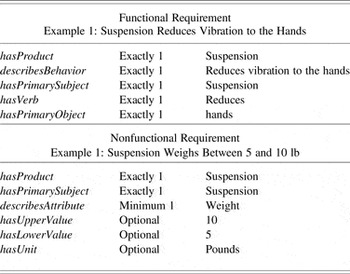
Completeness analysis is conducted through checking the presence of the necessary elements in the requirement statement. Requirements are often incomplete in the early stages of design to promote innovation and creative thinking. However, the focus of the completeness analysis in this paper is on structural and syntactic completeness and not technical completeness. If a requirement contains all of the required elements, depending on its type, it is considered to be a complete requirement structurally. Otherwise, it is incomplete. Table 5 and Table 6 show the essential properties of functional and nonfunctional requirements, respectively.
Cardinality restriction of essential properties for functional requirement

Cardinality restriction of essential properties for nonfunctional requirement

To assign a completeness score to each instance of the Requirement class, a Boolean data property named hasCompletenessScore was introduced. The domain of the property hasCompletenessScore is the Requirement class, and its range is between 0 and 1. A functional requirement will have a completeness score of 1 if it describes a behavior, which has exactly one product, one primary subject, one verb, and one primary object (if the verb is transitive). A nonfunctional requirement will have a completeness score of 1 if it has exactly one product, one primary subject, and describes at least one attribute. Table 7 shows examples of complete functional and nonfunctional requirements. Adjuncts contribute to the specificity of requirements, and they are not included in completeness analysis. A requirement can be structurally complete without an adjunct.
Example of complete functional and nonfunctional requirement

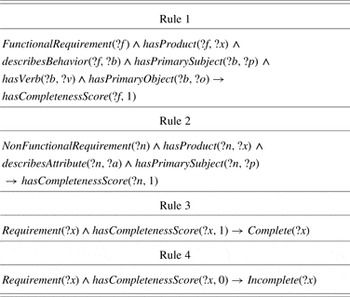
Completeness score computation and assignment is implemented through Semantic Web Rule Language (SWRL) rules as shown in Table 8. The first two rules compute the completeness score for functional and nonfunctional requirements, and the last two rules classify requirements as complete or incomplete requirements. Incomplete requirements are returned to the design team for revision.
SWRL rules for completeness score assignment

5.2. Specificity analysis
Complete requirements can be further analyzed to evaluate their specificity. Specificity reflects the level of details incorporated in the requirement. More specific requirements are more informative. For complete functional requirements, five criteria are used for specificity analysis, namely, existence of secondary subject, depth of verb, existence of secondary object, number of adjunct, and existence of a measure adjunct.
5.2.1. Existence of more than one subject
Requirements with more than one subject are more specific or informative. For example, the requirement statement “hand truck has a base pad that holds large and odd-shaped loads securely,” has a primary subject, base pad, and a secondary subject, hand truck, whereas, the requirement statement “hand truck holds large and odd-shaped loads securely,” has only a primary subject, hand truck. The first requirement describes a function of a component of the product while the second requirement describes a function of the product itself. As discussed before, a more specific requirement is not necessarily preferred over a less specific one due to confining the feasible design space. Designers are usually encouraged to start with a less specific list of requirements for more effective use of design freedom. In the hand truck example, the more specific requirement forces the designer to incorporate a base pad into the design concept.
5.2.2. Depth of verb
The depth criterion is used as a measure of specificity because it can be argued that deeper classes in a taxonomy are more specific than top-level classes. The proposed ontology uses hierarchical structure for some of classes such as Verb, Energy, Material, Adjunct, and Attribute. The class Verb is the most significant constituent of a functional requirement. Therefore, its depth is used as a criterion for specificity analysis.
5.2.3. Existence of more than one object
Functional requirements with a transitive verb have at least one object. Requirements with more than one object are deemed more informative because they further delineate the design problem. For example, the requirement statement “The suspension preserves the steering characteristics of the bike” has a primary object “Steering Characteristic” and a secondary object Bike.
5.2.4. Number of adjuncts
The specificity of functional requirements can be further improved through using adjuncts. For example, in the requirement statement “the hand truck holds boxes securely on steep slopes,” securely is an AdverbialAdjunct, while on steep slopes is a LocativeAdjunct. A study of more than 200 well-defined requirements revealed that a typical requirement with a reasonable level of specificity has two adjuncts.
Existence of a measure adjunct
The requirements that contain a Measure Adjuncts are typically among the most informative requirements. For example, the requirement statement “The suspension has a maximum vertical deflection at the seat mount of 8 mm at 250 lbs. static load” is pointing to an important design variable (maximum vertical deflection) with important implications for the final design. This type of requirement is typically generated during the later stages of the concept design phase.
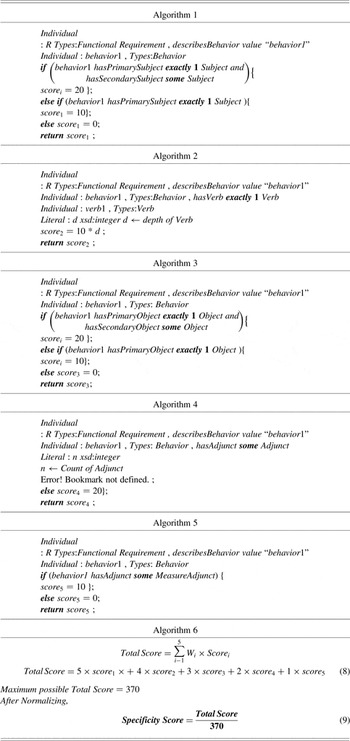
The specificity of functional and nonfunctional requirements is quantified through the specificity score. A continuous scale of 0 to 1 is used to represent the specificity score of the requirements. Table 9 shows the procedure used for calculating the specificity score of functional requirement. A similar procedure is used for nonfunctional requirements.
Algorithm to calculate specificity score of functional requirement

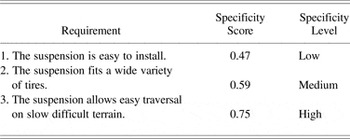
The weights used in Eqs. (8) and (9) depend on the nature of the design project, and they are recommended to the user by the system. For example, for new design projects where the design is conceived functionally without any reference to physical forms, more weight is put on verbs. Using the proposed scoring method, requirements can be classified into three classes: highly specific (specificity score > 0.75), moderately specific (0.75 > specificity score > 0.5), and not specific (0.5 > specificity score). SWRL rules are used to determine the equivalent specificity class of a requirement. Table 10 shows examples of requirements for a bike suspension with different levels of specificity based on the proposed scoring method.
Example requirements with low, medium, and high specificity

6. REQUIREMENT CLASSIFICATION
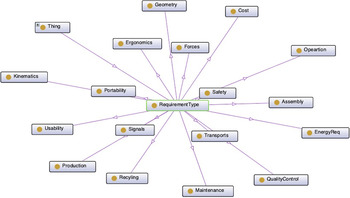
Automated requirement classification is another utility of ReqOn. Requirement classification and organization facilitates search and retrieval of requirements. An efficient and intelligent requirement search mechanism helps designers explore past design solutions that have addressed similar design problems. Based on Pahl et al.’s approach (1984) engineering requirements can be classified under different categories such as safety, performance, production, geometry, and ergonomics depending on their nature. For example, the requirements that belong to the Kinematics category typically deal with the type of motion of the product, direction of motion, velocity, and acceleration. As another example, Environmental requirements are the requirements that address the need for controlling the adverse environmental impacts of the product. Figure 8 shows the different categories of functional and nonfunctional requirements in this work.
Classification of requirement.

6.1. Classification of nonfunctional requirements
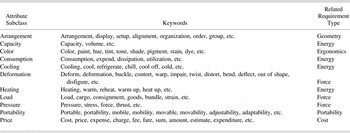
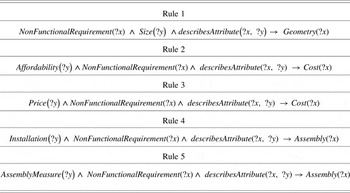
The type of nonfunctional requirements is determined based on the type of the attribute used in the requirement. A two-step method is used for classifying nonfunctional requirements. The type of attribute is determined through a keyword matching approach, and then the requirements are classified using SWRL rules. A Java-based tool is developed for this purpose. The tool analyzes each instance of the Attribute class and then matches it with a set of predefined keywords. Examples of keywords pertaining to different attribute classes are shown in Table 11.
Example keywords for selected attributes

Once the attribute type is identified, SWRL rules will be used to infer the requirement type. Examples of such rules are given in Table 12. For example, if a nonfunctional requirement describes an attribute that belongs to the class Size, the requirement is categorized under the Geometry class. Therefore, requirement statement “The frame of the ingot oven is not taller than 51/2 feet” is classified as a geometric requirement.
Example of SWRL rules of requirement classification (nonfunctional)

6.2. Classification of functional requirements
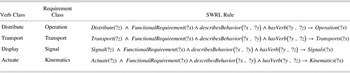
For functional requirements, verbs are used for inferring the type of the requirement. Unlike attribute instances, verb instances do not need to be classified because their type is already defined at the time of instantiation in ReqOn. Therefore, SWRL rules can be directly applied to requirements for classification purpose. The developed tool parses the requirement statement in its ontological form and extracts the verb instance and identifies its type. For example, in the requirement statement “The suspension traverse easily on a difficult terrain,” the verb traverse is an instance of the Transport class. As a result, through executing the appropriate SWRL rule, this requirement is classified as a Transport requirement. Examples of SWRL rule for functional requirement classification are given in Table 13.
Example of SWRL rules of requirement classification (functional)

7. CONCLUSIONS
In this work, a novel method for representation, evaluation, and classification of engineering requirements was introduced. The core technical contributions of this work are twofold: developing a comprehensive ontology for requirement representation based on OWL and developing quantitative methods and metrics for requirement evaluation supported by automated ontological reasoning. The tools, models, and methods developed in this work enable more intelligent management of engineering requirements particularly in the early stages of design process.
A Java-based automated tool was built to translate natural language requirement statements into OWL ontology. The tool is based on the linguistic structure of a requirement statement, and it was developed in such a way that the user does not require any knowledge of OWL ontology modeling to use it. Further, necessary methods and metrics to measure the information content of a requirement statement were established. A semiautomatic tool was created to measure the information content of a single requirement statement or a whole set of requirements for a product. The proposed information content metric can be used for evaluating the performance of design teams with respect to information generation rate. Furthermore, to evaluate the quality of a requirement statement, necessary metrics and rules were developed to measure the completeness and specificity of a requirement statement. A tool was developed to evaluate and assert the completeness and specificity of a requirement. In addition, a method for automated classification of requirements using ontological reasoning was introduced.
It should be noted that the methodologies presented in this work are tailored for requirement statements that already follow a semistructured syntax and grammar. For more unstructured texts and nontextual information, such as those found in technical standards or service guidelines, a more complete set of protocols should be developed. It can be argued that ontologies can be used for representation of different types of artifact because they model the world at the most abstract and conceptual level. Therefore, the proposed approach can be applied to other types of design artifacts, particularly textual design artifacts.
There are multiple possibilities for extension of this work in the future. The proposed ontology can be used for ensuring the consistency of product specifications and resolving potential conflicts and ambiguities. Further exterminations and analysis are required to study how the information content of requirements for a given product correlates with the complexity of the products. Although the proposed requirements ontology was developed to support intelligent requirement analysis, it could be used for enabling semantic information exchange and knowledge management and reuse during the requirement planning phase. A formal ontology with explicit semantics not only provides the requirement planning process with more structure but also facilitates retrieval and reuse of the requirements from similar design projects. If engineering requirements are mapped to different design features of the existing products in the design repository, designers can adopt the existing concepts, or their variations, to address new design problems.
Extension of the ontology defines another avenue for future work. The ontology is rich with respect to the vocabulary for functional requirements because it is based on the vocabulary of the FB, but the nonfunctional side of the ontology needs further expansion. In particular, there is a need for extending the Attribute class of the ontology and include a taxonomy that covers various type of attributes such as attributes durability, recyclability, serviceability, color, and ease of use. The ontology needs to be evolved continually such that it can capture the needs, desires, and beliefs of customers more accurately. Developing the methodology for ontology evolution, by itself, is research problem that needs to be addressed independently.
ACKNOWLEDGEMENT
Funding for this research was provided by the National Science Foundation under Award CMMI-1334259.
Alolika Mukhopadhyay is currently a PhD student in the Department of Mechanical and Industrial Engineering at Northeastern University. She received her MS degree in technology management from Texas State University.
Farhad Ameri is an Associate Professor of manufacturing engineering and technology in the Department of Engineering Technology at Texas State University and the head of the Engineering Informatics (INFONEER) Research Group. He received his doctoral degree in manufacturing engineering from the University of Michigan. Dr. Ameri's research interests include design and manufacturing informatics, smart manufacturing systems, and design theory and methodology.