INTRODUCTION
Children with autism spectrum disorders (ASDs) are usually delayed in the onset of their language development and frequently demonstrate impairments of various subcomponents of language (Eigsti, Bennetto & Dadlani, Reference Eigsti, Bennetto and Dadlani2007; Tager-Flusberg, Reference Tager-Flusberg2006; Tager-Flusberg et al., Reference Tager-Flusberg, Calkins, Nolin, Baumberger, Anderson and Chadwick-Dias1990). These impairments are probably attributable, at least in part, to the well-attested difficulties that children with ASD have with social attention and interaction. That is, if children do not pay attention to the people in their environment, they are probably also not paying attention to the language those people are using, and so not tapping into the language data those people are providing. Intervention thus frequently focuses on directing children with autism toward language input, and progress in language development is often seen once children begin such therapy (Lovaas, Reference Lovaas1981; Stone & Yoder, Reference Stone and Yoder2001). Some recent studies have provided evidence of children with ASD learning aspects of language incidentally, that is, from listening to regular social discourse (McDuffie & Yoder, Reference McDuffie and Yoder2010; Swensen, Naigles & Fein, Reference Swensen, Naigles, Fein, Caunt-Nulton, Kulatilake and Woo2007). Nonetheless, the extent to which children with ASD utilize their language input in the same ways (e.g. exploiting the same types of information) as typically developing (TD) children is still unknown. The purpose of the current study was to investigate whether children with ASD would show evidence of learning about some aspects of wh-questions from maternal input in naturalistic situations, as well as to compare the kinds of input information used by TD children and those with ASD.
From a pragmatic standpoint, wh-questions typically ask for information which is desired, but not known, by the speaker, and which the speaker assumes to be known by the addressee (Searle, Reference Searle1969). Syntactically, an English wh-question is an interrogative sentence that begins with a ‘Wh’ word (e.g. who, what, where, why, when), which represents missing information. Wh-questions can ask for a missing argument (1–3) or an adjunct (4):
(1) What did he eat?
(2) Who likes Mary?
(3) Who does Mary like?
(4) Why did he eat that?
Because the wh-word is almost always produced at the beginning of the sentence, wh-questions deviate from the standard SVO word order that English-learning children acquire before two years of age (Gertner, Fisher & Eisengart, Reference Gertner, Fisher and Eisengart2006; Swensen, Kelley, Fein & Naigles, Reference Swensen, Kelley, Fein and Naigles2007). Morphosyntactically, English object and adjunct wh-questions involve the inclusion of auxiliaries (e.g. do, can, shall, will) preceding the subject (e.g. (1), (3), and (4) above), unless the main verb is the copula, in which case the subject and copula invert (e.g. (5)):
(5) Where is that man?
Languages differ as to whether movement is involved in question formation (de Villiers, Roeper & Vainikka, Reference de Villiers, Roeper, Vainikka, Frazier and de Villiers1990); for example, the wh-word remains in situ in Mandarin (6), while all main verbs invert in German (7):
(6) Ni xihuan shei?
you like who
‘Who do you like?’
(7) Was glaubst du mit wem Daniel spricht?
what think you with whom Daniel talks
‘Who do you think Daniel is talking with?’
Wh-question development in TD children and those with ASD
Young TD children begin producing ‘where’ and ‘what’ wh-questions by the age of 2;3 to 2;5 (e.g. Bloom, Merkin & Wooten, Reference Bloom, Merkin and Wooten1982; Stromswold, Reference Stromswold1995; Tyack & Ingram, Reference Tyack and Ingram1977). These children's earliest wh-questions seem to be tied to social routines (e.g. ‘What is that?’, ‘Where is the [NP]?’), with the more sophisticated grammatical forms (e.g. subject and object wh-questions; inverted AUX) and speech acts (e.g. requests for information) becoming more frequent later in the third year of life (Ambridge, Rowland, Theakston & Tomasello, Reference Ambridge, Rowland, Theakston and Tomasello2006; Stromswold, Reference Stromswold1995). As is common in typical language acquisition, children provide evidence of understanding subject and object wh-questions at earlier ages (i.e. 1;8; Goodwin, Fein & Naigles, Reference Goodwin, Fein and Naigles2012; Seidl, Hollich & Jusczyk, Reference Seidl, Hollich and Jusczyk2003). Thus, the development of wh-question use in TD children has been shown to follow a specific progression and a fairly rapid rate.
In contrast, wh-question production has been found to be both delayed and sparse in children with ASD. For example, Tager-Flusberg et al.'s (Reference Tager-Flusberg, Calkins, Nolin, Baumberger, Anderson and Chadwick-Dias1990) longitudinal study of spontaneous speech produced by children with ASD found that question (and negation) complexity was significantly lower in the ASD group relative to controls, especially as utterance length increased. When only their wh-questions were scrutinized, these children produced many fewer wh-questions than language-matched peers (i.e. 1% of utterances vs. 2·8% of utterances for the controls; Tager-Flusberg, Reference Tager-Flusberg and Tager-Flusberg1994). Eigsti et al. (Reference Eigsti, Bennetto and Dadlani2007) also found lower question-and-negation complexity in the speech of five-year-olds with autism; moreover, these children produced higher frequencies of some more complex question-and-negation forms, but lower frequencies of less complex forms, where the opposite pattern is what is expected if development is proceeding typically. Taken together, these findings suggest that some children with ASD may acquire wh-questions via a different process than TD children; for example, they may rely on memorizing item-specific formats rather than analyzing the questions into their components and abstracting generalized wh-question constructions.
However, Goodwin et al. (Reference Goodwin, Fein and Naigles2012) also investigated the development of the understanding of subject and object wh-questions in children with ASD, using intermodal preferential looking (IPL). They used Seidl et al.'s (Reference Seidl, Hollich and Jusczyk2003) video, which showed transitive dynamic events (e.g. an apple hitting a flowerpot) followed by side-by-side static pictures of the participating objects (apple, flower). The audios presented both subject and object wh-questions (e.g. ‘What hit the flower?’, ‘What did the apple hit?’). Goodwin et al. found that the children with ASD demonstrated consistent comprehension at approximately the same language level (albeit chronologically later) as the TD children. The children with ASD also exhibited stable comprehension of these questions prior to producing them in spontaneous speech, thereby manifesting the usual TD pattern of comprehension preceding production (Maratsos, Reference Maratsos, Kuhn and Siegler1998; Snyder, Reference Snyder2007; Swensen, Kelley, et al., Reference Swensen, Kelley, Fein and Naigles2007). These findings raise the possibility that these children with ASD were indeed extracting wh-question patterns from their input.
Caregiver input and children's language development
Research with TD children has explored how the lexical, grammatical, and pragmatic aspects of caregiver input subsequently affect a child's language acquisition. Caregivers vary in the quantity and diversity of input they provide to children, and researchers have found a number of effects of this variation on children's subsequent grammatical production and comprehension. For example, Newport, Gleitman, and Gleitman (Reference Newport, Gleitman, Gleitman, Snow and Ferguson1977) found that mothers who used more yes/no questions, which highlight AUX verbs (e.g. ‘Do you want more juice?’), had children who subsequently used more AUX verbs (see also Hoff-Ginsberg, Reference Hoff-Ginsberg1985, for a similar facilitative effect of maternal wh-questions, and Shatz, Hoff-Ginsberg & MacIver, Reference Shatz, Hoff-Ginsberg and MacIver1989, for experimental evidence). According to Rowland and colleagues, the non-inversion errors in wh-questions produced by TD children (e.g. ‘What he is eating?’) can be explained by variations in the input frequency of specific wh-word/AUX pairs (e.g. what is vs. what are; Ambridge et al., Reference Ambridge, Rowland, Theakston and Tomasello2006; Rowland, Pine, Lieven & Theakston, Reference Rowland, Pine, Lieven and Theakston2003, Reference Rowland, Pine, Lieven and Theakston2005; see also Valian & Casey, Reference Valian and Casey2003). Finally, studies have shown that hearing more complex sentences facilitates children's production and comprehension of long and complex sentences (Gleitman, Newport & Gleitman, Reference Gleitman, Newport and Gleitman1984; Huttenlocher, Waterfall, Vasilyeva, Vevea & Hedges, Reference Huttenlocher, Waterfall, Vasilyeva, Vevea and Hedges2010; Vasilyeva, Huttenlocher & Waterfall, Reference Vasilyeva, Huttenlocher and Waterfall2006).
Concerns have been raised about some of the above findings, regarding the lack of specificity of the input–outcome link in some cases (e.g. Valian, Reference Valian, Ritchie and Bhatia1999) and a methodology that sometimes did not control for effects of children's early speech on their later speech (Huttenlocher et al., Reference Huttenlocher, Waterfall, Vasilyeva, Vevea and Hedges2010). However, recent studies have begun to incorporate more sophisticated statistical analyses, which allow for stronger conclusions to be drawn about the relationship between input and children's language development. For example, the use of lagged regression analyses (e.g. Huttenlocher et al., Reference Huttenlocher, Waterfall, Vasilyeva, Vevea and Hedges2010) has allowed researchers to make stronger claims about the direction of influence, as children's language development cannot predict previous caregiver input. Likewise, studies that experimentally manipulate the language input that children receive provide evidence that language development is indeed influenced by the language that they hear. Such studies have revealed that children who hear a high proportion of passives subsequently use more passives themselves, and differential exposure to auxiliaries results in varying abilities to generalize in preschool-aged children (i.e. Valian & Casey, Reference Valian and Casey2003; Vasilyeva et al., Reference Vasilyeva, Huttenlocher and Waterfall2006).
The role of caregivers' linguistic input has only recently begun to be examined with children with ASD. An important element of the impairment in ASD is the diminished degree to which children with autism engage in monitoring other people (Charman, Reference Charman1998; Mundy, Sigman & Kasari, Reference Mundy, Sigman and Kasari1994). Preverbal toddlers with autism show no overt preference for their own mother's voice (Klin, Reference Klin1991); therefore, a reasonable conjecture might be that caregiver input effects are unlikely to be observed in the language development of children with autism. It is possible, though, that as these children progress through intervention, they begin to attend to and learn from caregiver language in naturalistic settings. Several recent studies suggest that this might be the case: in the lexical realm, Warren et al. (Reference Warren, Gilkerson, Richards, Oller, Xu, Yapanel and Gray2009) reported correlations between overall adult word frequency and the concurrent vocalizations of children with ASD. In addition, McDuffie and Yoder (Reference McDuffie and Yoder2010) have found that parents who describe their own actions while their child with ASD is attending, and who expand upon their child's communicative utterances, have children with higher vocabulary scores six months later. In the syntactic realm, children with ASD have been shown to be responsive to wh-questions produced during intervention sessions (Yoder, Davies, Bishop & Munson, Reference Yoder, Davies, Bishop and Munson1994). Swensen, Naigles, and Fein (Reference Swensen, Naigles, Fein, Caunt-Nulton, Kulatilake and Woo2007) reported that mothers who produced more yes/no questions during naturalistic play sessions had children with ASD who produced more AUX verbs during such sessions eight months later. In the current study, we build on these recent findings by investigating the extent to which the comprehension of wh-questions by children with ASD–as well as those who are typically developing–is related to earlier aspects of their caregiver input.
There are no known published reports of how caregiver input might be related to children's acquisition of the wh-movement component of wh-questions; that is, the knowledge that the wh-word stands for or refers to an argument NP that originated in a different position in the sentence (e.g. that the What in (1) refers to the object/patient of eat). This is the first question we address in the current study. Recent findings lead us to hypothesize several possible relationships. First, caregiver input might exert corresponding (i.e. Huttenlocher et al., Reference Huttenlocher, Waterfall, Vasilyeva, Vevea and Hedges2010) effects on children's acquisition of wh-movement, such that children who hear more subject or object wh-questions should acquire these question forms earlier and/or more quickly than children who hear fewer subject or object wh-questions. Such effects (following Valian's, Reference Valian, Ritchie and Bhatia1999, ‘copy metaphor’ of input effects) would be consistent with demonstrations that hearing more passives or specific wh-word/AUX pairs is related to earlier acquisition of those specific linguistic forms (e.g. Rowland et al., Reference Rowland, Pine, Lieven and Theakston2003, Reference Rowland, Pine, Lieven and Theakston2005; Vasilyeva et al., Reference Vasilyeva, Huttenlocher and Waterfall2006). Also, consistency of lexical items within a grammatical construction might matter: children who hear one highly frequent wh-question form (e.g. ‘What do you want?’) might acquire that form (i.e. object wh-questions) more quickly than children who hear a range of wh-question forms (Casenhiser & Goldberg, Reference Casenhiser and Goldberg2005).
On the other hand, caregiver input might exert more indirect, diversity-related effects. For example, hearing a concentrated block of wh-questions with the auxiliaries can and be has been shown to result in children producing more wh-questions with the auxiliaries do and will (Valian & Casey, Reference Valian and Casey2003), and hearing sentences with a diverse set of elements within a clause (e.g. different adjectives, adverbs, possessives, or quantifiers) was found to be associated with children subsequently producing clauses with diverse elements (Huttenlocher et al., Reference Huttenlocher, Waterfall, Vasilyeva, Vevea and Hedges2010; see also Matthews & Bannard, Reference Matthews and Bannard2010; Naigles & Hoff-Ginsberg, Reference Naigles and Hoff-Ginsberg1998). Thus, hearing wh-questions with diverse lexical items might facilitate their acquisition by enabling children to abstract the wh-question construction itself, including the movement of the wh-word. Diversity in wh-question input might also work at the sentence frame level, in that hearing diverse types of wh-questions (e.g. subject, object, predicate nominative (‘What's that?’), adjunct (‘Why do you want that?’)) might enable children to distinguish each type. For example, children hearing both subject and object wh-questions, plus ‘why’ questions, might more quickly and/or easily extract their different patterns of wh-movement (i.e. from argument positions in the former vs. adjunct positions in the latter). Conversely, hearing only repeated tokens of ‘What do you want?’ or ‘What's that?’ might promote children learning these questions as frozen/unanalyzed forms.
Our second question concerns whether children with ASD show similar effects of input as TD children, in acquiring wh-questions. As summarized above, there are fewer findings relating to input effects with ASD groups, so any predictions must be tentative. However, given the later comprehension and less complex production of wh-questions by children with ASD, one prediction might be that these children show more ‘corresponding’ and fewer ‘diversity’ effects than TD children. Input investigations involving children with ASD are also complicated by the very real possibility that these children hear different input than TD children. For example, if children with ASD do not respond to questions (e.g. because they do not understand, or do not care to answer), parents may stop asking them. Furthermore, parents may tailor speech to children's perceived comprehension level; if parents of children with ASD cannot accurately judge the abilities of their child (because the child does not provide feedback; e.g. answering questions or repeating questions), parents may underestimate how much the child can comprehend and adjust their speech accordingly. Therefore, it is important to compare the actual input of the two groups, as well as observed input effects.
Prospectus
The current study investigated two questions about the role of caregiver input in children's acquisition of wh-questions. First, which types of caregiver input predict children's performance on a wh-question comprehension task? And second, did TD children and those with ASD use the same or different types of information in their caregiver input? We addressed these questions using the longitudinal corpus studied by Goodwin et al. (Reference Goodwin, Fein and Naigles2012), which included dyads of caregivers and their children, who were either TD or diagnosed with ASD, engaging in naturalistic interactions filmed every four months over the course of 1·5 years (5 visits). We examined the caregivers' usage of wh-questions at the first and second visits to ascertain whether the same or similar quantity and content of input was available to both groups of children. Our measures of children's degree of understanding of wh-questions include and expand upon those reported by Goodwin et al. (Reference Goodwin, Fein and Naigles2012), which were administered to the same children who participated in the naturalistic interactions. Following recent research that has found TD infants' and toddlers' degree of looking during experimental tasks to be indicative of their concurrent or subsequent language use (Fernald, Perfors & Marchman, Reference Fernald, Perfors and Marchman2006; Kuhl, Conboy, Padden, Nelson & Pruitt, Reference Kuhl, Conboy, Padden, Nelson and Pruitt2005; see also Naigles, Kelty, Jaffery & Fein, Reference Naigles, Kelty, Jaffery and Fein2011, for similar findings with children with ASD), we adopt as our outcome measures the children's relative visual fixation during the test trials, controlling in two ways for their baseline preferences.
We investigated which aspects of caregiver wh-question use at early visits (visits 1–2) predicted the children's degree of wh-question comprehension at subsequent visits. To the extent that children use ‘corresponding’ aspects of wh-questions as information for learning about wh-movement, then caregiver use of subject and object wh-questions, as well as ‘where’ questions and number of wh-words, should be positive predictors of later degree of wh-question comprehension. Whereas to the extent that children are able to abstract or analyze across items in their input for learning about wh-movement, then caregiver diversity of wh-question use at the lexical and/or construction levels, as indicated by the number of different AUX and/or main verbs used, may be positively predictive of later degree of wh-question comprehension. Inversely, caregiver restrictiveness or ‘routineness’ of wh-question use, as indicated by the number of questions with copular verbs (e.g. ‘What's this?’), may be negatively predictive of later degree of wh-question comprehension.
METHOD
Participants
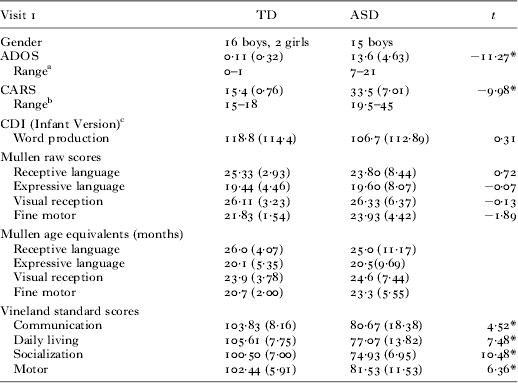
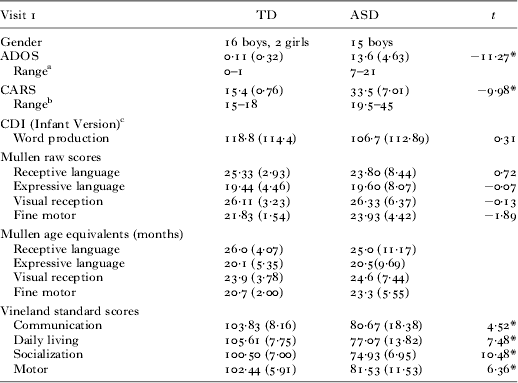
The final participant pool included fifteen children with ASD and eighteen TD children. The ASD group (13 White males, one White/ Hispanic male, one White/Asian male) was recruited through treatment facilities and schools in Connecticut, Massachusetts, New York, and New Jersey. This sample size is within the usual range of language outcome and experimental studies on children with ASDs (e.g. Charman, Drew, Baird & Baird, Reference Charman, Drew, Baird and Baird2003; Eigsti et al., Reference Eigsti, Bennetto and Dadlani2007; Swensen, Kelley, et al., Reference Swensen, Kelley, Fein and Naigles2007). The children ranged in age from 2;3 to 3;1 at the onset of the study (M = 2;9·3, SD = 0;3·12). All of the children in the ASD group were diagnosed with Autism or Pervasive Developmental Disorder-Not Otherwise Specified (PDD-NOS) by clinicians prior to the beginning of the study. Because of the difficulty in distinguishing between the two disorders before age 3;0, either diagnosis was accepted. We confirmed this diagnosis with the Autism Diagnostic Observation Schedule (ADOS; Lord, Rutter, DiLavore & Risi, Reference Lord, Rutter, DiLavore and Risi1999) and Childhood Autism Rating Scale (CARS; Schopler, Reichler & Renner, Reference Schopler, Reichler and Renner1988) prior to the start of the study (see Table 1). These measures generate good agreement between themselves, and with other diagnostic tools (Chlebowski, Green, Barton & Fein, Reference Chlebowski, Green, Barton and Fein2010; Ventola et al., Reference Ventola, Kleinman, Pandey, Barton, Allen and … Fein2006). All the children were within eight months of the start of an Applied Behavior Analysis program (ABA; Lovaas, Reference Lovaas1987; either inside or outside of the home) and were receiving between 5 and 30 hours of ABA therapy per week (M = 21·07 hours; SD = 10·13) at the onset of the study.
Comparison of TD and ASD groups at Visit 1
notes:* p < ·05; a: Autism Spectrum = 7+; Autism = 12+; b: CARS range = 15–60; Autism Spectrum = 30+; Autism = 36+; c: Number of words produced out of a possible 396.
The TD group consisted of sixteen males and two females (all White), between the ages of 1;6·26 and 1;11·27, with a mean age of 1;8·18 (SD = 0;1·22). Their average production vocabulary based on the MacArthur Communicative Development Inventory (CDI; Fenson et al., Reference Fenson, Dale, Reznick, Bates, Thal and Pethick1994) did not differ significantly from the ASD group (see Table 1). The TD children were also given the ADOS and CARS evaluations; as summarized in Table 1, none of these children (in contrast to all of the children with ASD) showed elevated scores. All were considered to be normally developing, in that none had been referred for any special services by their pediatricians, and no parent had requested any special evaluations or services.
Assessment contexts
Standardized tests
The ADOS (Lord et al., Reference Lord, Rutter, DiLavore and Risi1999) and CARS (Schopler et al., Reference Schopler, Reichler and Renner1988) were administered to assess ASD status. We also administered the Vineland Adaptive Behavior Scales, 2nd Edition (Vineland II; Sparrow, Cicchetti & Balla, Reference Sparrow, Cicchetti and Balla2005) to evaluate children's communication, socialization, daily living skills, and motor skills, which yielded standard scores based on mothers' reports. The Mullen Scales of Early Learning (Mullen, Reference Mullen1995) were administered to measure development in the areas of visual reception, fine motor skills, receptive language, and expressive language. The CDI (Fenson et al., Reference Fenson, Dale, Reznick, Bates, Thal and Pethick1994) provided a measure of the children's language production abilities, via parental report. All of these tasks were administered at visit 1.
Wh-question comprehension task
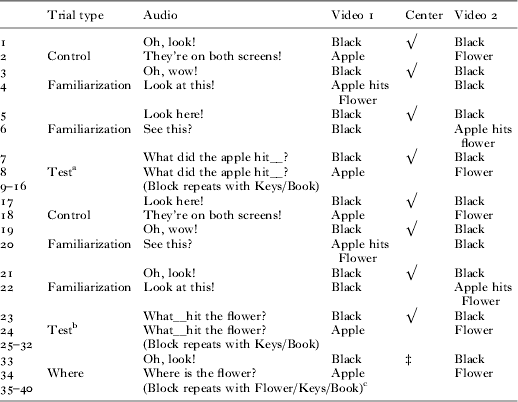
The children's understanding of subject and object wh-questions was assessed via the IPL paradigm (Golinkoff, Hirsh-Pasek, Cauley & Gordon, Reference Golinkoff, Hirsh-Pasek, Cauley and Gordon1987), which consists of showing children two videos side-by-side, while playing child-directed speech that corresponds to only one of the videos. The child's direction and duration of gaze are recorded and used as an indication of his/her understanding. We used a modified version of the video used by Seidl et al. (Reference Seidl, Hollich and Jusczyk2003), in which pairs of familiar objects (i.e. apple and flower, keys and book) first appeared simultaneously side-by-side without a directing audio, as control trials (Trials 2 and 18 in Table 2). The objects then appeared in ‘hitting’ events (i.e. the apple hit the flower, the keys hit the book; Trials 4, 6, 20, and 22 in Table 2), then were shown simultaneously again in static picture pairs as test trials. Children heard three wh-question types during the test trials: object ‘what’ questions (i.e. ‘What did the apple/keys hit?’; Trial 8 in Table 2), subject ‘what’ questions (i.e. ‘What hit the flower/book?’; Trial 24 in Table 2), and ‘where’ questions (i.e. ‘Where is the apple/flower/keys/book?’; Trial 34 in Table 2). The video was counterbalanced by participant: for half of the children, the apple and keys always appeared on the left, while the flower and book always appeared on the right. For the other half of the participants, this was reversed. Table 2 provides a sample layout of the wh-question video.
Sample layout of the wh-question video

notes: √ = Red dot flashing to draw the child's attention back to the center before the next trial begins; ‡ = Fish swimming across screen to maintain children's interest; a: Object wh-questions = ‘What did the apple hit?’ ‘What did the keys hit?’; b: Subject wh-questions = ‘What hit the flower?’ ‘What hit the book?’; c: ‘Where is the apple?’ ‘Where is the flower?’ ‘Where are the keys?’ ‘Where is the book?’
Mother–child play session
At each visit, mother and child engaged in a 30-minute play session, half of which was semi-structured and based on the Screening Tool for Autism in Two-Year-Olds (STAT; Stone, Coonrod & Ousley, Reference Stone, Coonrod and Ousley2000). For the first portion, mothers were periodically handed cards that prompted them to play with particular items that had been provided by the researcher. For example, cups were used to build a tower, the child was asked to choose between an empty container and one with a snack in it, and the mother and child looked in a pillowcase filled with toys. The prompts facilitated discussion of a variety of topics, while allowing the mother to produce the same quality of speech that she normally would in that situation. The final portion of the session was free play. The play session was recorded and later transcribed.
Procedure
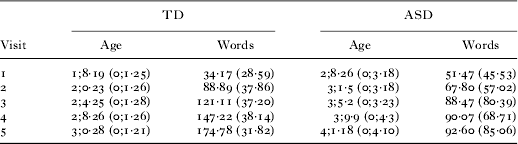
Children were visited in their homes at four-month intervals for five visits; their mean ages at each visit, and mean number of word types produced during the play session, are given in Table 3. The visits began with one experimenter administering standardized tests, while another experimenter prepared the IPL set-up. Next, the child sat approximately three feet in front of the screen and camcorder and watched a series of three IPL videos. The Wh-Question video was shown at visits 3 through 5, and was always the second or third video in the series.Footnote 1 Breaks were allowed as needed between videos.
Children's mean age and number of word types (SD) at each visit
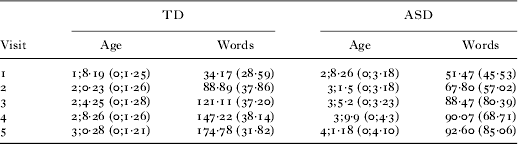
note: Mean ages of TD and ASD groups are significantly different at each visit (ps < ·05); Mean number of word types of TD and ASD groups are significantly different at Visits 4 and 5 (ps < ·01).
Following the IPL videos, the mother and child engaged in the 30-minute play session. After this, the mother was asked if this amount of speech was typical for her and her child. Finally, the mother completed any remaining surveys or forms.
Coding and dependent measures
The standardized tests were scored by the experimenter, and standard scores were calculated.
The children's gaze during the IPL task was video-recorded and then coded in the lab. Ten percent of the videos were coded a second time, to test for reliability (mean r = 0·99). Five variables were calculated for each child at each visit including: (1) children's mean percent looking time to the named object (relative to total looking to both scenes) when a ‘what’ wh-question was asked (Trials 8, 16, 24, 32 in Table 2); (2) percent of time looking to the matching scene across the four ‘what’ trials (Trials 8, 16, 24, 32 in Table 2); (3) mean percent looking time to the named object when a ‘where’ question was asked (Trials 34, 36, 38, 40 in Table 2); (4) mean percent looking to that object averaged across the four control trials (Trials 2, 10, 18, 26 in Table 2); and (5) percent of time looking to the matching scene averaged across the four control trials (Trials 2, 10, 18, 26 in Table 2) at each visit. Note that measures (1) and (2), and (4) and (5), are reciprocals of each other (i.e. during the same trials, measure (1) calculates the children's percent looking to the named object whereas measure (2) calculates their percent looking to the matching object).
Goodwin et al. (Reference Goodwin, Fein and Naigles2012) reported the findings comparing looking to the named object (Variables 1 and 3) for the ‘where’ vs. ‘what’ trials. The rationale for this comparison was that if children understand the ‘what’ questions, they should look more at the named item for ‘where’ questions (e.g. ‘Where is the book?’) than at the same named item for ‘what’ questions. That is, for ‘What hit the book?’, they should look longer at the keys (Seidl et al., Reference Seidl, Hollich and Jusczyk2003). This comparison provides a minimal indication of ‘what’ question understanding, showing that the ‘what’ question pulls children's attention away from the named item (even adults look at the named item, before switching to the correct referent, during on-line processing of wh-words; Kukona & Tabor, Reference Kukona and Tabor2011; Sussman & Sedivy, Reference Sussman and Sedivy2003). In the current paper, we also report findings of a more stringent test of ‘where’ comprehension, comparing the children's looking to the named object for the ‘where’ vs. control trials (Variables 3 and 4), as well as a more stringent test of subject and object wh-question comprehension, comparing the children's looking to the match (Variables 2 and 5) for the ‘what’ vs. ‘control’ trials, asking if the child looked at the matching scene significantly longer when the ‘what’ question was asked (during the ‘what’ trial), than when no question was asked (during the ‘control’ trial). For the child to identify the matching scene in Trial 8, for example, s/he needed to syntactically process the ‘what’ question while simultaneously recalling the hitting event in Trials 4 and 6 (i.e. remembering which was the agent and which was the patient).
Goodwin et al. (Reference Goodwin, Fein and Naigles2012) reported results from analyzing the entirety of each 4-second trial; however, further scrutiny has revealed that the children in both groups displayed a delay in responding to the ‘where’ questions, which are undoubtedly the easiest. That is, across all three visits, the TD children looked at the matching picture on average 54% of the time (SD = 8%) during the first half of the trial and 75% of the time (SD = 14%) during the second half of the trial. Across all three visits, the children with ASD looked at the matching picture on average 48% of the time (SD = 15%) during the first half of the trial and 63% of the time (SD = 12%) during the second half of the trial. These findings suggested that the second half of the trials was a more reliable indicator of the children's comprehension; therefore, the analyses described below included only the children's looking patterns during the second half of each trial.
Transcript coding
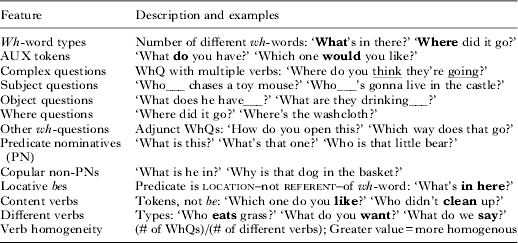
We coded children's speech at visits 3–5 for word types. We coded mothers' speech at visits 1 and 2 for wh-question use. Only phrases that were wh-questions with verbs were included in the analyses. Thus, utterances such as ‘What?’ or ‘When you?’ were excluded. These wh-questions were coded for the type of wh-word used, for the presence of an AUX verb, and for whether the questions were subject questions, object questions, ‘where’ questions, other questions (e.g. adjuncts) and/or complex (multi-clausal) questions. Moreover, these wh-questions were further subdivided by the type of verb used. The first subdivision targeted whether the verb was a copula (i.e. be), or a non-copular (hence, content-rich, such as clean or like) verb. Wh-questions with copulas were then subdivided into those that were predicate nominatives or non-predicate nominatives. Predicate nominatives resembled subject questions, but the copula was always followed by an NP that referred to the same physical object in the environment as the wh-word (e.g. ‘Who is that?’). Predicate adjectives were included in this category as well (e.g. ‘What is big?’). All other wh-questions with the copula were coded as non-predicative nominatives (e.g. locative questions, such as ‘What's he in?’). Wh-questions with all other verbs were coded as ‘content rich’. Examples of each category are given in Table 4.
Wh-question features
Analyses
Two difference scores were created for each child at each visit, capturing the degree to which the children shifted (a) away from the named object during the second half of the ‘what’ trials relative to the second half of the ‘where’ trials and (b) toward the matching object during the second half of the ‘what’ trials relative to the second half of the ‘control’ trials. Maternal use of wh-questions was investigated in a series of two-way ANOVAs (group × visit). Bivariate correlations were then performed between the children's ‘Where–What’ and ‘What–Control’ scores, and their mothers' use of wh-questions at visits 1 and 2, separately. Preliminary pairwise correlations between input and degree-of-comprehension measures were followed by partial correlations to address concerns that the obtained relationships could be attributed to the general factors of maternal input complexity and child language level. Because previous research has demonstrated that mothers with more complex speech have children with better language abilities overall (e.g. Gleitman et al., Reference Gleitman, Newport and Gleitman1984; Hoff & Naigles, Reference Hoff and Naigles2002), we controlled for mothers' mean length of utterance (MLU) at the same visit as their input measures. Additionally, children's better comprehension could be attributed to a larger vocabulary overall, so we controlled for children's total word types (produced spontaneously during the play sessions) at the same visit as their comprehension measures. A child receptive language score might be considered a better control for our comprehension measures; however, we only collected receptive language scores at visit 1 (from the CDI and Mullen). A second series of correlations was performed controlling for children's Mullen receptive language scores at visit 1; the results of this second series being generally similar to those of the first, here we only report those partialling out child word types.
RESULTS
Children's comprehension of wh-questions
Table 5 presents the mean percent looking scores for each measure across visits, for both groups. The significance notations in the ‘Where’ columns indicate at which visits each group looked significantly longer at the named object during the ‘where’ trials compared with the control trials. The significance notations in the ‘What-a’ columns indicate at which visits each group looked significantly less at the named object during the ‘what’ trials compared to the ‘where’ trials. As the table shows, the TD children demonstrated robust comprehension of the ‘where’ questions, and significantly less looking at the named object for the ‘what’ questions, across all visits (between 78% and 94% of TD children displayed this pattern at a given visit). As expected, the ASD group demonstrated somewhat less consistency, with significant ‘where’ comprehension, and significantly less looking at the named object during ‘what’ trials compared with ‘where’ trials, at two of the three visits (between 71% and 78% of children with ASD displayed this pattern at a given visit).
Percent of time looking during second half of trials: means (and standard deviations)

notes: + p < ·10; * p < ·05; ** p < ·001; a: These measures reflect percent looking to the named object; b: These measures reflect percent looking to the matching object for the subject and object wh-questions.
In Table 5, the significance notations in the ‘What-b’ columns indicate at which visits each group looked significantly longer at the matching object during the ‘what’ trials compared to the control trials. The TD children demonstrated marginally significantly more looking at the matching object during ‘what’ compared with control trials at visit 5 (65% of children displayed this pattern at visit 5); the children with ASD did not do so at any visit.
What types of wh-question did mothers produce?
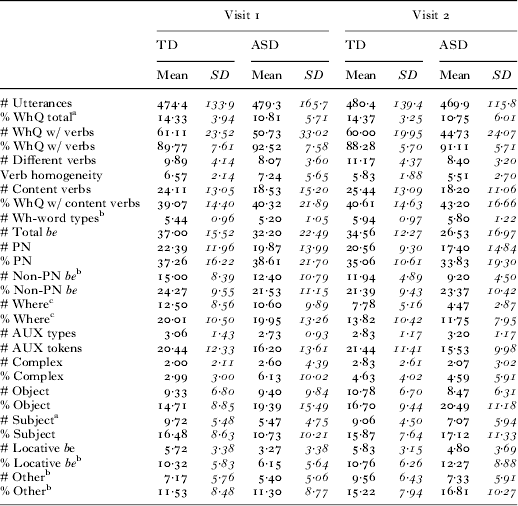
Overall, mothers in both groups (TD and ASD) produced speech of a similar quality. Means and standard deviations for all codes are displayed in Table 6, for both groups. Because the maternal input variables were non-orthogonal, a single ANOVA was not possible. Instead, we conducted a series of two-way ANOVAs, with group (TD vs. ASD) as the between-subjects variable, and visit (1 vs. 2) as the within-subjects variable. As Table 6 shows, there were only two significant differences between the mothers in the two groups: mothers in the TD group produced a higher percentage of wh-questions than mothers in the ASD group (F(31,1) = 5·688, p = ·023, partial eta squared = 0·155), and mothers in the TD group produced more subject wh-questions, on average, than mothers in the ASD group (F(31,1) = 4·457, p = ·043, partial eta squared = 0·126). Main effects of visit were observed for wh-word types (F(31,1) = 7·290, p = ·011, partial eta squared = 0·190), number of copular questions that were not predicate nominatives (F(31,1) = 4·460, p = ·043, partial eta squared = 0·126), percent of locative wh-questions (F(31,1) = 5·344, p = ·028, partial eta squared = 0·147), number of ‘where’ questions (F(31,1) = 11·770, p = ·002, partial eta squared = 0·275), percent of ‘where’ questions (F(31,1) = 10·318, p = ·003, partial eta squared = 0·250), number of ‘other’ wh-questions (F(31,1) = 5·329, p = ·028, partial eta squared = 0·147), and percent of ‘other’ wh-questions (F(31,1) = 6·153, p = ·019, partial eta squared = 0·166). There were no significant Visit × Group interactions. When conducting multiple tests, it is customary to adjust for type II error by reducing the significance level (i.e. requiring a p value of ·025 or less). We chose not to, in order to demonstrate that–even when being generous, rather than conservative–few differences in wh-question use were observed between mothers of TD children and mothers of (initially language-matched) children with ASD. The effects of visit, though, further supported our decision to perform the correlations and regressions with the maternal input measures separated by visit.
Means and standard deviations of maternal input features at Visits 1 and 2, for the TD and ASD groups
notes: a: Main effect of Group (TD vs. ASD): (F(1,31) > 4·45, p < ·05); b: Main effect of Visit (1 vs. 2): (F(1,31) > 4·45, p < ·05); c: Main effect of Visit (1 vs. 2): (F(1,31) > 10·31, p < ·01); PN = Predicate Nominative.
Did mothers' wh-question production correlate with children's comprehension of wh-questions?
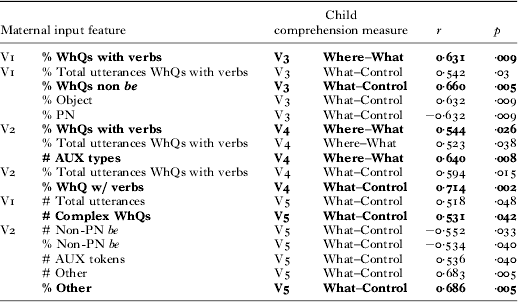
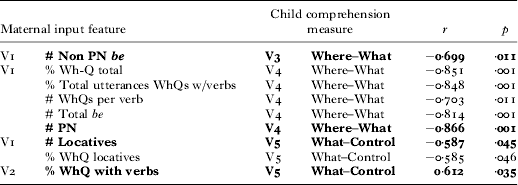
We correlated mothers' wh-question codes (listed in Table 6) at visit 1 and 2 with their children's later degree of comprehension measures (‘Where–What’, ‘What–Control’). Maternal MLU at the input visit and child word types at the outcome visit were partialled out; only those correlations that remained significant are discussed here. The partial correlations are presented in Tables 7 and 8.
Significant partial correlations between mothers’ input at Visits 1 and 2 and TD children's comprehension at Visits 3 through 5 (controlling for mother's MLU and children's word types)
note: PN = Predicate nominative.
Significant partial correlations between mothers’ input at Visits 1 and 2 and children with ASD's comprehension at Visits 3 through 5 (controlling for mother's MLU and children's word types)
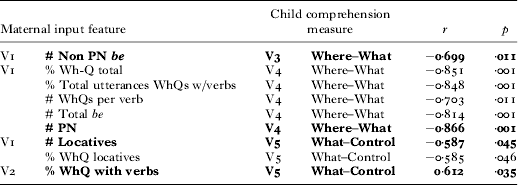
note: PN = Predicate nominative.
For the TD group, mothers who used a greater percentage of wh-questions with verbs, a greater percentage of wh-questions with verbs other than be, and a greater percentage of object wh-questions at visit 1, as well as those whose wh-questions with verbs comprised a greater percentage of their total utterances, had children with higher comprehension scores at visit 3. In contrast, mothers who used a greater number of predicate nominative questions (see Table 4) had children with poorer overall comprehension scores at visit 3. Similar measures of mothers' wh-question use at visit 2 were observed to positively correlate with the children's performance at visit 4; in addition, maternal use of more auxiliary verb types at visit 2 also positively correlated with children's wh-question performance at visit 4. Children's performance at visit 5 was positively associated with maternal total utterances and number of complex wh-questions at visit 1, as well as with mothers' use of ‘other’ wh-questions and auxiliary verb tokens at visit 2. Interestingly, mothers' use of copular wh-questions that were not predicate nominatives (see Table 4) was negatively associated with children's wh-question performance at visit 5.
Some of these same maternal input features were also correlated with degree of comprehension of ‘what’ questions in the ASD group (see Table 8). For example, mothers who produced more predicate nominative questions, more copular questions, and more wh-questions overall, had children with ASD with lower comprehension scores at visits 3 and 4. Mothers who produced more ‘locative’ wh-questions had children with lower comprehension scores at visit 5; however, like the TD group, mothers who produced a higher percentage of wh-questions with verbs at visit 2 had children with higher comprehension scores at visit 5. Finally, children who heard more wh-questions for a given verb (i.e. had higher verb homogeneity) performed more poorly on the wh-question task at visit 4. The bases for these correlations will be considered in more detail in the ‘Discussion’ section.
In sum, several aspects of maternal use of wh-questions at the early visits correlated significantly with children's ‘what’ question comprehension scores at later visits. However, some of the codes overlapped with each other (e.g. ‘locative’ wh-questions were also included as copula non-PN wh-questions), so it is not clear which aspect(s) of wh-question use contributed most strongly to the correlations. Additionally, correlations do not reveal the relative strength of the control variables. We conducted regression analyses to overcome these issues.
Which maternal input features predict later wh-question comprehension in children?
A series of multiple regressions was conducted to determine if the aforementioned maternal input features predicted later comprehension of wh-questions by children. For each analysis, mothers' MLU at visit 1 or 2 (i.e. the same visit that the predictor variables were obtained at) and children's number of word types from the same visit as the comprehension scores were entered in the first step of the hierarchical regression, to control for factors that have already been shown to predict later language outcome in young children. In the following steps, all input features that had been significantly correlated with comprehension scores at a subsequent visit (see Tables 7 and 8) were entered into the regression one at a time (i.e. one variable per step), with the order determined by the strength of the correlations (i.e. variables with the strongest correlations were entered in earlier steps than variables with weaker relationships). This method allowed us to determine if each variable was accounting for a significant amount of additional variance, above that provided by the first variables entered into the regression. Results of the regression analyses are presented for all significant models, in Tables 9–14.
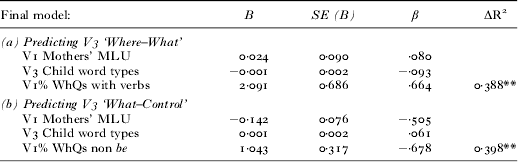
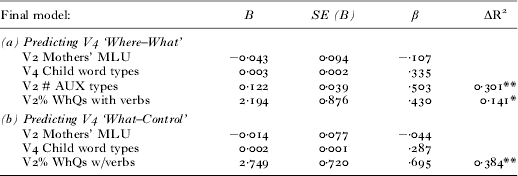
Regressing TD children's comprehension of wh-questions using the ‘Where–What’ measure at visit 3 on mothers' MLU and children's word types did not yield significant results. The addition of ‘percent wh-questions with verbs at visit 1’ to the model accounted for a significant amount of additional variance (ΔR 2 = 0·388, p = ·009), as shown in Table 9, model (a). In a second regression model for the TD group, using the ‘What–Control’ measure at visit 3, mothers' MLU and children's word types were not predictive of comprehension at visit 3. However, the addition of ‘percent wh-questions without be’ to the model resulted in a significant increase in variance accounted for (ΔR 2 = 0·398, p = ·005), as shown in Table 9, model (b). Both of these input features had positive values, indicating that children hearing a greater percentage of wh-questions with verbs, especially if those verbs were not the copula, had higher comprehension scores at visit 3.
Hierarchical regression analyses for maternal input at Visit 1 predicting overall comprehension of wh-questions by TD children at Visit 3
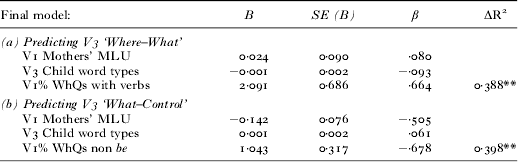
note: ** p < ·01.
Hierarchical regression analyses for maternal input at Visit 2 predicting overall comprehension of wh-questions by TD children at Visit 4
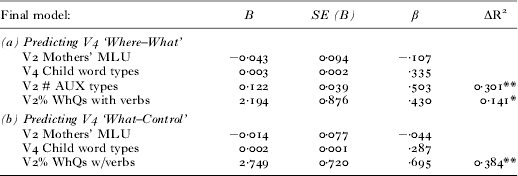
notes: * p < ·05; ** p < ·01.
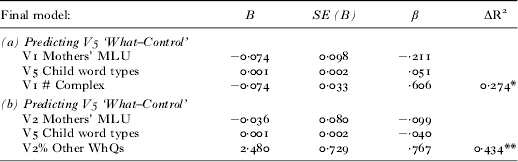
Hierarchical regression analyses for maternal input at Visits 1 and 2 predicting overall comprehension of wh-questions by TD children at Visit 5
notes: *p < ·05; ** p < ·01.
Hierarchical regression analyses for maternal input at Visit 1 predicting overall comprehension of wh-questions by children with ASD at Visit 3

note: * p < ·05.
Hierarchical regression analyses for maternal input at Visit 1 predicting overall comprehension of wh-questions by children with ASD at Visit 4

note: ** p < ·01.
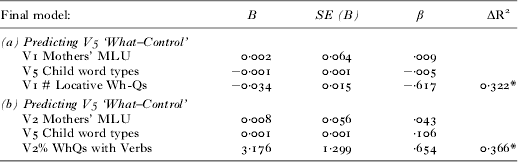
Hierarchical regression analyses for maternal input at Visits 1 and 2 predicting overall comprehension of wh-questions by children with ASD at Visit 5
note:* p < ·05.
Regressing TD children's comprehension of wh-questions using the ‘Where–What’ measure at visit 4 on mothers' MLU and children's word types did not yield significant results. However, the addition of ‘number of AUX types’ to the model resulted in a significant increase in variance accounted for (ΔR 2 = 0·301, p = ·008), and the addition of ‘percent wh-questions with verbs’ to this model resulted in another significant increase in variance accounted for (ΔR 2 = 0·141, p = ·026) as shown in Table 10, model (a). These input features had positive values, meaning that children who at visit 2 heard wh-questions with more varied auxiliaries, and more wh-questions with verbs, performed better on the wh-question comprehension task at visit 4.
In a second regression model for the TD group, using the ‘What–Control’ measure at visit 4, mothers' MLU and children's word types were not predictive of degree of comprehension at visit 4. However, the addition of ‘percent wh-questions with verbs’ to the model resulted in a significant increase in variance accounted for (ΔR 2 = 0·384, p = ·002), as shown in Table 10, model (b). This input feature had a positive value, meaning that children who heard more wh-questions with verbs at visit 2 performed better on the wh-question comprehension task at visit 4.
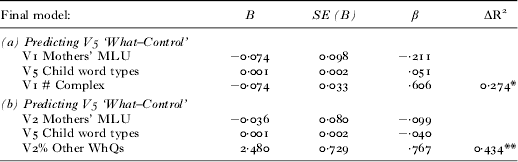
Regressing TD children's comprehension of wh-questions using the ‘What–Control’ measure at visit 5 on mothers' MLU and child word types at visit 1 also did not yield significant results; however, the addition of ‘number of complex wh-questions’ to the model resulted in a significant increase in variance accounted for (ΔR 2 = 0·274, p = ·042), as shown in Table 11, model (a). This input feature had a positive value, meaning that children who heard more complex wh-questions at visit 1 performed better on the wh-question comprehension task at visit 5. In a second regression model using the ‘What–Control’ measure at visit 5 and maternal input at visit 2, mothers' MLU and children's word types were not predictive of degree of comprehension at visit 5. However, the addition of ‘percent other wh-questions’ to the model resulted in a significant increase in variance accounted for (ΔR 2 = 0·434, p = ·005), as shown in Table 11, model (b). This input feature had a positive value, meaning that children who heard more ‘other’ wh-questions at visit 2 performed better on the wh-question comprehension task at visit 5.
Table 12 presents the effects of maternal input at visit 1 on the ASD group's ‘Where–What’ performance at visit 3. After controlling for mothers' and children's language abilities, the number of be questions that were not predicate nominatives at visit 1 accounted for a significant amount of the variance in the model (ΔR 2 = 0·407, p = ·011). Mothers who asked more be questions at visit 1 had children with lower wh-question comprehension scores at visit 3. No other variables added to the model in subsequent steps contributed a significant amount of explanatory power to the model.
Table 13 presents the effects of maternal input at visit 1 on the ASD group's ‘Where–What’ performance at visit 4. ‘Number of predicate nominatives’ at visit 1 significantly predicted children's performance (ΔR 2 = 0·605, p < ·001), although no other variables contributed significantly to the model. That is, the more predicate nominatives that mothers produced, the lower their children's subsequent comprehension scores tended to be.
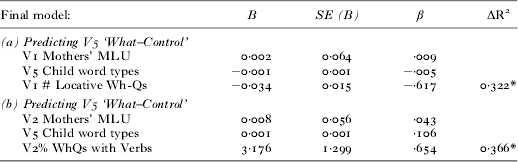
Table 14 presents the effects of maternal input on the ASD group's ‘What–Control’ comprehension scores at visit 5. Children's performance was significantly negatively predicted by number of locative wh-questions produced by mothers at visit 1 (ΔR 2 = 0·322, p = ·045; Table 14, model (a)), and significantly positively predicted by the percent of wh-questions with verbs produced by mothers at visit 2 (ΔR 2 = 0·366, p = ·035; Table 14, model (b)).
In summary, several maternal input measures were significantly correlated with children's comprehension of wh-questions, and some of these were shown to be unique and significant predictors, after controlling for maternal MLU, children's word types, and covariance among the predictors. The measures that remained significant in the regression analyses are bolded in Tables 7 and 8.
DISCUSSION
The goal of this research was to investigate the role of caregiver input in the acquisition of the wh-movement rule that characterizes the formation of wh-questions in English, by typically developing children and children with ASD. We assessed children's comprehension of subject and object wh-questions via IPL and compared this understanding to maternal input from earlier visits. We have three major sets of findings:
1. Only two aspects of wh-question use varied across groups, with the mothers of TD children producing a greater percentage of wh-questions overall, as well as more subject wh-questions than the mothers of children with ASD. Overall, though, the speech of the mothers of the children with ASD appeared to bear the same relationship to their children's language level as that of the TD group (i.e. because the children did not differ at Visit 1; see Table 1). However, as Table 6 shows, some characteristics of mothers' wh-question use changed from Visit 1 to Visit 2, including number of wh-word types, and number and percentage of ‘other’ questions, which increased, and number of non-PN be questions and number and percentage of ‘where’ questions, which decreased.
2. For the TD group, the aspects of caregiver wh-question use at Visit 1 that correlated significantly with the children's comprehension levels at the three visits included seven positive features (percent of total utterances that were wh-questions with verbs, percent of wh-questions that included verbs, percent of object wh-questions, percent of wh-questions that did not include the copula, number of auxiliary types and tokens, number of complex wh-questions, and number and percent of ‘other’ wh-questions), and two negative features (percent of PN wh-questions, number and percent of be questions that were not predicate nominatives). In the hierarchical regression models, once children's general language level (i.e. number of word types) and the mothers' general language complexity (i.e. MLU) were controlled, then mothers' percent of wh-questions with verbs contributed significantly to children's wh-question comprehension, using the more stringent ‘What–Control’ measure at Visit 4 and the less stringent ‘Where–What’ measure at Visits 3 and 4. The number of AUX types produced by mothers at Visit 2 also contributed positively and significantly to later wh-question comprehension, using the less stringent ‘Where–What’ measure. The percent of wh-questions that were not be and the number of complex wh-questions, produced at Visit 1, as well as the percent of ‘other’ questions produced at Visit 2, each contributed positively and significantly to children's subsequent degree of wh-question comprehension, using the more stringent ‘What–Control’ measure.
3. For the ASD group, most aspects of caregiver wh-question use at Visits 1 and 2 that correlated significantly with the children's subsequent wh-question comprehension correlated negatively, except for ‘percent of wh-questions with verbs’. In the hierarchical regression models, once children's general language level (i.e. number of word types) and the mothers' general language complexity (i.e. MLU) were controlled, the number of be questions that were not predicate nominatives at Visit 1 contributed significantly to the children's ‘Where–What’ comprehension scores at Visit 3, and the number of predicate nominative questions at Visit 1 contributed significantly to the children's ‘Where–What’ scores at Visit 4. The number of locative questions at Visit 1 predicted ‘What–Control’ degree of comprehension at Visit 5; all three of these models yielded negative betas indicating that hearing more be questions, be they predicate nominatives, locatives, or other types, predicted lower performance across visits. Finally, Visit 5 ‘What–Control’ scores were positively predicted by the percent of wh-questions with verbs at Visit 2.
In what follows, we discuss these findings with respect to our two major questions; namely, what do they reveal about the kinds of information in caregiver speech that children use in learning about wh-movement in questions, and what do they reveal about the similarity or difference in language acquisition processes used by TD children and those with autism?
How does caregiver input influence children's wh-question comprehension?
All of the input predictors for TD children's degree of wh-question comprehension were positive. The most robust finding, obtained across both measures of comprehension and at multiple visits, was that children who heard a greater percentage of their wh-questions with verbs (i.e. as full sentences) subsequently displayed longer looking to the match during the second half of the subject and object wh-question trials, relative to the control and/or ‘where’ trials. Plausible explanations for these effects are likely to include the fact that children who hear more of their wh-questions with verbs are hearing fewerwh-question fragments, such as ‘What else?’ and ‘What about the star?’ Such fragmentary questions reveal little about wh-question morphosyntax, whereas wh-questions with verbs provide information about auxiliary use (‘Who is eating?’ ‘Where are you going?’) and wh-movement (‘What are you eating?’). This explanation is supported by two more specific predictive relationships that were observed: children who heard a wider array of auxiliary verbs performed better with wh-question comprehension at Visit 4, and children who heard more wh-questions that did not include be as the main verbs performed better with wh-question comprehension at Visit 3. Hearing more wh-questions with auxiliaries might help children extract these components from the wh-question construction, learn their patterns of use, and so more effectively process the questions in the IPL task. And because wh-questions with be as their main verb (‘What's that?’) are not transparently indicative of wh-movement (as will be discussed in more detail below), TD children's sensitivity to wh-questions in their input withoutbe as their main verb provides some indication that the children are tapping into these sentences to learn about wh-movement. Finally, the corpus collected in this study also included full sentences that were very similar to the ‘Where’ questions in our IPL task (e.g. ‘Where's the Teddy Bear?’).
TD children's performance at Visit 5 demonstrated positive relationships with additional earlier features of their input, including complex wh-questions and ‘other’ wh-questions. Many of the complex questions in the corpus turned out to be object wh-questions (e.g. ‘What else do we have___ to play with?’ ‘What does Daddy say___ when he makes something disappear?’); thus, it seems likely that hearing these was also informative for learning how wh-movement works. For example, successfully parsing such sentences reveals the hierarchical nature of constituent phrases, and/or that object NPs are not only moved from sentence-final position. The positive effects of hearing ‘other’ wh-questions might also be related to learning about auxiliary verbs, as most involved subject–AUX inversion (e.g. ‘How do the wheels go?’ ‘Why don't we just give her the bottle?’). Given the high percentage of wh-questions in the corpus that did not involve such inversion (more than 60%, including be questions and subject wh-questions; see Table 6), the ‘other’ wh-questions might have provided critical data concerning this feature.
For the ASD group, most of the significant input predictors were negative: children with ASD who heard more be wh-questions, more predicate nominative questions and more locative questions at Visit 1 performed more poorly on subject and object wh-question comprehension at Visits 3 to 5. In other words, hearing more wh-questions with the copula (see Table 4) was associated with deficient knowledge about wh-movement. How might some aspect of caregiver input lead to a deficit in language acquisition? The key may be that these questions might mask the fact that wh-movement is involved in wh-questions. This masking may occur in a couple of (non-exclusive) ways. First, predicate nominatives, especially in the current corpus, were quite homogeneous in form (i.e. ‘what + [be] + [pronoun]’), which makes them rather amenable to rote memorization. For example, ‘What's that’ and ‘What's in there?’ do not necessarily need to be parsed correctly before a child can begin using these questions and understanding their intent. The more such rote questions recur, the more they may be treated by children as unanalyzed routines. Thus, wh-questions with the copula may not encourage internal analysis of wh-question structure. Predicate nominatives may also be uninformative for learning about wh-movement because the wh-word does not actually stand for a referent that is missing in the utterance. Instead, in questions such as ‘What is that?’ and ‘Who is the little bear?’ the wh-word serves as a cue to name or further specify whatever item is indicated later in the sentence. Thus, hearing a large number of questions such as ‘What's that?’ might lead a child to an (initial) incorrect assumption about the grammar of wh-questions, namely, that wh-words are simply cues to name the item in question. And children who do not understand the requisite wh-movement will then have difficulties comprehending subject and object wh-questions, especially in our time-dependent task.
An alternative interpretation of these findings might be that the children's delay in wh-question acquisition results in the mothers' using more wh-questions with the copula; that is, perhaps some mothers realize that their children do not understand complex wh-questions, so they use disproportionately more of the simpler ones. While correlational studies can never rule out this type of ‘reverse’ effect, we believe this interpretation is unlikely because the correlations in Tables 7 and 8 held even when we re-ran the correlations, controlling for the children's language level at Visit 1 (i.e. using their vocabulary production at that visit). That is, mothers can be expected to talk more simply in general to children with lower language levels; however, by controlling for the children's language levels from the same visit as the input measures, we controlled for this effect. The additional variance contributed by predicate nominative/locative/be question use, then, can be considered specifically relevant to children's subsequent wh-question acquisition.
Interestingly, the sole positive input predictor from Visit 1 for the ASD group was the most ubiquitous predictor for the TD group; namely, percent of wh-questions with verbs. This was also the only input predictor for the ASD group from Visit 2. Little change in maternal use of this measure was seen from Visit 1 to Visit 2 (Table 6); however, the presence of this relationship at Visit 2 rather than Visit 1 may indicate how the children are developing. That is, the children with ASD may have become able, at Visit 2, to take advantage of a wider array of wh-question forms, and to begin to glean information about the varied features of wh-questions that can be seen in full sentences.
How is caregiver input treated by TD vs. ASD groups?
On the most obvious level, caregiver input appears to be treated differently by TD children and children with ASD: within the TD group, the effects were all positive, whereas within the ASD group, most of the effects were negative. TD children's better wh-question comprehension was predicted by higher levels of wh-questions with verbs, especially those that included content verbs, a variety of auxiliaries, and/or multiple clauses. In contrast, children with ASD's poorer wh-question comprehension was predicted by higher levels of wh-questions with be verbs. However, these contrasting effects can also be interpreted as showing two sides of the same coin. That is, the TD children's effects suggest that they could take advantage of relevant data in their input concerning the morphosyntax of wh-questions; the children with ASD's effects suggest that they were hampered by the absence of such relevant data in their input. Without as much relevant data, children with ASD may be more susceptible to simply memorizing the wh-questions they do hear, which then hampers their ability to acquire the grammar of wh-questions.
Taken together, then, these findings seem consistent with a picture of TD children taking advantage of the diversity of utterance frames or constructions in their input to make generalizations about their language (e.g. Huttenlocher et al., Reference Huttenlocher, Waterfall, Vasilyeva, Vevea and Hedges2010; Valian & Casey, Reference Valian and Casey2003). The ‘corresponding’/copy metaphor view of input effects on language acquisition (Huttenlocher et al., Reference Huttenlocher, Waterfall, Vasilyeva, Vevea and Hedges2010; Rowland et al., Reference Rowland, Pine, Lieven and Theakston2003; Valian, Reference Valian, Ritchie and Bhatia1999) would have been supported for the TD group if those who had performed better on the comprehension task had heard more subject and/or object wh-questions in their input; however, as described above, the effects we observed were not at this level of specificity. Indeed, even the significant predictor of auxiliaries in the input can be interpreted as pointing toward a role for diversity because the children who heard a wider array of AUX types (is, are, can, do, did) were the ones who performed better on the wh-comprehension task (whose only auxiliary was did– ‘What did the apple hit?’) (Valian & Casey, Reference Valian and Casey2003).
In contrast, the corresponding/copy metaphor view may be closer to how the children with ASD were treating their input, as they seemed more influenced by the frequency of specific lexical items or lexical item combinations in the input (e.g. Casenhiser & Goldberg, Reference Casenhiser and Goldberg2005; Rowland et al., Reference Rowland, Pine, Lieven and Theakston2005). That is, they may have used the plethora of predicate nominatives and other wh-questions with the copula to memorize a type of wh-question that was uninformative for deciphering the structure of the subject and object questions in the IPL task. These findings then suggest that young children with ASD are sensitive to the presence of high-frequency phrases in their input; what they also suggest, though, is that such high-frequency phrases are sometimes not facilitative of later language development. Of course, this possibility should be treated with caution until these findings are replicated, ideally in an experimental situation.
Finally, though, a few caveats are in order. First, the current study has only investigated the role of caregiver input in children's comprehension of two types of wh-questions (subject and object questions); which types of caregiver input might influence the children's production of wh-questions, including their use of subject–AUX inversion, remains an open question (cf. Rowland et al., Reference Rowland, Pine, Lieven and Theakston2003, Reference Rowland, Pine, Lieven and Theakston2005). Another limitation of this study is the relatively small sample of caregiver speech, with only 30 minutes of mother–child interaction filmed at two visits. However, our sample duration was not atypical for studies of adult influences on language development in a developmentally delayed population (e.g. Eigsti & Cicchetti, Reference Eigsti and Ciccheti2004; McDuffie & Yoder, Reference McDuffie and Yoder2010; Yoder & Warren, Reference Yoder and Warren2004). Therefore, our results can be compared to those from previous studies without much concern about similarity of samples. However, our restriction of the participants to children receiving ABA as their primary intervention does limit the generalizability of these findings to the ASD population as a whole.
We do not view these input effects as definitive reasons why the lowest-functioning children with ASD in our sample had trouble acquiring wh-questions. The children's overall language level and inclination to engage in conversation are likely to be strongly implicated in their processes and products of language development. It is also unremarkable that mothers of lower-functioning children with ASD might hesitate to use diverse verbs and constructions if they thought their children might not understand them. These findings are among the first to show that linguistic aspects of caregiver input may be informative for the language acquisition of children with ASD (see also McDuffie & Yoder, Reference McDuffie and Yoder2010; Swensen, Naigles & Fein, Reference Swensen, Naigles, Fein, Caunt-Nulton, Kulatilake and Woo2007). Moreover, to the extent that some children with ASD are able to pay attention to and analyze their maternal input, certain types of input information are more facilitative than others for learning about wh-movement in questions. Hearing a plethora of predicate nominative questions–and other oft-repeated questions–provides little basis for inducing abstractions such as wh-movement, while hearing wh-questions with content verbs is more facilitative. TD children and children with ASD both exploit their linguistic input, but apparently not in similar ways.