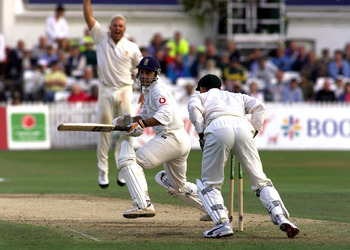
Trent Bridge 2001
Ramprakash's stumping off Warne – 3rd Test at Trent Bridge in 2001. Photograph by Hamish Blair. Courtesy of Getty Images.

On the Friday afternoon of the 3rd test at Trent Bridge in 2001, the series was in the balance. The Australians had won the first two tests easily, but England now found themselves in a position of some strength. They had restricted Australia to a first-innings lead of just 5 runs, and had built a lead of 120 with six wickets in hand. Mark Ramprakash was in and had been batting steadily for well over an hour. Even though this Australian side was as strong as any in cricket history, England had real hopes of getting back into the series.
This was a crucial time for Ramprakash as well as England. Despite being one of the most accomplished batsmen of the modern era, he had never managed to establish himself in the test team. He'd been in and out of the side for ten years, but had yet to achieve any consistency. As always, his place was in doubt, and he needed a big score.
With nine overs of the day left, Ramprakash did something extraordinary. He danced down the wicket to Shane Warne and was stumped by yards. The shot made no sense in the context of the game. There was no urgency and no reason to attack the bowling. Ramprakash was scoring steadily and simply needed to carry on as he was.
That was pretty much the end of the game and the series. Once Ramprakash was gone, Warne and Gillespie wrapped up the tail and Australia eased to a seven-wicket victory by the middle of the third day. They did lose the fourth test (if that great side had any flaw, it was a tendency to drop games in dead rubbers) but finished with an emphatic innings victory in the final Oval test.
The cricket pundits were nonplussed and unsympathetic. The Telegraph referred to Ramprakash's ‘moment of weakness’ and The Guardian to his ‘distinct lack of composure’. Jack Bannister was more forthright: ‘The red mist descended and he charged down the pitch … his attempted slog … would have been unacceptable in village cricket.’ David Gower summed up the general perplexity: ‘Nobody but Ramps can imagine what was going through his mind when he decided to play that shot at such a crucial time.’
As well as marking the effective finish to the series, this incident also signalled the impending end of Ramprakash's test career. The selectors persevered for a few more matches, and he did score his second and final test century in the losing last test at the Oval. But, after a few more low scores in New Zealand in the winter, the team management finally lost patience, and Ramprakash never played test cricket again. He went on to other successes – he is likely to be the last player ever to score a hundred first-class hundreds, and he gained millions of non-cricketing fans with his stylish and unexpected victory in the BBC's Strictly Come Dancing in 2006 – but as a test cricketer he will be remembered as someone whose supreme talent was undermined by mental fragility.
1. Saccading Eyes
This paper will try to understand why skilled sporting performers like Ramprakash will sometimes do the wrong thing in the heat of the moment. By analysing such cases I hope to cast light, not just on sporting psychology, but on the structure of human cognition in general.
At first sight there might seem to be little puzzling here. Didn't Ramprakash simply make a bad decision? When he saw the ball Warne bowled, he decided that he could hit it back over his head, and his dismissal was simply the penalty for his misjudgement.
But the trouble with this story is that there is no room for real-time conscious decisions in batting. Batting is automatic, not under conscious control. There is no time to think once the ball has been released. You can only react.
Let us start with the basic facts of timing. Top-rank bowlers project the ball at a batsman from about 60 ft distant at speeds in the range 50–100 mph. This means that the interval between ball release and bat impact is between 0.8 sec (800 ms) for the slower bowlers and 0.4 sec (400 ms) for the fastest.
These figures are similar for other bat and ball sports. Baseball pitchers project the ball at up to 100 mph from roughly the same distance as cricket bowlers. A tennis serve comes at up to 150 mph from 80 ft away. Squash and table tennis involve similar reaction times.
There is now a striking body of research on how batsmen in cricket cope with these extreme temporal constraints. An initial finding is that the batsman's eyes do not follow the ball throughout its flight. Instead they track it for the first 100–150 ms after release, after which their eyes saccade to the anticipated point at which the ball will hit the ground. The more skilled the batsman, the less time he will track the ball once it is released, and the sooner his gaze will shift to the anticipated bounce point. (Land and McLeod Reference Land and McLeod2000, Müller et al. Reference Müller and Abernethy2006a, Müller et al. Reference Müller, Abernethy, Reece, Rose, Eid and McBean2009)Footnote 1
To anybody who has played cricket, this will seem surprising, not to say incredible. The first thing that young batsmen are taught is to keep their eye on the ball. And certainly when you are actually batting, your awareness is of the ball moving continuously through the air from the bowler's release until it reaches you. When a distinguished Australian opening batsmen heard about the eye saccades at a conference, he started his contribution to the discussion period with – ‘I don't believe a word of it’. He was quite sure that he never took his eye off the ball and that he was aware of it continuously throughout its trajectory.
Perhaps the distinguished Australian was more surprised than he should have been. It is familiar knowledge in vision science that, when humans are surveying a scene, their eyes are constantly jagging around to get different items into central focus. For example, as you are reading these words right now, your eyes are unconsciously making a series of jerky movements to help you see different areas of the page with high resolution. Yet our conscious experience when we view a scene is not of a series of jerky visual fragments. Rather our brain mechanisms build up a representation of a stable environment containing identifiable features, and that is what we consciously experience.
No doubt it works the same when you are batting. Your eyes may be jumping around, but your brain is taking the information it receives from them and figuring out the precise trajectory of the ball. The best batsmen will say that they can sometimes see the position of the seam and even which way the ball is rotating, and there is no reason to doubt them. But this conscious awareness is constructed post-hoc from different bits of sensory input, and is not a simple registration of incoming radiation as in a camera.
It is highly controversial exactly which parts of the brain subserve this integrated conscious awareness, and so uncertain how long it takes to be constructed. Even so, it seems very likely that the batsman's conscious awareness of the ball lags behind the cognitive processes that actually guide the batsman's stroke. If this is right, then the batsman's movements must be the result of automatic and unconscious mechanisms. The function of the conscious awareness of the ball's trajectory is then merely to provide a record of what has already occurred.
2. Blurry Lenses
This picture receives strong support from recent work in visual neuroscience. It is now well-established that there are two different visual pathways with distinct functions that go from the visual cortex to other parts of the brain. The faster dorsal stream (the ‘where pathway’) subserves ‘vision-for-action’. It is concerned with the geometrical location of objects and guides our reaching, grasping and other immediate physical actions. The somewhat slower ventral stream (the ‘what’ pathway) subserves ‘vision-for-perception’. It is concerned with the classification of objects and informs cognitive processes that depend on such classification. (Milner and Goodale Reference Milner and Goodale1995)
Skilled motor behaviour is under the control of the dorsal stream. When we initially learn such actions as tying our shoelaces, driving a car, or executing a cover drive, we use the slower ventral stream to help us coordinate the relevant component movements with the positions of objects we are manipulating. But once the behaviour has become automatic, it comes under the control of the faster dorsal stream. The fine-tuned reaction of an expert batsman to a fast-approaching cricket ball is driven by the dorsal not the ventral stream.
Studies with brain-damaged patients suggest that the dorsal stream operates largely unconsciously. Patients with damage to the ventral stream but with intact dorsal streams report that they lack any visual awareness of the shape or identity of objects, yet are able to manipulate them competently, for example placing cards into angled slots, or adjusting their grip precisely to pick up objects they can't describe verbally. Conversely, patients with intact ventral streams but damaged dorsal streams report no loss of visual consciousness, but display marked delays in motor behaviour such as adjusting their grip to grasp objects.
There is some controversy about the extent to which the immediate control of skilled behaviour is fully unconscious. In normal healthy people there are rich interconnections between the ventral and dorsal streams, which suggests that in normal people at least the conscious processes in the ventral stream could yet have some influence on skilled behaviour.
However, there is further empirical research on the mechanics of batting in cricket which argues that in cricket batting at least it is very unlikely that the ventral stream plays any significant part in guiding the execution.
One difference between the dorsal and ventral streams is that the former has much lower visual acuity. While the ventral stream brings objects into sharp focus, the dorsal stream produces only a relatively blurred representation of the visible surroundings. Accordingly, the Australian sports scientist David Mann has tested the effects of visual blurring on batting performance. (Mann et al. Reference Mann, Abernethy and Farrow2010)
He used contact lenses to reduce the visual acuity of expert batsmen from a normal 20/20 to 20/60, 20/120 or 20/180. (These figures indicate the acuity with which you see something 20 ft away compared to the distance required for that acuity in the population in general. So, for example, 20/120 means that at 20 ft things look as blurred to you as they do to most people at 120 ft.)
Mann discovered that for bowling speeds up to 70 mph there was a deterioration in performance only with the highest degree of blurring. (That is, only at 20/180 – a level of indistinctness which makes you legally blind.) The 20/60 and 20/120 lenses had no noticeable effect on performance.
Even with bowling speeds in the interval 70-80 mph – which counts as fast-medium even at the highest standards – the 20/120 lenses were needed to affect performance. Blurring at the 20/60 level still had no effect on performance. (Most countries will not give you a driving license if you have 20/60 vision.)
These very striking results argue that batting performance is entirely under the control of the unconscious dorsal stream. The fact that the dorsal stream, unlike the visual stream, does not rely on high-acuity representations offers a natural explanation for why restricting the visual detail available to the batsman made no difference to performance.
Perhaps practising cricketers will continue to find it incredible that their conscious awareness of the ball's flight should make no difference to their shot-selection. After all, this certainly is not how it seems to subjective experience. For those who remain sceptical, I won't belabour the point any further. For present purposes, the important issue is not whether or skilled batting depends on conscious awareness. The more basic point is that the kind of actions involved in batting and similar sporting skills happen very fast indeed, and certainly too fast for any process worth calling decision-making to intercede between the visual detection of the ball's path and the execution of a stroke.
Maybe – though I very much doubt it – the batsman becomes consciously aware of the ball's path before committing to a stroke. But even so, the time interval is clearly too short for any considered choice of what shot to play. So Ramprakash's rash shot could not have been consciously selected once he had seen what ball Warne had bowled him. Even if there was time for him to become conscious of the ball's trajectory, there certainly wasn't time for him to start thinking about what shot to play.
3. The Yips
Further evidence of the automaticity of skilled sporting behaviour comes from the phenomenon known as the ‘yips’. This is what happens if you start thinking explicitly about the bodily movements required for some sporting performance. This can have devastating consequences. Skilled sporting movements need to be automatic. A competitor who starts thinking consciously about the movements they are about to perform will find themselves reduced to the level of the novice who has not yet acquired any automatic routines.
The phenomenon is most familiar from putting in golf. Sufferers from the yips end up jerking and twitching during their putting stroke, with the result that even putts of under two feet are regularly missed. Many famous golfers have succumbed, from Ben Hogan and Sam Snead to Tom Watson and Bernhard Langer. Some recover, often by radically changing their putting style, but others do not. It was said that Sam Snead's putting efforts in his later years were ‘difficult to watch’.
It is striking that the yips arise only in connection with those sporting movements that are triggered by the players themselves, as opposed to those that are responses to their competitors’ actions. It is specifically when you need to initiate some movement yourself that you are in danger of thinking about the movements you must perform. When somebody else is in control of the timing and direction of an approaching ball or other trigger to your movement, you have no time to think about what you must do – you just do it.
Perhaps the purest form of the yips is ‘dartitis’. Darts players don't need to do anything except project their darts at a board just under 8 feet away. Somewhat strangely, there is no time limit on how long you can take for your turn of three throws. Dartitis occurs when you start thinking about what you are doing. It leads to an inability to release the dart or to other throwing-action problems. The career of Eric Bristow, ‘The Crafty Cockney’, five-times world champion, went into a terminal decline in 1987 after he started having trouble letting go of the darts.
Snooker players can suffer similarly. The fine Irish player Patsy Fagan, UK champion in 1977, had a particular problem with the rest. He would move the cue back and forth dozens of times, to the extent that he became unable to make himself hit the ball when using the rest, an inability that eventually led to his premature retirement from professional snooker.
In cricket and baseball the yips do not affect the batters, but only those who have to throw or bowl, particularly those who are able to do it in their own time. The timing factor seems to be crucial. The New York Mets catcher Mackey Sasser had no trouble throwing out runners trying to steal second, something you have to do instantaneously, but his career fizzled out because he struggled with the mundane and unhurried task of lobbing the ball back to the pitcher between plays. Second basemen in baseball, who often have time to pause and ponder before throwing out the batter at first base, are notoriously susceptible. The unhelpfully named ‘Chuck’ Knoblauch of the Yankees, hitherto one of the most reliable of infielders, had to be moved to the outfield when he began spraying his throws to first in all directions.
In baseball all pitchers at risk, as they throw from a standing start, but in cricket, where the bowlers run in to bowl, it is only the slow bowlers who suffer. The faster bowlers are running at full speed when they commence their bowling action, and seem to be protected for the yips by their bowling being integrated into a sequentially automatic routine. With slower bowlers, however, who don't really run in, but simply project the ball after a few slow steps, the yips are not uncommon. Somewhat mysteriously, left-arm slow bowlers seem disproportionately susceptible: Phil Edmonds went through a series of bad patches when in the England side, and the Surrey all-rounder Keith Medlycott had to retire at 26 because he became unable to let the ball go when bowling.
In general, it seems to be the more cerebral of performers who are most at risk. Unreflective players who never pause to analyse their technique need not fear the yips. At most danger are the thinkers and tinkerers, those who are curious about the nature of their skills. It is noteworthy that both Patsy Fagan and Keith Medlycott became prominent coaches after their problems forced them into premature retirement.
The yips should not be confused with ‘choking’. The latter term refers to occasions where competitive sportsmen and women crumble under pressure and perform well below the level of which they are capable. In the most striking cases, they will be playing at their best in the early stages of the match, and collapse only as victory approaches. (In the Wimbledon final of 1993, Jana Novotna played a blinder against the great Steffi Graf and was serving at 40-30 to reach 5-1 in the final set – at which stage she double-faulted and scarcely won another point. To her eternal credit, she eventually gained her sole grand slam title by winning the same tournament five years later.)
The standard theory of choking explains it in the same way as I have been explaining the yips, namely as a consequence of the players starting nervously to focus on whether they are performing the right bodily movements. In my view, this is quite the wrong explanation for choking. This phenomenon is nothing to do with the misplaced bodily awareness of the yips, but a quite different kind of mental infirmity. But I will be better-placed to explain this when I get to the end of the paper.
4. Changing Strategies
Let us return to the puzzle of Ramprakash's charge down the wicket. It might seem as if I have been ignoring an obvious possible explanation. Might not Ramprakash simply have decided to change his strategy – not while the ball was in flight, but at some earlier point, between balls, or between overs, when he had time to reflect on the situation of the game? Thus he might have formed the view, after appropriate deliberation, that the Australian attack was becoming less penetrating, and that the most pressing danger now was thus not a further loss of wickets, but a failure to turn the temporary advantage into a good lead … and that therefore the best strategy was therefore to go on the attack, and start lofting Warne back over his head, not necessarily the very next ball, but the next time Warne gave the ball a bit of air.
Well, this was indeed Ramprakash's own story. When interviewed afterwards, he said that he had thought the condition of the game called for aggression on his part. However, I am sceptical of this explanation, and think I can offer a better account.
But that will need to come later. For the moment, let us just note that, even if we do accept Ramprakash's story, there is a sense in which it only pushes the basic puzzle back. We have seen ample reason to think that top-level batting is more like an automatic reflex than any consciously controlled sequence of movements. The basic facts of timing, plus the evidence I have rehearsed in the last three sections, all argue that the execution of a specific shot in response to the bowler's delivery is an automatic reaction honed by thousands of hours of previous practice. But if this is right, how could Ramprakash's strategic reflection possibly make a difference to what he did? Wouldn't the grooved channels in the brain continue to do the same automatic thing, quite independently of what Ramprakash deemed to be the best strategy?
Of course, we know that the answer to this question is ‘no’. There is no doubt that strategic decisions do often make a difference to batting and similar fast-response sporting performances. Skilled performers can certainly change the way they play by consciously deciding to do so. In saying that this is a puzzle, I am not querying whether this happens. The challenge is rather to explain how it does, given the automaticity of fast sporting skills.
The extent to which skilled performers can switch strategies is an interesting subject in itself. To stick with cricket, there are cases and cases. Some batsmen are notoriously unable to modulate their approach. Geoffrey Boycott had a reputation as a one-paced batsmen, as did Jacques Kallis early in his career, both sometimes finding it difficult to score faster when the situation demanded it. Neil Fairbrother had the converse problem. He was an extremely accomplished international one-day cricketer, but seemed unable to adjust to the lower-risk technique required for five-day test cricket. Still, these examples are the exception rather than the rule. Cricket is perhaps unique in the way it calls for a range of different playing strategies, with forms of the game varying from a two-hour 20-20 thrash to a five-day test match. Yet most players can perform well in more than one form, even though very different strategies are called for, and some excel in all versions.
Still, the issue at hand is not the precise extent to which conscious decisions affect batting and other fast-response performance. It is clear that they can and often do. The question is rather – how can they have this effect? If the execution of a batting stroke is a reflex response to the perceived motion of the ball, then won't it automatically be triggered once the batsman's unconscious dorsal visual stream identifies the ball's trajectory? And won't this mean that the execution of the stroke is insulated from any influence from prior conscious thought?
Note that the kind of influence that we need to understand here is subtler than any simple ‘premeditated’ shot. Sometimes a batsman in cricket will decide what to do before the bowler delivers the ball. Before seeing the ball, they commit themselves to jumping down the wicket and lofting it, or to stepping towards square leg and clattering it through the off side, or whatever. Such premeditation is generally a bad idea, for obvious reasons, though it can work well in the latter stages of a limited overs match, or if the batsman is confident of the ball the bowler is going to deliver.
But this is not the kind of choice that puzzles me. With a premeditated shot, the batsman has simply opted not to perform a normal pre-honed reflex response to the bowler's delivery, and instead to deliberately play a shot of his own conscious choosing, pretty much independently of what the bowler does. This is no more puzzling than any other deliberate choice to override one's automatic responses and do something deliberate at a preappointed time.
The kind of case I have in mind is different. It is not a matter of overriding your automatic responses. Rather you are still relying on them. You still respond automatically and unthinkingly, within a small fraction of a second, to the specific trajectory of the ball. Yet the way you do this has been altered by your prior conscious reflection. Perhaps you are now responding aggressively, when before you were playing defensively. Still, you have no chosen to play any particular shot, but have simply set yourself to respond automatically.
This is the puzzle I want to address. How can conscious decisions make a difference to automatic batting? Given the speed with which the batsman respond to the ball, there would seem no room for conscious thought to intrude. Yet there is no doubt that a batsmen's earlier conscious choices can make a difference to how they perform.
5. Basic Action Control
In order to resolve this conundrum, we need to think about how human behaviour is generally controlled. In this context, it is helpful to distinguish between a basic system of automatic action control that we share with other animals, and a more sophisticated ability to form long-term intentions, typically as the result of conscious deliberation.
Let me start with the more basic system. While we no doubt have genetic predispositions favouring some behaviours over others, the shaping of most of our automatic behaviour depends on instrumental learning. If doing B in circumstance C has led to a positive result in the past, then we will be the more inclined to do B in circumstance C in the future.
Recent psychological research distinguishes two different forms of such instrumental conditioning: simple stimulus-response (S-R) learning and response-outcome (R-O) learning. (See e.g. Balleine and O'Doherty Reference Balleine and O'Doherty2010)
In simple S-R learning, the organism is insensitive to what the behaviour B is good for, so to speak, and will simply tend to perform B whenever it experiences the stimulus of condition C. Provided B has led to rewarding result in the past in condition C, the organism will be disposed to do it again in C in the future.
In R-O learning, by contrast, the organism will form some representation of the positive causal consequences of B – the value of some outcome O – and will only perform behaviour B in circumstances C insofar as it continues to attach a positive value to O. The difference between R-O and S-R learning comes out when the outcome O is ‘devalued’ – by being associated with some unpleasant experience, say. When the behaviour B is under the control of the R-O system, such devaluation will lead to its non-performance in circumstance C, even though it has been associated with positive outcomes in that circumstance in the past. We can think of the R-O system as leading to the formation of desires for the outcomes O, with the behaviour B then depending on the continued existence of such desires.
There is evidence that the basal ganglia are central to both the S-R and R-O systems, and that dopamine release is relevant to both kinds of learning, functioning as a ‘prediction error signal’ – that is, signalling when rewards are different from what is expected. However, the precise differentiation of the two systems is less clear, as is the way they interact with each other.
In many ways the joint system that results from these two kinds of learning, which I shall call the ‘basic action-control system’ henceforth, is sophisticated and adaptable. It operates quickly and automatically at any time to select an action suitable to current needs. It has learned from experience which actions are good at ensuring rewards, and reacts accordingly. In effect, it approximates to the economists’ picture of a utility-maximizer that at any time selects that action that will maximally generate rewards.
However, there are various respects in which this automatic basic system is less than ideal. For a start, there are circumstances in which ingrained S-R habits will dominate the more sensitive R-O system, and lead the agent to do things which are not conducive to its current desires. Moreover, even when the more sensitive R-O system is in control, it is crucially dependent on which desires happen to be active, and this does not always happen in an optimal way.
This is because desires in the R-O system are to a large extent activated by opportunity as much as need: agents will tend to desire O specifically in circumstances when they have learned they can get O. Past experience may have shown you that chocolate cake is satisfying and so instilled a disposition to want it. But for the most part this disposition will remain latent, and will be activated only by seeing a slice of chocolate cake, or by walking past the bakery which stocks it. (See e.g. Rescorla Reference Rescorla1994)
From the perspective of creatures like us, who can plan, and so engineer opportunities to satisfy our desires, this arrangement is a design fault. If O is worth pursuing, it will be as worth pursuing in circumstances where it is not immediately available as those where it is. But we can see why this sub-optimal design would have evolved. For simple creatures, whose choices are always orientated to the here-and-now, the cueing of desires by opportunity will not be significantly dysfunctional. Since there is no point to simple creatures desiring Os which are not immediately available, there is no cost to these desires only being activated by opportunity.Footnote 2
6. Intentions
Happily, human beings are not always at the mercy of their less than optimal basic action-control systems. We are also capable of detailed conscious reflection about the best thing to do, all things considered, and of guiding our behaviour accordingly. Sometimes, when time permits, and the issues are both complicated and important, we pause and devote time to working out which of our options is best, and then setting ourselves to execute them.
This then enables us to do rather better than if we were governed by the basic action-control system alone. To the extent that our behaviour is guided by considered reflection, rather than immediate desire-gratification, we can improve on some of the cruder outcomes of the more basic system.
Philosophers discuss this ability under the heading of long-term intention-formation. Michael Bratman has been arguing for many years that intentions are a distinct species of cognitive attitudes, not reducible to complex sets of beliefs and desires. (Bratman Reference Bratman1987) And more recently Richard Holton has appealed to the special role that intentions play in our cognitive lives to explain a wide range of phenomena, including weakness of will, addiction, temptation, and will power. (Holton Reference Holton2009)
In outline, the nature of intention-formation is clear enough. We use all the information at our command, insofar as we can, to identify the benefits and costs of the alternative courses of action open to us. We then weigh up these overall benefits and costs, and on this basis select one course of action. Having done so, we commit ourselves to carrying out this course of action. (Thus, for example, you might be thinking about what to do next Sunday: play in a cricket match, go to the country, or fix the garage roof? You weigh up the pros and cons, pick one of the options, and take steps accordingly.)
There are various advantages to adding the capacity for long-term intention formation to the older system of basic action-control. Most obviously, some choices are both important and complicated, and quick decisions made on the basis of currently active desires are likely to be sub-optimal, as observed above. Moreover, in many cases, we won't have time to pause and reflect when the moment for action arrives. So we will do better to take time for deliberation earlier, and use the resolution then formed to guide our later behaviour.
There are also advantages of coordination. This covers both coordination between different individuals and also coordination between earlier and later selves within a given individual. Many of our projects depend for their success, not just on our current actions, but on those of other individuals and our later selves. (It's no good now deciding to play in a cricket match if you can't rely on the groundsman to prepare the pitch and on other players to turn up; it's no good now deciding to go to the country if you can't rely on yourself to catch the train on Sunday morning; and so on.) The formation of intentions is a solution to this problem. When people form intentions they bind themselves to certain future actions; this enables themselves and others to be confident of cooperation in complex projects; and this can in turn make commitment to those projects rational when it would not otherwise be.
7. Intentions and Action Control
It is clear enough that humans do form intentions, and that this affects their behaviour, often at some considerably later time. What is not so clear is how this works. What is the mechanism by which the formation of intentions has an influence on subsequent behaviour?Footnote 3
One natural hypothesis is that intention-formation affects behaviour by somehow re-setting the basic action-control system. This is in line with general evolutionary principles: we should expect a newer system of action control to piggy-back on any already-evolved such system, rather than to involve some new and distinct system for controlling actions.
The idea that intentions re-set the basic action-control system also fits with empirical data on the execution of intentions. Peter Gollwitzer (Reference Gollwitzer1999) has shown that merely forming a general intention – for example, to fix the garage roof on Sunday – is not always effective. What makes it more likely you will carry out your plan is that you also form ‘implementation intentions’ – for example, to go and buy some nails from the hardware shop once the morning news on the radio is finished, to get the stepladder from the cellar when you get back, and so on.
In effect, implementation intentions determine conditional dispositions to perform behaviour B in circumstance C. It is noteworthy that Gollwitzer's research shows that consciously formed implementation intentions can often be triggered subliminally. For example, you may well find yourself leaving to go and buy the nails even though you have not consciously registered that the morning news is finished. This phenomenon strongly suggests that long-term intentions do their work by adjusting the state of the basic action-control system. The formation of an implementation intention reconfigures this system so that it will trigger behaviour B when circumstance C is next encountered. After that the operation of the basic action-control system can proceed in its normal automatic manner.
So there is good reason to suppose that intention-formation affects behaviour by somehow re-setting the basic action-control system. But how exactly it might achieve this is not well-understood. Perhaps the existence of the intention is itself part of the stimulus which triggers the action (because in our experience we have been rewarded for doing B in circumstances where we have an-intention-to-do-B). Or perhaps the intention reconfigures the outcomes we regard as valuable, making us view the performance of B as itself of high positive value. Further hypotheses are also possible.
8. Will Power
Still, whatever the precise mechanism by which long-term intentions reset the basic action control system, we can draw one important moral from the analysis so far. As I am now viewing things, when a long-term intention is formed, it reconfigures the basic action-control system in such a way as to achieve its intended effect. But this then means that the actual execution of the intention will be subject to the vicissitudes of the basic action-control system. As I observed earlier, the basic action-control system is relatively volatile. Current cues and other distractions can influence which desires are active and hence the here-and-now selection of actions. This will apply just as much in the case where the basic action-control system has been reconfigured by long-term intention formation. If the intention-formation does its work by resetting the basic system of action control, and then leaving it to itself, so to speak, then the execution of intentions will itself be subject to current cues and other distractions.
Sometimes this will not matter too much. If you form an intention to fix the garage roof, and so set yourself to go to the hardware store for some nails once the radio news is finished, it won't be of any great consequence if you are absent-mindedly delayed at home for a few minutes by the start of the next programme, or if you get waylaid by the tempting chocolate cake in the bakery on the way there. For many of our plans, precision is not essential. It will be enough if we do roughly what is required, in roughly the right sequence, at roughly the right time.
But sometimes it is important that we adhere closely and precisely to our intended plans. One much-discussed kind of case is where we set ourselves specifically to avoid some temptation. For example, we might have adopted a diet, or given up smoking, or drinking, or some even more destructive habit. In this kind of case it will not work if, once we have formed our intention, we allow ourselves to be seduced by passing temptations, on the grounds that we will be able to catch up later. If we allow ourselves to give in, we will have failed. As experience shows, regimens of abstinence tend quickly to be abandoned once we give in to temptationFootnote 4.
Richard Holton thinks of ‘weakness of will’ as the failure to stick to one's intentionsFootnote 5. ‘Will power’, conversely, is for him what enables us to conform to our intentions. He cites empirical evidence that the exercise of will power in this sense is a real cognitive phenomenon, which causes mental tiredeness and cannot be sustained indefinitely.
Holton offers no definite positive account of will power. Here is one suggestion. Will power is simply a matter of holding one's earlier-formed intention in mind. Suppose that when you commit yourself to an intention, this does something to reconfigure the parameters of the basic action-control system so as to perform the intended action. However, if the basic action-control system is then left to itself, happenstance may undo this reconfiguration, not least by allowing some passing fancy to override the earlier resetting. A solution would be to keep on forming the intention, so to speak. To the extent we continue consciously to reaffirm the intention, it will keep resetting the action control system and prevent any happenstantial overriding. (This model of will-power would seem to fit well with the fact that it is tiring to exert it for a sustained period.)
9. Batting Again
Our earlier discussion of fast sporting skills left us with this general puzzle. How can the conscious strategic decisions of a batsman – to play more aggressively, say – make any difference to his performance, given that any physical response to a ball arriving at around 100 mph can only be the expression of an automatic and unthinking reflex? We are now better placed to answer this puzzle.
The first thing to note is that a batsman will have trained himself over many hours to bat in a range of possible modes: defensively, aggressively, keeping the ball on the ground, looking to play it to leg, and so on. We can think of these modes as each involving a raft of conditional dispositions: in defensive mode, leave any pitched-up ball outside the off stump, block any reasonable length ball, etc; in attacking mode, drive the half-volley outside the off-stump; force anything marginally short-pitched, etc; and so on.
At any stage of an innings, a competent batsman will have assessed the situation and formed a view about how to bat – a conscious intention to adopt a certain strategy. As with any intention, this will then set the parameters of the basic action-control system. It will direct that system to bat aggressively, say. It will take one raft of conditional dispositions from the batsman's repertoire, and reconfigure the basic control system so that it embodies just those dispositions. (Drive the half volley outside off stump, force the shortish straight ball, etc.) Having been so reset, the basic action-control system will then respond accordingly, without any further intrusion of conscious thought – which is just as well, given the extreme time constraints of batting.
This now answers our general puzzle about the influence of conscious strategic thought on fast automatic responses. We now see that such an influence is just a special case of the way that long-term intention-formation influences behaviour in general. We shouldn't think of conscious deliberation as influencing action directly. Rather, it does so indirectly, by issuing in an intention, which then resets the basic action control system, which does then affect action directly. But the consequent operation of the basic action-control system doesn't depend itself on any further conscious thought.
So with batting. At some stage, when time allows, you consciously reflect and decide, say, to start playing more aggressively. This then directs the basic action control system to switch from defensive mode (from one raft of automatic and extremely fast conditional dispositions) to attacking mode (to a different such raft). The execution of the shot itself is then an automatic and unthinking reflex, but which such reflex will be activated in response to that ball will depend on the earlier deliberation and conscious intention-formation.
10. Concentration
The relation between intentions and action control also explains why mental focus is so important in competitive sport.
Recall my earlier point that it is not always enough to form an intention and then leave it to the basic action-control system to carry it out. If there is a gap between intention and execution, the vicissitudes of the action-control system can intrude, and you can end up doing something else at the appointed time.
Now, as we saw, this often doesn't matter. Many intentions are perfectly adequately served if something roughly like the required action is performed at roughly the right time. But sometimes strict adherence is essential. Above I discussed the example of sticking to a regimen of abstinence. Highly skilled sporting performance is another such case. It is not enough to play roughly the right shot when the ball is bowled. Precision is essential in batting and other highly-tuned sporting performances.
There is why concentration, focus, getting your mind right, the inner game, being in the zone – call it what you will – is an essential feature of successful sporting performance. You need to keep your intention in mind to make sure your action-control system does the right thing.
The point applies even at the lower levels of sporting activity. When I play tennis with my friends, it is competitive even if not hugely accomplished. We knock up first. It can be very pleasant in England in the summer. I sometimes think how enjoyable it is to be stroking the ball back and forth with my friend. And then we start playing a match, and suddenly, to my consternation, I notice I am three games down. I have forgotten to switch from knocking-up mode to competitive mode. Instead of stroking it pleasantly back in roughly my friend's direction, I must now punch it as hard as I can to where my friend isn't. This doesn't happen automatically. I have to direct my action-control system to adopt competitive rather than knocking-up mode. And having done so, I have to keep this in mind. If I start day-dreaming about what's for dinner, or worrying about tomorrow's lecture, I will stop playing properly and start throwing away points.
It is interesting that the need to concentrate at tennis only applies to competitive mode. While knocking up you can daydream as much as you like. I think that this is to do with the precision required. The demands of knocking up don't require any great exactitude. You can switch off, so to speak – leave matters to your automatic action-control system and start thinking of other things – and you will still knock up perfectly well. You need only hit the ball roughly in the direction of your opponent. But competitive play does require focus. It is not enough that you return the ball with some stroke or other. You need to maintain a very precise set of conditional dispositions (keep it away from his forehand, mix the slice with the topspin, etc.), and this requires sustained single-mindedness.
I would say that the general point applies even to sporting skills that do not involve complex alternative batteries of conditional dispositions. Not all sports call for switches of strategy. Gymnasts, sprinters and many other sporting performers scarcely need to change what they are trying to do from one competitive context to another. Even so, they still need to focus hard when they are competing. The reason, I would suggest, is that they still need to hold in mind that they are now in competitive mode, to make sure that basic action-control system delivers precisely the right competition responses to stimuli, and not the responses that would be appropriate when they are practising, or when demonstrating something to a novice, or when testing equipment, and so on. Even if only one raft of dispositions is ever in play in competition, there are clearly other rafts that the action-control system can be set to display in the same physical contexts outside competition. If the performer stops concentrating, there will be nothing to stop this system being derailed into some such alternative by happenstantial influences.
11. Choking
I earlier contrasted ‘choking’ with ‘the yips’. While choking is often assimilated to the yips, I think it is a quite distinct phenomenon. The yips are caused, as I explained, by a destructive attention to bodily movements. Choking is rather a failure of concentration.
I have just argued that competitive sporting activity requires performers to hold firmly in mind what they are aiming to do. Of course, this doesn't mean that they should think about which physical movements they need to perform – that would only invite the yips. But they do need to focus on the results they are trying to achieve. They need to keep thinking about keeping it on the ground, or slicing it deep to the backhand, even if not about the relative positions of their hands and wrists. If their minds start wandering, they are likely to play false shots. They need to keep a tight rein on their action-control system, lest it stray away from the intended course and start working haphazardly.
This is what happens when players choke. Jana Novotna was an excellent tennis player and by the time she first reached the Wimbledon final she was no doubt very used to winning. But she wasn't absolutely in the top rank, and may well have wondered whether she would ever win a grand slam. When you are five points away from lifting the Wimbledon shield, it must be very hard not to start thinking about it. Indeed you would be something of a freak if you didn't. Novotna may have closed out many important victories before, but that's not the same as beating Steffi Graf at Wimbledon to win your first grand slam. It was no doubt the significance of her impending victory that turned her mind away from the game itself – with disastrous results.
It is common enough for players to ‘give up’ when they are losing. Once it becomes clear that your opponent has the measure of you, it is natural enough to start thinking about your imminent defeat and stop focusing on your strategy. The consequent deterioration in the loser's performance is so familiar as to be scarcely worthy of remark. Choking is pretty much the same thing, except that it is the imminent victory rather than defeat that so distracts the player. You start thinking about how wonderful it will be to receive the applause, and so stop thinking about where to hit the ball – and before you know victory has slipped away.
12. Ramprakash Explained
Finally, let us return to Mark Ramprakash's egregious dismissal. As I said, his own explanation was that he deliberately and quite reasonably decided to go on to the attack, but unfortunately it didn't work out. However, we are now in a position of offer a better explanation. I would suggest that Ramprakash's demise wasn't due to an unsuccessful strategic ploy, but to a fatal failure of concentration.
There is something that I have left out of the Ramprakash story so far. It is widely attested that Shane Warne had been working on Ramprakash for some overs. ‘Come on Ramps, you know you want to’ he had been saying, putting into Ramprakash's mind the thought of dancing down the wicket and lofting the ball back over Warne's head.
Perhaps we should believe Ramprakash's own story that he had consciously decided to attack, and had re-set his behavioural dispositions accordingly. But it seems to me much more likely that he just lost his focus. For some while he had been firmly maintaining the appropriate test match strategy – keep the ball on the ground, leave the full pitch outside off, … But Warne's urgings were eating away at his resolve, highlighting the attractions of a lofted drive. (There goes the ball, out of the middle of the bat, straight back over the bowler's head, right into the spectators – believe me, there are few more pleasant experiences in life.)
As long as Ramprakash could keep his mind firmly fixed on his test match repertoire, he was safe. But Warne had planted the seed of temptation. The seductive desire to jump down the wicket and loft the ball was waiting in the wings, poised to grab control of Ramprakash's action-control system. And then Ramprakash nodded. Who knows exactly what went through his mind. But somehow he forgot what he was supposed to be doing, and the result was inevitable.