




No CrossRef data available.
Article contents
Gender differences in childhood onset conduct disorder
Published online by Cambridge University Press: 13 April 2004
Abstract
The present study tested several predictions related to the theory that girls with conduct disorder (CD) follow a single delayed onset pathway. The following hypotheses were tested among a high-risk, stratified random sample of youth who used public services during a 6-month period: boys will be more likely to have childhood onset CD (COCD) than girls; girls with COCD will be less common than girls with adolescent onset CD (AOCD); COCD girls, AOCD girls, and COCD boys will be similar in terms of risk profiles and AOCD boys will have a less severe risk profile than COCD girls; and risk factors that differentiate between COCD and AOCD among males will not differentiate between COCD and AOCD among females. Among those youth who met the criteria for CD, males were significantly more likely to have COCD than females. However, close to half of females with CD met the criteria for the COCD subtype. Of the seven risk factors that were examined, girls with COCD scored higher than COCD boys on three factors and higher than AOCD girls on four factors; however, only one significant difference was found between AOCD girls and COCD boys. Finally, risk factors appeared to differentiate between COCD and AOCD groups in a similar way among males and females. These findings suggest that COCD is not rare among females in public service sectors, COCD girls can be distinguished from AOCD girls in terms of risk factors, and risk factors for COCD among males are also relevant to females.The Patterns of Youth Mental Health Care in Public Service Systems Study is supported by National Institute of Mental Health (NIMH) Grant U01 MH55282. Preparation of this article was supported by Research Scientist Development Awards K01MH01767 and K01MH01924. The authors are most grateful for the comments and suggestions on this manuscript that were provided by Dr. Persephanie Silverthorn and Dr. Theodore Beauchaine.
Information
- Type
- Research Article
- Information
- Copyright
- © 2004 Cambridge University Press
Although conduct disorder (CD) is less prevalent among girls than boys (American Psychiatric Association, 1994), recent statistics suggest that the proportion of girls involved in antisocial behavior is increasing at a faster rate than that of boys (Silverthorn & Frick, 1999; Snyder & Sickmund, 1999). The arrest rates for females increased from 1994 to 1999 in all major offense categories, and arrests for violent crimes were 85% higher in 1997 than in 1987 (Bilchik, 2000). When self-report measures are used instead of official statistics, the ratio of male to female crime drops from the official figure of 4:1 to 2:1 and girls are as likely as boys to report drug use, school-related offenses, and property and violent crimes against family members (Chesney–Lind & Shelden, 1992). Far from being a rare condition among females, CD is the second most common psychiatric disorder in girls (Cohen, Velez, Kohn, Schwab–Stone, & Johnson, 1987; Kashani, Beck, Hoeper, Fallahi, Corcoran, McAllister, Rosenberg, & Reid, 1987; Zoccolillo, 1993).
Despite the growing prevalence of delinquency among girls, few studies have focused on female youth with antisocial behavior problems (Chalmers & Townsend, 1990; Kavanagh & Hops, 1994; Miller, Trapani, Fejes–Mendoza, Eggleston, & Dwiggins, 1995; Zoccolillo, 1993). As a result, theories regarding the development and course of CD are based on data collected from males and generalized to females, despite a lack of information on how males and females may differ (Miller et al., 1995; Silverthorn & Frick, 1999; Zoccolillo, 1993). This tendency to conceptualize antisocial behavior in girls using the same theoretical framework as boys has been met by resistance from researchers who argue that there are fundamental differences in antisocial behavior patterns among boys and girls (Patterson, Reid, & Dishion, 1992). Some maintain that all aspects of the disorder may need to be reexamined for females, including diagnostic criteria (Zoccolillo, 1993), risk factors (Hoyt & Scherer, 1998; Miller et al., 1995), and developmental course (Silverthorn & Frick, 1999).
Theorists have given particular attention to possible gender differences in the developmental course of CD. Silverthorn and Frick (1999) provide a cogent argument that the childhood onset and adolescent onset subtypes of CD described by the DSM-IV (American Psychiatric Association, 1994) may not be applicable to females. These two subtypes have been found to have distinct etiologic pathways and developmental courses among males (Hinshaw, Lahey, & Hart, 1993; McCabe, Hough, Wood, & Yeh, 2001; Moffitt, 1993); however, they have rarely been researched among females (Silverthorn, Frick, & Reynolds, 2001). Childhood onset CD (COCD) is diagnosed in children who meet at least one criterion before the age of 10 (American Psychiatric Association, 1994). Children whose antisocial behavior begins before age 10 are at increased risk for a severe and persistent course, with antisocial behavior that escalates in adolescence and continues into adulthood (Loeber, 1990; Moffitt, 1993; Tolan, 1987). COCD is theorized as being rooted in neurological deficits, poor parenting, and parental antisocial behavior (Moffitt, 1993). In contrast, children with adolescent onset CD (AOCD) are more likely to desist offending by young adulthood, because their antisocial behavior is motivated by the desire to gain autonomy and to imitate deviant peers (Moffitt, 1993).
Based on their review of the literature, Silverthorn and Frick (1999) suggest that although the two-trajectory model may be valid for boys, it cannot be generalized to girls. They argue that girls' antisocial behavior rarely begins in childhood. However, although girls typically begin having conduct problems in adolescence, they share many of the same risk factors as childhood-onset males, including family dysfunction, poor parenting, comorbid attention-deficit/hyperactivity disorder (ADHD), and cognitive and neuropsychological dysfunction. Silverthorn and Frick (1999) propose a single “delayed onset” developmental trajectory for antisocial girls. This pathway shares many of the predisposing factors of male COCD, but it has an adolescence onset.
In support of their argument, Silverthorn and Frick (1999) present evidence that, although males are much more likely to engage in delinquent behavior than females during early childhood, the gender difference narrows in adolescence. Both males and females increase in their rates of offending at this time, but girls increase at a more rapid rate (Silverthorn & Frick, 1999). Thus, female antisocial behavior is extremely rare in the childhood years, but it becomes increasingly common in adolescence (Moffitt & Caspi, 2001; Silverthorn et al., 2001). However, preliminary evidence suggests that girls, even in cases of adolescent onset, may be more likely to have experienced risk factors associated with COCD than boys, such as family dysfunction. For example, antisocial girls may have family backgrounds that are more dysfunctional than antisocial boys (e.g., Henggeler, Edwards, & Borduin, 1987). Moreover, a history of maltreatment, particularly sexual abuse, appears to be more common among conduct disordered girls than boys (Hoyt & Scherer, 1998; Miller et al., 1995). Finally, adolescent girls with antisocial behavior have been found to have poor adult outcomes, such as psychiatric illness and continued arrests (e.g., Bardone, Moffitt, & Caspi, 1997; Zoccolillo & Rogers, 1991), similar to the persistent offending and higher rates of psychiatric comorbidity found among boys with COCD.
The theory that both COCD and AOCD girls follow a single developmental path with risk factors similar to those found among COCD boys generates several testable hypotheses. The theory predicts that girls with both COCD and AOCD will have risk profiles similar to boys with COCD. However, all three of these groups will have a more severe risk profile than AOCD males. In addition, it follows from this theory that risk factors that differentiate boys with COCD and AOCD should not differentiate girls with COCD and AOCD, because these groups of girls should be indistinguishable from one another.
However, there have been few direct comparisons of girls with COCD to boys with either COCD or AOCD, and studies to date have produced conflicting results (Silverthorn & Frick, 1999). Tolan and Thomas (1995) examined data from the National Youth Survey and found that, although COCD was less common among girls than boys (33 vs. 41% of delinquents, respectively), a substantial portion of the delinquent girls experienced onset prior to age 12. In addition, they found that childhood onset predicted more serious and persistent offending for both genders, suggesting that the two-trajectory model is applicable to females. Moffitt and Caspi (2001), reporting on data from the Dunedin sample, found COCD to be rare among girls. A visual inspection of the data indicated that the COCD girls appeared to have severe risk profiles similar to COCD boys, also supporting the two-trajectory model for girls. However, because of the small number of COCD girls in this community sample (n = 6), no statistical analyses could be conducted with this group. In contrast, Silverthorn et al. (2001) reported data from a sample of adjudicated delinquents (40 girls, 32 boys) that supported the notion that girls with COCD are rare, and they found that boys and girls with COCD did not differ on risk factors. However, because of the small number of COCD girls, no separate analyses could be conducted with this group. Thus, researchers have come to conflicting conclusions on the rarity of COCD and how COCD girls may differ in terms of risk factors from other gender and age of onset groups. In addition, sample size limitations have prevented investigation of the characteristics of COCD girls.
The current study utilizes data from the Patterns of Youth Mental Health Care in Public Service Systems Study (POC), which drew a stratified random sample of high-risk youth active to one of five public sectors of care. We examined this relatively large, multiethnic subsample of both males and females who met criteria for CD to test the following hypotheses related to the delayed onset theory:
- A significantly higher proportion of males than females will have COCD.
- Females who have COCD will be rare compared to AOCD females among youth with a history of public service use.
- Females with COCD will have demographic characteristics and risk profiles that are similar to both girls with AOCD and boys with COCD, but they will have a more severe risk profile than boys with AOCD.
- Risk factors that differentiate between COCD and AOCD among males (low socioeconomic status, family history of mental illness, family history of antisocial behavior, comorbid ADHD, maltreatment history, low parental monitoring) will not differentiate between COCD and AOCD for females.
Method
Participants
The participants were a subsample drawn from the larger POC sample of 303 children aged 11–18 who met the DSM-IV criteria for CD. Data are presented here for those youth age 11 and older who met full DSM-IV diagnostic criteria for CD with at least moderate diagnostic specific impairment and who had complete data from both parent and child interviews conducted in English.
The POC study surveyed a representative sample (N = 1,715) of youths aged 6–18 who were active in one or more public sectors of care in San Diego County (alcohol/drug treatment, child welfare, juvenile justice, mental health, or services for youth with serious emotional disturbance [SED] in the public schools) during fiscal year 1996–1997. Only adjudicated delinquents were included in juvenile justice, and only court-ordered dependents were included in child welfare. From the sampling frame of 12,662, we randomly selected 3,417 for recruitment. Of these 3,417 cases, 845 (24.7%) refused to participate, 791 (23.2%) could not be located, and 66 (2%) could not be recruited for other reasons (e.g., unable to obtain ex parte order for permission to participate). Participants did not differ significantly from nonparticipants on age, gender, sector affiliation, or race–ethnic distribution except that slightly fewer Asians participated relative to the eligible sample. The sample was stratified by service sector affiliation, race/ethnicity, and level of restrictiveness of treatment setting (i.e., home vs. aggregate care setting). Because particular groups were purposely oversampled to ensure an adequate sample size for subgroup analyses (e.g., Asian/Pacific Islanders and youth in alcohol/drug treatment), a poststratification weighting procedure was used to ensure that the data reflected the proportions of these groups in the total population of service users (Henry, 1990). All analyses were conducted using the STATA 7.0 statistical package.
Of those youth included in the current study, 13.2% had received services from alcohol/drug treatment, 12.9% from child welfare, 35.0% from juvenile justice, 58.7% from mental health, and 33.0% from school services for youth with SED during the second half of fiscal year 1996–1997. Some 42.2% received services from more than one sector of care. The racial/ethnic distribution was 43.9% Caucasian, 22.8% Latino, 17.5% African American, 5.9% Asian/Pacific Islander, and 9.9% biracial/other. The average age at the time of the interview was 15.14 years (SD = 1.92), and the sample was 30.0% girls (n = 91). The median household income was between $20,000 and $24,999 per year, and the average education level of the parent was completion of high school. A comorbid diagnosis of ADHD was present in 42.9% of the cases, and 61.1% (n = 185) had onset of CD before age 10.
Procedure
A parent or primary caregiver (hereafter referred to as parents) was interviewed about each child's demographic characteristics, psychological symptomatology, service-use history, and exposure to risk and protective factors. In the current subsample, 74.9% of the respondents were biological mothers; 8.9% were biological fathers; and the remaining 16.2% included step-, adoptive, and foster parents, as well as other relative and nonrelative caregivers. Youth also reported on their own psychological symptomatology and service-use history. Parents were paid $40.00 for participation, and youth were paid between $10.00 and $40.00, depending on age.
Measures
Demographics
Parents reported their yearly household income and the highest grade they had completed. Parents also reported the age, gender, and race/ethnicity of their participating child.
Diagnostic Interview Schedule for Children (DISC-IV)
Interviewers trained by a member of the DISC advisory board administered selected modules of the computer-assisted version of the DISC-IV (Shaffer, Fisher, Lucas, Dulcan, & Schwab–Stone, 2000) to parents and youth. The DISC-IV is a widely used, structured diagnostic interview that generates DSM-IV diagnoses for youth, including age of onset of each disorder. The DISC-IV has demonstrated acceptable reliability and validity for both parent and youth versions (Shaffer et al., 2000). Parents and youth aged 11 and older completed the ADHD and CD modules. A child was considered positive for CD or ADHD if the child met full diagnostic criteria and had at least moderate diagnostic specific impairment based on parent report alone, child report alone, or both parent and child report. This strategy was adopted because of recommendations in the literature that parent and child reports should be combined to yield estimates of disorders (Bird, Gould, & Staghezza, 1992; Cantwell, Lewinsohn, Rohde, & Seeley, 1996; Jensen, Rubio–Stipec, Canino, Bird, Dulcan, Schwab–Stone, & Lahey, 1999). In the current sample, 42.9% (n = 103) of youth with CD met the criteria based on parent report only, 32.7% (n = 99) met the criteria based on child report only, and 24.4% (n = 74) met the criteria based on both parent and child report (κ = .24). Of those youth with both CD and ADHD, 85.1% met the criteria for ADHD based on parent report alone, 5% on child report alone, and 9.9% based on both parent and child report (κ = .09).
COCD was defined as having at least one symptom of CD beginning prior to age 10, consistent with the DSM-IV definition (American Psychiatric Association, 1994). In cases where the parent's report led to the diagnosis of CD, age of onset was determined by the earliest age of any symptom of CD reported by the parent. In cases where the child's report resulted in the diagnosis, the child's earliest age of onset was used. If the child met criteria based on both parent and child reports, the parent's report of age of onset took precedence. Parent and child reports of the age of onset of CD were significantly correlated (r = .31, p < .000), and agreement on childhood versus adolescent onset yielded a kappa value of .38.
Parental psychopathology
Parents completed a short form of the Family History section of the Service Utilization and Risk Factors Interview, created for the Methods for the Epidemiology of Child and Adolescent Mental Disorders Study (Lahey et al., 1996). Two indicators were abstracted that reflected parental history of mental illness and parental history of antisocial behavior problems. The first indicator was formed by summing scores on five dichotomous items reflecting a history of psychiatric disorder in either the mother or father, including history of parental depression, suicide attempts, alcohol or drug problems, other serious mental or emotional problems, and use of services for emotional or mental health problems. Scores on this indicator ranged from 0 to 5, with higher scores indicating a greater evidence of familial mental health problems. The second indicator was formed by summing three dichotomous items that assess antisocial behavior of either parent, including being expelled from school, being fired or laid off from work because of behavior or attitude, and being arrested, convicted, or jailed for an offense other than drunk driving. Scores on this indicator ranged from 0 to 3, with higher scores indicating more parental antisocial behavior. Internal consistency data are not reported for these two measures because they were indicators rather than scales. These two indicators are analogous to “counts” of risk factors that have been found to have strong linear relationships with outcomes for children (e.g., Rutter, 1987).
Parental monitoring
Parents completed a parental monitoring scale, which consists of 10 items that assess how closely the parent supervises his/her child's activities. Items ask about parental rules concerning supervision and curfews, as well as the parent's awareness of the child's activities and friends (sample item: “Do you know who your child's companions are when s/he is not at home?”). The potential range of scores was 0–32, with higher scores indicating higher levels of parental monitoring. Because items differed in the number of available response options, scores on each item were standardized before being summed to calculate the total score. The Parental Monitoring Scale was adapted from a measure used in the Pittsburgh Youth Study (Loeber, Farrington, Stouthamer–Loeber, & Van Kammen, 1998). The Cronbach's alpha value for the current sample was .80.
Childhood Trauma Questionnaire, Short Form (CTQ)
Adolescents completed the CTQ (Bernstein & Fink, 1998), a 34-item scale designed to measure lifetime experiences of abuse and neglect (sample item: “When I was growing up, people in my family hit me so hard that it left me with bruises or marks.”). The total score, weighted to count each subscale equally, was used for purposes of these analyses (α = .77). The published version was not used because it was not yet available at the time of data collection. The version that was used included 12 additional items not retained in the final version and did not include 3 items included in the final version.
Columbia Impairment Scale (CIS)
Youth functional impairment was measured by the CIS (Bird, Shaffer, Fisher, Gould, Staghezza, Chen, & Hoven, 1993), a 13-item parent-report scale that reliably assesses the extent to which a child experiences disruption in various life domains (α = .89).
Results
To ensure that boys and girls with CD were comparable, several gender comparisons were made, disregarding the age of onset. Boys and girls did not differ in the severity of functional impairment as assessed by the CIS, t (1, 299) = 1.84, ns, or rates of comorbidity (defined as meeting criteria for more than one diagnosis), χ2 (1, N = 303) = .0.97, ns. Boys and girls were equally likely to have been sampled from mental health, χ2 (1, N = 303) = 0.22, ns, alcohol/drug treatment services, χ2 (1, N = 303) = 0.41, ns, and SED service sectors, χ2 (1, N = 303) = 0.37, ns. However, girls were more likely to have been sampled from child welfare, χ2 (1, N = 303) = 7.56, p < .01, and boys from juvenile justice, χ2 (1, N = 303) = 9.43, p < .01.
A chi-square test was computed to test the first hypothesis that girls would be less likely to have COCD than boys. Analyses weighted to reflect the sampling population revealed that 65.1% of the boys versus 47.5% of the girls had COCD, which is a significant difference, χ2 (1, N = 303) = 5.08, p < .05. The second hypothesis, which predicted that COCD would be a rare condition among girls with a history of public service use, was not supported, because close to half of the girls had onset before the age of 10.
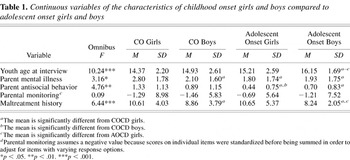
In order to address the third hypothesis predicting that COCD girls, AOCD girls, and COCD boys would all have similar risk profiles, girls and boys with COCD were compared on demographic characteristics and risk profiles to girls and boys with AOCD. The means and standard deviations of the continuous study variables are summarized in Table 1, along with the results of the analyses of variance (ANOVAs) comparing COCD girls and boys to all other groups.
Continuous variables of the characteristics of childhood onset girls and boys compared to adolescent onset girls and boys

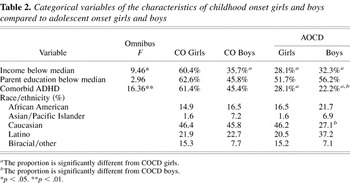
A significant omnibus F statistic indicated that the four gender and onset groups differed on youth age at interview, F (3, 299) = 10.24, p < .001, family history of mental illness, F (3, 294) = 3.16, p < .05, family history of antisocial behavior, F (3, 295) = 4.76, p < .01, history of maltreatment, F (3, 280) = 6.44, p < .001, below median parental income, χ2 (3, N = 303) = 9.46, p < .05, and ADHD, χ2 (3, N = 303) = 16.36, p < .01. The omnibus F statistic was not significant for parental monitoring, F (3, 299) = 0.09, ns, and below median parental education, χ2 (3, N = 303) = 2.96, ns, indicating similar levels across the four groups.
Planned comparisons were conducted for those variables that reached significance with the overall ANOVA or chi-square goodness of fit. These analyses revealed that COCD girls were significantly more likely to have a family history of mental illness than AOCD girls, t (1, 87) = 2.62, p < .05, COCD boys, t (1, 180) = 2.44, p < .05, and AOCD boys, t (1, 127) = 2.70, p < .01. COCD girls were more likely to have a family history of antisocial behavior than AOCD girls, t (1, 87) = 3.41, p < .01, and AOCD boys, t (1, 127) = 2.32, p < .05. COCD girls were also more likely to have a history of maltreatment than either COCD boys, t (1, 164) = 2.53, p < .05, or AOCD boys, t (1, 122) = 3.67, p < .001. The COCD girls were significantly younger at the time of the interview than the AOCD boys, t (1, 127) = −4.88, p < .001.
Few significant differences were found between boys with COCD and either girls or boys with AOCD. Boys with COCD were more likely to have a family history of antisocial behavior than girls with AOCD, t (1, 168) = −2.85, p < .01. COCD boys were significantly younger than AOCD boys at the time of the interview, t (1, 1464) = −4.10, p < .000, and t (1, 210) = −4.08, p < .001, respectively. No other differences between COCD boys and AOCD girls or boys emerged on continuous variables (see Table 1).
The chi-square tests performed to compare COCD girls and boys to AOCD girls and boys on categorical variables are summarized in Table 2. COCD girls were more likely to have below median income than AOCD girls, χ2 (1, N = 91) = 6.85, p < .01, COCD boys, χ2 (1, N = 185) = 6.19, p < .05, or AOCD boys, χ2 (1, N = 129) = 6.10, p < .05. COCD girls were also more likely to have ADHD than AOCD girls, χ2 (1, N = 91) = 5.97, p < .05, or AOCD boys, χ2 (1, N = 129) = 13.82, p < .001. The overall pattern suggests that COCD girls experienced levels of risk factors equal to or greater than the three other groups.
Categorical variables of the characteristics of childhood onset girls and boys compared to adolescent onset girls and boys

No significant differences were found between COCD boys and AOCD girls on categorical variables. However, COCD boys were more likely to have comorbid ADHD, χ2 (1, N = 212) = 7.84, p < .01, and to be Caucasian, χ2 (1, N = 212) = 3.95, p < .05, than were AOCD boys.
Because girls were more likely to have been sampled from the child welfare sector and boys from juvenile justice, it was possible that the observed gender patterns reflected bias in the sample. However, analyses of covariance, which were conducted with child welfare as a covariate for continuous variables and logistic regressions controlling for child welfare affiliation for the categorical variables, resulted in no changes in the pattern of results.
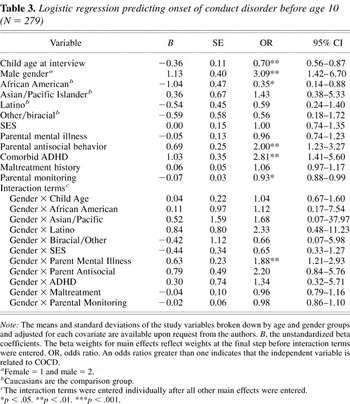
The fourth hypothesis asserted that risk factors that differentiate COCD and AOCD among males would not distinguish between COCD and AOCD among females. This hypothesis was tested with logistic regression analyses. Table 3 summarizes the unstandardized beta weights, the standard error of beta, odds ratios (OR), and 95% confidence intervals. The beta weights and ORs reported in the table reflect the final model after all other main effects were entered. Each interaction term was entered individually; thus, the interaction effect reflects the full model of main effects plus that particular interaction term. ORs greater than 1.00 indicate that the independent variable was related to COCD, whereas ORs lower than 1.00 indicate that the variable was predictive of AOCD.
Logistic regression predicting onset of conduct disorder before age 10 (N = 279)

Consistent with past cross-sectional studies examining the correlates of COCD (Lahey et al., 1998, 1999), the child's age at the time of interview was controlled in all analyses because the age of onset of the disorder is necessarily related to the current age of the child (i.e., children who were older at the time of the interview have a greater probability of having an older age of onset of the disorder). Children who were older at the time of the interview were significantly less likely to have COCD (OR = 0.70, p < .01). Males were significantly more likely to have COCD than females (OR = 3.09, p < .01). African American youth were less likely to have COCD than Caucasians (OR = 0.35, p < .05). Other demographic factors, including the remaining race/ethnicity variables and socioeconomic status, were not significantly related to COCD. Children with a parental history of mental illness were no more likely to have COCD than those without; however, parental history of antisocial behavior was a significant predictor of COCD (OR = 2.00, p < .01). Comorbid ADHD was also a strong predictor of COCD (OR = 2.81, p < .01). Finally, higher parental monitoring was associated with a lower likelihood of COCD (OR = 0.93, p < .05). Maltreatment history was not significantly related to COCD (see Table 3).
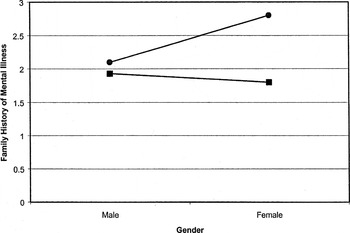
Next, the terms representing the interaction between gender and each of the independent variables were entered individually to determine if there were differential relationships between risk factors and COCD for boys and girls. Only the interaction between gender and family history of mental illness reached significance (OR = 1.88, p < .01). To determine the nature of the interaction, the data were graphed (see Figure 1). The means of the family history of mental illness were plotted for both COCD and AOCD girls and boys. This graph demonstrates that there is a stronger relationship between family history of mental illness and COCD for girls than for boys. All other interaction terms were nonsignificant. Finally, to ensure that gender differences in sector affiliation did not account for the observed patterns, child welfare was entered into the regressions. Child welfare affiliation was not a significant predictor of COCD, and its entry did not change the pattern of results. It was therefore not retained in the final model.

The gender differences in the relationship between family history of mental illness among children with ([bull ]) early onset and ([squf ]) late onset conduct disorder.
Discussion
The current study tested four hypotheses related to the theory that girls follow a single delayed onset pathway to COCD. The data presented here confirmed the first hypothesis that COCD was significantly more common among boys than among girls with CD in a service-utilizing sample. However, contrary to the second hypothesis, COCD was not a rare condition among girls with a history of public service use, with close to half of the girls meeting the DSM-IV criteria for the COCD subtype. The third hypothesis, that girls with both COCD and AOCD would be similar in their risk profile to boys with COCD but have more severe risk profiles than AOCD boys, also received mixed support. COCD girls scored similar to or higher than all three of the other groups across several risk factors. However, AOCD girls and COCD boys were generally similar in terms of risk. Finally, the fourth hypothesis predicting that risk factors for COCD among males would not differentiate between COCD and AOCD girls was largely unsupported. With the exception of family history of mental illness, there were no significant interactions between gender and any demographic or risk factors in the prediction of COCD. In general, these findings suggest that age of onset is relevant to girls with CD.
These data indicate that, among this high-risk sample of youth, boys with CD are more likely to have a childhood onset than girls with CD. However, the fact that nearly half of the girls with COCD had an onset before age 10 indicates that COCD is not rare among girls with a history of public service use. This is consistent with the findings of Tolan and Thomas (1995), who found a substantial proportion of delinquent girls to have COCD in a community sample; but it represents a substantially higher proportion of COCD girls than found by Moffitt and Caspi (2001), also in a community sample. It is likely that we found a higher proportion of girls with COCD because of the fact that we examined youth who had already been in contact with a public service sector. Nevertheless, the finding of a substantial number of COCD girls among a high-risk sample argues against the notion of a single delayed onset pathway for girls.
In addition, bivariate analyses testing the hypothesis that AOCD girls would be similar in demographic and risk profiles to both COCD girls and boys received mixed support. Although COCD girls were similar to COCD boys on most risk factors (parental antisocial behavior, parental monitoring, below median education, and ADHD), COCD girls had significantly higher rates of family mental illness and below median income than COCD boys. COCD girls also had higher rates of maltreatment than COCD boys, but this appears to represent a gender difference that exists regardless of age of onset. Significant differences were also found between COCD girls and AOCD girls, with COCD girls scoring higher on family history of mental illness and antisocial behavior, as well as below median income and comorbid ADHD. This pattern of findings suggests that COCD girls can be differentiated from AOCD girls, at least on several specific risk factors, consistent with the findings of Moffitt and Caspi (2001). However, AOCD girls were quite similar to COCD boys in terms of risk; the only significant difference was lower rates of family history of antisocial behavior among AOCD girls. This pattern of findings is inconsistent with the prediction of the delayed onset hypothesis that COCD girls are both rare and, when they do exist, similar to AOCD girls. However, it is consistent with the prediction that AOCD girls are similar to COCD boys in terms of risk factors, a hypothesis also supported by Silverthorn et al. (2001). These results can be interpreted as suggesting that girls may actually require exposure to greater environmental risk in order to develop CD, especially COCD (Eme, 1992; McCabe, Lansing, Garland, & Hough, 2002). For example, our data suggest that CD girls, regardless of age of onset, have higher rates of maltreatment than CD males. Past studies have also reported elevated rates of maltreatment among female offenders (Giordano & Cernkovich, 1997; Janus, McCormack, Burgess, & Hartman, 1987).
If age of onset is irrelevant to the developmental trajectory for girls with CD, one would expect that risk factors associated with COCD among males would show a weaker or nonexistent relationship to COCD among females. This hypothesis was not supported in our cross-sectional data. When the hypothesis that differential relationships would exist between risk factors and COCD for boys and girls was tested, very few significant interactions were found. One exception to this pattern was the finding that family history of mental illness appeared to be a stronger predictor of COCD for girls than for boys. Past studies have found that female delinquents are more likely to come from families characterized by psychopathology and conflict than male delinquents (Henggeler et al., 1987). Giordano and Cernkovich (1997) argue that family bonds are stronger for females and as a result may make family psychopathology a more important risk factor for COCD for girls compared with boys. This theory is consistent with findings that both female delinquents (McCabe et al., 2002) and girls with CD (Loeber & Keenan, 1994) have higher rates of comorbid psychopathology than their male counterparts. Because females who display antisocial behavior are more deviant vis-à-vis gender-specific cultural norms, they may also have more serious psychopathology (Dembo, Williams, & Schmeidler, 1994), which may be transmitted across generations either genetically or through adverse family environments. However, it should be noted that no gender differences were found on the overall rates of comorbidity in this sample, one indicator of the seriousness of psychopathology.
The current investigation has several limitations that should be noted. Parents reported on the majority of risk factors and also served as one of the informants on child CD symptoms, which could artificially inflate the relationship between risk factors and COCD. However, a comparison of the relationship found between risk factors and CD among cases identified by child report to the same analyses with cases identified by parent report yielded a similar pattern of findings, suggesting that shared informant variance does not account for the findings reported here. Because youth were selected as a result of contact with a public service agency, the sample is likely not to be typical of conduct disordered youth in the community. For example, girls with COCD may appear to have a more severe profile of risk factors because of differences in how boys and girls enter public service systems. In the current sample, girls with CD were more likely to have come from the child welfare sector and boys from juvenile justice. Although controlling for child welfare affiliation in our analyses did not alter the pattern of results, youth in child welfare may represent a population that has been exposed to different risk factors than those in juvenile justice. Therefore, these results should only be generalized to youth who have already entered public service systems, a more severe group than is likely to be found in the community. In addition, the univariate analyses failed to find differences between boys with COCD and AOCD, contrary to a substantial number of published studies (e.g., Hinshaw et al., 1993). This may be attributable to the fact that AOCD boys were significantly older at the time of interview than COCD boys, given that regression analyses that control for these age differences found that risk factors that typically differentiate these groups of boys also differentiated them in our sample. However, the possibility that our service-using sample is atypical cannot be ruled out.
The study also relied on cross-sectional rather than longitudinal data, which precludes conclusions about causality and prevents examination of long-term outcomes associated with the age of onset for girls. Although it is encouraging that Green, Loeber, and Lahey (1991) reported good stability of mothers' recall of the age of onset of the disruptive symptoms of ADHD and that acceptable test–retest reliability has been found for the DISC-IV age of onset questions for the disruptive disorders (Shaffer et al., 1996), the use of retrospective data to establish the age of onset of CD is vulnerable to errors in recall. Although the cross-sectional nature of our data and the sampling frame required the use of multivariate modeling to control for potential confounds, testing the interaction terms between independent variables and gender in the prediction of COCD may also represent a conservative test of our hypotheses. As McClelland and Judd (1993) point out, interactions are much more difficult to detect in observational studies in comparison with experimental studies partly because of measurement error. The findings presented here should therefore be replicated in other representative community samples with larger sample sizes. Future studies should examine other risk factors including low cognitive ability, impulsivity, and cold and callous interpersonal style (Silverthorn et al., 2001). In addition, several of the measures of risk factors employed in this study had substantial limitations. For example, the fact that the primary caregiver responded to questions about history of psychopathology and antisocial behavior for both parents necessarily excluded problems of which the primary caregiver was unaware. Future research should employ more sophisticated measures of risk factors, particularly parent history of mental illness and antisocial behavior. Finally, although the low rates of parent/child agreement found in the current study were not atypical (Herjanic & Reich, 1997; Weissman, Wickramaratne, Warner, John, Prusoff, Merikangas, & Gammon, 1987), the challenge of integrating these disparate perceptions is an important topic for future research.
Despite these limitations, the current study provides preliminary information on how service-utilizing boys and girls with CD may be both similar and different from one another. The findings suggest that the distinction between COCD and AOCD is relevant to girls. However, the development of CD may differ in some respects for boys and girls. For example, further studies should determine how differences in developmental processes lead to such findings as the higher prevalence of COCD among boys and greater severity of risk factors among girls with CD. Although some evidence suggests that girls with COCD may have a more extreme form of the disorder (Eme, 1992; Loeber & Keenan, 1994), this theory has yet to be fully tested. In addition, future studies should employ longitudinal methodologies to determine if the course of COCD is the same for both genders. For example, for the COCD and AOCD subtypes to be valid for girls as well as boys, COCD should be associated with such factors as greater persistence of offending, aggression, and unsocialized offending (Moffitt, 1993). A closer examination of this developmental model is likely to reveal both similarities and differences among males and females with CD and suggest ways in which interventions can be specifically tailored to meet the needs of both genders.
References
REFERENCES
American Psychiatric Association.
(1994).
Diagnostic and statistical manual of mental disorders
(4th ed.).
Washington, DC:
Author.
Bardone, A. M.,
Moffitt, T. E., &
Caspi, A.
(1997).
Adult mental health and social outcomes of adolescent girls with
depression and conduct disorder.
Development and Psychopathology
8,
811–829.Google Scholar
Bernstein, D. P., &
Fink, L.
(1998).
Childhood trauma questionnaire: A retrospective self report.
San Antonio, TX:
Psychological Corporation.
Bilchik, S.
(2000).
1999 National report series: Juvenile justice bulletin. Challenging
the myths.
Washington, DC:
Office of Juvenile Justice and Delinquency Prevention.
Bird, H.,
Gould, M. S., &
Staghezza, B.
(1992).
Aggregating data from multiple informants in child psychiatry
epidemiological research.
Journal of the American Academy of Child and Adolescent Psychiatry
31,
78–85.Google Scholar
Bird, H. R.,
Shaffer, D.,
Fisher, P.,
Gould, M. S.,
Staghezza, B.,
Chen, J. Y., &
Hoven, C.
(1993).
The Columbia Impairment Scale (CIS): Pilot findings on a measure of
global impairment for children and adolescents.
International Journal of Methods in Psychiatric Research
3,
167–176.Google Scholar
Cantwell, D. P.,
Lewinsohn, P. M.,
Rohde, P., &
Seeley, J.
(1996).
Correspondence between adolescent report and parent report of
psychiatric diagnostic data.
Journal of the American Academy of Child and Adolescent Psychiatry
36,
610–619.Google Scholar
Chalmers, J. B., &
Townsend, M. A.
(1990).
The effects of training in social perspective taking on socially
maladjusted girls.
Child Development
61,
178–190.Google Scholar
Chesney–Lind, M., &
Shelden, R. G.
(1992).
Girls: Delinquency and juvenile justice.
Pacific Grove, CA:
Brooks Cole.
Cohen, P.,
Velez, N.,
Kohn, M.,
Schwab–Stone, M., &
Johnson, J.
(1987).
Child psychiatric diagnosis by computer algorithm: Theoretical
issues and empirical tests.
Journal of the American Academy of Child and Adolescent Psychiatry
26,
631–638.Google Scholar
Dembo, R.,
Williams, L., &
Schmeidler, J.
(1994).
Psychosocial, alcohol/other drug use, and delinquency
differences between urban Black and White male high risk youth.
International Journal of the Addictions
29,
461–483.Google Scholar
Eme, R. F.
(1992).
Selective female affliction in the developmental disorders of
childhood: A literature review.
Journal of Clinical Child Psychology
21,
354–364.Google Scholar
Giordano, P. C., &
Cernkovich, S. A.
(1997).
Gender and antisocial behavior. In
D. M. Stoff,
J. Breiling, &
J. D. Maser (Eds.),
Handbook of antisocial behavior (pp.
496–510).
New York:
Wiley.
Green, S. M.,
Loeber, R., &
Lahey, B. B.
(1991).
Stability of mothers' recall of the age of onset of their
child's attention and hyperactivity problems.
Journal of the American Academy of Child and Adolescent Psychiatry
30,
135–137.Google Scholar
Henggeler, S. W.,
Edwards, J., &
Borduin, C. M.
(1987).
The family relations of female juvenile delinquents.
Journal of Abnormal Child Psychology
15,
199–209.Google Scholar
Henry, G. T.
(1990).
Practical sampling.
Newbury Park, CA:
Sage.
Herjanic, B., &
Reich, W.
(1997).
Development of a structured psychiatric interview for children:
Agreement between child and parent on individual symptoms.
Journal of Abnormal Child Psychology
25,
21–31.Google Scholar
Hinshaw, S. P.,
Lahey, B. B., &
Hart, E. L.
(1993).
Issues of taxonomy and comorbidity in the development of conduct
disorder.
Developmental Psychopathology
5,
31–50.Google Scholar
Hoyt, S., &
Scherer, D. G.
(1998).
Female juvenile delinquency: Misunderstood by the juvenile justice
system, neglected by social science.
Law and Human Behavior
22,
81–107.Google Scholar
Janus, M. E.,
McCormack, A.,
Burgess, A. W., &
Hartman, C.
(1987).
Adolescent runaways: Causes and consequences.
Lexington, MA:
Lexington Books/D. C. Heath and Company.
Jensen, P.,
Rubio–Stipec, M.,
Canino, G.,
Bird, H. R.,
Dulcan, M. K.,
Schwab–Stone, M. E., &
Lahey, B. B.
(1999).
Parent and child contributions to diagnosis of mental disorder: Are
both informants always necessary?
Journal of the American Academy of Child and Adolescent Psychiatry
38,
1569–1579.Google Scholar
Kashani, J. H.,
Beck, N. C.,
Hoeper, E. W.,
Fallahi, C.,
Corcoran, C. M.,
McAllister, J. A.,
Rosenberg, T. K., &
Reid, J. C.
(1987).
Psychiatric disorders in a community sample of adolescents.
American Journal of Psychiatry
144,
584–589.Google Scholar
Kavanagh, K., &
Hops, H.
(1994).
Good girls? Bad boys? Gender and development as contexts for
diagnosis and treatment.
Advances in Clinical Child Psychology
16,
45–79.Google Scholar
Lahey, B. B.,
Flagg, E. W.,
Bird, H. R.,
Schwab–Stone, M. E.,
Canino, G.,
Dulcan, M. K.,
Leaf, P. J.,
Davies, M.,
Brogan, D.,
Bourdon, K.,
Horwitz, S. M.,
Rubio–Stipec, M.,
Freeman, D. H.,
Lichtman, J. H.,
Shaffer, D.,
Goodman, S. H.,
Narrow, W. E.,
Weissman, M. M.,
Kandel, D. B.,
Jensen, P. S.,
Richters, J. E., &
Regier, D. A.
(1996).
The NIMH methods for the epidemiology of child and adolescent
mental disorders study: Background and methodology.
Journal of the American Academy of Child and Adolescent Psychiatry
35,
855–864.Google Scholar
Lahey, B. B.,
Goodman, S. H.,
Waldman, I. D.,
Bird, H.,
Canino, G.,
Jensen, P.,
Regier, D.,
Leaf, P. J.,
Gordon, R., &
Applegate, B.
(1999).
Relation of age of onset to the type and severity of child and
adolescent conduct problems.
Journal of Abnormal Child Psychology
27,
247–260.Google Scholar
Lahey, B. B.,
Loeber, R.,
Quay, H.,
Applegate, B.,
Shaffer, D.,
Waldman, I.,
Hart, E.,
McBurnett, K.,
Frick, P. J.,
Jensen, P. S.,
Dulcan, M. K.,
Canino, G., &
Bird, H. R.
(1998).
Validity of the DSM-IV subtypes of conduct disorder based
on age of onset.
Journal of the American Academy of Child and Adolescent Psychiatry
37,
435–442.Google Scholar
Loeber, R.
(1990).
Development and risk factors of juvenile antisocial behavior and
delinquency.
Clinical Psychology Review
10,
1–41.Google Scholar
Loeber, R.,
Farrington, D. P.,
Stouthamer–Loeber, M., &
Van Kammen, W.
(1998).
Antisocial behavior and mental health problems: Explanatory factors
in childhood and early adolescence.
Mahwah, NJ:
Erlbaum.
Loeber, R., &
Keenan, K.
(1994).
Interaction between conduct disorder and its comorbid conditions.
Clinical Psychology Review
14,
502–503.Google Scholar
McCabe, K. M.,
Hough, R.,
Wood, P., &
Yeh, M.
(2001).
Childhood and adolescent onset conduct disorder: A test of the
developmental taxonomy.
Journal of Abnormal Child Psychology
29,
305–316.Google Scholar
McCabe, K. M.,
Lansing, A.,
Garland, A., &
Hough, R.
(2002).
Gender differences in psychopathology, functional impairment, and
familial risk factors among adjudicated delinquents.
Journal of the American Academy of Child and Adolescent Psychiatry
41,
860–867.Google Scholar
McClelland, G. H., &
Judd, C. M.
(1993).
Statistical difficulties of detecting interactions and moderator
effects.
Psychological Bulletin
114,
376–390.Google Scholar
Miller, D.,
Trapani, C.,
Fejes–Mendoza, K.,
Eggleston, C., &
Dwiggins, D.
(1995).
Adolescent female offenders: Unique considerations.
Adolescence
30,
429–435.Google Scholar
Moffitt, T. E.
(1993).
Adolescence-limited and life-course-persistent antisocial behavior:
A developmental taxonomy.
Psychological Review
4,
674–701.Google Scholar
Moffitt, T. E., &
Caspi, A.
(2001).
Childhood predictors differentiate life-course persistent and
adolescent-limited antisocial pathways among males and females.
Development and Psychopathology
13,
355–375.Google Scholar
Patterson, G. R.,
Reid, J. B., &
Dishion, T. J.
(1992).
A social learning approach. IV. Antisocial boys.
Eugene, OR:
Castalia.
Rutter, M.
(1987).
Psychosocial resilience and protective mechanisms.
American Journal of Orthopsychiatry
57,
316–331.Google Scholar
Shaffer, D.,
Fisher, P.,
Dulcan, M. K.,
Davies, M.,
Piacentini, J.,
Schwab–Stone, M. E.,
Lahey, B. B..,
Bourdon, K.,
Jensen, P. S.,
Bird, H. R.,
Canino, G., &
Regier, D. A.
(1996).
The NIMH diagnostic interview schedule for children version 2.3
(DISC-2.3): Description, acceptability, prevalence rates, and
performance in the MECA study.
Journal of the American Academy of Child and Adolescent Psychiatry
35,
865–877.Google Scholar
Shaffer, D.,
Fisher, P.,
Lucas, C. P.,
Dulcan, M. K., &
Schwab–Stone, M. E.
(2000).
NIMH diagnostic interview schedule for children version IV (NIMH
DISC-IV): Description, differences from previous versions, and
reliability of some common diagnoses.
Journal of the American Academy of Child and Adolescent Psychiatry
39,
28–38.Google Scholar
Silverthorn, P., &
Frick, P. J.
(1999).
Developmental pathways to antisocial behavior: The delayed-onset
pathway in girls.
Development and Psychopathology
11,
101–112.Google Scholar
Silverthorn, P.,
Frick, P. J., &
Reynolds, R.
(2001).
Timing of onset and correlates of severe conduct problems in
adjudicated girls and boys.
Journal of Psychopathology and Behavioral Assessment
23,
171–181.Google Scholar
Snyder, H. N., &
Sickmund, M.
(1999).
Juvenile offenders and victims: 1999 national report.
Washington, DC:
Office of Juvenile Justice and Delinquency Prevention.
Tolan, P. H.
(1987).
Implications of age of onset for delinquency risk.
Journal of Abnormal Child Psychology
15,
47–65.Google Scholar
Tolan, P. H., &
Thomas, P.
(1995).
The implications of age of onset for delinquency risk II:
Longitudinal data.
Journal of Abnormal Child Psychology
23,
157–181.Google Scholar
Weissman, M. M.,
Wickramaratne, P.,
Warner, V.,
John, K.,
Prusoff, B. A.,
Merikangas, K., &
Gammon, D.
(1987).
Assessing psychiatric disorders in children.
Child Psychiatry
44,
747–753.Google Scholar
Zoccolillo, M.
(1993).
Gender and the development of conduct disorder.
Development and Psychopathology
5,
65–78.Google Scholar
Zoccolillo, M., &
Rogers, K.
(1991).
Characteristics and outcomes of hospitalized adolescent girls with
conduct disorder.
Journal of the American Academy of Child and Adolescent Psychiatry
30,
973–981.Google Scholar
Continuous variables of the characteristics of childhood onset girls and boys compared to adolescent onset girls and boys
Categorical variables of the characteristics of childhood onset girls and boys compared to adolescent onset girls and boys
Logistic regression predicting onset of conduct disorder before age 10 (N = 279)
The gender differences in the relationship between family history of mental illness among children with ([bull ]) early onset and ([squf ]) late onset conduct disorder.
 You have
Access
- 41
- Cited by