INTRODUCTION
Southampton Water is a shallow, partially mixed coastal plain estuary (Dyer, Reference Dyer1973) located on the south coast of England, that discharges into the Solent (Figure 1). It is essentially marine in character, with an average salinity between 25 and 30. There is little or no salinity variation near the mouth (~30), with stratification occurring mostly at the head of the estuary where values between 11 and 32 can be found (Raymont & Carrie, Reference Raymont and Carrie1964; Muxagata et al., Reference Muxagata, Williams and Sheader2004). Water temperature within Southampton Water varies seasonally, with winter minimums of <7°C in December to February and maximums >17°C during the summer, from June to August (Leakey et al., Reference Leakey, Burkill and Sleigh1992; Hirst, Reference Hirst1996).
The study area, with details showing sampling locations during 2001/2002.

During the past 50 years studies about ciliates (Leakey et al., Reference Leakey, Burkill and Sleigh1992; Kifle & Purdie, Reference Kifle and Purdie1993), bacteria (Antai, Reference Antai1989), phytoplankton (Iriarte & Purdie, Reference Iriarte and Purdie1994; Howard et al., Reference Howard, Comber, Kifle, Antai and Purdie1995), gelatinous predators (Lucas et al., Reference Lucas, Williams, Williams and Sheader1995, Reference Lucas, Hirst and Williams1997), calanoid copepods (Conover, Reference Conover1957; Raymont & Carrie, Reference Raymont and Carrie1964; Castro-Longoria & Williams, Reference Castro-Longoria and Williams1996; Hirst et al., Reference Hirst, Sheader and Williams1999), cyclopoid copepods (Williams & Muxagata, Reference Williams and Muxagata2006) and barnacle larvae (Raymont & Carrie, Reference Raymont and Carrie1964; Muxagata et al., Reference Muxagata, Williams and Sheader2004; Herbert & Muxagata, Reference Herbert and Muxagata2009; Muxagata & Williams, Reference Muxagata and Williams2011) highlighted the basic spatial and temporal patterns of the major planktonic components of Southampton Water. Acartia has been identified as the dominant mesozooplanktonic species, with the cyclopoid Oithona nana, harpacticoids and barnacle larvae overshadowing Acartia in certain seasons and locations (Muxagata et al., Reference Muxagata, Williams and Sheader2004; Williams & Muxagata, Reference Williams and Muxagata2006).
The occurrence of parasitic and commensal forms has been noted in the zooplankton of Southampton Water. The parasitic larvae of the cirripedes Trypetesa sp. (Cirripedia: Acrothoracica), Sacculina carcini and Peltogaster paguri (Cirripedia: Rhizocephala) and the copepods Monstrilla sp. (Copepoda: Monstrilloida) and Notodelphys allmani (Copepoda: Cyclopoida) have been reported mainly in species lists of PhD and MSc dissertations (Soares, Reference Soares1958; Hirst, Reference Hirst1996; Castro-Longoria, Reference Castro-Longoria1998; Muxagata et al., Reference Muxagata, Williams and Sheader2004; Muxagata, Reference Muxagata2005; Herbert & Muxagata, Reference Herbert and Muxagata2009). Furthermore, Lernaeocera lusci (Copepoda: Siphonostomatoida) has been reported in fish (Trisopterus luscus) caught on the cooling water intake screens of Fawley Power Station in 1982 (Evans et al., Reference Evans, Whitfield, Bamber and Espin1983). Although known to occur in the region, little attention has been paid to the seasonality and distribution of these parasitic and commensal forms in the zooplankton of Southampton Water.
The occurrence of larvae and/or adults of parasitic/commensal species within plankton samples are a reasonable indicator of the presence of the infected/associate host in the estuary or surrounding areas, so the present report was made in order to present the seasonality of occurrence of the parasitic/commensal forms that occur in zooplankton samples of Southampton Water and also to increase our knowledge of those forms.
MATERIALS AND METHODS
During a period of 19 months, from 12 January 2001 until 16 July 2002, a total of 108 mesozooplankton samples were collected from three sites within Southampton Water (Figure 1), as part of a survey focused on the collection of zooplankton samples for secondary production estimates (Muxagata, Reference Muxagata2005). Samples were collected during the extended period of ‘slack water’ during high tide from 5-m double oblique tows using conventional cod-end plankton nets of 50 cm mouth diameter and 120 µm mesh, with a calibrated flowmeter (TSK) attached to the mouth of the net. Samples were preserved in approximately 4% formaldehyde–seawater solution buffered with borax until processing (Steedman, Reference Steedman and Steedman1976). Detailed information on the study area and methods can be found in Muxagata et al. (Reference Muxagata, Williams and Sheader2004), Muxagata (Reference Muxagata2005) and Williams & Muxagata (Reference Williams and Muxagata2006).
When abundances were low, all parasitic/commensal forms were searched over the whole sample, counted and identified to the lowest taxonomic level possible. In the few samples where the abundance of parasitic/commensal forms was very high, individuals were counted from 1.5 to 12% sub-samples.
The taxonomic system adopted in this work follows that of Martin & Davis (Reference Martin and Davis2001), and the identification of individuals was done using a comprehensive literature (Sars, Reference Sars1921; Veillet, Reference Veillet1943; Turquier, Reference Turquier1967; Boxshall, Reference Boxshall1974; Isaac, Reference Isaac1975; Kabata, Reference Kabata1979; Isaac & Moyse, Reference Isaac, Moyse, Hayward and Ryland1990; Hoeg, Reference Hoeg, Harrison and Humes1992; Gotto, Reference Gotto1993; Piasecki, Reference Piasecki1996; Boxshall & Montú, Reference Boxshall and Montú1997; Kas'yanov et al., Reference Kas'yanov, Korn and Rybakov1998). The results are expressed as averaged monthly values for the three stations.
RESULTS AND DISCUSSION
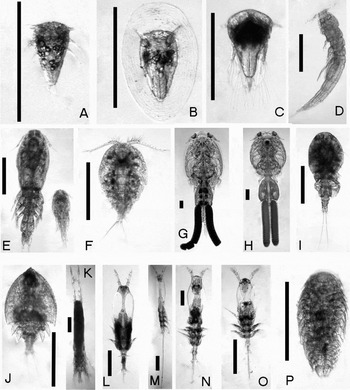
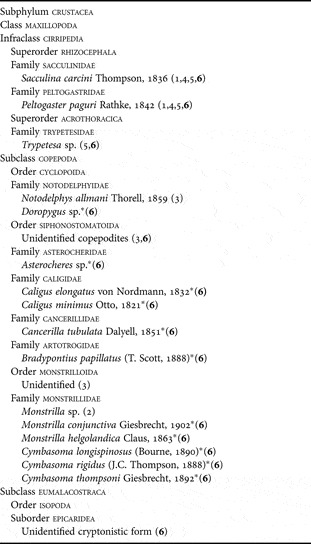
A total of 16 parasitic taxa belonging to three subclasses within the Crustacea were identified, 11 of which are new records for the mesozooplankton of Southampton Water (Table 1 and Figure 2). From these taxa, 11 were identified to species, three to genus and two were only identified to order (Table 1 and Figure 2).
Parasitic forms found in the zooplankton of Southampton Water during 2001/2002. (A) Sacculina carcini; (B) Peltogaster paguri; (C) Trypetesa sp.; (D) Doropygus sp.; (E) unidentified Siphonostomatoida copepodites; (F) Asterocheres sp.; (G) Caligus elongatus; (H) Caligus minimus; (I) Cancerilla tubulata; (J) Bradypontius papillatus; (K) Monstrilla conjunctiva; (L) Monstrilla helgolandica; (M) Cymbasoma longispinosus; (N) Cymbasoma rigidus; (O) Cymbasoma thompsoni; (P) unidentified cryptonistic form. Adapted from Muxagata & Williams (Reference Muxagata and Williams2004).

Parasitic forms found in the zooplankton of Southampton Water with all previous records.

*, organisms reported for the first time within this estuary. References: 1, Soares (1957); 2, Hirst (Reference Hirst1996); 3, Castro-Longoria (Reference Castro-Longoria1998); 4, Muxagata et al. (Reference Muxagata, Williams and Sheader2004); 5, Herbert & Muxagata (Reference Herbert and Muxagata2009); 6, present study.
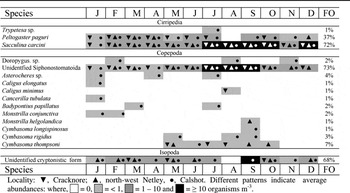
The most frequent parasitic/commensal forms observed were naupliar stages of Sacculina carcini (Figure 2A), Peltogaster paguri (Figure 2B), unidentified Siphonostomatoida copepodites and unidentified cryptonistic forms of isopods. All of the remaining forms were caught only sporadically (Table 2).
Seasonal occurrence of the parasitic/commensal species/groups in Southampton Water, with the frequency of occurrence (FO) of each taxa and locality of occurrence.

Adults of S. carcini and P. paguri are endoparasites of decapods that have a short free, non-feeding, planktonic dispersal stage. Adults of P. paguri have been reported infecting pagurid hermit crabs such as Pagurus bernhardus, Pagurus cuanensis, Anapagurus chiroachantus and Anapagurus laevis, while adults of S. carcini were reported in Portunidae and Pirimelidae crabs (Hansson, Reference Hansson1998). In Southampton Water the planktonic dispersal stages of both Peltogaster paguri and S. carcini were commonly found in zooplankton catches all year round (Table 2). The nauplii of S. carcini were abundant in August samples (Muxagata et al., Reference Muxagata, Williams and Sheader2004; Herbert & Muxagata, Reference Herbert and Muxagata2009) and a single specimen of Pagurus bernhardus infected by Peltogaster paguri was observed in 2002 from pagurids collected in the estuary.
A single nauplii of Trypetesa sp., possibly Trypetesa lampas (Figure 2C), a burrowing barnacle usually found in the shells of gastropod molluscs (Turquier, Reference Turquier1967, Reference Turquier1972), was observed on a July sample from Calshot (Table 2).
Cyclopoid notodelphyids were caught on three different occasions at Calshot (Table 2). Notodelphyids are considered commensals rather than parasitic (Boxshall & Halsey, Reference Boxshall and Halsey2004), they are usually associated with ascidians, and found inhabiting the pharynx or atrium, presumably sharing the food brought in by the host. Doropygus sp. (Figure 2D), probably Doropygus pulex, and Notodelphys allmani have been described associated with Ascidia conchilega, Ascidiella aspersa and Ciona intestinalis (Chordata: Ascidiacea) which are also present in the region (Isaac & Moyse, Reference Isaac, Moyse, Hayward and Ryland1990; Gotto, Reference Gotto2004). Notodelphys allmani had been previously reported in this estuary by Castro-Longoria (Reference Castro-Longoria1998).
About 1550 species of Siphonostomatoids are described, with around 1050 species related to fish and nearly 500 associated with invertebrate hosts (Huys & Boxshall, Reference Huys and Boxshall1991). Previously, the only identified Siphonostomatoida taxa for Southampton Water was Lernaeocera lusci (Siphonostomatoida: Pennellidae), found attached to the bib, Trisopterus luscus (Gadiformes: Gadidae). During the present study, four different species of siphonostomatoid copepods were recorded (Table 1), together with individuals pooled in an ‘unidentified copepodites’ category.
Unidentified siphonostomatoid copepodites (Figure 2E) can be found throughout the year in the whole estuary (Table 2). Based on differences in the mouth parts of these unidentified copepodites of siphonostomatoids at least five different species are present, and it is almost certain that copepodites of L. lusci occur among them.
Asterocheridae are reported on a wide variety of hosts, either as internal or external associates, or even as parasites. Asterocheres sp. (Figure 2F) is considered an ectoparasite of echinoderms (Isaac & Moyse, Reference Isaac, Moyse, Hayward and Ryland1990), but is also reported in association with Porifera, Mollusca, Cnidaria, Urochordata and Bryozoa (Hansson, Reference Hansson1998; Boxshall & Halsey, Reference Boxshall and Halsey2004; Gotto, Reference Gotto2004). Only four adults were observed in the zooplankton at Calshot (Table 2).
Caligids are ectoparasites that are usually found on the outer surface, mouth, gills and opercular cavity of fish hosts (Boxshall & Halsey, Reference Boxshall and Halsey2004). Apart from an adult male of Caligus elongatus found on samples of Castro-Longoria (Reference Castro-Longoria1998), only a single adult female of C. elongatus (Figure 2G) and an adult female of Caligus minimus (Figure 2H) were observed in the zooplankton samples during this study (Table 2). Caligus elongatus is regarded as the most common parasitic copepod in British waters (Kabata, Reference Kabata1979) and was reported associated with more than 80 species of fish (Kabata, Reference Kabata1979; Isaac & Moyse, Reference Isaac, Moyse, Hayward and Ryland1990) while C. minimus are usually reported on perciform fish (Kabata, Reference Kabata1979). Adult specimens of C. elongatus are commonly reported in plankton samples, probably indicating that its pelagic occurrence is a common facet of its behaviour (G. Boxshall, personal communication).
A single male specimen of Cancerilla tubulata (Figure 2I) was captured. Cancerillids are typical ectoparasites of brittle stars, being reported associated with Amphipholis squamata, Ophiocomina nigra, Ophiothrix fragilis and Ophiosila aranea or even free (Isaac & Moyse, Reference Isaac, Moyse, Hayward and Ryland1990; Gotto, Reference Gotto1993, Reference Gotto2004; Hansson, Reference Hansson1998). Amphipholis squamata and Ophiothrix fragilis have been previously reported in the Solent–Southampton Water area (Guyard, Reference Guyard2000).
Little is known from the Artotrogidae, but they have been reported as possible associates of sponges, scleractinians and ascidians (Hansson, Reference Hansson1998; Gotto, Reference Gotto2004), bryozoans (Kim, Reference Kim1996) and the polychaete Pomatoceros triqueter (Hansson, Reference Hansson1998). Two specimens of Bradypontius papillatus (Figure 2J) were caught in zooplankton samples from Calshot.
Five species of Monstrilloids were observed during this study (Figure 2). Monstrilloids have an endoparasitic naupliar stage which burrows into the host, finally emerging in the last copepodite stage, to moult into a free-swimming, non-feeding adult (Huys & Boxshall, Reference Huys and Boxshall1991; Gotto, Reference Gotto2004; Boxshall & Halsey, Reference Boxshall and Halsey2004). Male and female specimens of Monstrilla conjunctiva (Figure 2K) were caught in January–February at Calshot (Table 2) while only a single female specimen of Monstrilla helgolandica (Figure 2L) was captured at north-west Netley in September (Table 2). Males and females of Cymbasoma longispinosus (Figure 2M) and females of Cymbasoma rigidus (Figure 2N) were caught only at Calshot (Table 2) while males and females of Cymbasoma thompsoni (Figure 2O) were caught at the three locations from May through to October (Table 2). Cymbasoma rigidus is reported as a parasite of the polychaetes Salmacina dysteri, Polydora ciliata and Polydora giardi while M. helgolandica is recorded infecting the gastropod Brachystomia rissoides (Hansson, Reference Hansson1998). Only free-living adults of mostrilloids were caught during this survey, usually between May and October and toward the lower estuary, with C. thompsoni being relatively abundant and frequent throughout the summer. Isaac (Reference Isaac, Collins, Banner, Tyler, Wakefield and James1979) reported the occurrence of Monstrilla helgolandica and Cymbasoma rigidus in zooplankton catches of Swansea Bay.
Unidentified epicaridean isopods (Figure 2P) were frequently observed in the estuary, usually found free or attached to Acartia spp., Centropages hamatus and Temora longicornis (Copepoda: Calanoida). Isaac (Reference Isaac, Collins, Banner, Tyler, Wakefield and James1979) also reported the occurrence of epicaridean isopods in zooplankton samples of Swansea Bay.
This work is the first report on the occurrence of parasitic/commensal species in mesozooplankton samples of Southampton Water. The most abundant and frequent parasitic/commensal taxa reported here are mostly planktonic dispersal/infective stages. The adult species observed in our samples have been caught after detaching from its host, either as a common/natural behaviour, or due to tidal re-suspension, particularly at Calshot, where samples usually contained a relatively heavy layer of sand and other particles. The presence of those forms in zooplankton catches can also be used as an indirect indication of the presence of the infected/associate host in the estuary or surrounding areas. Some of the known hosts of a particular species have not been previously reported in the Solent–Southampton Water region, so they could either be associated with another, as yet, undescribed host, or the hosts still have to be recorded in the region.
Gotto (Reference Gotto2004) suggests that very few ill-effects are discernible in hosts, particularly in copepod–invertebrate associations, with most species being regarded as harmless commensals. The real impact and degree of parasitism and/or association of the species reported here are ambiguous, and in many cases poorly known. Considering that the more well-known parasitic species of fish, such as the Caligidae, are capable of serious damage to fisheries and aquaculture, it is reasonable to presume that a comparable impact could be expected on the individual and/or community-status of some invertebrate hosts of this estuary, but more studies should be carried out to investigate this.
This work adds several new records to the pelagic community of Southampton Water and indicates the seasonality of occurrence of those forms in zooplankton catches constituting the first study focused on those organisms for this estuary and hopefully will constitute a useful database for further biodiversity studies of this estuary and region as little critical information is available for the UK.
ACKNOWLEDGEMENTS
The authors thank G. Boxshall and anonymous referees for comments and suggestions on an earlier version of the manuscript. E.M. would also like to acknowledge the support from Conselho Nacional de Desenvolvimento Científico e Tecnológico—CNPq, Brazil with grant 200797/98-0.