1. Introduction
Jamaica was called the ‘Land of wood and water’ by the indigenous Taino Indians (Atkinson, Reference Atkinson2006, p. 1), but to the geologist it is an island of Cretaceous and Cenozoic volcanic rocks and particularly of limestones: the Cretaceous succession includes rudist limestones interbedded with island-arc volcanics (Coates, Reference Coates, Frost, Weiss and Saunders1977); the Eocene Yellow Limestone Group comprises a range of limestone and siliciclastic lithofacies (Robinson, Reference Robinson1988); the middle Cenozoic White Limestone Group is almost exclusively limestone with rarer cherts and bentonites (Donovan, Reference Donovan2004); and the Neogene Coastal Group includes a variety of lithofacies, notably raised reefs of various ages (Robinson, Reference Robinson, Donovan and Jackson1994, pp. 120–1).
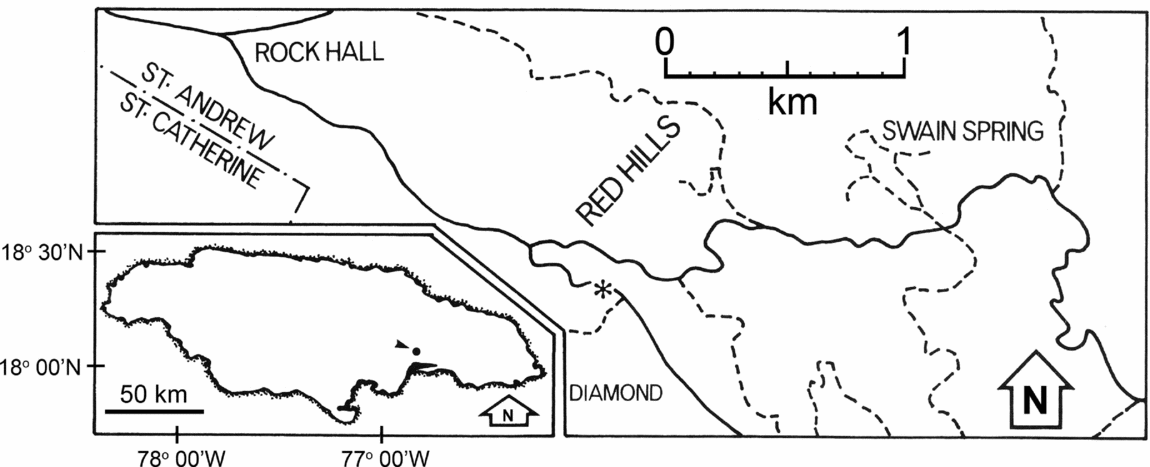
Jamaica has only been sub-aerially exposed for about 10 Ma (Robinson, Reference Robinson, Donovan and Jackson1994), during which time the effects of tropical temperatures, high seasonal rainfall and the presence of innumerable joints and faults in the widespread limestones have interacted to make the island a paradise for cavers. The monumental Jamaica Underground (Fincham, Reference Fincham1997) lists more than 1000 caves; many of the larger caves are described with detailed surveys. The Red Hills Road Cave (RHRC) or fissure near Kingston (Fig. 1) gets no more than a short mention in Fincham's book, which is all that the limited speleological aspects of this minimal cleft deserve; however, it is palaeontology and not karstic morphology which gives the RHRC special significance.
Locality map showing the position of the Late Pleistocene Red Hills Road Cave (*) on the south side of the Red Hills Road, near Diamond, parish of St Andrew, Jamaica (modified after Donovan & Gordon, Reference Donovan and Gordon1989, fig. 1A). Main (solid lines) and minor roads (dashed lines), and the boundary between the parishes of St Andrew and St Catherine are shown. Inset map of Jamaica shows the approximate position of the main map (arrowed).
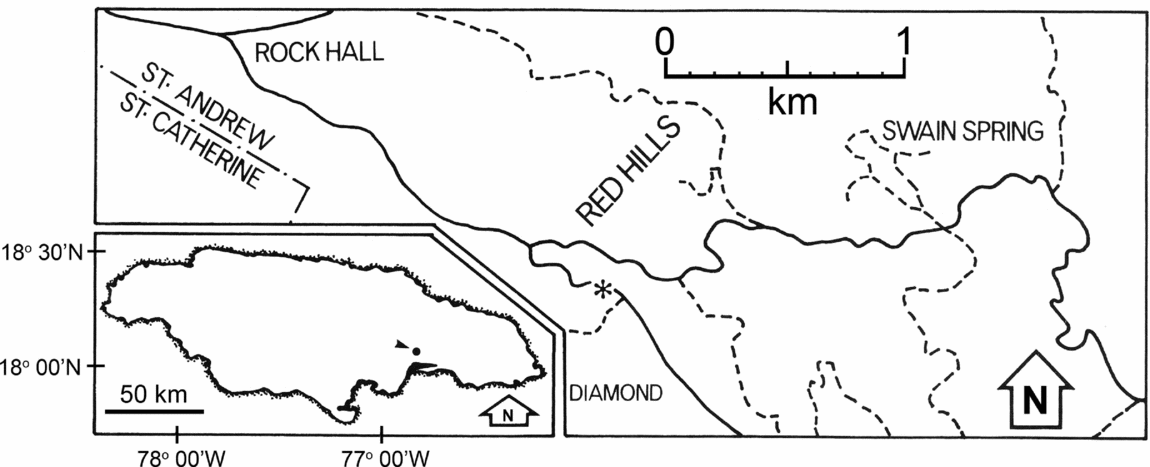
The cave itself is close to the University of the West Indies, Mona (Fig. 1). It was only discovered in 1988 by two students in search of recent and Pleistocene snail localities (Donovan et al. Reference Donovan, Baalbergen, Ouwendijk, Paul and Hoek Ostende2013, p. 79). The Red Hills are an area of hilly Miocene limestones, named for the prominent terra rossa soils. Most of the cave or fissure was destroyed when the Red Hills Road was driven through this area and what remains is shaped like one side of a beer bottle. The fissure extends up to the land surface about 4–5 m above the road surface, but it is not known how much extends below road level. When first found, unbedded, red and highly fossiliferous sediment was slumping from the cave onto the road. That the cave/fissure was once filled by fossiliferous sediment is demonstrated by land snails that have been cemented to the cave wall by dripstone extending almost to the top of the structure (Donovan et al. Reference Donovan, Baalbergen, Ouwendijk, Paul and Hoek Ostende2013, fig. 3). The age of the deposit is imprecisely known but is about 30 ka old, perhaps in the range c. 40–25 ka, which places it within Oxygen Isotope Stage 3. It has been dated by various methods, namely amino acid racemization and radiocarbon (uncorrected) of Pleurodonte snail shells, and ‘fluorine ages’ of teeth of the rodent Geocapromys (Paul & Donovan, 1996; McFarlane & Blake, Reference McFarlane and Blake2005).
The fauna has three components – snails, tetrapods and arthropods – all of which are terrestrial. Tetrapods and land snails are common components of Jamaican Pleistocene cave faunas (MacPhee in Fincham, Reference Fincham1997, pp. 47–56), whereas arthropods, apart from land crabs (Collins, Mitchell & Donovan, Reference Collins, Mitchell and Donovan2009), are unknown. Despite their rarity, arthropods such as isopods and millipedes are commonly well preserved, whereas tetrapods are more or less completely disarticulated. This unexpected contrast in style of preservation is worthy of further examination.
2. Fossil fauna of the RHRC
2.a. Gastropods
Gastropods are particularly common and the RHRC has produced the most diverse fauna of Pleistocene land snails yet identified from Jamaica. It has yielded 62 species of Pleistocene gastropods; 50 extant species were collected near the cave and 12 more from elsewhere in the Red Hills. However, only 30 species are common to both the Pleistocene and Recent deposits of this area, indicating that there have been local extinction and immigration; this is in contrast to other coeval accumulations (reviewed in Paul & Donovan, Reference Paul and Donovan2006).
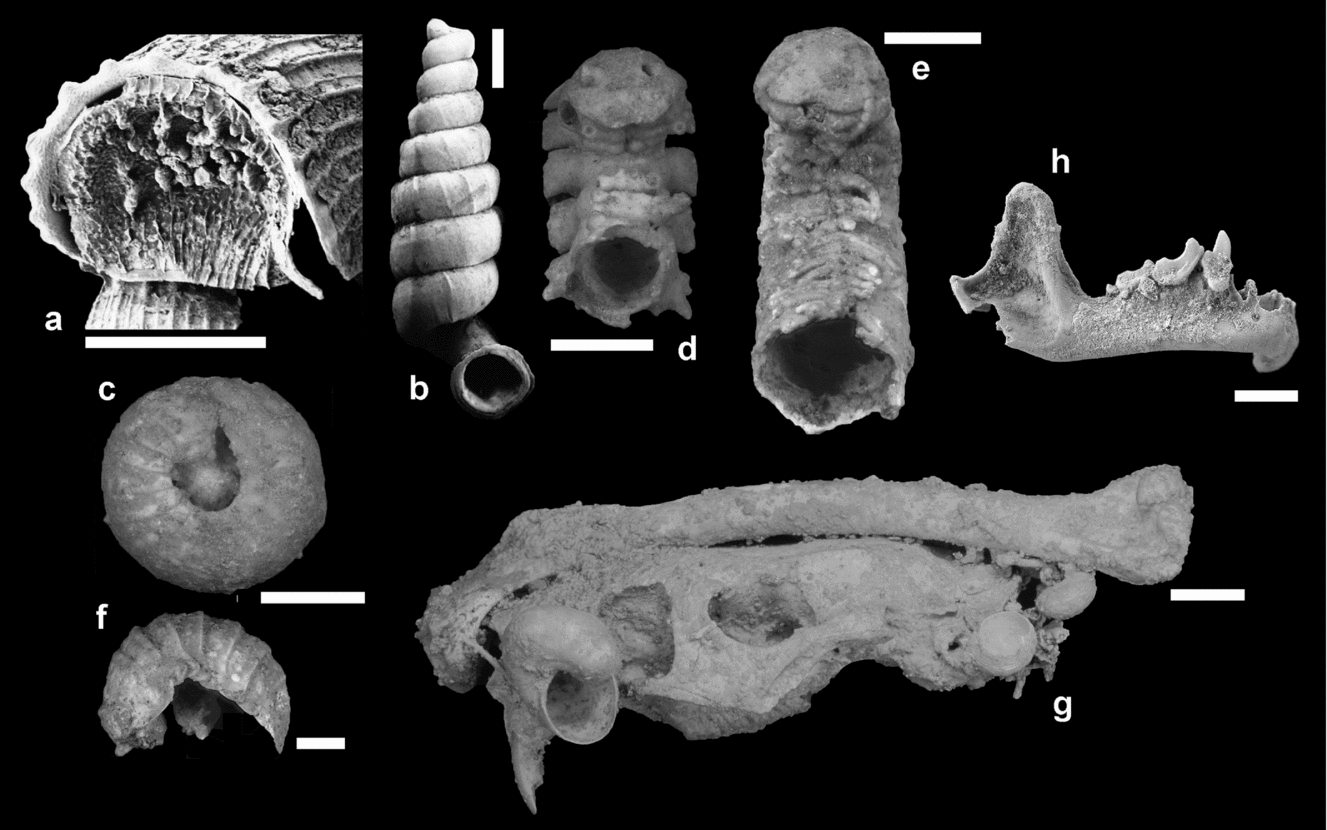
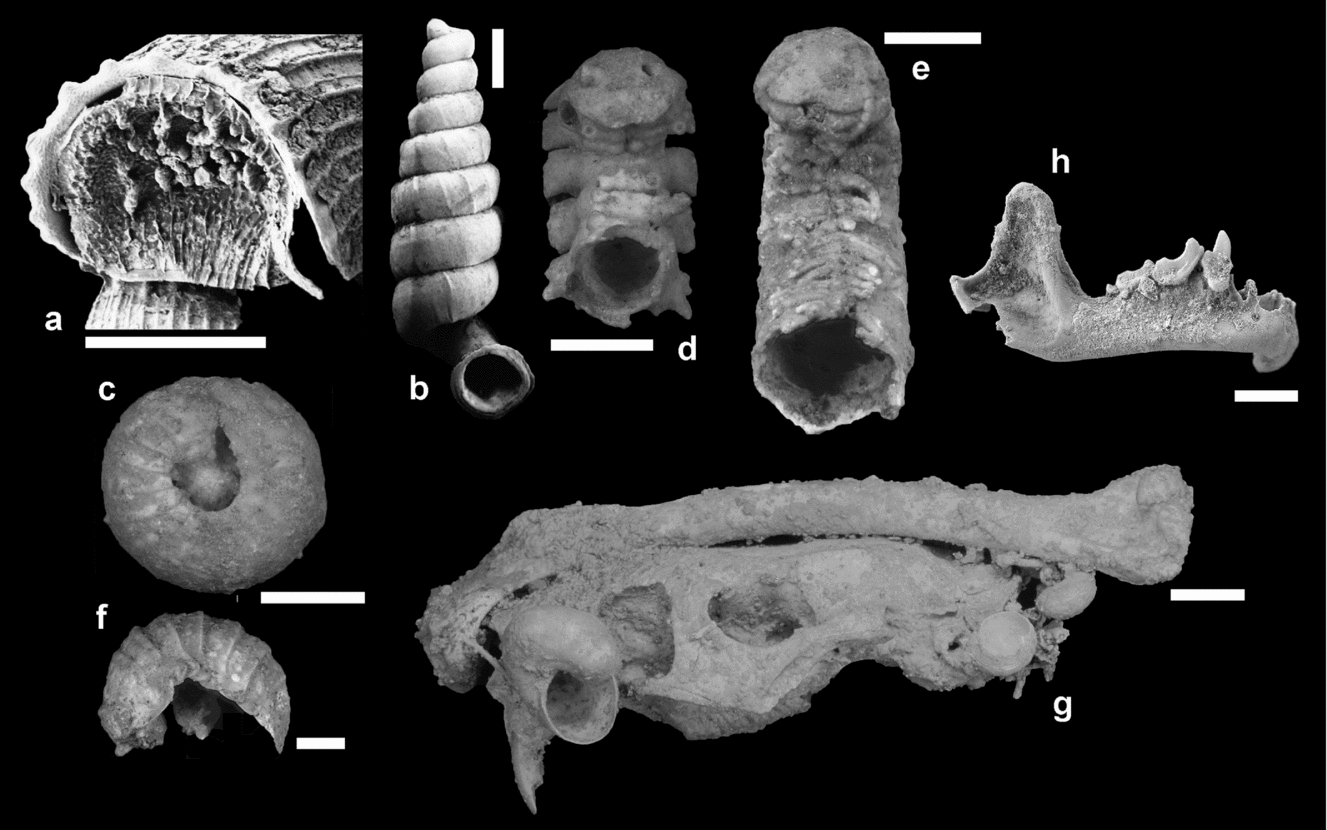
Only about half of the snail species are operculate, that is, with the shell closed at its outer end by a lid-like operculum. This has not proved problematic as both the shells and opercula can be identified by reference to the extant fauna (G. Rosenberg & D. Drumm, unpub. report, 2004: http://pick4.pick.uga.edu/mp/20q?guide=Molluscs; Rosenberg & Muratov, Reference Rosenberg and Muratov2006). Furthermore, many operculate species in the sample of Paul & Donovan (Reference Paul and Donovan2006) had the operculum preserved in situ (Fig. 2a). As gastropods are essentially single (but coiled) calcareous tubes, they have a high preservation potential. The only other slightly atypical group are the urocoptids which are decollate (Fig. 2b; Paul, Reference Paul1982, Reference Paul1983), but are otherwise complete. Many shells are essentially common and clean, facilitating accurate identification (Fig. 2a, b). The contribution of these shells to Jamaican palaeontology must be considered good.
Representative fossils from the Red Hills Road Cave, parish of St Andrew, Jamaica. (a, b) Scanning electron micrographs of land snails (after Paul & Donovan, 1996, pl. 17, fig. 4, pl. 22, fig. 3, respectively); specimens lost. (a) Fadyenia lindsleyana (C. B. Adams), detail of operculum preserved in situ in aperture of shell. Scale bar represents 500 µm. (b) Geoscala costulata (C. B. Adams), adult decollate shell in apertural view. Scale bar represents 1 mm. (c–e) Millipedes and (f) isopod (after Baalbergen & Donovan, Reference Baalbergen and Donovan2013, figs 4E, 3F, B, 5G, respectively). (c) Cyclodesmus sp. cf. C. porcellanus Pocock, RGM 789 611, lateral view of enrolled specimen. (d) Caraibodesmus verrucosus (Pocock), RGM 789 607, ventral view of the anterior segments, showing the head, and basal attachments for legs and antennae. (e) Rhinocricus sp., RGM 789 601, ventral view of anterior showing the head, antennae and legs. (f) Venezillo booneae Van Name, RGM 789 615, lateral view of isopod showing the ability to roll into a ball and the slightly raised confluent tubercles on the dorsal surfaces of the segments. Scale bar represents 1 mm. (g, h) Vertebrates (after Donovan & Paul, Reference Donovan and Paul2011, figs 11, 12, respectively). (g) Geocapromys brownii (Fischer), skull of a rodent, cemented to right humerus of the extinct flightless ibis Xenicibis xympithecus Olson & Steadman and various land snails. Specimen in the Geological Museum, University of the West Indies, Mona. Scale bar represents 10 mm. (h) Stenoderma rufum Desmarest, RGM 632 059, right lateral (labial) view of right mandible of a bat (see also Ouwendijk, van den Hoek Ostende & Donovan, Reference Ouwendijk, Hoek Ostende and Donovan2014, fig. 2D). Specimens in the collection of the Naturalis Biodiversity Center, Leiden (prefix RGM) unless stated otherwise. Scale bars represent 2 mm unless stated otherwise.
2.b. Vertebrates
Vertebrates, all of them tetrapods, present a very different picture from the gastropods. They are commonly preserved as disarticulated bones or teeth and, as such, many elements are commonly difficult to identify except to a high taxonomic level. At best, rare rodent skulls and jaws and bat jaws are known. In the initial survey of the vertebrates Savage (Reference Savage1990) listed: amphibians, represented by a few indeterminate bones; reptiles, including small lizards and iguana (mainly jaws); birds; including the extinct ibis Xenicibis xympithecus Olson & Steadman; and mammals, including the rodent Geocapromys brownii (Fischer) and bats.
Although the sediment is rich in bones, it is a vertebrate ‘Irish stew’ (Boot, Donovan & Meijer, Reference Boot, Donovan and Meijer2015) in that it is completely disarticulated and requires intensive picking to separate out similar remains. Cemented agglomerations of bones and shells may preserve unrelated taxa in close association. The skull of Geocapromys brownii (Fischer) in Figure 2g is cemented to Xenicibis xympithecus, along with some small limb(?) bones and gastropods. Bat jaws may retain teeth, but are rare and tiny (Fig. 2h). Some may be partially concealed by cement post-mortem (Fig. 2g) and small, non-descript bones may be difficult or impossible to separate into classes let alone species or genera. Although bones are common, the mode of preservation is unattractive to vertebrate palaeontologists. For this reason the vertebrates remain poorly studied and the contribution of the RHRC tetrapod fauna to Jamaican palaeontology has been poor.
2.c. Arthropods
Arthropods are the unusual component of the fauna of the Red Hills Road Cave. Fossil arthropods in Antillean caves are commonly limited to the fingers of rare claws of land crabs (Collins, Mitchell & Donovan, Reference Collins, Mitchell and Donovan2009). The common factor that unites those arthropods fossilized at the Red Hills Road Cave is that, in life, they were taxa that had an exoskeleton that was slightly calcified. Terrestrial macro-arthropod taxa that have been identified include millipedes (four species), isopods (four species), free fingers of terrestrial crabs (Sesarma sp. cf. S. cookei Hartnoll), and insects, mainly pupae (four species) (Donovan & Veltkamp, Reference Donovan and Veltkamp1994; Baalbergen & Donovan, Reference Baalbergen and Donovan2013) (Fig. 2c–f).
Millipedes and isopods have up to 10% calcite in their hardened exoskeleton (Hopkin & Read, Reference Hopkin and Read1992, pp. 29–30) and, as such, formed a natural substrate for calcite precipitation from groundwater fed through the limestone aquifer. This has given the preserved millipedes and isopods a sugary appearance.
The fingers and chelae of the land crab Sesarma sp. cf. S. cookei are, of course, calcified and robust, as are those of marine crabs. The carapaces of Sesarma have not been recognized from the RHRC, perhaps partly because they are thin, easily fragmented and have a much lower preservation potential than the fingers, but also possibly because these fragments are easily mistaken for the broken shells of gastropods. Alternately, the preservation of land crabs as mainly fingers suggests that they are possibly moults.
Although puparia of some insects have been found in the cave sediment (Baalbergen & Donovan, Reference Baalbergen and Donovan2013), many groups are not represented such as arachnids (spiders and scorpions), centipedes and most insects. The feature that unifies the taxa that are not preserved is their lack of any calcification of the exoskeleton. Despite the obvious gaps presented by these arthropod fossils, their contribution to Jamaican palaeontology can only be considered good; it is, indeed, unique.
3. Discussion
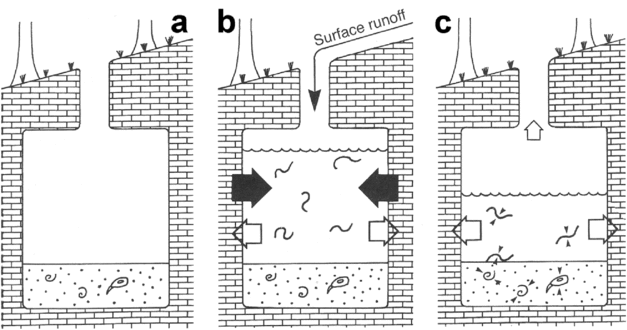
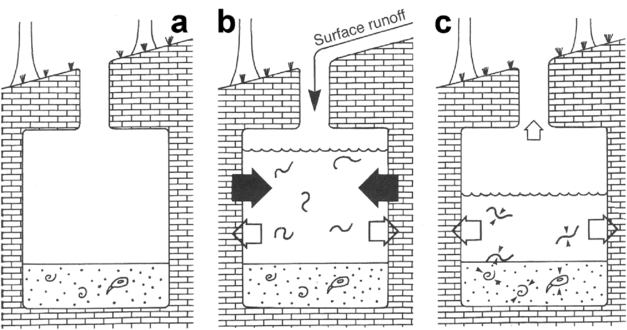
The true enigma of the RHRC is why are millipedes and isopods invariably better preserved than any vertebrate? It is because the fissure or bottle-shaped cave acted as a sediment trap sensu Simms (Reference Simms1994, fig. 1) into which live organisms fell or were washed in either alive or as carcasses during tropical storms and hurricanes (Fig. 3). The cave filled with water washed in from the surface and moving through the limestone aquifer; the latter would be charged with dissolved calcium carbonate. After the storm, the flooded cave would empty slowly by evaporation and seepage, and calcite would crystallize out of solution, partly on the limestone walls and partly on other calcareous substrates including organic skeletons. Many of the small arthropods that fell in after the storm events, such as isopods and millipedes, may have floated or been supported by surface tension more readily than snails. Calcite precipitation is particularly intense at water surfaces where degassing of CO2 occurs, with the arthropod exoskeletons acting as a focus for this in a process analogous to the formation of calcite rafts which are commonly found on carbonate saturated pools in caves (M.J. Simms, pers. comm. 2016; Taylor, Drysdale & Carthew, Reference Taylor, Drysdale and Carthew2004). The exoskeletons of millipedes, isopods and Sesarma would be immediately available for calcite growth; in particular, the former two groups are commonly preserved with a sugary outer crystalline coating (Fig. 2c–f) (compare with Fraser, Reference Fraser1988, p. 42; M. A. Girling, unpub. report: http://services.english-heritage.org.uk/ResearchReportsPdfs/2507.pdf).
Postulated depositional sequence for calcitic preservation of millipedes in Red Hills Road cave (after Donovan & Veltkamp, Reference Donovan and Veltkamp1994, fig. 7). (a) Dry/damp conditions. The cave acts as a bottle trap for any organisms, particularly terrestrial tetrapods that topple into the opening in the roof, but accumulation of infill is slow. Many of the invertebrates could come and go as they pleased. (b) Hurricane/tropical storm conditions. The cave fills with water from surface runoff and from the karstic aquifer (large black arrows; smaller open arrows indicate outflow into karst). Millipedes and other organisms washed in and drown. (c) After the storm. Water level drops by evaporation (small arrow) and karstic runoff. Calcareous skeletons in, on and floating above the sediment (mainly gastropods and some arthropods) act as substrates for calcite precipitation (small black arrows). Uncalcified organisms and soft tissues of tetrapods rot away.
In contrast, vertebrate carcasses would decompose more slowly. By the time the vertebrates' soft tissues had rotted away, the cave would again be dry. Further disarticulation of bones and teeth would occur before the next storm and calcification episode. Millipedes would therefore be available for mineralization at the time of maximum inundation by calcium-charged waters, but vertebrates would not.
Where else might similar taphonomic contrasts between organisms with multi-element skeletons be expected? The basic requirement is a cave or fissure in a limestone landscape which can fill with water during a major storm event and, in being filled, receives a suite of local vertebrates, arthropods and snails in what Simms (Reference Simms1994) has called an abiotic allochthonous concentrative mechanism. The humid tropics might be expected to provide many suitable sites. No similar locality is known from Jamaica however, with over a thousand known caves (Fincham, Reference Fincham1997), or the wider Antilles; they therefore appear to be particularly rare. Further, apart from temperatures being generally lower, similar conditions may prevail in more temperate settings.
In conclusion, the RHRC acted as a fissure trap, particularly during tropical storms (Donovan & Veltkamp, Reference Donovan and Veltkamp1994). The most unusual aspect of the fossil fauna preserved in the cave is the presence of a macro-arthropod component with a decidedly skewed composition, dominated by a few species of millipedes and isopods. Vertebrates remain understudied because they are so poorly preserved.
Freshly drowned vertebrates were not encrusted by calcite at the same time as millipedes. They were disarticulated by the time of the next tropical storm, that is, the prelude to the next calcification event.
Acknowledgements
I thank James R. Thomka (University of Akron, Ohio) and Matthew B. Vrazo (University of Cincinnati, Ohio) for inviting me to speak at their theme session ‘Perspectives of Multi-Element Skeleton Taphonomy: Case Studies, Approaches, and Advances’ at the Annual Meeting of the Geological Society of America in Baltimore in 2015. This represented the initial iteration of the present communication, which had been in navel contemplation for too many years. Michael J. Simms (National Museums Northern Ireland) and a second, anonymous reviewer are thanked for their positive comments.