INTRODUCTION
Root competition among woody seedlings and grasses, weeds and shrubs for below-ground resources negatively affects the survival and establishment of woody seedlings in tropical soils (Hooper et al. Reference HOOPER, LEGENDRE and CONDIT2005, Nepstad et al. Reference NEPSTAD, UHL, PEREIRA and SILVA1996) and may be an obstacle to secondary succession (Balandier et al. Reference BALANDIER, COLLET, MILLER, REYNOLDS and ZEDAKER2006, Gunaratne et al. Reference GUNARATNE, GUNATILLEKE, GUNATILLEKE, MADAWALA WEERASINGHE and BURSLEM2011, Holl et al. Reference HOLL, LOIK, LIN and SAMUELS2000). A restriction imposed by grasses may occur because some grass species have a high-density network formed by fine roots in the soil (Gunaratne et al. Reference GUNARATNE, GUNATILLEKE, GUNATILLEKE, MADAWALA WEERASINGHE and BURSLEM2011, Holl Reference HOLL1999, Nepstad et al. Reference NEPSTAD, UHL, PEREIRA and SILVA1996), which hampers the woody seedlings in competing for limited soil resources (Cramer et al. Reference CRAMER, WAKELING and BOND2012, Gunaratne et al. Reference GUNARATNE, GUNATILLEKE, GUNATILLEKE, MADAWALA WEERASINGHE and BURSLEM2010). The grass root system acts as a physical barrier since the root systems of woody seedlings are confined in the same superficial soil horizons as the grass roots (Flory & Clay Reference FLORY and CLAY2010). Some studies have verified that fast-growing, light-demanding plant species display less capacity to compete with grasses than slow-growing, shade-tolerant plant species (Balandier et al. Reference BALANDIER, COLLET, MILLER, REYNOLDS and ZEDAKER2006, Gunaratne et al. Reference GUNARATNE, GUNATILLEKE, GUNATILLEKE, MADAWALA WEERASINGHE and BURSLEM2010, Reference GUNARATNE, GUNATILLEKE, GUNATILLEKE, MADAWALA WEERASINGHE and BURSLEM2011; Hooper et al. Reference HOOPER, CONDIT and LEGENDRE2002, Messier et al. Reference MESSIER, COLL, POITRAS-LARIVIÈRE, BÉLANGER and BRISSON2009). Nepstad et al. (Reference NEPSTAD, UHL, SERRAO and Anderson1990) and Hooper et al. (Reference HOOPER, CONDIT and LEGENDRE2002) suggest that the low survival of light-demanding woody species occurs due to water restriction, and shade-tolerant plants are more tolerant to water scarcity caused by grass roots. Below-ground competition for space is also an important limiting factor, since the dense root network from grasses reduces gaps in soil for establishment of woody seedling roots (Cramer et al. Reference CRAMER, WAKELING and BOND2012). On the other hand, root competition can be attenuated by association with arbuscular mycorrhizal fungi (AMF), which improves the woody seedling survival, establishment and growth (Zangaro et al. Reference ZANGARO, BONONI and TRUFEN2000, Reference ZANGARO, NISIZAKI, DOMINGOS and NAKANO2003, Reference ZANGARO, TOREZAN, ROSTIROLA, SOUZA and NOGUEIRA2015). The AMF is an effective way for plants to partition the below-ground resources (i.e. roots and hyphae), and thus alleviate competition (Johnson et al. Reference JOHNSON, NGELARD, SANDERS and KIERS2013).
We assess the competitive influences of a large root system produced by an important exotic grass extensively cultivated as pasture in Brazil, Urochloa brizantha (Hochst. ex A. Rich.) R.D. Webster (Poaceae), and a small root system produced by a light-demanding herbaceous eudicotyledonous forb species, widespread in Brazilian open fields, Leonotis nepetifolia (L.) W.T. Aiton (Lamiaceae), on seedling emergence, survival, establishment and growth of eight tropical heliophilous herbaceous species, six light-demanding early-successional woody species and five shade-tolerant late-successional woody species. We hypothesized that (1) emergence, survival and growth of seedlings of plant species belonging to different successional ecological groups are more negatively affected by the competition with fine roots of the exotic grass U. brizantha than by the competition with fine roots of forb L. nepetifolia; (2) seedlings of early-successional plant species are more negatively influenced by below-ground competition than seedlings of late-successional woody species; (3) fine-root traits can explain the differences in seedling establishment among plant species belonging to different ecological groups of tropical succession.
METHODS
Plant species
Nineteen plant species belonging to different successional groups were grown in competition with roots of the exotic grass Urochloa brizantha or roots of the forb Leonotis nepetifolia, and without competition. Urochloa brizantha was chosen because it is a highly aggressive and competitive exotic grass, displays high growth rates and ability to form continuous canopies, produces root system with high density in soil, has high nutrient-uptake capacity and ability to rapidly deplete resources available in soil (Balandier et al. Reference BALANDIER, COLLET, MILLER, REYNOLDS and ZEDAKER2006). The forb Leonotis nepetifolia is frequently found growing in open fields in the presence of several other herbaceous species. Leonotis nepetifolia commonly produces a root system with moderate density in soil and could be considered as a less aggressive competitor than U. brizantha. The plant species grown in competition with U. brizantha and L. nepetifolia were the heliophilous herbs: Bidens pilosa L. (Asteraceae), Porophyllum ruderale (Jacq.) Cass.(Asteraceae), Senna obtusifolia (L.) H.S. Irwin & Barneby (Fabaceae), Mimosa pudica L. (Fabaceae), Cenchrus echinatus L. (Poaceae), Digitaria insularis (L.) Fedde (Poaceae), Urochloa brizantha (Poaceae) and Solanum viarum Dunal (Solanaceae); the native early-successional woody species: Cecropia glaziovii Snethlage. (Urticaceae), Schinus terebinthifolius Raddi (Anacardiaceae), Maclura tinctoria (L.) D. Don ex Steud. (Moraceae), Phytolacca dioica L. (Phytolaccaceae), Heliocarpus popayanensis (Kunth) K. Schum. (Malvaceae), Citharexylum myrianthum Cham. (Verbenaceae); and the native late-successional woody species: Aspidosperma polyneuron Müll.Arg. (Apocynaceae), Hymenaea courbaril L. (Fabaceae), Peltophorum dubium (Spreng.) Taub. (Fabaceae), Balfourodendron riedelianum (Engl.) Engl. (Rutaceae) and Gallesia integrifolia (Spreng.) Harms (Phytolaccaceae).
Soil sampling, preparation and analysis
A topsoil sample of a clay Rhodic Ferralsol (FAO 1994) was taken in the campus of the State University of Londrina, Paraná State, southern Brazil, and used for plant cultivation. The soil sampling site is mainly colonized by Paspalum notatum Flüggé and other herbaceous species. The soil was collected at 0–10 cm depth, sieved (2-mm mesh) and transferred to plastic pots with 3500 cm3 capacity. Soil samples were air-dried at room temperature and subjected to chemical analysis, as described in Rondina et al. (Reference RONDINA, LESCANO, ALVES, MATSUURA, NOGUEIRA and ZANGARO2014). First, one third of the pots were sown with seeds of the exotic grass U. brizantha as a competitor, another third of the pots were sown with seeds of the forb L. nepetifolia as a competitor, and the remaining third of the pots were left without a competitor, as control. Ten seeds of U. brizantha or L. nepetifolia were sown in the centre of each designated pot. After emergence, seedlings were thinned to one per pot and left to grow for 40 d. All the other seedlings from soil natural seed bank were manually removed during the experiment. After 40 d of growth of U. brizantha and L. nepetifolia, 15 seeds of each species from different successional groups were sown between the border of the pot and the established competitors, 1 cm below the soil surface. In the control pots, the seeds were sown between the centre of the pots and the border. The treatments consisted of five replicates (n = 5) that were randomly distributed in the greenhouse, under total sunlight, without air temperature control, from December 2011 to March 2012. The exotic grass U. brizantha and forb L. nepetifolia produced very low shading and did not compete above ground with the other seedlings grown in the same pot.
After plant growth period, soil samples from pots containing either U. brizantha or L. nepetifolia and from pots without plant competitors were obtained for mineral-N determination. The ammonium (N–NH4+) and nitrate (N–NO3−) were extracted with 2 M KCl and determined by Kjeldahl method, which consisted in double distillation (first with MgO and after with Devarda's alloy) and titration with 0.005 N H2SO4 (Keeney & Nelson Reference KEENEY, NELSON, Page, Miller and Keeney1982).
Plant emergence, survival and growth
The percentage of emerged seedlings was obtained from the ratio between the number of seedlings and the number of seeds sown. The percentage of seedlings surviving was obtained by the ratio between the number of living seedlings at 30 d after emergence and the number of emerged seedlings. After data on survival were obtained, the remaining seedlings were thinned to two seedlings per pot. The growth period of each plant species varied, since the heliophilous herbaceous species and early- and late-successional woody species grew for a further 40 d, 50 d and 70 d, respectively, after thinning. After the growth period, the plants were carefully removed from pots and the roots were washed in tap water. Roots and shoots were separated, oven-dried at 65ºC, weighed, and the root/shoot ratio was calculated. The competitive response between the species grown either in competition with exotic grass U. brizantha or in competition with the forb L. nepetifolia was calculated from the formula: CR = ln (DMC/DMW), in which CR: competitive response, DMC: seedlings shoot dry mass in competition, and DMW: seedling shoot dry mass without competition (Cahill Reference CAHILL2002). The shoot dry weight of dead seedlings was considered for determining the competitive response of all plant species. The competitive response does not have a unit of measurement. The lower the value of competitive response, the stronger is the negative influence of the competitor on seedling growth. The concentrations of P, K, Ca and Mg in the shoots were quantified after nitric-perchloric digests, while N was determined after sulphuric acid digests. The small amount of biomass produced by several plant species grown in competition with the grass or the forb made it impossible to determine the nutrient concentrations in some cases.
Fine-root morphological traits
Samples of fresh fine roots were collected for estimation of total root length by the gridline intersection method (Tennant Reference TENNANT1975). Specific root length was calculated as the ratio between fine-root length and root dry mass. Root tissue density was determined by the ratio between the root fresh mass and the volume displaced upon immersion in water. The diameter of fine-root tips was measured at 0.5 cm from the root tip using a microscope at ×100 magnification with a micrometric ocular (Zangaro et al. Reference ZANGARO, ALVES, SOUZA, ROSTIROLA, LESCANO, RONDINA and NOGUEIRA2014). Assessment of mycorrhizal infection intensity was carried out on fine roots after clarifying (10% KOH), acidifying (1% HCl), washing in tap water then staining (0.05% trypan blue) (Brundrett et al. Reference BRUNDRETT, BEEGHER, DELL, GROOVE and MALAJCZUK1996). Dark-pigmented root fragments were treated with 0.5% H2O2 after KOH. Total AMF infection was estimated using the magnified intersection method (McGonigle et al. Reference McGONIGLE, EVANS and MILLER1990) by observing the presence of fungal structures at ×100 magnification. Only non-septate hyphae in the root cortex were considered mycorrhizal.
Data analysis
Data normality and homoscedasticity were first tested using Shapiro–Wilk's and Bartlett's tests, respectively. For some plant species, data on the shoot dry mass, root dry mass and fine-root length were square-root transformed. Percentages were arcsine(×/100)-transformed before analysis. Data were submitted to one-way ANOVA, according to a completely randomized design, followed by Tukey's test. Data from competitive response were compared with Student's t-test. Principal component analysis (PCA) was performed to explore how the plant species traits and the responses exhibited by plants in each competition treatment were related to each other. Data for heliophilous herbaceous and early-successional woody species grown with U. brizantha were not used in PCA because only the individuals of one species for each of these groups survived in the presence of U. brizantha. Pearson's correlation analyses were performed among plant intrinsic traits (from plants grown without competitor) and emergence, survival and competitive response of plants grown in competition with either L. nepetifolia or U. brizantha. In all tests, P < 0.05 was adopted as significant.
RESULTS
The exotic grass U. brizantha produced a root system with high density in soil (48.1 cm cm− 3 soil). This fine-root density was seven times greater than the density of fine-roots produced by L. nepetifolia (6.8 cm cm−3 soil). The mycorrhizal root infection intensity was very high in both competitor plants, reaching 94% in U. brizantha and 92% in L. nepetifolia.
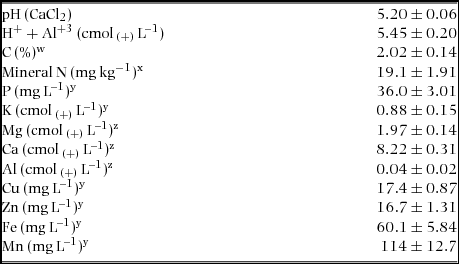
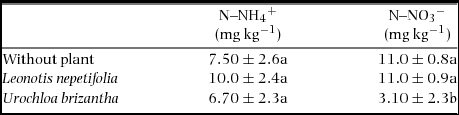
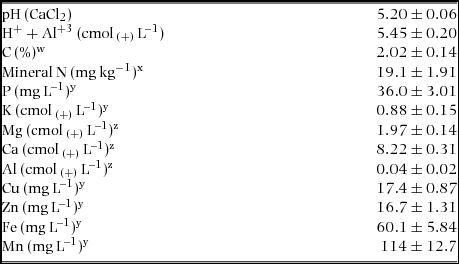
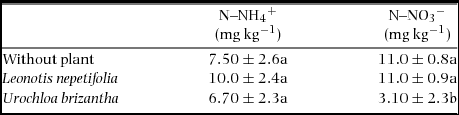
The soil used for plant growth had a moderate to high fertility (Table 1), and plants did not exhibit any nutrient deficiency symptom during the experimental period. After plant growth, the concentration of ammonium did not change in soil of pots that had U. brizantha and L. nepetifolia, but the concentration of nitrate was almost four times higher in soil where L. nepetifolia was grown and in soil without plants than in soil that had U. brizantha (Table 2).
Mean (± SD) of chemical attributes of the natural soil used as substrate for plant growth. Mineral N = ammonium + nitrate. W = Walkley–Black method; x = extraction with 2 M KCl; y = extraction with Mehlich-1; z = extraction with 1 M KCl.
Mean (± SD) for concentration of ammonium (N–NH4+) and nitrate (N–NO3−) in the substrate where only Urochloa brizantha or Leonotis nepetifolia were grown, and natural soil without plants. Means followed by different letters indicate significant difference among treatments by Tukey's test at P < 0.05 (n = 5).
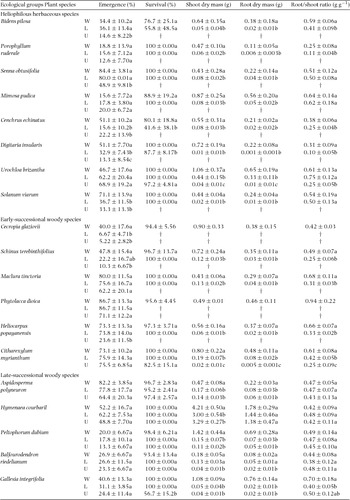
Generally, the root systems of both competitors were prejudicial to emergence of seedlings of the heliophilous herbaceous, moderately prejudicial to seedling emergence of the early-successional woody species and did not affect emergence of the late-successional ones (Table 3). The root system of the exotic grass negatively influenced the survival of seedlings of heliophilous herbaceous and early-successional woody species, except for U. brizantha and Citharexylum myrianthum, whereas among the late-successional woody species only Gallesia integrifolia was negatively affected. Considering the surviving seedlings, their production of shoot and root dry mass decreased in most plant species grown with U. brizantha or L. nepetifolia, regardless of the ecological group. The root/shoot ratio decreased in most heliophilous herbaceous and early-successional woody species grown with U. brizantha or L. nepetifolia, whereas for the late-successional woody species, the root/shoot ratio decreased only in G. integrifolia.
Mean (± SD) for seedling emergence, survival, shoot dry mass, root dry mass and root to shoot ratio of the plant species belonging to different ecological groups grown without root competition (W) and in competition with roots of Leonotis nepetifolia (L) or Urochloa brizantha (U). Means followed by different letters indicate significant difference among treatments by Tukey's test at P < 0.05 (n = 5). † indicate death of plants in the treatment.

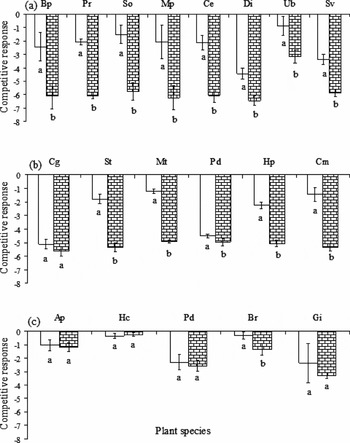
The competitive pressure imposed by the exotic grass U. brizantha was more intense than imposed by the forb L. nepetifolia, in terms of the growth of most plant species (Figure 1). The average (±SD) competitive response of the heliophilous herbs was higher when in competition with the forb (−2.36 ± 1.09) than in competition with the exotic grass (−5.7 ± 1.04), whereas for early-successional woody species the competitive responses were −2.71 ± 1.67 and −5.21 ± 0.27, respectively. However, the average competitive response of late-successional woody species did not change with competitors, i.e. −1.27 ± 1.01 and −1.74 ± 1.21 when grown with the forb or the exotic grass, respectively. So, the competitive pressure applied by the grass root system on seedling growth of the heliophilous herbaceous, early- and late-successional woody species were 2.4, 1.9 and 1.4 times bigger, respectively, than the forb root system.
Competitive response (± SD) of seedlings of heliophilous herbaceous (a), early-successional woody species (b) and late-successional woody species (c), grown in competition with roots of Leonotis nepetifolia (white columns) or Urochloa brizantha (crosshatch columns). Different letters indicate significant difference among treatments by Student's t-test at P < 0.05. Species name abbreviation: Bp = Bidens pilosa, Pr = Porophyllum ruderale, So = Senna obtusifolia, Mp = Mimosa pudica, Ce = Cenchrus echinatus, Di = Digitaria insularis, Ub = Urochloa brizantha, Sv = Solanum viarum, Cg = Cecropia glaziovii, St = Schinus terebinthifolius, Mt = Maclura tinctoria, Pd = Phytolacca dioica, Hp = Heliocarpus popayanensis, Cm = Citharexylum myrianthum, Ap = Aspidosperma polyneuron, Hc = Hymenaea courbaril, Pd = Peltophorum dubium, Br = Balfourodendron riedelianum, Gi = Gallesia integrifolia.

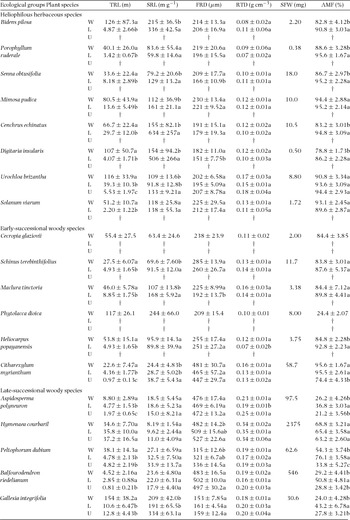
The total root length of seedlings was higher in early-successional plant species than in late-successional woody species, and decreased severely in seedlings grown with either competitor, except for the late-successional woody Hymenaea courbaril (Appendix 1). The specific root length was also higher in early-successional plant species than in late-successional woody species, and increased in most seedlings of heliophilous herbaceous and early-successional woody species grown with either competitor. For the late-successional woody species, only G. integrifolia increased specific root length when in competition with the exotic grass. The fine-root tissue density was lower in early-successional plant species than in late-successional woody species, but had no influence of either competitor. The fine-root diameter was also lower in early-successional plant species than in late-successional woody species and decreased in some heliophilous herbaceous and early-successional woody species due to the competitors. Seedlings of late-successional woody species Peltophorum dubium and H. courbaril increased their fine-root diameter when grown in competition with the exotic grass. The averages of seed fresh weight were 6.51 mg, 14.6 mg and 622 mg for heliophilous herbaceous, early- and late-successional woody species, respectively. The AMF root infection intensity decreased over the successional groups. AMF root infection intensity generally increased in seedlings grown in the presence of the forb, but decreased in seedlings grown with the exotic grass.
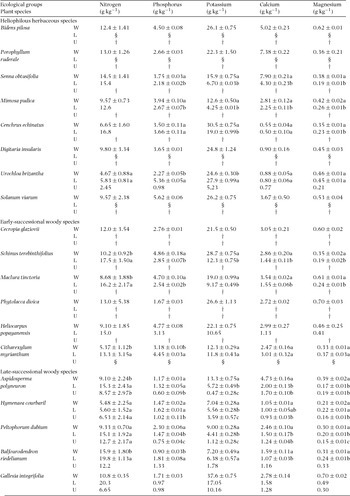
The N concentration in shoots of most seedlings of the early- and late-successional woody species increased when in competition with the forb, but did not change in shoots of seedlings grown with the exotic grass (Appendix 2). The shoot P, K, Ca and Mg concentrations generally decreased in most seedlings grown with forb, but decreased even more in shoots of seedlings grown in the presence of exotic grass.
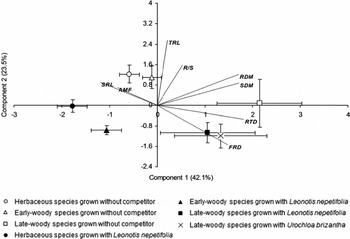
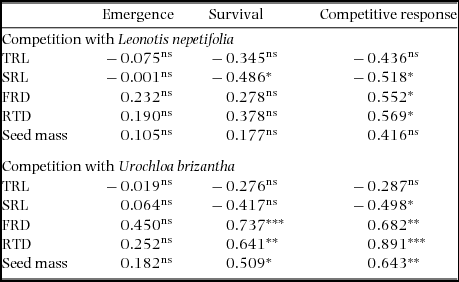
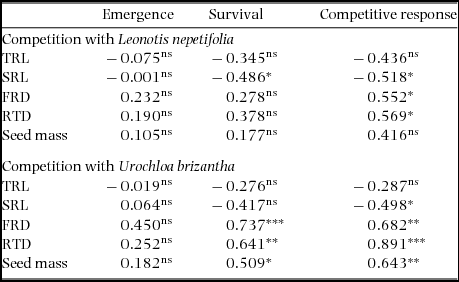
In the PCA, the total root length, root/shoot ratio, root dry mass, shoot dry mass, fine-root diameter and root tissue density were positively associated in late-successional woody species, whereas fine-root diameter and root tissue density were more related to late-successional woody plants grown in the presence of U. brizantha or L. nepetifolia (Figure 2). Only specific root length and AMF root infection intensity were related to herbaceous and early-successional woody species, especially when grown without a competitor. Survival exhibited negative correlation with specific root length for plants grown with L. nepetifolia (Table 4). For plants grown in the presence of U. brizantha, survival exhibited positive correlation with seed weight and strong positive correlation with fine-root diameter and root tissue density. Competitive response showed negative correlation with specific root length and positive correlation with fine-root diameter and root tissue density for plants grown with L. nepetifolia. For plants grown with U. brizantha, competitive response exhibited strong positive correlation with fine-root diameter, root tissue density and seed weight, and negative correlation with specific root length.
Principal component analysis (PCA) based on plant traits: shoot dry mass (SDM), root dry mass (RDM), root/shoot ratio (R/S), total root length (TRL), specific root length (SRL), fine-root diameter (FRD), root tissue density (RTD) and AMF root infection intensity (AMF). Horizontal and vertical bars indicate standard error in relation to components 1 and 2, respectively.

Pearson's correlation coefficient (r) between plant intrinsic traits (from plants grown without competitor) and emergence, survival and competitive response of plants grown in competition with Leonotis nepetifolia or Urochloa brizantha. TRL = total root length, SRL = specific root length, FRD = fine-root diameter, RTD = root tissue density. * P < 0.05; ** P < 0.01; *** P < 0.001; ns P ≥ 0.05.
DISCUSSION
Seedling emergence and mineral-N in soil
The fine-root system of the forb L. nepetifolia did not influence the seedling emergence of most plant species, whereas the exotic grass U. brizantha had a negative influence on the emergence of seedlings of the heliophilous herbaceous and early-successional woody species, but did not affect seedling emergence of late-successional ones. The dense network produced by root systems of the exotic restricted seedling emergence of the heliophilous herbaceous and early-successional woody species because this plant species typically has small seeds that produce small and fragile seedlings (Rondina et al. Reference RONDINA, LESCANO, ALVES, MATSUURA, NOGUEIRA and ZANGARO2014, Zangaro et al. Reference ZANGARO, NISIZAKI, DOMINGOS and NAKANO2003, Reference ZANGARO, TOREZAN, ROSTIROLA, SOUZA and NOGUEIRA2015). In contrast, seeds of late-successional woody species are usually larger and produce larger and more robust seedlings, which had their emergence less affected by the network of the competitor root system.
The establishment of seedlings of the heliophilous herbaceous and early-successional woody species was strongly reduced in competition with the exotic grass, whereas seedlings of late-successional woody species established successfully. Subbarao et al. (Reference SUBBARAO, RONDON, ITO, ISHIKAWA, RAO, NAKAHARA, LASCANO and BERRY2007, Reference SUBBARAO, NAKAHARA, HURTADO, ONO, MORETA, SALCEDO, YOSHIHASHI, ISHIKAWA, ISHITANIB, OHNISHI-KAMEYAMA, YOSHIDA, RONDON, RAO, LASCANO, BERRY and ITO2009, Reference SUBBARAO, SAHRAWAT, NAKAHARA, RAO, ISHITANI, HASH, KISHII, BONNETT, BERRY and LATA2012) found that Urochloa humidicula and U. decumbens release root exudates that inhibit biological nitrification, resulting in decrease of nitrate in soil. We also verified a decrease in nitrate concentration in the soil with U. brizantha, but not ammonium. Thus, a difference in take up preference between mineral-N forms by early- and late-successional woody species may occur: early-successional woody species may prefer nitrate, whereas late-successional ones may prefer other forms, such as ammonium (Aidar et al. Reference AIDAR, SCHMIDT, MOSS, STEWART and JOLY2003). The preference for distinct N-forms can contribute to explaining the differences of the seedling establishment among species belonging to different stages of succession. However, all seedlings of early- and late-successional woody species survived and grew in the same soils where U. brizantha was grown previously (data not shown), indicating that the exotic grass did not exhaust the soil nutrients and the different concentrations of mineral-N forms were not sufficient to prevent the growth of seedlings. Conversely, grasses compete strongly with seedling of woody species (Hooper et al. Reference HOOPER, CONDIT and LEGENDRE2002, Nepstad et al. Reference NEPSTAD, UHL, PEREIRA and SILVA1996) and the below-ground competition for space is likely to be the strongest competition, since the seedling roots are forced to occupy the same soil horizons in which grass roots occur (Cramer et al. Reference CRAMER, WAKELING and BOND2012).
Below-ground competition with heliophilous herbaceous and early-successional woody species
The shoots and fine roots of heliophilous herbaceous and early-successional woody species were more negatively affected by the root system of the exotic grass U. brizantha than by the root system of the forb L. nepetifolia, and thus confirming our first hypothesis. Root competition with grasses was considered the main reason for the limited tropical woody seedling establishment in Sri Lanka (Gunaratne et al. Reference GUNARATNE, GUNATILLEKE, GUNATILLEKE, MADAWALA WEERASINGHE and BURSLEM2011). The dense root system of the grass U. brizantha hindered the development of the root system of all heliophilous herbaceous and early-successional woody species, since most seedlings were dead 5–7 wk after emergence. The root systems of these species remained confined to a small space enclosed by the fine roots of the exotic grass, resulting in a curling of the root systems. The absence of root growth in these plant species can be a combination of their typical small seeds with low reserves that produce seedlings with high specific root length, low root-tissue density and low fine-root diameter. These root traits results in a weak penetration force to overcome the web of the competitor root system and also to surpass the soil compaction zone created by the root system of the exotic grass (Rillig & Mummey Reference RILLIG and MUMMEY2006). The root competition between early-successional plant species and the exotic grass occurred for soil space, based on the premature and high seedling mortality. The very high AMF root infection intensity exhibited by heliophilous herbaceous and early-successional woody species was not sufficient to increase the nutrient uptake for plant survival and growth. This suggests that the root competition by soil nutritional resources via AMF may have not occurred, since the cooperation between plant-AMF is based on a bidirectional exchange of nutrients, whereas AMF mines nutrients for the roots in exchange for photoassimilates (Kiers et al. Reference KIERS, DUHAMEL, BEESETTY, MENSAH, FRANKEN, VERBRUGGEN, FELLBAUM, KOWALCHUK, HART, BAGO, PALMER, WEST, VANDERNKOORNHUYSE, JANSA and BÜCKING2011, Selosse & Rousset Reference SELOSSE and ROUSSET2011). In contrast, the low root density produced by L. nepetifolia in the soil did not constrain seedling growth in most heliophilous herbaceous and early-successional woody species. In this case, fine-root competition in soil may have occurred mainly for nutritional resources and less for space, since the nutrient concentration in shoots of seedlings grown in competition with the forb decreased when compared with seedlings grown without competitors.
The large and dense root system of U. brizantha provided high competitive efficiency and may be the main attribute that promoted the strong competition between this grass and the early-successional plant species grown without light restriction (Balandier et al. Reference BALANDIER, COLLET, MILLER, REYNOLDS and ZEDAKER2006). This finding is in consonance with previous studies in which fine roots of woody species were negatively affected by competition with herbs and shrubs (Brisson & Reynolds Reference BRISSON and REYNOLDS1994, McConnaughay & Bazzaz Reference McCONNAUGHAY and BAZZAZ1992, Messier et al. Reference MESSIER, COLL, POITRAS-LARIVIÈRE, BÉLANGER and BRISSON2009, O'Brien & Brown Reference O'BRIEN and BROWN2008). When the below-ground environment is occupied by a lower density of fine roots, such as the root system of L. nepetifolia, a moderate survival, establishment and growth of early-successional plant species may occur and ecological succession can proceed less affected by competition. Without competing roots in an unoccupied below-ground environment, the performance of fine-root establishment and shoot growth increases among early-successional plant species.
Below-ground competition with late-successional woody species
All seedlings of late-successional woody species survived and grew in competition. They were not drastically affected by the competitive mechanisms shown by exotic grass (competition for soil space) or forb (competition for soil nutritional resources) when compared with the heliophilous herbaceous and early-successional woody species, and thus confirming our second hypothesis. The dense root network and soil compaction provided by the exotic grass were not sufficient to restrict root growth and plant establishment of late-successional woody species, since the seedling roots displayed growth through the high-density root system of the grass and reached the bottom of the cultivation pots. Several morphological and physiological fine-root traits inherent of late-successional woody species, such as high root tissue density, low specific root length and high fine-root diameter, can explain the good performance facing the competitive mechanisms displayed by exotic grass. These fine-root attributes exhibited correlation with the survival and the competitive response of late-successional woody species when grown in the presence of U. brizantha. When considered in combination, these root traits can represent roots with more resistant tissues, with cells of thick walls, more carbon allocation to roots and typical large root diameter with radial growth. This confers stronger penetration force into soil, facilitating the root penetration through the compacted soil and fine-root network of the competitor exotic grass. The root diameter and the degree of branching influence the physical force that roots exert to penetrate into the soil (Rillig & Mummey Reference RILLIG and MUMMEY2006). Plant species with thicker roots had better penetration through compacted soil because root radial expansion relieves the constraint at the root tip by weakening the soil resistance (Materechera et al. Reference MATERECHERA, DEXTER and ALSTON1991, Reference MATERECHERA, ALSTON, KIRBY and DEXTER1992). Thicker roots allow more efficient penetration because they are more resistant to buckling (Clark et al. Reference CLARK, WHALLEY and BARRACLOUGH2003, Reference CLARK, PRINCE, STEELE and WHALLEY2008). The thicker roots of slow-growing woody species may have an extra fortification against desiccation and disease (Comas et al. Reference COMAS, BOUMA and EISSENSTAT2002). In addition, the unexpected enlargement in fine-root diameter exhibited by seedlings of H. courbaril and P. dubium grown in competition with the exotic grass suggests that this extra increase in radial growth is attributed to a plasticity of the fine roots that probably contributed to achieving more penetration force and overcome the soil resistance imposed by the grass fine-root system.
As seen in PCA, the higher positive association of root tissue density and fine-root diameter with the treatments of late-successional woody species grown in the presence of competitors reinforces the importance of thick roots in facing the competition with high root density in soil. Overcoming the physical restriction imposed by the competitors can assure the survival and growth of a plant. As a strategy, seedlings of the late-successional shade-tolerant plant species overcame the barriers imposed by the exotic grass such as: decreasing nitrate availability in soil, soil space competition and competition for more efficient nutrient uptake. This suggests that: (1) the change of mineral-N forms in soil does not affect the growth of late-successional woody species; (2) during the seedling establishment, these species do not experience nutritional deficiencies (Messier et al. Reference MESSIER, COLL, POITRAS-LARIVIÈRE, BÉLANGER and BRISSON2009) since their inherent slow growth rate allows a low nutritional demand (Comas et al. Reference COMAS, BOUMA and EISSENSTAT2002) and these late-successional woody species display satisfactory growth in low-fertility soils (Zangaro et al. Reference ZANGARO, NISHIDATE, VANDRESEN, ANDRADE and NOGUEIRA2007); (3) during the seedling establishment, the large seeds of late-successional woody species produce plants with robust and thick fine roots (Zangaro et al. Reference ZANGARO, NISHIDATE, CAMARGO, ROMAGNOLI and VANDRESEN2005), and can help to overtake nutritional deficiencies induced by competitors.
Only the late-successional woody species that exhibited typical root traits grew among the dense root system of U. brizantha. In contrast, the fine-root growth of G. integrifolia was negatively affected due to competition with both the exotic grass and the forb. This late-successional woody species displays fine-root traits such as low fine-root tissue density, high specific fine-root length and low fine-root diameter, which are root traits closely related to the early-successional woody species. These findings highlight the fine-root traits as an important biological parameter to predict the competition effect of the grass and the forb on survival, establishment and growth of seedlings of plant species from different ecological groups. Fine-roots attributes can also indicate the seedling capacity to compete for soil space and nutritional resources, which is in accordance with our third hypothesis. Besides being correlated among themselves (Zangaro et al. Reference ZANGARO, ASSIS, ROSTIROLA, SOUZA, GONÇALVES, ANDRADE and NOGUEIRA2008, Reference ZANGARO, ALVES, LESCANO, ANSANELO and NOGUEIRA2012, Reference ZANGARO, ROSTIROLA, SOUZA, ALVES, LESCANO, RONDINA, NOGUEIRA and CARRENHO2013), the fine-root morphological traits also display relationships with plant survival, establishment and growth among different plant functional groups depending on the density of competitor root systems in soil.
In summary, the different density of root system produced by U. brizantha and L. nepetifolia affected in different ways the seedling establishment of the early- and late-successional plant species in below-ground competition. When the soil is occupied by a root system with low or moderate density, the survival and growth of the seedlings of plant species belonging to different ecological groups of succession are generally not obstructed. In contrast, below-ground competitors that produce high root density create a strong negative influence on the survival of heliophilous herbaceous and early-successional woody species, but may allow the establishment of late-successional woody species. The difference between root morphological traits among early- and late-successional plant species can be the reason for the difference in seedlings establishment in soil occupied with high-density root systems.
ACKNOWLEDGEMENTS
The authors would like to thank CNPq and CAPES for financial support. Thanks to Osmar Rodrigues Brito for assistance in chemical analysis in plants and soil. Thanks to Edson Mendes Francisco for assistance during the seed collecting and Valdecir A. Castilho for soil samplings. Waldemar Zangaro and Marco A. Nogueira are CNPq scholars.
Mean (± SD) for total root length (TRL), specific root length (SRL), fine-root diameter (FRD), root tissue density (RTD), seed fresh weight (SFW) and AMF root infection intensity (AMF) of seedlings grown without root competition (W) and in competition with roots of Leonotis nepetifolia (L) or Urochloa brizantha (U). Means followed by different letters indicate significant difference among treatments by Tukey's test at 5% (n = 5). † indicate death of plants in the treatment.

Mean (± SD) for shoot nutrient concentrations of seedlings grown without root competition (W) and in competition with of the Leonotis nepetifolia (L) and Urochloa brizantha (U). Means followed by different letters indicate significant difference among treatments by Tukey's test at P < 0.05 (n = 5). † indicate death of plants in the treatment. § indicate insufficient dry mass for analysis.