Implications
Results show that the implementation of alternative rearing systems for growing-finishing pigs may reduce their reactivity to pre-slaughter stress, and thereby potentially improve carcass and meat quality. This study confirms that skin lesions reflect the physiological activity of the animals during the pre-slaughter period, and is a reliable predictor of meat quality variation.
Introduction
Pig rearing conditions are diversifying since consumers are more concerned about animal welfare throughout Europe (Eurobarometer, 2007). A wide variety of pig rearing conditions differentiated on claims on dimensions of food production such as eating quality or animal welfare currently exists in Europe (Bonneau and Lebret, Reference Bonneau and Lebret2010). Outdoor or environmentally enriched systems are better perceived than conventional (CON) intensive systems by modern consumers, as CON housing provides a barren environment to animals and prevents them from expressing their natural behaviors (Dransfield et al., Reference Dransfield, Ngapo, Nielsen, Bredahl, Sjoden, Magnusson, Campo and Nute2005; Edwards, Reference Edwards2005). Several studies showed that, in comparison to indoor-reared animals, pigs reared in ALT systems are less aggressive and less active during transport and lairage periods (Geverink et al., Reference Geverink, De Jong, Lambooij, Blokhuis and Wiegant1999; De Jong et al., Reference De Jong, Prelle, Burgwal, Lambooij, Korte, Blokhuis and Koolhaas2000; Barton Gade, Reference Barton Gade2008a and Reference Barton Gade2008b; Terlouw et al., Reference Terlouw, Berne and Astruc2009). Many studies also show that rearing conditions may affect meat quality. For example, at slaughter, outdoor pigs usually exhibit a higher muscle glycolytic potential (GP) associated with a lower ultimate pH (Lebret et al., Reference Lebret, Meunier-Salaun, Foury, Mormède, Dransfield and Dourmad2006; Lebret, Reference Lebret2008; Terlouw et al., Reference Terlouw, Berne and Astruc2009). Besides, outdoor pigs can also exhibit improved meat juiciness (Lebret et al., Reference Lebret, Meunier-Salaun, Foury, Mormède, Dransfield and Dourmad2006; Lebret et al., Reference Lebret, Prunier, Bonhomme, Foury, Mormède and Dourmad2011) in comparison with pigs reared in CON systems. Other studies found, however, no effects (Gentry et al., Reference Gentry, McGlone, Blanton and Miller2002; Lebret et al., Reference Lebret, Massabie, Granier, Juin, Mourot and Chevillon2002) or negative effects (Enfalt et al., Reference Enfalt, Lundstrom, Hansson, Lundeheim and Nystrom1997; Sather et al., Reference Sather, Jones, Schaefer, Colyn and Robertson1997) of rearing system on eating quality of pork. These conflicting results may be at least partly explained by differences in the genetic background of pigs or stress conditions at slaughter (Hambrecht et al., Reference Hambrecht, Eissen and Verstegen2003; Terlouw et al., Reference Terlouw, Berne and Astruc2009).
Pre-slaughter stress, including aggressive interactions mainly due to mixing animals from different pens, stimulates the two main stress-responsive neuroendocrine systems, the hypothalamic-pituitary-adrenocortical axis and the sympathetic nervous system, that release cortisol and catecholamines (adrenaline and noradrenaline), respectively. Increased levels of stress hormones may influence post-mortem muscle metabolism, and consequently, various indicators of meat quality such as drip loss and ultimate pH (Foury et al., Reference Foury, Devillers, Sanchez, Griffon, Le Roy and Mormède2005 and Reference Foury, Geverink, Gil, Gispert, Hortos, Furnols, Carrion, Blott, Plastow and Mormède2007; Geverink et al., Reference Geverink, Foury, Plastow, Gil, Gispert, Hortos, Furnols, Gort, Moisan and Mormède2006). As rearing conditions contribute to the variation of pig response to pre-slaughter stress (Terlouw, Reference Terlouw2005), this study aimed at comparing a CON rearing system with three different ALT systems on pre-slaughter stress indicators and meat quality, and at studying the possible relationships between stress reactions at slaughter and meat quality.
Material and methods
Animals and experimental design
The study was undertaken in three French experimental stations during the winter period: Romillé (station 1, Ille-et-Vilaine, France), Trinottières (station 2, Maine-et-Loire, France) and Villefranche de Rouergue (station 3, Aveyron, France). Within each station, ALT (outdoors for station 1, indoors with straw bedding for station 2, and hut with sawdust and access to a courtyard for station 3) and CON (fully slatted floor) systems were compared, according to the experimental design shown in Table 1.
Experimental design

LW = Large White; LR = Landrace; P = Piétrain; P76 = boar Pen ar lan (synthetic line); ♂ = males, ♀ = females.
For stations 1 and 2, animals were genotyped for the halothane sensitivity gene (RYR1; Nn or NN; Fuji et al., Reference Fuji, Otsu, Zorzato, De Leon, Khanna, Weiler, O'Brien and MacLennan1991) because pigs were born from boars Large White (LW) × Piétrain (P) (Nn), whereas pigs from station 3 were born from boars P76 (NN; www.penarlan.com). In each experimental station and rearing system, there were both castrated males (50%) and females (50%). All pigs were fed ad libitum during the whole growing-finishing period. Pigs were slaughtered at the age of 159 days (111.00 ± 5.20 kg), 165 days (111.85 ± 1.65 kg) and 163 days (109.10 ± 3.60 kg) for stations 1, 2 and 3, respectively. Pigs were transported to the abattoir of La Guerche de Bretagne (Ille-et-Vilaine, France; 80 km from stations 1 and 2) or to the abattoir of Rodez (Aveyron, France; 60 km from station 3). The transport time between each experimental station and abattoir was between 1 and 2 h, and animal density in the truck was of 235 kg/m2 in all cases. At the slaughter house, pigs from the same experimental station and rearing system were mixed together in the same pen, because there were no facilities to keep the pigs in small groups as they were during rearing. After a fasting period of approximately 23 h and a resting period at the abattoir of 2 h (two pigs/m2), pigs were stunned by either CO2 (Butina system, 82% CO2, individual corridor at the handling; La Guerche de Bretagne, for pigs from stations 1 and 2) or by electricity (STORK RMS system, V restrainer, 550 volts; Rodez, for pigs from station 3).
Sampling procedure and chemical analyses
Blood sample was collected at exsanguination on EDTA tubes (6 mg of Na2-EDTA solution), centrifuged immediately (3500 r.p.m., 4°C) and stored at −20°C before determination of plasma creatine kinase (CK) activity with a clinical biochemistry automat (Hitachi 911) and assay kits from Roche diagnostics (Meylan, France). The coefficients of variation (CV) of the intra- and inter-assay were 0.6% and 1.4%, respectively.
After evisceration, urine samples were collected from the bladder. A preservative (6N HCl, 1 ml/40 ml) was added and samples were frozen (−20°C) until determination of stress hormone levels (cortisol and catecholamines). Cortisol was assayed using a solid-phase extraction procedure on C18 cartridges followed by HPLC (Agilent Technologies, Massy, France) with UV absorbance detection (254 nm), as described previously (Hay and Mormède, Reference Hay and Mormède1997a). The intra- and inter-assay CV were 7.4% and 10.6%, respectively. Catecholamines (adrenaline and noradrenaline) were assayed using an ion-exchange purification procedure followed by HPLC (Agilent Technologies) with electrochemical detection, as described previously (Hay and Mormède, Reference Hay and Mormède1997b). The intra- and inter-assay CV were 7.0% and 7.1% for adrenaline, and 6.5% and 11.6% for noradrenaline, respectively. Concentrations of hormones in urine were expressed as their ratio to creatinine content (ng : mg creatinine), to correct for the variable dilution of urine related to water intake (Crockett et al., Reference Crockett, Bowers, Sackett and Bowden1993). Creatinine levels were determined using a colorimetric quantitative reaction (Creatinine, BIOLABO, Fismes, France).
Meat quality measurements
The ultimate pH (pH24) was determined in the semimembranosus (SM) muscle, 24 h after slaughter (Ingold Xerolyte electrode, SYDEL pH meter with automatic temperature compensation, Lorient, France). GP was determined according to Monin and Sellier (Reference Monin and Sellier1985), as GP = 2[(glycogen) + (glucose) + (glucose-6-phosphate)] + (lactate). These metabolites were measured in a sample of the SM muscle using an automatic spectrophotometric analyser (Cobas Mira, Hoffmann-LaRoche, Basel, Switzerland), as described previously (Lebret et al., Reference Lebret, Meunier-Salaun, Foury, Mormède, Dransfield and Dourmad2006). Owing to a technical problem, GP could not be measured in station 1. GP was expressed as micromoles of equivalent lactate per gram of wet tissue. Skin lesions of more than 3 cm were counted on each carcass (Barton Gade et al., Reference Barton Gade, Warris, Brown and Lambooij1996).
Statistical analyses
Plasma CK activity and hormone levels in urine were transformed into their logarithmic score (log10) for data normalization. Within each station, data were analyzed using the GLM procedure of the SAS Software (Statistical Analysis Systems Institute, 2008). Before testing the rearing conditions effect, data were corrected for sex and halothane sensitivity effects when significant. Rearing conditions were included as the fixed effect in the model and least squares means were generated by the LSMEANS statement. Pearson correlation coefficients were calculated between residuals of data relative to biological, meat quality and carcass traits, after correction for the station and rearing conditions, and for the halothane sensitivity (for CK only) with the CORR procedure, in order to have a global analysis of the relationships between the different variables.
Results
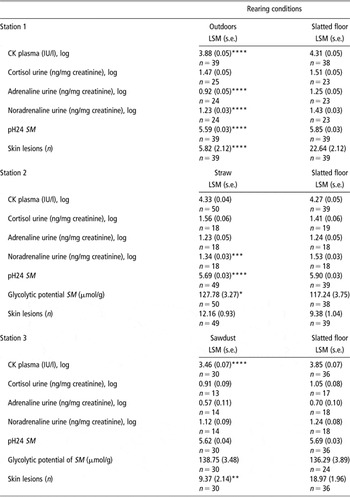
Results for biological and meat quality traits, and for skin lesions of pigs reared in ALT or CON systems, are shown in Table 2. The effect of the halothane sensitivity allele was tested on animals from stations 1 and 2, each station having 50% of heterozygotes Nn and 50% homozygotes NN. This effect was significant only for CK activity in station 2, with a higher (P < 0.0001) CK activity for the heterozygotes Nn than for the homozygotes NN pigs (27.73 v. 14.53 × 10³ UI/l, respectively). Sex effect was not significant for any of the traits under study.
Biological and meat quality traits, and skin lesions of pigs reared in alternative or conventional systems

LSM = least squares means; SM = Semimembranosus muscle; n = number of observations for each group; CK = creatine kinase activity; pH24 = ultimate pH.
Significance of the difference between rearing conditions: *P < 0.05; **P < 0.01; ***P < 0.001;****P < 0.0001.
In station 1, ALT pigs showed lower levels (P < 0.0001 for all traits) than CON pigs for CK activity, urinary catecholamines, pH24 and skin lesions. Levels of urinary cortisol were not influenced by rearing conditions. In station 2, urinary noradrenaline level and pH24 were lower (P < 0.001 and P < 0.0001, respectively), but muscle GP was higher (P < 0.05) for the ALT pigs in comparison to the CON pigs. There was no difference between ALT and CON pigs for the others traits. In station 3, ALT pigs showed lower levels of CK activity (P < 0.0001) and less skin lesions (P < 0.01) than CON pigs, whereas there was no significant difference between rearing systems for all the others traits.
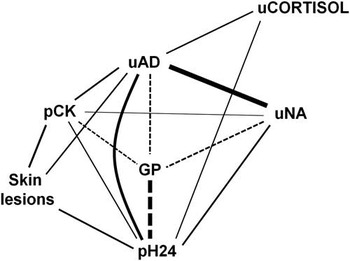
As GP values were not available for station 1, Pearson correlations between residuals of biological and meat quality traits and skin lesions were calculated using the data from stations 2 and 3 only. Results are shown in Figure 1.
Correlation network between biological and meat quality traits and skin lesions. pCK = creatine kinase activity measured in plasma; pH24 = Ultimate pH in the semimembranosus (SM) muscle; GP = GP in the SM muscle; uCORTISOL = cortisol measured in urine; uAD = adrenaline measured in urine; uNA = noradrenaline measured in urine; positive correlations are represented by a continuous line, negative correlations are represented by a dotted line; each line thickness is proportional to the Pearson correlation coefficient value (P < 0.05).

Urinary catecholamines were strongly inter-correlated (r = 0.82, P < 0.0001), but only adrenaline was significantly correlated with urinary cortisol (r = 0.26, P < 0.05). pH24 was correlated with urinary noradrenaline (r = 0.31, P < 0.05), and more strongly with adrenaline (r = 0.44, P < 0.001). Plasma CK activity was correlated with urinary adrenaline (r = 0.28, P < 0.05) and pH24 (r = 0.17, P < 0.05). The number of skin lesions was correlated with urinary adrenaline (r = 0.24, P < 0.05) and cortisol (r = 0.28, P < 0.05), pH24 (r = 0.27, P < 0.001) and, more particularly, with plasma CK activity (r = 0.33, P < 0.0001). For GP, Pearson correlations showed negative correlations with urinary catecholamines (adrenaline: r = −0.29, P < 0.05; noradrenaline: r = −0.28, P < 0.05), plasma CK activity (r = −0.26, P < 0.01) and more strongly with pH24 (r = −0.71, P < 0.0001).
Discussion
The increased number of skin lesions, the higher plasma CK and urinary levels of catecholamines and the higher pH24 values in CON pigs compared to outdoor pigs (station 1), suggest that conventionally reared pigs fought more before slaughter. For this comparison, differences between rearing systems may be explained by the lower level of mixing of animals at slaughterhouse, and therefore, by the lower level of fights between animals for outdoor (one group of 40 pigs mixed in the same pen) compared with conventionally reared pigs (four groups of 10 pigs mixed in the same pen). However, for station 3, where the level of mixing was identical between the ALT and CON systems (four groups of 10 pigs mixed in the same pen, for both systems), pigs reared with an outdoor access showed also lower CK levels and skin lesions, than pigs reared on CON slatted floor. Similarly, other studies found that pigs reared outdoors show less aggressive interactions after mixing at loading, during transport and lairage than conventionally reared pigs, even with the same level of mixing (Barton Gade, Reference Barton Gade2008a; Terlouw et al., Reference Terlouw, Berne and Astruc2009). In accordance with previous studies investigating either urinary (Lebret et al., Reference Lebret, Meunier-Salaun, Foury, Mormède, Dransfield and Dourmad2006 and Reference Lebret, Prunier, Bonhomme, Foury, Mormède and Dourmad2011) or plasma or salivary cortisol (De Jong et al., Reference De Jong, Ekkel, Van de Burgwal, Lambooij, Korte, Ruis, Koolhaas and Blokhuis1998 and Reference De Jong, Prelle, Burgwal, Lambooij, Korte, Blokhuis and Koolhaas2000; Geverink et al., Reference Geverink, De Jong, Lambooij, Blokhuis and Wiegant1999; Klont et al., Reference Klont, Hulsegge, Hoving-Bolink, Gerritzen, Kurt, Winkelman-Goedhart, De Jong and Kranen2001; Lebret et al., Reference Lebret, Meunier-Salaun, Foury, Mormède, Dransfield and Dourmad2006; Barton Gade, Reference Barton Gade2008a and Reference Barton Gade2008b), urinary cortisol levels were not affected by the rearing system.
Whatever the rearing system, pigs from station 3 exhibited the lowest levels of physical activity and/or stress indicators (plasma CK, cortisol and catecholamines) at slaughter. These differences may be related to differences in the rearing or in the slaughtering conditions, or to the different genetic background of pigs compared with stations 1 and 2, since pigs were issued from boars P76 (NN) in station 3, and from boars LW × P (Nn) in stations 1 and 2. Indeed, earlier studies have already shown the effects of genetic background on stress reactions at slaughter as well as the consequences of stress reactions on pork quality (Terlouw and Rybarczyk, Reference Terlouw and Rybarczyk2008; Terlouw et al., Reference Terlouw, Berne and Astruc2009).
The correlation network combining physiological and meat quality parameters presents a logical framework and contributes to improve our understanding of the influence of rearing environment on animal biology and meat quality traits. In agreement with a previous experiment (Foury et al., Reference Foury, Devillers, Sanchez, Griffon, Le Roy and Mormède2005), urinary adrenaline and noradrenaline levels at slaughter were highly correlated. Urinary adrenaline and cortisol levels were also correlated albeit less strongly. The latter correlation may be explained by the influence of adrenocortical activity on adrenaline release by the adrenal medulla. Indeed, glucocorticoids regulate the levels of phenylethanolamine N-methyltransferase, the enzyme which converts noradrenaline into adrenaline (Ciaranello, Reference Ciaranello1978). It may also reflect the regulatory influence of the splanchnic nerve on the adrenal cortex sensitivity to ACTH (Edwards and Jones, Reference Edwards and Jones1993; Bornstein et al., Reference Bornstein, Engeland, Ehrhart-Bornstein and Herman2008).
Mixing may lead to fighting between pigs, causing not only increased physical activity but also emotional stress (Warriss, Reference Warriss1996; Terlouw et al., Reference Terlouw, Arnould, Auperin, Berri, Le Bihan-Duval and Deiss2008 and Reference Terlouw, Berne and Astruc2009). These relationships are illustrated in the correlation network. In this study, the number of skin lesions, which mainly reflects the number and intensity of pre-slaughter fights, was positively correlated with plasma CK, an indicator of muscle activity, and with cortisol (P < 0.10, not shown in Figure 1) and adrenaline levels, indicators of either emotional stress or physical activity (Scheurink et al., Reference Scheurink, Steffens, Bouritius, Dreteler, Bruntink, Remie and Zaagsma1989; Korte et al., Reference Korte, Bouws and Bohus1992; Warriss et al., Reference Warriss, Brown, Edwards and Knowles1998a; Gispert et al., Reference Gispert, Faucitano, Oliver, Guardia, Coll, Siggens, Harvey and Diestre2000; Terlouw et al., Reference Terlouw, Berne and Astruc2009; Turner et al., Reference Turner, Roehe, D'Eath, Ison, Farish, Jack, Lundeheim, Rydhmer and Lawrence2009). The negative correlations between indicators of physical exercise or plasma catecholamines and the GP are explained by the combined effects of increased physical activity and catecholamine levels on muscle glycogen consumption (Terlouw et al., Reference Terlouw, Porcher and Fernandez2005). GP and pH24 are usually negatively correlated, as in case of low muscle GP; less glycogen can be catabolized post-mortem and consequently less protons and lactic acid are produced (Fernandez and Tornberg, Reference Fernandez and Tornberg1991; Monin, Reference Monin2003; Foury et al., Reference Foury, Devillers, Sanchez, Griffon, Le Roy and Mormède2005). This explains the positive correlation between variables related to fighting behavior and meat pH24 (Warriss, Reference Warriss1996; Warriss et al., Reference Warriss, Brown, Gade, Santos, Costa, Lambooij and Geers1998b; Gispert et al., Reference Gispert, Faucitano, Oliver, Guardia, Coll, Siggens, Harvey and Diestre2000; Terlouw et al., Reference Terlouw, Porcher and Fernandez2005; D'Eath et al., Reference D'Eath, Turner, Kurt, Evans, Tholking, Looft, Wimmers, Murani, Klont, Foury, Ison, Lawrence and Mormede2010). In this study, among the physiological traits evaluated, the highest correlation with pH24 was found for adrenaline levels in urine. Earlier findings also showed relationships between indicators of autonomic nervous system activity, including urinary adrenaline levels and pre-slaughter heart rate, with post-mortem muscle metabolic rate (Foury et al., Reference Foury, Devillers, Sanchez, Griffon, Le Roy and Mormède2005; Terlouw and Rybarczyk, Reference Terlouw and Rybarczyk2008).
Acknowledgements
The present results were obtained with the financial support of the French ‘Action de Coordination Technique Agricole’. The authors gratefully acknowledge Nathalie Bonhomme (INRA, UMR Systèmes d'Elevage Nutrition Animale et Humaine) for excellent technical assistance.