


Introduction
Bipolar disorders (BD) are defined by mood swings that include emotional highs (mania or hypomania) and lows (depression) (American Psychiatric Association, 2000). Unipolar depression (UD) refers to individuals who have ever experienced a depressive episode and without a manic/hypomanic episode. Differentiating UD from BD can allow physicians to provide more personalized treatment and develop new treatments (Forty et al. Reference Forty, Smith, Jones, Jones, Caesar, Cooper, Fraser, Gordon-Smith, Hyde, Farmer, McGuffin and Craddock2008). However, distinguishing UD and BD has been challenging in clinical settings (Cardoso de Almeida & Phillips, Reference Cardoso de Almeida and Phillips2013). Compelling evidence has indicated that cognitive dysfunction collectively appears in BD and UD (Bora et al. Reference Bora, Harrison, Yucel and Pantelis2013; Bourne et al. Reference Bourne, Aydemir, Balanza-Martinez, Bora, Brissos, Cavanagh, Clark, Cubukcuoglu, Dias, Dittmann, Ferrier, Fleck, Frangou, Gallagher, Jones, Kieseppa, Martinez-Aran, Melle, Moore, Mur, Pfennig, Raust, Senturk, Simonsen, Smith, Bio, Soeiro-de-Souza, Stoddart, Sundet, Szoke, Thompson, Torrent, Zalla, Craddock, Andreassen, Leboyer, Vieta, Bauer, Worhunsky, Tzagarakis, Rogers, Geddes and Goodwin2013; Rock et al. Reference Rock, Roiser, Riedel and Blackwell2014; Porter et al. Reference Porter, Robinson, Malhi and Gallagher2015). Characterizing UD and BD with a neuropsychological test is crucial and would be very valuable in clinical settings (Papazacharias & Nardini, Reference Papazacharias and Nardini2012). Neurocognitive assessment is beneficial because it is non-invasive, can be easily administrated, and is efficient in clinical practice. Furthermore, identifying specific cognitive profiles can contribute to a better understanding of the pathophysiology of these mood disorders. Finally, cognitive profiles provide an important reference for developing patients’ treatment strategies and socio-occupational rehabilitation (Trivedi & Greer, Reference Trivedi and Greer2014).
An increasing amount of literature has investigated the cognitive profiles of UD and BD, but the findings have been mixed and inconclusive (MacQueen & Memedovich, Reference MacQueen and Memedovich2017; Szmulewicz et al. Reference Szmulewicz, Valerio, Smith, Samame, Martino and Strejilevich2017). Several studies have shown that, compared with healthy subjects, both UD and BD patients performed worse in episodic memory, executive function, attention, and processing speed (Gildengers et al. Reference Gildengers, Butters, Chisholm, Anderson, Begley, Holm, Rogers, Reynolds and Mulsant2012; Xu et al. Reference Xu, Lin, Rao, Dang, Ouyang, Guo, Ma and Chen2012; Daniel et al. Reference Daniel, Montali, Gerra, Innamorati, Girardi, Pompili and Amore2013). However, some studies have indicated that only BD patients, but not UD patients, underperform healthy subjects in cognitive function (Clark et al. Reference Clark, Kempton, Scarna, Grasby and Goodwin2005; Canuto et al. Reference Canuto, Giannakopoulos, Moy, Rubio, Ebbing, Meiler-Mititelu, Herrmann, Gold, Delaloye and Weber2010). Furthermore, no significant difference was found in attention (Robertson et al. Reference Robertson, Kutcher and Lagace2003) or theory of mind (Purcell et al. Reference Purcell, Phillips and Gruber2013) between patients with mood disorders and healthy subjects. Regarding the head-to-head comparison of UD and BD, several studies have found that BD patients underperform UD patients in memory, attention, and executive function (Smith et al. Reference Smith, Muir and Blackwood2006; Canuto et al. Reference Canuto, Giannakopoulos, Moy, Rubio, Ebbing, Meiler-Mititelu, Herrmann, Gold, Delaloye and Weber2010; Gildengers et al. Reference Gildengers, Butters, Chisholm, Anderson, Begley, Holm, Rogers, Reynolds and Mulsant2012). However, some studies have reported no difference in neuropsychological profiles between UD and BD (Xu et al. Reference Xu, Lin, Rao, Dang, Ouyang, Guo, Ma and Chen2012; Daniel et al. Reference Daniel, Montali, Gerra, Innamorati, Girardi, Pompili and Amore2013). In contrast, one study revealed that BD patients outperformed UD patients in executive function (Paradiso et al. Reference Paradiso, Lamberty, Garvey and Robinson1997). These inconsistent findings may be due to various reasons, including heterogeneity of sample sizes, patients’ emotional status, or the neuropsychological tests adopted in the study. Furthermore, some confounding factors (e.g. age, gender, education, age of onset, number of episodes and durations, symptoms severity, and medication in use) may influence the cognitive assessments and were not fully addressed in previous studies. Overall, studies containing emotional processing tasks have been lacking, which may reflect the specific cognitive characteristics in mood disorders for determining the distinction between UD and BD.
The Brief Assessment of Cognition in Affective Disorders (BAC-A) is a series of tests that contain the cognitive measures of the Brief Assessment of Cognition in Schizophrenia (BACS). The BACS includes six subtests (i.e. verbal memory, working memory, motor speed, verbal fluency, attention and processing speed, and executive function), which reflect the cognitive deficits commonly observed in schizophrenic patients (Keefe et al. Reference Keefe, Goldberg, Harvey, Gold, Poe and Coughenour2004, Reference Keefe, Poe, Walker and Harvey2006a , Reference Keefe, Poe, Walker, Kang and Harvey b , Reference Keefe, Harvey, Goldberg, Gold, Walker, Kennel and Hawkins2008). The BAC-A also has one more test, namely the Affective Processing Test, which has been specifically designed to assess the emotional cognition of people with mood disorders (Keefe et al. Reference Keefe, Fox, Davis, Kennel, Walker, Burdick and Harvey2014; Bauer et al. Reference Bauer, Keefe, Sanches, Suchting, Green and Soares2015a ). The BAC-A can be easily administrated with a pencil or pen and requires approximately 40 min to complete. The BAC-A has been proved to have satisfactory psychometric properties and has been validated to identify the cognitive deficits in BD patients (Keefe et al. Reference Keefe, Fox, Davis, Kennel, Walker, Burdick and Harvey2014; Bauer et al. Reference Bauer, Keefe, Sanches, Suchting, Green and Soares2015a ). However, little is known about whether the BAC-A, which consists of traditional cognitive domains and specific assessments for disturbances of affective cognition, can be applied to distinguish UD from BD.
To fill the research gap, this study aimed to investigate the cognitive profiles of patients with UD and patients with BD by applying the BAC-A for neuropsychological assessment. Furthermore, we aimed to determine whether combining all indexes of the BAC-A (Affective Processing Test and the traditional cognitive domains of the BACS) can more effectively differentiate patients with UD and BD compared with using either the traditional cognitive domains or the Affective Processing Test alone.
Method
Study participants
We conducted this cross-sectional study at Chang Gung Memorial Hospital and was approved by its Institutional Review Board (IRB No: 104-7324B). All procedures in this study were performed in accordance with the ethical standards of the institutional and/or national research committee and with the Helsinki declaration and its subsequent amendments or comparable ethical standards. We obtained informed consent from all the individuals that participated in this study.
We recruited patients with mood disorders from two general hospitals (Kaohsiung Chang Gung Memorial Hospital and Kaohsiung Veterans General Hospital). The eligibility criteria for patients consisted of the following: (a) diagnosis of a depressive disorder or a BD pursuant to the criteria of the Diagnostic and Statistical Manual of Mental Disorders, Fourth Edition (DSM-IV-TR) (American Psychiatric Association, 2000); (b) age ⩾18 years; (c) without any known systemic or neurological diseases that may influence cognitive performance; (d) ethnic Han Chinese; and (e) ability to speak Mandarin and read Chinese and provide informed consent. A total of 68 patients with depressive disorders [50 with major depressive disorder, 13 with dysthymic disorder, five with depressive disorder Not Otherwise Specified (NOS)] were recruited and formed into the UD group; 67 patients with BD (38 with bipolar I disorder and 29 with bipolar II disorder) made up the BD group. We interviewed the patients and administered their neuropsychological tests when their mood symptoms were relatively stable for at least 1 week.
The control group included healthy individuals recruited from the Kaohsiung Chang Gung Memorial Hospital staff and from community volunteers in Kaohsiung City. The recruitment criteria included the following: (a) no history of major psychiatric disorders (e.g. psychosis, BD, depressive disorders, dementia, or organic mental disorders) or systemic or neurological diseases that would influence cognitive performance; (b) age ⩾18 years; (c) ethnic Han Chinese; and (d) ability to speak Mandarin and read Chinese and provide informed consent. We recruited a total of 135 healthy controls.
Cognitive assessment
The cognitive functions of all participants were evaluated by a research team member properly trained in administering the BAC-A, which is based on the BACS (Keefe et al. Reference Keefe, Goldberg, Harvey, Gold, Poe and Coughenour2004). The BACS is a battery of tests with high test–retest reliability that measures the aspects of cognitive deficits in schizophrenic patients (Keefe et al. Reference Keefe, Poe, Walker, Kang and Harvey2006b ). The Chinese version of the BACS has been demonstrated to have satisfactory psychometric properties (Wang et al. Reference Wang, Lin, Lee, Huang, Hsu, Hung, Chen, Chen, Wang and Tsai2016), and the normative data have been established by our research team (Wang et al. Reference Wang, Huang, Hung, Chen, Chen, Lee, Wang, Liu, Lin and Hsu2017). The BAC-A has also been adapted into a Chinese version, which has been checked and approved by the original author (Professor Richard S.E. Keefe). The normative data of the Chinese BAC-A has also been established by the original authors (data unpublished). The BAC-A contains six subtests of the BACS, as well as one additional test, the Affective Processing Test.
BACS subtests
The six subtests for assessing traditional neurocognitive domains are the List Learning Test, Digit Sequencing Task, Token Motor Task, Category Instances Test, Controlled Oral Word Association Test, Symbol Coding, and Tower of London Test, which measure verbal memory, working memory, motor speed, verbal fluency, attention and processing speed, and executive function, respectively. A composite score is subsequently calculated by comparing each patient's performance in each test to that of a healthy comparison group, which is the T- or Z-score of that sum (Keefe et al. Reference Keefe, Harvey, Goldberg, Gold, Walker, Kennel and Hawkins2008). The T-scores, which are computed based on Taiwanese norms, were applied for statistical analysis (Wang et al. Reference Wang, Huang, Hung, Chen, Chen, Lee, Wang, Liu, Lin and Hsu2017).
Affective Processing Test
In addition to the six aforementioned subtests, the Affective Processing Test of the BAC-A includes three subtests: Affective Interference Test (AIT), Affective Interference Test Delayed Recognition (AIT-DR), and Emotion Inhibition Test (EIT). In the AIT, subjects are given a list of 20 words, 10 of which have emotional content (affective words, like ‘killer’, ‘intimate’), and the other 10 are fruits or vegetables (non-affective words like ‘apple’, ‘zucchini’). Subjects were given three learning trials and were asked to recall as many of these words as possible at each trial. Then subjects were asked to perform a free recall of the non-affective words (fruits and vegetables) and the ‘other words’. Four indexes were calculated for analyses: (a) total affective words; (b) total non-affective words; (c) cued affective words; and (d) cued non-affective words.
After a delay of 15–20 min, recognition memory is tested by presenting the initial 20 words (10 emotional and 10 fruits and vegetables) along with 20 foil words that had not previously been presented. The subjects were asked whether certain affective and non-affective words were included in the previous word list. In the AIT-DR, four indexes were calculated for analyses: (a) number of correct affective words; (b) number of correct non-affective words; (c) affective false alarms; and (d) non-affective false alarms.
In the EIT, subjects were presented with sheets of papers with four columns of words of either neutral or affective polarity in colored (red, blue, green, and yellow) or black ink. They were then instructed to either read the words (word naming) or the color of the words (color naming) going down the columns. Subjects are given 30 s to read as many words as they can on each page. The EIT index is calculated by subtracting: (a) the number of correct responses to the color naming; (b) the number of correct responses to the neutral color words; (c) the number of correct responses to the affective color words; and (d) the number of correct responses to neutral words.
Psychopathological assessment
We assessed the clinical psychopathology of patients with UD and BD using the 17-item Hamilton Depression Rating Scale (17-item HAM-D). Patients with BD were further evaluated using the Young Mania Rating Scale (YMRS). The 17-item HAM-D is a clinician-rated assessment of depressive symptoms consisting of 17 items (Ramos-Brieva & Cordero-Villafafila, Reference Ramos-Brieva and Cordero-Villafafila1988), and a higher total score represents a greater severity of depressive symptoms (Zheng et al. Reference Zheng, Zhao, Phillips, Liu, Cai, Sun and Huang1988). The YMRS is a commonly used rating scale for measuring manic symptoms (Young et al. Reference Young, Biggs, Ziegler and Meyer1978). The scores of each item are summed to form a total score ranging from 0 to 60; higher scores indicate more severe symptoms.
Statistical analyses
We analyzed the data using the statistical software package SPSS (Version 21.0; SPSS Inc., Chicago, Illinois, USA). The variables were shown as either mean (±s.d.) or frequency (%). In a two-tailed test, p < 0.05 was considered statistically significant. Categorical variables among participant groups were compared using the χ2 test, and we adopted one-way analysis of variance with least significant difference (LSD) post hoc tests to compare continuous variables among groups.
Inter-group differences in BAC-A performance were determined using multivariate analysis of covariance (MANCOVA), controlling for age, gender and education levels. Corrections of multiple comparisons were performed using Fisher's LSD. Additionally, MANCOVA was employed to evaluate the effects of disease characteristics on each BAC-A indexes in the UD and BD groups, respectively. The age- and gender-adjusted T-scores from each BAC-A subtest were set as dependent variables. Partial η 2 was used to calculate the effect size for group comparisons, with the small, medium, and large effect sizes being 0.01, 0.06, and 0.14, respectively (Cohen, Reference Cohen1988).
We further used the BAC-A subtest T-scores as predictors in the discriminant function analysis (DFA) to organize group memberships into the three diagnostic categories. We further identified the standardized coefficients for independent variables of the extracted discriminant functions. Classification analysis was performed based on the discriminant functions. Individuals were categorized into the predicted groups for which they had the highest classification scores.
We carried out three DFA models to determine which model has the highest rate of original grouped cases correctly classified. Model 1 consisted of the six traditional cognitive domains and the composite score of the BACS as predictors; model 2 consisted of the 12 indexes derived from the Affective Processing Test as predictors; model 3 contained all of the indexes measured by the BAC-A (both the traditional cognitive domains and the Affective Processing Test).
Results
Characteristics and cognitive function across groups
Table 1 lists the characteristics and performance in the BAC-A of the 68 patients in the UD group (mean age: 45.2 years, 35.5% males), 67 patients in the BD group (mean age: 41.0 years, 43.3% males), and 135 healthy control subjects (mean age: 44.5 years, 43% males). No significant differences were observed among the three groups with regard to age or gender. The control subjects had a greater level of education than both the UD patients and the BD patients. In comparison with UD patients, BD patients had younger age of disease onset, longer duration of illness, lower rate of antidepressant use, and higher rates of receiving antipsychotics or mood stabilizers.
Characteristics of patients with unipolar depression, patients with bipolar disorders, and healthy control subjects

HAM-D, the 17-item Hamilton Depression Rating Scale; YMRS, the Young Mania Rating Scale.
Data are expressed as mean ± s.d. or n (%).
a Information about pharmacotherapy was missing in four patients with bipolar disorders.
After controlling for age, gender, and education levels (Table 2), significant differences were observed in all BAC-A domains across the three participant groups, except for non-affective correct words and affective false alarms of the AIT-DR. Post hoc tests demonstrated that healthy controls performed better in all of the BAC-A subtests than both the UD and BD patients, with the exception of the four indexes of the AIT-DR. Compared with the BD group and the control group, the UD group demonstrated the worst performance in non-affective false alarms of the AIT-DR. Compared with the BD group, the UD group exhibited better performance in working memory, and color naming score and affective color word score of the EIT. The effects of disease characteristics on each BAC-A performance in the UD and BD groups were listed in online Supplementary Tables S1 and S2, respectively.
Cognitive function (BAC-A) of patients with unipolar depression, patients with bipolar disorders, and healthy control subjects

BAC-A, Brief Assessment of Cognition in Affective Disorders; AIT, Affective Interference Test; AIT-DR, Affective Interference Test: Delayed Recognition; EIT, the Emotion Inhibition Test; D, depression; BD, bipolar disorders; C, controls; n.s., non-significant.
The scores of the BAC-A subtests are expressed as the T-scores. Statistical values were determined using multivariate analysis of covariance, controlling for age, gender, and education levels. Corrections of multiple comparisons were using Fisher's least significant difference.
Discriminant functions analysis
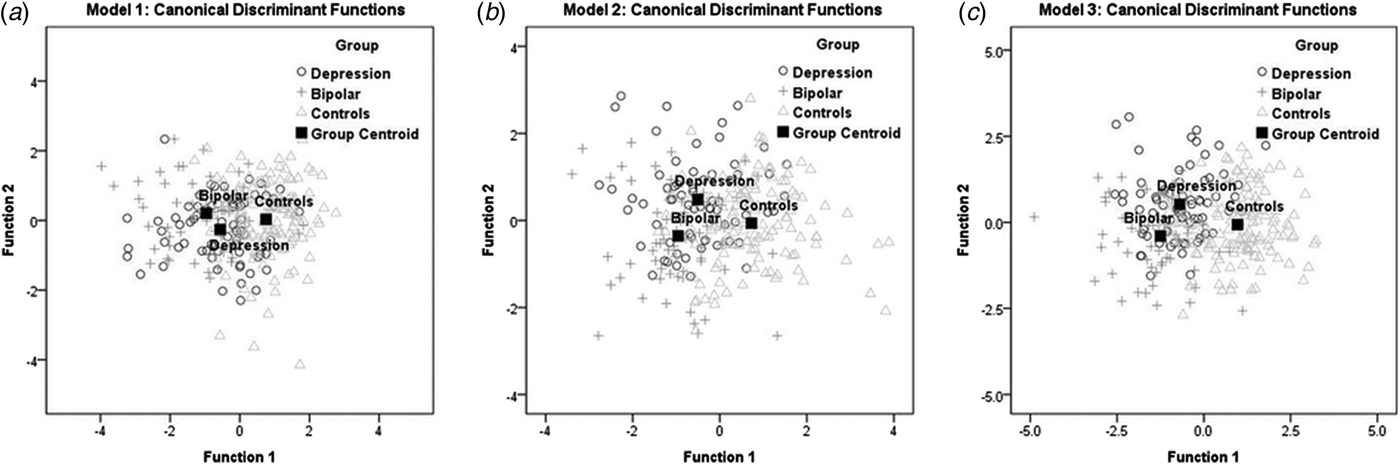
We further developed three different DFA models to determine whether combining the performance of BAC-A could effectively differentiate the three participant groups (UD, BD, and healthy controls). We found two extracted discriminant functions in each model, using the T-scores of the BACS subtests as predictors (Table 3). In model 1, working memory belonged to the second function, and all of the remaining domains were the property of the first function. In model 2, the delayed recognition of affective false alarms and non-affective false alarms belonged to the second function, and all of the other indexes of the Affective Process Test belonged to the first function. In model 3, the delayed recognition of affective false alarms and non-affective false alarms belonged to the second function, and all of the other BAC-A indexes belonged to the first function. Figure 1 shows the distributions of individuals on the canonical discriminant functions and group centroids in the three different DFA models.
Distributions of individuals on the extracted canonical discriminant functions and group centroids are the class means of canonical variables in the discriminant function analysis. (a) Model 1 consisted of the six traditional cognitive domains and the composite score of the Brief Assessment of Cognition in Schizophrenia (BACS) as predictors; (b) model 2 consisted of the 12 indexes derived from the Affective Processing Test as predictors; (c) model 3 consisted of all the indexes measured by the Brief Assessment of Cognition in Affective Disorders (BAC-A) (both the traditional cognitive domains and the Affective Processing Test).
Structure matrix of the extracted discriminant functions using the T-scores of BAC-A subtests as predictors in the DFA to categorize participants into their respective groups

BAC-A, Brief Assessment of Cognition in Affective Disorders; DFA, discriminant function analysis; BACS, Brief Assessment of Cognition in Schizophrenia; AIT, Affective Interference Test; AIT-DR, Affective Interference Test: Delayed Recognition; EIT, the Emotion Inhibition Test.
a Largest absolute correlation between each variable and any discriminant function.
As seen in the first part of Table 4, the classification results generated from DFA model 1 revealed that 39.7% of UD patients, 59.7% of BD patients, and 75.6% of healthy control subjects were correctly categorized. DFA model 2 (the middle part of Table 4) showed that 50.0% of UD patients, 58.2% of BD patients, and 71.9% of healthy control subjects were correctly categorized. With regard to DFA model 3 (the last part of Table 4), 58.8% of UD patients, 65.7% of BD patients, and 77.8% of healthy control subjects were correctly categorized. Combined, the overall correct classification rates of the original grouped cases were 62.6%, 63%, and 70%, respectively.
Classification results generated from the DFA models

BAC-A, Brief Assessment of Cognition in Affective Disorders; DFA, discriminant function analysis.
Correctly classified subjects are expressed in bold face type; among DFA models 1, 2, and 3, 62.6%, 63%, and 70% of original grouped cases correctly classified.
Discussion
Applying the BAC-A for neuropsychological assessment, our results revealed that compared with the healthy control subjects, both patients with UD and BD demonstrated poorer performance in most cognitive dimensions. However, UD patients outperformed BD patients in working memory, and color naming score and affective color word score of the EIT. Furthermore, using all the indexes of the BAC-A, a total of 70% of participants could be correctly classified, and the distinguishing validity between UD and BD was better than using either the traditional cognitive domains (BACS) or the Affective Processing Test alone.
The evidence from studies investigating neurocognitive profiles in UD and BD are still controversial regarding differentiation between these two disorders (MacQueen & Memedovich, Reference MacQueen and Memedovich2017; Szmulewicz et al. Reference Szmulewicz, Valerio, Smith, Samame, Martino and Strejilevich2017). These inconsistent findings may be attributed to the lack of applying emotional processing tasks in such previous studies. The BAC-A contains traditional cognitive domains and specific assessments for affective cognition and may be sufficiently sensitive to identify the neurocognitive distinction between UD and BD. Two previous studies have evaluated the cognitive function in BD and healthy subjects using the BAC-A (Keefe et al. Reference Keefe, Fox, Davis, Kennel, Walker, Burdick and Harvey2014; Bauer et al. Reference Bauer, Keefe, Sanches, Suchting, Green and Soares2015a ). Bauer et al. (Reference Bauer, Ouyang, Mwangi, Sanches, Zunta-Soares, Keefe, Huang and Soares2015b ) reported that BD patients demonstrated significant deficits in verbal memory and verbal fluency, which may reflect inefficient learning strategies and/or difficulties in retrieving information. Furthermore, Keefe et al. (Reference Keefe, Fox, Davis, Kennel, Walker, Burdick and Harvey2014) found that the BAC-A is sensitive to cognitive impairments both in traditional neuropsychological domains and in affective cognitive processes among BD patients. Our results are generally consistent with these two previous reports.
We also provide the data about BAC-A performance in a UD group that allow us to delineate the neurocognitive difference between UD and BD. We observed that UD and BD exhibit similar deficits in most traditional cognitive domains (with the exception of working memory). In this study, we assessed working memory using the Digit Sequencing Task (Crowe, Reference Crowe2000). A previous study revealed that UD patients in a current episode had verbal working memory impairment (Kaneda, Reference Kaneda2009). Working memory is the cognitive capacity of short-term storage of information for goal-directed behaviors, and the auditory cortex stores information through persistent changes in neural activity (Huang et al. Reference Huang, Matysiak, Heil, Konig and Brosch2016). Hence, it is warranted to clarify whether UD and BD patients carried differential function in the neural networks that underlie working memory.
The first part of the Affective Processing Test is AIT, which assesses immediate affective and non-affective memory (Kaiser et al. Reference Kaiser, Andrews-Hanna, Spielberg, Warren, Sutton, Miller, Heller and Banich2015). We found that the UD and BD patients showed comparable deficits in this cognitive domain. In the AIT-DR (the second part of the Affective Processing Test), the UD group exhibited the worst performance in delayed recognition of non-affective false alarms, compared with BD and the controls. Literature suggests that individuals with features of depression preferentially processed negative information (Siegle et al. Reference Siegle, Ingram and Matt2002), and this cognitive process might be associated with confusion in recognizing non-affective stimuli. The EIT (the third part of the Affective Processing Test) measures an individual's ability to suppress irrelevant stimuli and identify the color of a word rather than the color/meaning denoted by the word (interference) (Dresler et al. Reference Dresler, Meriau, Heekeren and van der Meer2009). We found that two indexes of the EIT (color naming score and affective color word score) might be utilized to differentiate UD and BD patients. Combined with the results in the current study, we suggest that relative to the traditional cognitive domains (BACS), the Affective Processing Test seems to be more sensitive to capture the specific neurocognitive profiles of UD and BD. Previous studies have indicated that neural mechanisms of affective interference have implicated brain regions involved in cognitive control, including lateral prefrontal cortex, dorsal anterior cingulate cortex, and anterior insula (Kaiser et al. Reference Kaiser, Andrews-Hanna, Spielberg, Warren, Sutton, Miller, Heller and Banich2015). Whether the neurocognitive mechanisms underlying affective interference reflect the distinct pathophysiologic processes between UD and BD warrants further verification through brain imaging studies (Cusi et al. Reference Cusi, Nazarov, Holshausen, Macqueen and McKinnon2012).
This study showed that a total of 70% of participants among the three original groups could be correctly categorized based on the whole performance of the BAC-A (Table 4). The discriminating validity between UD and BD was superior to using the traditional cognitive domains (62.6%). The application of the Affective Processing Test was particularly beneficial in identifying the UD patients. The correct identification rate using BACS alone (DFA model 1) was only 39.7%; the rate raised to 50% using the Affective Processing Test (DFA model 2) and increased to 58.8% using all the indexes of the BAC-A (DFA model 3). However, in the DFA model 3, the high correct identification rate was mainly contributed by the healthy control group (77.8%), and only 58.8% of UD patients and 65.7% of BD patients were correctly differentiated. These findings suggest that the BAC-A can assist in differentiating patients with mood disorders from healthy individuals, but the discrimination validity between UD and BD may not be sufficiently robust for clinical implications. However, some evidence indicates that pathophysiologic processes may differ, especially in emotional regulation and attentional control neural circuitry between BD and UD (Cardoso de Almeida & Phillips, Reference Cardoso de Almeida and Phillips2013). Inferring from our findings, we assume that the neurocognitive performance and associated neurobiological mechanism of UD and BD may have subtle difference. However, our results and assumptions need to be replicated and verified in future studies across various ethnicities and countries.
This study has several limitations that should be noted. First, our UD samples consisted of various depressive disorders (major depressive disorder, dysthymic disorder, and depressive disorder NOS), and our BD sample contained both bipolar I and bipolar II disorders. We have found that mood symptom severity, disease subtypes, age of onset, duration of illness, and psychotropic drug usage were potentially associated with patients’ cognitive function. Therefore, the heterogeneity of the patient population may have influenced the results of classification analysis. Second, the age, gender, and educational levels among the UD group, the BD group, and the healthy control group were not perfectly matched. Third, the BAC-A was assessed when patients are in a euthymic state, and the assessments of cognitive profiles in acute states are lacking in this study. Cognitive performance is very much likely to differ between euthymic and acute states of both bipolar and UD. Therefore, the neurocognitive deficits identified in this study are more likely to be trait-related, and the results in this study should not be generalized into patients with affective disorders in acute states. Fourth, several crucial factors that may be associated with cognitive function (e.g. premorbid function, comorbidities, or cognition-related genes) were not addressed in this study (MacQueen & Memedovich, Reference MacQueen and Memedovich2017; Szmulewicz et al. Reference Szmulewicz, Valerio, Smith, Samame, Martino and Strejilevich2017). Future studies that have larger sample sizes and comprehensive assessments are necessary to understand the influence that the aforementioned factors have on between-group neurocognitive differences.
Despite this study's limitations, we have provided data about emotional processing tasks that may reflect the specific cognitive characteristics in mood disorders among patients with UD and BD. We have observed that, compared with healthy subjects, UD and BD patients showed comparable deficits in many of the traditional cognitive domains. Regarding working memory and two indexes of the EIT, UD patients had intermediate performance between healthy subjects and BD patients. Furthermore, using all the indexes, the BAC-A outperforms using either the traditional cognitive domains (BACS) or the Affective Processing Test alone in distinguishing UD from BD. However, further research is required to verify whether the BAC-A could be utilized to differentiate BD patients from UD patients in clinical settings.
Supplementary Material
The supplementary material for this article can be found at https://doi.org/10.1017/S003329171700229X.
Acknowledgements
Chun-Yi Lee and Liang-Jen Wang are co-first authors and contribute equally to this manuscript. The authors express their deepest gratitude to YF Lo and SM Wang for helping participant recruitment, and thank all of the individuals who participated in this study. This study was funded by Chang Gung Memorial Hospital, Taiwan (CMRPG8E1351) and Kaohsiung Veterans General Hospital (VGHKS105-12 and VGHKS106-13). The funding sources had no involvement in the study design, collection, analysis and interpretation of data, writing of the report, or the decision to submit the article for publication.
Declaration of Interest
None.



