Postsurgical infections in children may result in serious morbidity and substantial healthcare utilization. Reference Gould, Hennessey, Kiernan, Safier and Herman1–Reference Sherrod and Rocque3 Despite efforts to adhere to guidelines and other prevention efforts, Reference Ban, Minei and Laronga4 infections still occur with varying frequency depending upon the type of surgery and patient population. Reference Perencevich, Sands, Cosgrove, Guadagnoli, Meara and Platt5–Reference Anderson and Kaye8 Surgical site infections (SSIs) are currently the third most commonly reported type of healthcare-associated infection (HAI), Reference Lake, Weiner, Milstone, Saiman, Magill and See9,Reference Magill, O’Leary, Janelle and Thompson10 and they occur after 2%–5% of surgeries in the United States. Reference Anderson and Kaye8,Reference Magill, O’Leary, Janelle and Thompson10,Reference Bruny, Hall and Barnhart11 For pediatric patients, postsurgical infections may be particularly serious, given young age, immature immune systems, as well as comorbidities and congenital conditions that are more prevalent among young children undergoing surgery. Reference Bruny, Hall and Barnhart11,Reference Siegel12
Information on postsurgical infections across a broad range of surgeries in both inpatient and outpatient settings is limited, particularly for children. SSI surveillance through the National Healthcare Safety Network (NHSN) is available for selected inpatient surgeries, 13 but comparable data for a broad range of pediatric surgeries, particularly in the ambulatory settings, are more limited despite increasing performance of surgery in the outpatient setting. Reference Steiner, Karaca, Moore, Imshaug and Pickens14
Staphylococcus aureus is the second most common cause of HAIs among all patients (children and adults). Reference Magill, O’Leary, Janelle and Thompson10 It is the leading pathogen among healthcare-associated SSIs, ventilator-associated pneumonia, and the second leading pathogen among central-line–associated bloodstream infection (CLABSI) in children. Reference Lake, Weiner, Milstone, Saiman, Magill and See9 In a study involving SSIs reported to NHSN, of the 3,053 pathogens reported, S. aureus was the most common pathogen after pediatric orthopedic surgeries (39%) and cardiac surgeries (55%), and it was the second most common isolate after neurological surgery (28%). Reference Lake, Weiner, Milstone, Saiman, Magill and See9
Most studies of pediatric postsurgical S. aureus infections have focused on limited surgery types and/or were conducted in single centers with large institutional variability. Reference Labbe, Demers, Rodrigues, Arlet, Tanguay and Moore2,Reference Steiner, Karaca, Moore, Imshaug and Pickens14–Reference Warner, Uppstrom and Miller30 National-level estimates of pediatric postoperative S. aureus infections based on real-world microbiological data are lacking. Surgeries planned during an elective admission may provide an opportunity to maximize perioperative preventative measures to decrease postoperative infections (eg, through a potential vaccine). In this study, we sought to determine the incidence and types of culture-confirmed S. aureus infections among a wide variety of pediatric elective surgeries in a large sample of US hospitals.
Methods
In this retrospective study, we utilized data from the Premier Healthcare Database (PHD) to identify S. aureus infections among children after inpatient surgeries and hospital-based outpatient surgeries during elective admissions. The PHD is a large, geographically diverse, hospital administrative database containing patient-, hospital-, and payer-level discharge information. 31 Visits from the same hospital were tracked through unique masked identifiers. The PHD represents 20% of US hospital discharges, and data were deidentified. During the study period, 665 hospitals contributed data; 181 hospitals also provided microbiology laboratory data. Culture results include specimen type and site (eg, wound, blood, urine), isolated pathogen(s), and susceptibility results(s).
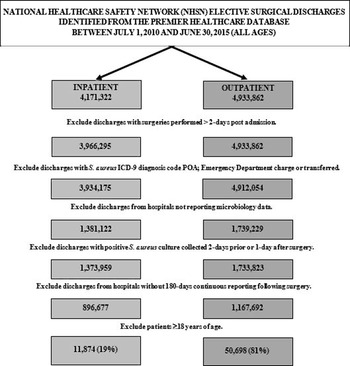
Discharges for patients <18 years of age with surgeries performed on the day of or day after an elective admission during July 1, 2010, and June 30, 2015, were identified from hospitals continuously reporting microbiology data for ≥180 days following surgery. Admissions with emergency department charges or transfers from other facilities were excluded to restrict the population to surgeries performed during elective admissions. Admissions with International Classification of Diseases, Ninth Revision Clinical Modification (ICD-9-CM) diagnosis codes for S. aureus infections that were present on admission and those with positive S. aureus cultures 2 days prior through 1 day after the surgery were excluded (Fig. 1).
Attrition. Attrition diagram shows the inclusion and exclusion criteria applied to the inpatient and hospital-based outpatient populations identified in the Premier Healthcare Database with elective surgical discharges between July 1, 2010, and June 30, 2015.

Patient characteristics at index surgical discharge included age, sex, and race. Patient comorbidities were defined according to the Feudtner pediatric complex chronic conditions classification system (CCC v2), including diagnostic and procedure codes indicating likely dependence on medical technology or organ transplantation. Reference Feudtner, Feinstein, Zhong, Hall and Dai32 Visit characteristics included admission type and source; discharge status and destination; and primary payer. Hospital characteristics included teaching status, urban or rural populations served, geographical region, and bed capacity.
Qualifying surgeries were identified with ICD-9 CM and current procedural terminology (CPT) codes using NHSN operative procedure categories, 33,34 as well as other relevant surgeries identified by one author (M.A.O.), as detailed elsewhere. Reference Dreyfus, Yu, Begier, Gayle and Olsen35 For discharges with multiple elective procedures in the same anatomic category, the infection was attributed to the surgery with the highest risk of infection according to the NHSN hierarchy. 33 Discharges with multiple surgeries involving >1 surgical category during the index visit were classified in a multiple surgery group. For patients with multiple surgical visits in the 180 days prior to infection, the surgical encounter closest in date to the infection was chosen as the attributable surgery.
Identification of postsurgical S. aureus infection was based on an algorithm combining positive nonsurveillance culture results, hospital chargemaster descriptions, and ICD-9-CM diagnosis codes (ICD-10 after October 1, 2015), as detailed elsewhere. Reference Dreyfus, Yu, Begier, Gayle and Olsen35 Infections were assigned into mutually exclusive categories, in the following order: BSI > SSI > all other. Because culture results did not always distinguish deep incisional and organ-space infections from superficial SSIs, they are reported as a single SSI category. The “all other” infection type category included urinary tract, respiratory, uncertain, and all other types. Uncertain types of S. aureus infections were those with a nonspecific culture descriptions from the hospital. All S. aureus infections were classified as methicillin sensitive (MSSA) or methicillin resistant (MRSA).
Incident S. aureus infections were reported dichotomously overall, by infection category for each of the surgical groups, and by inpatient and outpatient settings for the surgeries. The cumulative incidences of infection were assessed during the index hospitalization for inpatients, and within 30, 90, and 180 days after surgery for both operative settings, and these data are reported per 100 discharges. For patients with >1 type of S. aureus infection (eg, BSI and SSI), infection was included once in the numerator of the overall S. aureus incidence but individually for the surgical groups.
Projected US inpatient elective surgical volumes were estimated using 2014 surgery counts from the National Inpatient Sample (NIS) 36 for those aged 0–17 years multiplied by the proportion of each surgical category reported during elective admissions in the PHD for the same age group. To estimate the national inpatient S. aureus infection burden, surgery-specific infection rates calculated from the subset of PHD hospitals reporting microbiology data were multiplied by the number of nationally projected inpatient elective surgeries.
For descriptive statistics, we used means (standard deviation) or medians (interquartile range) for continuous variables and counts (percentages) for categorical variables. Continuous variables were compared using Student t tests or Wilcoxon rank-sum tests, and categorical variables were compared using χ Reference Labbe, Demers, Rodrigues, Arlet, Tanguay and Moore2 tests. All statistical analyses were performed using SAS version 9.4 software (SAS Institute, Cary, NC), and P < .05 was considered statistically significant.
Results
Patient, visit, and hospital characteristics
In total, 62,572 pediatric elective surgical discharges were identified with 11,874 (19.0%) and 50,698 (81.0%) occurring in the inpatient and outpatient settings, respectively. Among these discharges, 5,268 patients (8.42%) had >1 operation. Total postsurgical S. aureus infections through 180 days were identified from 393 (0.63%) surgical discharges. Inpatient postsurgical S. aureus infections were identified from 213 (1.79%) surgical discharges. Outpatient postsurgical S. aureus infections were identified from 180 (0.36%) surgical discharges.
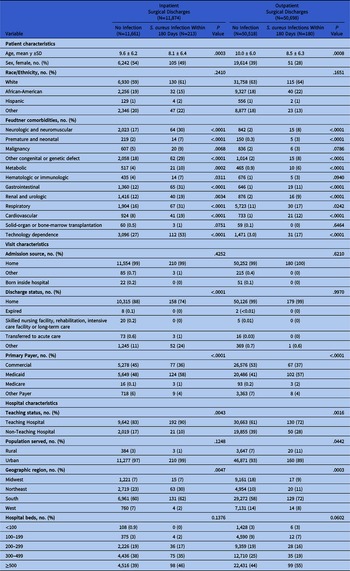
Children with postsurgical S. aureus infections tended to be younger, had a greater frequency of Medicaid as the primary payer, and more often had their surgery at a teaching hospital (Table 1). Children with versus without S. aureus infection after inpatient surgery were less often discharged to home, were more frequently discharged to another facility, and were more often given codes for complex chronic conditions, Reference Feudtner, Feinstein, Zhong, Hall and Dai32 indicating a higher level of medical complexity. Children with versus without S. aureus infection after outpatient surgery were more often male and were more often treated in rural hospitals.
Pediatric Patient, Visit, and Hospital Characteristics at the Index Surgical Visit

Note. SD, standard deviation.
Incidence and time to infection
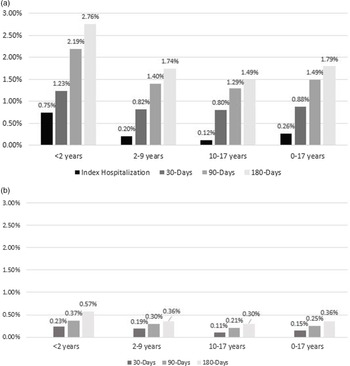
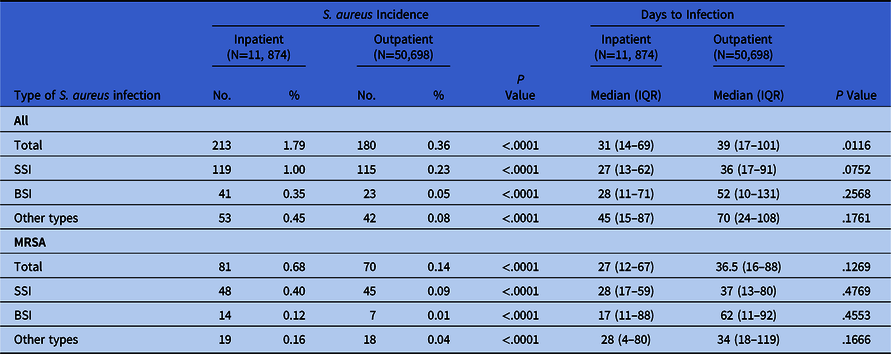
Staphylococcus aureus incidence was 5-fold higher after inpatient (1.79%) versus hospital-based outpatient (0.36%) surgeries (Fig. 2a and b, Table 2). The cumulative incidence of postsurgical S. aureus infections increased steadily from index surgical hospitalization through 180 days for all age groups after inpatient and outpatient surgeries. More than half of infections were identified between 30 and 180 days after surgery in both settings. The most common type of S. aureus infection was SSI, followed by BSI, and finally “other” (Table 2). MRSA represented 38% (81 of 213) and 39% (70 of 180) of postsurgical inpatient and outpatient S. aureus infections. The overall MRSA incidence was significantly higher after inpatient (0.68%) compared with outpatient (0.14%) surgeries (P < .0001). Among surgeries with at least 100 discharges, the highest incidences of MRSA were found after the following surgeries: colon (1.55%), skull (1.26%), and vascular (1.17%). Patients who developed MRSA had characteristics like those who developed an MSSA infection, except a higher proportion with MSSA had a neurologic or neuromuscular comorbidity or were technology dependent after outpatient surgery. We detected slight differences between these groups in the distribution of the bed size for treating hospitals (Supplementary Table 1).
Cumulative S. aureus incidence by timing of infections and pediatric age group after inpatient (a) or outpatient (b) elective surgeries. Bar graphs of S. aureus infection incidence at index hospitalization, 30 days, 90 days, and 180 days by age group after inpatient (a) and hospital-based outpatient (b) elective surgical discharges.

Staphylococcus aureus Infection Incidence and Timing of Infection Within 180 Days After Inpatient and Outpatient Surgeries

Note. IQR, interquartile range; MRSA, methicillin-resistant S. aureus; SSI, surgical site infection; BSI, bloodstream infection.
The median number of days to S. aureus infection was longer after outpatient compared with inpatient surgery (39 vs. 31 days; P = .0116), although these differences for each of the specific types of S. aureus infections were not significant (Table 2). Infections in the “other” type category of S. aureus infections had the longest median times to positive culture after surgery in both inpatient and outpatient settings. The number of days to infection varied substantially across both surgical settings and all infection types.
Incidence by surgery types and by age groups
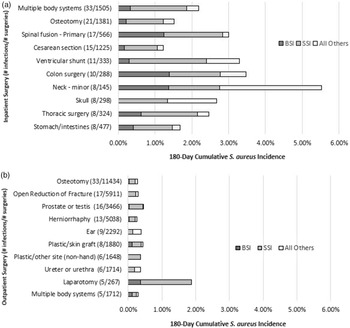
Among inpatient surgeries, those involving multiple surgical categories during the same visit were most frequent and had the highest burden of infections by number (Fig. 3a). Among surgeries with at least 100 discharges, the surgeries with the highest 180-day cumulative infection incidences after inpatient surgery were minor neck surgeries (8 of 145, 5.52%), vascular surgeries (7 of 168, 4.17%), and colon surgeries (10 of 288, 3.47%) (Supplementary Table 2). The surgeries with the highest 180-day infection incidences after outpatient surgery were gastric surgeries (4 of 160, 2.50%), vascular surgeries (4 of 173, 2.31%), and exploratory laparotomies (5 of 267, 1.87%) (Supplementary Table 3).
Pediatric S. aureus infection 180-day incidence after (a) inpatient elective surgeries or (b) hospital-based outpatient elective surgeries—top 10 by highest volume by infections. Stacked bar graphs of S. aureus surgical site, bloodstream, and other infection types (respiratory, urinary tract infection (UTI), uncertain invasive, and/or all other uncertain sites) at 180 days after inpatient (a) and hospital-based outpatient (b) elective surgical discharges with the highest infection incidence identified from the Premier Healthcare Database microbiology reporting hospitals between July 1, 2010, and June 30, 2015.

The overall 180-day incidence after inpatient surgery was highest in children aged <2 years (2.76%) followed by those aged 2–9 years (1.74%) and those aged 10–17 years (1.49%) (Fig. 2a). For inpatient surgeries with at least 100 discharges, the surgeries with the highest S. aureus incidences in children aged <2 years were minor neck surgeries (7.04%), multiple body systems surgeries (6.29%), and colon surgeries (3.97%) (Supplementary Table 4). For those aged 2–9 years, the highest S. aureus incidences were observed for plastic surgery or surgeries at other (non-hand) sites (4.95%), multiple body systems surgeries (1.48%), and osteotomy procedures (1.42%). The surgeries with the highest S. aureus incidences for those aged 10–17 years were spinal fusion (2.41%), thoracic surgeries (1.90%), and multiple body systems surgeries (1.75%).
The 180-day incidence of S. aureus infection after outpatient surgery was also highest for children <2 years of age (0.57%), followed by those aged 2–9 years (0.36%) and those aged 10–17 years (0.30%) (Fig. 2b). For outpatient surgeries with at least 100 discharges, the surgeries with the highest S. aureus incidences in children aged <2 years were gastric surgeries (7.14%), vascular surgeries (5.00%), and exploratory laparotomies (3.13%) (Supplementary Table 5). For those aged 2–9 years, the surgeries with the highest S. aureus incidences were peripheral or cranial nerve surgeries (6.67%), vascular surgeries (3.03%), and other or unclassified surgeries (2.54%). For those aged 10–17 years, the surgeries with the highest S. aureus incidences were lymph node surgeries (1.99%), exploratory laparotomies (1.69%), and vascular surgeries (1.15%).
National inpatient estimates
In 2014, there were an estimated 3,946 pediatric S. aureus infections identified within 180 days after 208,960 inpatient surgeries performed during elective admissions in the United States when applying the PHD S. aureus incidence rates to the NIS surgical volume estimates (Supplementary Table 2).
Discussion
In this real-world database study, we estimated the 180-day incidence of culture-confirmed S. aureus infection in children after elective surgeries performed in inpatient and hospital-based outpatient settings in a large US hospital network. These results add to the published literature by comprehensively summarizing the burden of culture-confirmed S. aureus infection following pediatric hospital-based surgeries overall and across all identified surgery types. We have estimated that nearly 4,000 postsurgical S. aureus infections occur in the US annually, following ∼200,000 inpatient pediatric surgeries. The infection risk was high, with nearly 2 in 100 inpatient surgeries and 1 in 250 outpatient procedures complicated by a culture-confirmed postoperative S. aureus infection.
Staphylococcus aureus infection incidence varied substantially by type of surgery and by surgical setting. Children aged <2 years had the highest incidence of S. aureus infections, which was ∼2-fold higher than for those aged 10–17 years. Some of the difference in incidence by age might be explained by greater frequency of higher-risk surgeries in younger versus older children (Supplementary Tables 4 and 5). For example, surgeries with a higher infection risk (eg, colon, stomach or intestine, skull other than craniotomy, and neck) were among the most commonly performed inpatient surgeries in children <2 years. Surgeries with a lower risk of infection such as cesarean section and osteotomy were more common among those aged 10–17 years. These findings highlight the heterogeneity of surgeries performed in the pediatric population, many of which are not part of routine surveillance.
Smaller, single-center studies have reported SSI incidence after a broad range of surgeries for pediatric patients with results similar to the current study. A 2005–2007 study from an Illinois children’s hospital reported a S. aureus SSI incidence of 2% after pediatric elective surgeries, but no data on infection after individual procedures were reported. Reference Vegunta, Gray and Wallace37 Similarly, SSI incidence was 0.99% in a study from the St. Louis Children’s Hospital that included only clean and clean-contaminated surgeries (75% ambulatory) from 1996–2008. Reference Bucher, Guth and Elward15
Other studies focused on specific pediatric procedures and reported SSI rates ranging from 0.25% to 6% for cardiothoracic surgery Reference Allpress, Rosenthal, Goodrich, Lupinetti and Zerr39–Reference Mehta, Cunningham, Colella, Alferis and Weiner41 and 0.5% to 14% for spinal fusion surgery. Reference Floccari and Milbrandt22–Reference Mackenzie, Matsumoto and Williams24,Reference Cahill, Warnick and Lee42,Reference Linam, Margolis and Staat43 A 2011 collaborative of 30 children’s hospitals reported an SSI incidence of 2.5% after spinal fusion, neurosurgical ventricular shunt, or cardiothoracic surgery, with reduction to 1.8% after implementation of a quality improvement initiative. Reference Schaffzin, Harte and Marquette38 Among 50 hospitals reporting to the National Surgical Quality Improvement Program-Pediatric (NSQIP-P) 2013 database, the SSI rate was 5.9% after pediatric colorectal surgeries. Reference Feng, Sidhwa, Cameron, Glass and Rangel21 Another study using the NSQIP-P 2012–2014 database of pediatric neurosurgical surgeries (other than shunt) reported 30-day SSI rates of 2.7%. Reference Sherrod and Rocque3
The 180-day cumulative incidence of S. aureus SSI infection in this study was 5-fold higher after inpatient surgeries (1.0%) compared with hospital-based outpatient surgeries (0.2%). Consistent with our finding, in a single pediatric tertiary-care center, the overall SSI incidence was 0.29% after pediatric ambulatory surgeries during 2009–2014. Reference Rinke, Jan, Nassim, Choi and Choi44
SSIs were the most common type of postsurgical S. aureus infections in our study, followed by all other types of infection and BSIs. Comparable pediatric studies reporting the incidence of postsurgical BSI and other non-SSI S. aureus infections are limited. A study of the Danish Civil Registration System that included children aged 5–18 years during 2000–2015 reported an incidence of postsurgical bacteremia of 0.33%, which is close to the BSI estimate of 0.35% for inpatients in our study. Reference Oestergaard, Schmiegelow and Bruun46
In this study, MRSA represented 38% and 39% of all S. aureus infections after inpatient and outpatient surgeries, respectively. MRSA was commonly isolated in children with S. aureus SSI (40% and 39% MRSA after inpatient and outpatient surgeries, respectively) but was slightly less common from children with S. aureus BSI (34% after inpatient and 30% after outpatient surgeries). These proportions were slightly higher than those reported by Lake et al Reference Lake, Weiner, Milstone, Saiman, Magill and See9 of pathogens isolated from SSIs to the NHSN after pediatric surgeries from 2011–2014; 26%–31% of the S. aureus isolates were resistant to methicillin, depending on the type of surgery. Reference Lake, Weiner, Milstone, Saiman, Magill and See9 The difference may be due to inclusion of procedures in this study beyond those under standard NHSN SSI surveillance.
Time to infection onset was significantly longer after outpatient versus inpatient surgeries. In a systematic review of SSI among adults and children of all ages, median time to SSI onset was 17 days and was longer for orthopedic (33.5 days) and transplant (41 days) surgeries. Reference Korol, Johnston and Waser47 These times are comparable to the median time to SSI in our current study of 31 days after inpatient and 39 days after outpatient surgeries. Recommended surveillance for SSI is for 30 days for superficial incisional and 90 days for deep incisional and organ-space infections associated with a foreign body. 48 The findings in our study point to the need for longer-term monitoring and prevention of infections beyond just the typical 30-day surveillance window. Future studies to determine the incidence and timing of postoperative S. aureus infections after emergent surgeries would provide a more comprehensive profile of postoperative S. aureus infections in the pediatric population to support surveillance and prevention programs.
This study had several limitations. Neonates are underrepresented in the analysis because of the restriction to elective admission type, and infants or children transferred to a PHD hospital were also excluded. Infections may have been missed if patients presented to hospitals other than the one where the surgery was performed. Data from the subset of hospitals reporting the microbiology laboratory data were assumed to represent the burden of S. aureus infections among the selected operative surgeries nationwide. There is no way to verify this assumption, but we included a large sample of 181 hospitals from diverse geographic areas of the United States. Misclassification was possible because the definition for each surgery used administrative codes and not clinical review of medical records. Finally, this study included only culture-positive S. aureus cases and missed infections that were not cultured or were culture negative. The study was not designed to evaluate the underlying reasons for variation in infection incidence.
Strengths of the study include the large sample size, which allowed capture of infrequent postsurgical infections among the pediatric population and use of microbiology data to confirm S. aureus infections. The PHD includes diverse geographic areas and races or ethnic groups across the United States, including all payers, varying sizes, teaching status, geographic locations, and surgeries from both inpatient and outpatient settings. Additionally, we report the prevalence of specific pediatric comorbidities among patients highlighting areas for future research into underlying conditions that could be targeted for enhanced infection prevention measures and surveillance. Finally, our study included procedure codes defined by the NHSN plus additional categories and focused on surgeries during elective admissions, which may provide a greater opportunity for infection prevention.
In this study, we made a comprehensive assessment of S. aureus incidence using microbiology data from a large number of US hospitals. S. aureus infection incidence after surgeries performed during an elective admission was highest for the youngest children and for certain surgical groups in the inpatient and outpatient settings that are not currently part of routine SSI surveillance. The surgeries and patient characteristics with higher incidence of infections represent priority areas for existing and novel methods for prevention, such as vaccination. These results may help guide targeted postsurgery infection prevention efforts among children after surgeries performed at US hospitals.
Supplementary material
To view supplementary material for this article, please visit https://doi.org/10.1017/ice.2021.462
Acknowledgments
The authors thank Alvaro Quintana, Pfizer, Inc, for his contributions to the study design and guidance on interpretation of the results; Carol Cohen for her medical writing and editing contributions; and Ning Rosenthal for providing consultation on identification of infections in the Premier Healthcare Database. Jessica Chung, Jake Gundrum, John House, and Roberta James from Premier provided programing and statistical support for this project.
Financial support
The study was performed by Premier Applied Sciences (Premier, Charlotte, NC) with funding from Pfizer.
Conflicts of interest
J.D. was an employee and shareholder of Premier at the time of this work and is now employed by Pfizer. J.G. is an employee of Premier. H.Y., A.G., I.M., and E.B. are employees and shareholders of Pfizer. M.A.O. is a paid consultant by Pfizer, working for Washington University in St. Louis.