Borderline personality disorder (BPD) emerges by late adolescence or young adulthood and is characterized by multiple debilitating symptoms, including cognitive deficits, tumultuous interpersonal relationships, and impulsive behaviors that interfere with occupational, academic, and social functioning (American Psychiatric Association [APA], 2013; Bagge et al., Reference Bagge, Nickell, Stepp, Durrett, Jackson and Trull2004; Skodol et al., Reference Skodol, Pagano, Bender, Shea, Gunderson and Yen2005; Soloff, Lynch, & Kelly, Reference Soloff, Lynch and Kelly2002; Stepp, Reference Stepp2012; Zweig-Frank & Paris, Reference Zweig-Frank and Paris2002). Moreover, an estimated 8%–10% of individuals with BPD will die by suicide (APA, 2013; Holm & Severinsson, Reference Holm and Severinsson2011). These devastating consequences speak to the urgent need for effective prevention strategies. However, successful prevention is predicated on elucidating markers of vulnerability so that at-risk youth can be reliably assessed and identified early.
Emotional vulnerability to environmental stressors is sine qua non for BPD symptom expression. For instance, DSM-5 (APA, 2013) explicitly conceptualizes BPD criteria regarding affective instability, paranoid ideation, and other transient psychotic experiences as reactions to a distressing event. Several prominent etiological theories of BPD development also view susceptibility in terms of child-level emotional vulnerabilities interacting with deleterious environmental circumstances or events (Batemen & Fonagy, Reference Bateman and Fonagy2003; Kernberg, Reference Kernberg1984; Linehan, Reference Linehan1993). For example, the biosocial model postulates that BPD develops from transactions between an emotionally sensitive child and family systems that are ill equipped to meet the child's emotion regulation needs, which serve to further promote emotional reactivity and dysregulation in the child (Crowell, Beauchaine, & Linehan, Reference Crowell, Beauchaine and Linehan2009; Linehan, Reference Linehan1993). We previously found support for maintenance of the disorder consistent with biosocial theory by demonstrating the reciprocal, bidirectional nature of BPD symptoms and deleterious parenting practices across adolescence in a large, community sample of adolescent girls (N = 2,451; Stepp et al., Reference Stepp, Whalen, Scott, Zalewski, Loeber and Hipwell2014). However, emotional vulnerability components of the biosocial model have yet to be tested. In general, most research has focused on cross-sectional associations between markers of emotion vulnerability and BPD in adult clinical samples.
In addition, little longitudinal work has examined whether susceptibility to BPD symptoms varies as a function of exposure to adversity. Moreover, the high rates of childhood sexual abuse reported by adult patients with BPD has led most researchers examining environmental risk factors to focus exclusively on exposure to childhood abuse (Bornolova, Huibregtse, Hicks, Iacono, & McGue, Reference Bornovalova, Huibregtse, Hicks, Iacono and McGue2013; Fossati, Madeddu, & Maffei, Reference Fossati, Madeddu and Maffei1999). This relatively narrow focus ignores potent environmental risks related to exposure to childhood poverty that have been associated with altered stress responses, severe mental illness, and overall poor health (Evans, Reference Evans2004; van Os, Kenis, & Rutten, Reference van Os, Kenis and Rutten2010). Thus, we contextualize adversity in terms of the accumulation of multiple adversities impacting the child's family system (Evans & Cassells, Reference Evans and Cassells2013; Evans & Kim, Reference Evans and Kim2007). We limited adversities to difficulties that were not directed at, or solely experienced by, the child but were stressors veritably impacting the larger family system (e.g., poverty, crowded housing, parental incarceration, and single-parent household). Thus, we examine the impact of childhood sexual abuse separately from family adversity for two reasons. First, while the entire family often experiences trauma when a child is sexually abused, this may not necessarily be the case, especially if a member outside of the family perpetrates the abuse and/or the child does not disclose the event. Second, by considering childhood sexual abuse separately from family adversity, we are able to determine whether or not exposure to adversity impacting the broader family system has a specific influence on the development of BPD symptoms not the influence of exposure to childhood sexual abuse. Therefore, we chose not to include childhood sexual abuse in our conceptualization of family adversities. However, given the extensive body of work linking exposure to childhood sexual abuse and BPD, we did examine its' effects on BPD symptom development separately from family adversity.
Thus, the current study focuses on the etiology of BPD by utilizing an intensive multimethod longitudinal study to examine negative emotional reactivity conferring vulnerability to BPD symptom development during late adolescence. Further, we examined the strength of the relationship between negative emotional reactivity and the development of BPD symptoms in the context of exposure to family adversity in a racially and economically diverse sample of adolescent girls oversampled for heightened BPD risk. To determine the unique impact of negative emotional reactivity and exposure to family adversity on BPD symptom development, we examined these relationships relative to temperamental factors and childhood sexual abuse.
Adolescence as a Window of Vulnerability
Even though adolescence represents an ideal developmental window to identify markers of vulnerability, most research on BPD has been conducted with adults. Because adolescents are expected to engage in more independent emotion regulation and behavioral control strategies with age, deficits in self-regulatory skills become more apparent during this developmental period. Thus, for predisposed youth, it is not surprising that recognizable symptoms and features of BPD are likely to first manifest during adolescence (Bradley, Zittel Conklin, & Westen, Reference Bradley, Zittel Conklin and Westen2005; Westen & Chang, Reference Westen and Chang2000). In addition, findings from community samples demonstrate that BPD symptoms and features peak during midadolescence and decline during late adolescence and young adulthood (Beauchaine, Klein, Crowell, Derbidge, & Gatzke-Kopp, Reference Beauchaine, Klein, Crowell, Derbidge and Gatzke-Kopp2009; Bornovalova, Hicks, Iacono, & McGue, Reference Bornovalova, Hicks, Iacono and McGue2009; de Clercq, van Leeuwen, van den Noortgate, de Bolle, & de Fruyt, Reference de Clercq, van Leeuwen, van den Noortgate, de Bolle and de Fruyt2009; Goodman et al., Reference Goodman, Patil, Triebwasser, Diamond, Hiller and Hoffman2010; Stepp et al., Reference Stepp, Whalen, Scott, Zalewski, Loeber and Hipwell2014). For example, Bornalova et al. (Reference Bornovalova, Hicks, Iacono and McGue2009) examined the developmental trajectory of BPD symptoms across ages 14 to 24 years and reported the highest mean-level stability during the period from 14 to 17 years old, with a significant decline in mean-level symptoms from ages 17 to 24. Thus, aberrant patterns of consistently high and/or increasing levels of BPD symptoms are evident by late adolescence, which provides an opportunity to identify markers of vulnerability for the development of BPD symptoms.
The optimal acquisition of self-regulatory skills requires reliability and predictability in the child's environment. Such environmental conditions afford caregivers greater opportunities to respond with sensitivity to the child's emotional needs. In contrast, children embedded within families facing poverty and high levels of chronic stress are likely to encounter unstable housing conditions, changes in family structure, caregiver unemployment, family conflict, and violence (Conger, Ge, Elder, Lorenz, & Simons, Reference Conger, Ge, Elder, Lorenz and Simons1994; Conger et al., Reference Conger, Wallace, Sun, Simons, McLoyd and Brody2002; Evans, Reference Evans2004). Exposure to these disruptions and adversities likely impedes the acquisition of interpersonal skills, decision-making abilities, emotion regulation skills, and identity development (Conger, Conger, & Martin, Reference Conger, Conger and Martin2010). Moreover, children with high levels of emotional sensitivity and reactivity may be especially vulnerable to the detrimental effects of exposure resulting from such adversities (van Os et al., Reference van Os, Kenis and Rutten2010).
Adolescent girls appear to be at particularly high risk for BPD features and their detrimental consequences. Although BPD is equally prevalent among males and females in most community samples (Coid, Yang, Tyrer, Roberts, & Ullrich, Reference Coid, Yang, Tyrer, Roberts and Ullrich2006; Grant et al., Reference Grant, Chou, Goldstein, Huang, Stinson and Saha2008; Lenzenweger, Lane, Loranger, & Kessler, Reference Lenzenweger, Lane, Loranger and Kessler2007), significantly higher rates of BPD are consistently observed among females as compared to males in both clinical and forensic populations of adolescents and adults (Eppright, Kashani, Robinson, & Reid, Reference Eppright, Kashani, Robinson and Reid1993; Grilo et al., Reference Grilo, Becker, Walker, Levy, Edell and McGlashan1995; Myers, Burkett, & Otto, Reference Myers, Burkett and Otto1993; Sansone & Sansone, Reference Sansone and Sansone2009; Skodol & Bender, Reference Skodol and Bender2003; for a review, see Miller, Muehlenkamp, & Jacobson, Reference Miller, Muehlenkamp and Jacobson2008). Evidence also shows that BPD is associated with greater distress and disability among women than among men (Grant et al., Reference Grant, Chou, Goldstein, Huang, Stinson and Saha2008; Trull, Jahng, Tomko, Wood, & Sher, Reference Trull, Jahng, Tomko, Wood and Sher2010), suggesting that girls may be in particular need of prevention and treatment efforts. As a result, the current study focuses on female-specific vulnerabilities identified in childhood and adolescence.
Negative Emotional Reactivity as a Marker of Vulnerability for BPD
Individuals with BPD report increased emotional reactivity to negative events compared to healthy and psychiatric control groups (Jovev & Jackson, Reference Jovev and Jackson2006; Pagano et al., Reference Pagano, Skodol, Stout, Shea, Yen and Grilo2004; Sinha & Watson, Reference Sinha and Watson1997; Stiglmayr et al., Reference Stiglmayr, Grathwol, Linehan, Ihorst, Fahrenberg and Bohus2005; Trull, Reference Trull1995). Negative emotional reactivity in response to daily stressors is associated with many forms of psychopathology and has been linked to genetic risk for depression and psychosis (Gottesman & Gould, Reference Gottesman and Gould2003; Lataster et al., Reference Lataster, Wichers, Jacobs, Mengelers, Derom and Thiery2009; Myin-Germeys & van Os, Reference Myin-Germeys and van Os2007; Wichers et al., Reference Wichers, Myin-Germeys, Jacobs, Peeters, Kenis and Derom2007). Extending this previous work, adults with BPD reported heightened negative emotional reactivity to daily stressors compared to healthy controls and patients with a psychotic disorder even when controlling for depression (Glaser, van Os, Mengelers, & Myin-Germeys, Reference Glaser, van Os, Mengelers and Myin-Germeys2008). Taken together, these finding suggest that negative emotional reactivity is distinct from the stable and negative mood states characterizing depression. However, whether negative emotional reactivity is distinguishable from the temperament trait of emotionality is unknown.
Temperament emotionality reflects individual differences in the experience and expression of negative emotions (Buss & Plomin, Reference Buss and Plomin1984; Rothbart, Reference Rothbart2007; Shiner et al., Reference Shiner, Buss, McClowry, Putnam, Saudino and Zentner2012) and has been found to predict BPD symptoms in adolescence (Stepp, Keenan, Hipwell, & Krueger, Reference Stepp, Keenan, Hipwell and Krueger2014) and adulthood (Carlson, Egeland, & Sroufe, Reference Carlson, Egeland and Sroufe2009). In the current study, we view negative emotional reactivity as a rapid and intense emotional response that occurs in the presence of a stressor; thus, while this construct is a near neighbor of temperament emotionality, it is nonetheless a more circumscribed aspect of emotional vulnerability relative to the broader temperament dimension. Therefore, we consider negative emotional reactivity as conceptually distinguishable from temperament emotionality. Furthermore, because previous work has identified temperament emotionality as a risk factor for BPD, in the current study we examine the incremental utility of negative emotional reactivity in the prediction of BPD symptoms not the influence of temperament emotionality.Footnote 1
Much of the prior work examining negative emotionality as a vulnerability factor for BPD has relied on self-report measures, which may be biased in a number of ways. We extend this body of work by integrating information across multiple methods that vary by informant (self- vs. observer ratings), time frame (from minutes to hours to several years), and context (laboratory vs. home environments) to derive a latent factor of negative emotional reactivity. This novel methodological approach reduces measurement error, thereby reducing shared method effects among negative emotional reactivity and BPD symptoms.
Childhood Adversity and BPD Risk
Stressful life events and childhood adversity are more commonly reported in patients with BPD compared to patients with other personality disorders and healthy controls. Patients with BPD often retrospectively report experiencing trauma and neglect during childhood and adolescence, with sexual abuse reported most frequently (Bandelow et al., Reference Bandelow, Krause, Wedekind, Broocks, Hajak and Rüther2005; Battle et al., Reference Battle, Shea, Johnson, Yen, Zlotnick and Zanarini2004; Johnson, Smailes, Cohen, Brown, & Bernstein, Reference Johnson, Smailes, Cohen, Brown and Bernstein2000; Pietrek, Elbert, Weierstall, Müller, & Rockstroh, Reference Pietrek, Elbert, Weierstall, Müller and Rockstroh2013; Zanarini et al., Reference Zanarini, Williams, Lewis, Reich, Vera and Marino1997). Recent evidence from a longitudinal twin design suggests that the link between childhood abuse and BPD may be due to child vulnerabilities that confer risk for both abuse and BPD (Bornolova et al., Reference Bornovalova, Huibregtse, Hicks, Iacono and McGue2013). The majority of work in this area has relied on retrospective reports of childhood abuse, which may conflate adversity exposure with negative cognitive biases associated with the disorder at the time of the assessment. Providing stronger support for family adversity as a risk factor, a recent study relying on prospective assessments demonstrated harsh parenting and family conflict predicted BPD at age 11 (Winsper, Zanarini, & Wolke, Reference Winsper, Zanarini and Wolke2012). In addition, samples have largely comprised White, middle-class women, limiting our ability to understand the impact of chronic poverty and its sweeping sequelae on the development of BPD symptoms in more diverse populations that would be expected to experience greater cumulative adversities and stress.
While the independent effects of childhood adversity and emotional vulnerability have been shown to relate to BPD, the transaction between these factors is complex and multifaceted. A transactional model of BPD development would assume that youth with high levels of negative emotional reactivity are at increased risk for numerous adverse life events and are inadequately prepared to cope with them. This ineffective emotional response in turn sets them up to experience more stressful life events that further deplete their resources to cope. While the directionality of adverse experiences and negative emotional reactivity is difficult to determine (Glaser, van Os, Portegijs, & Myin-Germeys, Reference Glaser, van Os, Portegijs and Myin-Germeys2006; Wichers et al., Reference Wichers, Geschwind, Jacobs, Kenis, Peeters and Derom2009), we use prospectively gathered data on adversity measured prior to our negative emotional reactivity assessment to investigate whether the relationship between child-level vulnerability and BPD symptom development is exacerbated for girls experiencing family adversity in the form of poverty, single parenthood, and other difficult life circumstances. In addition, our measure of family adversity relied exclusively on parent reports to further safeguard against confabulation among adversity exposure, negative emotional reactivity, and BPD symptoms.
Current Study
The current study examined negative emotional reactivity as a marker of vulnerability for the development of BPD in late adolescent girls. Within this broad goal, several more specific goals were addressed. First, using a multimethod index, we examined negative emotional reactivity as a predictor of aberrant developmental patterns of BPD symptoms. Based on normative personality development, we expected to find an overall decline in BPD symptoms during late adolescence. In contrast to this normative decline, we expected negative emotional reactivity to predict higher and/or increasing levels of BPD symptoms from ages 16 to 18 years. Second, we examined the impact of exposure to family adversity across childhood and adolescence on the development of BPD symptoms. We expected that exposure to family adversity would predict higher levels and/or increasing levels of BPD symptoms across late adolescence. Third, we examined the interplay between negative emotional reactivity and childhood adversity as predictors of BPD symptom development in girls during late adolescence. We hypothesized that negative emotional reactivity would increase the risk for BPD symptoms, providing support for its role as a marker of vulnerability. Moreover, the relationship between negative emotional reactivity and BPD symptoms would be stronger in the context of greater exposure to family adversity. Conversely, we expected the relationship between negative emotional reactivity and BPD symptoms to be mitigated for those with less exposure to family adversity.
Method
Participants and recruitment procedures
Participants were recruited from the longitudinal Pittsburgh Girls Study (PGS) for a multimethod substudy on girls' personality development (personality substudy). The PGS involves an urban community sample of four age cohorts of girls who were ages 5–8 years at the first assessment in 2000/2001 and have been followed with annual assessments for the past 14 years. The PGS sample was identified by oversampling from low-income neighborhoods, such that neighborhoods in which at least 25% of families were living at or below poverty level were fully enumerated and a random selection of 50% of households in all other neighborhoods were enumerated. Of the 2,875 eligible families that were contacted to determine interest in study participation, 2,450 families (85%) agreed to participate in the PGS and provided informed consent (for further details on PGS study design and recruitment, see Hipwell et al., Reference Hipwell, Loeber, Stouthamer-Loeber, Keenan, White and Kroneman2002; Keenan et al., Reference Keenan, Hipwell, Chung, Stepp, Stouthamer-Loeber and Loeber2010).
A total of 113 adolescent girls (all age 16 at the time of recruitment) were selected from the larger PGS for participation in the personality substudy in 2010–2012 (girls in age Cohort 7 in 2010, Cohort 6 in 2011, and Cohort 5 in 2012). Girls were recruited based on their self-reports on the affective instability subscale of the Personality Assessment Inventory (PAI-AI; Morey, Reference Morey1991; described further under Measures), which was administered as part of the PGS annual assessment battery. The sampling strategy was designed to produce a sample with a high degree of variability in this core symptom of BPD, and thus a sample representing a wide range of risk for BPD. Unlike measures of temperament negative emotionality or trait neuroticism, the PAI-AI assesses mood intensity and variability (e.g., “My mood can shift quite suddenly”). The PAI-AI contains six items scored on a 4-point scale (0 = false, not at all true, 3 = very true). These items were summed to create an AI index. Scores > 11 on the PAI-AI (2 SD above the mean score for community participants) suggest clinical significance (Morey, Reference Morey1991; Trull, Reference Trull1995; Trull, Useda, Conforti, & Doan, Reference Trull, Useda, Conforti and Doan1997). To ensure representation of girls with high levels of affective instability, participants with PAI-AI scores in the clinically significant range were oversampled. Accordingly, 26% percent of the subsample scored in the clinically significant range on this measure. Reflecting the demographic characteristics of the PGS, the subsample was racially and socioeconomically diverse (67% African American and 33% European American; 56% of families reported receiving public assistance in the past year).
Assessment procedures and measures
Overview
This multimethod study combines self-reports and parent reports from the PGS with daily ecological assessments and observer-rated data collected in the personality substudy. For the PGS, separate in-home interviews for both the girl and the parent were conducted annually by trained interviewers using a laptop computer. Measures of BPD features across three consecutive years (spanning ages 16–18)Footnote 2 as well as sociodemographic characteristics, stressful family experiences, temperament, and exposure to sexual abuse were obtained from these PGS interviews. Within the personality substudy, adolescent BPD symptoms were assessed via semistructured clinical interviews at age 16. In addition, girls completed a 1-week cellular phone-based ecological assessment protocol to measure daily emotional reactivity to negative events, which is further described below. As part of this substudy protocol, girls and their biological mothers were also videotaped while completing a structured conflict discussion task in the laboratory. All study procedures were approved by the university institutional review board. Families were compensated for their participation.
BPD symptoms
BPD symptoms were assessed in three consecutive years with girls' reports at ages 16, 17, and 18 using questions from the screening questionnaire of the International Personality Disorders Examination (IPDE-BOR; Loranger et al., Reference Loranger, Sartorius, Andreoli, Berger, Buchheim and Channabasavanna1994). Although the IPDE screening questionnaire was originally developed for adults, this questionnaire has been validated for use in adolescent samples (Chanen et al., Reference Chanen, Jovev, Djaja, McDougall, Yuen and Rawlings2008; Stepp, Burke, Hipwell, & Loeber, Reference Stepp, Burke, Hipwell and Loeber2012; Stepp, Pilkonis, Hipwell, Loeber, & Stouthamer-Loeber, Reference Stepp, Pilkonis, Hipwell, Loeber and Stouthamer-Loeber2010) and found to have adequate concurrent validity, sensitivity, and specificity to clinicians' diagnosis in a sample of youth, with a score of 4 or greater considered to be clinically significant (Smith, Muir, & Blackwood, Reference Smith, Muir and Blackwood2005). The IPDE-BOR consists of nine items (e.g., “I get into very intense relationships that don't last”) rated either true (0) or false (1). Items were summed to yield a dimensional BPD symptom score in each year. One item, “I show my feelings for all to see,” reduced overall internal consistency alphas to unacceptable levels, and was therefore dropped from calculation of BPD symptom totals. In this sample, the average internal consistency for BPD symptom scores was adequate (α = 0.69), with values ranging from α = 0.65 (age 16) to 0.76 (age 18). Because the scale contained very few items, we also examined the average interitem correlation to evaluate internal consistency (Clark & Watson, 2005; Nunnally, Reference Nunnally1978, pp. 229–230). The overall average interitem correlation was in the range reflecting adequate internal consistency (r = .23; Clark & Watson, 2005). Thus, based on both the coefficient alphas and the average interitem correlations, we deemed these scales adequately internally consistent.
The upper quartile of the sample had an average score of 4, which is in the clinically significant range (Smith et al., Reference Smith, Muir and Blackwood2005; Stepp et al., Reference Stepp, Burke, Hipwell and Loeber2012). IPDE-BOR self-reports at each assessment year (ages 16–18) were also significantly correlated with clinician-rated BPD dimensional scores (rs = .52–.60, ps < .001, N = 113) based on the Structured Clinical Interview for DSM-IV Personality Disorders (SIDP-IV; Pfohl, Blum, & Zimmerman, Reference Pfohl, Blum and Zimmerman1997) administered at age 16. Because we lacked SIDP-IV interview data over multiple assessment years, we used repeated IPDE-BOR scores at ages 16–18 in this report, which allowed us to examine within-individual changes in BPD symptoms over this developmental window. During the age 16 assessment, 6 girls (5%) met full criteria for BPD (five or more symptoms above threshold) and 20 girls (18%) met three or more criteria for BPD (indicating clinically significant symptoms; Clifton & Pilkonis, Reference Clifton and Pilkonis2007) according to the SIDP-IV clinical interview. There was a high degree of variability in the presence of individual BPD symptoms above threshold, particularly excessive anger (36%) and affective instability (25%).
Family adversity
A composite measure of family adversity comprised prospectively gathered annual parent reports from Wave 1 (when girls were ages 5–7) through age 16 in the main PGS study. Measures used to compute family adversity included caregivers' reports on the Difficult Life Circumstances Scale (DLC; Barnard, Reference Barnard1994), as well as single-parent status (coded 1 if participant was living in a single-parent household, and 0 if they were not) and family poverty (coded 1 if participant's family was receiving some form of public assistance, and 0 if they were not) in each assessment year. The DLC is a 28-item questionnaire designed to assess life stressors and chronic family problems (e.g., regular arguments or conflicts with family members, partner absence or incarceration, and lack of privacy or crowding in the home). Each item was coded yes (1) or no (0), and items were summed to yield an overall scale score for each assessment year. DLC scores in each year were recoded as 1 if the participant was in the top quartile of DLC scores in that year, and as 0 if the participant was not in the top quartile. The overall family adversity index was calculated based on the average of these categorical items (single-parent status, family poverty, and DLC top quartile in each year) across time (Wave 1 through age 16) for each participant in order to capture overall level of exposure to cumulative family adversity on a scale ranging from 0 to 1 (α = 0.91). Similar approaches to quantifying cumulative risk have been used in previous studies to combine multiple risk factors into a single construct that is parsimonious and statistically sensitive in small samples (for a review, see Evans, Li, & Whipple, Reference Evans, Li and Whipple2013). To characterize the sample in terms of individual risk factors, 62% reported single-parent household status, 67% were receiving public assistance, and 66% were in the top quartile of DLC scores for at least 1 year within the assessment window.
Negative emotional reactivity
Negative emotional reactivity at age 16 was modeled as a latent variable comprising three manifest variables, each reflecting a distinct method of assessment: self-reported affective instability on the PAI-AI (Morey, Reference Morey1991); observer ratings of girls' negative affective behavior in a laboratory conflict discussion with their mothers; and girls' self-reported emotions in response to negative events in daily life during a week-long ecological assessment protocol. The laboratory conflict discussion coding procedures and daily ecological assessment protocol are described in further detail below.
Conflict discussion task and behavioral coding procedures
Mothers and daughters were videotaped while completing an 8-min structured discussion task designed to elicit conflict and negative emotion (Furman & Shomaker, Reference Furman and Shomaker2008; McMakin et al., Reference McMakin, Burkhouse, Olino, Siegle, Dahl and Silk2011; O'Connor, Hetherington, Reiss, & Plomin, Reference O'Connor, Hetherington, Reiss and Plomin1995). This task is described in further detail elsewhere (see Whalen et al., in press). Briefly, mothers and daughters were asked to indicate common areas of conflict in their relationship, and then each dyad was asked to discuss a topic that they both rated highly in terms of frequency and severity of their conflicts. Videotapes of these discussions were then coded using the Revised Interactional Dimensions Coding System (Furman & Shomaker, Reference Furman and Shomaker2008), which was originally designed to observationally measure couples' interactions during problem solving, but was modified for use with adolescents (Furman & Shomaker, Reference Furman and Shomaker2008). The coding team included a master reliability coder, who was trained by the developers of the coding system, and several research assistants, who were trained to acceptable levels of reliability. Coders were blind to each participant's BPD scores and study hypotheses. Tapes were randomly assigned to each coder, and girls' behaviors were coded separately from their mothers based on their own individual behaviors during the task. For the current analysis, we utilized ratings of girls' negative affective behavior during the task, which was coded on a 5-point Likert scale with half-point intervals (1 = extremely uncharacteristic, 5 = extremely characteristic). Examples of negative affective behaviors include negative facial expressions (e.g., eye rolling), body positioning (e.g., crossed arms), and negative emotional tone or quality of voice (e.g., using a harsh tone of voice or yelling). Twenty-one percent of the tapes were coded by all members of the team and were used to calculate intraclass correlation (ICC) coefficients for interrater agreement. The ICC for girls' negative affective behavior codes was good (ICC = 0.82).
Daily ecological assessment
Girls were given modified, answer-only cellular telephones to use during the daily ecological assessment protocol. Participants were scheduled to receive a maximum of four scheduled telephone calls from research staff per day over the course of 7 days to ask them a series of questions about their moods and behaviors. Calls were not scheduled at times when girls were in school or scheduled to work because requiring participants to answer calls during these activities directly violated school policies and most employer–employee contracts. On the last call of each day, participants were asked to rate on a 5-point Likert scale (1 = very slightly or not at all, 5 = extremely) the extent to which they felt four negative emotions (angry, nervous, sad, and upset) “at the worst point” of the most negative event that they experienced that day. The mean number of end-of-day assessments completed in this sample was 4.20 (SD = 1.53, range = 1–7), and most participants (78%) completed 3 or more end-of-day assessments. Compliance in this study reflects rates commensurate with or greater than those reported in other studies (Silk et al., Reference Silk, Forbes, Whalen, Jakubcak, Thompson and Ryan2010; Silk, Steinberg, & Morris, Reference Silk, Steinberg and Morris2003; Hankin, Mermelstein, & Roesch, Reference Hankin, Mermelstein and Roesch2007). We compared girls with any missing data in the daily assessments (n = 27) to girls with complete data (n = 86) on all other variables included in the current study. The only significant difference was that those with missing data had higher age 15 temperament emotionality temperament scores (t = 2.60, df = 111, p = .01) compared to girls without missing data. Because age 15 temperament was included as a covariate in our analyses, we statistically corrected for any biases due to missing data. We calculated the within-person mean of these four affect ratings across the diary period for each participant to index each girl's overall level of negative affective reactivity to events in daily life. The internal consistency of this construct was adequate (α = 0.71).
Covariates
To examine the unique main and interactive effects of family adversity and negative emotional reactivity while controlling for other potentially confounding variables, we included minority race (0 = European American, 1 = African American), reported experiences of childhood sexual abuse, and temperament emotionality as covariates. In addition, because three different age cohorts of girls were recruited across 3 consecutive years when they reached age 16, we also controlled for potential cohort effects in our model.
Childhood sexual abuse was assessed by annual parent and child reports from ages 12 through 16 in the main PGS. Specifically, at the first assessment, parents were asked one yes/no question regarding whether their child had ever experienced any type of sexual assault or abuse, and subsequent assessments inquired about sexual assault/abuse occurring in the past year. Similarly, at the age 12 assessment, girls were asked four yes/no questions regarding whether they had ever experienced different forms of sexual abuse, while subsequent assessments inquired about sexual abuse in the past year. If any of these five questions were endorsed, the girl received a “1,” and if no items were endorsed, the girl received a “0” in that assessment year. Due to the low base rate of reported sexual abuse within each assessment wave, we created a dichotomous summary variable indicating whether a girl or her parent had reported sexual abuse at any time (0 = no reported childhood sexual abuse, 1 = reported childhood sexual abuse). Eight participants (7%) reported experiencing childhood sexual abuse through the age 16 assessment wave.
The temperament dimension reflecting emotionality was assessed via parent report when girls were 15 years old using the Emotionality, Activity, and Sociability Temperament Survey (Buss & Plomin, Reference Buss and Plomin1984). The emotionality subscale consists of five items (e.g., “She cries easily”) scored using a 5-point scale (1 = a little, to 5 = a lot). This subscale has demonstrated construct validity in comparisons of girls with and without depression in a community sample (Goodyer, Ashby, Altham, Vize, & Cooper, Reference Goodyer, Ashby, Altham, Vize and Cooper1993). In our study, the internal consistency coefficient for the emotionality scale was α = 0.75.
Data analytic plan and procedures
Hypotheses were tested using latent growth curve models (LGCMs; Duncan, Duncan, & Strycker, Reference Duncan, Duncan and Strycker2006) in Mplus version 7 (Muthén & Muthén, Reference Muthén and Muthén2012). Models were estimated using full-information maximum likelihood estimation with robust standard errors (MLR estimator), which can include missing data and is robust to nonnormality. We began by testing an unconditional LGCM to examine the pattern of change in BPD symptoms from ages 16 to 18. We also used a confirmatory factor analysis to establish a well-fitting measurement model for negative emotional reactivity. The fit of these models was evaluated holistically by examining multiple indices using conventional guidelines for evaluating good model fit: nonsignificant χ2 likelihood ratio test, comparative fit index (CFI) and Tucker–Lewis index (TLI) ≥ 0.95, root mean square error of approximation (RMSEA) < 0.05, and standardized root mean square residual (SRMR) < 0.08 (Hu & Bentler, Reference Hu and Bentler1999; McDonald & Ho, Reference McDonald and Ho2002).
Next, we tested the full conditional model with all predictors and the interaction between negative emotional reactivity and family adversity. We also explored all other possible two- and three-way interactions in order to rule out moderation of results by other covariates in the model. Only statistically significant interaction terms were retained in the final model. Interactions with a latent variable predictor of negative emotional reactivity required the addition of the TYPE = RANDOM statement to the ANALYSIS command in Mplus, which does not provide comprehensive model fit indices or standardized coefficients because the random statement results in more than one covariance matrix to evaluate. Thus, only unstandardized coefficients for the final model are reported. All predictors (other than manifest variables for the latent variable) were grand-mean centered prior to analysis.
Results
Preliminary unconditional growth and measurement models
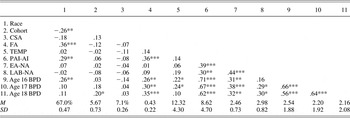
Descriptive statistics (prior to centering) and correlations for all study variables are presented in Table 1. An unconditional linear growth model was initially fit to the BPD data at ages 16 to 18 to examine the developmental growth trajectory of BPD and variability around this trajectory. To disentangle the overall level of BPD from age 16 predictors, the intercept was fixed to the age 17 assessment. The linear model fit the data well, χ2 (1, N = 113) = 1.29, p = .26, RMSEA = 0.05, CFI = 0.997, TLI = 0.991, SRMR = 0.02. The intercept (M = 2.29, SE = 0.16, z = 14.32, p < .001) and slope (b = –0.21, SE = 0.09, z = –2.48, p = .01) differed significantly from zero. The significant negative slope indicates that BPD symptoms show an overall pattern of linear decrease from ages 16 to 18 years. Significant individual variability was found for the intercept (σ2 = 2.46, SE = 0.34, z = 7.31, p < .001), but not for the slope (σ2 = 0.22, SE = 0.24, z = 0.93, p = .35). These results indicate a high degree of variability within the sample around the mean level of BPD symptoms at age 17, but less variability around the mean rate of change in BPD symptoms over time. The correlation between intercept and slope was not significant (r = 0.16, SE = 0.21, p = .46), suggesting that the estimated mean rate of change over time was unrelated to the mean level of BPD symptoms at age 17.
Descriptive statistics and intercorrelations for all study variables (N = 113)

Note: Race coded 0 = European American, 1 = African American. Cohort, Age at start of Pittsburgh Girls Study (range = 5–7); CSA, childhood sexual abuse (reported anytime from ages 12 to 16; coded 0 = no reported CSA, 1 = reported experiencing CSA); FA, family adversity index; TEMP, temperament negative emotionality (parent report at age 15); PAI-AI, affective instability subscale from the PAI-BOR (Morey et al., Reference Morey1991); EA-NA, average of negative affect ratings in response to daily negative events in the ecological assessment protocol; LAB-NA, girls’ negative affective behavior in the laboratory conflict discussion task; BPD, borderline personality disorder symptoms (self-report).
*p < .05. **p < .01. ***p < .001.
Next, we fit a confirmatory factor analysis model for the latent negative emotional reactivity factor using three indicators: self-report measure of affective instability, observer-rated negative affective during a conflict discussion task, and daily ecological assessment ratings of negative emotions in reaction to stress as manifest variables. The negative emotional reactivity factor was scaled by fixing the factor loading for the self-report indicator to 1. For this step only, in order to achieve model identification to produce fit indices, we constrained the other two factor loadings to equality. This model also fit the data well, χ2 (1, N = 113) = 1.05, p = .31, RMSEA = 0.02, CFI = 0.998, TLI = 0.993, SRMR = 0.03, and factor loadings were strong and significant (λs = 0.50, 0.62, 0.71, ps < .001, for the self-report measure, observational ratings, and daily ecological assessment ratings, respectively).
Conditional growth model to examine main and interactive effects of negative emotional reactivity and family adversity on BPD growth trajectories
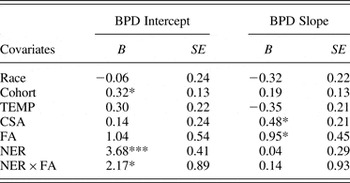
After establishing good fit for the unconditional LGCM for BPD symptoms and a well-fitting measurement model for negative emotional reactivity, we tested a conditional model with BPD growth parameters regressed on mean-centered covariates, including cohort, minority race, temperament negative emotionality, childhood sexual abuse, family adversity, negative emotional reactivity, and the Negative Emotionality Reactivity × Family Adversity interaction term. Unstandardized coefficients for the final model are presented in Table 2. There was a significant effect of cohort on the BPD intercept, indicating that older girls from the PGS who were recruited into the study earlier had higher levels of BPD symptoms at age 17 than did younger girls who were recruited later in the study. Race and temperament negative emotionality did not emerge as significant predictors but are important to retain in order to examine the unique main and interactive effects of negative emotional reactivity and family adversity. We also tested all other possible two- and three-way interactions among predictors, and none were statistically significant, indicating that cohort, race, temperament emotionality, and childhood sexual abuse did not moderate results.
Unstandardized regression coefficients from the final conditional latent growth curve model

Note: Race coded 0 = European American, 1 = African American. Cohort, Age at start of Pittsburgh Girls Study (range = 5–7); CSA, childhood sexual abuse (reported anytime from ages 12 to 16; coded 0 = no reported CSA, 1 = reported CSA); FA, family adversity index; TEMP, temperament negative emotionality (parent report at age 15); NER, negative emotional reactivity latent variable; BPD, borderline personality disorder symptoms (self-report). The BPD intercept is fixed at the age 17 assessment, and the BPD slope is the rate of change in BPD symptoms from ages 16 to 18.
*p < .05. **p < .01. ***p < .001.
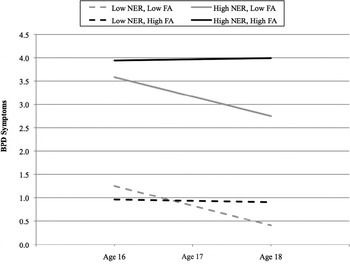
As shown in Table 2, greater levels of negative emotional reactivity predicted a higher mean level of BPD symptoms at age 17, but this effect was moderated by family adversity, as indicated by the significant Negative Emotional Reactivity × Family Adversity interaction effect on intercept. Negative emotional reactivity did not have a main effect on rate of change (slope) in BPD symptoms over time, nor was there a significant interaction between negative emotional reactivity and family adversity for slope. However, greater levels of both family adversity and childhood sexual abuse positively predicted the slope of BPD symptoms over time. To aid in the interpretation of these effects, we plotted the model-implied intercepts and simple slopes and tested their significance (i.e., whether they differed significantly from zero) at high and low levels (±1 SD) of the predictors using methods described by Preacher, Curran, and Bauer (Reference Preacher, Curran and Bauer2006). As illustrated in Figure 1, the influence of family adversity on the mean level of BPD symptoms at age 17 depended on the level of negative emotional reactivity, such that girls who were more emotionally reactive and who also had been exposed to greater family adversity had the highest BPD symptoms at age 17, followed by those who were high in negative emotional reactivity and had been exposed to less adversity. In contrast, those with low negative emotional reactivity had much lower levels of BPD symptoms at age 17, regardless of their exposure to family adversity. The main effect of family adversity on the rate of change in BPD (i.e., slope) is also visible in Figure 1, demonstrating that BPD symptoms remained relatively stable over time for those exposed to more adversity (high family adversity) and only appear to decrease from ages 16 to 18 for those with low family adversity. However, it should be noted that the slope only differed significantly from zero for those with high negative emotional reactivity and low family adversity (b = –0.43, SE = 0.14, z = –3.07, p < .001) and did not reach significance for those with low negative emotional reactivity and low family adversity (b = –0.42, SE = 0.27, z = –1.52, p = .13). This may be due to the much higher level of BPD symptoms at age 16 (thus, having more room for decrease over time) in those with higher negative emotional reactivity, and also the greater level of variability in trajectories of BPD symptoms for those with high negative emotional reactivity and low family adversity (as reflected in the higher standard error). Hence, girls with greater levels of negative emotional reactivity who were also exposed to more family adversity had the highest mean levels of BPD symptoms, and demonstrated the most maintenance of these symptoms over time.
Interaction between negative emotional reactivity (NER) and exposure to family adversity (FA) predicting borderline personality disorder (BPD) symptoms at age 17 (intercept) and main effect of FA on rate of change in BPD symptoms from ages 16 to 18. Lines represent model-estimated simple slopes at –1 SD to +1 SD from the mean of NER and FA.

We also probed the significant effect of childhood sexual abuse on the BPD slope. BPD symptoms remained relatively stable from ages 16 to 18 (i.e., did not significantly decrease over time) for girls who reported experiencing childhood sexual abuse (b = –0.08, SE = 0.10, z = –0.88, p = .38). BPD symptoms only showed a significant decrease among those who did not report experiencing childhood sexual abuse (b = –0.34, SE = 0.11, z = –3.03, p = .003). The effect of childhood sexual abuse was not moderated by negative emotional reactivity or any other covariate. However, these results should be interpreted with caution given the very low base rate of childhood sexual abuse (7%) in this small sample.
Discussion
This study adds to knowledge about the role of emotional vulnerabilities in the development of BPD by demonstrating direct and environmentally moderated effects of girls' negative emotional reactivity on BPD symptoms during late adolescence. Although postulated as a critical vulnerability factor in the etiology and development of the disorder, these prospective relationships have not been examined in previous research with adolescents. The use of LGCMs revealed a steady decline in BPD symptoms across ages 16 to 18 years mirroring findings from community samples regarding normative changes in personality across development (Beauchaine et al., Reference Beauchaine, Klein, Crowell, Derbidge and Gatzke-Kopp2009; Bornovalova et al., Reference Bornovalova, Hicks, Iacono and McGue2009; de Clercq et al., Reference de Clercq, van Leeuwen, van den Noortgate, de Bolle and de Fruyt2009; Goodman et al., Reference Goodman, Patil, Triebwasser, Diamond, Hiller and Hoffman2010; Stepp et al., Reference Stepp, Whalen, Scott, Zalewski, Loeber and Hipwell2014). In the aggregate, these findings suggest girls who fail to desist from BPD symptoms by late adolescence warrant additional assessment for risk.
We found support for our hypothesis that heightened negative emotional reactivity interferes with this maturational decline in BPD symptoms even after controlling for temperamental emotionality. Specifically, findings demonstrated that negative emotional reactivity predicted an overall higher level of BPD symptoms and that exposure to family adversity significantly moderated this effect. As we expected, the relationship between negative emotional reactivity and BPD symptoms was stronger for girls with higher levels of exposure to family adversity. Conversely, the association between our marker of emotional vulnerability and BPD symptoms was weaker in the absence of such adversities.
Contrary to our hypothesis, the interaction between negative emotional reactivity and family adversity did not predict increasing rates of BPD symptoms in late adolescence. However, girls with heightened negative emotional reactivity and greater exposure to family adversity maintained a high level of BPD symptoms over time. In addition, our findings revealed a main effect for exposure to family adversity and increasing rates of BPD symptoms. These findings suggest exposure to environmental adversity is a risk factor for increasing levels of BPD symptoms over time even among girls with low levels of negative emotional reactivity.
In sum, our findings are consistent with the large body of research documenting the adverse health outcomes associated with exposure to childhood poverty and the accumulation of risk factors tied to this type of deprivation, such as crowded and substandard housing, family turmoil and violence, and child separations from caregivers due to parental incarceration, drug use, or out-of-area employment (Evans, Reference Evans2004; Evans & Cassells, Reference Evans and Cassells2013; Johnson et al., Reference Johnson, Smailes, Cohen, Brown and Bernstein2000; van Os et al., Reference van Os, Kenis and Rutten2010). Childhood poverty likely confers vulnerability to poor health via the accumulation of these additional stressors and adversities, which have been linked to aberrant stress responses across multiple regulation systems (Evans & Cassells, Reference Evans, Li and Whipple2013; Evans & Kim, Reference Evans and Kim2007). Consistent with our conceptualization of family adversity as a cumulative index of a myriad of family adversities, previous work suggests that the sheer number of risk factors to which a child is exposed predicts mental health outcomes more so than exposure to a specific type or specific clustering of risk factors (Evans et al., Reference Evans, Li and Whipple2013). Future work is needed to determine the impact of cumulative family adversity on other stress regulation systems and how these relationships confer risk for BPD.
Although we interpret the results with caution due to the small number who reported childhood sexual abuse, exposure to such abuse also predicted increases in BPD symptoms during late adolescence. These findings are consistent with existing studies linking childhood sexual abuse and BPD (Bandelow et al., Reference Bandelow, Krause, Wedekind, Broocks, Hajak and Rüther2005; Battle et al., Reference Battle, Shea, Johnson, Yen, Zlotnick and Zanarini2004; Johnson et al., Reference Johnson, Smailes, Cohen, Brown and Bernstein2000; Zanarini et al., Reference Zanarini, Williams, Lewis, Reich, Vera and Marino1997). It is important to also consider that childhood sexual abuse in the current study included any instance of sexual abuse that occurred across childhood and adolescence. While little work has examined whether exposure to childhood sexual abuse during specific developmental windows heightens risk for BPD, both the preschool and adolescent years may represent such windows of vulnerability. Pietrek et al. (Reference Pietrek, Elbert, Weierstall, Müller and Rockstroh2013) retrospectively examined several types of childhood adversities across ages 3–16 years in a sample of adult inpatients. They found that sexual abuse reported during the preschool (ages 3–5) and adolescent (ages 14–16) years explained a significant amount of variance in BPD diagnosis during adulthood but not in diagnoses of major depressive disorder or schizophrenia. Due to low base rates in the current study, further refinement of sexual abuse, such as by the developmental timing of the abuse (i.e., childhood vs. adolescence), was not feasible. Future work is clearly needed to further explicate the nature of the relationship between the timing of exposure to abuse and BPD risk.
There are several strengths to our current study. One distinctive aspect lies in our measurement of negative emotional reactivity. We evaluated negative emotional reactivity as a latent trait by incorporating information across multiple methods that varied by informant, time scale, and ecological validity. This analytic strategy enhanced the precision of our emotional vulnerability signal by reducing measurement error. Each referent represented distinct elements of the unitary trait. Adolescent girls' negative affect during a conflict discussion with their mothers is germane to the developmental period, and interpersonal stressors are particularly relevant for BPD pathology. The daily ecological assessment method is consistent with well-established protocols designed to examine negative emotional reactivity to daily stressors in risk for psychopathology, especially schizophrenia and depression (Gottesman & Gould, Reference Gottesman and Gould2003; Lataster et al., Reference Lataster, Wichers, Jacobs, Mengelers, Derom and Thiery2009; Myin-Germeys & van Os, Reference Myin-Germeys and van Os2007; Wichers et al., Reference Wichers, Myin-Germeys, Jacobs, Peeters, Kenis and Derom2007). It is widely accepted that the use of multiple reporters improves validity (Achenbach, Reference Achenbach2006; Holmbeck, Li, Schurman, Friedman, & Coakley, Reference Holmbeck, Li, Schurman, Friedman and Coakley2002). However, the inclusion of multiple modalities is rarely practiced, and we are not aware of any previous studies that have combined multiple indices of emotional reactivity in this way. We hope future investigations will undertake such efforts to integrate information from multiple sources in hopes of improving validity when measuring markers of vulnerability to psychopathology.
Additional strengths of this study included the use of a longitudinal design and a racially and economically diverse community sample oversampled for BPD risk. The prospective design allowed us to examine the associations among negative emotional reactivity, family adversity, and the developmental trajectories of BPD symptoms without retrospective bias, which has been a major limitation of previous studies relying on adult reports of childhood experiences (Bandelow et al., Reference Bandelow, Krause, Wedekind, Broocks, Hajak and Rüther2005; Battle et al., Reference Battle, Shea, Johnson, Yen, Zlotnick and Zanarini2004; Johnson et al., Reference Johnson, Smailes, Cohen, Brown and Bernstein2000; Zanarini et al., Reference Zanarini, Williams, Lewis, Reich, Vera and Marino1997). The use of community participants rather than clinical patients ensures that the prospective associations observed are more representative of the development of BPD that unfolds in the general population and are less likely to be biased by the effects of treatment or characteristics that are specific to those that seek treatment.
This study is not without limitations. Our indices of negative emotional reactivity were not measured prior to age 16, so it is not possible to determine the reciprocal influence of childhood adversity and negative emotional reactivity. While we cannot rule out that negative emotional reactivity would predispose girls to more adversity, the prospective nature of our assessments and the nature of our family adversity variable (e.g., poverty and parent incarceration) lessen concerns that girls' negative emotional reactivity would be driving exposure to such adversities. As girls enter young adulthood and exert more control over their environment, it will be important to examine reciprocal associations between negative emotional reactivity and exposure to adversity. Another limitation concerns the limited generalizability of our findings. The sample did not include boys, and so the findings may not generalize to male-only or mixed-gender samples. In addition, BPD was not measured repeatedly with a semistructured interview but relied on interview-guided self-reports. However, this measure has been widely used in adolescent community and psychiatric patient samples, and its relationship to diagnosis is well established (Chanen et al., Reference Chanen, Jovev, Djaja, McDougall, Yuen and Rawlings2008; Loranger et al., Reference Loranger, Sartorius, Andreoli, Berger, Buchheim and Channabasavanna1994). Finally, the strong bivariate correlations between the self-report measure of negative emotional reactivity and borderline symptoms reflect shared method variance at least to some extent. However, because we used the self-report measure as a referent of a latent negative emotional reactivity variable, we reduced the overlap between negative emotional reactivity and BPD symptoms due to shared method variance.
Our findings have several implications for etiological models of BPD. Consistent with several developmental theories of BPD, negative emotional reactivity during adolescence is a vulnerability factor, heightening risk for symptoms of the disorder. Furthermore, we found further support for the notion that this emotional vulnerability is environmentally moderated by exposure to the cumulative effects of family adversity. While most theoretical models stress the role of parental responses to the child or childhood trauma as potential stressors preceding the onset of the disorder, we have extended this framework by demonstrating that the environmental risk is also apparent at the level of family adversity. This finding is consistent with previous work demonstrating the link between family level adversities, especially those associated with the experience of poverty, and other forms of severe mental illness (Evans, Reference Evans2004; van Os et al., Reference van Os, Kenis and Rutten2010).
Although more research is needed to directly inform prevention and intervention efforts, the findings from the current study offer several things to consider. Developing screening instruments for the detection of negative emotional reactivity among youth exposed to chronic poverty and family stress may be beneficial for identifying youth in most need of services. Findings also suggest potential avenues for prevention strategies. Vulnerable youth with high levels of negative emotional reactivity might benefit from stress inoculation training to enhance emotion regulation in the face of environmental stressors. In addition, eliminating stressors occurring in the family system may be integral to prevention and intervention efforts, especially for emotionally vulnerable youth.