Introduction
In many developed countries including Japan, the ratio of aged persons in the total population grows larger, and dementing diseases are more frequent in the total population (Kashiwagi et al., Reference Kashiwagi, Tamiya, Sato and Yano2013). However, we cannot cure most degenerative dementing diseases, and the burden of caring for patients with dementia becomes a major social problem.
QOL has been recently recognized as the central purpose of health care and it should be monitored if it is to be optimized (Riazi et al., Reference Riazi, Bradley, Barendse and Ishii2006). Medication and dementia care should not be used at the expense of psychological well-being or QOL. However, a positive correlation of psychological well-being or QOL with medication and dementia care cannot be assumed (Riazi et al., Reference Riazi, Bradley, Barendse and Ishii2006). Therefore, QOL has become an important outcome measure in the care of dementia patients and dementia research (Terada et al., Reference Terada2002; Beerens et al., Reference Beerens, Zwakhalen, Verbeek, Ruwaard and Hamers2013). Nonetheless, there have been few studies focusing on the difference in QOL between different dementing diseases, and the difference in QOL between different dementia subtypes was thought to be one of the areas needing particular attention in a recent systematic review (Banerjee et al., Reference Banerjee2009).
A comprehensive evaluation of QOL should consist of both subjective (self-administered) and objective (proxy assessment) domains. Subjective assessment of QOL of patients with dementia may be reliable in the earlier stages of some types of dementia (Brod et al., Reference Brod, Stewart, Sands and Walton1999). However, for example, severe loss of insight is one of core clinical features of patients with FTD, even in the early stage (Neary et al., Reference Neary1998), and FTD patients were reported to show significantly inaccurate self-awareness of the current characteristics of almost every aspect of personality (Rankin et al., Reference Rankin, Baldwin, Pace-Savitsky, Kramer and Miller2005). FTD patients described themselves much more positively than caregivers, and significantly underestimated the persistence of their current personality style (Rankin et al., Reference Rankin, Baldwin, Pace-Savitsky, Kramer and Miller2005). Therefore, it is difficult to gain reliable subjective QOL rating among FTD patients, and we adopt an objective QOL rating in this study.
Psychological well-being is thought to be the core dimension for QOL of patients with dementia (Jonker et al., Reference Jonker, Gerritsen, Bosboom and Van Der Steen2004). Psychological well-being consists of both the presence of positive affect and the absence of negative affect, but the absence of depressive symptoms is not necessarily the presence of psychological well-being (Nierenberg et al., Reference Nierenberg, Bentley, Farabaugh, Fava and Deckersbach2012). In this study, we compared the QOL of different dementias, especially focusing on positive and negative affect, using an objective QOL scale for dementia (Terada et al., Reference Terada2002).
Methods
Patients
Two-hundred seventy-nine consecutive patients with AD, DLB, or FTD were recruited from the outpatient units of the Memory Clinic of Okayama University Hospital between September 2008 and April 2012. All patients with AD met the criteria for probable AD formulated by the NINCDS-ADRDA (McKhann et al., Reference McKhann, Drachman, Folstein, Katzman, Price and Stadlan1984), and all patients with DLB met the criteria for probable DLB formulated by McKeith et al. (Reference McKeith2005). All patients with FTD were diagnosed according to the international consensus criteria for FTD (Neary et al., Reference Neary1998).
They all (i) underwent general physical and neurological examinations and extensive laboratory testing, including thyroid function tests, serum vitamin B12, and syphilis serology; (ii) took the Mini-Mental State Examination (MMSE) (Folstein et al., Reference Folstein, Folstein and McHugh1975); (iii) had a dementia severity of 0.5 or 1 on the clinical dementia rating (CDR) (Hughes et al., Reference Hughes, Berg, Danziger, Coben and Martin1982); and (iv) had family caregivers who could give necessary information. The exclusion criteria were (i) complications from other neurological diseases or illnesses; (ii) history of mental illness or substance abuse prior to the onset of dementia; (iii) evidence of focal brain lesions on head MRI; (iv) treatment with cholinesterase inhibitors or memantine; (v) treatment with antipsychotics, antidepressants, anticonvulsants, or anxiolytic drugs; and (vi) MMSE scores under 12.
Inclusion criteria for caregivers were (i) being the family caregivers of an outpatient with dementia, (ii) living with the patient or visiting him or her three times a week or more, and (iii) being cognitively intact. Exclusion criteria were (i) being unable to come to hospital with the patients, (ii) having a history of mental illness or substance abuse, and (iii) being treated with antipsychotics, antidepressants, or anxiolytic drugs.
The profile of each patient (age, sex, and years of education) was obtained from family caregivers. Scores of the QOL-D, the Neuropsychiatric Inventory (NPI), and the Instrumental Activities of Daily Living (IADL) were evaluated by a trained clinical psychologist based on the information from family caregivers.
Ethics
This study was approved by the Internal Ethical Committee of Okayama University Graduate School of Medicine, Dentistry and Pharmaceutical Sciences. After a complete description of the study to the patients and their relatives, written informed consent was obtained.
The instruments
The QOL-D comprises 31 items encompassing six domains: positive affect, negative affect & actions, communication, restlessness, attachment to others, and spontaneity (Terada et al., Reference Terada2002). Each item is ranked on a 4-point scale (from 1 to 4). In the four domains of the QOL-D, viz. positive affect, ability to communicate, spontaneity & activity, and attachment to others, a high score means a higher QOL, whereas in the two domains of the QOL-D, viz. negative affect & actions and restlessness, a high score means a lower QOL. Domain scores are the mean values of item scores.
The MMSE is a cognition screening test used widely in many parts of the world. The MMSE has a maximum score of 30 points. It assesses aspects of orientation, recall, language, and visual construction (Folstein et al., Reference Folstein, Folstein and McHugh1975). The MMSE was evaluated by a trained clinical psychologist.
The NPI is a valid and reliable instrument for measuring non-cognitive symptoms in dementia (Hirono et al., Reference Hirono1997). The original NPI comprises 12 domains, but the Japanese version of NPI (Hirono et al., Reference Hirono1997) consists of ten domains because it excludes appetite and eating abnormalities. It is a caregiver-based tool that assesses ten different domains in dementia. The NPI gives a composite score for each domain, which is the product of frequency by severity subscores: scores from 1 to 4 (with 4 being the most severe) for the frequency and from 1 to 3 (with 3 being the most severe) for the severity of each behavior. The maximum attainable subscore of each NPI item is 12.
The Physical Self-Maintenance Scale (PSMS) and the IADL are validated scales for the assessment of activities of daily living (ADL) (Lawton and Brody, Reference Lawton and Brody1969; Hokoishi et al., Reference Hokoishi2001). The PSMS is a 6-item scale that rates self-care ability in toileting, feeding, dressing, personal hygiene & grooming, locomotion (physical ambulation), and bathing. PSMS has a maximum score of 6. The IADL scale assesses patients’ ability to perform eight complex daily tasks: ability to use the telephone, shop, prepare food, perform household tasks, do laundry, use public transportation, take responsibility for medications, and manage finances. Three tasks (food preparation, household tasks, and laundry) are scored only for females, and the original IADL has a maximum score of eight for women and five for men. In this study, the IADL score for men was calculated by multiplying the original IADL score × 1.6. Therefore, in this study, the IADL has a maximum score of eight for both men and women.
Statistical analysis
Statistical analysis was performed using the SPSS 19.0J software program (SPSS Inc., Chicago, IL, USA). One-way analysis of variance (ANOVA) with Tukey's HSD test was used to test for differences among the three diagnostic groups in means of age, years of education, and scores of MMSE, IADL, ten domains of NPI, and six domains of QOL-D. The sex differences between the three groups were examined by χ2 test.
All dementia-specific instruments consider affect to be an essential domain of QOL (Ettema et al., 2005). Therefore, in this study, to identify which variables were significantly correlated with positive affect or negative affect & actions, we used multiple linear regression with each score as a dependent variable. Independent variables were gender, age, years of education, MMSE scores, IADL scores, scores of 10 NPI domains, and diagnoses as three dummy variables (AD = 1, others = 0; DLB = 1, others = 0; FTD = 1, others = 0). Subsequently, forward stepwise linear regression models (entrance criterion p = 0.05, exit p = 0.10) determined if disparate predictors accounted for a unique additive variance in the scores of positive affect or negative affect & actions. The significance for the hypothesis testing analyses was set at p < 0.05.
Due to the lower incidence of FTD and DLB, we consider that the allocation ratio AD/FTD or AD/DLB is about ten. To compare the mean of three groups, we adopt independent t-test with Bonferroni correction at p = 0.017. To detect the large effect size (d = 0.8) with type 1 error rate of 0.017 and the power high as 0.9, we need group 1 sample size 20 and group 2 sample size 202.
Results
Patients
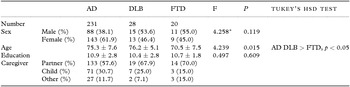
A profile of patients (age, sex, and years of education) is shown in Table 1. There were no significant differences in the sex and years of education among patients with AD, DLB, and FTD. The mean age of the FTD patients was significantly younger than those of the patients with AD or DLB.
Demographic data of patients

AD, Alzheimer's disease; DLB, dementia with Lewy bodies; FTD, frontotemporal dementia.
HSD, honestly significant difference; *chi-square.
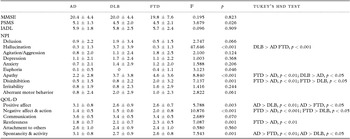
There were no significant differences in the MMSE and IADL scores between AD, DLB, and FTD groups (Table 2). The PSMS scores of patient with DLB or FTD patients were lower than those of AD patients. However, Tukey's HSD test revealed no significant differences. The hallucination score on the NPI of DLB patients was significantly higher than those of AD or FTD patients. The apathy score of the NPI of AD patients was significantly lower than those of patients with DLB or FTD. The disinhibition score of FTD patients was significantly higher than those of patients with AD or DLB.
Characteristics of patients

AD, Alzheimer's disease; DLB, dementia with Lewy bodies; FTD, frontotemporal dementia; HDS, honestly significant difference.
MMSE, mini mental state examination; PSMS, physical self-maintenance scale.
IADL, Instrumental Activities of Daily Living; NPI, Neuropsychiatric Inventory.
QOL-D, Quality of Life Questionnaire for Dementia.
Positive and negative affect
The QOL-D scores are shown in Table 2. The scores of positive affect and spontaneity & activity of AD patients were significantly higher than those of patients with DLB or FTD. The scores of negative affect & action of FTD patients were significantly higher than those of patients with AD or DLB. The restlessness score of FTD patients were higher than those of AD patients. There were no significant differences in the communication and attachment to others scores between the three dementia groups.
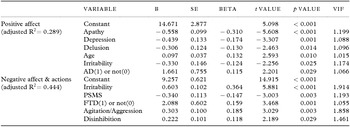
The multiple linear regression analysis showed a significant association of various variables to the scores of positive affect or negative affect & actions as follows (Table 3). Apathy, depression, delusion, and irritability were inversely related to positive affect. Age was positively related to positive affect. AD diagnosis was related to higher scores of positive affect. Irritability, agitation/aggression, and disinhibition were positively related to negative affect & actions. PSMS scores were inversely related to negative affect & actions. FTD diagnosis was related to higher scores of negative affect & actions.
Stepwise multiple regression analysis for scores of “positive affect” and “negative affect & actions” (n = 279)

QOL-D, Quality of Life Questionnaire for Dementia; VIF, variance inflation factor; AD, Alzheimer's disease.
FTD, frontotemporal dementia; PSMS, physical self-maintenance scale; IADL, instrumental activities of daily living.
Discussion
There have been only a few studies focusing on the difference of QOL among different degenerative dementias (Boström et al., Reference Boström, Jönsson, Minthon and Londos2007; Figari-Jordan et al., Reference Figari-Jordan2012). Boström et al. (Reference Boström, Jönsson, Minthon and Londos2007) reported that DLB patients have significantly lower QOL than AD patients regardless of whether patient- or caregiver-reported QOL was used in both the EuroQol 5 Dimension and the Quality of Life-Alzheimer disease. Figari-Jordan et al. (Reference Figari-Jordan2012) showed that DLB had significantly worse QOL than those with AD using the Short Form 12. We also found that DLB patients had lower objective QOL scores than AD patients, especially in the areas of positive affect and spontaneity & activity. Our results in this study were in line with those previous reports.
This is to our knowledge the first study to compare the QOL of FTD patients with patients with other dementia diseases. FTD patients had lower objective QOL scores than AD patients, especially in the areas of positive affect, negative affect & action, restlessness, and spontaneity & activity.
There have been few reports comparing positive affect in different dementia diseases. In this study, the scores of positive affect among AD patients were higher than those among DLB and FTD patients. Positive affect was inversely related to apathy, depression, delusion, and irritability scores of NPI. Apathy and disinhibition are core features of FTD (Neary et al., Reference Neary1998), and it is not strange that FTD patients showed much higher scores of apathy and disinhibition and lower scores of positive affect than AD patients.
DLB patients are reported to show more depression than AD patients (Klatka et al., Reference Klatka, Louis and Schiffer1996; Yamane et al., Reference Yamane, Sakai and Maeda2011). Depressive mood and apathy are two core features of depression. Therefore, it is natural that DLB patients showed higher scores of depression and apathy on NPI and lower scores of positive affect than AD patients. Moreover, AD itself was significantly related to higher positive affect in this study. We think that some factors not evaluated in this study might affect the difference between positive affect of AD and other dementias.
In the categories of spontaneity & activity, AD patients showed higher scores than those with DLB or FTD in this study. Several studies pointed out that positive affect was related to activity. Greater engagement in activity was associated with a higher positive affect in nursing home residents with dementia (Kolanowski et al., Reference Kolanowski, Van Haitsma, Meeks and Litaker2014). Long-term care residents appeared happier and less anxious during structured activity (Casey et al., Reference Casey, Low, Goodenough, Fletcher and Brodaty2014). Nursing home residents with dementia expressed happiness over seven times more often during recreation time than during ordinary times (Schreiner et al., Reference Schreiner, Yamamoto and Shiotani2005). Therefore, we also suppose that positive affect and activity are closely related to each other.
In this study, the scores of negative affect & actions of FTD patients were higher than those of AD and DLB patients. The scores of negative affect & actions were related to the irritability, agitation/aggression, and disinhibition scores of NPI. Disinhibition is one of the core features of FTD, and FTD patients in this study showed higher disinhibition scores than AD and DLB patients. Therefore, it is not strange that FTD patients showed higher scores of negative affect & actions on QOL-D than AD and DLB patients.
Further, multiple linear regression analysis with negative affect & actions as a dependent variable showed no significant relation of age to the scores of negative affect & actions. Therefore, we think that the difference of mean age between three dementia diseases did not affect the difference in negative affect & actions. Moreover, FTD itself was significantly related to higher scores of negative affect & actions. Some factors not evaluated in this study might cause the difference in negative affect & actions between FTD and other dementias.
We feel the differences in QOL scores are clinically relevant. For example, treating clinicians could target interventions differentially to offer strategies for overcoming negative affect or retaining positive affect in patients with different dementia diseases. Apathy is a biologically based symptom of dementia, but it is suggested that planned activity may ameliorate it (Politis et al., 2004).
There were several limitations in this study. First, there were only 20 FTD and 28 DLB patients. Therefore, small significant differences between different dementias might have been missed in this study. Second, this study used a cross-sectional model, and cannot clarify the cause–effect relationship. Third, there was no subjective data in this study. Irrespective of the reliability of subjective information, such data might cast a new light on the QOL of dementia patients. In spite of these shortcomings, this is the first study comparing positive affect among different degenerative dementias. We showed that the three major neurodegenerative dementing diseases showed different patterns of positive and negative affect. AD showed high positive and low negative affect, while DLB low positive and low negative affect and FTD low positive and high negative affect.
Conflict of interest
None.
Description of authors’ roles
Kairi Kurisu was involved in design of the study and data analysis. He wrote the paper with Seishi Terada. Seishi Terada designed the study and analyzed the data with Kairi Kurisu. Etsuko Oshima, Makiko Horiuchi, Nao Imai, Mayumi Yabe, Osamu Yokota, and Takeshi Ishihara collected data, and assisted with writing the paper. Norihito Yamada supervised the study design, participated in data analysis, and assisted with writing the paper.
Acknowledgments
We sincerely thank Ms Yifei Tang for her skillful assistance. This work was supported by grants from the Japanese Ministry of Education, Culture, Sports, Science and Technology (15K09831) and the Zikei Institute of Psychiatry.