Introduction
Members of Megarthrus Curtis (Coleoptera: Staphylinidae: Proteininae) are saprophagous and (or) microphagous rove beetles with body lengths ranging from 0.8 to 2.3 mm (from middle of anterior pronotal margin to apex of elytral suture). They favour cool and temperate climates and are usually found in forest leaf litter, dung, carrion, and fungi. Of particular note is their ability to build up water droplets on their dorsum when filter feeding on microorganisms in decaying organic matter (Cuccodoro Reference Cuccodoro1995). Within the Proteininae, they are characterized primarily by the basally narrowed eleventh antennomere (Cuccodoro Reference Cuccodoro1998). Most species also have a medially grooved, laterally expanded pronotum with basally notched irregular lateral margins. Males often show striking sexual dimorphism, usually involving features on the legs but occasionally also on the head, elytra, metaventrite, or abdomen.
Since the genus was erected by Curtis (Reference Curtis1829), nearly 140 species of Megarthrus have been described worldwide, although none have been reported for Madagascar, southern South America, Australia, or New Zealand. In the East Palaearctic region, 7 Megarthrus species have been recorded from China, 16 species from Japan, and 9 species from Far East Russia (Cuccodoro Reference Cuccodoro1996, Reference Cuccodoro, Cuccodoro and Leschen2003; Cuccodoro and Löbl Reference Cuccodoro and Löbl1997). In Korea, only 2 Megarthrus species have been reported previously: M. hemipterus (Illiger) (as “M. heterops Sawada” in Kim et al. Reference Kim, Kwon, Paik, Lee, Ahn, Park and Chu1994) and M. aino Cuccodoro (Cho and Kim Reference Cho and Kim2003).
Here, we describe Megarthrus coreanus Kim and Cuccodoro sp. nov. and report seven additional species collected for the first time in Korea (M. corticalis Sharp, M. fennicus Lahtinen, M. incubifer Cuccodoro, M. japonicus Sharp, M. montanus Sawada, M. sawadai Cuccodoro, and M. zerchei Cuccodoro and Löbl). We present habitus illustrations, diagnoses, and a key to all of the Megarthrus species of Korea.
Materials and methods
Specimens used in this study have been deposited in the Chungnam National University Insect Collection, Daejeon (CNUIC), the Hannam University Natural History Museum, Daejeon (HUNHM), the Hungarian Natural History Museum, Budapest (HNHM), and the Museum of Natural History, Geneva (MHNG). Unless otherwise specified, specimens mentioned in the text are deposited in CNUIC. The terminology of taxonomic characters and measurements of specimens mainly follow Cuccodoro and Löbl (Reference Cuccodoro and Löbl1997).
Taxonomy
Megarthrus Curtis
Megarthrus Curtis Reference Curtis1829: 28.
Type species: Staphylinus depressus Paykull, by subsequent designation (Westwood Reference Westwood1838).
Phloeobium Dejean Reference Dejean1833: 69.
Psyllius Gistel Reference Gistel1834: 9.
Diagnosis
Body length ranging from 0.8 to 2.3 mm (from middle of anterior pronotal margin to apex of elytral suture), fairly oval and moderately convex. Head without ocelli. Eyes 0.25 to 0.50 times as long as head, moderately convex to hemispherical, each separated from antennal insertions by broad genal gutter. Antennal scape and pedicel thick; antennomere 3 much narrower than pedicel; following antennomeres gradually broadening, not forming a distinct club; antennomere 11 narrowed at the base, ovoid or piriform. Pronotum with disc uneven, dull, variously sculptured, usually grooved medially; lateral edges not carinate and generally irregular in outline. Aedeagus with parameres obsolete and affixed to median lobe. Female ovipositor with gonocoxites fused into complex plate with large emarginations for styli.
- Frons evenly deflexed toward clypeus; maxillary palpi with third palpomere swollen, slightly longer than half of fourth palpomere
2
- Frons forming ridge above clypeus; maxillary palpi with third palpomere fairly cylindrical, not longer than half of fourth palpomere
3
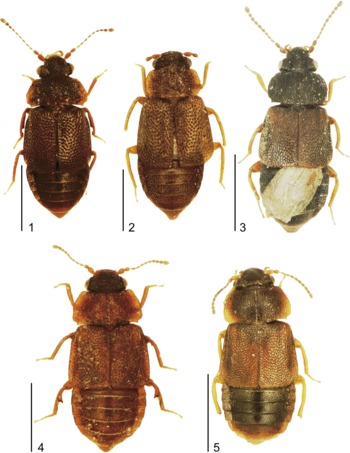
- Pronotum markedly wider than the basal width of the elytra combined; male mesotibia deeply notched subapically (Fig. 1)
M. montanus Sawada
- Pronotum about as wide as the basal width of the elytra combined; male mesotibia entire (Fig. 2)
M. coreanus Kim and Cuccodoro
- Anterior portion of pronotal hypomeron without oblique ridge; male with first protarsomere bearing tenent setae
4
- Anterior portion of pronotal hypomeron with marked oblique ridge; male with first protarsomere lacking tenent setae
6
- Pronotum blackish, about as wide as basal width of elytra combined (Fig. 3)
M. fennicus Lahtinen
- Pronotum reddish brown to dark brown, markedly wider than basal width of elytra combined
5
- Head markedly darker than pronotum; lateral outline of elytra subangulate; anteriolateral angles of pronotum projecting anteriorly; male metatibia with conspicuous adventral process (Fig. 4)
M. hemipterus (Illiger)
- Head concolored with pronotum; lateral outline of elytra straight; anteriolateral angles of pronotum not projecting anteriorly; male metatibia without adventral process (Fig. 5)
M. japonicus Sharp
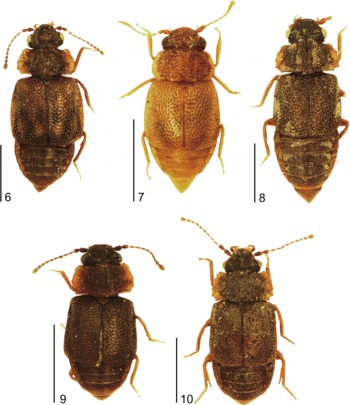
- Elytra bicolored (Fig. 6)
M. corticalis Sharp
- Elytra unicolored
7
- Body yellowish; lateral margins of pronotum arcuate (Fig. 7)
M. aino Cuccodoro
- Body dark brown; lateral margins of pronotum angulate
8
- Scutellum rounded posteriorly; male mesotibia straight (Fig. 8)
M. incubifer Cuccodoro
- Scutellum pointed posteriorly; male mesotibia bent
9
- Lateral outline of pronotum forming three marked angles; male metatibia straight (Fig. 9)
M. sawadai Cuccodoro
- Lateral outline of pronotum forming four marked angles; male metatibia with conspicuous adventral process (Fig. 10)
M. zerchei Cuccodoro and Löbl
Key to Korean species of Megarthrus
Megarthrus aino Cuccodoro
Megarthrus aino Cuccodoro Reference Cuccodoro1996: 478.
Diagnosis
Habitus as in Figure 7. Body uniformly yellowish, about 1.1 mm long (from middle of anterior pronotal margin to apex of elytral suture). Frons ridged above clypeus, with medial pubescence oriented backward. Antennae bearing short and dense pubescence on articles 8 to 11. Pronotum with lateral outline fairly arcuate, without marked angles; anterior portion of hypomeron with marked oblique ridge. Male with aedeagus symmetrical; lacking secondary sexually dimorphic features.
Material examined
KOREA: Chungnam Prov., Buyo-gun, Mt. Mansusan, 20.vii.1999, H.-J. Kim, ex sifting (1 male and 1 female); Daejeon city, Yuseong-gu, Chungnam-Univ., 16–28.vii.2003, J.-H. Choi, D.-H. Lee, S.-M. Choi, ex FIT (1 female); Mt. Gyejoksan, 14.ix.1985, Y.-B. Cho (HUNHM, 1 male); Gangwon Prov., Gosungun, Jinburyeng, 13.ix.1998, K.-J. Ahn, K.-L. You, H.-J. Lim, ex leaf litter (1 female); Chungil-myeon, Mt. Balgyosan, 4–5.vii.1998, K.-L. You, H.-J. Lim, ex FIT (2 males and 1 female); same data, but 9–10.ix.1998, K.-J. Ahn, K.-L. You, H.-J. Lim, ex sifting (1 male); Jinbu-myeon, Mt. Odaesan, 16.viii–15.ix.2001, S.-J. Park, C.-W. Shin, ex FIT (1 female); Pyongchang-gun, Pyeongchang-eup, Mt. Sambangsan, 13–15.vii.2001, K.-J. Ahn, S.-J. Park, C.-W. Shin, ex FIT in Pinus forest (1 female); Youngwol-gun, Suju-myeon, Mt. Baekdeoksan, Gwaneumsa, 13.vii–15.viii.2001, K.-J. Ahn, S.-J. Park, C.-W. Shin, ex FIT (1 female); Gyengbuk Prov., Bonghwa-gun, Mt. Sundalsan, 23–25.vi.1998, K.-L. You, H.-J. Lim, ex FIT (2 males and 1 female); Gyeonggi Prov., Gapyeong-gun, Buk-myeon, Mt. Myeongjisan, 25–30.vii.2001, K.-J. Ahn, S.-J. Park, C.-W. Shin, ex FIT (2 males and 8 females in CUNIC and MHNG).
Distribution and natural history
Megarthrus aino occurs in Japan (Honshu) and South Korea. This species seems to favour elevations below 1000 m, where it was found in forests (Pinus L. (Pinaceae)) and plantations (Cryptomeria japonica (L. f.) D. Don (Cupressaceae)) by sifting litter or using flight interception traps.
Comments
Megarthrus aino is the only member of the genus without male secondary sexually dimorphic features on the legs. It strongly resembles the Nepalese species M. minor Coiffait, which has a distinct aedeagus and the apical half of the metatibiae shallowly depressed in the male (Cuccodoro Reference Cuccodoro, Cuccodoro and Leschen2003).
Megarthrus coreanus Kim and Cuccodoro, sp. nov.
Diagnosis
Habitus as in Figure 2. Body reddish brown with darkened head, about 1.7 mm long (from middle of anterior pronotal margin to apex of elytral suture). Frons evenly deflected toward clypeus, with medial pubescence directed backward. Antennae bearing short and dense pubescence on articles 5 to 11. Pronotum with lateral outline fairly arcuate, without marked angles; anterior portion of hypomeron with marked oblique ridge. Male with aedeagus strongly asymmetrical; peg-like setae present on protibia, mesotrochanter, mesotibia, metatrochanter, and metafemur; mesotibia entire; protarsomere 1 lacking tenent setae.
Description
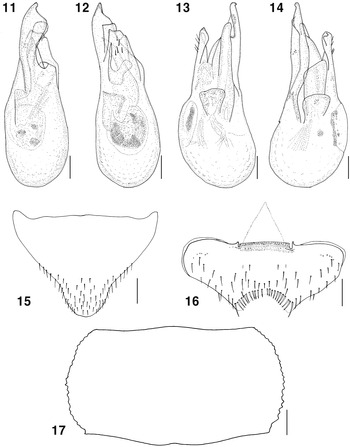
Habitus as in Figure 2. Length 1.6–1.7 mm (from middle of anterior pronotal margin to apex of elytral suture); width 0.9 mm. Body reddish brown, with darkened head and paler appendages; antennomeres 1–7 paler than antennomeres 8–11. Dorsal pubescence fairly uniform, sparser on elytral disc; setae on medial area of frons directed backward; elytral and pronotal pubescence slightly arcuate, recumbent; metaventral pubescence becoming denser posteromedially, as long as prosternal; pubescence on abdominal tergites uniform, converging on tergites IV–VI; that on sternites parallel, uniform, except for a pair of macrosetae on each sternite. Frons and abdominal tergites very finely and sparsely granulate, with granulations not higher than half of their diameter and separated by twice their diameter or more; vertex coarsely granulofossulate; pronotum moderately granulofossulate; elytra and metaventrite coarsely punctate, relief on metaventrite becoming denser and finer posteromedially. Frons raised above level of vertex, evenly deflected toward clypeus; anterior frontal margin in dorsal view weakly arcuate in middle, and laterally oblique or sinuate; mesal portion of disc strongly vaulted in lateral view; frontal impression with middle portion shallow and lateral portions deep. Eye almost hemispherical, with highest point slightly below or reaching level of vertex; supraocular margin sinuate in dorsal view. Temple and occipital ridge similar to that in Cuccodoro (Reference Cuccodoro1996: Fig. 1n); occipital ridge straight in middle, sinuate laterally. Antenna similar to that in Cuccodoro (Reference Cuccodoro1996: Fig. 20c), without patches of sensilla; scape not compressed; antennomere 3 slightly asymmetrical, 4 symmetrical; short and dense pubescence present on 5–11. Maxillary palpus with palpomere 4 about 1.6–1.8 times as long as palpomere 3. Pronotum (Fig. 17) moderately convex in frontal view; mesal portion fairly straight in lateral view; disc slightly depressed along basal portion of medial groove and moderately depressed near middle portion of lateral edge, latter slightly raised; medial groove shallow, parallel-sided; anterior portion of hypomeron bearing marked, oblique ridge, central area without pit. Scutellum with anterior margin angulate in middle and posterior margin slightly subangulate to sharp-angled apex. Elytron fairly rectangular; base gradually inclined, overhanging; humeral callus obsolete; elytral disc with low swellings; lateral edge finely carinate, denticulate, weakly arcuate in dorsal view; sutural margin in lateral view with anterior portion straight and posterior portion slightly arcuate; apical margin straight near suture; inner apical angle obtuse. Prosternal medial ridge present anteriorly, fine; anterior prosternal margin not bordered by longitudinal ridges. Protrochanter without transverse ridge. Metaventrite with postmesocoxal ridge arcuate in the middle; anteromedial and posteromedial ridges absent. Abdominal tergites IV–VI with basal portion flat, then slightly vaulted transversally; sternites II and III with medial processes similar to those in Cuccodoro (Reference Cuccodoro1996, Fig. 20h), posterior portion of process of sternite III straight.
Male
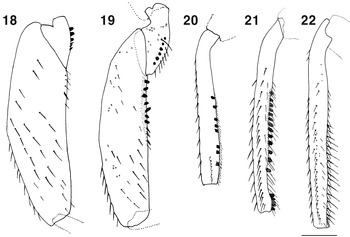
Frontoclypeal area, metaventrite, protarsomere 5, and abdominal sternites IV–VI unmodified. Protarsomere 1 lacking tenent setae. Mesofemur (Fig. 18) slightly longer than metafemur (Fig. 19). Mesotibia (Fig. 21) slightly shorter than metatibia (Fig. 22). Metatarsomere 1 about as long as combined length of metatarsomeres 2–4. Peg-like setae absent from protrochanter, mesofemur, and metatibia; arranged in a single row on protibia (Fig. 20), mesotrochanter (Fig. 18), mesotibia, metatrochanter (Fig. 19), and metafemur. Abdominal tergite VIII as in Figure 15. Sternite VIII as in Figure 16. Sternite IX similar to Figure 19g in Cuccodoro (Reference Cuccodoro1996), with marked sub-basal annular process. Aedeagus (Figs. 11–14) 0.83 mm long, strongly asymmetrical, with parameres hyaline and obsolete attached to median lobe.
Female
Unknown.
Type material
Holotype (male, in CNUIC): “KOREA: Gangwon Prov., Wonju-city, Chiaksan, Guryong Area, 9.vii.1999, H.-J. Kim, ex near stream”. Paratypes (2): KOREA: Gangwon Prov., Wonju-city, Chiaksan, Guryong Area, 9.vii.1999, U.-S. Hwang, H.-J. Kim, ex FIT, 1 male (on slide) in MHNG; Gyeongbuk Prov., Chungsong-gun, Mt. Juwhangsan, 28–29.vi.1987, Y.B. Cho, 1 male in HUNHM.
Distribution and natural history
This new taxon is the only Megarthrus species apparently endemic to Korea. It has been collected in the South Korean provinces of Gangwon and Gyeongbuk.
Comments
Other than M. coreanus, the only Megarthrus species to have the frons evenly deflexed toward the clypeus are the East Palaearctic species M. montanus and the two Nearctic species M. arcuatus Hatch and M. smetanai Cuccodoro and Löbl. This character is found elsewhere in Proteinini only in Proteinus Latreille. These Megarthrus species, which also uniquely share a rather long and unusually swollen maxillary palpomere 3, form the M. montanus group (G. Cuccodoro, unpublished data). Among these species, M. coreanus is easily recognized by its pronotum, which is not markedly wider than the basal width of the elytra combined. The asymmetrical aedeagus is also a diagnostic character for this species.
Although species of the M. montanus group (except M. coreanus) are rather widely distributed, they remain quite poorly represented in collections. The limited available natural history information indicates that they inhabit rather low elevations, with no collection recorded above 1000 m. Several singleton specimens of M. montanus came from sifted samples of leaf litter. Several specimens of M. arcuatus and M. smetanai were obtained from sifted samples of river flood debris (Cuccodoro and Löbl Reference Cuccodoro and Löbl1996). No other habitat information is available.
Megarthrus corticalis Sharp
Megarthrus corticalis Sharp Reference Sharp1889: 468; Sawada Reference Sawada1962: 10; Nakane Reference Nakane, Nakane, Ohbayashi, Nomura and Kurosawa1963: 82; Cuccodoro Reference Cuccodoro1996: 483.
Diagnosis
Habitus as in Figure 6. Body predominantly dark brown with bicolored elytra, about 1.5 mm long (from middle of anterior pronotal margin to apex of elytral suture). Frons ridged above clypeus, with medial pubescence directed backward. Antennae bearing short and dense pubescence on articles 6 to 11. Pronotum with lateral outline subangulate, occasionally with up to three blunt angles; anterior portion of hypomeron with marked oblique ridge. Male with aedeagus symmetrical; peg-like setae present on mesotrochanter, mesotibia, metatrochanter, and metatibia; metatibia bearing small adventral spur on proximal third; protarsomere 1 lacking tenent setae.
Material examined
KOREA: Gangwon Prov., Jinbu-myeon, Mt. Odaesan, Sangwonsa, 4.vi–22.vi.2001, K.-J. Ahn, S.-J. Park, M.-S. Kim, M.-J. Jeon, ex FIT (7 males and 6 females, in CNUIC and MHNG); same data, but 30.iv–4.vi.2001 (2 males and 3 females, in CNUIC and MHNG); Ryanggang Prov., Chong-bong, 900 m, n° 1366, 30.vi.1988, O. Merkl and Gy. Szél (1 male in HNHM).
Distribution and natural history
Previously known only from Japan (Honshu and Shikoku), this species is recorded here for the first time from Korea. Unfortunately, no precise data are available on habitat preferences of this poorly collected species.
Comments
Megarthrus corticalis is the only Korean member of the genus with bicolored elytra. It resembles M. pictus Motschulsky (the only bicolored Nearctic Megarthrus species) in various aspects, although they have very different sexual characters (Cuccodoro and Löbl Reference Cuccodoro and Löbl1996).
Megarthrus fennicus Lahtinen
Megarthrus fennicus Lahtinen Reference Lahtinen1938: 254; Cuccodoro and Löbl Reference Cuccodoro and Löbl1997: 1369.
Diagnosis
Habitus as in Figure 3. Body predominantly blackish with brown elytra, about 1.1 mm long (from middle of anterior pronotal margin to apex of elytral suture). Frons ridged above clypeus, with medial pubescence directed backward. Antennae bearing short and dense pubescence on articles 5 to 11. Pronotum with lateral outline arcuate anteriorly and sinuate posteriorly; anterior portion of hypomeron without marked ridge. Male with aedeagus symmetrical; peg-like setae present on protrochanter (usually 1), mesotrochanter, mesotibia, metatibia, and occasionally also on metatrochanter (at most 1); protarsomere 1 bearing tenent setae.
Material examined
KOREA: Ryanggang Prov., 31 km on Paekdu-san road, NW of Samjiyon, 2000 m, n° 1356, 28.vi.1988, O. Merkl and Gy. Szél (1 male in HNHM).
Distribution and natural history
Megarthrus fennicus is a rather poorly collected species occurring over an apparently disjunct range in northern Europe and Transbaikalian Siberia (Cuccodoro and Löbl Reference Cuccodoro and Löbl1997). Its identification in North Korea (new to Korea), where it seems confined to quite high elevations (2000 m), represents the southernmost record of the species. In Finland, it was collected from dead fish and human excrement (Lahtinen Reference Lahtinen1938).
Comments
In Korea, M. fennicus is the only known member of the genus with blackish head, pronotum, and abdomen. It is distinguished from the other northern European species M. strandi Scheerpeltz by sexual characters (Cuccodoro and Löbl Reference Cuccodoro and Löbl1997).
Megarthrus hemipterus (Illiger)
Silpha hemiptera Illiger Reference Illiger and Schneider1794: 597.
Staphylinus melanocephalus Olivier Reference Olivier1795: 38.
Phloebium nitiduloides Lacordaire Reference Lacordaire, Boisduval and Lacordaire1835: 493.
Megarthrus hemipterus: Erichson Reference Erichson1839: 645; Sharp Reference Sharp1889: 468; Sawada Reference Sawada1962: 14; Cuccodoro Reference Cuccodoro1996: 485; Cuccodoro and Löbl Reference Cuccodoro and Löbl1997: 1372.
Megarthrus heteropus Sawada Reference Sawada1962: 14 [misspelled as M. heterops in Watanabe Reference Watanabe, Uéno, Kurosawa and Satô1994: 264; Kim et al. Reference Kim, Kwon, Paik, Lee, Ahn, Park and Chu1994: 139; Cho and Ahn Reference Cho and Ahn2001: 51].
Diagnosis
Habitus as in Figure 4. Body predominantly reddish brown with markedly darker head, about 1.3–1.6 mm long (from middle of anterior pronotal margin to apex of elytral suture). Frons ridged above clypeus, with medial pubescence directed backward. Antennae bearing short and dense pubescence on articles 5 to 11. Pronotum with lateral outline subangulate usually with three blunt angles; anterior portion of hypomeron without marked ridge. Male with aedeagus symmetrical; peg-like setae present on mesotrochanter, mesotibia, metatrochanter, and metatibia; metatibia with conspicuous tooth-like adventral process; protarsomere 1 lacking tenent setae.
Material examined
KOREA: Chungbuk Prov., Boeun-gun, Songnisan, 12.ix.1999, M.-H. Kim, ex mushroom (Russula sp.) (1 female); Jecheon City, Mt. Waraksan, Songwon valley, 4.viii.2000, U.-S. Hwang, ex mushroom (2 males and 4 females); Danyang-gun, Yeongchun-myeon, Mt. Taewhasan, 14.vii–14.viii.2001, K.-J. Ahn, S.-J. Park, C.-W. Shin, ex FIT (38 males and 45 females); Chungnam Prov., Daejeon City, Mt. Sikjangsan, 5.viii.2000, M.-H. Kim, ex a little rotten mushroom (10 males and 13 females); ex entirely rotten mushroom (4 males); Mt. Gyeryongsan, Geumsubong, 18.vii.2001, S.-J. Park, ex mushroom (1 female); Gangwon Prov., Hoengseong-gun, Gangrim-myeon, Mt. Chiaksan, 15.viii.2000, M.-H. Kim, ex rotten mushroom (Boletaceae) (13 males and 6 females); Nae-myeon, Mt. Kyebangsan Unduryeong, 18.viii.2000, M.-H. Kim, ex mushroom (1 male); Inje-gun, Jumbongsan, Gombaeryoung, 23–30.viii.1999, U.-S. Hwang, ex bait trap (4 males and 10 females); Sangnam-myeon, Mt. Bangtaesan, 18.viii.2000, M.-H. Kim, ex mushroom (2 males and 4 females); 29.vii.2000, U.-S. Hwang, S.-J. Park (1 female); Pyongchang-gun, Bangrim-myeon, Mt. Baeduksan, 12.vii–16.viii.2001, K.-J. Ahn, S.-J. Park, C.-W. Shin, ex FIT (6 males and 10 females); Jinbu-myeon, Mt. Odaesan, Sangwonsa, 28–30.viii.1998, K.-L. You, K.-J. Ahn, ex mushroom (1 female); 22.viii.2000, K.-J. Ahn, J.-H. Ahn (1 male and 1 female); 22.viii.2000, M.-H. Kim, ex mushroom (10 males and 13 females); ex mushroom (1 male); 22.viii.2000, M.-H. Kim, ex mushroom (musty Boletaceae) (3 males and 2 females); ex mushroom (11 females); 22.viii–20.x.2000, K.-J. Ahn, ex FIT (4 females); mushroom (1 female); 23.viii.2000, M.-H. Kim, ex mushroom (1 male and 5 females); 16.viii.2001, M.-H. Kim, ex mushroom (Tricholomataceae) (1 male); 16.viii.2001, M.-H. Kim, ex entirely rotten mushroom (Boletaceae) (2 males and 3 females); 23.viii.2001, M.-J. Jeon, ex under rotten mushroom (2 male); 4–22.vi.2001, K.-J. Ahn, S.-J. Park, M.-S. Kim, M.-J. Jeon, ex FIT (5 males and 1 female); 22.vi–16.viii.2001, S.-J. Park, C.-W. Shin, ex FIT (36 males and 25 females, in CNUIC and MHNG); 16.viii–15.ix.2001, S.-J. Park, C.-W. Shin, ex FIT (5 males and 13 females, in CNUIC and MHNG); 15.ix–14.xi.2001, K.-J. Ahn, C.-W. Shin, ex FIT (1 male and 1 female); N37.78711 E128.56319, 25.vii.2003, D.-H. Lee, S.-M. Choi, ex sifting (1 female); Bukdaesa, 23.viii.2000, M.-J. Jeon, ex entirely rotten mushroom (Boletaceae) (1 male); ex mushroom (1 female); J.-H. Ahn, ex mushroom (3 females); Jin-gogae, 23.viii.2000, M.-H. Kim, ex mushroom (1 male and 2 females); 23.viii.2000, M.-H. Kim, ex entirely rotten mushroom (1 male); Tongpikol camp complex, 7–9.vii.1998, K.-L. You, ex FIT (1 male); Woljeongsa, 22.viii.2000, M.-J. Jeon, ex under rotten mushroom (2 females); ex leaf litter (1 female); 23.viii.2000, M.-J. Jeon, ex under rotten mushroom (1 female); 23.viii.2000, U.-S. Hwang, ex mushroom (1 female); Mt. Sambangsan, 13.vii–15.viii.2001, K.-J. Ahn, S.-J. Park, C.-W. Shin, ex FIT in Pinus forest (56 males and 84 females, in CNUIC and MHNG); Yangyang-gun, Mt. Seolaksan, 16.viii.2000, M.-H. Kim, ex entirely rotten mushroom (1 female); Yeongwol-gun, Yeongwol-eup, Taehwasan, 14.viii.2001, M.-H. Kim, ex mushroom (Boletaceae) (2 males and 2 females); Wonju city, Mt. Chiaksan Sangwonsa, 14.viii.2000, M.-H. Kim, ex mushroom (6 males and 9 females); Gyeongbuk Prov., Sangju City, Mt. Cheontaeksan, 6.viii.2000, M.-H. Kim, ex mushroom (7 males and 7 females); mushroom (1 male); mushroom (2 males and 1 female); mushroom (1 female); 10.ix.2000, M.-H. Kim, ex decayed mushroom (Boletaceae) (4 males and 5 females); ex decayed mushroom (Boletaceae) (1 female); 27.vii.2001, M.-H. Kim, ex mushroom (Boletaceae) (4 males and 2 females); decayed Boletaceae (3 females); mushroom (Amanitaceae) (1 female); mushroom (Cortinariaceae) (1 female); Yeongyang-gun, Subi-myeon, Mt. Ulyeonsan, 12–14.vii.2001, Y.-B. Cho, ex bait trap (HUNHM, 3 males); Gyeonggi Prov., Gapyeong-gun, Buk-myeon, Mt. Myeongjisan, 25–30.vii.2001. K.-J. Ahn, S.-J. Park, C.-W. Shin, ex FIT (15 males and 10 females); Yangju-gun, Jangheung-myeon, Mt. Bukhansan, 26.vii–31.viii.2001, K.-J. Ahn, S.-J. Park, C.-W. Shin, ex FIT (1 male and 1 female); Jeonbuk Prov., Wanju, Dongsang, 26.vii.1991, J.-Y. Choi (1 male).
Distribution and natural history
Distributed without major gaps from the British Isles, Fennoscandia, and Europe (except the Mediterranean area) to China, Far East Russia, and Japan (Hokkaido, Honshu, and Shikoku), M. hemipterus is the most widespread member of the genus. In Korea it is most likely close to its southeastern distributional limit. In Korea, this species has been found abundantly in fresh and rotten fungi (Amanitaceae, Boletaceae, Cortinariaceae, Russulaceae Russula sp., Tricholomataceae). Elsewhere, it has been collected in carrion, fungi, leaf litter, and various types of decaying organic matter (Cuccodoro and Löbl Reference Cuccodoro and Löbl1997).
Comments
Megarthrus hemipterus strongly resembles the Chinese species M. dentipes Bernhauer and the trans-Himalayan species M. flavolimbatus Cameron, which have slightly different sexual characters (Cuccodoro and Löbl Reference Cuccodoro and Löbl1997; Cuccodoro Reference Cuccodoro, Cuccodoro and Leschen2003).
Megarthrus incubifer Cuccodoro
Megarthrus incubifer Cuccodoro Reference Cuccodoro1996: 486.
Diagnosis
Habitus as in Figure 8. Body dark brown, about 1.5 mm long (from middle of anterior pronotal margin to apex of elytral suture). Frons ridged above clypeus, with medial pubescence directed forward. Antennae bearing short and dense pubescence on articles 5 to 11. Pronotum with lateral outline markedly subangulate, forming two blunt angles; anterior portion of hypomeron with marked oblique ridge. Male with aedeagus symmetrical; peg-like setae present on mesotibia, mesotrochanter, and metatibia; protarsomere 1 lacking tenent setae.
Material examined
KOREA: Gangwon Prov., Jeongsun-gun, Gohan-eup, Mt. Hambaeksan, 13.vii.1999, U.-S. Hwang, H.-J. Kim, ex FIT (1 female); Pyongchang-gun, Jinbu-myeon, Mt. Odaesan, 4–22.vi.2001, K.-J. Ahn, S.-J. Park, M.-S. Kim, M.-J. Jeon, ex FIT (2 males and 1 female); 22.vi–16.viii.2001, S.J. Park, C.-W. Shin, ex FIT (2 males); Pyeongchang-eup, Mt. Sambangsan, 13.vii–15.viii.2001, K.-J. Ahn, S.-J. Park, C.-W. Shin, ex FIT in Pinus forest (19 males and 21 females, in CNUIC and MHNG); Wonju-city, Mt. Chiaksan, Guryong Area, 10.vii.1999, U.-S. Hwang, H.-J. Kim, Y.-J. Jeong, ex sifting (3 males and 4 females); U.-S. Hwang, H.-J. Kim, ex FIT (1 male); Gyeongbuk Prov., Ulsan city, Sangbuk-myeon, Mt. Gajisan, near Baenae-gogae, 3.vii.2001, Y.-B. Cho, ex sifting (HUNHM, 1 male and 1 female); Gyeonggi Prov., Gapyeong-gun, Buk-myeon, Mt. Myeonggisan, 25.vii–30.viii.2001, K.-J. Ahn, S.-J. Park, C.-W. Shin, ex FIT (1 female).
Distribution and natural history
Previously known only from Japan (Hokkaido and Shikoku), M. incubifer is recorded here from South Korea (new to Korea). The largest series (40 individuals) came from a flight intercept trap left from mid-July to mid-August in a Pinus forest.
Comments
Megarthrus incubifer resembles in many aspects the Himalayan species M. elevatus Coiffait. The latter species, found predominantly in leaf litter at elevations ranging from 2000 to 3500 m, has quite different sexual characters (Cuccodoro Reference Cuccodoro, Cuccodoro and Leschen2003).
Megarthrus japonicus Sharp
Megarthrus japonicus Sharp Reference Sharp1874: 99; Sawada Reference Sawada1962: 12; Nakane Reference Nakane, Nakane, Ohbayashi, Nomura and Kurosawa1963: 82; Cuccodoro Reference Cuccodoro1996: 488; Cuccodoro and Löbl Reference Cuccodoro and Löbl1997: 1375; Watanabe Reference Watanabe1998: 313.
Diagnosis
Habitus as in Figure 5. Body brown with darkened head, about 1.3 mm long (from middle of anterior pronotal margin to apex of elytral suture). Frons ridged above clypeus, with medial pubescence directed backward. Antennae bearing short and dense pubescence on articles 5 to 11. Pronotum with lateral outline fairly arcuate anteriorly, and sinuate or angulate posteriorly; anterior portion of hypomeron without marked ridge. Male with aedeagus symmetrical; peg-like setae present on mesotrochanter, mesotibia, metatrochanter, and metatibia; protarsomere 1 bearing tenent setae.
Material examined
KOREA: Gangwon Prov., Chunsung-gun, Suchun-ri, 16.ix.1984, J.-I. Kim (1 male); Gyeongnam Prov., Sachun-gun, Guam-ri, 10.v.1986, K.-S. Lee (1 female); Jeju Prov., Gashiri, 2.v.1985, K.-S. Lee, 1 female; 5.v.1985, K.-S. Lee, ex vegetable (1 female).
Distribution and natural history
Megarthrus japonicus is an East Palaearctic species known from Siberia, Far East Russia, North China, and Japan. It is recorded here for the first time from Korea. Its habitat preferences remain unclear.
Comments
Megarthrus japonicus strongly resembles the trans-Palaearctic species M. nitidulus Kraatz, which has different sexual characters and has been collected in a wide range of habitats (Cuccodoro and Löbl Reference Cuccodoro and Löbl1997).
Megarthrus montanus Sawada
Megarthrus montanus Sawada Reference Sawada1962: 15; Cuccodoro Reference Cuccodoro1996: 489; Cuccodoro and Löbl Reference Cuccodoro and Löbl1997: 1381.
Diagnosis
Habitus as in Figure 1. Body dark brown, about 1.5 mm long (from middle of anterior pronotal margin to apex of elytral suture). Frons evenly deflected toward clypeus, with medial pubescence directed backward. Antennae bearing short and dense pubescence on articles 5 to 11. Pronotum with lateral outline subangulate, usually forming two blunt angles; anterior portion of hypomeron with marked oblique ridge. Male with aedeagus symmetrical; peg-like setae present only on mesotibia; mesotibia subapically deeply notched; protarsomere 1 lacking tenent setae.
Material examined
KOREA: Gangwon Prov., Pyeongchang-gun, Jinbu-myeon, Mt. Odaesan, Sangwonsa, 30.iv–4.vi.2001, K.-J. Ahn, S.-J. Park, M.-S. Kim, M.-J. Jeon, ex FIT (1 female); same data, but 4–22.vi.2001, K.-J. Ahn, S.-J. Park, M.-S. Kim, M.-J. Jeon, ex FIT (1 male); same data, but 22.vi–16.viii.2001, S.-J. Park, C.-W. Shin, ex FIT (1 male); same data, but <37°47′4.7″ N; 128°34′18.7″ E> 829 m, 31.v.2008, J.G. Lee, T.K. Kim, ex sifting leaf litter (1 female in CNUIC and 1 female in MHNG); Wonju-city, Chiaksan, Guryong Area, 10.vii.1999, U.-S. Hwang, H.-J. Kim, Y.-J. Jeong, ex sifting (2 females); same data, but U.-S. Hwang, H.-J. Kim, ex FIT (1 female); Gyeonggi Prov., Namyangju City, Sudong-myeon, Chukryongsan, 13.ix.1999, U.-S. Hwang, H.-J. Kim, ex sifting (1 male).
Distribution and natural history
Megarthrus montanus is an East Palaearctic species known from Siberia, Far East Russia (Sikhote-Alin range), North China, and Japan (Honshu). It is recorded here for the first time from Korea. The few available specimens of this species are mostly singletons extracted from sifted samples of forest leaf litter. Some individuals are brachypterous (Cuccodoro Reference Cuccodoro1996).
Comments
See comments under M. coreanus.
Megarthrus sawadai Cuccodoro
Megarthrus sawadai Cuccodoro Reference Cuccodoro1996: 492.
Diagnosis
Habitus as in Figure 9. Body dark brown, about 1.2 mm long (from middle of anterior pronotal margin to apex of elytral suture). Frons ridged above clypeus, with medial pubescence directed backward. Antennae bearing short and dense pubescence on articles 5 to 11 (misquoted as 7 to 11 in Cuccodoro Reference Cuccodoro1996). Pronotum with lateral outline forming three marked angles; anterior portion of hypomeron with marked oblique ridge. Male with aedeagus symmetrical; peg-like setae present on mesotrochanter, mesotibia, and metatibia; metatibia straight; protarsomere 1 lacking tenent setae.
Material examined
KOREA: Chungnam Prov., Geumsan-gun, Mt. Daedunsan, 25.v.2001, S.-J. Park, M.J. Jeon, H.-J. Yun, ex sifting (1 female); Gangwon Prov., Jinbu-myeon Dongsan-ri Odaesan Sangwonsa, 15.ix–14.xi.2001, K.-J. Ahn, C.-W. Shin, ex FIT (1 male); Wonju-city, Chiaksan, Guryong Area, 10.vii.1999, U.-S. Hwang, H.-J. Kim, Y.-J. Jeong, ex sifting (1 male); Jeonnam Prov., Gwangyang city, Daab-myeon, Eochi-ri, 25.v.2000, H.-J. Kim, M.-J. Jeon, ex sifting (2 males and 3 females, in CNUIC and MHNG); Jeju Prov., Namjeju-gun, Geopyeoi-oreum, 28.v.2003, S.-J. Park, C.-W. Shin, M.-J. Jeon, ex sifting (1 female); 5.v.1885, K.-S. Lee, ex vegetable (1 female).
Distribution and natural history
Megarthrus sawadai is new to Korea. It was known previously only from two males from Japan (Honshu), one of which was extracted from a sifted sample of forest leaf litter. The Korean specimens were collected by sifting and using flight intercept traps.
Comments
Megarthrus sawadai strongly resembles the Japanese species M. parallelus Sharp, which has markedly different sexual characters (Cuccodoro Reference Cuccodoro1996).
Megarthrus zerchei Cuccodoro and Löbl
Megarthrus zerchei Cuccodoro and Löbl Reference Cuccodoro and Löbl1997: 1406.
Diagnosis
Habitus as in Figure 10. Body dark brown, about 1.2 mm long (from middle of anterior pronotal margin to apex of elytral suture). Frons ridged above clypeus, with medial pubescence directed backward. Antennae bearing short and dense pubescence on articles 6 to 11. Pronotum with lateral outline forming four marked angles; anterior portion of hypomeron with marked oblique ridge. Male with aedeagus symmetrical; peg-like setae present on mesotrochanter, mesotibia, and metatibia; metatibia with long adventral process projecting from middle of tibia to its apex; protarsomere 1 lacking tenent setae.
Material examined
KOREA: Ryanggang Prov., 31 km on Paekdu-san road, NW of Samjiyon, 2000 m, n° 1355, 28.vi.1988, O. Merkl and Gy. Szél (1 male in HNHM); Ryanggang Prov., 31 km on Paekdu-san-milyong, 1500 m, n° 1353, 27.vi.1988, O. Merkl and Gy. Szél (1 male in MHNG and 1 female in HNHM).
Distribution and natural history
Known previously only from Far East Russia (Sikhote-Alin range), this species is reported here from North Korea for the first time. No precise habitat data are available for this species.
Comments
Megarthrus zerchei strongly resembles the Nepalese species M. calcaratus Coiffait, which occurs in forest leaf litter at quite high elevations (3150–3700 m) and has slightly different sexual characters (Reference Cuccodoro, Cuccodoro and LeschenCuccodoro 2003).
Discussion
This study increases the number of Megarthrus species known to occur in the Korean peninsula from 2 to 10. One species (M. coreanus) is apparently endemic to the area. Of the remaining species, one was previously known to be uniquely shared by Japan and Korea (M. aino), four were previously considered endemic to either Japan (M. corticalis, M. incubifer, and M. sawadai) or Far East Russia (M. zerchei), two are widespread in the East Palaearctic region (M. japonicus and M. montanus), one also occurs in Fennoscandia and in Transbaikalian Russia (M. fennicus), and the last is trans-Palaearctic (M. hemipterus).
Although the diversity of Korean Megarthrus may appear high compared with other larger north temperate regions, such as Central and Southern Europe (seven species), Fennoscandia (eight species), and North America (12 species), it remains lower than that of nearby Japan (16 species). Although the Japanese archipelago remains an area of relatively high endemism for Megarthrus, these new Korean findings decrease the number of Megarthrus species considered endemic to the Japanese archipelago from nine (56%) to six (37%).
Only five specimens of Megarthrus from North Korea (Ryanggang Prov.) were available for this study. These represent three species (M. corticalis, M. fennicus, and M. zerchei), the latter two of which are unknown from South Korea. Further collecting in North Korea will likely reveal additional Megarthrus species, such as M. nigrinus Sahlberg (its distribution is very similar to that of M. fennicus), the East Palaearctic species M. conspirator Cuccodoro, and the three trans-Palaearctic species M. denticollis (Beck), M. depressus (Paykull), and M. nitidulus Kraatz.


Acknowledgments
We thank Y.B. Cho (HUNHM) and Otto Merkl (HNHM) for providing valuable specimens for this study. We are also grateful to T.-K. Kim (CNUIC) for formatting the manuscript, including illustrations. This research was supported by a National Institute of Biological Resources (NIBR) project on the survey and excavation of Korean indigenous species under the Ministry of Environment, Korea.