INTRODUCTION
The rapid pace of development in emerging economies has drawn intensive attention from global entrepreneurs and academia. In emerging economies, government policies favor economic liberalization and the adoption of a free-market system; however, emerging economies are also heavily regulated during their transition to marketization and privatization (Hoskisson, Eden, Lau, & Wright, Reference Hoskisson, Eden, Lau and Wright2000), which results in significant market fluctuations and regulatory uncertainty. Emerging economies, such as China, are experiencing an even more profound transformation. As previous advantages of low labor cost and resources gradually disappear, knowledge and innovation are increasingly emphasized. To adapt to turbulent market-based competition, emerging market firms have become increasingly pioneering by adopting proactive and innovative strategies (Yu, Dong, Shen, Mohamend, & Hao, Reference Yu, Dong, Shen, Mohamend and Hao2013). In particular, new private firms, with minimal inherited organizational inertia and higher levels of market orientation, face a different set of strategic imperatives and are more likely to make aggressive, bold moves to build up the organizations’ dynamic capability (Tan & Tan, Reference Tan and Tan2005).
Successful emerging market private firms that lacked sufficient knowledge capability during the start-up stage tended to invest intensive efforts in catching-up and narrowing their knowledge gap with leading global firms. However, seldom has research explored the trajectory of emerging market private firms’ transformation from simple manufacturers to innovators in the conditions of lacking knowledge and resources. Thus, it is vital to reveal how firms continuously adapt and learn as markets emerge. The primary objective of this research is to explore emerging market private firms’ evolutionary path of fast knowledge capability development and how the related organizational elements co-evolve over time in order to adapt to an increasingly turbulent, dynamic, and competitive market environment.
According to the resource-based view (RBV) and the derived knowledge-based view (KBV) of firms (Alavi & Leidner, Reference Alavi and Leidner2001; Grant, Reference Grant1996; Kogut & Zander, Reference Kogut and Zander1992), knowledge serves as a strategic resource and thus the capability of managing knowledge, including knowledge creation, integration, and leverage, is seen as vital for attaining a sustainable competitive advantage in a dynamic environment. Tanriverdi's (Reference Tanriverdi2005) empirical study of Fortune 1,000 firms demonstrates that IT (Information Technology) enabled knowledge management capability creates and exploits cross-unit synergies from the product, customer, and managerial knowledge resources of firms and raises financial performance. Most often, RBV/KBV has been examined in a cross-sectional snapshot and applied to knowledge-rich economies and firms; however, knowledge capability development cannot be completed in a short period but needs to be considered from a long- term perspective. Considering the absence of knowledge and resources in most emerging market private firms during their start-up period, it is necessary to investigate the process of appropriate knowledge capabilities development in those firms from an evolutionary and longitudinal perspective.
Any evolution is coevolution (Kauffman, Reference Kauffman1993) and coevolution can occur at macro and micro levels (Van den Bosch, Volberda, & de Boer, Reference Van den Bosch, Volberda and de Boer1999). A firm's development of appropriate knowledge capabilities should align with its strategic intent. To adapt to an emerging economy, firms must dynamically make strategic choices on appropriate value propositions. Dixon, Meyer, and Day (Reference Dixon, Meyer and Day2014) propose that organizational transformations in transitional economies is a stepwise process and the firms’ dynamic capability building continuously reinforces their footing and long-term sustainability in such economies. As emerging economies, such as China, Brazil, and Russia, have experienced fundamental transitions in the past decades, the interaction between a rapidly changing, competitive environment and firms’ strategic choices co-evolves over time. Thus, at a macro level, we attempt to tease out the evolutionary and coevolutionary path of emerging market private firms’ strategic choices to develop appropriate knowledge capabilities for adapting to the dynamic and turbulent environment.
Finally, knowledge management within a firm is composed of several key processes, including knowledge creation, acquisition, sharing, integration, and application (Alavi & Leidner, Reference Alavi and Leidner2001; Tanriverdi, Reference Tanriverdi2005). In developed economies, such as the US, western Europe, and Japan, the building blocks of knowledge capability in firms typically stems from knowledge creation (Nonaka, Reference Nonaka1994; Stonehouse & Minocha, Reference Stonehouse and Minocha2008) and knowledge sharing (Rezgui, Hopfe, & Vorakulpipat, Reference Rezgui, Hopfe and Vorakulpipat2010). Their knowledge progression is often in a bottom-up spiral form from individuals’ creativity to institutionalized knowledge at the organizational level. However, emerging market private firms that have limited knowledge and resources usually adopt an imitation strategy and knowledge creation is less emphasized at the beginning (Zhou, Reference Zhou2006); therefore, they are more likely to develop an initial knowledge capability by intensive knowledge acquisition and information technologies buy-in. Later in the firm's development, it would then move to innovation-oriented KM activities. Hence, at a micro level, we are particularly interested in the knowledge capability development trajectory of emerging market private firms that shifts from knowledge deficit to knowledge richness.
To address the aforementioned key questions and challenges, we conducted an in-depth case study of a Chinese private firm – Li-Ning Sports Limited Corporation (henceforth known as Li-Ning). Li-Ning, which was founded in 1990, is the leading firm in China's sporting goods and apparel market and is aiming to expand its global brand. We are particularly interested in the specific timeframe from 1990 to 2011, during which Li-Ning achieved a remarkable success from zero to a peak. Also, during this period, China experienced the second round of economic transition, which provides us with a unique chance to investigate an unabridged course of firm-environment interactions. Through a coevolution lens, this paper traces Li-Ning's developmental path for the past two decades and specifically focuses on its knowledge capability building for catching-up in China's emerging economy. The coevolution is revealed at both the macro-level (between environment-strategic choices) and the micro-level (knowledge capability building). The investigation of the firm's multi-level coevolutionary journey adds value to the RBV/KBV and strategy research from a longitudinal perspective. By underscoring the dynamic internal knowledge capability building for adaptation, we believe this in-depth investigation can provide important insights for how entrepreneurial firms that lack knowledge and resources can compete in the dynamic and turbulent emerging economies.
THEORETICAL BACKGROUND AND CONCEPTUALIZATION
Resource-Based View, Dynamic Capability View, and Knowledge-Based View
Hoskisson et al. (Reference Hoskisson, Eden, Lau and Wright2000) systematically reviewed the strategy literature in emerging economies in terms of institutional theory, transaction cost economics, and RBV of firms. He noted that the examination of dynamic capabilities and KBV of firms are more prominent in the study of emerging economies. RBV emphasizes the heterogeneous resources of a firm for sustained competitive advantage. Firm resources, including assets, capabilities, organizational processes, firm attributes, information, knowledge, etc., are controlled by the firm and enable it to conceive of and implement strategies that improve its efficiency and effectiveness (Barney, Reference Barney2001). The dynamic capability view enriches RBV from a dynamic and evolutionary approach; it argues that organizational capabilities are developed rather than bought and that the heterogeneity of resources is embedded in the capability building process. Barney (Reference Barney2001) viewed the notion of dynamic capability as an evolutionary version of RBV. Halfat and Peteraf (Reference Helfat and Peteraf2003) also described the organizational capability lifecycle as an evolutionary process. Further, KBV specifically emphasizes knowledge as a strategic resource for competition. Grant (Reference Grant1996) argues that firms must develop capabilities to acquire, assemble, integrate, and deploy valuable knowledge-based resources distributed in the firm to achieve competitive advantage sustainability. Knowledge-based resources allow organizations to succeed not by market control or by precluding competition, but by giving firms the skills to adapt their products to market needs.
Through integrating the dynamic capability view and knowledge-based view, we initially argue for the necessity of an evolutionary view of knowledge capability building. An evolutionary KBV acknowledges the dynamism and learning nature of a firm's growth; it also suits the growing trajectory of emerging market private firms. Emerging market firms, such as in China, have increased their reliance on market-based capabilities as formal market-supporting institutions have been gradually implemented, especially after 1990 during which the business environment experienced a more fundamental transition (Peng, Reference Peng2003). Some private firms founded in 1990s have successfully transformed from simple manufacturer into market leaders and innovators, e.g., Huawei, Lenovo, Li-Ning, etc.
Evolution and Coevolution
We have initially argued for an evolutionary view of knowledge capability building and the building process shapes a firm's evolution that is path-dependent and irreversible. Further, all evolution is really coevolution, as Kauffman (Reference Kauffman1993: 237) argued that ‘organisms do not merely evolve, they co-evolve both with other organisms and with a changing abiotic environment’. Accordingly, McKelvey (Reference McKelvey1997, Reference McKelvey1999) proposed the quasi-natural organization science and multi coevolutionary complexity to explain firms’ coevolutionary adaptive progression in competitive contexts. Coevolution occurs when the direct or indirect interaction of two or more evolving agents produces an evolutionary response in each other. Thus, we conjecture there is coevolution between a firm and its environment as well as coevolution among microstates within the firm during the firm's knowledge capability development. Further, the focus of this study is on how a firm adapts to environmental changes rather than how a firm can change its Environment.
Coevolution can be examined on multiple levels. At the macro-level, coevolution takes place between a firm and its competitors or other niche elements that may have adaptive significance (McKelvey, Reference McKelvey1999). Firms implement strategic choices based on the context of their competitors’ choices and changes in non-firm elements such as technology, markets, government policies, etc. A key aspect of coevolution theory for organizations is to examine an organization's adaptation within a historical context and its environment (Lewin & Volberda, Reference Lewin and Volberda1999; Tan & Tan, Reference Tan and Tan2005). The dynamic interaction between a changing environment and firms’ strategic choices over time shapes the coevolutionary journey with the evolving environment and firms. At the micro-level, coevolution occurs among microstates within the firm, e.g., strategies, resources, structures, processes, infrastructures, etc. A firm's strategic choice is its response to the environment and provides direction for building up the capability by allocating appropriate resources, designing processes and structures, implementing infrastructures, and cultivating cultures. Appropriate capability building typically not only makes the firm achieve superior performance but also informs new strategic choices for competition in the future.
Macro-level Coevolution of Firms and Environment
Macro-level coevolution stems from the relationship between a firm and its surrounding environment. A firm, as a whole, continuously repositions itself for new profitable positions within the dynamic market environment by adjusting its strategic choices and decisions. Coevolutionary research in the organizational sciences has concluded that firms and their environments are locked into perpetual co-evolutionary cycles of change, in which the increasing turbulence of the business environment leads to the movement of firms’ strategic choices (McKelvey, Reference McKelvey1997). In particular, the environment-strategy paradigm implies that it is a firm's strategy that links the firm to the external environment.
A firm's strategy is an integrated and coordinated set of commitments and actions designed to exploit core competencies and gain a competitive advantage (Hitt, Ireland, & Hoskisson, Reference Hitt, Ireland and Hoskisson2014). According to Porter (Reference Porter1987), a diversified firm has two levels of strategy: corporate (or companywide) strategy or competitive (or business unit) strategy. Corporate strategy concerns two different questions: (1) What business(es) should the corporation be in? and (2) how should the corporate office manage its business units? Treacy & Wiersema (Reference Treacy and Wiersema1993, Reference Treacy and Wiersema1997) propose value propositions for competing in the market, including the discipline of operation excellence, product leadership, and customer intimacy. This typology addresses the primary question of corporate strategy of targeted business(es). Competitive strategy concerns how to create competitive advantage in each of the businesses in which a company competes. Porter (Reference Porter1980) has proposed a competitive strategy topology including cost-leadership, differentiation, and focus strategies.
The changing environment in an emerging economy determines what firms choose as an appropriate strategy to recombine or build resources and capabilities for adaptation. Zhou (Reference Zhou2006) specifically investigated the imitation versus innovation strategies on new product performance in Chinese market conditions. The imitation strategy is based on, but not limited to, cost-leadership, as Chinese firms often imitate leading global firms, while simultaneously implementing strict cost controls at the startup phase. For Chinese firms, imitation, focus, and differentiation strategies are often used for competition. To address the question of corporate strategy, emerging market private firms must identify profitable product market positions in the changing business environment and reposition themselves to those product markets. These firms may not be able to simultaneously achieve operational excellence, product leadership and customer intimacy at their initial stages due to limited resources and knowledge. Rather, they focus on a particular value position in a certain stage and shift to others when the environment changes. Further, the focused value discipline is recognized and implemented company-wide while not limited in business units.
In return, emerging market private firms are constantly evolving with stronger knowledge capabilities and continuous strategic renewal, thus creating a new landscape of emergent competitive structures. This iteration points to a constitutive effect from firms to environment. As Stead and Stead (Reference Stead and Stead2013) pointed out, in the firm-environment coevolution, the spiral dynamics between reciprocity and permanence are particularly important. Spiral dynamics demonstrate that the reciprocal firm–organization change process results in both firms and their environments continuously morphing over time. Further, such dynamics shape an upwardly spiral firm-environment coevolution, in which new core values shift over time to help firms adapt and survive environment changes. During the coevolution, the firm's strategic recognition of the environmental changes plays an important role in directing the firm into a virtuous cycle (Burgelman, Reference Burgelman1994).
Micro-level Coevolution for Knowledge Capability Building
At the micro-level, the firm that best co-evolves with the dynamic environment requires functional fitness, i.e., how resources and capabilities at the operational level co-evolve with strategic choices. Here, the knowledge-based resources and capabilities are focused, because knowledge capability helps the firm import new energy to create and maintain a dissipative dynamic structure. Thus, the micro-level coevolution is exactly shaped by the dynamic knowledge capability building in firms.
According to Gold, Malhotra, and Segars (Reference Gold, Malhotra and Segars2001), the capability of managing knowledge is constituted by the formulation of knowledge management (KM) orientations and the sequent development of KM infrastructure and KM processes. KM orientations represent the strategic choices that direct and shape KM processes and infrastructure, and thus determine what knowledge capabilities a firm can build. Three types of knowledge have been identified playing crucial roles for firms (Tanriverdi, Reference Tanriverdi2005): (1) operational/managerial knowledge, which refers to the knowledge required for governing multi units of the firm; (2) product knowledge, which refers to R&D and operations knowledge by which the firm develops and produces its products and services; and (3) customer knowledge, which refers to the needs, preference, and buying behaviors of customers and markets of the firm. Therefore, the efficient management of related operational, product, and customer knowledge forms a firm's knowledge capability.
Inspired by Henderson and Venkatraman's (Reference Henderson and Venkatraman1993) information technology and business strategy alignment model, we also argue for the strategic alignment between knowledge management orientations and business strategies, which is a prerequisite for the firm to develop its knowledge management capability. The KM orientation formation is the bridge that links the competitive and corporate strategies to the infrastructure and processes development at the operational level for performance improvement and sustained competitiveness. To match with the value-oriented corporate strategy, KM orientations can be formulated with three foci: managerial knowledge focused, product knowledge focused, and customer knowledge focused. In respect to the complementary nature of these knowledge resources, the three KM orientations with different foci can be concurrent for competition. The concurrency of all three KM orientations in a firm should be drawn on its strong knowledge capabilities, otherwise, the KM orientations will be formulated in a sequence and the knowledge capability will be developed step by step.
To develop knowledge capability, the firm must initiate a set of organizational processes to create, exploit and renew knowledge resources. Four KM processes are commonly discussed in the KM literature, including knowledge acquisition/creation, transfer, integration, and application (Alavi & Leidner, Reference Alavi and Leidner2001; Leonard, Reference Leonard1995; Tanriverdi, Reference Tanriverdi2005; Tanriverdi & Venkatraman, Reference Tanriverdi and Venkatraman2005). Knowledge acquisition emphasizes the sake of new knowledge from external sources, while knowledge creation emphasizes new knowledge created by internal employees. Knowledge acquisition and creation play a vital role in renewing the knowledge base of a firm and provide the external and internal opportunities for formulating or revisiting the knowledge and competitive strategy. Sharing and transferring knowledge across the firm's individuals, groups, and business units extend the range of applicability of the firm's knowledge resources (Sambamurthy, Bharadwaj, & Grover, Reference Sambamurthy, Bharadwaj and Grover2003). Knowledge integration refers to the synthesis of disparate knowledge into systemic knowledge, the synthesis of new knowledge and the existing knowledge (Grant, Reference Grant1996). Knowledge application is the actual use of knowledge by which knowledge resources is converted into actual performance results. It is noteworthy that firms may focus on different KM processes or a different combination of KM processes for achieving particular organizational goals. For instance, when firms lack knowledge resources at the start-up stage, they may focus on acquiring, assimilating, and applying external knowledge, which is a process of knowledge internationalization; when firms mature, they may focus on creating and transferring knowledge, which is a process of knowledge externalization. When firms build a strong knowledge base, they are able to integrate internal and external knowledge, existing and new knowledge for innovations.
Another key to building knowledge capability is suitable infrastructure. KM infrastructure consists of technological and structural infrastructure that supports KM processes and practices (Gold et al., Reference Gold, Malhotra and Segars2001). Technical KM infrastructure determines how knowledge travels throughout a firm and how knowledge is accessed. Technical infrastructure usually refers to the information systems that a firm has implemented to facilitate its critical knowledge activities (Grant, Reference Grant1996; Leonard, Reference Leonard1995). It includes IT-based systems developed to support and enhance the organizational processes of knowledge acquisition, creation, sharing, transferring, integration, and application. The KM infrastructure may also include other function-based information systems that can be used to manage knowledge from various sources, e.g., enterprise resource planning for managing operational knowledge, customer relationship management system for managing customer knowledge, etc. (Khalifa, Yu, & Shen, Reference Khalifa, Yu and Shen2008). Structural KM infrastructure is associated with the formal organizational structures and incentive systems for knowledge creation and sharing activities (Leonard, Reference Leonard1995). Organizational structures can be designed as ‘loose coupling’ where business units are weakly connected to each other, or ‘tight coupling’ where business units are closely inter-connected (Pfeffer & Salancik, Reference Pfeffer and Salancik1978). The degree to which components are loosely coupled or tightly coupled in an organization design depends on the extent to which a change in the design of one component requires compensating design changes in other components (Sanchez & Mahoney, Reference Sanchez and Mahoney1996). In the organization and product design, it has been believed that loose coupling structure allows separate business units to conduct fairly autonomous actions when they confront a pluralistic environment (Orton & Weick, Reference Orton and Weick1990). For KM infrastructure, the decoupling components are resource-based, including technological, human and knowledge components, which are managed by the IT, human resource, and KM units, respectively. Although each unit may benefit from a loose coupling structure for autonomy, the firm may gain greater values when technologies, human talents and organizational knowledge can be synthesized through a tight coupling KM infrastructure.
A firm's KM processes and infrastructures constitute the essential KM capabilities. Tanriverdi (Reference Tanriverdi2005) emphasizes the simultaneous implementation of knowledge capability in managing the operational, product and customer knowledge. This implementation utilizes the complementarities among these knowledge resources to create super-additive value synergies. However, the simultaneous implementation may not suit emerging market private firms, especially when they are in the initial startup phase—their strategic position is emerging and knowledge capability is in process of building (Inkpen & Choudhury, Reference Inkpen and Choudhury1995). These firms were more likely to develop the knowledge capability in one business domain within a given period of time and then focus on another domain as part of a strategic renewal. In a certain period, a firm's strategic positions and KM orientations determine the firm's development of relevant KM processes and infrastructures. The cumulated knowledge resources and reinforced capability allow the firm to adopt a more proactive strategy in the next period and to develop the knowledge capability in other domains. These on-going bidirectional interactions shape the coevolution among the microstates within the firm.
METHOD
We adopted the ‘Interactive Model of Research Design’ methodology (Maxwell, Reference Maxwell2012) to study the multilevel coevolution of environment changes and strategic adaptation, and strategic transition and knowledge capability development. This process involves tracking back and forth between the different components of the study, assessing the implications of goals, conceptual framework, research questions, methods, and validity threats against one another. A longitudinal case study method was used for validating and developing conceptual framework for two reasons: firstly, the case study is suitable for exploring ‘how’ research questions; secondly, the case study is suitable for studying the macro-level and micro-level coevolutions of knowledge capability building that is inextricably linked to the national context and organizational context. A single case study design was used, due to the lack of sufficient investigation in the previous research and a single revelatory and typical case study is appropriate for exploring unexplored areas of research and longitudinal phenomena (Yin, Reference Yin2003).
Case Access and Data Collection
Li-Ning was selected for research for two reasons: First, the selected company continuously implemented intensive KM practices in the past 20 years and is currently leading in China's sporting goods market. Second, the sporting goods industry in China is less protected by the government of China and thus the business environment is more market-based and suffers from intensive competition. In such a market-based environment, Li-Ning faced both domestic and global competition.
Research access was granted in April 2010, during which Li-Ning's Knowledge Collaboration Center (KCC) manager provided the research team with widespread access. Given that the research team has no personal stake in the company, the KCC manager showed a keen interest in providing the team with a deep understanding of the Li-Ning's KM development. Two types of data sources were used: (1) 15 in-depth interviews with managers ranging from middle to top levels from KCC, IT, Learning and Development Center (LDC), Human Resources (HR) and strategy, as well as KCC members who participated in various KM projects; (2) archival data, including organizational documents, internal publications, and online documents and information, as well as the public authorized information regarding the company (e.g., books).
In general, the majority of interviews lasted around 1.5 to 2 hours and were digitally recorded and later transcribed for data analysis. Interview questions were prepared in advance and designed to be open-ended in nature and tailored to the roles of the interviewees. The interview process and sample interview questions are listed in Appendices. All interviews were conducted by a group of two or more researchers in the research team. Data triangulation was achieved through iterative data validation and consolidation from the researchers until a congruent and coherent theme emerged (Yin, Reference Yin2003).
Data Analysis
According to the interactive model of research design (Maxwell, Reference Maxwell2012), we conducted several iterations between the data and our initial framework until they converged. Based on the literature review, we identified an initial set of themes that formed the basis of the theoretical lens of this paper and served as a ‘sensitizing device’ (Klein & Myers, Reference Klein and Myers1999) to guide data collection. Data was coded, arranged into the identified set of themes and the theoretical lens was modified incrementally whenever new evidence that challenged the existing schema emerged.
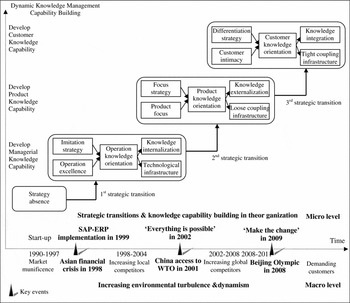
Data analysis was carried by recursively iterating between the empirical data, the theoretical lens, relevant literature, and the emerging process model (Eisenhardt, Reference Eisenhardt1989). We used narratives and visual diagrams to condense the large amount of empirical data into a manageable size (Langley, Reference Langley1999). The diagrams capturing the emergent models were presented to the relevant stakeholders at Li-Ning to validate the interpretation. From the emergent data, four distinct phases of knowledge capability building were identified and represented by three strategic transitions. Accordingly, events, activities, and decisions at Li-Ning were divided into four distinct phases to facilitate the examination of its knowledge capability building, including how the company's business strategy co-evolved with the changing environment at a macro level and how the company's KM strategy, together with its KM infrastructure and processes, co-evolved with the business strategy at a micro level.
CASE DESCRIPTION
Company Background
Li-Ning is a prime example of rapidly growing Chinese private companies that were established during China's economic transition in the 1990s. The Li-Ning Company was founded by Mr. Ning Li (a famous Chinese gymnast) in 1990 in Guangdong Province. The company has been recognized as the leading brand amongst Chinese sporting goods brands since 1996. It has established several brands, including Li-Ning, LNG, Z-Do, etc., and has strategic partnerships with global brands, such as AIGLE, LOTTO. As of 2011, the company has around 2,000 employees and 8,255 retail stores, and its sales reached RMB 9,479 million. In the past 20 years, the company has become strong and completed its catching-up ability based on global market benchmarks by changing its strategic positions and developing appropriate knowledge capabilities for continuous adaptation to the dynamic environment in China.
The Coevolutionary Roadmap of the Li-Ning Company
Inspired by the literature review on resource-based theories and coevolution theory, we focus the inquiry on the following four pertinent themes: (1) environmental changes of China's transition economy and the strategic choices, including Li-Ning's corporate and competitive strategies; (2) business strategies that determined KM strategic orientations; (3) the subsequent knowledge capability development, including the construction of KM infrastructures and KM processes; and (4) competitive advantages that emerged as a result. Figure 1 depicts this roadmap of Li-Ning's knowledge capability building for adapting the changing environment across four phases. Narratives are used to provide a detailed description of the multilevel coevolution of Li-Ning across the four distinct phases.
The coevolutionary journey of Li-Ning Company

Phase 1: Strategy absence (1990–1997)
Environmental change and strategy absence. During its startup period, between 1990 and 1997, Li-Ning saw tremendous growth with minimal obstacles due to a low barrier of entry; by 1996, the company was already the leader in China's sporting goods and apparel industry. Much of this success could be attributed to the flourishing Chinese market and the founder's ‘celebrity charm’. Due to the deepening institutional transition towards marketization and privatization, the demand and supply sides of the emerging market of China were booming in the 1990s. Thus, Li-Ning's entry to market brought sizable profits despite the absence of strategy in the company during its start-up period.
Initial development within company
During the early 1990s, Mr. Li developed a single mission for the company: become No. 1 among Chinese sporting goods brands. During this period, Li-Ning showed strategic absence in a booming while rapidly changing environment. The company produced both sporting goods and non-sporting goods (e.g., leather goods) during its start-up period and achieved remarkable growth in the market. From 1993 to 1996, the annual sales income in Li-Ning increased by a rate of over 100%. Mr. Chen, the Vice President (VP) of Strategy, indicated that,
There was no idea of real strategy management in Li-Ning Company in the early stage, because anything we produced could be sold out, even jackets and wallets.
Instead of viewing Li-Ning as a lucky firm with unintentional strategic absence, we view this absence as a transitional phase in a firm's life cycle (Inkpen & Choudhury, Reference Inkpen and Choudhury1995), as Li-Ning was a young firm and its strategy was in the process of emerging. In fact, the background of the founder played a critical role during this period. Naming the company based on the personal image of the founder represented the bourgeoning of plain branding development. Also, the company was already aware of using sports sponsorship deals (e.g., the Asian Games in 1990) to raise its profile. Because institutional regulations were absent in the early 1990s, the personal network was an effective method for competition. On the one hand, this partially confirms Peng et al.’s (Reference Peng, Wang and Jiang2008) institutional theory for interpreting the appropriateness of using network strategy, but not market-based strategy, in the early transitional economy in China. On the other hand, Li-Ning's strategic absence was also a result of the changing market environment caused by the nation-wide transition in 1990s; this strategic absence shaped the constructive ambiguity of strategy in its early stage. Li-Ning's rapid growth in the early 1990s provided a strong signal of the relationship between sports and economy. By 1995, over 3,000 small and medium-sized sporting goods manufacturers were established and Li-Ning was able to hold its leading position, occupying 13.67% of the market share. This was a wholly new landscape of the Chinese sports industry in 1990s.
Phase 2: Developing operational knowledge management capability (1998–2004)
Environmental change and strategic positioning
The lack of strategy and strong organizational capability threatened the company's sustainability in the increasingly turbulent and dynamic market. The 1998 Asian financial crisis gave the company its first sign of trouble. From 1997 through 1999, the growth of the company slowed down and performance was at a standstill. While external crises may trigger a firm to examine its internal problems, it is the firm's proactive crisis construction that pushes the firm forward (Kim, Reference Kim1998). Similarly, Li-Ning's top management recognized the potential crisis that could result from a lack of strategic planning and inefficient management and operations.
During the period of 1998–2004, Li-Ning adopted the imitation strategy, in which the firm imitated the production and managerial process of leading global sports goods companies and established the value proposition of operational excellence to compete in the domestic market. In 1999, Li-Ning initiated the SAP (Systems, Applications and Products in Data Processing) -ERP (Enterprise Resource Planning) program and emphasized technology-enabled knowledge management to re-engineer its ill-structured business processes and thus achieve operational excellence. The first strategic transition from 1998 to 2004 led the company from strategic absence to the imitation strategy and resulted in operational excellence for the domestic market. This phase of growth was closely in line with China's ‘world factory’ status.
1st Strategic transition and operational knowledge capability development
The VP of Strategy, Mr. Chen, indicated that ‘Prior to 2002, we were just seeking to imitate what other outstanding companies were doing’. This statement reflects Li-Ning's imitation strategy, in which the company decided to develop solid operational capability after a stagnant period of growth in 1997–1999. The top management considered operational excellence as the value proposition of the company; thus, a knowledge management strategy that focused on operational knowledge was formulated and the company continuously acquired advanced production and managerial knowledge from external sources.
The entry of Nike and Adidas in the China market offered perfect learning models for Li-Ning. Following their practices, the company established self-distribution networks in China, instead of utilizing old state-owned retail stores. This self-established retail network turned out to be powerful against domestic competitors. Similarly, the Pyramid Marketing Model and Adjacent Business Development Model were acquired from observing Nike's best practices. Furthermore, Japanese and Korean companies’ operations in fast-consumption industries also served as important learning sources for Li-Ning.
When a firm lacks a knowledge base, a more efficient acquisition of operational knowledge is via buy-in. Thus, in 1999, Li-Ning was the first company in China's sporting goods industry to implement the SAP-ERP system. Prior to that, the company adopted two information systems, a Sales and Inventory System and a Financial System. However, the independent systems were not sufficient in supporting the company's business operations because of information inconsistency and operational delay. The SAP-ERP embedded advanced business processes in the system, and led the company to achieving operational excellence within the next few years after its implementation. The IT Manager, Mr. Sha, indicated that,
We were willing to learn advanced operational experience from global brands, and use their best practice for reference, especially in regards to managerial capability and internal operations. Although SAP was regarded as an expensive system at that time, the top management insisted that it was a good chance to master advanced management ideas and models through implementing this system.
In 2001, Li-Ning's sales incomes reached RMB 734 million and its sales income growth rate also rose. Further, the company continuously invested in the development of its IT infrastructure. Consequently, the knowledge of excellent business processes and management were imported into and implanted in the company. During this phase, global brands had not yet fully entered the Chinese market and they primarily served as learning sources for local companies. Li-Ning not only benefited from the operational excellence, which allowed it to compete with domestic competitors, but also benefited from the low production cost, which allowed it to compete with global competitors in the Chinese sports goods market. The IT-enabled operational excellence achieved by Li-Ning raised the competitive barrier of the domestic sports goods industry, where the Jinjiang Grassroots sports goods companies such as Anta learned lessons that improved their own operations.
Phase 3: Developing product knowledge management capability (2002–2008)
Environmental change and strategic re-positioning
In 2001, China's membership in the WTO (World Trade Organization) resulted in increased dynamism and competition within the Chinese business environment. The influx of global competitors into the Chinese market changed the competitive structures. At the same time, a series of Jinjiang Grassroots sports goods companies emerged with the objective of surpassing Li-Ning. Facing competition from both local and global competitors, the company made its second strategic transition shifting from an operation-efficiency orientated strategy to a product-focused strategy. In 2002, Li-Ning's top management proposed the strategic vision of ‘Everything is possible’ and the company dedicated itself to a new brand identity, which was ‘not be Chinese Nike, but the Global Li-Ning’. During this time, knowledge and human capital were emphasized. The focus strategy for product leadership gradually led the company from being an imitator to an innovator.
2nd Strategic transition and product knowledge capability development
Facing fierce external competition, Li-Ning recognized the importance of producing unique products to compete with other global brands and sustain its rapid growth within the domestic Chinese market. Thus, the company experienced the second phase of strategic transition: from the imitation and cost leadership strategy to the product focused strategy, which focused on the core product lines. The VP of Strategy, Mr. Chen, indicated that,
In 2002, we made a significant strategic transformation and we began adopting the focus strategy. As a leading sports goods brand, we cannot produce everything. We have to focus on the sports goods, among which we should pay more attention to footwear, because the footwear can best reflect the technological contents of our unique products and enhance our competitiveness.
To align with this strategic transformation, the KM strategy in Li-Ning focused on product knowledge management. This transformation was accomplished with help from external consulting companies. The company created the Knowledge Collaboration Center (KCC), which was operated by the company's IT Division, and the Learning Development Center (LDC), which was operated by the company's Human Resource Division, in 2003 and 2005, respectively. Then, in 2007, KCC was upgraded as a part of the Strategy Division. The two centers have different emphases for building up the company's KM capabilities. While KCC is primarily focused on organizing and managing knowledge, LDC is centered on human capital development. The company also established its own R&D centers in Hong Kong and the US to encourage knowledge creation and exploration.
At this stage, knowledge management in KCC was concentrated on externalizing the organizational knowledge. KCC was responsible for combining the company's vast range of knowledge. In 2005, KCC initiated the ‘Knowledge Tree Project’ to integrate the distributed knowledge within individuals and departments. The project was centered on the CEO's (Chief Executive Officer) knowledge and connected the top-management knowledge to all related departments and individuals. KCC organized the organizational knowledge in two dimensions: business process and functionality. In the business process dimension, KCC established the knowledge architecture across business processes. The technical concepts and terminologies, reports, formats, and regulations were explicated. The process-related knowledge was clearly outlined and applied to the product, marketing, and procurement departments, among others. Regarding the functionality dimension, KCC defined the hierarchical body of knowledge for the functional divisions, including division of strategy, footwear planning and design, marketing research, finance, etc. For instance, KCC defined the knowledge of footwear planning and design in three levels: Level 1 refers to regulations and division directions; Level 2 refers to footwear lifecycles; and Level 3 refers to the specific activities in each planning stage and the supporting knowledge (e.g., models, cases, training courses, etc.). In addition, the CEO Document Management System went online in 2007 and was continuously updated. By 2011, the system held 27,000 files.
The responsibility of LDC was to develop and improve middle managers’ professionalism by training and sharing externally acquired knowledge. Li-Ning consulted with U-Sys Consulting and Information Technology Co. Ltd., which specialized in marketing and retailing innovation. Different from prior knowledge acquisition via buy-in, Li-Ning selectively acquired knowledge on the basis of decent communication and mutual agreement. The HR manager, Ms. Dai, indicated that,
After rapid acquisition of personnel from external sources from 2001 to 2004, we realized that acquisition from external sources could only solve the burning issues and that fast training in-house talents was the key to tackle the trouble of lack of professional management personnel.
Although in-house talent training still relied on the external consultation, the knowledge acquired and assimilated at this stage met the specific demands of Li-Ning appropriately. The external consultants interviewed middle managers, reviewed Li-Ning’ cases, and integrated Li-Ning's specific practices with their consulting courses. Consulting courses targeted middle managers from different geographic regions and divisions and offered training in marketing and retail know-how. The external knowledge via consultation was applied to practices in certain geographic regions for four months, which provided feedback on the actionable knowledge obtained from external consultation. This actionable knowledge was then shared across all regions. Performance was then reported to headquarters for another four months. Since 2005, the course subject matter was implemented with respect to different annual themes. LDC Manager, Mr. Ma, indicated that,
Our talent development systems were acquired from global HR service company, DDI, and tailored to Li-Ning Company's demands. It had two components. One was the leadership development system based on the human resource promotion system. The other was professional competence development system in line with positions in the business system.
During 2002–2008, the compound annual growth average was over 30%. In 2003, although Nike and Adidas’ market shares of sports goods in China both exceeded that of Li-Ning, knowledge and talent capability building after the second strategic transformation helped Li-Ning catch up with those global brands and narrow the gaps. Knowledge capability building in this period led the company to achieve impressive performance in 2008. The systematic knowledge management enhanced the individual talents and the organizational capabilities in Li-Ning. However, the IT, human and knowledge resources were loosely coupled, as the IT department, KCC and LDC work independently with limited collaboration.
Phase 4: Develop customer knowledge management capability (2008-2011)
Environmental change and strategic re-positioning
The 2008 Beijing Olympics functioned as the third trigger for another wave of strategic transition from product focus to differentiation and the value proposition was built on customer intimacy. This transition was essentially in line with the increasing consumption awareness and demands of Chinese consumers. Chinese consumers are increasingly interested in purchasing products that are new, high quality, and technology-driven, but they often have limited exposure to and knowledge about these products (Zhou, Reference Zhou2006). Thus, understanding Chinese consumers’ preferences and establishing customer intimacy led to sustained competitiveness in the Chinese market. This also implies that there are significant potential profits for innovators who leap ahead of market demand. In addition to targeting the domestic market, Li-Ning also started its internationalization process by setting up several retail stores in the US, Malaysia, Hong Kong, etc. in 2010.
3rd Strategic transition and customer knowledge capability development
The remarkable growth that occurred in 2008 provided Li-Ning with the competence and confidence to compete on a larger scale. The company initiated a new round of strategic transformations. In order to survive and thrive in an increasingly competitive environment with more uncertainty and dynamism, as well as internationalize its brand, Li-Ning viewed customer intimacy as their value proposition and made efforts in differentiating its brand from other brands. The company changed their logo and switched the old slogan to ‘Make the Change!’ in 2010. The VP of Strategy, Mr. Chen, indicated that,
In the past, our advantages, compared with global sports goods brands lay in our localized retailing channels and efficient supply chain management. However, as the competition becomes more intense, the differences again return to the brand position and the understanding of customers’ intrinsic needs.
The HR Manager, Ms. Dai, also commented on the new round of transformation,
We are always seeking to differentiate ourselves from competitors. Now we discover the distinguished feature of our company is that Li-Ning was created by an outstanding athlete. We are inherent with sportsmanship. We can start over no matter we win or lose. This is the DNA of our company which has been incorporated into our new value, namely ‘Winning for the Dream’.
As a consequence, the KM strategy in Li-Ning shifted to the foci of customer knowledge. In the past three growing phases, the company accumulated managerial and product knowledge via buy-in, acquisition, and assimilation. KCC explicates the external knowledge for learning and talent development. In the fourth phase when customer knowledge is emphasized, Li-Ning emphasized knowledge creation through understanding customers. Instead of exploiting external knowledge, knowledge exploration is stressed. The IT Manager, Mr. Xiao, indicated that,
After we have a full coverage of EPOS (Electronic Point of Sale) in 8,000 retail stores in China, we are going to control the quality of transported data and make better use of it to support decision making and know more about consumers’ purchasing behavior.
KCC emphasized transferring and sharing knowledge of critical projects, which represented the best practices of Li-Ning. For instance, KCC codified and shared the knowledge of the noticeable Olympic marketing project during the 2008 Olympic Games, which involved a huge number of talents. That knowledge was transferred into 5 e-books and various videos and PPTs and stored online, making it available to certified people who need such knowledge. As a result, LDC could utilize the knowledge for training courses to train the marketing staff that were involved in the 2012 London Olympic marketing project and other key events.
Li-Ning also made efforts in knowledge integration by upgrading the supporting IT infrastructures. In 2009, the EPOS I system was upgraded into EPOS II, and the sales planning system was upgraded into a customer relationship management system. By 2010, the usage of the EPOS systems achieved a full physical coverage of 8,000 retail stores in China. A more sophisticated supply chain management system was scheduled to integrate the independent small systems distributed across the company. In order to enhance the customer intimacy, Li-Ning used the social media to interact with their end consumers. The company set up the i-Run virtual community for interactions between designers and consumers. The VP of Strategy, Mr. Chen, indicated that,
We collect consumers’ needs and purchasing habits from several channels. We have official blogs to interact with consumers. Running-lovers have joined the Li-Ning i-RUN online club to communicate with us. The CRM (Customer Relationship Management) system also provides us a good channel to learn from our customers. Meanwhile, the sales system pays more attention to sell-through than sell-in. That is, we care more about whether the products have been sold to the end consumers rather than retailers. And the integrated sales system provides more information about consumers’ purchasing habits and preferences through data mining and business intelligence.
LDC continuously invested efforts in talent development for managers and employees by using internally created knowledge, e.g., the Olympics Marketing Knowledge. Also, LDC invested efforts in knowledge integration by auditing, updating and integrating prior accumulated training course materials to match with the needs of corporate development in the dynamic environment. The LDC manager, Christine, mentioned as below,
We have just finished a knowledge audit project to check the current status of our courses systems. Now we have 50 courses regarding professional competence and 45 courses associated with leadership competence. We will then begin to optimize our talent development systems and courses systems. We intend to find out what the current courses were talking about, or how those courses supported corporate strategy and whether those courses were needed to be optimized or just eliminated. Then the courses will be integrated to better support the learning and development of our company.
In fourth phase, Li-Ning developed stronger KM infrastructure with a tight coupling structure of IT, human and knowledge, as the IT department, KCC, and LDC showed a closer collaborative relationship. Incentive systems for encouraging knowledge sharing and knowledge creation were established. For example, the Key Development Index (KDI) has been added to the Key Performance Index (KPI) for assessing employees; employees are required to share with others for six hours per month. The ‘We’ culture and ‘New play’ culture established in the company are expected to stimulate creativity and innovation. For example, the designers in Li-Ning researched and designed high quality products, e.g., the footwear with Li-Ning Arc 2.0.
During years of 2008–2011, Li-Ning retained a high return of investment. In 2009, its sales income reached to RMB 8.387 billion, exceeding that of Adidas in the market of China (Internal memo). The company gradually reduced the gap with Nike with regard to the market share in China. During this period, Li-Ning's remarkable achievements can be attributed to the company's efforts in integrating the acquired knowledge from external sources and the internally created knowledge, reconciling the existing knowledge and new knowledge, as well as the tight coupling structure of knowledge, human and IT resources which enables efficient knowledge transferring and synthesis.
However, it has been difficult for Li-Ning to differentiate itself as a premium brand. Since the 2008 Olympics, Li-Ning constantly switched strategies and post-2011 its sales and income have dramatically declined. Due to a focus on the value proposition of customer intimacy and its differentiation strategy, Li-Ning abandoned its safe niche of value-for-money and aligned its prices with global leaders in the market (Waldmeir, Reference Waldmeir2015). Further, Li-Ning did not possess a comprehensive understanding of the needs and behaviors of its new, targeted customers base, the post-90s generation.
Section Summary
Over the last two decades, Li-Ning has transformed itself from a sports goods manufacturer to an innovative and global contender with brand recognition. The company continuously invests in transforming itself from a local brand to a global brand (although it encountered trouble after 2011). The four-phase evolution of Li-Ning from its start-ups to 2011 corroborates Kauffman's (Reference Kauffman1993) notion of ‘all evolution is really coevolution’ and coevolution occurs at both macro and micro levels. Unlike the evolutionary path of companies in developed economies, Li-Ning experienced the transformation from an imitator to a prospector with a reversed sequence of technology trajectory. In terms of KM processes at Li-Ning, the external knowledge internalization (knowledge acquisition, assimilation and application) was focused in its early phase and the knowledge creation and integration were emphasized as the company grew strong. The KM infrastructure development at Li-Ning also evolved from merely relying on IT infrastructure to the collaborative KM infrastructure with IT, human and knowledge resources. The capability developed in one phase enabled the firm to make a strategic transformation and carve out a niche in the market during the next phase.
DISCUSSION
This research entails important theoretical and managerial implications. Theoretically, utilizing the longitudinal case study to trace a company's knowledge capability building from a coevolution perspective significantly contributes to the research streams of coevolution, dynamic capability theory, and enterprise knowledge management. The case study reveals the specificity of knowledge capability development in emerging market private firms, adding value to the KM research. Practically, Li-Ning's strategic transitions and knowledge capability development practices, such as identifying knowledge gaps and applying the rule of ‘intensity of pressure’ for knowledge capability building, provide important managerial insights and imperatives for firms to survive in China and other emerging economies.
Theoretical Implications
Firstly, this research enriches coevolution research by revealing both macro-level coevolution between the environment and a firm and the micro-level coevolution within the firm regarding its knowledge capability building. The evolution of the emerging economy in China determines Li-Ning's strategic transformations for continuous adaption to the environment. A single firm might not change the environment. However, when a leading firm creates a new landscape for competition, groups of firms follow similar organizational strategies and actions, thus resulting in firms ultimately reshaping the business environment. Li-Ning is a distinguished representative of emerging market private firms that rose substantially since 1990s and illustrated proactive business strategy and strong learning abilities. Tracing China's economic transition over the past two decades, it is not difficult to analyze the coevolution between emerging economies and private firms like Li-Ning. This is a macro coevolutionary complexity system, in which firms should have a strategic recognition of the macro environmental trends and market opportunities, and be able to perform intended adaption to the environment (Ferreira, Serra, & Reis, Reference Ferreira, Serra and Reis2011). From the micro coevolution perspective, our research demonstrates how Li-Ning adapted to the dynamic environment over time by scrutinizing the coevolution among organizational strategies, KM orientations, processes, and infrastructures within the company from its founding to 2011. Different organizational strategies and KM orientations influence the foci of KM processes and infrastructures and, as a result, the gradually developed knowledge capability offers the firm a knowledge base to renew strategies for the next transformation wave. The micro coevolution shapes the knowledge capability building process of the emerging market private firms for catching up with the leading global firms.
Secondly, this research contributes to the dynamic capability theory and the knowledge based view of a firm by emphasizing the time dimension of knowledge capability building. Time matters to multilevel coevolution by exerting unrelenting forward pressures on firms to continuously transform for intended adaptation, in which knowledge is the influx of energy. Prior research has emphasized knowledge as a key source for firms to gain sustainable competitive edges (Grant, Reference Grant1996) and demonstrated the direct impact of the capability of managing managerial, product, and customer knowledge on organizational performance (Tanriverdi, Reference Tanriverdi2005; Tanriverdi & Venkatraman, Reference Tanriverdi and Venkatraman2005). They examined the knowledge capability from a cross-sectional static perspective by emphasizing complementarities among different knowledge resources for super-additive value synergies while ignoring the developmental process of differentiated knowledge capability building in firms. This research demonstrates that firms, especially those with limited knowledge and resources at the initial stage, should have a stage-based, knowledge management capability building process. Our case study illustrates that Li-Ning focused on one particular knowledge capability to align with its competitive strategy and value proposition during each phase; as a result, the achieved competitive edge gave rise to the strategic transformation to develop another domain knowledge capability. The longitudinal capability building enables the firm to possess a healthy portfolio with multiple knowledge resources and capabilities.
Thirdly, this research makes an important contribution to the KM literature by finding a reversed sequence of the knowledge capability building process in emerging economies, compared with the sequence of ‘research, development and engineering’ which was found in firms from developed economies (Kim Reference Kim1998). The specific trajectory of capability building in emerging market private firms is in the order of engineering (operational excellence), development (product leadership) and research (customer intimacy). In Li-Ning, they first developed the operational capability by implementing SAP-ERP from an engineering perspective. On the basis of excellent operations enabled by IT infrastructure, Li-Ning launched the knowledge coordination center and the learning development center to manage the externally acquired and internally created knowledge and talents for developing the self-branded products. R&D centers were also launched in the 3rd and 4th development phase, e.g. Li-Ning Sports Science Research Center was established in 2008. The similar reserved sequence of research, development and engineering has also been found in other emerging economies, e.g., Korea. Kim's (Reference Kim1998) research indicates that Korean firms started with engineering for products and processes imported from abroad, then progressively evolved into the position of undertaking substantial development and research. Thus, the sequence of ‘engineering, development, and research’ is normative in emerging economies where an initial knowledge base was absent and innovation was not emphasized in the earlier period.
Furthermore, the priorities of KM processes are also strikingly different between emerging economies and developed economies. For instance, in Nike, the individual learning and creativity were strategically emphasized since its founding in 1970s (Stonehouse & Minocha, Reference Stonehouse and Minocha2008). Rezgui et al. (Reference Rezgui, Hopfe and Vorakulpipat2010) summarized three generations of KM in the industry of construction in Europe: the KM processes evolved from knowledge sharing, to knowledge nurturing, and finally to the creation of sustained organizational and societal values. In Japanese firms, Nonaka (Reference Nonaka1994) also found knowledge was created and shared among individual employees, and upgraded into organizational knowledge. Such a bottom-up spiral KM process led the firms to innovativeness and sustained competitiveness. On the contrary, in the emerging economies such as China, where operational and management knowledge is deficient, external knowledge acquisition and internalization are often stressed by firms, then the knowledge is disseminated to individuals, reflecting a top-down KM process. The importance of internal knowledge creation and sharing for organizational innovation is not emphasized in the firms’ early stage but recognized as they mature.
Managerial Implications
By investigating the growth of a representative case, our research informs the emerging market firms with valuable managerial implications. First, the longitudinal case study informs private firms in emerging economies that have limited resources and knowledge to adopt an incremental knowledge capability building process and to apply the ‘intensity of pressure’ rule to compete in the dramatically changing environment. The strategic transformations in Li-Ning build on prior capabilities and the capability building is based on the company's expeditious ‘step by step’ learning. With resource constraint, private firms should realize resource utility maximization by focusing on one type of capability building given a certain condition. In addition, Li-Ning acknowledges the acquired external knowledge and IT advancement that spurs operational excellence. This momentum not only allowed Li-Ning to find a foothold in the niche of the local market in its earlier development phase, but also functioned as the impetus to pursuing a premium brand and differentiation. This incremental organizational learning in the real case verifies Fang's (Reference Fang2012) simulated learning model in credit assignment, in which organizations gradually recognize important stepping stones to achieve organizational goals. Thus, emerging market private firms can learn lessons from Li-Ning's allocation of limited resources to develop the capability needed to push a particular strategic choice at a given period of time. Instead of partitioning the effort for developing multiple capabilities, investing all efforts in developing a core capability during a given period is reasonable and actionable for most private firms in emerging economies, especially when firms have limited resources and knowledge.
Second, our research demonstrates the importance of strategic positioning and knowledge gap identification in firms’ capability development phase. Strategic making and capability building is a learning process and strategic choices provide the foundation for learning. The success of Li-Ning from its founding to 2011 embodies one key takeaway: the firm understood the strategic and knowledge gaps between itself and its competitors and what it should learn during each developmental phase; therefore, it dynamically adjusted its KM orientations, processes, and supporting infrastructures to achieve strategic intent. Li-Ning gradually narrowed the knowledge gap, starting from simple, structural knowledge and gradually shifting to complex, tacit knowledge. Operational knowledge can be easily acquired from external sources or bought via the implementation of advanced information systems. Product research and design knowledge can be gained by setting up R&D centers, hiring capable designers, and other personnel development actions. However, it is difficult to obtain the understanding of market trends and customer preferences needed to establish customer intimacy, especially as Chinese customers have become more demanding (Zhou, Yim, & Tse, Reference Zhou, Yim and Tse2005). Market insight and brand construction knowledge is complex and unstructured. Li-Ning's post-2011 decline demonstrates its weakness in managing market and customer knowledge. ‘Li Ning used to know exactly who they should be and who their customers were and they did exactly what they should do to be successful. Once they stopped playing to their strengths that was a big problem’ (Waldmeir, Reference Waldmeir2015). Although the rise and provisional fall of the firm is frustrating, the contrastive fact (Tsang & Ellsaesser, Reference Tsang and Ellsaesser2011) exactly affirms the highlights of strategic positioning and building of appropriate knowledge capability for firms to co-evolve with turbulent and dynamic environment, otherwise the firm will become a variation during coevolution.
Limitations and Future Research Directions
We are aware that a single case cannot address all questions for knowledge capability building in emerging market private firms. In fact, the questions that were not addressed represent opportunities for future research. First, we find the coevolutionary trajectory of Li-Ning in China's emerging economy. On one hand, our longitudinal single case research may generate theoretical generalization, as the case firm is a typical representative of private firms starting up in 1990s. Further, the longitudinal case study can provide stronger evidence of tracking the coevolutionary effect (Tsang, Reference Tsang2014). On the other hand, we must admit the single case design might limit the empirical generalization of some idiosyncratic case findings to other populations (Tsang, Reference Tsang2014). Multiple cases will be studied and compared in the future to gain the convergence or a typology with divergence in terms of the multilevel coevolutionary journeys of firms from different industries.
Second, it is common in an emerging market that the firms have strong motives to acquire external knowledge in their earlier development phase and the external knowledge gave rise to their prior knowledge base. However, when the knowledge is accumulated for a certain while, a prior knowledge base may impede the internal knowledge creation in different contexts. Although continuous learning is important, unlearning is also necessary for firms if they struggle in a new environment. According to Tsang & Zahra (Reference Tsang and Zahra2008), unlearning refers to an organization's intentional discarding of old routines to make way for new ones. Zahra et al. (Reference Zahra, Abdelgawad and Tsang2011) has discussed the implications of organizational unlearning for emerging multinationals’ entrepreneurial capacity exploitation in developed economies. Thus, despite continuous learning by knowledge acquisition, emerging market private firms, such as Li-Ning, should consider establishing organizational unlearning to improve the knowledge creation in the company, in order to realize the value proposition of establishing customer intimacy. This research is focused on knowledge capability building by learning in the period of a firm's rapid growth, future research can investigate how organizational unlearning influences a firm's strategic transformation.
CONCLUSION
In conclusion, our research reveals the macro coevolution of the transition economy of China and Li-Ning's strategic transformations and the micro coevolution of the company's strategic choices and its knowledge capability building for dynamically adapting to the environment. Our research adds value to the research streams of organizational strategy and knowledge management by revealing how a firm's knowledge capability building co-evolves with its strategic transformations from imitation to differentiation for catching up. Strong knowledge capability in a firm is developed incrementally, rather than a ‘one-time delivery’. The multilevel coevolutionary journey that Li-Ning has experienced is the epitome of what has occurred in China's transition economy and has valuable implications for firms’ survival in other emerging economies.
APPENDIX I
Interview Process

APPENDIX II
Sample Interview Questions
Questions for Director of Corporate strategy
-
1) How does the strategy change over time at Li-Ning?
-
2) What differentiates Li-Ning from other sports goods companies?
-
3) What are the core competences of Li-Ning?
-
4) What is the part that Li-Ning needs to learn to achieve it strategic goal?
-
5) How did Li-Ning grow at a faster pace?
-
6) What is the role of Knowledge Management at Li-Ning?
-
7) What is the relationship of knowledge management and corporate strategy?
-
8) What is organization's expectation of knowledge management in the next 5 years?
Questions for Manager of KCC
-
1) When did knowledge management start to develop at Li-Ning?
-
2) What are the knowledge management processes at Li-Ning?
-
3) What is the relationship between knowledge management and corporate strategy?
-
4) What is the relationship between KCC and LDC?
-
5) How did the Olympic marketing project work?
-
6) What is the most difficult part in promoting knowledge management?
Questions for Manager of LDC:
-
1) What is the purpose of launching the learning development center?
-
2) What is the relationship between knowledge management and LDC?
-
3) What is the relationship between KCC and LDC?
-
4) What is the relationship between LDC and strategic development?
-
5) How does the learning and training work at LDC?
-
6) What is the most difficult part of implementing learning and training at Li-Ning?
Questions for Manager of IT:
-
1) What types of information technologies and systems have been implemented at Li-Ning?
-
2) What is the relationship between IT department and KCC?
-
3) How does IT department coordinate with KCC?
-
4) How have the IT infrastructures influenced the company?
-
5) How have the IT infrastructures influenced the knowledge management initiatives and processes?
-
6) What is the future plan of IT implementation at Li-Ning?