When faced with stressful situations, individuals react differently depending on many factors, including their genetic makeup. For example, individuals who carry one or two copies of the short variant of the serotonin transporter linked polymorphic region gene (5-HTTLPR) are more susceptible than individuals who are homozygous for the long allele to the effects of stressful life events on risk for internalizing problems, particularly when stressful events comprise hostile or abusive relationships with family members or peers (Åslund et al., Reference Åslund, Leppert, Comasco, Nordquist, Oreland and Nilsson2009; Caspi et al., Reference Caspi, Sugden, Moffitt, Taylor, Craig and Harrington2003; Cicchetti, Rogosch, & Sturge-Apple, Reference Cicchetti, Rogosch and Sturge-Apple2007; Karg, Burmeister, Shedden, & Sen, Reference Karg, Burmeister, Shedden and Sen2011; Taylor et al., Reference Taylor, Way, Welch, Hilmert, Lehman and Eisenberger2006; but see Munafò, Durrant, Lewis, & Flint, Reference Munafò, Durrant, Lewis and Flint2009, and Risch et al., Reference Risch, Herrell, Lehner, Liang, Eaves and Hoh2009, for negative findings). Adults who report having experienced family violence or hostility in childhood (Taylor et al., Reference Taylor, Way, Welch, Hilmert, Lehman and Eisenberger2006), maltreatment (Caspi et al., Reference Caspi, Sugden, Moffitt, Taylor, Craig and Harrington2003; Cicchetti et al., Reference Cicchetti, Rogosch and Sturge-Apple2007; Kaufman et al., Reference Kaufman, Yang, Douglas-Palumberi, Houshyar, Lipschitz and Krystal2004), and youth who report having been bullied (Sugden et al., Reference Sugden, Arseneault, Harrington, Moffitt, Williams and Caspi2010) are at elevated risk for symptoms of depression, but only if they carry one or two copies of the short allele. In contrast, individuals who are homozygous for the long allele usually have low levels of depression regardless of their exposure to stressful life events.
5-HTTLPR is a 43 base pair insertion/deletion polymorphism (Heils et al., Reference Heils, Teufel, Petri, Stöber, Riederer and Bengel1996; Lesch et al., Reference Lesch, Bengel, Heils, Sabol, Greenberg and Petri1996). The serotonin transporter (5-HTT) plays a vital role in the regulation of serotonin (5-HT) reuptake (Lesch et al., Reference Lesch, Bengel, Heils, Sabol, Greenberg and Petri1996; Neumeister et al., Reference Neumeister, Konstantinidis, Stastny, Schwarz, Vitouch and Willeit2002; Verona, Joiner, Johnson, & Bender, Reference Verona, Joiner, Johnson and Bender2006), and dysregulated 5-HT functioning is associated with depression as well as aggression (Caspi et al., Reference Caspi, McClay, Moffitt, Mill, Martin and Craig2002; Maes & Meltzer, Reference Maes, Meltzer, Bloom and Kupfer1995; Moeller et al., Reference Moeller, Allen, Cherek, Dougherty, Lane and Swann1998; Verona et al., Reference Verona, Joiner, Johnson and Bender2006). Homozygosity for the long allele is associated with increased transcriptional efficiency in human lymphoblast cells, whereas the short allele is associated with diminished 5-HTT gene transcription (Greenberg et al., Reference Greenberg, Tolliver, Huang, Li, Bengel and Murphy1999; Heils et al., Reference Heils, Teufel, Petri, Stöber, Riederer and Bengel1996). Compared to the long variant, the short allele is less active, which leads to reduced 5-HTT expression or function as well as reduced 5-HT binding sites and uptake (Greenberg et al., Reference Greenberg, Tolliver, Huang, Li, Bengel and Murphy1999).
There is growing evidence (reviewed below) that the short allele is involved in the physiological response to psychosocial stress and to cognitive appraisals of stressors, suggesting that short allele carriers may cope differently than youth who are homozygous for the long allele when confronted with potential threats or chronic stressors. This physiological and psychological profile may hinder youth from practicing coping strategies that are usually associated with greater psychological well-being, such as actively engaging with and acting on sources of stress, while promoting the use of coping strategies that are usually associated with poorer psychological functioning, such as avoiding or withdrawing from stressors (Compas, Connor-Smith, Saltzman, Thomsen, & Wadsworth, Reference Compas, Connor-Smith, Saltzman, Thomsen and Wadsworth2001). Thus, the goal of research reported herein is twofold: to test whether 5-HTTLPR genotype moderates the effect of stressful relationships and experiences (measured as caregiver–child relationships characterized by hostility, lack of warmth, and exposure to traumatic events) on children's internalizing and externalizing problems and to evaluate whether individual differences in coping style explain the anticipated elevated risk of problem behaviors among short allele carriers faced with high levels of environmental risk.
Why Do Stressful Life Events Increase Risk for Depression Among Short Allele Carriers?
Although the interaction between 5-HTTLPR genotype and stressful life events is reasonably robust across studies (but see Munafò et al., Reference Munafò, Durrant, Lewis and Flint2009; and Risch et al., Reference Risch, Herrell, Lehner, Liang, Eaves and Hoh2009, for an alternative perspective), research has only begun to identify possible explanations for why short allele carriers are particularly susceptible to the adverse effects of stressful life events. Meta-analyses have shown that short/short homozygotes mount a significantly greater cortisol response to acute stressors than long allele carriers (Miller, Wankerl, Stalder, Kirschbaum, & Alexander, Reference Miller, Wankerl, Stalder, Kirschbaum and Alexander2013) and that short allele carriers show enhanced amygdala reactivity to negatively valenced stimuli compared with individuals who are homozygous for the long allele (Munafò, Brown, & Hariri, Reference Munafò, Brown and Hariri2008). A handful of investigations have shown that elevated cortisol reactivity to acute stressors and amygdala reactivity to negative emotional stimuli in short allele carriers is most pronounced among those who have experienced numerous stressful life events (Alexander et al., Reference Alexander, Kuepper, Schmitz, Osinsky, Kozyra and Hennig2009, Reference Alexander, Klucken, Koppe, Osinsky, Walter and Vaitl2012; Williams et al., Reference Williams, Gatt, Schofield, Olivieri, Peduto and Gordon2009; but see Canli et al., Reference Canli, Qiu, Omura, Congdon, Haas and Amin2006, and Mueller et al., Reference Mueller, Armbruster, Moser, Canli, Lesch and Brocke2011, for alternative interaction patterns), thus demonstrating that potential endophenotypes for depression (and aggression) are also predicted by Gene × Environment (G × E) interactions. Moreover, functional connectivity between the amygdala and hypothalamus is enhanced in healthy adult men who are homozygous for the short allele and who have experienced high levels of stressful life events. This suggests that elevated hypothalamus–pituitary–adrenal axis reactivity to psychosocial stress and limbic system reactivity to threatening stimuli reflect a coordinated biological response in individuals who are homozygous for the short allele and who have experienced multiple stressful life events (Alexander et al., Reference Alexander, Klucken, Koppe, Osinsky, Walter and Vaitl2012). Finally, the 5-HTTLPR genotype has been shown to moderate the effect of stressful life events on fear conditioning. Thus, individuals who are homozygous for the short allele and who have experienced multiple stressful life events show greater reactivity in some (but not all) regions of the fear network of the brain to conditioned versus unconditioned fear stimuli compared with individuals who have experienced low levels of stressful life events or who are homozygous for the long allele (Klucken et al., Reference Klucken, Alexander, Schweckendiek, Merz, Kagerer and Osinsky2013). Considering that heightened physiological reactivity and fear conditioning are hypothesized to underlie depression and anxiety, these findings potentially reflect brain mechanisms by which the short allele confers risk for depression and anxiety in the context of stressful life events, although this hypothesis has not been tested directly.
Along with the imaging genetic studies, there is evidence that the short allele is associated with cognitive vulnerabilities to depression, particularly under stressful conditions (Gibb, Beevers, & McGeary, Reference Gibb, Beevers and McGeary2013). For example, compared with individuals who are homozygous for the long allele, healthy adults who carry the short allele take longer to disengage attention from facial expressions of emotions (Beevers, Wells, Ellis, & McGeary, Reference Beevers, Wells, Ellis and McGeary2009) and to appraise recent stressful life events as being more negative (Conway, Hammen, et al., Reference Conway, Hammen, Espejo, Wray, Najman and Brennan2012), with negative appraisals correlated with elevations in depressive symptoms (Conway, Hammen, et al., Reference Conway, Hammen, Espejo, Wray, Najman and Brennan2012). Another study found that healthy children who carried the short allele had enhanced memory for negative (versus positive) self-descriptive traits (Hayden et al., Reference Hayden, Olino, Bufferd, Miller, Dougherty and Sheikh2013), thus exhibiting a potential cognitive vulnerability for depression. None of these studies formally tested the hypothesis that cognitive vulnerabilities to depression associated with the 5-HTTLPR genotype account for the elevated risk for depression among short allele carriers who experience stressful life events. Thus, mediating psychological processes remain largely unexplored, a lacuna addressed directly in this report.
The Role of Coping
To the extent that short allele carriers are more physiologically reactive to stressful situations and have a tendency to perceive situations as more stressful, they may engage in less effective coping strategies when faced with stressful life events than do individuals who are homozygous for the long allele (Compas, Reference Compas2006; Taylor & Stanton, Reference Taylor and Stanton2007). According to Compas et al. (Reference Compas, Connor-Smith, Saltzman, Thomsen and Wadsworth2001), coping is defined as “conscious volitional efforts to regulate emotion, cognition, behavior, physiology, and the environment in response to stressful events or circumstances” (p. 89). Several dimensions of coping have been identified in adults, including problem-focused versus emotion-focused coping (Lazarus & Folkman, Reference Lazarus and Folkman1984), primary control versus secondary control coping (Weisz, McCabe, & Dennig, Reference Weisz, Mccabe and Dennig1994), and engagement versus disengagement coping (Ebata & Moos, Reference Ebata and Moos1991; Tobin, Holroyd, Reynolds, & Wigal, Reference Tobin, Holroyd, Reynolds and Wigal1989). These different dimensions distinguish between efforts to change the nature of the stressor (e.g., by taking some action to solve the problem as would be observed in problem-focused, primary control, or engagement coping strategies) versus efforts to change how one feels about or responds to the stress (e.g., by reframing one's circumstances, denying the existence of the stressor, or distracting oneself as would be observed in emotion-focused, secondary control, or disengagement coping strategies). These dimensions have been criticized for being overly broad (e.g., emotion-focused coping comprises highly disparate strategies some of which may be more adaptive than others) and for failing to capture adequately the dimensions of children's coping (Ayers, Sandler, West, & Roosa, Reference Ayers, Sandler, West and Roosa1996; Compas et al., Reference Compas, Connor-Smith, Saltzman, Thomsen and Wadsworth2001).
In contrast to studies of adults, research on children reveals three to four dimensions that differ slightly in terms of how coping strategies are grouped together. One framework distinguishes primary control (e.g., problem solving or emotional expression), secondary control (e.g., distraction or cognitive restructuring), and disengagement strategies (e.g., denial or avoidance; Connor-Smith, Compas, Wadsworth, Harding Thomsen, & Saltzman, Reference Connor-Smith, Compas, Wadsworth, Harding Thomsen and Saltzman2000). A second framework distinguishes active coping (e.g., direct problem solving or cognitive restructuring), avoidance (e.g., denial or staying away from the source of the problem), distraction (e.g., physical release of emotions or distracting actions), and support-seeking strategies (e.g., emotion- or problem-focused social support; Ayers et al., Reference Ayers, Sandler, West and Roosa1996; Sandler, Tein, & West, Reference Sandler, Tein and West1994). Ayers et al. (Reference Ayers, Sandler, West and Roosa1996) found that among a sample of fourth- through sixth-grade children, the four-dimension framework provided a better fit to the data than did a two-dimension framework (i.e., problem- vs. emotion-focused and passive vs. active); for this reason, we rely on the four-dimension framework in the current work.
In general, the more frequent use of active coping, support seeking, distraction, or primary and secondary control strategies is associated with fewer internalizing and externalizing symptoms (Connor-Smith et al., Reference Connor-Smith, Compas, Wadsworth, Harding Thomsen and Saltzman2000; Fear et al., Reference Fear, Champion, Reeslund, Forehand, Colletti and Roberts2009; Gonzales, Tein, Sandler, & Friedman, Reference Gonzales, Tein, Sandler and Friedman2001; Jaser et al., Reference Jaser, Langrock, Keller, Merchant, Benson and Reeslund2005, Reference Jaser, Fear, Reeslund, Champion, Reising and Compas2008; Nicolotti, El-Sheikh, & Whitson Reference Nicolotti, El-Sheikh and Whitson2003; Weisz, Francis, & Bearman, Reference Weisz, Francis and Bearman2010). In contrast, the more frequent use of avoidance or disengagement coping strategies is associated with more symptoms of internalizing and externalizing problems (Forns, Balluerka, Gomez-Benito, Kirchner, & Amador, Reference Forns, Balluerka, Gomez-Benito, Kirchner and Amador2010; Nicolotti et al., Reference Nicolotti, El-Sheikh and Whitson2003; Sandler et al., Reference Sandler, Tein and West1994; Wadsworth, Raviv, Santiago, & Etter, Reference Wadsworth, Raviv, Santiago and Etter2011). Recent research suggests that avoidance coping may be adaptive for inner-city youth (Gonzales et al., Reference Gonzales, Tein, Sandler and Friedman2001; Grant et al., Reference Grant, O'Koon, Davis, Roache, Poindexter and Armstrong2000; Sanchez, Lambert, & Cooley-Strickland, Reference Sanchez, Lambert and Cooley-Strickland2013).
Coping Genetics
Might coping and genotype be related, even perhaps helping to explain the untoward consequences of carrying one or two short alleles when subject to stress? A few investigations have shown that coping or perceptions of coping are associated with the 5-HTTLPR genotype; for example, among adults who were asked to recall recent situations in which they had felt strong emotions of fear, sadness, or joy, those who carried the short allele reported that they had felt less able to cope with situations that evoked strong feelings of sadness or fear than did individuals who were homozygous for the long allele (Szily, Bowen, Unoka, Simon, & Kéri Reference Szily, Bowen, Unoka, Simon and Kéri2008). In another study, healthy young adults who were homozygous for the short allele less frequently endorsed the use of cognitive reappraisals to deal with negative emotions or events (e.g., “When I want to feel less negative emotion, I change what I'm thinking about” or “I look for the positive side of the matter”) than did long allele carriers. In turn, their less frequent use of cognitive reappraisal strategies explained why individuals who carried two copies of the short allele had increased symptoms of social anxiety (Miu, Vulturar, Chis, Ungureanu, & Gross, Reference Miu, Vulturar, Chis, Ungureanu and Gross2013). Finally, in a sample of 156 healthy adults, Wilhelm et al. (Reference Wilhelm, Siegel, Finch, Hadzi-Pavlovic, Mitchell and Parker2007) reported that short allele carriers utilized fewer problem-solving coping strategies in response to a stressor. Thus, it is possible that the interaction between exposure to stressful life events and 5-HTTLPR may affect internalizing and externalizing symptoms through its influence on coping strategies. To repeat, that is a core hypothesis we test in the research reported herein, predicting that this will be the case.
Beyond Internalizing Problems
The majority of research on the 5-HTTLPR genotype and stressful life events has focused on outcomes like depression and anxiety. However, serotonin is involved in regulating both depression and aggressive behavior (Lucki, Reference Lucki1998), and internalizing and externalizing problems tend to co-occur at relatively high rates in children (Angold, Costello, & Erkanli, Reference Angold, Costello and Erkanli1999; Marmorstein, Reference Marmorstein2007; Russo & Beidel, Reference Russo and Beidel1994).
Some work indicates that individuals who exhibit externalizing symptoms, including conduct problems, aggression, and violence, are more likely to carry the short allele than are individuals with lower levels of externalizing problems (Gerra et al., Reference Gerra, Garofano, Castaldini, Rovetto, Zaimovic and Moi2005; Haberstick, Smolen, & Hewitt, Reference Haberstick, Smolen and Hewitt2006; Lyons-Ruth et al., Reference Lyons-Ruth, Holmes, Sasvari-Szekely, Ronai, Nemoda and Pauls2007; Retz, Retz-Junginger, Supprian, Thome, & Rösier, Reference Retz, Retz-Junginger, Supprian, Thome and Rösier2004; Verona & Patrick, Reference Verona, Patrick, Joiner and Rudd2000; Zalsman et al., Reference Zalsman, Frisch, Bromberg, Gelernter, Michaelovsky and Campino2001). However, this association has not been found consistently; in samples of younger children, the association between 5-HTTLPR genotype and aggressive behavior tends to be nonsignificant (Beitchman et al., Reference Beitchman, Baldassarra, Mik, De Luca, King and Bender2006; Davidge et al., Reference Davidge, Atkinson, Douglas, Lee, Shapiro and Kennedy2004).
In addition to a shared genetic vulnerability, both internalizing and externalizing disorders have common environmental risk factors such as exposure to harsh, rejecting, and dangerous environments (Margolin & Gordis, Reference Margolin and Gordis2000), which could help to explain their co-occurrence in middle childhood. Inconsistencies among genetic studies of children's externalizing problems may reflect the fact that genetic associations are only observed under conditions of high environmental risk or that the direction of genetic associations may change at low versus high levels of environmental risk (Belsky, Bakermans-Kranenburg, & van IJzendoorn, Reference Belsky, Bakermans-Kranenburg and van Ijzendoorn2007; Belsky & Pluess, Reference Belsky and Pluess2009, Reference Belsky and Pluess2013; Ellis, Boyce, Belsky, Bakermans-Kranenburg, & van IJzendoorn, Reference Ellis, Boyce, Belsky, Bakermans-Kranenburg and van IJzendoorn2011). The few studies that have tested interactions between 5-HTTLPR and measures of environmental risk on externalizing symptoms indicate that individuals with the 5-HTTLPR short allele have more symptoms of externalizing problems than do long/long (L/L) carriers if they have experienced high levels of environmental risk (Conway, Keenan-Miller, et al., Reference Conway, Keenan-Miller, Hammen, Lind, Najman and Brennan2012; Reif et al., Reference Reif, Rösler, Freitag, Schneider, Eujen and Kissling2007; Retz et al., Reference Retz, Freitag, Retz-Junginger, Wenzler, Schneider and Kissling2008; Simons et al., Reference Simons, Lei, Beach, Brody, Philibert and Gibbons2011; Verona et al., Reference Verona, Joiner, Johnson and Bender2006). Thus, we hypothesized that the association between cumulative environmental risk and externalizing problems would be more pronounced, the more short alleles a child had. Moreover, because poor coping strategies are associated with externalizing as well as internalizing problems, we hypothesized that coping would explain why stressful relationships and experiences were associated with elevations in externalizing problems among short/short (S/S) and potentially among short/long (S/L) allele carriers.
Diathesis Stress or Differential Susceptibility?
Recent thinking about G × E interaction from a differential susceptibility perspective calls attention to the fact that opposite genetic effects may be observed under benign or supportive conditions versus high-risk environments (Belsky et al., Reference Belsky, Jonassaint, Pluess, Stanton, Brummet and Williams2009; Belsky & Pluess, Reference Belsky and Pluess2009, Reference Belsky and Pluess2013). A recent meta-analysis of relevant research reveals that to be the case in Caucasian children and adolescents (van IJzendoorn, Belsky, & Bakermans-Kranenburg, Reference van IJzendoorn, Belsky and Bakermans-Kranenburg2012). Thus, we further expect that short carriers, especially perhaps homozygotes, will manifest the most problems under conditions of adversity, but the least when contextual conditions are benign. To test this hypothesis, we employed a new model-fitting approach that directly evaluates alternative models of G × E interactions, in this case diathesis stress versus differential susceptibility (Belsky, Pluess, & Widaman, Reference Belsky, Pluess and Widaman2013; Widaman et al., Reference Widaman, Helm, Castro-Schilo, Pluess, Stallings and Belsky2012).
The Current Study
In summary, the current study tested whether the 5-HTTLPR genotype moderates the effect of a cumulative risk index of stressful relationships and experiences on children's risk for internalizing and externalizing problems. Moreover, we tested whether children's coping styles (including active, support-seeking, distraction, and avoidance strategies) were associated with children's internalizing and externalizing problems and whether children's coping strategies explained observed G × E effects. The current study is only the second of which we are aware to evaluate a mediated moderation model of 5-HTTLPR G × E effects in order to elucidate how 5-HTTLPR functions at the psychological level. The other investigation that made a similar effort (Davies & Cicchetti, Reference Davies and Cicchetti2014) found that children's angry reactivity partially mediated the effects of maternal unresponsiveness on increases in externalizing symptoms, but it revealed that children who were homozygous for the long rather than the short allele were most susceptible to maternal unresponsiveness. The children in that study were mostly African American, and the aforementioned meta-analysis by van IJzendoorn et al. (Reference van IJzendoorn, Belsky and Bakermans-Kranenburg2012) documented differential susceptibility related G × E effects involving 5-HTTLPR only in the case of Caucasian children, both of which would seem to support the prediction that it will be short allele carriers who will prove most susceptible to environmental effects and in a for better and for worse manner, consistent with differential susceptibility thinking (Belsky et al., Reference Belsky, Bakermans-Kranenburg and van Ijzendoorn2007; Belsky & Pluess, Reference Belsky and Pluess2009, Reference Belsky and Pluess2013; Ellis et al., Reference Ellis, Boyce, Belsky, Bakermans-Kranenburg and van IJzendoorn2011).
Method
Sample
The sample included 400 children (49% female, 51% male) who participated in the Children's Experiences and Development Study (CEDS), which was conducted from 2009 through 2011 in England. CEDS children were born between 1999 and 2001 and were originally assessed as part of a separate study of over 6,000 families when they were 3 years old (Belsky et al., Reference Belsky, Melhuish, Barnes, Leyland and Romaniuk2006). Children ranged in age from 8 to 11 years (M = 9.99, SD = 0.74). Details of the CEDS sampling frame are described in Jaffee et al. (Reference Jaffee, McFarquhar, Stevens, Ouellet-Morin, Melhuish and Belsky2015). The 400 families who were successfully recruited to CEDS were similar to the 729 families who were eligible to participate but who refused or could not be located in terms of parental education, perceived financial hardship, ethnicity, child problem behaviors at age 3, and parenting at age 3. However, families who participated were more likely to be employed, to own their own homes, and to speak only English at home (Jaffee et al., Reference Jaffee, McFarquhar, Stevens, Ouellet-Morin, Melhuish and Belsky2015).
In 20% of CEDS households, the highest educational qualification attained was an O-level degree or equivalent (the degree required to complete school at 16 years), in 24% of families it was an A-level degree or equivalent (advanced secondary school degree), and in 37% of families it was an advanced vocational degree, undergraduate degree, or higher qualification. In 19% of families, caregivers did not complete secondary schooling. Mean pretax household income (M = 8.89, SD = 4.44) corresponded to £18,000–£19,000 (~$29,000–$30,500), which is below the mean income of £26,500.
To avoid confounding by population stratification in the G × E interaction analyses reported below, the analysis sample was restricted to 279 children (70% of the CEDS sample) who were of White British or other White race/ethnicity. In the full sample including all ethnic/racial groups, 7% were Black British, 16% were Asian (including Pakistani, Indian, and Bangladeshi), and 7% were other ethnicities. The analysis sample of White children was 46% female (n = 129) and 54% male (n = 150), who were 9.97 years old, on average (SD = 0.73). We compared Caucasian participants to the other racial/ethnic groups on several demographic and clinical variables. Caucasian youth did not significantly differ from non-Caucasian participants in terms of child age, child sex, household standard occupational classification, household education level, or externalizing or internalizing problems. However, Caucasians reported significantly greater household income compared to non-Caucasian participants, t (385) = 4.06, p < .001.
CEDS protocol
Weeklong training sessions were held before research workers were sent into the field. Visits were conducted in the family's home and lasted for approximately 4 hr. Visits were usually scheduled for weekday afternoons and involved an interview with the child and with the child's main caregiver (the mother in 98% of families). Research workers obtained signed consent from caregivers and signed and/or verbal assent from children before beginning the interview. Store vouchers were paid to caregivers (£35) and children (£10) for their participation. Ninety-seven percent of caregivers provided contact details for their child's teacher, and 70% of teachers who were contacted completed questionnaires about the child's behavior. Teachers were given a £10 store voucher for their participation. The study was approved by the King's College London Research Ethics Committee.
Measures
Cumulative risk
A cumulative risk index was created to capture children's exposure to harsh parenting in middle childhood, low parental warmth in middle childhood, and lifetime traumatic events. Harsh parenting in middle childhood was measured by two items from the corporal punishment subscale (“You smack your child when s/he does something wrong” and “You slap your child when s/he does something wrong”) and one item from the other discipline subscale (“You yell or scream at your child when s/he does something wrong”) of the Alabama Parenting Questionnaire (Shelton, Frick, & Wooton, Reference Shelton, Frick and Wooton1996) plus an additional item from a measure of parental hostility that was developed for use in the Iowa Youth and Families Project (“You criticize your child's ideas”; Conger, Wallace, Sun, McLoyd, & Brody, Reference Conger, Wallace, Sun, McLoyd and Brody2002). Parental warmth in middle childhood was measured with nine items developed for use in the Iowa Youth and Families Project (e.g., “You act lovingly and affectionately towards NAME” and “You listen carefully to NAME's point of view”; Conger et al., Reference Conger, Wallace, Sun, McLoyd and Brody2002). Caregivers were asked if they engaged in these harsh and warm behaviors (1 = no, never to 3 = yes, often), and scores were summed to create harsh and warm parenting scale scores. The Cronbach α for the parental warmth measure was 0.72. Internal consistency reliability for the harsh parenting measure was low (α = 0.52), although the harsh parenting items are better represented as causal indicators rather than effects indicators of harsh parenting; thus, Cronbach α may not be a relevant metric (Bollen & Lenox, Reference Bollen and Lenox1991). To create dichotomous indicators for use in the cumulative risk score, high levels of harsh and low levels of warm parenting were defined at the top and bottom tertiles, respectively, of their distributions.
Traumatic events were assessed with the Traumatic Events Screening Inventory (Ribbe, Reference Ribbe and Stamm1996) in which caregivers and children reported if the child ever experienced any of 13 traumatic events. Because agreement between caregiver and child reports was modest (κs ranged from 0 for low base rate events like “child was kidnapped” to 0.51 for “family member was in trouble with the police or in prison”), events were coded as having happened if both the child and the caregiver reported the event. To maintain approximate consistency with the other cumulative risk indicators for which high risk reflected the top (or bottom) tertile of the distribution, we identified children who had experienced 2 or more traumatic events in their lifetime (35%) for use in the cumulative risk score.
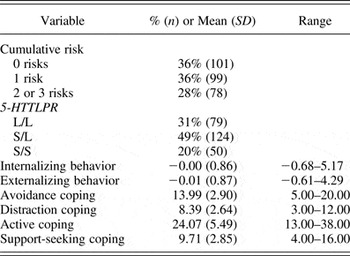
To create the cumulative risk score, we summed the indicators for harsh parenting in middle childhood, low parental warmth in middle childhood, and lifetime traumatic events. Thirty-six percent of youth were not characterized by any of the risk indicators, 36% had one risk indicator, and 28% had more than one risk indicator (Table 1). We describe this as cumulative risk, because all three indicators are robust risk factors for children's internalizing and externalizing problems. We note that youth in our analysis sample experienced relatively fewer cumulative risks than did non-Caucasian youth, t (395) = –2.50, p < .05.
Means (standard deviations) or percentages (numbers) for study variables

Note: Genotypic data were available for 253 of the 279 children. There were 25 cases in which children refused to give DNA, and one sample was lost. 5-HTTLPR, Serotonin transporter linked polymorphic region gene; L/L, long/long allele; S/L, short/long allele; S/S, short/short allele.
To assess the validity of the cumulative risk variable, we tested whether cumulative risk status predicted children's use of medical, educational, or counseling services, and specifically, their use of emotional and behavioral health services (psychiatrists, psychotherapists, behavioral therapists, family therapists, or school counselors). We also tested whether the cumulative risk variable was associated with clinically significant levels of internalizing and externalizing problems. We identified children with clinically significant internalizing and externalizing problems as those who exceeded the Child and Adolescent Symptom Inventory-defined clinical cut-point for conduct disorder or oppositional defiant disorder (externalizing) and generalized anxiety disorder or dysthymia (internalizing) according to caregivers or teachers.
Results of logistic regression analyses showed that the odds of using any services were 2.05 times greater (95% confidence interval [CI] = 1.09 to 3.84) and the odds of using emotional and behavioral health services specifically were 3.35 times greater (95% CI = 1.33 to 8.47) for children who had two or more risk factors compared with children who had no risk factors. Compared to children with no risk factors, those with only one cumulative risk factor did not have a greater odds of using any services (odds ratio [OR] = 1.19, 95% CI = 0.65 to 2.18) or emotional and behavioral health services specifically (OR = 1.66, 95% CI = 0.64 to 4.32).
Results of logistic regression analyses also showed that the odds of having clinically significant externalizing (OR = 8.64, 95% CI = 3.56 to 20.97) and internalizing problems (OR = 4.90, 95% CI = 1.56 to 15.34) were significantly greater for children with two or more risk factors compared with children who had no risk factors. There was a trend-level association between having one versus zero risk factors and children's clinically significant externalizing problems (OR = 2.38, 95% CI = 0.95 to 5.97), but this association was not significant for children's internalizing problems (OR = 1.85, 95% CI = 0.55 to 6.21). Thus, children with two or more risk factors were more likely to have clinically significant levels of internalizing and externalizing problems and were significantly more likely to use emotional and behavioral health services as well as medical and educational services compared with children who had none of the cumulative risk factors.
5-HTTLPR
The promoter activity of the 5-HTT gene, located on 17q11.2, is modified by sequence elements within the 5′ regulatory region, designated 5-HTTLPR. There is a 20–23 base pair repeat motif within this region within which two alleles are typically identified: a 14-repeat short allele versus a 16-repeat long allele.
DNA was extracted from buccal swabs as described by Freeman, Curtis, Huckett, Mill, and Craig (Reference Freeman, Curtis, Huckett, Mill and Craig2003) for the 91% of the White British and other White participants within the sample. 5-HTTLPR was genotyped using standard polymerase chain reaction protocols using a PTC-225 thermocycler. The forward primer had the sequence 5′-TCGAGGCTGAGCGTCTAGAGGGACTGAGCT-3′ and the reverse primer had the sequence 5′-CTTGTTGGGGATTCTCCCGCCTGGCGT-3′. Cycling conditions included an initial 10-min denaturing step at 95 °C, followed by 30 cycles at 65 °C for 1 min each, and a final extension phase at 72 °C for 5 min. Reactions were performed on 2 μl DNA, 10× NH4 buffer, 25 mM MgCl2, 5 pmol primer, and 1 U Taq polymerase and made up to 10 μl total volume with H2O. Polymerase chain reaction fragments were resolved on a 2% ethidium bromide stained agarose gel by electrophoresis for 1.5 hr at 220 V. Visualization under ultraviolet allowed for identification of genotypes (Table 1). The three groups were in Hardy–Weinberg equilibrium, χ2 (2) = 0.01, p = .56. Twenty-five children refused to provide DNA, and one sample was lost.
Internalizing problems were measured with the Child and Adolescent Symptom Inventory—4 Revised (Gadow & Sprafkin, Reference Gadow and Sprafkin2005). Caregivers and teachers reported how often children engaged in behaviors reflecting symptoms of generalized anxiety disorder (six items for caregivers, five items for teachers) and symptoms of dysthymia (eight items for caregivers, six items for teachers). Responses ranged from 0 (never) to 3 (very often). Children were coded as having met criteria for a symptom if they did it “often” or “very often” or if they did it “sometimes” in the case of low base rate behaviors. Symptoms were summed within informant. Generalized anxiety and dysthymia symptom sum scores were correlated within informant (caregivers: r = .60, p < .001; teachers: r = .64, p < .001). These scores were standardized and averaged to create caregiver- (α = 0.71) and teacher-reported (α = 0.79) internalizing scores, respectively. The correlation between caregiver and teacher internalizing scores was r = .37 (p < .001), and these scores were standardized and averaged to form the combined informant internalizing score used in our analyses. Means and standard deviations are provided in Table 1.
Externalizing problems were measured with the Child and Adolescent Symptom Inventory—4 Revised (Gadow & Sprafkin, Reference Gadow and Sprafkin2005). Caregivers and teachers reported how often children engaged in behaviors reflecting symptoms of conduct disorder (15 items for caregivers; 8 items for teachers) and symptoms of oppositional defiant disorder (8 items for both caregivers and teachers). Responses ranged from 0 (never) to 3 (very often). Children were coded as having met criteria for a symptom if they did it “often” or “very often” or if they did it “sometimes” in the case of low base rate behaviors (e.g., “starts fires”). Symptoms were summed within informant. Conduct and oppositional defiant symptom sum scores were correlated within informant (caregivers: r = .60, p < .001; teachers: r = .76, p < .001). These scores were standardized and averaged to create caregiver- (α = 0.87) and teacher-reported (α = 0.92) externalizing scores, respectively. The correlation between caregiver and teacher externalizing scores was r = .42, p < .001, and these scores were standardized and averaged to form the combined informant externalizing score used in our analyses. Means and standard deviations are provided in Table 1.
Coping strategies were measured with a modified version of the Children's Coping Strategies Checklist—Revision 1 (CCSC-R1; Ayers et al., Reference Ayers, Sandler, West and Roosa1996; Program for Prevention Research, 1999). Children were asked to think about how often they used various coping strategies to solve their problems, or make themselves feel better, during the past month (0 = never to 3 = most of the time). The CCSC-R1 comprises 4 higher order scales (active, distraction, avoidance, and support seeking strategies), each of which consists of 2 to 6 lower order scales (13 in total) comprising 4 to 5 items each. To reduce the time burden on participants, we administered a shortened version of the CCSC-R1 that included 2 items from each of the 13 subscales, with items selected for face validity. This included 4 items reflecting distraction coping, 4 items reflecting support seeking, 12 items reflecting active coping, and 6 items reflecting avoidant coping.
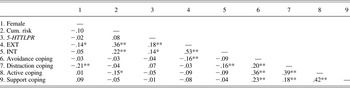
Given evidence that the four higher-order factors of the CCSC-R1 are highly correlated (Ayers et al., Reference Ayers, Sandler, West and Roosa1996), we subjected the 26 items to an exploratory factor analysis with direct oblimin rotation. All items (except 2, which were excluded) loaded on their original scales, and the internal consistency reliability of most of the original scales was adequate, although Cronbach α was low for the avoidance coping measure (α = 0.56). Within each coping scale, items were summed (see Table 1 for means and standard deviations). The Cronbach α for distraction coping was 0.70 (after deleting 1 item “you read a book or magazine,” which reduced the magnitude of Cronbach α to 0.67). For support seeking, the Cronbach α was 0.64, and for active coping the Cronbach α was 0.75. As shown in Table 2, correlations among the coping subscales ranged from r = .18 to .42 (all ps < .001).
Bivariate correlations among study variables
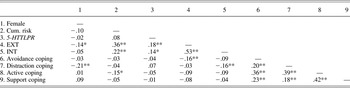
Note: Female = 1; Cum. risk, cumulative risk; EXT, externalizing; INT, internalizing.
*p < .05. **p < .01.
Statistical analysis
First, bivariate correlations were conducted among study variables (see Table 2). Second, we attempted to replicate previous findings in the literature (and facilitate the work of future meta-analysts) by conducting ordinary least squares (OLS) regression analyses to test whether 5-HTTLPR moderated the effect of cumulative environmental risk on children's problem behaviors. An additive mode of transmission was assumed for genetic data (0, 1, 2 short alleles). Thereafter, hypothesis-testing analyses were undertaken. The Widaman et al. (Reference Widaman, Helm, Castro-Schilo, Pluess, Stallings and Belsky2012) model-testing approach that we describe and implement below is designed to evaluate, on an a priori basis, competing models of Person × Environment interaction. In contrast to traditional OLS approaches that evaluate whether an omnibus interaction, taking no particular form, is statistically significant, the model-testing approach can determine whether the anticipated moderating effect of 5-HTTLPR on contextual risk in predicting problem behavior proves more consistent with diathesis–stress or differential susceptibility thinking.Footnote 1
In order to illuminate and competitively evaluate the form of the hypothesized genetic moderational process under investigation, we employed SAS 9.3 PROC NLIN and NLMIXED to fit all models. The reparameterized model adapted from Widaman et al. (Reference Widaman, Helm, Castro-Schilo, Pluess, Stallings and Belsky2012) follows the form
 $$\eqalign{Y & = {A_{0}} + {B_1}\left( {{X_1} - C} \right) + {B_4}\left( {\left( {{X_1} - C} \right) \times {D_2}} \right) \cr & \quad + {B_5}\left( {\left( {{X_1} - C} \right) \times {D_3}} \right) + E\comma} $$
where Y represents the combined-informant internalizing or externalizing score, adjusted for sex; X 1 demarcates cumulative risk; D 2 and D 3 are the dummy variables with unit values for individuals in 5-HTTLPR allelic groups 2 and 3, respectively (i.e., Group 2: S/L heterozygotes; Group 3: S/S homozygotes); and C is the crossover point of the three allelic groups. Note that the current inquiry only evaluates three allelic groups using the same crossover point.
Equivalent to Equation 1, the following reflects the equation for each allelic group:
 $$\!\!\!\!\!\!\!\!\!Y = \left\{ \!\!{\matrix{{{\rm Group}\; 1\left( {{\rm L/L}} \right)\!\!:\; } & \hskip-2.7pt{Y = {A_0} + {B_1}\left( {{X_1} - C} \right) + E} \cr {{\rm \!\!Group}\; 2\left( {{\rm S/L}} \right)\!\!:} & \hskip0.5pt\!\!{Y = {A_0} + {B_2}\left( {{X_1} - C} \right) + E} \cr {{\rm \hskip1pt\!\!\!Group}\; 3\left( {{\rm S/S}} \right)\!\!:} & \hskip0.5pt\!\!{Y = {A_0} + {B_3}\left( {{X_1} - C} \right) + E} \cr } } \right.\!\comma $$
where B 2 = B 1 + B 4, and B 3 = B 1 + B 5 (B 4, B 5 in Equation 1); B 1, B 2, and B 3 stand for the slope for each allelic group; and A 0 is the intercept for each group. All other symbols are defined above.
The model in Equation 1 is the weak differential susceptibility model (Model 1w) in which the crossover point falls within the range of environmental measurement and all allelic groups prove susceptible to environmental influence to some degree, though some more strongly than others. In contrast, the strong differential susceptibility model (Model 1s) stipulates that the association between environmental predictor and outcome is nonsignificant for the least (or less) malleable group(s), thereby fixing B 1 (or B 1 and B 2) to zero, and significant for the most (or more) malleable group(s). Weak and strong diathesis–stress models (Models 2w and 2s) differ in similar ways from each other, although for both the crossover point is fixed at the positive end (i.e., low risk end) of the environmental parameter.
Each model supplies Akaike and Bayesian information criteria (AIC and BIC, respectively). Lower values of AIC and BIC indicate better fit to the data. Both AIC and BIC contain penalties for model complexity, so adding unnecessary parameters will lead to a rise in the index, thereby indicating poorer fit to the data. We evaluated relative model fit using the AIC and BIC in connection with statistical significance of model parameters. Additional statistical details can be found in Widaman et al. (Reference Widaman, Helm, Castro-Schilo, Pluess, Stallings and Belsky2012) and Belsky et al. (Reference Belsky, Pluess and Widaman2013). Recommendations for comparing differential susceptibility versus diathesis stress models have also been made by Roisman et al. (Reference Roisman, Newman, Fraley, Haltigan, Groh and Haydon2012).
Results
OLS regression results
We conducted OLS regression analyses in which we regressed internalizing and externalizing problems (separately) on the cumulative risk score, 5-HTTLPR genotype (0, 1, or 2 short alleles), and the cumulative Risk × Genotype cross-product. Prior to analysis, all variables were examined for fit between their distributions and the assumptions of OLS regression analysis including normality, linearity, and homoscedasticity of residuals.
Internalizing symptoms
After controlling for child sex, the interactive effect of the 5-HTTLPR genotype and cumulative risk on combined caregiver and teacher-reported internalizing problems was significant (b = 0.19, SE = 0.10, p < .05). The interaction term accounted for 2% of the variance, with the full model accounting for 6% of the variance in combined caregiver and teacher reported internalizing problems.
Externalizing symptoms
The interaction between the 5-HTTLPR genotype and cumulative risk was significant for combined caregiver- and teacher-reported externalizing problems (b = 0.25, SE = 0.09, p < .01), with the interaction accounting for 3% of the variation and the full model accounting for 20% of the variation in caregiver-reported externalizing problems.
Form of the interactions
Based on the preliminary analyses, we added gender as another parameter in the equation:
 $$Y = \left\{{\hskip-4pt} \matrix{ \hbox{Group }1 \left({\rm L/L} \right)\colon & {\hskip-10pt}Y = {A_0} + {B_1} \left({{X_1} - C}\right) \cr &{\hskip-2.5pt} \qquad + \, {B_4} \times \hbox{Gender} + E \cr \hbox{Group }2 \left({\rm S/L}\right)\colon & {\hskip-10pt}Y = {A_0} + {B_2} \left({X_1} - C\right) \cr &{\hskip-2.5pt}\qquad + \, {B_4} \times \hbox{Gender} + {E} \cr \hbox{Group } 3 \left({\rm S/S}\right)\colon & {\hskip-10pt}Y = {A_0} + {B_3} \left({X_1} - C\right)\cr &{\hskip-2.5pt}\qquad +\, {B_4} \times \hbox{Gender} + E \cr} \right. \,\comma $$
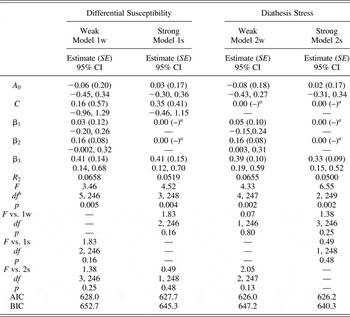
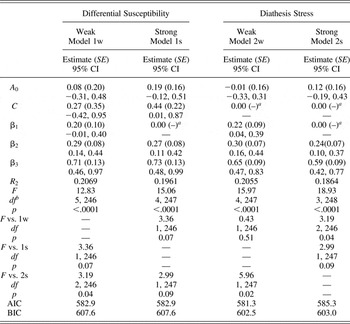
Then we fit a set of reparameterized models (Equation 3). Summary model results, including each estimated parameter and AIC and BIC for each model, are displayed in Tables 3 and 4. We next fixed the corresponding parameters to be zeroFootnote 2 as previously described in order to compare the four alternative models (Model 1s/1w, 2s/2w).
Alternative regression analyses for internalizing behavior (N = 252)

Note: AIC, Akaike information criterion; BIC, Bayesian information criterion; F vs. 1w, an F test of the differences in R 2 for a given model versus Model 1w.
a Parameter fixed at the reported value; Standard errors and 95% confidence intervals are not applicable and are listed as (–)/(–).
b The original model included another estimated parameter for child gender (as a covariate). The parameter estimates (i.e., β4) are not reported in the table, but the degrees of freedom counted for this parameter.
Alternative regression analyses for externalizing behavior (N = 252)
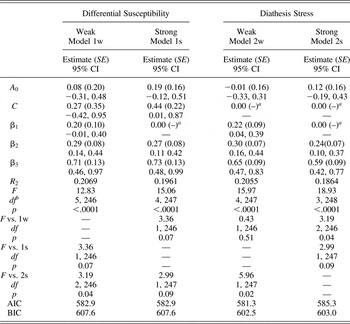
Note: AIC, Akaike information criterion; BIC, Bayesian information criterion; F vs. 1w, an F test of the differences in R 2 for a given model versus Model 1w.
a Parameter fixed at the reported value; Standard errors and 95% confidence intervals are not applicable and are listed as (–)/(–).
b The original model included another estimated parameter for child gender (as a covariate). The parameter estimates (i.e., β4) are not reported in the table, but the degrees of freedom counted for this parameter.
Internalizing problems
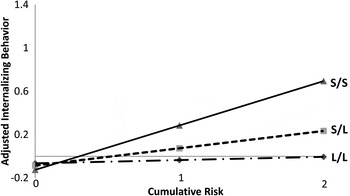
The results proved consistent with the strong diathesis–stress model for internalizing problems (Figure 1). This was because (a) all four alternative models fit the data well (see R 2 values in Table 3) and equally so (see F test results for comparing models in Table 3); (b) Model 2s (i.e., strong diathesis–stress) had the smallest BIC and the second smallest AIC values; (c) in the freely estimated model (Model 1w), the crossover point (see values of C and CI in Table 3) fell partly outside the possible range of the environmental predictor, thus proving inconsistent with differential susceptibility; and (d) estimated slopes and 95% confidence intervals in Model 1w were significantly different from zero for the 5-HTTLPR S/S homozygotes but not for the long-allele carriers (i.e., S/L and L/L). Furthermore, constraining the two slopes to be zero did not result in a significant decrease in R 2.
Interaction between exposure to cumulative risk and 5-HTTLPR genotype predicting internalizing behavior. (Cumulative risk: “0” = 0 risk, “1” = 1 risk, “2” = 2 or 3 risks. “Adjusted Internalizing Behavior” represented the dependent variable after adjusting for child gender.)

Externalizing problems
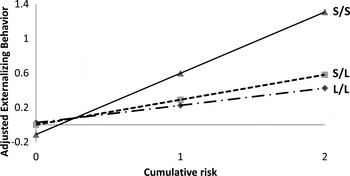
The results proved consistent with the weak diathesis–stress model for externalizing problems (Figure 2). This was because, (a) although all four alternative models (Model 1w/s, 2w/s) fit the data (see R 2 values in Table 4), the weak diathesis–stress model (i.e., Model 2w) accounted for the most variance, an amount comparable to the full Model 1w (see F test results in Table 4); (b) the AIC and BIC values for Model 2w were the smallest; (c) in the freely estimated Model 1w (i.e., weak differential susceptibility model), the 95% confidence interval for the crossover point fell partly outside the possible range of the measured environmental predictor (see values C and CI in Table 4), thus proving inconsistent with differential susceptibility; (d) in Model 1w, the estimated slopes for all allelic groups were different from zero; (e) and even though the confidence interval for the estimated slope of 5-HTTLPR L/L homozygotes (i.e., β1) in Model 1w fell slight below zero, constraining it to zero in the more parsimonious Model 2w did not significantly decrease R 2 relative to Model 1w.
Interaction between exposure to cumulative risk and 5-HTTLPR genotype predicting externalizing behavior. (Cumulative risk: “0” = 0 risk, “1” = 1 risk, “2” = 2 or 3 risks. “Adjusted Externalizing Behavior” represented the dependent variable after adjusting for child gender.)

Mediated moderation
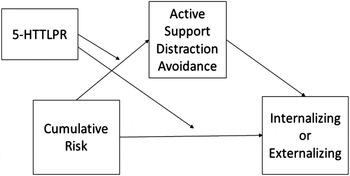
To test the hypothesis that individual differences in coping strategies explained why the relationship between cumulative risk and internalizing and externalizing problems varied as a function of genotype, we used PROCESS (Model 8; Hayes, 2013), which estimates indirect effects using a bootstrapping procedure. Bias-corrected bootstrap confidence intervals based on 5,000 bootstrap samples were used to test the indirect effects. Coping strategies were evaluated as potential mediators by entering them simultaneously into the model, which allowed for testing whether these strategies collectively mediated observed associations as well as whether individual strategies uniquely mediated the associations, above and beyond the intercorrelations with the other strategies.
Internalizing problems
The results of the mediated moderation model are presented in Figure 3. Mediated moderation analyses indicated that avoidance, support seeking, and active coping strategies did not significantly mediate the interaction between 5-HTTLPR genotype and cumulative risk on internalizing problems. However, distraction coping was a significant mediator. The bootstrapping results yielded a total indirect effect of distraction coping (b = 0.02, SE = 0.02) with a 95% confidence interval that did not contain zero (0.0016, 0.0855). We further examined the indirect effects for each of the three genotype groups by testing for mediation in the simple slopes. These results demonstrated that the indirect effect of cumulative risk on combined caregiver and teacher reported internalizing problems through distraction coping was only significant for children who were homozygous for the short allele (b = 0.04, SE = 0.03; 95% CI = 0.0073, 0.1249) and that 16% of the effect of cumulative risk on combined caregiver and teacher reported internalizing symptoms could be explained by distraction coping. Among children who were homozygous for the short allele, the more cumulative risk indicators they had, the less frequently they used distraction coping, which in turn was associated with higher levels of internalizing problems. The indirect effects via the mediator were not significant for children who were heterozygous (b = 0.01, SE = 0.01; 95% CI = –0.0066, 0.04444) or children who were homozygous for the long allele (b = –0.02, SE = 0.02; 95% CI = –0.0818, 0.0078).
Mediated moderation model for internalizing symptoms.

Externalizing problems
Although youth who more frequently used avoidance coping strategies had fewer externalizing problems (Table 2), none of the coping strategies significantly mediated the interactive effect of 5-HTTLPR genotype and cumulative risk on externalizing problems.
Discussion
Implications for research and theory
To date, a relatively small number of studies have identified potential mechanisms by which risk for internalizing problems is increased among (Caucasian) short allele carriers who experience stressful life events. As reviewed earlier, these include imaging genetic studies showing that short/short homozygotes mount a significantly greater cortisol response to acute stressors than do long allele carriers (Miller et al., Reference Miller, Wankerl, Stalder, Kirschbaum and Alexander2013) and that the association between 5-HTTLPR genotype and amygdala reactivity is most pronounced in individuals who have been exposed to high levels of stressful life events (Alexander et al., Reference Alexander, Kuepper, Schmitz, Osinsky, Kozyra and Hennig2009, Reference Alexander, Klucken, Koppe, Osinsky, Walter and Vaitl2012; Williams et al., Reference Williams, Gatt, Schofield, Olivieri, Peduto and Gordon2009). These also include studies showing that the short allele is associated with cognitive vulnerabilities to depression, particularly under stressful conditions (Gibb et al., Reference Gibb, Beevers and McGeary2013) and suggestive evidence that short allele carriers cope differently with problems than do individuals who are homozygous for the long allele (Miu et al., Reference Miu, Vulturar, Chis, Ungureanu and Gross2013; Szily et al., Reference Szily, Bowen, Unoka, Simon and Kéri2008; Wilhelm et al., Reference Wilhelm, Siegel, Finch, Hadzi-Pavlovic, Mitchell and Parker2007). Consistent with this body of research, we found that (Caucasian) youth who carried two copies of the short allele differed from long allele carriers in how they coped with problems, particularly in the context of hostile and cold relationships with caregivers and exposure to traumatic events, mainly in their homes and neighborhoods.
Our finding that distraction coping strategies were associated with reductions in internalizing problems is consistent with (a) experimental evidence showing that inducing depressed people to focus on benign or positive thoughts reduces their dysphoria and improves their ability to generate effective solutions to problems and (b) some correlational data indicating that the more people manage to distract themselves from their problems, the less depressed they feel (Compas et al., Reference Compas, Connor-Smith, Saltzman, Thomsen and Wadsworth2001; Nolen-Hoeksema, Wisco, & Lyubomirsky, Reference Nolen-Hoeksema, Wisco and Lyubomirsky2008). One possible explanation of such results is that instead of distracting themselves from potentially chronic and uncontrollable problems, youth who were homozygous for the short allele ruminated about those problems. Youth who were less capable of suitably distracting themselves from problems within their families or neighborhoods might have engaged in perseverative negative thinking that made it more difficult to think constructively or take action to solve problems or to enlist social support, thus increasing their chances of becoming depressed or anxious (Mor & Winquist, Reference Mor and Winquist2002; Nolen-Hoeksema et al., Reference Nolen-Hoeksema, Wisco and Lyubomirsky2008). Another possibility is that youth who carried two copies of the short allele were simply not getting exercise-related benefits associated with distraction coping. Two of the distraction-coping strategies referred to playing sports and doing exercise, and there is evidence that exercise itself may relieve symptoms of internalizing problems, possibly by stimulating the release of endorphins (Craft & Landers, Reference Craft and Landers1998; Rimer et al., Reference Rimer, Dwan, Lawlor, Greig, McMurdo and Morley2012).
We did not find that coping styles mediated the 5-HTTLPR G × E effect on externalizing problems. Given the common co-occurrence of internalizing and externalizing symptoms in this developmental period (Angold et al., Reference Angold, Costello and Erkanli1999; Caron & Rutter, Reference Caron and Rutter1991; Drabick, Reference Drabick2009; Klein & Riso, Reference Klein, Riso and Costello1993), we expected that similar coping constructs would account for both outcomes. While short allele carriers who were exposed to stressful experiences and relationships were at increased risk for internalizing and externalizing problems, our findings suggest that the mechanism by which this G × E interaction exerts its effect may differ for internalizing versus externalizing problems. In the case of externalizing problems, it may be that heightened physiological reactivity associated with short allele genotype, coupled with executive function deficits that weaken inhibitory control (Morgan & Lilienfeld, Reference Morgan and Lilienfeld2000), increases the likelihood that youth will respond with reactive aggression to perceived threats.
Although we measured four coping strategies, only two (distraction and avoidance) were associated with children's internalizing and externalizing problems, respectively, particularly when youth were homozygous for the short allele. Distraction and avoidance may be particularly effective coping strategies when stressors are perceived as uncontrollable, as may have been the case for youth in our sample who were exposed to yelling, shouting, and violence in their homes and neighborhoods as well as relationships with caregivers that were relatively harsh and lacking in affection.
Although distraction coping has frequently been associated with reduced risk of internalizing and externalizing problems, avoidance coping shows mixed associations. Consistent with the possibility that avoidance coping may be beneficial in the context of uncontrollable stressors, several studies of socioeconomically disadvantaged, inner-city youth faced with high rates of family and neighborhood poverty and violence indicate that avoidance coping is associated with reductions in externalizing problems and other outcomes, at least for some groups (Gonzalez et al., 2001; Grant et al., Reference Grant, O'Koon, Davis, Roache, Poindexter and Armstrong2000; Sanchez et al., Reference Sanchez, Lambert and Cooley-Strickland2013). Like the youth in these studies, CEDS youth were predominantly from socioeconomically disadvantaged neighborhoods with relatively high rates of family and community violence. In this context, engaging with the stressor may provoke aggressive interactions and thus be associated with increases in children's externalizing problems, whereas avoidance behaviors like trying to stay away from things that make you upset or trying to avoid people who make you feel bad may decrease the chances that children will engage in externalizing behavior.
Although we did not find that active and support-seeking coping strategies were associated with children's internalizing and externalizing problems, it is possible that these strategies will be used to greater benefit as the children get older. For example, children's effective use of active coping strategies may rely on a level of cognitive maturity and abstraction that our participants lacked. Similarly, as children age, they may have a broader social circle on which to rely for advice and support, making support-seeking strategies more effective in reducing the risk for internalizing and externalizing problems. Such a developmental transition, in which children learn to engage with their emotions, may be necessary to prevent distraction coping strategies from morphing into more harmful avoidance behaviors (Nolen-Hoeksema et al., Reference Nolen-Hoeksema, Wisco and Lyubomirsky2008).
Limitations
Although the study had a number of strengths, including assessments of children's internalizing and externalizing problems by multiple informants, it was also characterized by various weaknesses. First, although internal consistency reliability for the active and distraction coping subscales was adequate (≥0.70), it was lower for the support-seeking and avoidance-coping subscales. Thus, measurement error might have attenuated observed associations between coping style and other predictor or outcome variables in our models. Second, although the effect of the interaction between 5-HTTLPR genotype and cumulative environmental risk on children's internalizing problems was significantly mediated by distraction coping strategies, the mediated effect was small, suggesting that other factors also explain why short/short homozygotes are at elevated risk for internalizing problems in the context of stressful relationships and experiences.
Third, cumulative risk measures have been criticized for making arbitrary designations of risk status (e.g., the “risk” end of a continuously distributed variable can be identified anywhere from above the median to the top 10%), for presuming additive (versus interactive) effects of risk variables, for weighting all risks equally (despite potential differences in risk severity), and for comprising combinations of more proximal versus more distal risk factors representing conceptually distinct domains of risk (e.g., socioeconomic stressors versus parental psychopathology; Evans, Li, & Whipple, Reference Evans, Li and Whipple2013). Nevertheless, cumulative risk measures reflect the reality that physical and psychosocial risk factors frequently co-occur (Evans, Reference Evans2004); they are parsimonious; and they are more highly predictive of poor developmental outcomes than are measures of single exposures (Evans et al., Reference Evans, Li and Whipple2013). Although our cumulative risk measure comprised indicators of caregiver–child relations and children's exposure to traumatic events, these generally reflected caregiver–child, family, and neighborhood relationships that were high in hostility and low in warmth given that children in our sample most frequently reported traumatic events involving family and neighborhood discord. Our measure of cumulative risk also showed predictive validity in that youth who had experienced two or more of the risk indicators were more likely to have received services (including emotional and behavioral health services) and to have clinically significant levels of internalizing and externalizing problems.
Future directions for translating research on the influential child into preventive intervention
Children in our sample benefited from the use of avoidance and distraction strategies (particularly short/short carriers in the case of distraction strategies). Given the potential for these strategies to become maladaptive if children fail to eventually engage with their emotions, distractions that provide opportunities for children to form socially supportive relationships may be especially beneficial in the short and long term. Playing sports on a team or joining a club might be a good distraction and have the added benefit of surrounding children and adolescents with peers and adults who could encourage them to share their feelings and help them address whatever problems they may be experiencing. Sports teams and clubs may also provide youth with structured alternatives to engaging in more risky behaviors. In contrast, more solitary distractions like reading books, watching movies, or playing video games may not benefit youth in the long term if they do not ultimately provide opportunities to engage with emotions or to actively problem-solve. We note that such opportunities could present themselves if, for example, youth gained insight into their own circumstances by seeing them mirrored in the lives of fictional and nonfictional figures.
Youth who are homozygous for the short allele and who appear to be highly physiologically and emotionally reactive in the face of stress may benefit the most by being trained to do something they enjoy that takes their minds off their problems when they feel overwhelmed. If research on child effects has taught us anything, however, it is that this hypothesis must be evaluated so as to rule out the possibility of reverse causation. That is, children who are naturally capable of distracting themselves may be the same children who are least likely to experience internalizing or externalizing problems. A randomized control trial would demonstrate whether exercises or activities that facilitate distraction coping strategies reduce children's internalizing or externalizing problems independent of whatever characteristics children bring to the activity.