Introduction
The genus Byssoloma, an almost cosmopolitan group of foliicolous lichens, is most diverse in the tropics; it includes c. 55 currently recognized species characterized by their byssoid apothecial margin, Byssoloma-type of ascus structure, pycnidia conidiomata, pyriform or bacillar conidia and 1–7-septate ascospores (Vězda Reference Vězda1974, Reference Vězda1975, Reference Vězda1987; Sérusiaux Reference Sérusiaux1979, Reference Sérusiaux1998; Kalb & Vězda Reference Kalb and Vězda1990; Aptroot & Sipman Reference Aptroot and Sipman1991; Sipman & Aptroot Reference Sipman and Aptroot1992; Fárkas & Vězda Reference Fárkas and Vězda1993; Malcolm & Vězda Reference Malcolm and Vězda1995; Kondratyuk Reference Kondratyuk and Wasser1996; Aptroot et al. Reference Aptroot, Diederich, Sérusiaux and Sipman1997, Reference Aptroot, Ferraro, Lai, Sipman and Sparrius2003; Cáceres Reference Cáceres1999; Thor et al. Reference Thor, Lücking and Matsumoto2000; Lücking et al. Reference Lücking, Streimann and Elix2001; Sérusiaux et al. Reference Sérusiaux, Gómez-Bolea, Longán and Lücking2002; Schubert et al. Reference Schubert, Lücking and Lumbsch2003; Hermansson & Thor Reference Hermansson and Thor2004; Lücking Reference Lücking2006, Reference Lücking2008, Reference Lücking2013; Messuti & de la Rosa Reference Messuti and de la Rosa2007; Nguyen et al. Reference Nguyen, Joshi, Lücking, Wang, Dzung, Koh and Hur2010; Lumbsch et al. Reference Lumbsch, Ahti, Altermann, Amo de Paz, Aptroot, Arup, Bárcenas Peña, Bawingan, Benatti and Betancourt2011; Breuss Reference Breuss2013, Reference Breuss2016a, Reference Breussb; Cáceres et al. Reference Cáceres, Santos, Mendonça, Mota and Aptroot2013; Aptroot Reference Aptroot2014; Gupta & Sinha Reference Gupta and Sinha2015; van den Boom Reference van den Boom2016; Wei Reference Wei2017; Elix & McCarthy Reference Elix and McCarthy2018; Wang & Wei Reference Wang and Wei2018). Most species occur on living leaves and a small number can be found on bark, such as Byssoloma arboricola Sérus. & Aptroot, B. australiense P.M. McCarthy & Elix, B. catillariosporum M. Cáceres et al., B. fuscum van den Boom, B. llimonae Sérus. et al., B. maderense Breuss, B. marginatum (Arnold) Sérus., B. permutans (Nyl.) Lücking, B. rubromarginatum Messuti & de la Rosa, B. vezdanum Sérus. and B. xanthonicum Aptroot (Aptroot et al. Reference Aptroot, Diederich, Sérusiaux and Sipman1997; Sérusiaux Reference Sérusiaux1998; Sérusiaux et al. Reference Sérusiaux, Gómez-Bolea, Longán and Lücking2002; Messuti & de la Rosa Reference Messuti and de la Rosa2007; Cáceres et al. Reference Cáceres, Santos, Mendonça, Mota and Aptroot2013; Lücking Reference Lücking2013; Aptroot Reference Aptroot2014; Breuss Reference Breuss2016a, Reference Breussb; van den Boom Reference van den Boom2016; Elix & McCarthy Reference Elix and McCarthy2018) or rocks, such as B. adspersum Malcolm & Vězda and B. octomerum Malcolm & Vězda (Malcolm & Vězda Reference Malcolm and Vězda1995). Byssoloma lichenophila S.Y. Kondr. et al., is the only lichenicolous species (Kondratyuk Reference Kondratyuk and Wasser1996).
This study is based mainly on our own collections from South China and Thailand. The phylogenetic reconstruction with molecular data and detailed analysis of morphological and anatomical characters supports the description of three new species.
Material and Methods
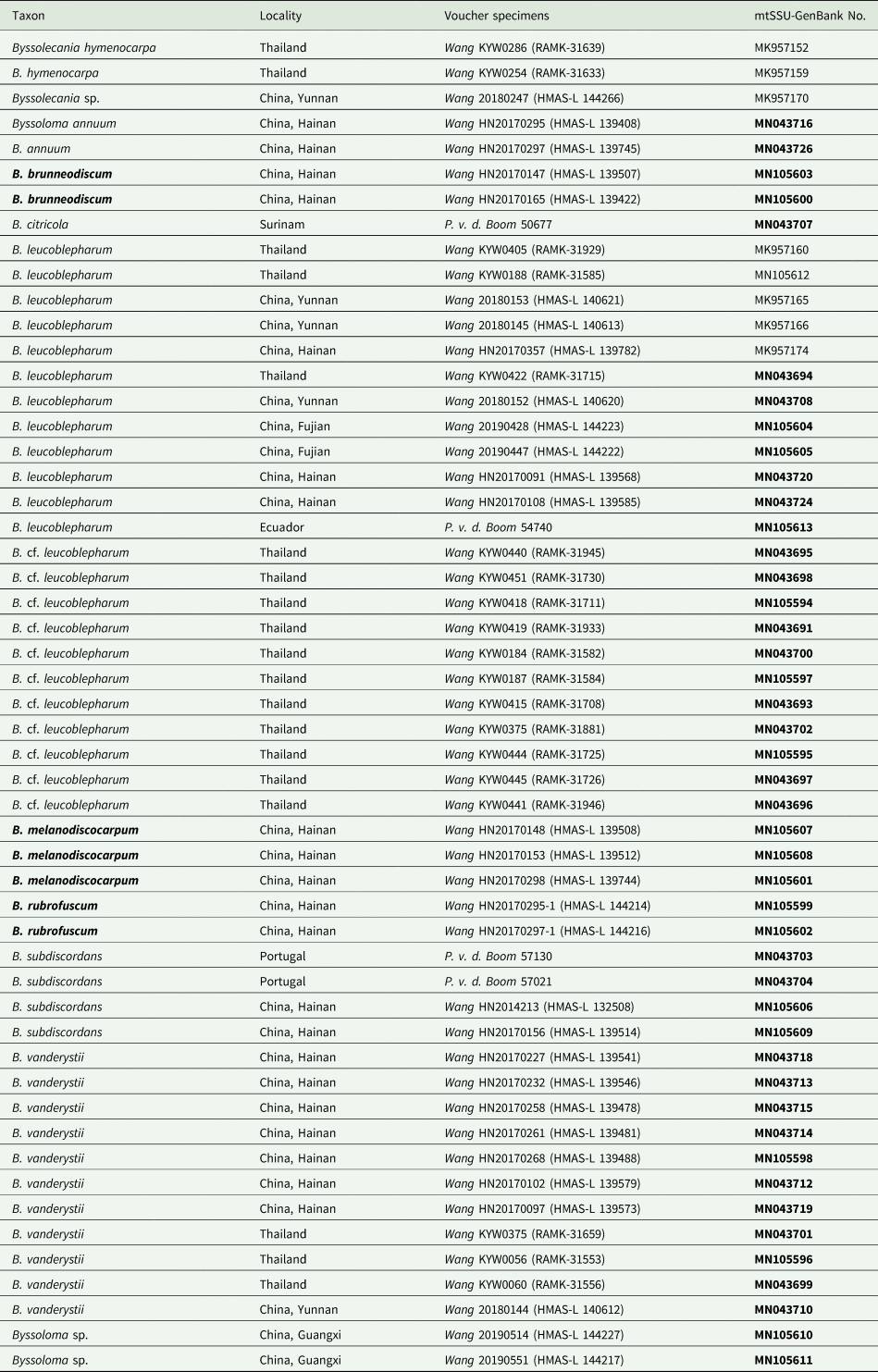
Material of the new species and other samples used for DNA analysis are deposited in the herbaria HMAS-L and RAMK, with an additional four specimens from South America and Europe stored in the private herbaria of Pieter van den Boom (Table 1).
Specimens used in the mtSSU-based phylogenetic analysis of Byssoloma species together with their voucher information and GenBank Accession numbers. New sequences and new species are in bold.

Morphology and chemistry
All specimens were examined using a Motic dissecting microscope and an Olympus CX21 compound microscope. Micrographs were taken with a Leica M125 dissecting microscope equipped with a Leica DFC450 camera. Anatomical mounts were photographed with a Zeiss Imager A2 compound microscope equipped with a Zeiss AxioCam MRc5 camera. For identification purposes, colour reactions of apothecium sections were tested with KOH (a 10% aqueous solution of potassium hydroxide), I (a 10% aqueous solution of potassium iodide) and P (saturated solution of p-phenylenediamine in 95% ethyl alcohol). Lichen substances were identified using standardized thin-layer chromatography techniques (TLC) with solvent system C (Orange et al. Reference Orange, James and White2010). Paraphyses were investigated in 10% KOH when they were indistinct due to strong gelatinization.
DNA extraction, PCR amplification and sequencing
DNA was extracted from 8–30 apothecia per sample using the DNAsecure Plant Kit DP320-03 (200preps; Tiangen, Beijing, China). Apothecia were cut from cleaned thallus material with a razor blade, and extractions were carried out following the instructions of the kit. Finally, the DNA was held in 1.5 ml microcentrifuge tubes and kept at −20 °C.
PCR amplification of mtSSU rDNA was performed using the primers mrSSU1 and mrSSU3R (Zoller et al. Reference Zoller, Scheidegger and Sperisen1999). The 25 μl of PCR mix contained 12.5 μl 2 × MasterMix (TaqDNA Polymerase (0.1 units/μl), 4 mM MgCl2, 0.4 nM dNTPs; Aidlab Biotechnologies Co., Ltd, Beijing, China), 1 μl of each primer, 8.5 μl ddH2O, and 2 μl of DNA. The PCR cycling parameters included an initial denaturation at 94 °C for 5 min, followed by 30 cycles of 94 °C for 30 s, 53 °C for 30 s and 72 °C for 1 min 30 s, and a final extension at 72 °C for 8 min. PCR products were purified using the magnetic bead method and Sanger sequenced by the Beijing Ruibio BiotechCo., Ltd (China).
Sequence alignment and phylogenetic analysis
A total of 45 new mtSSU sequences were aligned, together with 8 sequences retrieved from GenBank (Table 1). Three sequences of Byssolecania Vain. were chosen as outgroup based on previous phylogenetic analyses (Andersen & Ekman Reference Andersen and Ekman2005) and phenotypic similarity. Primary sequences were assembled and edited with Geneious v.6.1.2 (Biomatters Ltd, Auckland, NZ), and sequence alignments were conducted online using MAFFT v.7 (Katoh et al. Reference Katoh, Asimenos and Toh2009). Ambiguously aligned sites were excluded with Gblocks v.0.91b (Castresana Reference Castresana2000), implementing all the options for a less stringent selection (http://molevol.cmima.csic.es/castresana/Gblocks_server.html). A matrix consisting of 814 unambiguously aligned mtSSU positions was produced.
Phylogenetic analyses based on mtSSU were carried out using two different approaches, maximum likelihood (ML) and Bayesian inference (BI). Maximum likelihood analysis was performed with RAxML-HPC v.8.2.6 (Stamatakis Reference Stamatakis2014) on the Cipres Science Gateway (http://www.phylo.org) and support values were inferred from the 70% majority-rule tree of all saved trees obtained from 1000 non-parametric bootstrap pseudoreplicates. Bayesian analysis was performed using MrBayes v.3.2.6 (Huelsenbeck & Ronquist Reference Huelsenbeck and Ronquist2001; Ronquist & Huelsenbeck Reference Ronquist and Huelsenbeck2003). For the BI analysis, the GTR + G model was selected, based on jModelTest 2.1.4 (Darriba et al. Reference Darriba, Taboada, Doallo and Posada2012). Markov chain Monte Carlo (MCMC) was initiated from a random tree using 5 million generations and saving every 1000th tree, with the initial 25% of trees discarded as burn-in. Stationarity of analysis was determined by examining the standard deviation of split frequencies (< 0.01). A majority-rule consensus tree was constructed from the remaining trees to obtain posterior probability (PP), with values ≥ 0.95 considered to be significantly supported. The phylogenetic tree was visualised with FigTree v.1.4.3.
Results
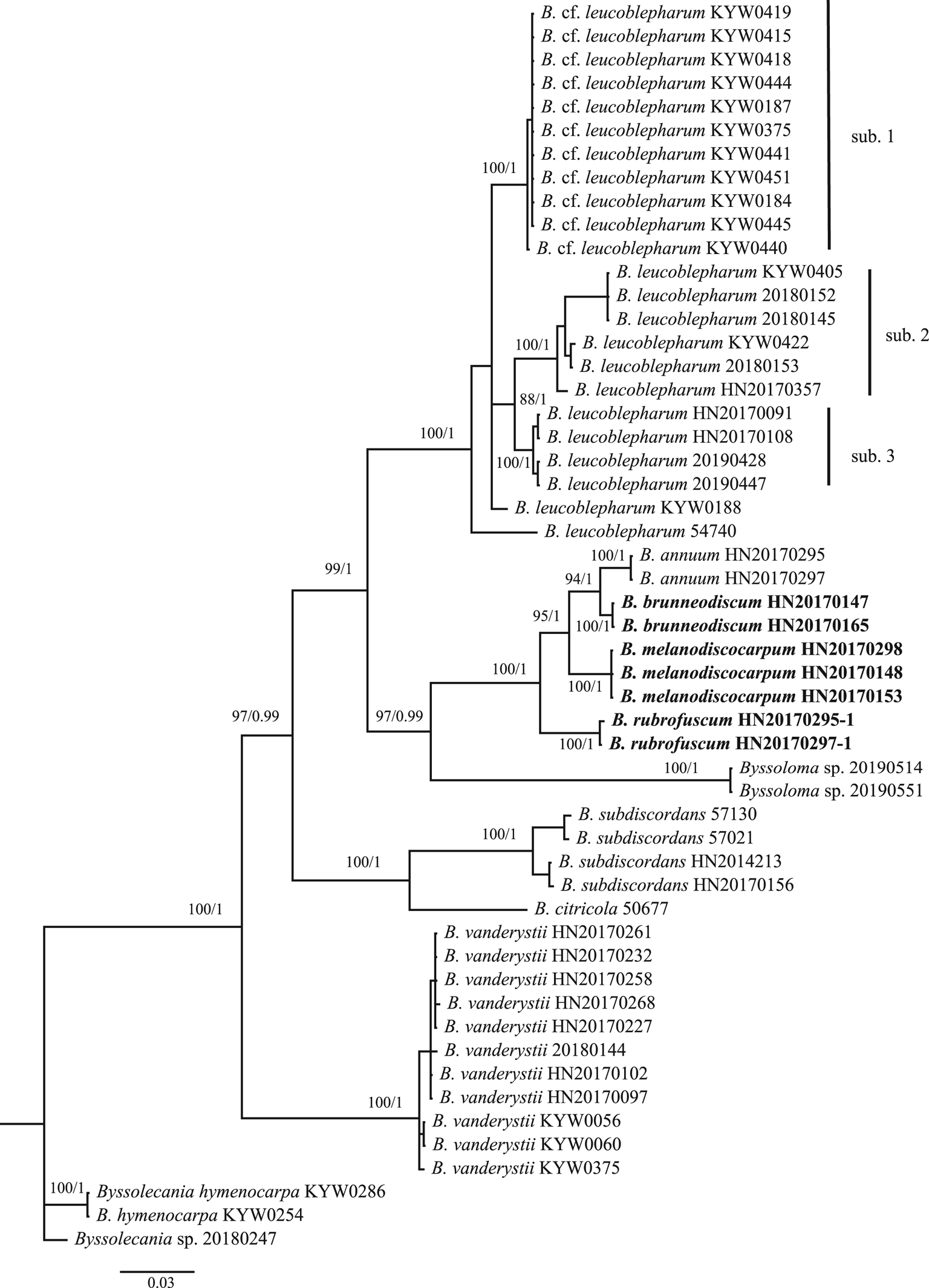
The final alignment consisted of 45 mtSSU sequences newly generated from 45 global Pilocarpaceae specimens, and 8 mtSSU sequences downloaded from NCBI (Table 1). The two separate analyses, maximum likelihood and Bayesian inference, did not show any conflicts; therefore, only the BI tree is presented, with ML bootstrap support (BS) ≥ 75% and BI posterior probabilities (PP) ≥ 0.95 (Fig. 1).
Phylogenetic relationships among 50 sequences (Table 1) representing 9 species of Byssoloma based on a Bayesian analysis of the mtSSU dataset. Bootstrap values ≥ 75 and posterior probabilities ≥ 0.95 are indicated at the branches. Newly described species are in bold. Three subclades are indicated for B. leucoblepharum. The tree was rooted using Byssolecania spp. Scale = 0.03 substitution per site.

The mtSSU sequences show that all species with multiple accessions form strongly supported clades in the tree, and the in-group consists of four distinct well-supported clades: sequences of B. vanderystii Sérus. are combined in a basal clade, B. subdiscordans (Nyl.) P. James and B. citricola (Maubl.) Lücking et al. form a strongly-supported monophyletic clade, B. annuum (Vain.) G. Thor et al. is strongly supported as sister to the new species B. brunneodiscum and the B. annuum-brunneodiscum clade together with B. melanodiscocarpum, are sister to B. rubrofuscum; consequently these four species form a highly supported clade together with an unnamed species which is basal to this clade. We name this the B. subundulatum clade according to Lücking (Reference Lücking2008). All sequences of B. leucoblepharum (Nyl.) Vain. form a well-supported clade sister to the B. subundulatum clade, the sister relationship receiving high support (BS = 99, PP = 1).
Discussion
Our molecular results show that B. subdiscordans is sister to B. citricola, with which it forms a monophyletic group instead of belonging to the B. leucoblepharum group as originally suggested by Lücking (Reference Lücking2008). Byssoloma subdiscordans forms dispersed thalli and pure black apothecia resembling those of B. citricola; our molecular data point to the importance of thallus character in taxonomic studies of Byssoloma.
In his monograph of foliicolous lichens in the Neotropics, Lücking (Reference Lücking2008) combined the species with a compact apothecial margin composed of densely woven hyphae in the B. subundulatum group. In our study, five species belonging to this group, B. annuum, B. rubrofuscum, B. melanodiscocarpum, B. brunneodiscum and an unnamed species, are sequenced and form a well-supported clade. Our data suggest that the B. subundulatum group is probably monophyletic.
The main morphological features separating the B. vanderystii clade from other groups in the tree are its bacillar conidia and 7-septate ascospores, while other Byssoloma species usually have pyriform conidia and 3–5-septate ascospores.
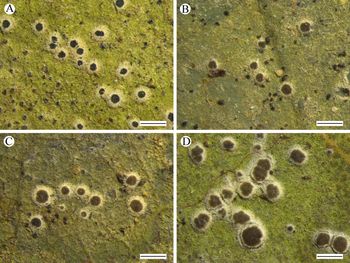
Byssoloma leucoblepharum has been found to be a highly variable species in terms of pigmentation, shape and size of apothecia, and apothecial anatomy. There are three main subclades (sub. 1, sub. 2, sub. 3) in the B. leucoblepharum clade, all of which have the same pyriform conidia and are without secondary compounds detected by TLC. However, their morphological distinctions are: sub. 1 has a smooth thallus, small apothecia (0.1–0.2 mm diam.) with a grey-black, flat disc and an indistinct prothallus (accession KYW0188 also has this morphology); sub. 2 has a smooth thallus and flat apothecia, similar to sub. 1 but the apothecia are larger (0.2–0.4 mm diam.) and paler in colour (grey-brown), and the prothallus is grey; sub. 3 is distinguished by even larger apothecia than above (up to 0.6 mm diam.), the disc is pale to dark grey-brown and strongly convex in some specimens (Fig. 2).
Byssoloma leucoblepharum, thalli with apothecia representing the different subclades in Fig. 1. A, Wang KYW0184 (sub. 1). B, Wang 20180153 (sub. 2). C, Wang 20180152 (sub. 2). D, Wang 20190447 (sub.3). Scales: A–D = 0.5 mm.
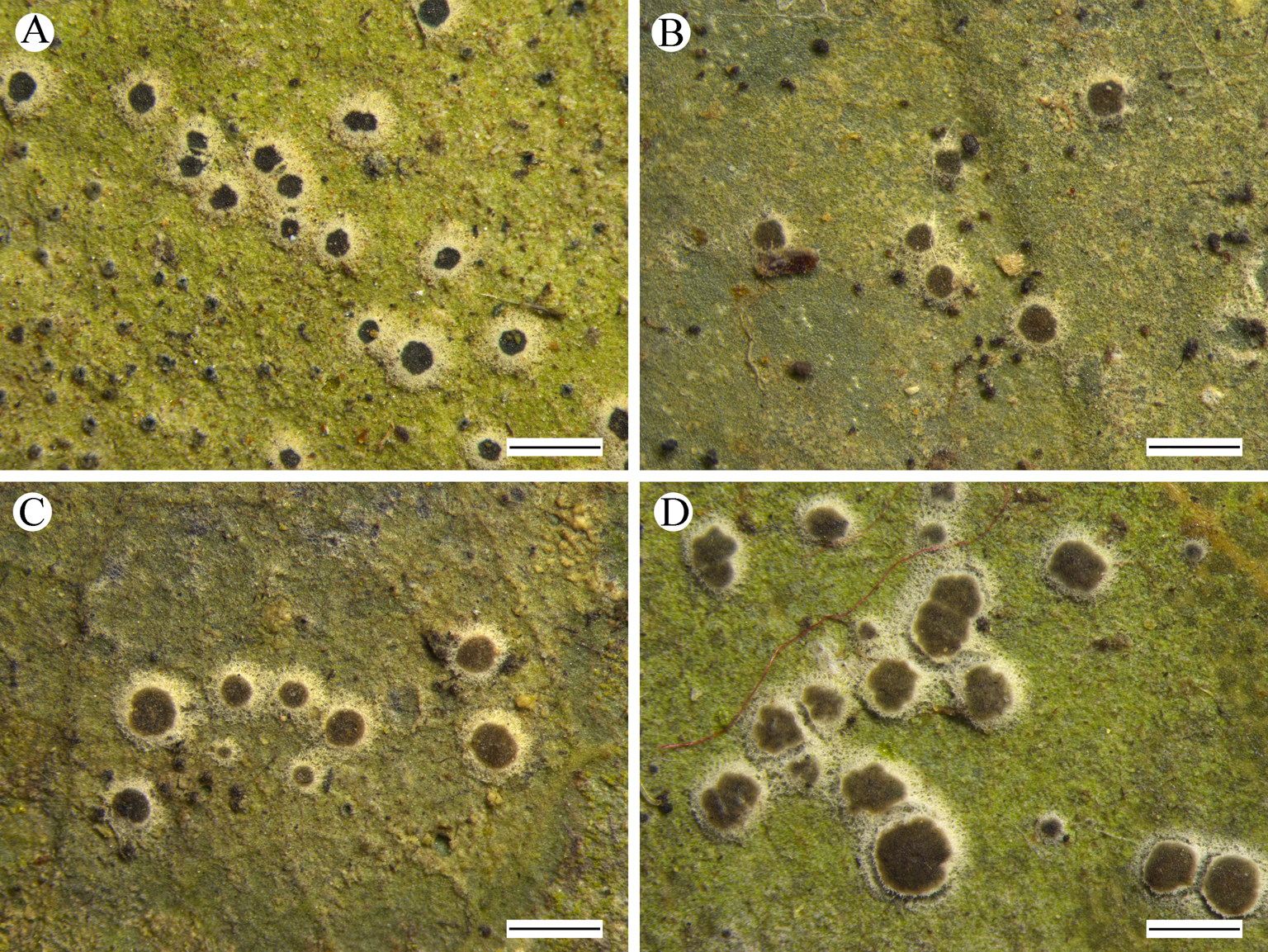
The morphological characteristics of B. leucoblepharum seem to conform to the geographical distribution of the subclades: the higher the latitude, the larger the apothecia (specimens of sub. 1 are from Thailand, sub. 2 from Xishuangbanna and Hainan in China, and sub. 3 are from Hainan and Fujian in China), and the intermediate transition is obvious. Although specimens from different regions exhibit some minor morphological differences, we tentatively treat these specimens as one species here. A more comprehensive understanding of this species worldwide is necessary before dividing them into different new taxa.
Taxonomic Treatment
Byssoloma brunneodiscum W. C. Wang & J. C. Wei sp. nov.
Fungal Names No.: FN 570659
Similar to B. annuum but differs in having brown to dark brown apothecia and a pale brown hypothecium.
Type: China, Hainan Province, Ledong County, Jianfeng Ridge, Mingfeng Valley, 18°44′N, 108°50′E, 960 m alt., on leaves, 6 September 2017, W. C. Wang 139422 (HMAS-L—holotype).
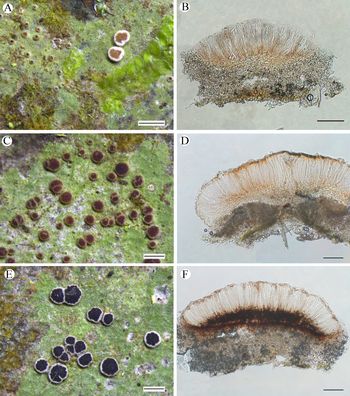
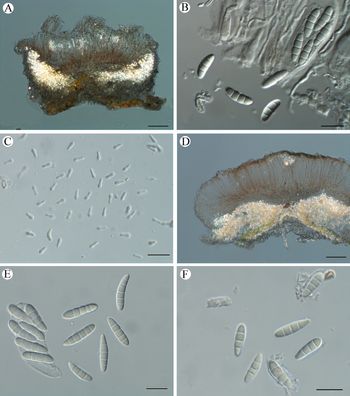
A & B, Byssoloma brunneodiscum (holotype, Wang 139422). C & D, B. rubrofuscum (holotype, Wang 144214). E & F, B. melanodiscocarpum (holotype, Wang 139744). A, C & E, thallus with apothecia. B, D & F, section through apothecium (in water). Scales: A, C & E = 200 μm; B, D & F = 50 μm.

A–C, Byssoloma brunneodiscum (139422). D & E, B. rubrofuscum (144214). F, B. melanodiscocarpum (139744). A, section through apothecium showing colourless crystals in exciple and apothecial base (using cross-polarized light). B, E & F, ascospores (using differential interference contrast microscopy). C, pyriform conidia. D, section through apothecium showing yellow crystals in apothecial base (using cross-polarized light). Scales: A & D = 50 μm; B, C, E & F = 10 μm. In colour online.

Thallus epiphyllous, 0.5–1 cm diam., smooth, continuous, green, K−, P−, without hypothallus. Photobiont chlorococcoid with globose green cells, 5–7.5 μm diam.
Apothecia rounded, single, sessile, basally constricted, 0.3–0.5 mm diam., 100–120 μm high; disc plane, brown to dark brown, dull, epruinose; margin white, byssoid but compact, hyphae not forming a rim over the surrounding thallus, thick, prominent and persistent, c. 50 μm wide, K−, P−. Excipulum and apothecial base (the part below hypothecium) composed of abundant colourless loosely interwoven hyphae, encrusted with crystals which dissolve in K, K+ pink or K− (colourless or very pale green in excipulum), P−; excipulum 35–40 μm wide, apothecial base 35–40 μm high; hypothecium pale brown, poorly developed, 25–30 μm high, K−, P−; epithecium colourless or pale brown, K−, P−; hymenium hyaline, mixed with brown pigment, 40–50 μm high; paraphyses indistinct, branched and anastomosing. Asci clavate, 45–50 × 10–12 μm, 8-spored, ascus apex I+ dark blue, Byssoloma-type (Hafellner Reference Hafellner1984); ascospores 3-septate, without gelatinous perispore, ellipsoid, colourless, 11–14 × 3–4 μm.
Pycnidia sessile, wart-shaped, 10–13 μm wide, with an apical ostiolum when mature, pale grey-brown with black centre. Conidia pyriform, colourless, non-septate, 2–2.5 × 1.5 μm.
Chemistry
2,5,7-trichloro-3-O-methylnorlichexanthone detected by TLC.
Etymology
The epithet of the new species ‘brunneodiscum’ is a Latin compound consisting of ‘brunneo’ (= brown) and ‘discum’ (= disc).
Habitat
Currently known only from Hainan Island, China, where it grows, only sparsely, on leaf surfaces in the damp understory of rainforests at high altitudes on a mountain.
Notes
Byssoloma annuum is one of the most closely related species to B. brunneodiscum (both contain 2,5,7-trichloro-3-O-methylnorlichexanthone), but it can be distinguished by its orange-yellow apothecia with a colourless hypothecium. A further closely related species is B. confusum Farkas & Vězda from Africa, which differs by its excipulum lacking crystals, halonate ascospores and K− apothecial base (Fárkas & Vězda Reference Fárkas and Vězda1993). Byssoloma brunneodiscum is also similar to B. polychromum (Müll. Arg.) Zahlbr. in its brown apothecia with a compact byssoid white margin and 3-septate ascospores, but the latter differs by its finely verrucose thallus and the presence of a chemosyndrome of 3-O-methylchloro-xanthones with thiophanic acid and 3-O-methylthiophanic acid, as the major components (Elix et al. Reference Elix, Lumbsch and Lücking1995).
Byssoloma brunneodiscum also appears to be closely related to B. rubrofuscum and B. melanodiscocarpum, the other two new species described below, both of which have a green, smooth continuous thallus, a compact white byssoid apothecial margin and a similar habitat. However, there are a number of differences which set the species apart: B. rubrofuscum has red-brown apothecia, 3–6-septate ascospores and produces 5,7-dichloro-3-O-methylnorlichexanthone as a major compound; B. melanodiscocarpum has pure black apothecia without crystals, produces thiophanic acid as a major secondary compound, and its hypothecium is dark reddish brown and K+ olive-black.
Fellhanera albidocincta (Vain.) Lücking is similar in general appearance but has translucent apothecia with a thin chamois-coloured margin and a paraplectenchymatous excipulum (at least in internal parts), while Bysolloma brunneodiscum has opaque apothecia with a thick white margin, and its excipulum is entirely composed of free, intricate hyphae with cylindrical cells which extend to the apothecial base.
Additional specimen examined
China: Hainan: Ledong County, Jianfeng Ridge, Mingfeng Valley, 18°44′N, 108°50′E, 960 m alt., on leaves, 2017, W. C. Wang 139507 (HMAS-L).
Byssoloma rubrofuscum W. C. Wang & J .C. Wei sp. nov.
Fungal Names No.: FN 570657
Similar to B. confusum but differs in having red-brown apothecia, yellow crystals in the excipulum and apothecial base, 3–6-septate ascospores and containing 5,7-dichloro-3-O-methylnorlichexanthone.
Type: China, Hainan Province, Wuzhishan City, Wuzhishan National Forest Park, 18°54′N, 109°41′E, 800 m alt., on leaves, 8 September 2017, W. C. Wang 144214 (HMAS-L—holotype).
Thallus epiphyllous, 1–2.5 cm diam., smooth, continuous, green, K−, P−; margin irregular or dispersed into small patches, without hypothallus. Photobiont chlorococcoid with globose green cells, 10–15 μm diam.
Apothecia rounded, single or some clustered in groups, sessile, basally constricted, 0.25–0.75 mm diam., 150–170 μm high; disc plane, red-brown, or dark red-brown in old specimens, epruinose; margin white, byssoid but compact, hyphae not forming a rim over the surrounding thallus, thick, prominent and persistent, c. 50 μm wide, K−, P−. Excipulum and apothecial base composed of abundant colourless, loosely interwoven hyphae, encrusted with yellow crystals which partly dissolve in K, K+ pale yellow, P−, but in some samples inner part extending from hypothecium is well developed, made of radially arranged rows of tight elongated cells instead of loosely interwoven hyphae, without crystals, and the original excipulum (composed of loosely interwoven hyphae) becomes vestigial (Fig. 3D); excipulum 35–40 μm wide, apothecial base 50–60 μm high; hypothecium pale brown, 45–55 μm high, K+ brown or orange; epithecium well developed, pale brown to brown, K−; hymenium with a pale brownish pigment, 60–65 μm high; paraphyses indistinct, branched and anastomosing. Asci clavate, 40–50 × 10–12.5 μm, 8-spored, ascus apex I+ dark blue, Byssoloma-type (Hafellner Reference Hafellner1984); ascospores 3–5(–6)-septate, without gelatinous perispore, ellipsoid, colourless, 14–18 × 3.5–4 μm.
Pycnidia not seen.
Chemistry
5,7-dichloro-3-O-methylnorlichexanthone detected by TLC.
Etymology
The epithet of the new species ‘rubrofuscum’ refers to its reddish brown apothecium.
Habitat
Currently known only from Hainan Province, China, growing on leaf surfaces in damp understory of rainforests at high altitudes of a mountain or near to a river in a forested valley. It is usually associated with B. melanodiscocarpum.
Notes
The new species is unique in the genus in having predominantly 3–6-septate ascospores, and absent to poorly developed superficial hyphal strands.
Byssoloma sprucei (C. Bab. ex Müll. Arg.) Lücking & M. Cáceres, a member of the B. subundulatum group, has red-brown apothecia very similar to B. rubrofuscum but differs in its farinose pale blue thallus, brown apothecial base and 3-septate ascospores. Byssoloma sprucei (syn. B. pernambucense M. Cáceres) is a neotropical species previously reported only from Brazil.
Additional specimens examined
China: Hainan: Wuzhishan City, Wuzhishan National Forest Park, 18°54′N, 109°41′E, 800 m alt., on leaves, 2017, W. C. Wang 144216 (HMAS-L); Ledong County, Jianfeng Ridge, 18°44′N, 109°10′E, 900 m alt., on leaves, 1993, Y. M. Jiang & S. Y. Guo 138605, 138623, 138626, 138639 (HMAS-L); ibid., 18°44′N, 109°10′E, 1000 m alt., on leaves, 2000, M. R. Huang 112918, 112963 (HMAS-L); ibid., hydrometric station, 18°44′N, 109°10′E, on leaves, 2006, J. C. Wei 112786, 112811, 112813, 112815, 112816, 112947 (HMAS-L).
Byssoloma melanodiscocarpum W. C. Wang & J. C. Wei sp. nov.
Fungal Names No.: FN 570658
Similar to B. discordans var. flavescens G. Thor et al. but differs in having a continuous, smooth green thallus, pure black apothecia and a K+ olive-black hypothecium.
Type: China, Hainan Province, Wuzhishan City, Wuzhishan National Forest Park, 18°54′N, 109°41′E, 800 m alt., on leaves, 8 September 2017, W. C. Wang 139744 (HMAS-L—holotype).
Thallus epiphyllous, 1–2.5 cm in diam., smooth, continuous, green, K−, P−; margin irregular or sometimes dispersed into small patches, without hypothallus. Photobiont chlorococcoid with globose green cells, 7.5–15 μm diam.
Apothecia rounded, single or some clustered in groups, sessile, basally constricted, 0.25–0.75 mm diam., 180–200 μm high; disc plane, pure black, epruinose; margin white, byssoid but compact, hyphae not forming a rim over the surrounding thallus, prominent and persistent, thick, c. 50 μm wide, K−, P−. Excipulum and apothecial base well developed, without crystals, composed of abundant, colourless, loosely interwoven hyphae, mixed with granular substances which dissolve in K, K+ pale yellowish green, P−, excipulum 35–40 μm wide, apothecial base 70–80 μm high; hypothecium dark brown to dark reddish brown, 45–55 μm high, K+ olive-black (the red tinge disappears), P−; epithecium well developed, pale brown, turning colourless in K, P−; hymenium hyaline, mixed with pale brown pigment, K+ olive, P−, 60–65 μm high; paraphyses indistinct, branched and anastomosing. Asci clavate, 45–50 × 7.5–10 μm, 8-spored, ascus apex I+ dark blue, Byssoloma-type (Hafellner Reference Hafellner1984); ascospores 3-septate, slightly constricted at the septa, some with a gelatinous perispore, ellipsoid, colourless, 12–15 × 3–4 μm.
Pycnidia not seen.
Chemistry
Thiophanic acid detected by TLC.
Etymology
The epithet of the new species ‘melanodiscocarpum’ is a Greek compound consisting of ‘melano’ (= black), ‘disco’ (= disc) and ‘carpus’ (= fruit).
Habitat
This species is abundant in Jianfeng Ridge and Mt Wuzhishan (Hainan Island, China) and is also present in Thailand, growing on living leaves, such as monocotyledons, in the damp understory of rainforests at high altitudes of a mountain or near the river in a valley.
Notes
Byssoloma melanodiscocarpum is closely related to B. discordans var. flavescens described from Japan (Thor et al. Reference Thor, Lücking and Matsumoto2000), which also has almost black apothecia with a white compact margin and 3-septate ascospores. However, in B. discordans var. flavescens, the thallus is pale green to blue-white, and the apothecia are dark brown to black-brown with a K− hypothecium and crystals in the excipulum. Byssoloma melanodiscocarpum is also close to B. confusum, which has similar apothecia with a white compact margin, but which differ in colour (pale brown) and have a K− brown hypothecium.
Byssoloma melanodiscocarpum should not be confused with a member of the genus Eugeniella Lücking et al. They might be similar at first glance, but Eugeniella is characterized by a smooth and slightly prominent apothecial margin, distinct, unbranched or slightly branched paraphyses, fusiform to oblong conidia, and an excipulum composed of strongly compacted, moniliform hyphae with globose cells and constricted septa; in contrast, B. melanodiscocarpum has a byssoid apothecial margin, indistinct, sparsely to densely branched and anastomosing paraphyses, and an excipulum typically composed of free, loosely interwoven, branched and septate hyphae with cylindrical cells and lacking constrictions.
Additional specimens examined
China: Hainan: Ledong County, Jianfeng Ridge, 18°44′N, 109°10′E, 900 m alt., on leaves, 1993, Y. M. Jiang & S. Y. Guo 138617, 138618, 138627, 138629, 138636, 138637, 138638 (HMAS-L); ibid., 2006, J. C. Wei 112790, 112791, 112812, 112824, 112828, 112830, 112831, 112942, 112943, 112949, 112950, 112954, 112955, 112958, 113055 (HMAS-L); ibid., 18°44′N, 109°1′E, 1000 m alt., on leaves, 2000, M. R. Huang 108866, 108865, 108868, 112792, 112795, 112834, 112920, 112922 (HMAS-L); ibid., Mingfeng Valley, 18°44′N, 108°50′E, 960 m alt., on leaves, 2017, W. C. Wang 139435, 139499, 139502, 139505, 139506, 139507, 139508, 139510, 139512, 139513, 139515 (HMAS-L); Wuzhishan City, Wuzhishan National Forest Park, 18°54′N, 109°41′E, 800 m alt., on leaves, 2017, W. C. Wang 144215 (HMAS-L); Qiongzhong County, Mt Limu, 19°10′N, 109°44′E, 800 m alt., on leaves, 2017, W. C. Wang 139786 (HMAS-L); Wuzhishan City, Mt Wuzhishan, 18.53°N, 109.41°E, 900 m alt., on leaves, 2000, J. C. Wei 112810, 113047 (HMAS-L); Changjiang County, Bawang Ridge, 19°15′N, 109°02′E, 670 m alt., on leaves, 2007, T. Zhang 126591, 126593, 126602, 126605, 126606, 126607, 126609, 126767 (HMAS-L); Lingshui County, Mt Diaoluo, 19.02°N, 109.5°E, 1000 m alt., on leaves, 2000, M. R. Huang 112796, 112800, 112802, 112837, 112898, 112904, 112906 (HMAS-L).—Thailand: Nakon Ratchasima: Khao Yai National Park, Pakchong District, forest surrounding the cliff ‘Diao Dai’, 14°22′N, 101°23′E, 1281 m alt., on leaves, 1999, K. Papong 4605 (RAMK).
Acknowledgements
This research was funded by the National Natural Science Foundation of China (31800010). We are grateful to Prof. John Elix (Australian National University, Australia) for identifying the secondary compounds and Prof. Mark Seaward (University of Bradford, England) for kindly checking the spelling and making useful comments on the manuscript.
Author ORCIDs
Wei-Cheng Wang, 0000-0002-8391-5120; Pieter P. G. van den Boom, 0000-0002-1929-2088.