Introduction
Several prospective studies have examined intellectual function in pre-schizophrenic children or adolescents using prospectively ascertained neuropsychological batteries (Jones & Done, Reference Jones, Done, Keshavan and Murray1997; Davidson et al. Reference Davidson, Reichenberg, Rabinowitz, Weiser, Kaplan and Mark1999; Cannon et al. Reference Cannon, Bearden, Hollister, Rosso, Sanchez and Hadley2000; Reichenberg et al. Reference Reichenberg, Weiser, Rabinowitz, Caspi, Schmeidler, Mark, Kaplan and Davidson2002; Zammit et al. Reference Zammit, Allebeck, David, Dalman, Hemmingsson, Lundberg and Lewis2004). The results of these studies, using a variety of designs, are notable for their consistency in demonstrating that schizophrenia is associated with global pre-morbid cognitive abnormalities. However, two important issues remain unexplained.
First is the question of school performance. The only two large prospective studies to date that have assessed pre-morbid school performance have had negative results. Isohanni et al. (Reference Isohanni, Jarvelin, Nieminen, Jones, Rantakallio, Jokelainen and Isohanni1998) followed the Northern Finland 1966 birth cohort of 11 000 individuals, until the age of 28, using the Finnish Hospital Discharge Register. Surprisingly, grade point average (GPA) at age 16 had no association with later schizophrenia and other non-affective psychoses. Conversely, boys with excellent school performance at age 16 had a fourfold increased risk of schizophrenia compared with controls, although this effect was not seen in girls (Isohanni et al. Reference Isohanni, Jarvelin, Jones, Jokelainen and Isohanni1999). In another Finnish study, using a nested case–control design, Cannon et al. (Reference Cannon, Jones, Huttunen, Tanskanen, Huttunen, Rabe-Hesketh and Murray1999) studied prospective data from children born in Helsinki during the 1950s. School grades and teachers' ratings at ages 7–11 were identified for just under half the cases of schizophrenia, and compared to Helsinki-born controls. Principal components analysis identified three factors: academic, non-academic and behavioural. There was no difference in overall performance between cases and controls. Pre-schizophrenic cases underperformed only on the behavioural factor, which loaded mainly sports and handicrafts.
The second issue that needs to be addressed is confounding. Many of the known risk factors for schizophrenia are also associated with poor cognitive performance and might therefore act as confounders. These include migrant status (Cantor-Graae & Selten, Reference Cantor-Graae and Selten2005; Perreira et al. Reference Perreira, Harris and Lee2006), pregnancy and birth abnormalities (Matte et al. Reference Matte, Bresnahan, Begg and Susser2001; Cannon et al. Reference Cannon, Jones and Murray2002), low socio-economic group (Wicks et al. Reference Wicks, Hjern, Gunnell, Lewis and Dalman2005), season of birth (McGrath et al. Reference McGrath, Welham and Pemberton1995; Lawlor et al. Reference Lawlor, Clark, Ronalds and Leon2006) and advanced paternal age (Sipos et al. Reference Sipos, Rasmussen, Harrison, Tynelius, Lewis, Leon and Gunnell2004; Malaspina et al. Reference Malaspina, Reichenberg, Weiser, Fennig, Davidson, Harlap, Wolitzky, Rabinowitz, Susser and Knobler2005). Some previous studies have controlled for some of these potential confounders, but none has been able to control for all simultaneously.
Method
We conducted a population-based historical cohort study with educational attainment at age 16 as the exposure, and hospital admission for psychosis as the outcome. To obtain the necessary data and covariates, we linked eight Swedish national registers, using the unique identifiers carried by every resident of Sweden.
The Swedish National School Register
The Swedish National School Register, administered jointly by the Swedish School Authority (Skolverket) and Statistics Sweden, contains the individual school grades for all pupils graduating from the final year of compulsory education (class 9), since 1988. The quality of the data in the National School Register is high and summary statistics are published regularly (www.skolverket.se). Under the Swedish educational system, most pupils with learning disabilities or sensory impairments are integrated into mainstream education, and are thus included in the register. Independent schools, which provided around 1% of compulsory education in Sweden before 1992, were included in the register from 1993 onwards.
All children in Sweden are obliged to attend school until June of the calendar year in which they turn 16, when they sit national examinations to assess their suitability for upper secondary education (16–18 years). During the period covered by this study, pupils received grades ranging from ‘A’ (excellent) to ‘E’, in each of 16 compulsory subjects. The grading system was designed such that the grades in each subject would follow a normal distribution, and grades were nationally standardized as follows. The results from national tests in Swedish and Mathematics were used to rank the performance of each class within the country, which in turn determined the number of grades at each level (A–E) that could be awarded in each class. The teachers then allocated the available grades within each class based on the scores in the end-of-year examinations. These grades were used to calculate a GPA for each pupil. Pupils had a strong incentive to perform well because those with a high GPA were more likely to gain admission to the most desirable upper secondary schools (Björklund et al. Reference Björklund, Lindahl and Sund2003).
Other registers
The Swedish Hospital Discharge Register contains details on almost all psychiatric hospitalizations since 1973, including admission and discharge dates and the discharge diagnosis made by the treating physician. It is coded using ICD-9 (WHO, 1992) until 1996, and ICD-10 subsequently. The Medical Birth Register contains data on pregnancy and birth for more than 99% of all births in Sweden, and has been described in detail elsewhere (Cnattingius et al. Reference Cnattingius, Ericson, Gunnarskog and Kallen1990). The Death and Emigration Register includes the dates of all deaths or emigrations from Sweden. The Multi-Generation Register enabled us to identify the parents of the children, allowing linkage to the Education, Census and Population Registers, which include information on the parents' socio-economic status, education level, country of origin and citizenship.
Study design and linkage procedure
The study population comprised all individuals in the National School Register from 1988 to 1997 inclusive (n=907 011). To prevent confounding by migrant status and to minimize missing data, we excluded individuals if they had either parent born outside Sweden (n=181 596), or if they had died (n=235) or emigrated (n=9404) at any time prior to the start of the follow-up period, even if they had subsequently returned to Sweden.
We identified episodes of schizophrenia (ICD-9 codes 295.A–G, W, X; ICD-10 codes F20.0–F20.9), schizo-affective disorder (ICD-9 code 295.H; ICD-10 codes F25.0–F25.9) or other non-affective psychoses (ICD-9 codes 293, 294, 297, 298; ICD-10 codes F22.0–F24.9, F28.9, F29.9) until 31 December 2003. To minimize contamination by prodromal effects, we excluded all individuals admitted with an index diagnosis during the year following the examinations (n=375). We constructed lifetime diagnoses by taking all episodes into account, using a hierarchical system in which schizophrenia was given primacy, followed by schizo-affective disorder.
Statistical analysis
The data were analysed using SAS for UNIX version 9.1 (SAS Institute Inc., Cary, NC, USA) and Intercooled Stata for Macintosh version 9.2 (Stata Corporation, College Station, TX, USA). GPA followed a normal distribution. To allow scale-independent comparisons with other studies, we converted GPAs to Z scores. We defined four exposure categories: Z score >+2, +1 to +2, −1 to −2 and <−2, with Z score −1 to +1 as the reference category. Using Cox proportional hazards models, we calculated hazard ratios (HRs) for hospital admission for each disorder, with Z-score category as the exposure. We censored observations at the point of death, emigration or admission for any index diagnosis. We confirmed that the data satisfied the proportional-hazards assumption using Schoenfeld residuals (Schoenfeld, Reference Schoenfeld1982).
We initially performed analyses adjusted for sex only. We then performed analyses adjusting for the following potential confounders: advanced paternal or maternal age (the cut-off was 40 years), highest parental socio-economic status at either census (1980 or 1990), highest parental education, and spring birth (January–April). We then added low birthweight, low birth length and low head circumference for gestational age (each defined as more than two standard deviations below the sex-specific Swedish population mean for the gestational age), pre-term delivery (before the 36th week), parity greater than 2 and hypoxia (Apgar score <7 at 5 min).
Finally, we examined grade E in each school subject as a risk marker for psychosis, adjusting for sex. In the case of Mathematics and English, pupils are streamed into lower or upper streams based on their ability, so the grades in these subjects are not comparable for all students. We therefore included two exposures for these school subjects: scoring an E grade and being in the lower stream (31% of students in English and 42% of students in Mathematics).
Ethical approval
We obtained ethical approval from the respective ethics committees at King's College London (Institute of Psychiatry) and the Karolinska Institutet, Stockholm.
Results
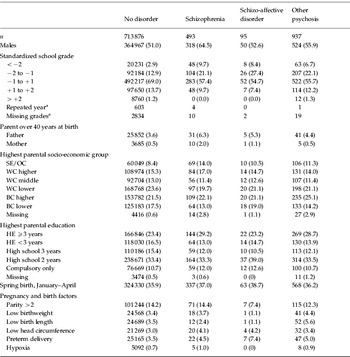
For the 715 401 individuals included, the mean follow-up time was 9.5 years. A total of 1519 individuals received an index diagnosis, giving an annual incidence of 22 per 100 000 for all psychotic disorders combined. Annual incidence rates per 100 000 were seven for schizophrenia, two for schizo-affective disorder, and 14 for other psychoses. Mean age at first admission was 21.1 (s.d.=2.7) years for schizophrenia, 21.0 (s.d.=2.9) years for schizo-affective disorder and 21.8 (s.d.=2.9) years for other psychoses. The mean numbers of admissions were 4.5 (s.d.=5.5), 4.9 (s.d.=4.8) and 1.8 (s.d.=1.66) respectively. Table 1 gives the standardized school grades, sociodemographic characteristics and pregnancy and birth details for each group.
Sample characteristics

SE/OC, Self-employed/own company; WC, white collar; BC, blue collar; HE, higher education.
Values are numbers of individuals and percentages.
Grade point average (GPA) was categorized according to standard deviations above or below the population mean. Parental socio-economic group and education were categorized according to the standard system used by Statistics Sweden. Pregnancy and birth characteristics were defined as described in the method section.
a Children who repeated the year were included in the analysis using their last grade. Those with missing grades were excluded from the analysis.
The number of individuals who had missing GPA scores, usually through non-attendance, was 2905 (0.3%). A missing GPA score was significantly associated with all outcomes [schizophrenia HR 5.9, 95% confidence interval (CI) 3.2–11.1; schizo-affective disorder HR 6.1, 95% CI 1.5–24.7; other psychoses HR 4.7, 95% CI 2.8–8.0]. All individuals with missing grades were excluded from subsequent analyses.
Six hundred and eight individuals (0.08%) were recorded in two consecutive years in the School Register (Table 1), indicating that they had repeated the last year of compulsory schooling. Repeating a year was a significant predictor of schizophrenia (HR 9.2, 95% CI 3.4–24.7), but not of the other outcomes. Individuals who had repeated a year were included in the analysis, and their most recent data were used.
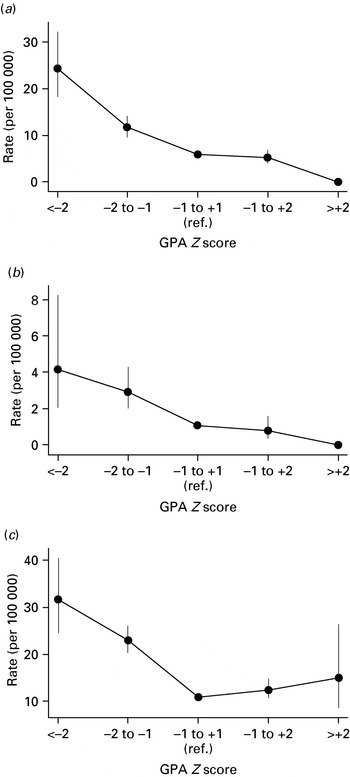
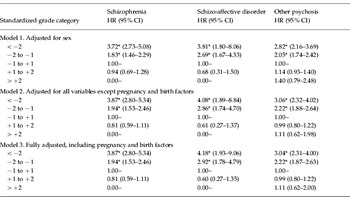
GPA scores for the remainder of the population ranged from 1.0 to 5.0 for both sexes, with mean value of 3.1 (s.d.=0.7) for males and 3.4 (s.d.=0.7) for females. The results for the main analyses are presented as HRs in Table 2 and as rates in Fig. 1. Compared with children in the reference category (mean±1 s.d.), those with low grades (<−2 s.d.) had an approximately fourfold increase in risk for schizophrenia and schizo-affective disorder, and around a threefold risk for other non-affective psychoses. Children with moderately poor grades faced around a doubling in risk for all psychoses. Above-average grades were associated with a decreased risk for schizophrenia and schizo-affective disorder. Adjustment for the potential confounding variables had almost no impact on any estimates of association between school grade and psychosis.
Rates of psychosis per 100 000 population, by grade point average (GPA) for (a) schizophrenia, (b) schizo-affective disorder, (c) other psychoses.

Grade point average (GPA) as a predictor of psychosis

Model 1 is adjusted for sex only. Model 2 includes adjustment for gender, paternal and maternal age >40 at birth, highest parental education, spring birth and socio-economic status. Model 3 is adjusted for all the aforementioned variables, plus parity >2, low birthweight, length and head circumference for gestational age, preterm delivery and hypoxia. Hazard ratios (HRs) and 95% confidence intervals (95% CIs) are shown for GPA, categorized according to standard deviations from the population mean.
* p<0.001.
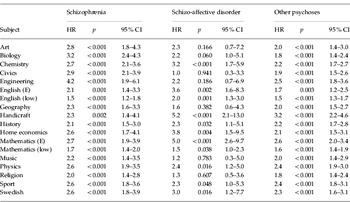
The results for specific school subjects are presented in Table 3. Scoring an E grade was a significant predictor of adult schizophrenia and other psychoses in every school subject, and of schizo-affective disorder in some subjects.
Grade E as a predictor of psychosis

HR, Hazard ratio; CI, confidence interval.
HRs of achieving Grade E (lowest) in individual school subjects as a predictor of psychosis. Individuals scoring B, C and D constituted the reference group. In the case of Basic Mathematics and English, separate HRs are given for being in the lower stream (the upper stream was the reference group) and for scoring an E grade, regardless of stream. Results are adjusted for sex.
Discussion
In this national population-based study, we have demonstrated that poor school performance at age 16 is strongly associated with schizophrenia, schizo-affective disorder and other non-affective psychoses. In every school subject, students scoring grade E are at significantly increased risk for schizophrenia. There is no evidence that these results are explained by confounding.
Several of the most impressive prospective studies in this field have used military conscription data, but many of these studies may suffer from selection bias: there are typically no data for females, and individuals who are not conscripted are usually excluded. Our sample included every child leaving compulsory school from the whole of Sweden over a 9-year period.
Through linkage between eight national registers, we were able to adjust for an array of potential confounders that we selected a priori on the basis that they were likely to be associated with both school performance and psychosis. These included pregnancy and birth characteristics, advanced parental age, parental education level, socio-economic status and spring birth. Migrant status is also a potential confounder in studies of this type because migrants are at increased risk for schizophrenia (Cantor-Graae & Selten, Reference Cantor-Graae and Selten2005), and are also disadvantaged with respect to school grades (Perreira et al. Reference Perreira, Harris and Lee2006). As migrant status was also associated with missing parental data in our sample, and we had information on country of origin of the parents, we decided to exclude all first- and second-generation migrants rather than attempt to adjust for migrant status in the analysis. By analysing only children with two Swedish-born parents, we eliminated any confounding effects of migration and at the same time achieved extremely low levels of missing data (see Table 1).
Limitations
The diagnoses in this study were based on routinely collected clinical data, raising concerns of validity and bias. Two studies have demonstrated good concurrent validity for diagnoses of schizophrenia in this register (Dalman et al. Reference Dalman, Broms, Cullberg and Allebeck2002; Ekholm et al. Reference Ekholm, Ekholm, Adolfsson, Vares, Osby, Sedvall and Jonsson2005). Ekholm et al. (Reference Ekholm, Ekholm, Adolfsson, Vares, Osby, Sedvall and Jonsson2005) have shown that 41% of patients recorded as having unspecified psychoses (the ‘other psychoses’ category in this study) in fact fulfilled DSM-IV criteria for narrow schizophrenia at diagnostic interview, suggesting that Swedish clinicians adopt a conservative approach in diagnosing schizophrenia.
Some patients with psychosis may have been treated entirely outside hospital, in which case they would have been misclassified as unaffected in this study, biasing our estimates towards the null. In common with most developed nations, there has been a reduction in in-patient care in Sweden over the past two decades. However, a recent study on psychiatric care in Sweden during 1994–2003 showed that, although the total number of days spent in psychiatric beds fell dramatically, the number of admissions scarcely changed (Arvidsson & Ericson, Reference Arvidsson and Ericson2005). Moreover, it is likely that any non-admitted cases would have been towards the less severe end of the spectrum of psychosis.
Interpretation of findings
Our results concord with almost all previous studies of pre-morbid cognitive functioning, showing deficits in those who will later develop psychosis. However, school performance should not be seen simply as a proxy for intelligence. A recent longitudinal study of 70 000 individuals showed that 50–60% of the variance in examination results at age 16 could be explained by intelligence at age 11 (Deary et al. Reference Deary, Strand, Smith and Fernandes2007). Some of the residual variance will be attributable to measurement error, but the remainder is likely to be influenced by factors that are poorly captured by cognitive tests, such as school attendance and engagement, long-term memory, attention, motivation, diligence, organizational abilities, creativity and social skills. It is possible that some or all of these competences are impaired in pre-psychotic individuals, in addition to general intelligence.
It is difficult to explain why the two Finnish prospective studies on school performance and psychosis failed to show any association between school grades and risk for psychosis. Possibilities include the highly structured nature of the school system in Finland, which may have minimized variation between individuals, and the young assessment age and large proportion of missing grades in the Helsinki study. Furthermore, the procedures for standardizing grades in this cohort were extremely rigorous (Björklund et al. Reference Björklund, Lindahl and Sund2003). However, it notable that both Finnish studies found circumstantial evidence of poor performance in pre-schizophrenic children: namely, not being in the normal class at age 14 (Isohanni et al. Reference Isohanni, Jarvelin, Nieminen, Jones, Rantakallio, Jokelainen and Isohanni1998) and failure to progress to high school (Cannon et al. Reference Cannon, Jones, Huttunen, Tanskanen, Huttunen, Rabe-Hesketh and Murray1999).
The 16 compulsory school subjects reflected a broad range of academic and non-academic skills. Nevertheless, when we examined the results for different school subjects (Table 3), an E grade was associated with increased risk for schizophrenia and other psychoses in almost every subject. This remains the case after correcting for multiple testing using the conservative Bonferroni method (accepting a p value of 0.05/48 tests≈0.001). For the smaller group with schizo-affective disorder, the association was non-significant for many subjects, but the HRs were in a similar range, and the associations with overall GPA were almost identical for schizophrenia and schizo-affective disorder (Table 2). Taken together, these results suggest that the associations are not specific with respect to school subject or to diagnosis: almost every domain of school performance is associated with risk for all types of psychosis.
Like many epidemiological risk factors for psychosis, poor school performance is unlikely to cause psychosis directly, but is probably a marker for biological, psychological or social risk factors for psychosis. We have not found evidence for confounding by social factors or pregnancy and birth factors, so these are unlikely to explain the association, although unmeasured confounding remains a possibility. Our findings are compatible with the evidence for a neurodevelopmental basis to schizophrenia and other non-affective psychoses (reviewed in MacCabe & Murray, Reference MacCabe and Murray2004). They are also compatible with cognitive theories that individuals with low intelligence, or with specific cognitive deficits, are more prone to suffer thought disorders or hallucinations or to make delusional inferences from their experiences (reviewed in Barnett et al. Reference Barnett, Salmond, Jones and Sahakian2006).
Clinical implications
Because psychosis is relatively uncommon, and most patients have school performance in the normal range, poor school grades are unlikely to be useful for identifying high-risk individuals in the general population. However, these findings may have some clinical utility. Information on school performance is much more easily obtainable in clinical settings than are the results of childhood cognitive tests. Poor school performance might therefore raise the index of suspicion of a psychotic disorder in patients with equivocal symptoms and/or a high genetic risk for psychosis.
Acknowledgements
Dr MacCabe was funded by a joint Department of Health/Medical Research Council Special Training Fellowship in Health of the Population Research (no. G106-1213). The Swedish Council for Working Life and Social Research (grant no. 2013/2002) also supported the study. We thank Sven Sundin of the Swedish national education board for his advice on the interpretation of school records.
Declaration of Interest
None.