I. INTRODUCTION
Magnesium (Mg) alloys are currently of interest to the transportation industry because of their excellent physical properties, such as high specific strength and low density. Reference Máthis, Gubicza and Nam1,Reference Bohlen, Yi, Swiostek, Letzig, Brokmeier and Kainer2 However, the strength of Mg alloys is markedly lower than that of corresponding Al alloys, Reference Nie, Zhu, Liu and Fang3 which limits the use of Mg alloys in engineering applications. Therefore, numerous studies have been conducted to improve the strength of Mg alloys. Precipitate particles are used to strengthen various commercial Mg alloys. Reference Robson, Stanford and Barnett4 In Mg–Al–Zn (AZ) alloys, the precipitation and formation of β phase precipitates occur during aging. The β phase is an intermetallic compound with a stoichiometric composition of Mg17Al12 and an α-Mn type cubic cell. Reference Clark5,Reference Braszczyńska-Malik6 The β-Mg17Al12 phase precipitates through discontinuous and continuous precipitation. Reference Duly, Brechet and Chenal7,Reference Duly, Simon and Brechet8 Both discontinuous and continuous β-Mg17Al12 phases have a plate morphology with accurate Burgers orientation relationship, i.e., (011)β‖(0001)α, [111]β‖[2110]α. Their broad surfaces are parallel to the basal plane of the Mg matrix. Reference Celotto9,Reference Zhang and Kelly10 Consequently, the basal plates are generally ineffective in strengthening AZ alloys. Reference Robson, Stanford and Barnett4 It has been proved that the cold deformation after solution treatment could increase the age hardening response by inducing high number density of dislocations for β phase to nucleate. Reference Duly, Audier and Brechet11
Mg alloys have limited capacity for plastic deformation because of their hexagonal close-packed (HCP) structure and low crystal symmetry. Twinning is an important deformation mode that dominates the deformation at lower temperatures. Reference Barnett12,Reference Barnett13 The most commonly observed twinning mode is the {10-12} extension twinning, which results in an 86.3° reorientation of the basal pole. Reference Pei, Godfrey, Jiang, Zhang, Liu and Liu14 In addition to twinning, detwinning can occur in the twinned region during reversed loading. Reference Wang and Huang15 Twinning can be modified by the presence of precipitates in aged Mg alloys. Reference Gharghouri, Weatherly and Embury16–Reference Stanford, Taylor, Cizek, Siska, Ramajayam and Barnett19 Twins have been observed to engulf, bypass, or impinge upon the precipitates in an Mg–7.7 at.% Al alloy, but the precipitates themselves were not twinned. Reference Gharghouri, Weatherly and Embury16 The interaction between twinning and the precipitates has been suggested to impede the migration of twin boundaries.16−18 Accordingly, a reduction in the scale and volume fraction of twins in aged samples has been reported in Mg–5%Zn Reference Stanford and Barnett17 and AZ80. Reference Jain, Poole, Sinclair and Gharghouri18 A similar reduction in the twin size was also found in an aged AZ91 alloy, even though the volume fraction of the twins was not changed. Reference Stanford, Taylor, Cizek, Siska, Ramajayam and Barnett19 Although the interaction of the precipitates and the twins has attracted considerable attention, the precipitation behavior of a pretwinned Mg alloy has not been fully characterized. Therefore, the current study was designed to investigate the precipitation in a pretwinned AZ61 alloy and the effect on the subsequent compressive and tensile deformation.
II. EXPERIMENTAL DETAILS
The material used in the current study was a hot-extruded AZ61 (Mg–6Al–1Zn) alloy bar with a diameter of 25 mm. First, the extruded bar was solution treated at 420 °C for 12 h to dissolve the precipitates that crystallized during extrusion. Then, the homogenized bar was machined to produce cylindrical specimens with a diameter of 20 mm and a height of 30 mm. The samples were precompressed parallel to the extrusion direction (ED) using 3% plastic strain, which led to the initiation of {10-12} extension twins. After precompression, the cylindrical specimens were cut into tensile and compressive specimens along ED. The specimens were aged at 180 °C for 0, 5, 20, and 50 h. Subsequently, the tensile and compressive tests were performed on a CMT5105 material test machine at a constant strain rate of 10−3 s−1 to explore the role of precipitates in twinning and detwinning.
The samples were manually ground, polished, and etched using a picric acid solution (5 g picric acid + 10 mL acetic acid + 10 ml distilled water + 100 mL ethanol). The microstructures and morphologies of the specimens were characterized through optical microscopy and scanning electron microscopy (SEM) using an accelerating voltage of 20 kV. The pole figures of the samples were determined using x-ray diffraction (XRD; RigakuD/max-2500 PC, Rigaku Corporation, Tokyo, Japan) to identify their crystallographic orientations. XRD was performed using a D/Max-1200X diffractometer with Cu Kα radiation operated at 30 kV and 100 mA to determine the quantity of precipitates that formed during the aging process. Electron backscattered diffraction (EBSD) analysis was conducted to analyze the twinning and detwinning behavior on a FEI Nova 400 scanning electron microscope (FEI Corporation, Hillsboro, OR) equipped with an HKL-EBSD system using a step size of 1 μm. The samples used for EBSD were mechanically ground, followed by electrochemical polishing in the commercial solution AC2.
III. RESULTS AND DISCUSSION
A. The original materials
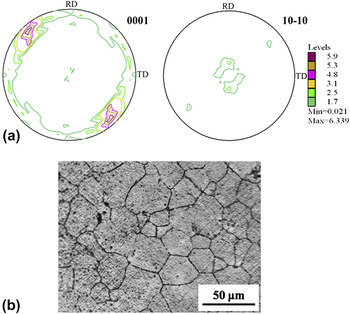
The microstructure and the pole figures of the AZ61 alloy used in the current study are shown in Fig. 1. The intensity of the basal poles was distributed in circles around the extrusion axis. The farther from the extrusion center, the greater was the intensity, exhibiting an obvious fiber extruded texture with most basal planes oriented nearly parallel to the ED. Reference Yin, Wang, Liu and Zhao20 The {10-10} plane also showed a preferential orientation with most of the {10-10} planes nearly perpendicular to ED. This kind of texture facilitated the activation of the {10-12} extension twinning and its dominance in the deformation process when the compression was parallel to ED. The solid solution treatment (420 °C for 12 h) provided a twin-free equiaxial microstructure with almost complete dissolution of the β-Mg17Al12 precipitates in the matrix [Fig. 1(b)].
(a) The pole figures and (b) the microstructure of the as-used AZ61 alloy. The observing surface is the transverse section (plane perpendicular to ED).

B. The precipitation behavior of pretwinned samples
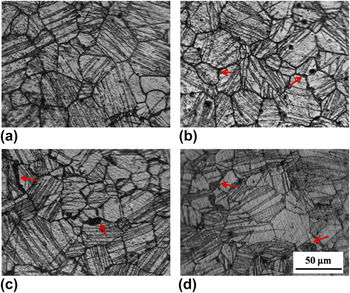
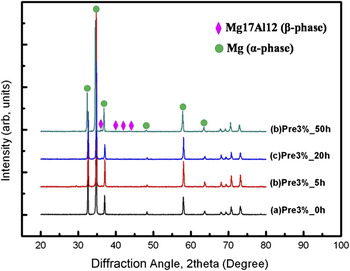
Optical micrographs of precompressed and aged AZ61 samples are shown in Fig. 2. For the precompression along ED, {10-12} twins were generated, and the twin morphologies developed in one grain were parallel to each other [Fig. 2(a)]. After the aging treatment at 180 °C, cellular precipitation was primarily observed at the grain boundaries, as shown in Figs. 2(b)–2(d) (see red arrows), without the destruction of the structure of the {10-12} twins. The XRD results in Fig. 3 also confirm the occurrence of the β-Mg17Al12 precipitates in the aged samples.
The optical micrographs of (a) precompressed samples, and AZ61 samples after being aged for (b) 5 h, (c) 20 h, and (d) 50 h. (To show them more clearly, some precipitations are pointed by red arrows.)

XRD scans from the transverse planes of the pretwinned samples with aging at different times.

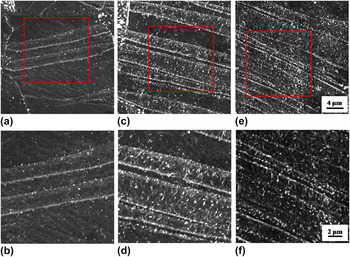
The SEM micrographs (Fig. 4) reveal a magnified view of the precipitates in the aged condition. The preferential distribution of precipitates was observed. For the pretwinned samples aged for 5 h [Figs. 4(a) and 4(b)], the precipitates mostly nucleated on the {10-12} twin boundaries. Numerous precipitates nucleated within the twins after 20 h aging, while the density of precipitates in the matrix was significantly smaller [Figs. 4(c) and 4(d)]. After aging for 50 h, the amount of precipitates within the untwinned region increased and the difference between the twinned and untwinned region was negligible [Figs. 4(e) and 4(f)]. It means that the nucleation of β precipitates most rapidly occurs in the interface of and within {10-12} twins. It has been reported that the interface of the lenticular {10-12} twins is locally disordered, and a high density of dislocations and stacking faults exists within the {10-12} twins. Reference Clark5 Such lattice defects provide more heterogeneous nucleation sites for β precipitation, resulting in a higher density of precipitates formed at the twin interface and within twins than that in the untwinned regions.
SEM micrographs of the distribution of the precipitates in the pretwinned samples after aging for (a, b) 5 h; (c, d) 20 h; and (e, f) 50 h. (b, d, f) are the local magnifications of the area in the red square in (a, c, e), respectively.

C. The mechanical behavior of the subsequent deformation
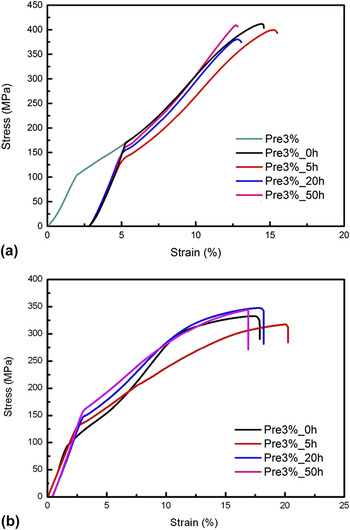
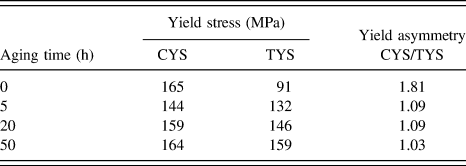
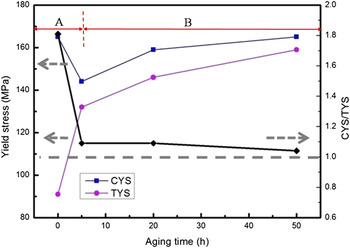
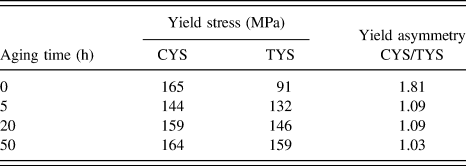
The recompressive and tensile stress–strain curves of the precompressed AZ61 samples with or without aging are illustrated in Fig. 5. The mechanical properties derived from the curves in Fig. 5 are listed in Table I. The recompression along the ED showed a typical “concave down” shape, which is a characteristic of {10-12} extension twinning. Reference Hong, Park and Lee21 Similar features also appeared in the tension of the precompressed specimens. Given the polar nature of twinning, {10-12} extension twinning was easily activated when the tension was parallel to the c-axis of the HCP lattice or the compression was perpendicular to the c-axis. Reference Hong, Park and Lee22 For the recompressed specimens, the compressive yield stresses (CYS) of the aged samples were always lower than the stress when the precompression was interrupted, even if the aging time was prolonged to 50 h [Fig. 5(a)]. However, the tensile yield stress (TYS) in Fig. 5(b) showed a different trend. When the precompressed specimen was aged for 5 h, a remarkable increase in TYS from 91 to 132 MPa occurred. When the aging time was prolonged from 5 to 50 h, the TYS more gradually increased from 132 to 159 MPa. The changing trends of the yield stresses are illustrated in Fig. 6. TYS was always lower than CYS at the same condition, and the difference became smaller with the extension of the aging time. Consequently, the tension–compression yield asymmetry of the pretwinned samples was effectively suppressed as the aging time increased.
The stress–strain curves of the (a) recompressive and (b) tensile AZ61 samples after precompression and aging at 180 °C at different times.

The CYS, TYS, and the yield asymmetry of the pretwinned samples after aging.
The changing trends of CYS and TYS, and of the yield asymmetry.

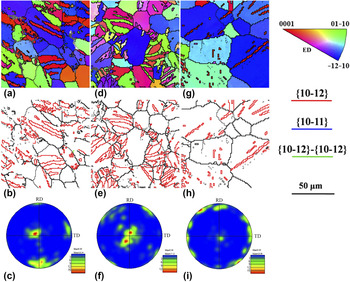
The EBSD maps reveal the microstructure evolution of the AZ61 specimens after deformation in Fig. 7. The transverse sections (plane perpendicular to ED) of the samples were observed. The deformation in the precompressed samples produced {10-12} extension twinning [Figs. 7(a) and 7(b)]. The occurrence of {10-12} twinning caused the basal planes to rotate by 86.3°, which led to the c-axis‖ED orientations [Fig. 7(c)]. After recompression about 3%, the twins generated during precompression became thicker, and some grains were completely engulfed by twinning [Figs. 7(d) and 7(e)]. The numbers of twin lamellae per unit area were separately evaluated using the statistics of three metallographic figures with an area of about 27,434 μm2. The numbers of twin lamellae per unit area were 2916 and 2880 mm−2 for the precompressed and recompressed samples, respectively. The slight decrease was due to the adjacent twins coalescing with each other. Therefore, the expansion of the preexistent {10-12} twins is the primary deformation mechanism of recompression at the early plastic deformation stage. After tension to a strain of approximately 3%, the pretwinned regions of the samples became fewer and thinner [Figs. 7(g) and 7(h)]. This phenomenon indicates that the detwinning occurs through the reorientation of the twinned domains back into their parent orientation [Fig. 7(i)].
EBSD micrographs and pole figures of samples (a–c) after the precompression of 3%; (d–f) recompression of 3%; and (g–i) tension of 3% along ED. The observing surface is the transverse section (plane perpendicular to ED).

So, as mentioned above, twinning expansion and detwinning behavior are the dominant deformation mechanisms at the early stage of plastic deformation for the recompression and tension of precompressed specimens, respectively. The yield points are directly linked to the stresses required to activate twinning and detwinning. Therefore, the effect of the precipitation on the twinning and detwinning behavior is reflected in the variation of CYS and TYS with aging time. As shown in Fig. 6, this variation can be characterized into two distinct stages.
For recompression, a decrease in CYS was first observed with aging (stage A). At this stage of isothermal aging, two processes, i.e., precipitation and recovery simultaneously occur. These processes have opposite effects on the mechanical behavior of materials. The recovery process removes the dislocations generated during precompression, leading to the softening of the alloy and a decrease in the CYS. This phenomenon indicates that the pinning effect of the dislocations on the expansion of the {10-12} twin boundaries is reduced. By contrast, precipitation occurs and induces precipitation hardening in the alloy. The migration of the twin boundaries is impeded, and the twin growth is hindered by β precipitates, causing an increase in CYS. Evidently, in the current study, the hardening effect of the precipitates on the twin expansion had less effect at this stage than the softening effect caused by recovery.
With the increase of aging time, the precipitation hardening started to play an important role and the CYS increased (stage B). However, the CYS remained lower than the stress at the point when the precompression was interrupted, even if the aging time was prolonged to 50 h. Thus, the hardening effect of the precipitation on the twin expansion was consistently smaller than the effect of the recovery during the recompression of the pretwinned samples.
For the tension of the precompressed specimens, the TYS showed a different tendency compared with the CYS in stage A, while the trends in stage B are similar. TYS dramatically increased after aging for 5 h. This result may be caused by the preferential nucleation of the precipitates. At stage A, the precipitates distributed mostly at the {10-12} twin boundaries and surrounded by the twinned regions [Figs. 4(a) and 4(b)]. This preferential distribution of the precipitates at this stage made the shrinkage of the preexistent {10-12} twins more difficult. So, at stage A, the β-Mg17Al12 phase impeded detwinning more than continued twinning.
The rate of the increase in TYS slowed down during stage B, and the values of TYS and CYS were similar after 50 h aging. For a fixed volume fraction of precipitates, precipitation strengthening is controlled by interparticle spacing, which is influenced by the precipitate size and number density. Reference Rosalie, Somekawa, Singh and Mukai23 Thus, the slowdown of the precipitation strengthening for detwinning was caused by the coarsening of the β phase and the increase in interparticle spacing. Moreover, the occurrence of the precipitates within the untwinned regions eliminated the discrepancy of the precipitation strengthening in twinning expansion and detwinning, which led to the similarity of the values of TYS and CYS.
After aging for 50 h, the TYS of the precompressed AZ61 increased by approximately 68 MPa, whereas CYS was still slightly lower than the stress when the precompression was interrupted. Thus, the precipitation strengthening on detwinning is significantly greater than that on twin expansion for the pretwinned alloy due to the preferential nucleation of β precipitates within the preexistent twins.
IV. CONCLUSIONS
In this study, as-extruded AZ61 samples were used to investigate the precipitation behavior of a pretwinned material and the effect on the subsequent deformation. Tensile and recompressive tests were performed on the precompressed and aged samples. The effect of the β-Mg17Al12 precipitates on the twinning and detwinning behavior is reflected by the various trends of CYS and TYS with aging time. The following conclusions have been made:
-
(1) The preferential nucleation of precipitates has been observed in the pretwinned AZ61 alloy. In the order of decreasing preference, the nucleation of precipitates occurs first at the {10-12} twin boundaries, within {10-12} twins, and within the untwinned region.
-
(2) For the recompression process, the hardening effect of the precipitates on twin expansion cannot counteract the softening effect caused by recovery.
-
(3) For the tension process, the precipitates that form within the preexistent {10-12} twins at the initial stage of aging cause significant inhibition of detwinning.
ACKNOWLEDGMENT
This work was supported in part by the Fundamental Research Funds for the Central Universities (Project No. CDJXS12 13 11 12) and supported in part by the Hunan Provincial Nature Science Foundation of China (Grant No. 14JJ3111).