1. Introduction
A paradigm shift has taken place in the way that we view the lives of ordinary people in history, thanks in no small part to the fact that their voices, written into narratives and ego documents, are getting ever stronger.Footnote 1 Even the epistolary voices of the very poor are now being heard in greater numbers, and much of this has to do with the (re)discovery over the past 20 years or so of letters and petitions soliciting charity and relief. Scholars have identified significant collections of these written appeals from across Europe and beyond, dating from as early as the Middle Ages right up to the middle of the twentieth century.Footnote 2 This move towards recapturing the epistolary voices of the poor found early expression with James Steven Taylor's work on narratives of English ‘sojourners’ and Thomas Sokoll's magisterial collection of Essex pauper letters.Footnote 3 The study of pauper letters under the English and Welsh Old Poor Law remains one of most fertile areas of research on demotic narratives. Older debates about the nature of poor law administration, the competence or cruelty of local officials and the ‘residualist’ nature of the old system have been enhanced, but also partly displaced, by a new focus on negotiation and the potential for agency among paupers themselves. Historians are now looking beyond the structural conditions of welfare, towards such issues as the establishment of entitlement and negotiation between the various actors who trod the welfare stage locally, and pauper letters have proved to be a vital source in this process.Footnote 4
Yet despite the rediscovery of pauper letters as a key source for the history of the Old Poor Law, very little work has been done on similar narratives that were produced in great numbers under the New. Consequently, we are in the curious position of knowing far more about the day-to-day lives and experiences of the parish poor in the long eighteenth century than we do about the union poor in the Victorian period, despite the fact that (as we shall see) the sources for studying those lives are not only abundant but are at least as accessible as pauper letters produced under the old regime. The neglect of the voices of paupers and their advocates under the New Poor Law reflects a wider lack of scholarly attention to the ways that paupers experienced the dramatic changes in relief administration in England and Wales following the passing of the Poor Law Amendment Act in 1834.Footnote 5 A few published studies do exist (though only a few), which hint at the ways that the new regime was applied at the regional and sub-regional levels, and a few more as-yet unpublished studies are now emerging.Footnote 6 However, with the exception of David Green's work on London, even these investigations into local practice take little account of the lived experiences of paupers, or the degree to which they were able to negotiate for relief with New Poor Law officials.Footnote 7 As a result, it can be argued quite forcefully that the view we have of New Poor Law paupers remains that of a powerless and inert body, a depressed mass largely subject to the whims of local officials and trapped in a bureaucratic web of rules, directives and circulars. In this respect, it is difficult to identify much progress since the 1970s, when Anne Crowther characterised workhouse paupers as lacking any sense of ‘activity and purpose’, and of being ‘a passive emblem of the misery of the nineteenth century’.Footnote 8
The present study therefore shines a much-needed light on the experience of poverty and the potential for pauper agency under the New Poor Law. Much of the context for the discussion is taken from existing work on pauper letters under the old regime, but it concentrates on letters sent by paupers and their advocates to the central Poor Law Commission and its successor, the Poor Law Board, between 1834 and 1871.Footnote 9
2. The Poor Law commissioners and pauper correspondence
The Commission was a regulatory body, charged with advising and establishing uniformity of practice among the more than 580 local poor law unions in England and Wales in 1834. It was also a body of advice and arbitration, taking evidence and adjudicating in cases of practical and administrative dispute between unions, officials and even paupers themselves. It was the first national body responsible for welfare practice in Europe and, as such, it generated a huge bureaucratic archive, much of which is still held at The National Archives in London. Of particular importance to this article is the correspondence received by the Commission and its later incarnations, which is held under the catalogue reference MH 12. This collection is vast: notwithstanding a few gaps in some unions, it is largely complete for the period between 1834 and c. 1900 and it runs to more than 16,700 volumes. The volumes themselves are, on average, between five and eight hundred pages long.Footnote 10 The great majority of the collection remains uncatalogued and unexplored, and although the following discussion is based on a relatively small sample of the collection as a whole, it still represents a much larger selection from MH 12 than has been analysed in any previous study.Footnote 11 The seven unions on which the majority of this discussion relies have been chosen for their broad typological and geographical spread. They are: Poplar in London, Rye in West Sussex, Newcastle-under-Lyme in Staffordshire, Axminster in Devon, Chelmsford in Essex, Keighley in West Yorkshire, and Manchester. Bethnal Green Union also appears later in the discussion as a special case study, but it has not been included in the overall analysis of pauper letters for two reasons: the first is that, alongside Poplar, it would have created a qualitative imbalance in favour of London and metropolitan unions, and while this is not primarily a comparative discussion, it was felt that this may have led to conclusions that relate more accurately to the metropolis than to the country as a whole. The second reason is that Bethnal Green is, as we shall see, an exaggerated example of a union that was beset by scandals, and including it may once again have created a distorted view of the nature and impact of the epistolary relationship across all of the unions in our sample.
Given the scale of MH 12 overall, we make no claims that the unions discussed here are in any way representative of particular regions or ‘types’. Indeed, the intention of the following discussion is not primarily to compare the nature of the pauper experience or the content of the letters across these unions. Such an exercise would, in all likelihood, be misleading in terms of the overall content of MH 12. Rather, it is to demonstrate that paupers did indeed have a ‘voice’ under the New Poor Law, just as they did under the old, and that their voices (and those of their advocates) were loud enough to be heard by the national administrators of the new regime in London. However, the article will also look in some detail at the nature of the letters from these sample unions as a body of correspondence, in order to draw preliminary lessons about the changing epistolary relationship between paupers and officials during the transition from the Old Poor Law to the New, and as the new regime matured.
The letters on which this discussion is based have been drawn from a complete survey of 129 volumes containing upwards of 100,000 pages of incoming and outgoing correspondence. From these 129 volumes, 173 individual letters were identified of which 93 were sent by paupers themselves and 80 were sent by others on their behalf (their advocates).Footnote 12 As noted above, the work of the commissioners in relation to poor law administration was extensive: its main purpose was to advise on the local application of central policies arising from new laws and regulations and to establish uniformity of practice among the unions. As the new regime matured, the commissioners also formulated and attempted to enforce a number of ‘general orders’ relating to specific aspects of poor law policy, as well as disseminating information and advice on new policies and policy directions as they arose.Footnote 13 Consequently, the number of letters received from, or on behalf of, individual paupers is small relative to the scale of MH 12 overall, but this should not blind us to the fact that they are an extremely important part of the collection, representing as they do a unique record of the voices and experiences of the subjects, or ‘end users’, of New Poor Law legislation, policy and practice. In fact, even if there are, on average, only one or two pauper letters per volume in the collection (and our early research suggests that there may well be more than this) this still amounts to somewhere between 16,700 and 33,400 letters in total.
The letters in our sample are broadly analogous to Old Poor Law pauper letters, but they differ in one important respect. Old Poor Law letters were the product of the ‘out-parish’ relief system: that is, they were sent back ‘home’ from paupers who lived away from their parish of settlement in order to apply for relief or to query relief decisions.Footnote 14 The letters in MH 12, on the other hand, were sent directly to the central Commission or Board in London, and were more often than not the result of a breakdown in relations with local officials. As such, they rarely represent primary applications for relief, as do many Old Poor Law letters (although, in the early years of the new regime paupers did occasionally send letters for this purpose). Instead, most of the letters sent by paupers and their advocates in MH 12 take the form of complaints, usually as a result of the actions and decisions made by local Boards of Guardians and union officials. In these cases, the commissioners were being pressed into service as a higher court of arbitration by paupers and advocates in disputes with local officials. Despite this essential difference between Old Poor Law letters and those sent under the new regime, what becomes clear on a close reading of them is that the letters in MH 12 are a unique touchstone for gauging the shifting landscape of sentiment, entitlement and negotiation for relief after 1834.
At the core of the following discussion are some important and, as yet, rarely addressed questions about the exercise of power under the New Poor Law, and its limits. The discussion explores the ways that the establishment of a national regulatory framework, theoretically controlled from the centre, affected relations between paupers and officials locally and regionally. It shines a light on the ways in which paupers both perceived, and adapted to, structural and sentimental shifts in the transition from the old to the new regime; and it looks in detail at the new uses to which the epistolary relationship between paupers, their advocates, and poor law officials (local and national) was put after 1834. We begin with a discussion of the richness and complexity of work currently being undertaken on pauper letters under the Old Poor Law, pointing out that this single source has the potential to fundamentally alter the way we view the relief relationship and the role of paupers as agents within it. We then go on to explore the continuing importance of sentiment in the relief relationship under the New Poor Law, noting the shifts and changes that occurred in the way that sentimental markers were deployed in the letters of the poor and their advocates over time, and their gradual decline in importance and effectiveness as the new regime matured. We move on to explore an increasingly important shift in the tone and content of pauper letters, away from appeals relating to the rights and wrongs of individual relief decisions, and towards the systemic failings of individual officials and even, at times, whole regimes locally. In taking account of these shifts, we note the ways that paupers and others adapted to changes in relief administration, and exploited an increasingly regulated and, theoretically, uniform system to their own advantage. Finally, in bringing these themes together we reach towards a framework for exploring pauper agency under the rapidly growing administrative state in the middle decades of the nineteenth century.
3. Pauper letters and regime change in the nineteenth century
Pauper letters are now a vital source for many aspects of social and economic history in the later eighteenth and early nineteenth centuries. For example, they have become central to the work of scholars looking at the history of emotion, of the family, of citizenship and belonging, and those with an interest in the history of popular linguistics.Footnote 15 It is, however, in the study of parish relations, pauper agency and negotiations for relief that pauper letters have demonstrated their greatest value. Initially, they tended to be seen as a way of accessing the details of those relationships, and historians emphasised the strategic use by individual paupers of rhetorical devices and symbolism in their attempts to establish entitlement and secure favourable outcomes to requests for relief. This is still a defining feature of their use, but more recent studies have started to look beyond the content of individual letters and typological sub-groups in order to view them in the full context within which they were produced; that is, within the totality of correspondence between out-parish paupers and local officials.Footnote 16 As a result (and as was mentioned in the Introduction) it has even been suggested that pauper letters cannot be fully understood as documents of negotiation outside the full framework of this correspondence and that, taken as a whole, this correspondence offers ‘a persistent and insistent commentary on the proper duty of parishes’ towards the poor.Footnote 17
Hence, Old Poor Law pauper letters not only embody the spirit and content of negotiations for relief, they are also indicative of much of the sentiment that lay behind a discretionary welfare system that was interpreted and applied locally. To an extent, this is both emphasised and attested by the shift away from the ‘two-way monologue’ of the pauper petition, and towards the dialogic (and much more archivally abundant) familiar letter over the course of the long eighteenth century.Footnote 18 Old Poor Law pauper letters are, therefore, beginning to be seen as part of a much wider socio-cultural conversation about who could, or should, be entitled to relief and how that entitlement might be established and maintained. As Lynn Hollen Lees reminds us, the struggle to establish rights and to ensure that communal obligations were met was never straightforward.Footnote 19 Nonetheless, even at times of so-called ‘crisis’, such as the run-up to the New Poor Law in 1834, it has been suggested that pauper letters demonstrate a surprising consensus between those who sought relief and those who were charged with allocating it in terms of who could and should be relieved, and how that relief should be administered.Footnote 20 This is true to the extent that ‘we find little evidence, either in this corpus [of letters] or the wider parochial archives on which it rests, of dwindling sympathy for the claims of the poor and migrant poor in the public administration [of relief]’ in the last years of the Old Poor Law.Footnote 21
Fundamental to the present study, then, is the question of just how the shift from a discretionary system of welfare, funded and administered locally, to a national system, regulated by a central authority in London and administered by extra-parochial bodies (unions of parishes), changed this relationship in the long run. One might expect that the ‘sympathy’ fostered by, and expressed in, the dialogic relationship between communally connected actors would have been fundamentally eroded as the welfare arena widened and took on an increasingly bureaucratic appearance. One might also expect that the underlying impetus for the new law – that of rationalising entitlement and standardising welfare practice in order to reduce costs – would further erode the sympathy and mutuality of those older, more familiar relationships. There is no doubt this was the intention of the architects of the new law, and it is also the overwhelming narrative that has been presented so far in the literature.Footnote 22 How, and how far, these shifts in sentiment and practice were experienced by paupers themselves remains to be tested, however, and this is where the letters sent by and on behalf of paupers in MH 12 can provide an extremely useful corrective to studies based solely on official reports and administrative documentation.
4. Relief appeals and ‘sentiment’ under the New Poor Law
The first thing to note about our sample of 173 letters is that the majority (105) relate directly to individual relief decisions. That is, they complain of the reduction, refusal or cessation of outdoor relief (money or provisions given to paupers to subsist outside the workhouse). Most also complain that, as part of this process, a pauper has been ordered to enter the workhouse if they cannot subsist outside it. This, in itself, is hardly surprising, as the reduction or withdrawal of outdoor relief and the application of the ‘workhouse test’ are two of the most notorious aspects of the new system.Footnote 23 Nevertheless, the manner in which these relief appeals were framed exposes the way that the new law was experienced by the poor and how they, and those who wrote on their behalf, responded to the new regime and adapted to it over time. An early example of this kind of letter was sent in 1837 by a Mr Philpot on behalf of Mary Minson, of Colyton, Devon. Philpot urged the Commission to intervene in Minson's case, stating that: ‘I think you will allow that her case is one that requires it.’ Minson was an elderly widow (‘upwards of 60 years of age’) without children. She had been ‘accustomed to receiving 1 shilling & a Loaf per week’, but had recently broken her arm and found it impossible to subsist on her small allowance. On applying for further relief to the guardians of Axminster, Minson was ‘threatened with being taken into the house’ (the workhouse). As a result, Philpot wrote to ask the Commission ‘how I may proceed for the relief of this woman’, adding that ‘I understand that no one at her age can be compelled to go into [the workhouse]’ and that ‘it is distressing to see people starving around us’.Footnote 24
Philpot's letter is revealing in a number of ways. In the first place, it was sent early on in the transition between the Old and New Poor Laws. At the date of this letter, Axminster Union was barely one year old and we know that it took years – and possibly even decades – for the full impact of the new regime to be felt locally, even in the most amenable unions.Footnote 25 Yet Philpot's letter suggests that Axminster was already attuning itself to the workhouse test a full year before its new union workhouse was completed. Minson was refused extra relief and was presumably told that, if she could not subsist on her usual allowance, her only recourse was to enter the Old Poor Law workhouse, which was still being used to house the poor.Footnote 26 On the other hand, this letter demonstrates that, for paupers and their advocates, the exact rules of the new regime remained uncertain and were still expected to be negotiable. Philpot clearly believed that an elderly person could not be ‘compelled’ to go into the workhouse, implying that they somehow had a right to be relieved outside of it on proving sufficient need. Intriguingly, this is a theme that crops up again and again in letters from paupers and their advocates, particularly in rural and suburban unions. The Rev. George Augustus Lamb wrote from Iden near Rye, in Sussex, in 1835 to ask ‘whether aged persons, widows, cripples and ideots will still be allowed relief without being forced into the Union Houses’, and John Lee of Stockland, in Devon, asked the Poor Law Board a full 20 years later ‘whether [the guardians] can refuse me out door relief at 70 years of age and thereby oblige me to go into the House’. He considered it ‘a cruel case to shutt a man up in a union House after he is 70 years of age’.Footnote 27
In fact, no such exception existed in the early provisions of the New Poor Law, or at any point in its history. There was no explicit ruling or order specifying that elderly paupers must be maintained outside the workhouse, or that they could not be ‘compelled’ (if in need of relief) to enter it.Footnote 28 Yet it is easy to see how a belief in such a rule could have arisen, particularly in the early days of the new regime, and especially in rural and semi-rural southern unions such as Rye and Axminster. For one thing, the workhouse test was only intended as a deterrent to able-bodied paupers, not to those who were elderly or infirm. This intention was explicit in the original legislation, and in the many circulars and general orders issued by the authorities at Whitehall.Footnote 29 Indeed, for the statistically rich period between 1890 and 1906, George Boyer recently noted that the proportion of workhouse residents over 60 years of age varied considerably depending on the level of urbanisation of the union, but that in the south and south-west of England between two thirds and four fifths of all elderly paupers were relieved outside the workhouse, rather than being required to become inmates.Footnote 30 This, perhaps, goes some way towards explaining the kind of interpretation of the new rules that we see in appeals from the elderly such as those cited above, and which was concisely articulated in Thomas Carter's letter to the commissioners from Northiam, in Sussex: ‘I understand your Honors have power to order out door relief to aged persons like myself’, he wrote, ‘particularly where they have paid parish taxes as I have.’Footnote 31
In other words, even though these paupers had been refused outdoor relief and ‘ordered’ into the workhouse, generally, across the country, elderly paupers were far less likely than most other groups to have their applications for outdoor relief refused.Footnote 32 The exception to this rule was in metropolitan unions, and particularly in London. Again, this exceptionalism is clearly visible in our sample. In Poplar, no appeals were made specifically against being taken into the house by elderly paupers, and only three were sent from Manchester. In these three letters no reference at all is made to a right to outdoor relief, or even to an expectation that it would be given simply because of the age of the appellant. Instead, these letters used other sentimental markers and measures of deservingness to make their case, measures that are very familiar from negotiations under the Old Poor Law. In two of the three letters, the writers refer to military service as a means of establishing and emphasising respectability. Widow Elizabeth Burke claimed that she was ‘born in the army’, and went on to emphasise that her husband, brother and two sons had all been serving soldiers. Ann Goulding, also a widow, similarly mentioned that her only son ‘is at present serving her Majesty as a British Soldier to the 17 Lancers’. Such was the perceived strength of active service as a measure of respectability that Widow Burke went on to add that ‘if her Magesty knew[,] I am sure she would allow me A something that would enable me to go home’.Footnote 33 Notwithstanding this metropolitan exceptionalism, there does seem to be clear evidence that, in many unions in England, at least, particular groups of vulnerable citizens were able to draw on deep traditions of differential treatment long after the establishment of the much-trumpeted transition to ‘rational relief’ in 1834. It could also be that the continuing appeal of long-cherished sentimental and rhetorical tropes with regard to the treatment of the elderly, which are clearly visible in Old Poor Law letters, continued to hold sway with local officials despite the changed environment.Footnote 34 Certainly, their transgression continued to be met with anger and incredulity by the poor and their advocates.
There was, however, one sub-group of elderly paupers who were particularly vulnerable to being forced into the workhouse against their will when all else failed. These were the ‘non-settled’ or ‘non-resident’ poor. As was mentioned above, non-residence was a particular feature of the Old Poor Law, and it was this that gave rise to the proliferation of pauper letters between 1780 and 1834.Footnote 35 The architects of the New Poor Law were particularly keen to clamp down on non-resident relief because it was felt that parishes under the old system had used it to keep many of their paupers at arm's length, and thus without sufficient scrutiny as to their real circumstances and eligibility. Non-residence was therefore viewed as a means by which the able-bodied and potentially independent poor might avoid the workhouse test.Footnote 36 As Keith Snell has noted, George Nicholls, one of the first commissioners under the New Poor Law and later the Board's permanent secretary, described non-resident relief under the Old Poor law as ‘peculiarly open to misrepresentation and abuse’.Footnote 37 Unfortunately, under the new regime elderly non-resident paupers were especially vulnerable to the hardening attitudes of the authorities. Many of them had lived in their parish of residence for many years, even decades; they had worked there, raised children there, and developed networks of friends and neighbours upon whom they could, to an extent, rely in times of need. To be torn from one's home of long standing and be put in a workhouse in a distant and, often, unfamiliar place simply because of advanced years was more than just a hardship; it could be a personal, as well as a practical, tragedy, and it was treated as such by paupers and the advocates who appealed on their behalf.
For example, in 1838 Peter Garnett of Otley, in the West Riding of Yorkshire, wrote to the commissions about Richard Cook and his wife. Cook had moved to the parish 30 years previously, had married his wife there, and had worked in Otley for most of his adult life. By the time Garnett wrote to the commissioners, the Cooks were ‘very infirm, quite unable to work’, and for three or four years previously the Overseers of Newcastle-under-Lyme had allowed them two shillings and sixpence in out-parish relief. Two months prior to the date of Garnett's letter, however, their relief had been stopped, and he wrote to complain that ‘they are suffering the most extreme privations selling which little furniture they have rather than go into the workhouse at Newcastle’. Garnett considered it a severe case, ‘the parties [being] so very infirm’, and went on to observe that ‘the woman especially cannot bear the idea of being torn away from her native place’. Just the mention of sending them to the workhouse ‘seemed to break the poor old Woman's health’, he wrote, and he added that:
[i]t is certainly very much to be regretted that some of the poor have so decided a distaste to enter the workhouse … [and I] frequently find it so … with those who have been the most industrious in their habits and have never troubled the parish, at all till old age has completely disabled them.Footnote 38
Similarly, John Wise wrote to the commissioners on behalf of Nancy Higginson, a widow of 78 years of age who was living at Bridgeford, near Stafford, but who also had a legal settlement in the Newcastle-under-Lyme Union. Higginson had lived at Bridgeford for half a century, but her husband had never gained a settlement there, having been a casual farm labourer for the whole of his working life. Wise visited the Newcastle Board of Guardians on Higginson's behalf but was told that, as the old woman had a daughter – a single mother providing for two illegitimate children – they would not reconsider their decision to stop her weekly pension of one shilling. Wise's letter is notable for its tenor and tone, and for the fact that Wise himself was a magistrate and chairman of the Stoke Board of Guardians (the union in which the elderly widow resided). In a letter (copied to the commissioners) that he had previously sent to the Newcastle Board, Wise stated that ‘[s]he is so fit an object for the exercise of your liberality and charitable feelings that I should propose (were I a Member of your Board) 2s/ [a week] instead of 1s/.’ In his address to the commissioners, Wise went even further, stating that:
The mal-administration of the old Poor Law caused me to hail the new Act with pleasing expectations, as I believed it would improve the Condition of the People, if administered by tender and benevolent Parties but when I see its practical working, in a case like the present, where there appears to be a total absence of sympathy and fellow feeling for the Poor I feel it my duty as an Englishman and as a friend to the destitute to protest against such practises [sic].Footnote 39
Wise's emphasis on the discretionary nature of relief to the elderly non-settled poor tells us a number of things about the practicalities of relief administration under the new regime, and also about the continued role of sentiment in negotiating issues of entitlement and fair treatment. Certainly, the bureaucratic and administrative landscape changed irrevocably following the passing of the new law in 1834, but, as some scholars have noted, the local interpretation of important, even fundamental, tenets of it remained surprisingly malleable.Footnote 40 Wise highlights in his letter the very different treatment that the elderly non-resident poor could receive, even in neighbouring unions.Footnote 41 He was at pains to point out to the commissioners his belief that ‘[t]he inevitable consequences of such harshness must be fatal to the good working of the Act and pregnant with greater evils than those the Legislature intended to remedy.’Footnote 42 However, he was not naïve enough to think that his personal appeal would hold any sway with the Commission, or influence the overall trajectory of policy. ‘I apprehend that you as commissioners do not interfere in any individual cases’, he acknowledged, and he was merely content that ‘I have done my duty in drawing your attention to the subject.’ He did, however, finish with a further challenge to the commissioners: ‘I am desirous to know’, he wrote, ‘whether all deserving aged and infirm Paupers are entirely excluded from relief, if they reside out of the Union Boundary as laid down by the Newcastle under Lyme Board of Guardians.’ Even though he received the expected response from the commissioners with regard to individual relief decisions, he did wring from them an acknowledgement that there was little they could do, under existing rules, to stop unions from relieving paupers at a distance should they wish to do so – and this despite the fact that they ‘entertain so strong opinion of the cost [which] result from granting relief to non-residents … [that] they cannot approve of the Gns [guardians] … taking such steps’.Footnote 43
There seems to have been some discrepancy, then, between the Poor Law commissioners, who sought to put an end to ‘the frauds and evils which are incidental to non-resident relief’, and the attitude of many boards of guardians and local officials who continued to view non-resident relief for the elderly as the most humane, and quite possibly the most practical, solution to their difficulties.Footnote 44 The fact that the law, and even later clarifications of it, created and maintained a space within which local interpretation could, at times, trump central policy is extremely important for our discussion.Footnote 45 Despite the desire of the commissioners to clamp down on non-resident relief, it is clear from much of the correspondence in our sample that local officials and guardians continued consciously to occupy that space, and to make relief decisions that accorded very much with the spirit and sentiment of the Old Poor Law while challenging some of the fundamental tenets of the New. As we have already seen, Wise was a magistrate and guardian of the Stoke Union, and from his correspondence it is clear that he used his position and influence to dispense a humane and sensitive version of the new law. Similarly, Peter Garnett, who appealed on behalf of Richard Cook and his wife, had, at the time of writing been a parish officer in Otley for upwards of 14 years, and had ‘ordered our Overseer, two or three times to write to Newcastle’ on the Cooks’ behalf, to no avail. There is no indication that Mr Philpot, Mary Minson's advocate, was a poor law official, but he wrote to the Commission on behalf of more than one pauper in the Axminster Union. Echoing Wise, he acknowledged that ‘you will say that you are not authorised to interfere to order relief in individual cases’. Still, he persisted in pursuing ‘what course I can … in order to obtain redress in [cases] so hard & so unjust’.Footnote 46
Even though these examples date from the early years of the New Poor Law, when the interpretation of the rules was inevitably more fluid and the influence of the Old Poor Law was still strong, elderly paupers, resident and non-resident, continued to contest the relief decisions of local guardians right to the very end of the period under scrutiny. In 1867, Evan Evans complained that the Guardians of Poplar Union had refused to assist him in returning to his native Wales, despite the fact that he was in his 77th year.Footnote 47 In 1880, 87-year-old Paul Mahoney had ‘made application several times to the Board of Guardians of the Poplar Union’, but each time he had been refused, despite the fact that he had a petition ‘numerously & Respectably signed by the Gentlemen & Shop-Keepers of Mill Wall certifying that I was a real object of Charity & requesting of them to grant me Relief’.Footnote 48 In the same year, Mary Russell of Colyton complained that she had been refused outdoor relief, even though ‘my age is 73 [and] I am a widow’, and she wished ‘to know the reason that I cannot be relieved without going into the House’.Footnote 49 In each of these cases, advanced age was seen as sufficient reason in itself to challenge the local board's decision to refuse relief and to question the underlying principles of certain aspects of the New Poor Law. However, it is also the case that the rules were viewed as malleable for other groups of paupers, too, especially during the transition years in the 1830s and 1840s.
In particular, widows with children and their advocates drew on a long tradition of special treatment, even under the strictures of the New Poor Law.Footnote 50 In 1842 the curate of Colyton, having assured the Commission that he was ‘not one of those that like to set people agst the laws’, nonetheless complained bitterly that a recently widowed woman had had her usual allowance cut, even though it was already ‘far too little for [her] support’.Footnote 51 And in 1844, J. W. Long intervened in the case of Caroline Kelly, a widow with five young children, who had been refused outdoor relief by the Guardians of Manchester Union. Long maintained that the Manchester officials had decided, against a magistrate's ruling, that Kelly actually ‘belonged’ (that is, had a settlement) in Liverpool, and had thus ‘offered her the workhouse test, for the implied purpose of driving the poor woman out of the Township’. He went on to add that ‘the whole proceedings in the case … appear to me to be so contrary to the true spirit of the new Poor Law’ that it required further enquiry by the Commission. However, Long also explicitly challenged the moral foundation of the guardians’ decision:
It may be said the Guardians have only applied a general rule which they invariably adopt. But they are not compelled to offer the Workhouse test, and I cannot see a greater or more incumbent duty upon a Guardian in offering the Workhouse test than to discriminate between the deserving and the undeserving; and surely this is a case deserving out-door relief if any be.Footnote 52
Appeals against individual relief decisions form the majority of letters sent to the commissioners in our sample. It is clear from many of these that paupers and their advocates, including those holding parish and union positions locally, continued to try to negotiate entitlement on the basis of sentiment long after the demise of the Old Poor Law. They quickly found pockets of light in the new welfare architecture, which allowed discretionary space for guardians and officials to interpret apparently rigid, centrally directed rules and regulations more favourably. This is particularly true in the case of those paupers who belonged to traditionally privileged groups, such as the elderly and widows with dependent children. There is some evidence that, even among these groups, there was considerable local and regional variation in the interpretation and application of the rules. In London, for example, it appears from our survey that elderly paupers were far less likely than their rural and suburban counterparts to complain of being compelled to go into the workhouse. Not only does this accord with Boyer's evidence on patterns of workhouse residence among the elderly (see note 30), it also makes intuitive sense: in 1834, Londoners young and old already had a hundred years’ experience of workhouses that looked and felt very similar to the new ‘bastilles’.Footnote 53 It is notable, however, that across all of the unions examined here, very few of the letters attempted to argue the rights and wrongs of decisions made in the case of the able-bodied poor. Almost all of them used the traditional yardsticks of deservingness to develop narratives of entitlement: widowhood, disability and infirmity, and especially old age. Even within this discourse of deservingness, however, letter writers knew they were up against a largely unsympathetic audience in the Poor Law commissioners. After all, this was the body that had crafted the new law, and which attempted to enforce a spirit of reformism and deterrence through its General Orders and case-by-case decisions. Nonetheless, writers (such as Captain H. G. Morris of Charmouth) doggedly continued to argue for an older and more sympathetic application of the rules, even in this most inhospitable forum:
Now Gentlemen, I do most earnestly appeal to your Justice, to your humanity, and to those feelings, which characterize Gentlemen in your high situation, that the case of this poor, this destitute, and almost starving man, and his family, may be considered by you, and such directions given, as will meet it, by affording him that relief, which the spirit, if not the letter of the New Poor Law, has intended for the deserving.Footnote 54
5. Workhouse complaints
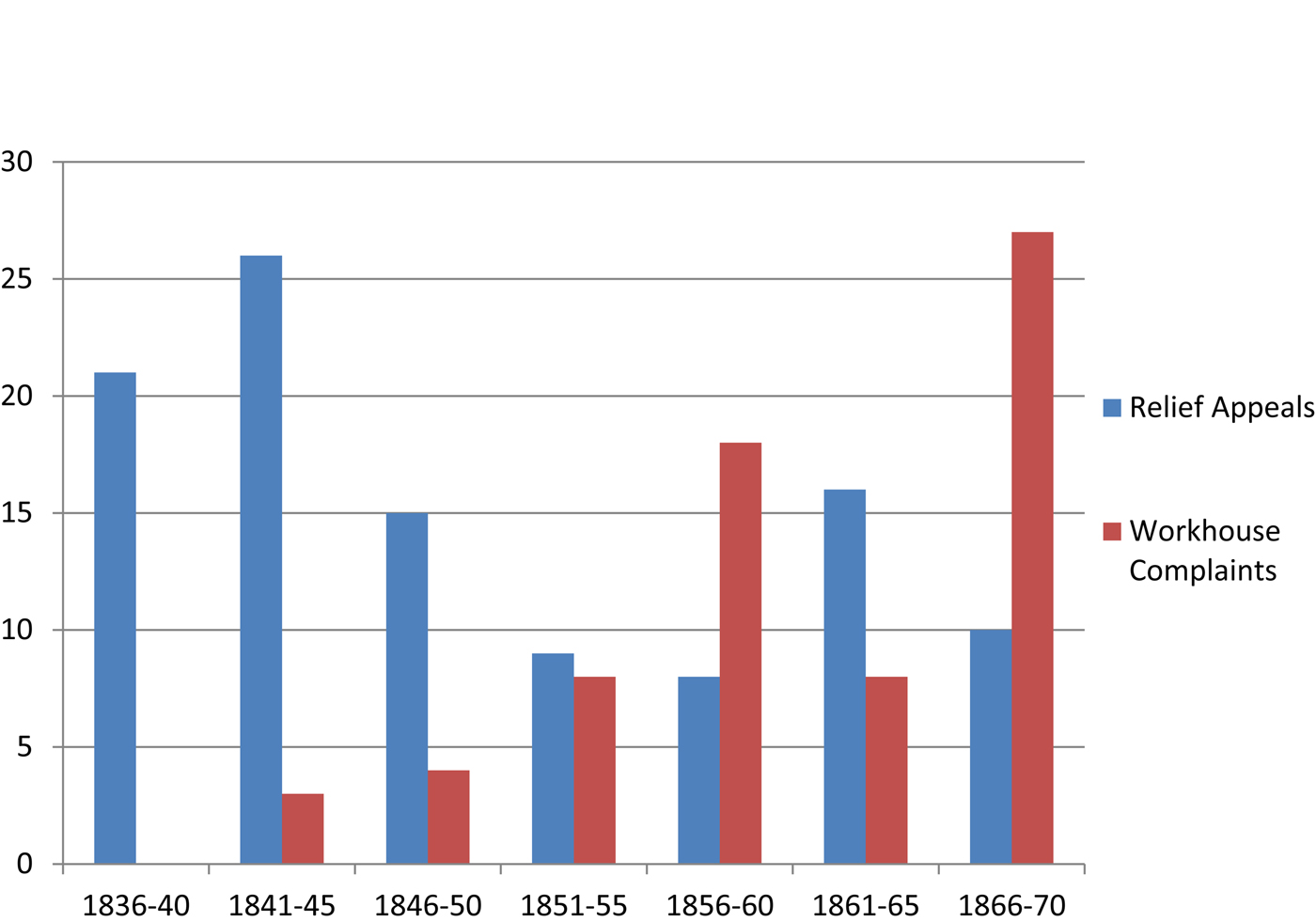
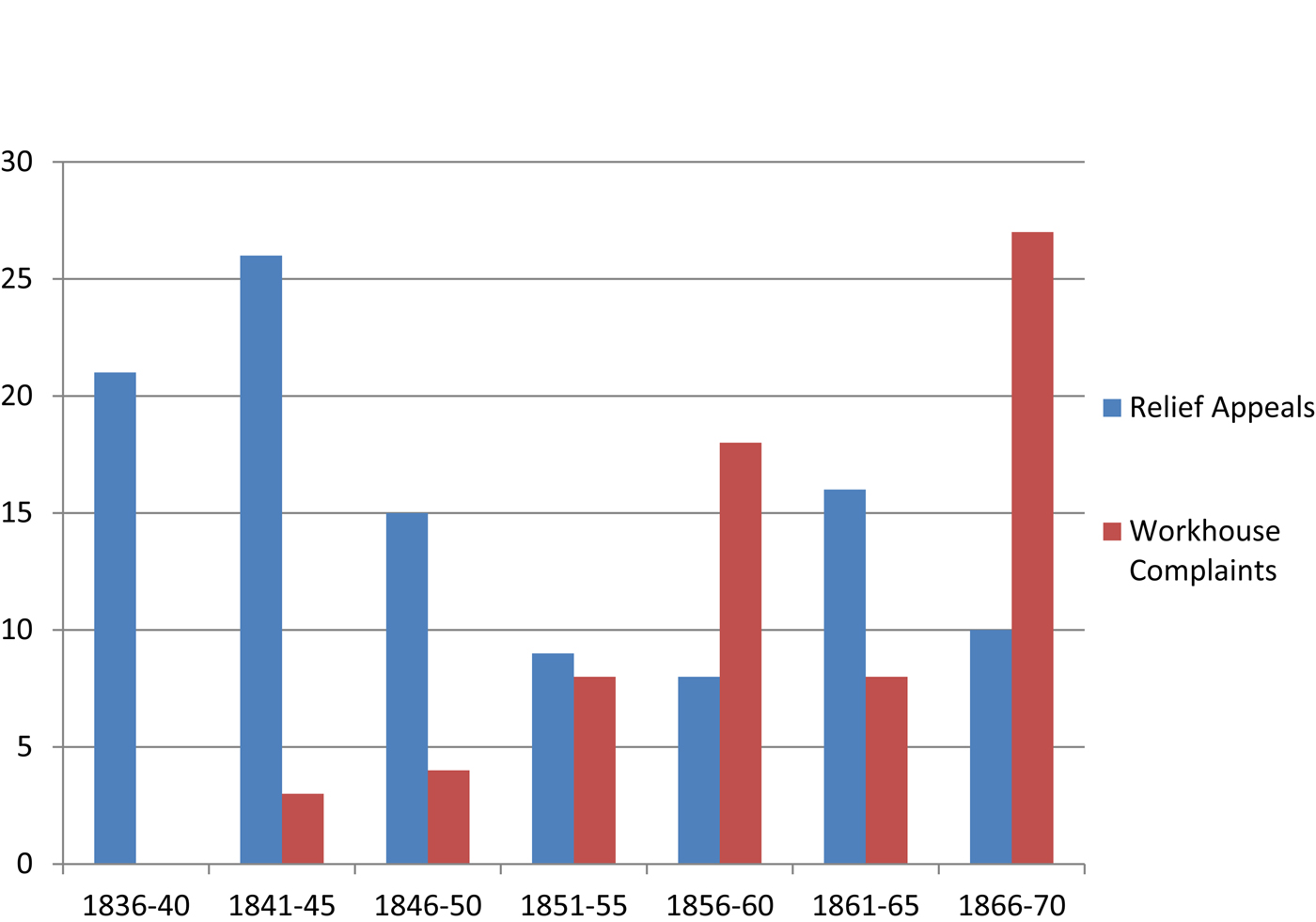
Even though relief appeals form the majority of the letters in our sample, it is important to note that, as a proportion of all letters from paupers and advocates to the commissioners in London, they declined over time. The greatest number of relief appeals was sent in the early years of the new law, between 1834 and 1845, which strongly suggests a hangover of both sentiment and expectation from the Old Poor Law to the New. From the 1840s onwards, however, they were joined, and then overtaken, by a second category of letters that we might describe as ‘workhouse complaints’ (Figure 1). These letters still sought the arbitration of the central authorities in disputes between paupers and local officials, but they were markedly different from appeals against individual relief decisions in both tone and content. For one thing, whereas relief appeals often included complaints about paupers being compelled to enter the workhouse against their will, these letters came exclusively from paupers who were already resident there and who had, very often, been there for some time. These workhouse complainants focused on matters of procedure and personnel rather than specific decisions relating to the nature of their relief. They focused on aspects of workhouse life such as the work regime or diet, or on the behaviour of workhouse staff and ‘trusty’ inmates. They usually arose as a result of perceived ill-treatment or unfair practice towards the writer themselves, towards other named or specified individuals, or even to workhouse inmates more generally.
Relief appeals and workhouse complaints received by the Poor Law Commission and Board from Seven Unions (1836–1870) (five-yearly intervals).
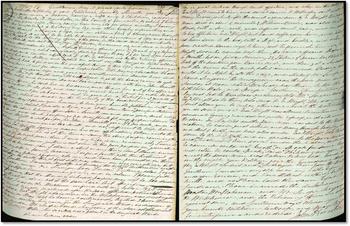
John Hunter's is an early example of such a letter (Figure 2). It was sent in 1841 and consists of two pages of dense script. Hunter complained, in the first instance, of the treatment of his wife at the hands of one of the relieving officers, but he then went on to write a series of allegations against a fellow pauper in the Manchester workhouse, Edward Wright, who he accused of being partly responsible for the deaths of two inmates in the sick ward. Wright was casually employed as the house surgeon's ‘dresser of sores’, and Hunter accused him of gross cruelty and negligence. Hunter originally complained to the Manchester Guardians about Wright's conduct, as a result of which he (Wright) was discharged from the workhouse. Having done so, though, Hunter complained that he had ‘incurred the displeasure’ of the workhouse master, the surgeon and the relieving officers, who ‘are also against me’. He finished by asking for the Commission's ‘interference and redress’ in his case.Footnote 55
John Hunter's letter, sent from Manchester Workhouse to the Poor Law Board, 14 February 1841.
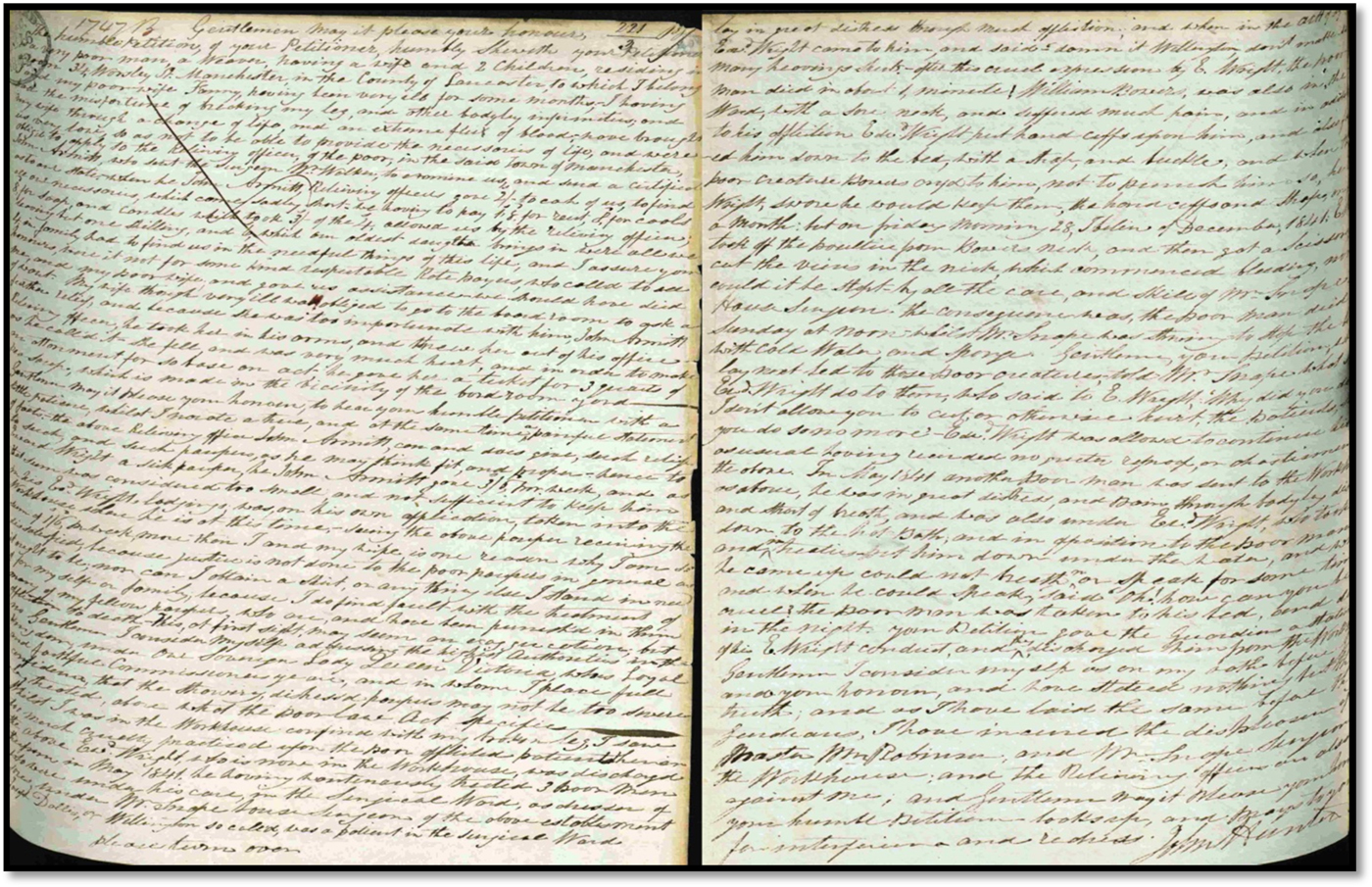
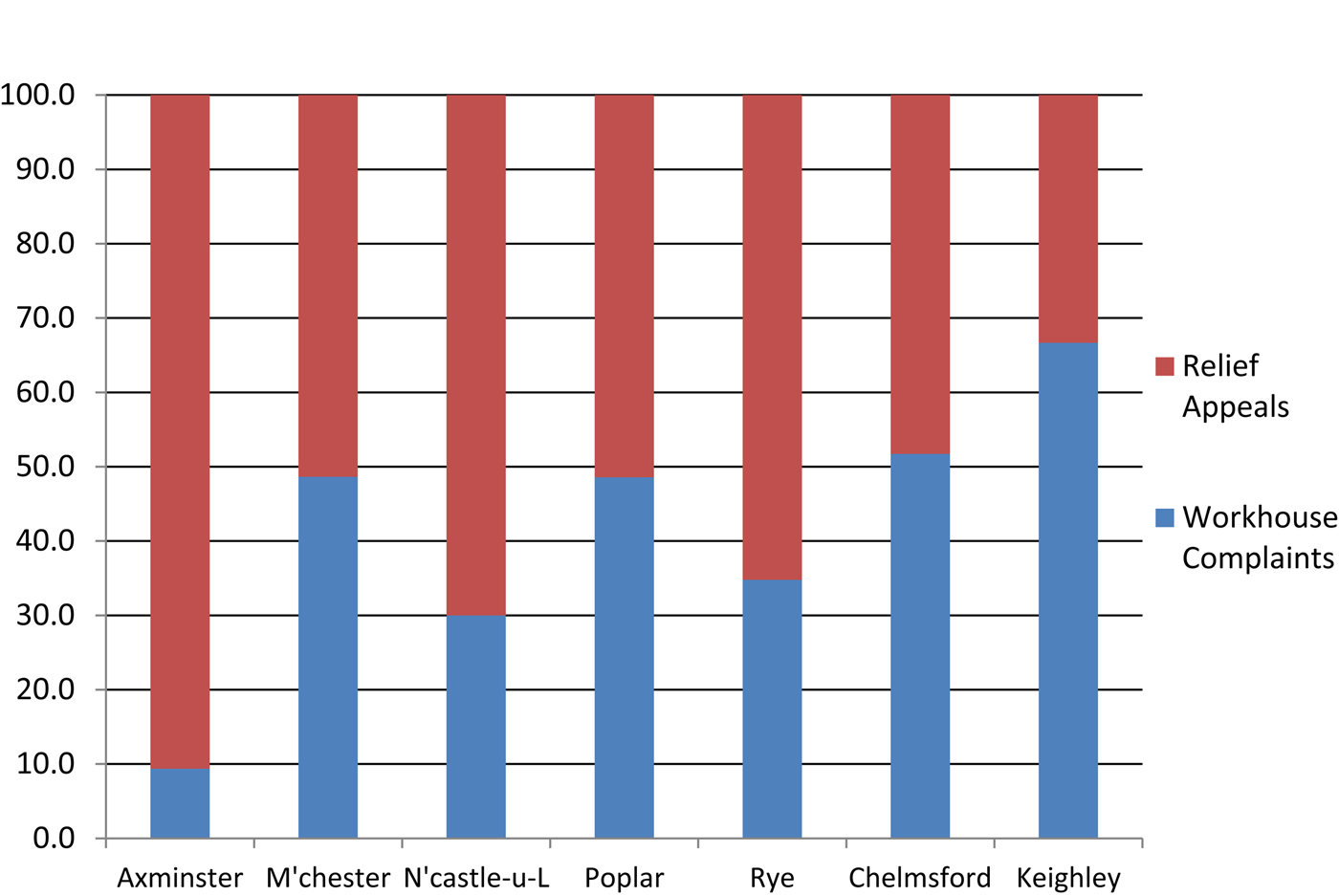
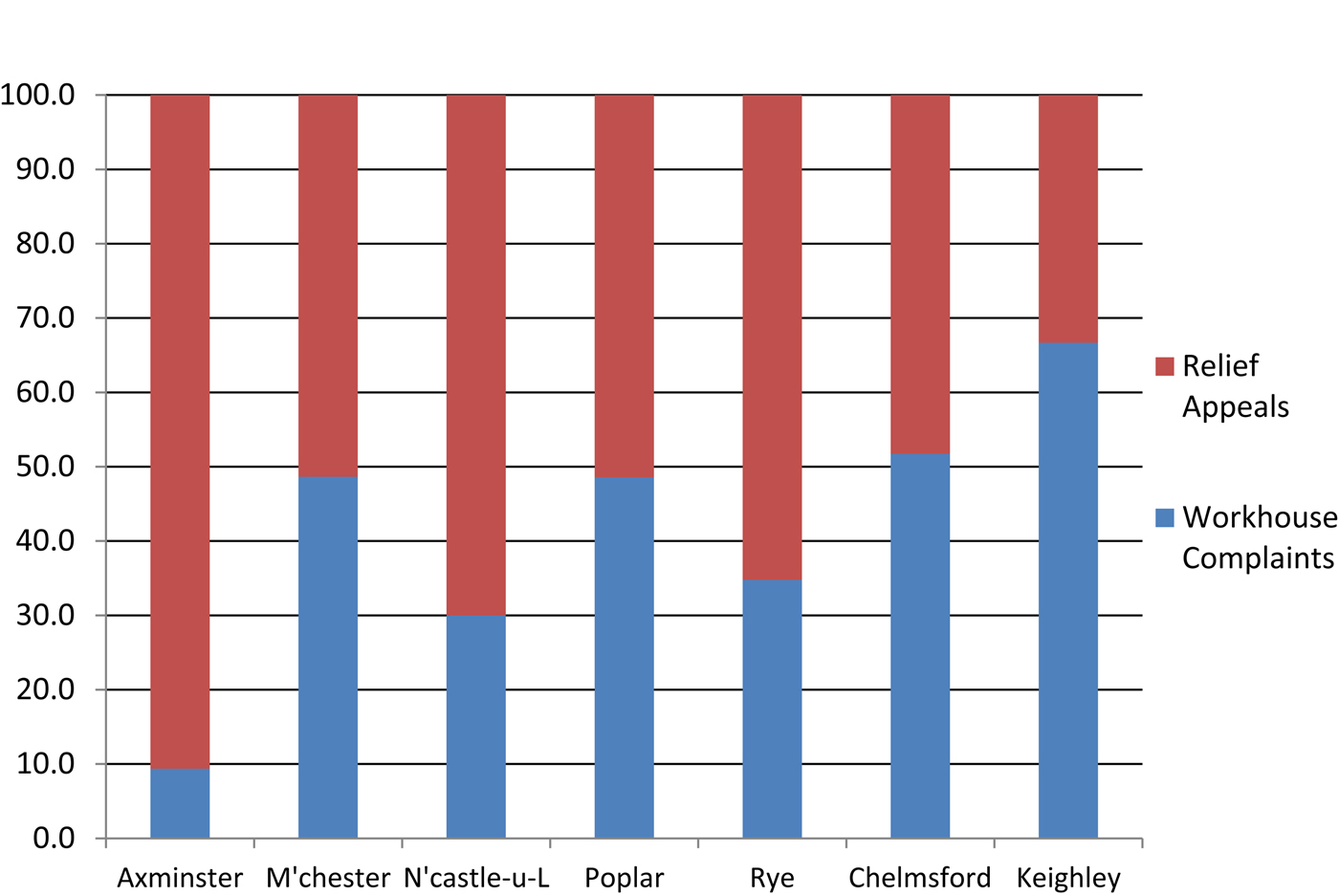
Hunter's letter is broadly typical of this type of workhouse complaint. It begins with a specific personal grievance, but moves quickly on to detail other aspects of mistreatment and maladministration. Hunter mentions other paupers and perpetrators by name, and is at pains to establish his case as methodically as possible. The defining feature of his letter is its close attention to detail: step-by-step, he builds a case against Wright and the union officials he has cause to complain about. In many ways, the content of this letter and the many others like it reminds one more of witness statements to inquiries, coroner's courts and courts of law than of pauper letters as we now understand them.Footnote 56 There is a sense that, without bothering to wait for due process (or, perhaps, recognising that such a thing was rarely available to workhouse paupers) writers like Hunter sought to make their case as thoroughly as they could to the only court of arbitration open to them: the central Poor Law Commission or Board. Detailed complaints like this are well represented in the correspondence from all of our unions, with the sole exception of Axminster (Figure 3).Footnote 57 Many are stand-alone complaints from paupers who wrote only a single, albeit detailed, letter. Others, by contrast, form bodies of correspondence sent by a single inmate, often building in intensity and saturated in detail about the shortcomings of workhouse officers and procedure. Occasionally, a single pauper inmate wrote thousands of words of complaint contained in many letters sent over a period of years. Indeed, there is a sense in many of these letters that the personal grievance with which a pauper begins his or her complaint is merely the preamble to a much more damning critique of the workhouse regime overall.
Relief appeals and workhouse correspondence as a percentage of total pauper and advocate correspondence received by the Poor Law Commission and Board from Seven Unions (1834–1871).
For example, Henry Clark wrote two letters from Newcastle-under-Lyme workhouse in 1850. He was, he said, often unable to take enough solid food to ‘satisfie nature’, and he had therefore been ordered milk and wine, along with bread and cheese, by the medical officer in the mornings and evenings to sustain him. However, in the previous month these privileges had been withdrawn, which was the ostensible reason for writing to the Board. Yet this personal grievance turned out to be a relatively minor part of a long and detailed account of the regime in the workhouse and, in particular, the treatment of the aged and sick poor. First, Clark complained that the medical officer had not performed his duty adequately, and that ‘the itch’ (or scabies) was endemic in the men's infirm ward. He then developed this complaint, claiming that many inmates were forced to leave the ward early in the morning because ‘the stench and smell was such they found themselves ill in the stomach’. Overall, Clark blamed the neglect and malpractice of Mr Banks, the workhouse medical officer, who had ‘greatly neglected his Duty as a “Medical Man”’, but implicit in his letters is a sense that the overall care of the elderly and infirm was grossly inadequate (he himself was 69 years old at the time of writing). Clark, like John Hunter, was unafraid to name names, not only of the officers he accused, but also of those he claimed had suffered the most serious neglect. For example, he wrote in detail of the ill treatment of two other inmates, Golding and Rubie; and, like Hunter, he claimed that neglect had led to the death of a further sick inmate called Tamsett. Finally, Clark was keen to emphasise his credentials as a respectable pauper in order that the Board might trust his detailed account, stating that ‘my returns in Business was about 7000£ per Annum As a Army Contractor’, and that he only fell on hard times because of poor treatment at the hands of his debtors.Footnote 58
As the New Poor Law matured and the workhouse regimes became more firmly established, the number of workhouse complaints received by the Poor Law Board increased considerably (see Figure 1). In some cases, they also became much more strident in their language and rhetoric. For example, in 1863 James Ashworth wrote from Manchester to complain about ‘the violence [and] ill treatment [by] the master [and] his hired servants’. In particular, he complained of the actions of Mrs Hunter, a paid servant in the ‘Old mens Helpless Ward’ who meted out cruelty and ill treatment to all, and ruled the ward with a rod of iron. Such was her control, he alleged, that ‘I have seen Mrs Hunter make 40 men back her lie to the Governor in the twinkling of an eye.’ Again, he detailed many specific incidences of cruelty and, for his own part, claimed that ‘I took my discharge to save my life and crawled to a Lodgings … close by the Poor house.’Footnote 59 In 1868, an anonymous pauper wrote from Axminster workhouse to complain about the poor diet and living conditions. The letter began boldly, by stating that the commissioners should ‘open your eyes and look into the affairs of this Union and others to see how the poor are served’, and it went on ask the incendiary question: ‘why not do away with the Unions and let every parish maintain its own poor’?Footnote 60 In 1870, another anonymous letter accused the master of Newcastle workhouse of cruelty towards a young inmate, as well as peculation, and it, too, urged the commissioners to take a closer look in order to ‘know the truth about this and a good deal more of underhand cruelty besides’.Footnote 61
In fact, these two anonymous letters are quite unusual in our sample, in that the vast majority of workhouse complaints written by paupers were openly signed.Footnote 62 On the face of it, this is, perhaps, surprising given the obvious danger of reprisals for inmates who were prepared to name officials and make accusations of serious neglect. Many paupers acknowledged these dangers, even including them in their list of grievances. As we saw above, John Hunter of Manchester wrote that:
as I have laid the same [complaints] before the Guardians, I have incurred the displeasure of Master Wm. Robinson; and Mr. Snape Surgeon in the Workhouse; and the Relieving officers are also against me.Footnote 63
John Conde of Poplar hoped ‘that by making this true Statement that it wil not be the means of making me a marked man a munks my Supeariers has i frequentley finds it the case’; and Josiah Hougham, in the workhouse at Rye, was ‘aware of the danger incurred by me if I could not prove the truth of what I herein assert’.Footnote 64 The fact that so many pauper correspondents who were workhouse inmates wrote detailed reports of abuse and neglect in their own name implies that they were confident of the truth of the assertions they made, and also that they were prepared to stand witness to these abuses in front of the Poor Law commissioners. Moreover, it also implies that they were aware that only personally attested accounts would hold sway with the commissioners in London. In this, they were quite correct: the commissioners explicitly refused to consider the details of any letter, or to take any further action based on its contents, unless it were signed by the sender.Footnote 65 Nonetheless, it cannot be emphasised strongly enough that workhouse inmates were keenly aware of the risks involved in making serious allegations against named officials, and yet they did so in ever-increasing numbers during the period under scrutiny. Joseph Murphy wrote from the Manchester workhouse in 1866, that ‘I cannot say no more for the Officers of the House has to Read all the Letters.’Footnote 66 Most pauper writers remained in the workhouse having made their allegations, and they knew that reprisals were not only possible, but likely. This raises important questions about why they continued to send detailed complaints to the commissioners, knowing that they put themselves at such risk, something that is addressed in the following section.
6. Fixing the ‘faulty machinery’ of the workhouse regime
It has already been noted that the literature on Old Poor Law letters suggests that something like a common linguistic register existed between paupers, epistolary advocates and local officials charged with administering relief.Footnote 67 This was, after all, a relationship forged and maintained between local actors and, despite the obvious imbalance of power, it was one that allowed for ‘dialogic’ negotiations about the roles and responsibilities of all concerned. In many ways, the New Poor Law was explicitly framed to put a stop to this kind of intimacy in relief terms. In place of interpretation and negotiation by local actors, relief was now to be guided and overseen nationally and administered extra-locally by elected boards of guardians. Bureaucracy trumped sentiment, theoretically at least, and rational rules governing relief would, it was hoped, replace arbitrary judgement. This model of the New Poor Law, which has largely held sway in the literature, very much accords with the vision of nineteenth-century Britain as a crucible for the development of the modern administrative state. As Edward Higgs has noted:
If one were asked to create a list of the features of the modern Western state which sets it apart from previous political formations, the central collection and analysis of information, especially that on individuals, would be a strong contender for inclusion.Footnote 68
As we have seen, the correspondence of the Poor Law Commission and its successors generated over 16,700 volumes of correspondence between 1834 and 1900. Information poured into the centre, giving a detailed account of the workings of every union, board of guardians and workhouse in England and Wales. This, in turn, enabled the commissioners to monitor the progress of individual unions and to formulate and disseminate advice on best practice according to the law as they interpreted it. Bodies like the Poor Law Commission became part of a new ‘knowledge-bearing elite’; they gained ‘influence where none had existed before, and information gathering was used to expand that influence’.Footnote 69
More importantly, the workhouse complaints considered in the previous section suggest that there was another, largely unforeseen consequence of this huge bureaucratic and administrative undertaking. In the formulation and widespread dissemination of a rational, uniform system of rules governing relief, which included the precise conditions to be applied and maintained in every New Poor Law workhouse, the commissioners also established an obvious administrative framework through which grievances could be addressed. Paupers quickly came to understand that this was a rules-based system, and that they therefore had a de facto right to challenge those who administered it when those rules were not adhered to. Initially, they took their complaints to the local boards of guardians, but if this failed to achieve redress they looked to a higher court of arbitration, the commissioners in London. Often, an understanding of the rules was implicit in their letters. John Conde, for example, charged the officials in charge of the sick wards at Poplar workhouse with routinely robbing the inmates under their care ‘for want of Propper Regulation’, and asked for an ‘imparshal Servant to Sea that Regulation fulfilled’.Footnote 70 Just as often, however, they demonstrated a clear knowledge of specific laws and directives governing workhouse procedure and the conduct of officers. James Ashworth alluded to:
The 93rd clause of the New Poor Law Act passed on the 12th Agust 1834 [which] provides for the protection of the inmate of a Workhouse from they violens [sic] of the Master … and those of whom the Master may appoint over the inmates, or else make the Masters responsible for all acts matters and things done by his authorize [sic] servants.Footnote 71
William Hunter spoke for many when he wrote that ‘I Know the rules in these Houses and also the Laws with regard to the treatment of the poor both in the Workhouse and out just the same as the Schoolboy Knows.’Footnote 72
It is no exaggeration to suggest that the principles on which the New Poor Law was founded – and even, to an extent, those that underpinned the development of the modern administrative state – were turned on their head in these complaints. As the workhouse system settled, and as its rules and regulations became more firmly entrenched and more widely known, indoor paupers came to realise that while they lacked freedom and autonomy, they did not entirely lack influence. When workhouse masters and other officers transgressed the official code relating to their conduct, paupers demonstrated a keen awareness of the rules in their complaints to local guardians and workhouse visitors. When this failed to effect change or achieve redress, they turned to the body that issued those rules in the first place: the Poor Law Commission and its later incarnations. Through the accumulation of evidence relating to wrongdoing and transgression, they sought to bring officials, and sometimes even whole regimes, to account; and, on occasion, they succeeded quite spectacularly.
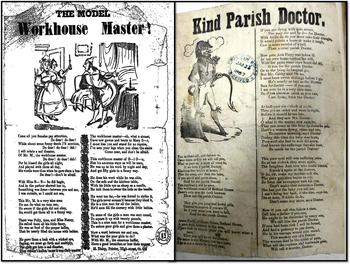
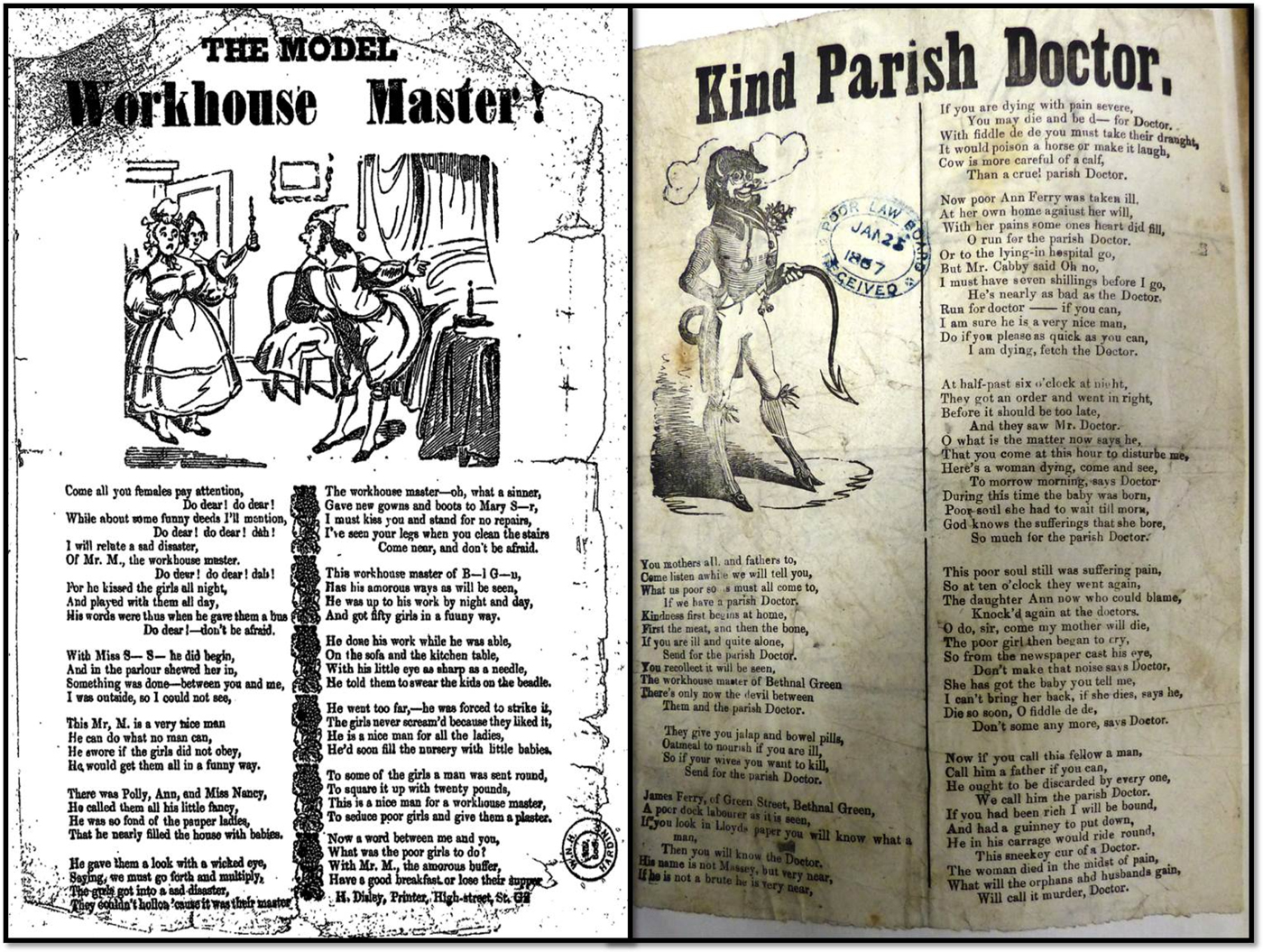
Even though it has so far been excluded from the sample of unions under discussion, the case of the Bethnal Green workhouse demonstrates what could be done when the administrative tools of the New Poor Law were decisively turned on its own faulty machinery. Bethnal Green was one of the poorest East End unions, and throughout the mid-1800s it struggled with the welfare needs of a casually and intermittently employed workforce, in particular large numbers of Spitalfields weavers. Ratepayers and guardians were therefore keen to cut costs wherever possible, leading to ‘deterrence [being] pursued most vigorously’, and to a harsh regime erring, it was alleged, on the side of cruelty.Footnote 73 By the late 1850s, these allegations were joined by others of mismanagement, and the trickle of workhouse complaints from paupers and their advocates became a torrent.Footnote 74 Internal inquiries were established into the conduct of a gatekeeper, two porters and a paid nurse. Serious allegations of cruelty and misconduct followed against two senior medical officers and, most significantly, against Theobald Meyrick, the workhouse master. Crucially, in most cases, these inquiries were stimulated by letters of complaint sent to the Poor Law Board from paupers and advocates when they found the local guardians reluctant to take action. Initially, these letters were sent on to the guardians for comment, but when the number of complaints in each case continued to escalate the Board had little choice but to instigate its own inquiries. These inquiries took evidence from officials, ratepayers, workhouse visitors and from many of the inmates themselves. In the cases of Meyrick, Massingham and Moore, the details of the inquiries ran to entire volumes – thousands of pages of evidence, counter-evidence and judgement, some of it printed and widely circulated beyond Whitehall.Footnote 75 The cumulative effect of these complaints, and the investigations to which they led, was an entire regime change at the Bethnal Green workhouse. All three senior officers were dismissed in the 1860s, and with Meyrick went his daughter who had succeeded her mother as Matron in 1859. The crisis at Bethnal Green workhouse was even commemorated in the penny ballads that circulated widely on London's streets (Figure 4).
Broadside Ballads commemorating the Bethnal Green Scandals, c. 1860s
There is no doubt that the nineteenth-century workhouse was, for most of its inmates, a place of last refuge. The picture that has come down to us of an austere, quasi-penal institution, where a meagre subsistence and rough lodgings were provided at the cost of useless and unpleasant toil is largely borne out by the letters of complaint that were received by the commissioners in London. They were, after all, written specifically to highlight what were considered to be the unjust and, at times, inhumane treatment and conditions endured by inmates. Yet they also demonstrate that the fabled monotony, tight discipline and penal regulations of the workhouses failed to crush paupers’ spirit or to cow them into submission. Forty years ago, Anne Crowther suggested that ‘inmates subverted the system, either by open defiance or developing their own rituals’ (though the examples she gave were few, and were considerably outweighed by stories of submission and resignation).Footnote 76 The workhouse complaints discussed here suggest that inmates were considerably more sophisticated, subtle and forthright than her assessment allows. Paupers quickly came to understand that the restraints of a rules-based system applied in two directions, and that workhouse officials and boards of guardians could be held to account for their actions just as they themselves were constrained by those rules. In making an epistolary connection with the commissioners in London, they sought to force open the cracks that appeared as a result of the errant behaviour of individuals and in whole workhouse regimes, and in doing so they not only battled for personal redress but sought to shine a light on the system's worst excesses. In many cases, they were successful in these endeavours, and though it is true that their letters are far outnumbered in the correspondence of the commissioners by those relating to bureaucratic and administrative matters, the voices in those letters were compelling enough to have been heeded by the highest authorities.
7. Conclusion
This article has investigated how the new welfare bureaucracy impacted on the epistolary relationship between paupers and those charged with administering it locally and nationally. It has traced the changes in those relationships between the earliest years of the new regime and its maturity in the 1870s. It has explored the ways that paupers responded to the New Poor Law, and how they negotiated the structural and sentimental shifts that took place over that period. In particular, it has looked in detail at the new uses to which the epistolary relationship was put by paupers and their advocates. There is no doubt that structural changes in the relationship between local poor law bodies, paid officials and paupers are clearly reflected in the letters sent to the Poor Law Commission and Board. At the most basic level, the concern of letter writers was almost entirely with those aspects of the new regime that the architects of the new law were most keen to enforce in contrast to the old: reductions in, or the cessation of, outdoor relief; the application of the workhouse test; the erosion of out-parish relief; and a tightening of the regulatory regime in New Poor Law workhouses. Throughout the period under consideration, outdoor paupers and relief claimants, and those who wrote on their behalf, sent letters of complaint to the commissioners about the individual relief decisions that they received, and focused in particular on reductions in outdoor relief and the compulsion to enter the workhouse. Crucially, however, in complaining about these decisions, the traditional yardsticks of deservingness – old age, infirmity, disability and widowhood, those attributes which appealed to sentiment and most obviously gained purchase under the Old Poor Law – continued to be applied by letter writers.
It is important to recognise that letter writers clearly reckoned these yardsticks to be of continuing importance in negotiating for relief long after the New Poor Law came into force, even though the commissioners in London explicitly considered them largely irrelevant. The regularity with which appeals to sentiment using traditional measures of deservingness continued to be received by the commissioners, and the fact that they were often sent by advocates who themselves held unpaid offices under the new regime, may suggest that they did indeed continue to have a central place in establishing entitlement locally. However, this is something that can only be tested by looking in detail at the rhetoric of local negotiations, an area of the New Poor Law that remains under-studied. Nonetheless, it is also true that, within our sample, the numerical importance of these kinds of relief appeals declined over time, and this almost certainly signifies a growing recognition by paupers and their advocates that the central authorities at Whitehall were little interested in the fate of individual paupers. Unlike local magistrates under the Old Poor Law, it is clear that the Poor Law commissioners believed that there was no place in their remit to interfere in relief decisions between paupers and boards of guardians, and they were explicit about this in their responses to such letters. On the other hand, complaints from workhouse inmates about their treatment, and about the shortcomings of workhouse officials and even whole workhouse regimes, greatly increased in number over the same period. In fact, by the end of the 1860s workhouse complaints outstripped relief appeals in the correspondence of the Poor Law Board by almost three to one.
These complaints were qualitatively different from relief appeals in a number of important ways. In the first place, they largely eschewed the ‘yardsticks of deservingness’ that had characterised negotiations for relief under the Old Poor Law, and which continued to be applied in individual relief appeals under the New. Instead, they focused on the harsh realities of workhouse life, and in particular on the commissioners’ own regulatory framework. Rather than negotiating entitlement, these letters sought to hold workhouse officers, boards of guardians and, at times, even the commissioners themselves to account. The paupers (and, very occasionally, their advocates) who wrote them demonstrated a keen understanding of the laws and regulations governing their care, and they used that knowledge to highlight and protest against shortcomings and breaches by local officers. Collectively, however, they did much more than that: in the wholesale accumulation of evidence against malpractice and mismanagement, workhouse letter writers turned the regulatory framework that was specifically designed to keep them contained and subdued on its head. They named and shamed workhouse officers, they exposed in great detail incidences of peculation, misconduct and moral lapse, and occasionally even systemic failure. Through repeated appeals they maintained pressure on the commissioners to take action against those they exposed. They did so in their own names, acknowledging the risks to themselves, and occasionally (as in the case of Bethnal Green) their successes were considerable. In other words, the paupers who wrote these workhouse complaints used the commissioners’ own regulatory framework as a point of leverage to establish effective avenues of complaint and a procedure for the redress of grievances which, in effect, gave workhouse paupers – that ‘passive emblem of the misery of the nineteenth century’Footnote 77 – a clear space to argue for the fulfilment of their rights as citizens and legal subjects. Sentiment may have given way to evidence-gathering and quasi-legal interpretation, but paupers continued to demonstrate long after the passing of the New Poor Law that they would not be sidelined in the relief relationship and that they remained adept at negotiating the conditions of their welfare.
Acknowledgements
This article is based on the early findings of a three-year AHRC grant-funded project investigating the letters of paupers and their advocates to the Poor Law commissioners in London, entitled ‘In Their Own Write: The Lives and Letters of the Poor, 1834–c. 1900’. For further details, see https://intheirownwriteblog.com/about/. The authors would like to thank the AHRC for their generous support and the anonymous referees for their useful comments and suggestions.