Background
Breast cancer is one of the most common cancers causing death among women worldwide.Reference Firouzjah, Banaei, Farhood and Bakhshandeh1 Nowadays there are different treatment modalities performed for breast cancer treatment, for instance, radiation therapy, hormone therapy and mastectomy, or a combination of various modalities.Reference Brown, Mutter and Halyard2–Reference Abdi Goushbolagh, Abedi Firouzjah and Ebrahimnejad Gorji4 Radiotherapy for cancer patients after mastectomy and lumpectomy has been established as the main treatment option for breast cancer,Reference Brown, Mutter and Halyard2, Reference Khan and Gerbi5–Reference Mani, Poudel and Das8 and several literatures report that these techniques improve survival and reduce locoregional recurrence.Reference Santiago, Wu and Harris9–Reference Tsoutsou, Vozenin, Durham and Bourhis12
Although newer techniques such as volumetric modulated arc therapy (VMAT) and intensity-modulated radiotherapy (IMRT) are becoming increasingly popular in breast cancer radiotherapy and have higher dose uniformity at the target tissue,Reference Abdulmoniem, Bayoumi and Al Asiri13 these techniques need longer times for planning and treatment as well as additional pretreatment quality assurance.Reference Firouzjah, Banaei, Farhood and Bakhshandeh1, Reference Cheung14 Furthermore, these are associated with higher inaccuracy risks of dose delivery to moving targets and increased low doses in normal structures.Reference Court, Seco and Lu15, Reference Moon, Shin and Kim16 Therefore, three-dimensional conformal radiotherapy (3D-CRT) is being widely used in many centres for treating breast cancer.
The treatment area generally includes the chest wall and supraclavicular, axillary and internal mammary nodes.Reference Mani, Poudel and Das8 To determine pathological anatomy and metastatic progression, lymph nodes are divided into three levels.Reference Mani, Poudel and Das8, Reference Bland, Copeland, Gradishar and Klimberg17 These levels are associated with their position relative to the pectoralis minor muscle, which is inserted at the coracoid process. Level I lymph nodes lie lateral to the lateral border of the pectoralis minor muscle; level II lymph nodes lie behind the pectoralis minor muscle; and level III lymph nodes are located in the medial border of the pectoralis minor muscle. Level II lymph nodes are among the most important structures in chest wall radiotherapy of mastectomy patients due to their locations in field junction area.Reference Assaoui, Toulba and Nouh18 Under- or overdose of the lymph nodes will cause further complications.Reference Khan and Gerbi5, Reference Halperin, Brady and Perez7, Reference Spratt19–Reference Jemal, Siegel and Ward21
Generally, two tangential and one/two supraclavicular fields are used for mastectomy radiotherapy in 3D-CRT and IMRT. The use of a greater number of fields in IMRT leads to higher doses to organs at risk (OARs).Reference Abo-Madyan, Aziz and Aly22 Two methods, including dual-isocentric (DIT) and mono-isocentric techniques (MIT), are applied for performing 3D-CRT and IMRT.
Two independent isocentres (one for tangential fields and one for supraclavicular field) are used for setting the radiation fields in DIT. However, in MIT, one isocentre is utilised for setting all of the fields. This isocentre (in the MIT) is located in a border between the tangential and supraclavicular fields, under the edge of the collimator shadow on the patients’ skin or in the depth of the isocentre point. Nevertheless, there are two different independent isocentres for tangential and supraclavicular fields in DIT. The field junction area in DIT may have higher or lower doses than the prescribed dose due to the superposition of some parts of tangential fields with supraclavicular field in this area. In MIT, supraclavicular and tangential fields can be matched completely, and there is no field junction area due to using half fields.
In some previous studies,Reference Banaei, Hashemi and Bakhshandeh23, Reference Romeo24 tangential and supraclavicular fields matching in MIT and DIT were evaluated for 3D-CRT. Level II lymph nodes are located in field junction area; however there are not any investigations comparing dose distribution of these nodes in the two methods (MIT and DIT) for mastectomy patients by IMRT. Hence, due to a lack of studies in literature, the aim of this study was to evaluate and compare the dosimetric parameters of level II lymph node doses delivered by DIT and MIT in mastectomy patients utilising 3D-CRT and IMRT.
Methods
Patient selection and computer treatment planning
A single-centre retrospective study was performed following National Research Ethics Board approval. Computed tomography (CT) images of 20 mastectomy patients with an average age of 52 years (ranged 34–69) were randomly selected from the recent referrals to the radiotherapy department. Our study used just CT images without any demographic information about the patients. Selected patients were prescribed chest wall radiotherapy using megavoltage photon irradiation. Patients with a history of previous radiotherapy or who underwent partial breast surgery were excluded from the study. A history of chemotherapy or hormone therapy was not considered as inclusion criteria in our study.
CT images were acquired with a CT simulator (Siemens Somatom Plus16; Siemens Healthineers, Munich, Germany). Patients were placed in supine position during free breathing and their ipsilateral arms were elevated on the CT simulator bed. Slice thickness was chosen to be 5 mm for all patients. The CT imaging procedure and all of the exposure parameters were the same for all patients (kVp = 120, resolution = 1 mm, field of view = 30×30 cm2, pitch factor = 1·06, and regulated mAs depending on patient size).
CT images were imported into a computer treatment planning system (Eclipse, version 11; Varian Corporation, USA) in DICOM (Digital Imaging and Communication On Medicine) format. Target volumes were defined in the mastectomy region by the radiotherapy oncologist. The prescribed dose was 50 Gy delivered to the chest wall and lymph nodes, in 25 fractions given over 5·5 weeks.Reference Mani, Poudel and Das8
Patients were planned with both MIT and DIT in both 3D-CRT and IMRT methods, that is, each patient had four radiotherapy treatment plans (total number of plans = 80). Two tangential and one supraclavicular 6 MV photon beams were considered for treatment planning in all the techniques. Wedges were used for 3D-CRT plans depending on the patient’s anatomy, as well as multileaf collimators (MLCs) were used to produce modulated irradiation in IMRT. Inverse planning methods were applied to regulate the motion of MLC in IMRT.
DIT and MIT methods
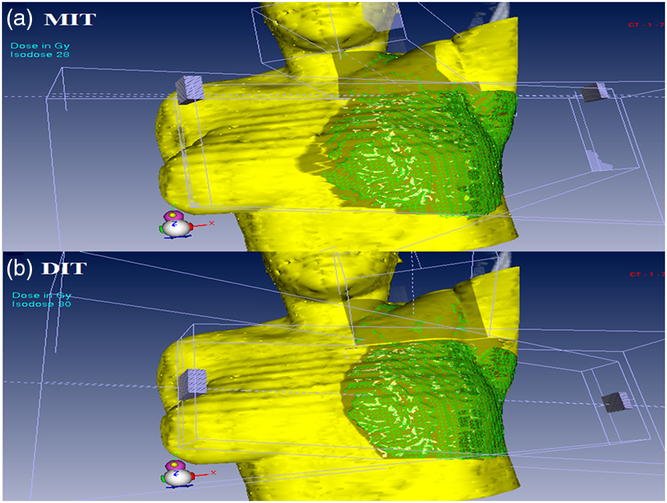
MIT and DIT methods were planned in both 3D-CRT and IMRT techniques. For each of these techniques, a DIT plan was created utilising two tangential fields delivering 25 Gy to the dose normalisation point for each field, and one supraclavicular field for irradiating the axillary lymph nodes. For MIT, the tangential and supraclavicular fields were adjusted to one isocentre point. More details about MIT and DIT, such as isocentre point locations, have been described in a previous study.Reference Banaei, Hashemi and Bakhshandeh23 According to Figure 1, no divergence or overlapping occurs in MIT. However, regions with higher/lower doses than the prescribed doses are observed at the junctions of treatment fields in DIT. In Figure 2, two treatment planning configurations with MIT and DIT in 3D-CRT are demonstrated.
MIT (a) and DIT (b) treatment fields showing the occurrence of hot and cold areas in DIT (23).

Treatment planning configuration used for MIT (a) and DIT (b) in 3D-CRT for one of the patients.

Dosimetric parameters
Several parameters were used for evaluating dose distributions.Reference Firouzjah, Banaei, Farhood and Bakhshandeh1, Reference Banaei, Hashemi and Bakhshandeh23D mean and V(xGy) represent average dose delivered to a structure and percentage of its volume receiving xGy or higher, respectively. D mean, D min (minimum dose) and D max (maximum dose), and a dose at 95% to the level II lymph node volume were assessed. Also V20 and V30 describe the percentage of the ipsilateral lung volume receiving 20 and 30 Gy doses, respectively, and V10 and V40 represent the percentage of heart volume receiving 10 and 40 Gy doses, respectively. These dosimetric parameters are the tolerance doses chosen based on previous studies,Reference Assaoui, Toulba and Nouh18, Reference Banaei, Hashemi and Bakhshandeh23, Reference Milano, Constine and Okunieff25 and these can show high and low dose volumes for comparing the different techniques. In addition, mean doses delivered to the axillary level I and III lymph nodes, heart (in the left breast mastectomy patients) and lungs were assessed. These parameters were derived from relevant dose volume histograms. Homogeneity index (HI) was derived for the evaluation of planning target volume (PTV) dose coverage.Reference Prasana Sarathy26, Reference Paddick27
Statistical analysis
Relevant statistical tests were done using SPSS version 11.5 (SPSS Inc., Chicago, IL, USA). Paired sample t-test was used to find significant difference between MIT and DIT results for every dosimetric parameter. Statistical significance was defined as p values < 0·05.
Results
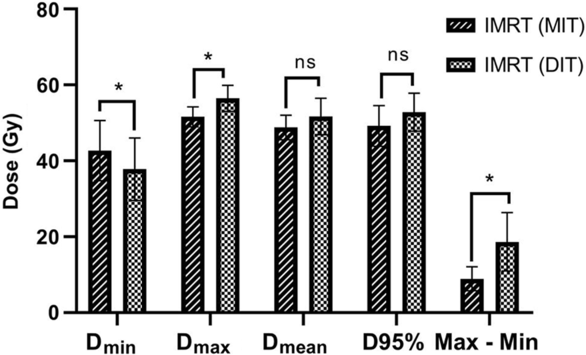
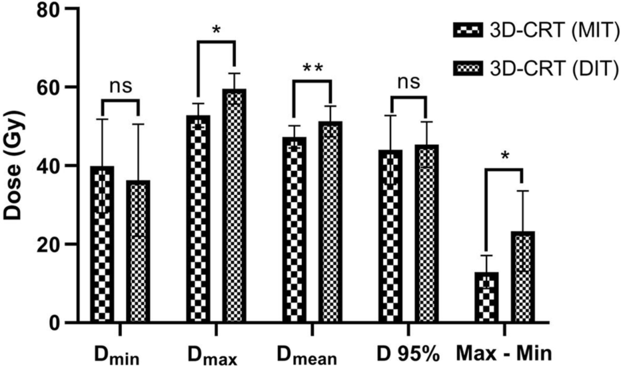
Figure 3 indicates level II lymph node dosimetric parameters averaged over all the patients in DIT and MIT in IMRT technique, and Figure 4 shows the same parameters in 3D-CRT. There are significant differences in D min, D max and maximum–minimum dose between DIT and MIT methods in IMRT (p < 0·05); in contrast, no significant differences were observed in D mean and dose at 95%. Furthermore, statistical analysis showed that there were considerable differences in D mean, D max and maximum–minimum (p < 0·05) between DIT and MIT in 3D-CRT, but it was not remarkable in D min and dose at 95% dosimetric parameters.
Differences in dosimetric parameters in MIT and DIT in IMRT technique.

Differences in dosimetric parameters in MIT and DIT in 3D-CRT technique.

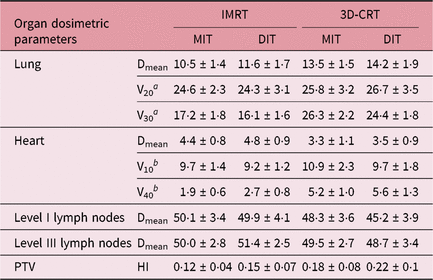
Table 1 illustrates that there was not any variations in all of the dosimetric parameters (V20 and V30 for ipsilateral lungs, V10 and V40 for the heart and mean doses of axillary level I and III lymph nodes) in DIT and MIT for IMRT and 3D-CRT techniques. Level II lymph nodes had a better dose homogeneity using MIT with the prescribed dose (50 Gy) showing lower values and better dose distribution compared with DIT.
Dosimetric parameters along with standard deviation in level I lymph nodes, level III lymph nodes, lung, heart and PTV resulting from MIT and DIT planning in IMRT and 3D-CRT techniques (Dmean in Gy, Vx in %, and HI is unit-less)

Notes: aFor the ipsilateral lung.
bFor the heart in left breast mastectomy patients.
Discussion
In the current study, the main dosimetric parameters of level II lymph nodes and OARs were evaluated and compared between MIT and DIT utilising 3D-CRT and IMRT techniques in 20 mastectomy patients.
Although more advanced methods such as IMRT and VMAT have some benefits such as dose coverage and uniformity to the target volume, organ doses in the out-of-field regions are greater compared with 3D-CRT, due to greater scattering and number of monitor units.Reference Abo-Madyan, Aziz and Aly22, Reference Lee, Lee, Sung and Yoon28 Lee et al.Reference Paddick27 reported that the secondary cancer risk for breast cancer was lower in 3D-CRT than in IMRT and VMAT. According to previous studies,Reference Assaoui, Toulba and Nouh18, Reference Abo-Madyan, Aziz and Aly22, Reference Lee, Lee, Sung and Yoon28 every technique has both advantages and disadvantages; therefore, conventional and advanced radiotherapy techniques are used in different radiotherapy centers for the treatment of mastectomy patients.
In DIT, field junction regions showed more variation in the prescribed dose compared with MIT.Reference Assaoui, Toulba and Nouh18, Reference Banaei, Hashemi and Bakhshandeh23
Some of the previous studiesReference Banaei, Hashemi and Bakhshandeh23, Reference Romeo24 have evaluated tangential and supraclavicular fields matching in MIT and DIT for 3D-CRT technique. Level II lymph nodes are among the most important structures in chest wall radiotherapy of mastectomy patients due to their location in the field junction area.Reference Assaoui, Toulba and Nouh18 However, there are no studies assessing and evaluating the dosimetric parameters of these nodes in MIT and DIT in IMRT technique.
The number and angle of radiation fields were similar in 3D-CRT and IMRT for both MIT and DIT techniques, because previous studies have shown that the use of a greater number of fields in IMRT led to higher doses in OARs.Reference Abo-Madyan, Aziz and Aly22
Our results showed that significant differences were observed in some of the dosimetric parameters of level II lymph nodes (Figures 3 and 4). It is noticeable that MIT indicated better dosimetric results than DIT in both techniques (3D-CRT and IMRT). Level II lymph nodes are located in the field junction region; therefore, a difference in the dose distribution of these nodes between MIT and DIT was expected. A similar expectation existed regarding hot and cold points (points with higher and lower doses than the prescribed dose) in field junction regions of DIT, which was also confirmed by previous researches.Reference Assaoui, Toulba and Nouh18, Reference Banaei, Hashemi and Bakhshandeh23
As expected, it was confirmed that D max in the field junction and overlap regions for DIT was significantly higher compared with MIT (59·59 versus 52·8 Gy in 3D-CRT and 56·48 versus 51·6 Gy in IMRT). Previous investigations have also reported similar findings in this regard.Reference Assaoui, Toulba and Nouh18, Reference Marshall29–Reference Edlund and Gannett31
Regarding the lower variation of D min and D max for level II lymph nodes and lack of any hot or cold points in MIT (in both 3D-CRT and IMRT techniques), dose homogeneity was better with MIT compared to DIT.
Because of similar field sizes and radiation intensities in regions located outside the field junction, dosimetric parameters related to such regions did not show any significant differences (Table 1).
Assaoui et al.Reference Assaoui, Toulba and Nouh18 and Banaei et al.Reference Banaei, Hashemi and Bakhshandeh23 reported the same results for dosimetric parameters regarding the chest wall, lung and heart resulting from MIT and DIT with 3D-CRT technique. In another study by Lefkopoulos et al.,Reference Lefkopoulos, Levrier, Bendada and Touboul32 a general optimisation procedure for stereotactic small-beam using multi-isocentric radiotherapy was investigated. In a dual/multi-isocentric configuration, an appropriate optimised configuration was more difficult to be found than in the mono-isocentric case.
Level I and level III lymph nodes are usually located in the chest wall and supraclavicular region, respectively. Therefore, dose distributions in these nodes were not evaluated, because the dose distribution outside the field junction regions did not show a significant difference between the two methods. It can be concluded that the dose distributions of level III and I lymph nodes given by MIT and DIT should be similar.
For future research, it is suggested that tumour control probability and normal tissue complication probabilities along with cancer incidence risks in MIT and DIT methods should be studied to establish a superior technique.
Conclusion
Due to a better matching of supraclavicular and tangential fields in MIT, level II lymph node dose distribution was clinically closer to the prescribed dose compared with DIT in both 3D-CRT and IMRT techniques. The superposition and overlaps in the field junction region in DIT leads to a significantly higher D max and maximum–minimum dose and lower D min values for level II lymph nodes. Furthermore, other dosimetric parameters related to OARs, chest wall and other lymph node levels had no significant differences between MIT and DIT. Therefore, to achieve a better dose homogeneity in the radiotherapy of mastectomy patients, we recommended using MIT instead of DIT in both 3D-CRT and IMRT techniques.
Acknowledgement
CT imaging and patients’ radiotherapy planning procedures were carried out at the Radiotherapy and Oncology Department of ShohadayeTajrish Hospital, Tehran, Iran. Authors would like to express their sincere appreciation to the institution for their cooperation.