INTRODUCTION
Coral reefs are the major coastal ecosystem in the intertidal and shallow subtidal zones of exposed and semi-exposed areas along the shore of Sanya Bay (Hainan Island, China). During the past two decades, the marine benthic flora of Hainan Island was sufficiently studied (Titlyanov et al., Reference Titlyanov, Kiyashko, Titlyanova, Yakovleva, Li and Huang2011a, Reference Titlyanov, Titlyanova, Xia and Bartschb, Reference Titlyanov, Titlyanova, Huang and Li2014a; Titlyanova et al., Reference Titlyanova, Titlyanov, Xia and Bartsch2012). Three major algal surveys at Hainan Island (including Sanya Bay) were conducted between the 1930s and 2010s.
The first survey included algal samplings from the 1930s to 1970s, by the Chinese phycologist C.K. Tseng and colleagues (Tseng, Reference Tseng2004) resulting in numerous papers and books published up to 2011. All these publications were considered and mentioned in our works (Titlyanov et al., Reference Titlyanov, Kiyashko, Titlyanova, Yakovleva, Li and Huang2011a, Reference Titlyanov, Titlyanova, Xia and Bartschb, Reference Titlyanov, Titlyanova, Huang and Li2014a, Reference Titlyanov, Titlyanova, Kalita, Xia and Bartschb; Titlyanova et al., Reference Titlyanova, Titlyanov, Xia and Bartsch2012).
The second survey included macroalgal samplings during two German–Chinese expeditions which were conducted in Hainan Island in October–December 1990 and in March–April 1992. Marine algae were sampled at shallow water at 16 localities from the island of Hainan. Results of these expeditions were partially published (on Chlorophyta) (Titlyanov et al., Reference Titlyanov, Titlyanova, Xia and Bartsch2011b; Titlyanova et al., Reference Titlyanova, Titlyanov, Xia and Bartsch2012) or have been submitted (Titlyanov et al., Reference Titlyanov, Titlyanova, Kalita, Xia and Bartsch2014b).
In a more recent survey (2008–2010) we investigated macroalgae only in Sanya Bay. The aim of this study was to inventory the marine benthic flora of Sanya Bay based on collections of 2008–2010. Moreover, on the basis of analysis of the marine flora in Sanya Bay we tried to reveal decadal changes in the diversity and species composition of benthic marine algae (Rhodophyta, Phaeophyceae and Chlorophyta) and possible reasons for these changes.
MATERIALS AND METHODS
Study site
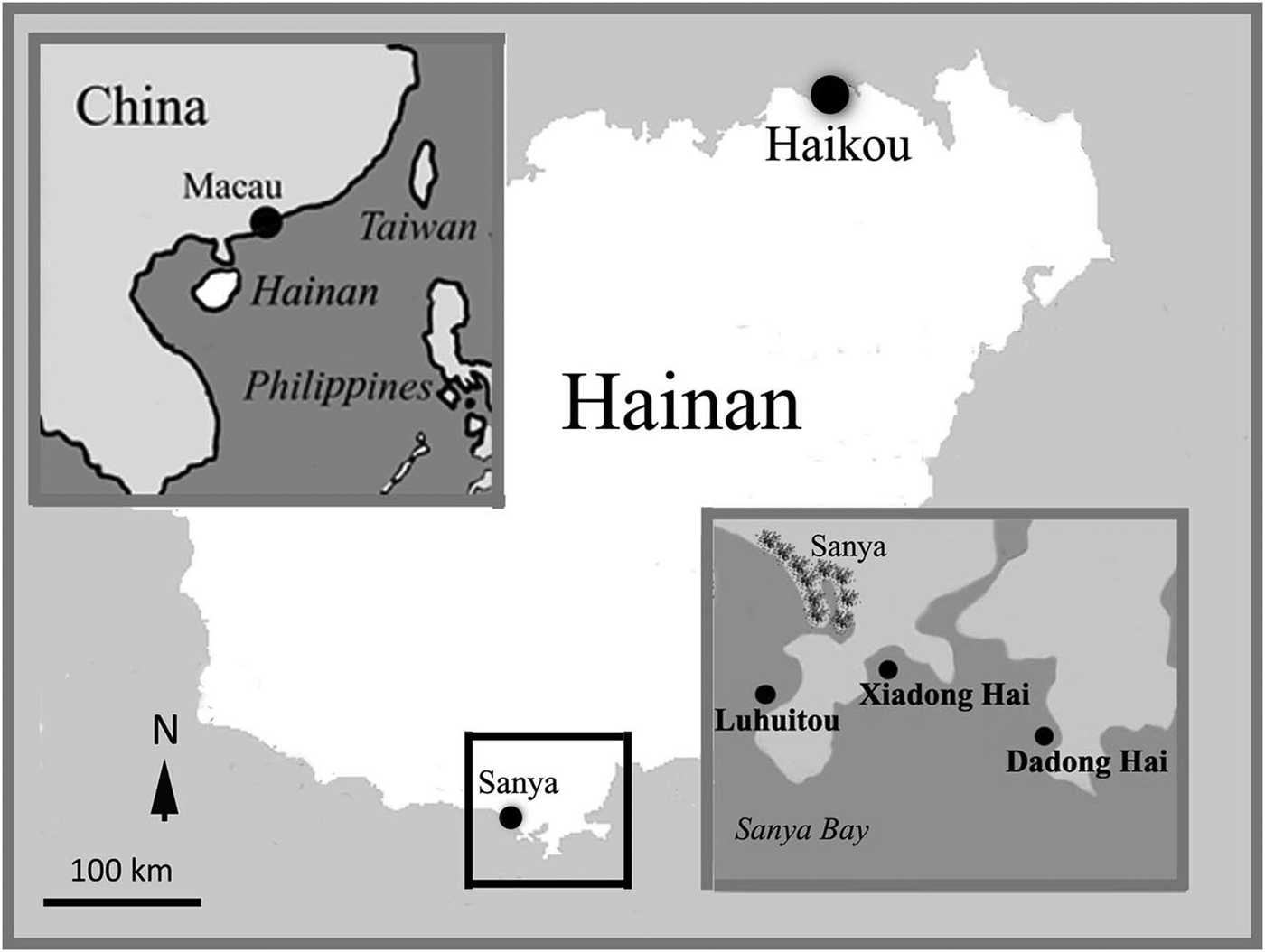
Sanya Bay is located in the southern part of Hainan Island (South China Sea), 18°15′N 109°28′E; the coastline extent of the bay is about 209 km. The marine flora of Sanya bay was studied at three localities: Luhuitou Peninsula (in front of the Marine Biological Station of the South China Sea Institute of Oceanology), Xiaodong Hai and Dadong Hai (Figure 1). At Luhuitou Peninsula macroalgae were sampled in October 2008, April 2009 and in November–December 2010; at Xiaodong Hai and Dadong Hai localities macroalgae were collected in October 2008.
Hainan Island (South China Sea, China) (18°10′–20°9′N, 108°37′–111°1′E). Collection sites during 1990/1992 and 2008–2010.

Macroalgal zonation
In 2008–2010, Luhuitou (Figure 2) and Dadong Hai (Figure 3) localities were characterized by damaged coral reefs (projected cover of live hard corals approximately 30 and 5%, respectively), whereas Xiaodong Hai (Figure 4) was characterized by dead coral reefs and seagrass beds. At the localities investigated, the splash zone (Luhuitou Peninsula) consisted of a horizontal belt (~20 cm broad) on the vertical walls of an artificial dam built of dead colonies of massive corals. The upper intertidal zone (0.1–0.5 m deep at high tide) consisted of a sloping shore (2–3 m broad) with hard substrates composed of stones and dead coral fragments of various shapes and sizes, tossed about by storms (Figure 2B). The sloping shore of the middle intertidal zone (0.6–1.0 m deep at high tide and ~10 m broad) consisted mainly of flat carbonate patches intermixed with coral debris and stones (Figure 2C). The lower intertidal zone (1.1–1.5 m deep at high tide and ~15 m broad) was mainly composed of dead colonies of massive and branched corals intermixed with sand and small fragments of dead branched corals (Figure 2D). The upper subtidal zone consisted of a sloping shore (1.6–5.0 m deep at high tide and 50–200 m broad) with hard substrates composed of stones and dead coral fragments of various shapes and sizes and was composed of dead and live colonies of massive and branched corals intermixed with sand and small fragments of dead branched corals (Figure 2E).
Different macroalgal communities of the Luhuitou Peninsula (Sanya Bay) in October 2008 in (A–B) upper intertidal, mono-dominant community of Ulva clathrata; (C) mid intertidal, bi-dominant of Cladophora vagabunda and Ceramium procumbens; (D) low intertidal, poly-dominant algal turf community, Dictyosphaeria cavernosa in front line; (E) upper subtidal, poly-dominant algal turf among corals.
Different macroalgal communities of the Dadong Hai sampled in October 2008 in (A–B) upper intertidal, the red crust alga Hildenbrandia rubra; (C) mid intertidal, algal turf community with the predominance of Ulva clathrata; (D) low intertidal, mono-dominant community of the seagrass Thalassia hemprichii on sandy bottom; (E) upper subtidal, poly-dominant algal turf community and rare massive corals partially overgrown by the community.
Different macroalgal communities at the Xiaodong Hai locality sampled in October 2008: (A–B) upper intertidal, bi-dominant algal turf community with the predominance of Ulva clathrata and Gelidium pusillum; (C) mid intertidal, mono-dominant community of Gelidium pusillum; (D) low intertidal, poly-dominant algal turf community; (E) upper subtidal, poly-dominant algal turf community, Amphiroa foliacea in front line.
Macroalgal samplings
Sampling of the marine plants was carried out via snorkelling during low and high tides. Samples were collected from all substratum types at more than 200 sites. All these collections were sampled in the intertidal and upper subtidal zones (to 4–5 m deep). Samples were herbarized and identified by T. Titlyanova and E. Titlyanov. Herbarium material was deposited at the A.V. Zhirmunsky Institute of Marine Biology, Far Eastern Branch of the Russian Academy of Sciences.
Floristic analysis
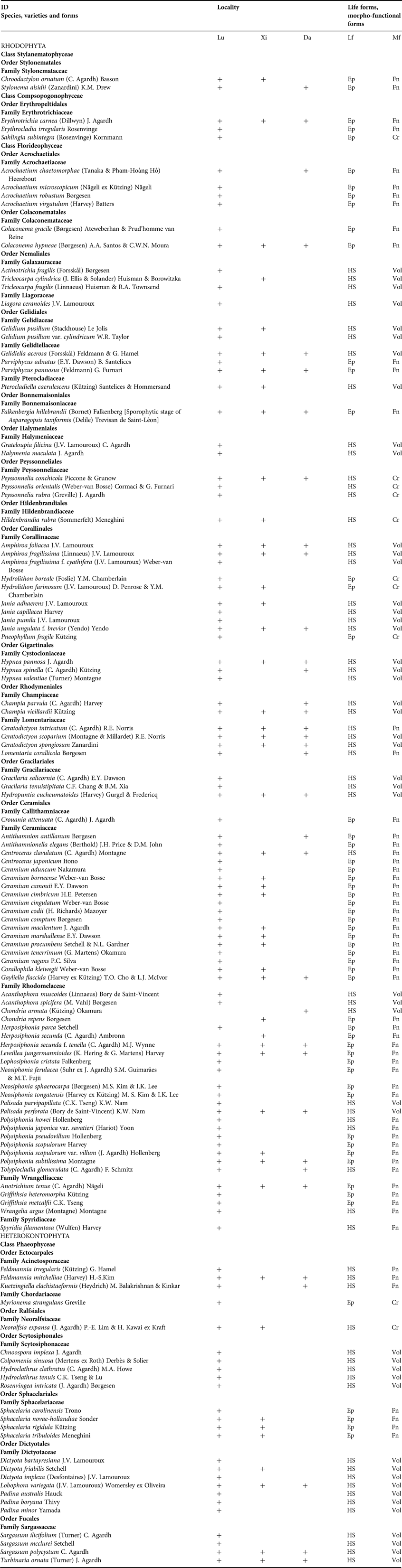
All available data on the marine red (Rhodophyta, Rh), and brown (Heterokontophyta-Phaeophyceae, Ph) macroalgae in Sanya Bay collected in 2008–2010 were compiled and integrated into a common list (see Table 1). Additionally a classification of species into life forms and morpho-physiological forms have been performed. Two life forms were considered: epilithic algae growing only or predominantly on hard substratum and epiphytic algae. The following morpho-functional groups have been classified: volumetric forms with a low volume to surface ratio (fleshy, foliose, leathery, calcareous articulated); fine filamentous, branched, or membranaceous thalli with a high surface to volume ratio and crustose forms. The systematic order of species basically follows Tsuda (Reference Tsuda2006) and author names follow Algaebase (Guiry & Guiry, Reference Guiry and Guiry2014). Relative change was analysed by comparing the floristic composition during the 1990/1992 and 2008–2010 time periods. Materials of the 1990/1992 and 2008–2010 were identified using monographic publications, floristic studies and systematic articles cited in previous publications (Titlyanov et al., Reference Titlyanov, Kiyashko, Titlyanova, Yakovleva, Li and Huang2011a, Reference Titlyanov, Titlyanova, Xia and Bartschb, Reference Titlyanov, Titlyanova, Huang and Li2014a; Titlyanova et al., Reference Titlyanova, Titlyanov, Xia and Bartsch2012). The program Adobe Photoshop CS2, version 12 was used for picture processing. The program Kaleida Graph v. 3.51 was used for charts.
List of species (including varieties and forms) of the marine flora (Rhodophyta and Phaeophyceae) for Sanya Bay (China), 2008–2010 survey. Lu, Luhuitou; Xi, Xiaodong Hai; Da, Dadong Hai; Lf, Life forms; Mf, morpho-functional forms; HS, algae growing on hard substrate (epilithic); Ep, epiphytes; Fn, fine form; Vol, volumetric form; Cr, crust form.
RESULTS AND DISCUSSION
Species composition, life and morpho-functional forms
CHANGES IN RHODOPHYTA
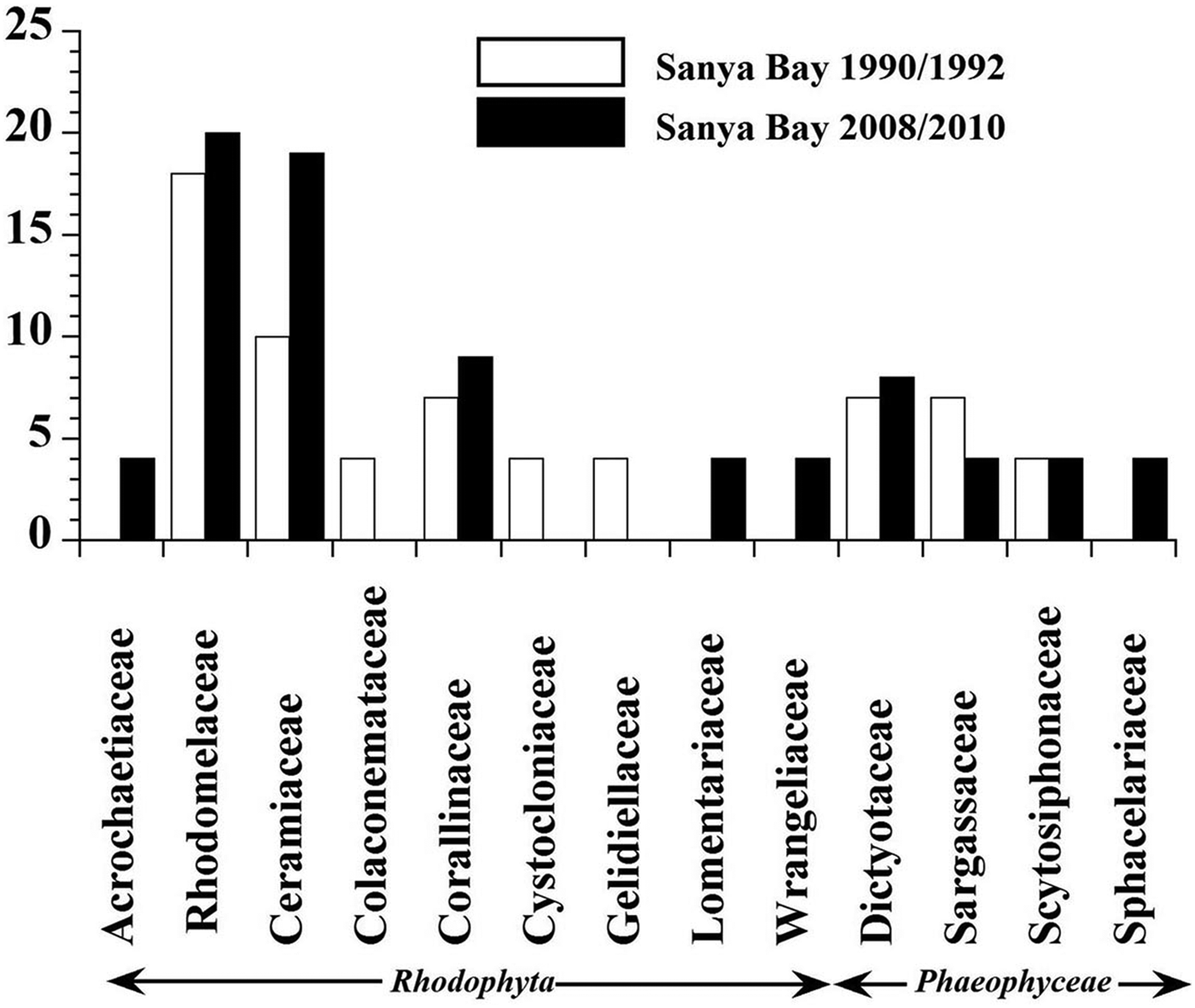
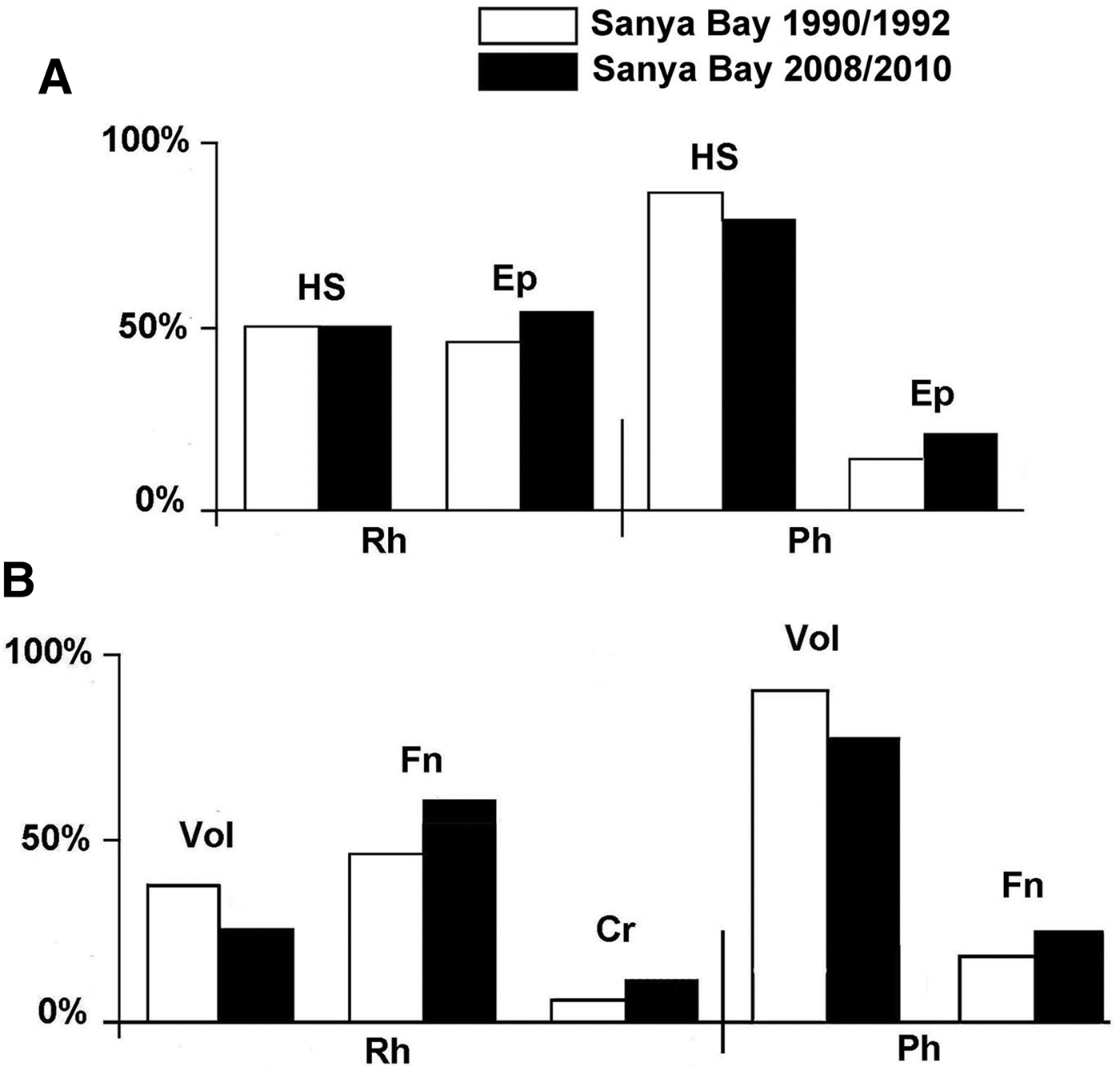
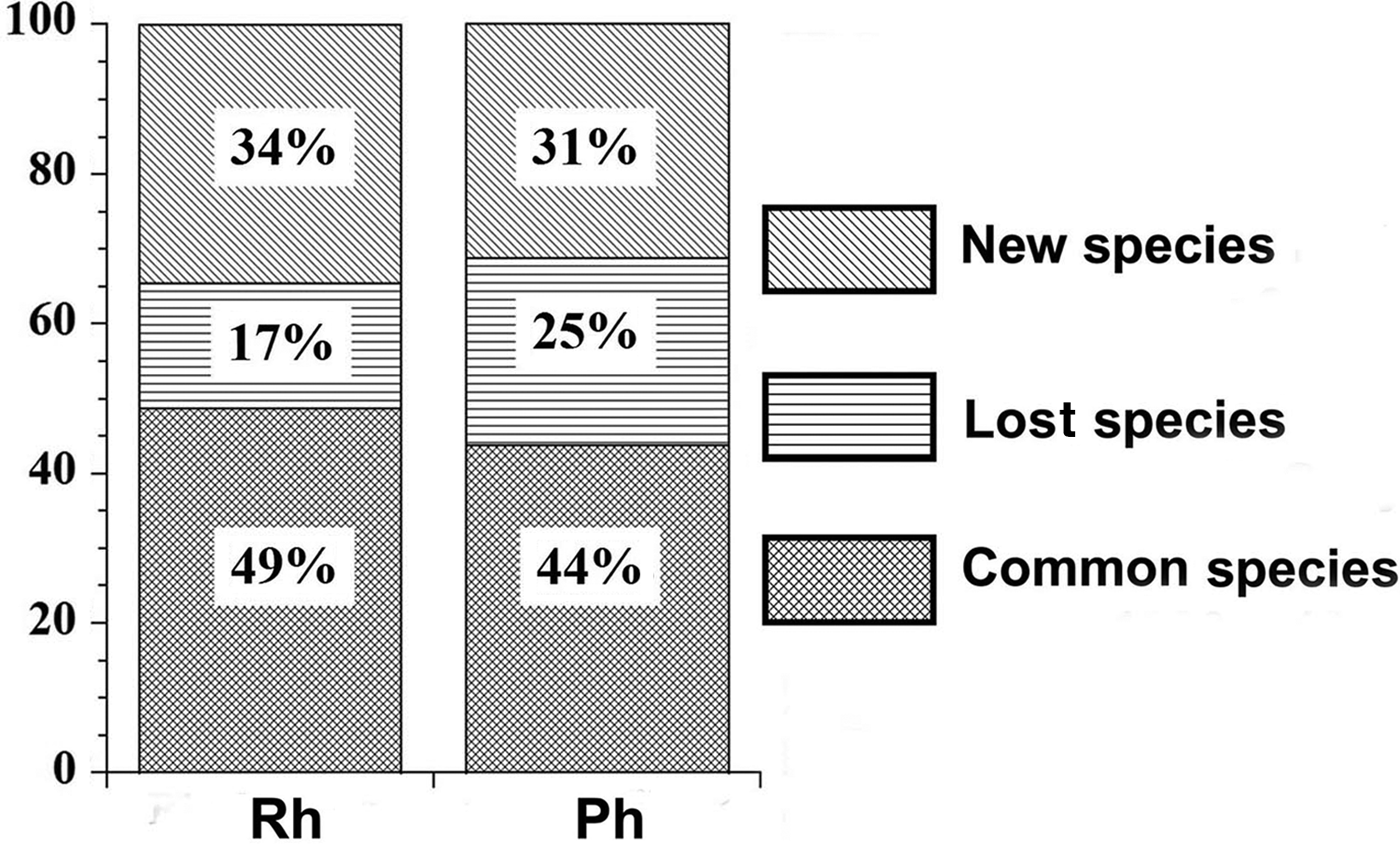
A total of 113 species of red algae were recorded in Sanya Bay (Dadong Hai, Xiaodong Hai and Luhuitou localities); 75 species were found in 1990/1992 (Titlyanov et al., Reference Titlyanov, Titlyanova, Kalita, Xia and Bartsch2014b) and 95 species in 2008–2010 (Table 1). In both collections, species from the families Rhodomelaceaе, Ceramiaceae and Corallinaceae predominated (Figure 5). Relative number of epilithic and epiphytic algae in the first collection was equal, in the second collection the number of epiphytic algae and algae with fine filamentous thalli was increased (Figure 6). In 2008–2010, 39 species (or 34% of all red species found in Sanya Bay in previous collections) were recorded for the first time (Table 1; Figure 7). Among these newly recorded species found in Sanya Bay, 23 taxa had fine branched, filamentous and membranaceous forms (Table 1; Figure 6). The largest number (20 taxa) of these species belonged to the Order Ceramiales (Table 1). In 2008–2010, 19 taxa (17%) of red algae were not found again in Sanya Bay (Figure 7), of which 12 taxa comprised fine filamentous or fine branched, filamentous forms. Fifty-five taxa (49% of all found red algae) were common for both (1990/1992 and 2008–2010) extensive collections from Sanya Bay (Figure 7).
Comparison of species recorded in Sanya Bay (Dadong Hai, Xiaodong Hai and Luhuitou, see Figs 1–4) in 1990/1992 and 2008–2010.
Relative number of benthic algal species (Rhodophyta and Phaeophyceae) in Sanya Bay existing in different life forms (А) and in different morpho-functional forms (B) in 1990/1992 and 2008–2010. HS, algae growing on hard substrate (epilithic); Ep, epiphytes; Fn, fine form; Vol, volumetric form; Cr, crust form.
Relative number of newly recorded species, species which were found in 1990/1992 but not found again (or species not encountered any more) in 2008–2010 and common species (for both surveys 1990/1992 and 2008–2010) of red (Rh) and brown (Ph) algae.
CHANGES IN PHAEOPHYCEAE
A total of 32 taxa of brown (Ph) were recorded for Sanya Bay, with 23 species sampled in 1990/1992 (Titlyanov et al., Reference Titlyanov, Titlyanova, Kalita, Xia and Bartsch2014b) and 25 species during the period from 2008 to 2010 (Table 1). The largest number of species in both collections belonged to the families Dictyotaceae and Sargassaceae (Figure 5), with the predominance of epilithic algae of volumetric form (Figure 6). Ten newly recorded species of brown algae (31% of the brown flora) were documented for Sanya Bay which were not found in 1990/1992 (Figure 7). These findings were composed of fine filamentous, volumetric and crusts forms (Table 1; Figure 6). Twenty-five per cent of species of brown algae documented earlier were not found in 2008–2010. These species comprised the finely branched form of Feldmannia irregularis and the volumetric forms (Canistrocarpus cervicornis, Dictyota dichotoma var. intricata, Sargassum aquifolium, S. oligocystum, S. swartzii, S. tenerrimum). Fourteen taxa (44% of brown algae) were common for both (1990/1992 and 2008–2010) the extensive collections from Sanya Bay (Figure 7).
New records of red and brown algae for Hainan Island
Nineteen new records were documented for Hainan Island which were found in Sanya Bay during samplings in 2008–2010: Ceramiaceae (Antithamnionella elegans, Centroceras japonicum, Ceramium camouii, C. cimbricum, C. codii, C. comptum, C. marshallense, C. procumbens; Rhodomelaceae (Lophosiphonia cristata, Polysiphonia japonica var. savatieri, P. pseudovillum); Acrochaetiaceae (Acrochaetium chaetomorphae); Galaxauraceae (Tricleocarpa cylindrica); Halymeniaceae (Grateloupia filicina); Peyssonneliaceae (Peyssonnelia rubra); Hildenbrandiaceae (Hildenbrandia rubra); Cystocloniaceae (Hypnea valentiae); Lomentariaceae (Ceratodictyon scoparium) and Gracilariaceae (Gracilaria tenuistipitata) (Table 1).
Four species of brown algae were recorded for the first time for Hainan Island: Myrionema strangulans (Chordariaceae), Neoralfsia expansa (Neoralfsiaceae), Hydroclathrus tenuis (Scytosiphonaceae), Sphacelaria carolinensis (Sphacelariaceae) (Table 1).
Probable reasons for decadal changes in algal species compositions and their life and morpho-functional forms
Maximum similarity boundary values between the floras in Sanya Bay in 1990/1992 and 2008–2010 amounted to 65%. In 2008–2010, there were 28% more species found than in 1990/1992 mainly due to species from the families Ceramiaceae and Rhodomelaceae (Table 1) and green algae from the families Ulvaceae and Cladophoraceae (Titlyanov et al., Reference Titlyanov, Titlyanova, Xia and Bartsch2011b), the majority of them were composed of epiphytes with fine filamentous highly productive morpho-functional form.
We believe that these changes in the benthic flora of the island are connected with the influence of anthropogenic factors. By 2008–2010 the development of tourism infrastructure and urbanization resulted in extreme pollution of Sanya Bay. According to the data of our Chinese colleagues (Titlyanov et al., Reference Titlyanov, Kiyashko, Titlyanova, Yakovleva, Li and Huang2011a) Sanya Bay for the most part of the year was sufficiently enriched with dissolved nitrogen and phosphorus or was 5–7 times and 2 times higher, respectively, than clear waters of oceanic atolls and reefs (Charpy-Roubaud & Charpy, Reference Charpy-Roubaud and Charpy1994; Furnas et al., Reference Furnas, Mitchell and Skuza1997; Charpy et al., Reference Charpy, Charpy-Roubaud and Buat1998). It is known that increased concentrations of dissolved inorganic and organic nitrogen and phosphorus lead to increases in the production of seaweeds, green algal blooms of filamentous and thin blade-like forms, and in some cases the appearance of new, often invasive species, especially algae-epiphytes (Berchez & Oliveira, Reference Berchez, Oliveira, Cordeiro-Marino, Azevedo, Sant'anna, Tomita and Plastino1992; Lapointe, Reference Lapointe1997; Lapointe et al., Reference Lapointe, Littler and Littler1997, Reference Lapointe, Barile, Littler and Littler2005a, Reference Lapointe, Barile, Littler, Littler, Bedford and Gasqueb, Reference Lapointe, Barile, Wynne and Yentschc; Malta & Verschuure, Reference Malta and Verschuure1997; Lirman, Reference Lirman2001; Diaz-Pulido & McCook, Reference Diaz-Pulido and McCook2002; Gartner et al., Reference Gartner, Lavery and Smit2002; Oliveira & Qi, Reference Oliveira and Qi2003; Karez et al., Reference Karez, Engelbert, Kraufvelin, Pedersen and Sommer2004; McClanahan et al., Reference McClanahan, Marnane, Cinner and Kiene2006; Sfriso & Curiel, Reference Sfriso and Curiel2007; Kinzie III, Reference Kinzie2008; Titlyanov et al., Reference Titlyanov, Titlyanova and Chapman2008, Reference Titlyanov, Kiyashko, Titlyanova, Yakovleva, Li and Huang2011a; Lapointe & Bedford, Reference Lapointe and Bedford2010; Fricke et al., Reference Fricke, Titlyanova, Nugues and Bischof2011).
However, as has been mentioned in some studies, enrichment of benthic flora on coral reefs by increasing species with high dry matter production (fine-filamentous and fine-lamellar forms) can also occur after coral bleaching episodes have resulted in catastrophic loss of the main component of the ecosystem – hermatypic corals (Petraitis & Dudgeon, Reference Petraitis and Dudgeon2004; Sergeeva et al., Reference Sergeeva, Titlyanova and Titlyanov2007; Titlyanov & Titlyanova, Reference Titlyanov and Titlyanova2008; Titlyanov et al., Reference Titlyanov, Titlyanova and Chapman2008; Glynn & Enochs, Reference Glynn, Enochs, Dubinsky and Stambler2011). It has been repeatedly shown that unusually high sea temperatures (30–31 °С) combined with periods of slack winds, calm seas and high solar radiation cause bleaching and subsequent mortality of hermatypic corals, resulting in the formation of new substrates comprised of dead or damaged hermatypic corals and also of stones and/or sand, which are rapidly colonized by sessile organisms such as seaweeds, sponges, hydroids, gorgonians and other organisms.
Numerous observations have shown that strongly damaged coral reefs transform into a seaweed-dominated state (coral reef ‘phase shifts’) (Done, Reference Done1992; Knowlton, Reference Knowlton1992; McCook, Reference McCook1999; Szmant, Reference Szmant2001; McManus & Polsenberg, Reference McManus and Polsenberg2004; Titlyanov & Titlyanova, Reference Titlyanov and Titlyanova2012). Changes in the marine flora of Sanya Bay between 1990 and 2010 might be connected not only with anthropogenic impact but also with coral bleaching episodes. Unfortunately we could not find any authentic information on coral bleaching events at Hainan Island. It is known that in nearby regions of the South China Sea during the period between the 1990s and 2000s some catastrophes occurred including a severe bleaching episode in 1998 (Nakano, Reference Nakano, Tsuchiya, Nadaoka, Kayanne and Yamano2004). In this connection, we consider that serious changes in the marine flora of Sanya Bay could be evoked by the combined influence of seawater eutrophication and the bleaching events of 1998.
The analysis of the floristic composition of the marine red, brown and green macroalgae in Sanya Bay during different time periods in 1990/1992 and 2008–2010 revealed that considerable changes have taken place. There was an increase in fine filamentous, tubular and blade-like red and green algae mainly from families such as Ceramiaceae and Rhodomelaceae (Rh), Ulvaceae and Cladophoraceae (Ch) and displacement of volumetric forms of macrophytes, probably as a consequence of reef degradation, increased urban and aquaculture wastes and coral bleaching in shallow bays of Hainan Island.
ACKNOWLEDGEMENTS
T. Titlyanova and E. Titlyanov thank Professor Huang Hui for the invitation to work at the Hainan Tropical Marine Biological Research Station (Chinese Academy of Sciences). They are grateful to Li Xiu Bao for help in algal sampling in 2008.
FINANCIAL SUPPORT
This study was partially supported by the grant ‘Succession of algal communities in seas of tropical and temperate regions’ (2007–2010) from the Russian Foundation for Basic Research.