Surgical site infection (SSI) is one of the most common healthcare-associated infections (HAIs) in developed and developing countries. 1 , Reference Magill, Edwards and Bamberg 2 Allegranzi et alReference Allegranzi, Nejad and Combescure 3 reported a total incidence of 5.6 SSIs per 100 surgical procedures in developing countries, which is more than double the rate in developed countries such as the United States (2.6 per 100 surgeries) and in European countries (2.9 per 100). Similarly, data from the International Nosocomial Infection Control Consortium have indicated that the overall SSI rate is higher in developing countries than in the United States, as reported by the Centers for Disease Control and Prevention National Healthcare Safety Network.Reference Rosenthal, Richtmann and Singh 4 These figures, however, may not adequately represent the incidence of SSI in developing countries due to the scarcity of published data and the lack of proper surveillance systems in these regions.Reference Allegranzi, Nejad and Combescure 3 , Reference Rosenthal, Richtmann and Singh 4
Triclosan is a broad-spectrum antiseptic used in a variety of pharmaceutical products; it has an established safety profile and activity against common pathogens responsible for SSIs, including resistant strains.Reference Chang, Srinivasa and Morton 5 Triclosan-coated sutures (TCSs) have been documented to reduce bacterial colonization and to inhibit a wide spectrum of pathogens without impeding wound healing or altering suture properties.Reference Wang, Jiang and Cao 6
A number of published studies have evaluated the efficacy and safety of using TCSs in preventing SSIs. A systematic review of 7 randomized controlled trials (RCTs) with 836 patients suggests that TCSs did not decrease the rate of SSI or decrease the rate of wound breakdown.Reference Chang, Srinivasa and Morton 5 Three recent meta-analyses that included several additional RCTs and involved a greater number of patients demonstrated positive effects of TCSs in the prevention of SSIs following surgery.Reference Wang, Jiang and Cao 6 – Reference Daoud, Edmiston and Leaper 8 These published meta-analyses, however, did not include non-randomized controlled trials (non-RCTs). Although the potential for bias is greater in non-RCTs, the inclusion of non-RCTs as well as unpublished studies, abstracts, and conference proceedings in a meta-analysis may increase the precision of effect estimates and may enhance the external validity of results.Reference Higgins and Green 9 , Reference Shrier, Steele and Platt 10 Moreover, including non-RCTs and unpublished data increases the number of studies, which minimizes publication bias and allows sufficiently powered subgroup analysis.Reference Higgins and Green 9 In this study, we aimed to analyze the available evidence evaluating TCSs versus non-triclosan-coated sutures (non-TCSs) in reducing the risk of SSI following surgery.
METHODS
Study Selection
A systematic search of both randomized and nonrandomized studies (prior to May 15, 2014) was performed on PubMed Medline, OVID, EMBASE, and SCOPUS. The following keywords, based on a similar study,Reference Wang, Jiang and Cao 6 were used to search for relevant literature: triclosan, antimicrobial, antiseptic, Vicryl, Vicryl Plus, Monocryl, Monocryl Plus, PDS, PDS Plus, and suture. Keywords were used singly and in combination using Boolean terms. There were no restrictions regarding language and publication type. Abstracts, conference proceedings, and unpublished literature were included. In cases of series of studies utilizing the same population of subjects, the latest study or the study that provided more comprehensive outcomes was included. One investigator conducted the search and two investigators performed title, abstract, and full-text reviews.
Data Abstraction and Study Quality
Data abstraction was conducted by one investigator and reviewed by another, and discrepancies were resolved by consensus. If an issue was unresolved, a third investigator provided the final decision. The following data were extracted from the studies: author, year of publication, study design, text availability (whether full text or abstract was retrieved), blinding method, surgical procedure, mean follow-up time, CDC wound classification, definition of SSI, incidence of SSI in each group, and number of patients allocated. SSI was defined based on the definitions used by the investigators of the controlled trials. Study quality was assessed using the Cochrane Collaboration risk of bias toolReference Higgins and Green 9 for RCTs, and the Newcastle Ottawa Scale (NOS)Reference Wells, Shea and O’Connell 11 was used for non-RCTs.
Statistical Analysis
Fixed-effects meta-analysis using the Mantel–Haenszel method was used if no substantial heterogeneity was observed. Otherwise, random-effects meta-analysis was performed using the DerSimonian and Laird method. Relative risk (RR) and 95% confidence interval (CI) were used to show pooled estimates. Tests of robustness via subgroup analysis, sensitivity analysis, and heterogeneity were based on the protocol reported by Daoud et al.Reference Daoud, Edmiston and Leaper 8 Funnel plot and Egger’s test were used to determine funnel plot asymmetry.
The following predetermined categories were used for subgroup analyses: study design, blinding method, CDC wound classification,Reference Garner 12 suture type, surgical procedure, publication type, and SSI definition. A subgroup with ≥5 studies was assumed to have sufficient power to reject the null hypothesis that RR=1.
Meta-regression analysis was performed using the identified categories for subgroups as explanatory variables. Sensitivity analysis was performed by removing individual studies to examine whether they affected the null hypothesis or whether there was a substantial change in magnitude or direction of pooled estimates.
RESULTS
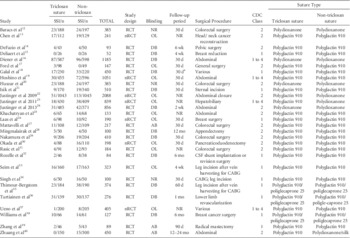
A total of 3,073 studies were obtained in the initial search. After deduplication and exclusion of studies based on title and abstract review, 236 studies were screened. Of these, 35 full-text articles were reviewed, and 29 studies were included in the quantitative analysis.Reference Baracs, Huszar and Sajjadi 13 – Reference Zhuang, Cai and Wang 41 A summary of study characteristics is presented in Table 1. Of the 29 included studies, 22 studies were RCTs and 7 studies were non-RCTs. All included studies were published in peer-reviewed journals; 25 were full-text articles and 4 were abstracts. The percentages of studies that demonstrated low risk of bias using Cochrane’s risk of bias tool are as follows: 38% for random sequence generation, 45% for allocation concealment, 31% for blinding of participants and personnel, 41% for blinding of outcome assessment, 45% for incomplete outcome data, 31% for selective reporting, and 38% for other sources of bias. For the non-RCTs using NOS, all 7 studies received full scores for selection (4 of 4, the highest possible score); 6 of 7 received full scores for comparability (2 of 2, the highest possible score); while 3 of 7 studies received full scores for outcome (3 of 3, the highest possible score).
Study Characteristics

Note. N, total number of subjects per study; RCT, randomized controlled trial; nRCT, nonrandomized controlled trial; DB, double-blinded; AB, assessor-blinded; OL, open-label; NR, not reported; CDC class, Centers for Disease Control surgical wound classification; CSF, cerebrospinal fluid; CABG, coronary artery bypass graft.
a 1 year for patients with implants.
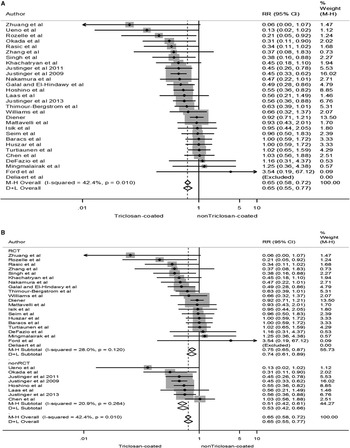
The pooled RR of acquiring SSI based on 29 controlled trials with 11,942 patients was 0.65 (95% CI: 0.549–0.769) in favor of TCS use (Figure 1A). The method of DerSimonian and Laird was used due to moderate heterogeneity (I2=42.4%, P=.01).
A. Forest plot for random-effects meta-analysis. B. Forest plot for subgroup analysis by study design. M-H, Mantel–Haenszl (fixed-effects model); D+L, Dersimonian and Laird (random-effects model).

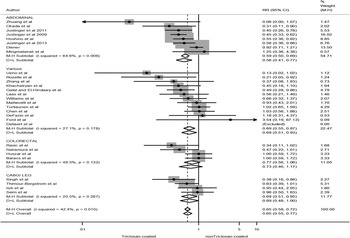
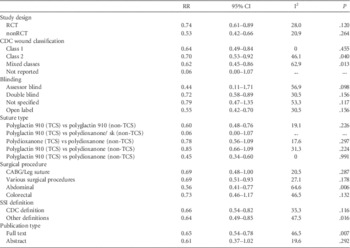
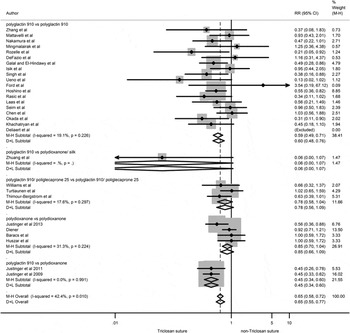
To determine the possible causes of heterogeneity, subgroup (Table 2) and meta-regression analyses were performed. The subgroup analysis based on study design (Figure 1B) showed a lower pooled RR for non-RCTs (RR: 0.53; 95% CI: 0.42–0.66) than with RCTs alone (RR: 0.74; 95% CI: 0.61–0.89). Pooled estimates for both subgroups favored the use of TCSs. The I2 heterogeneity values for both subgroups were similar, and the χ2 test did not indicate heterogeneity (RCTs: I2=28%, P=.12; non-RCTs: I2=21%, P=.264). For subgroups based on CDC wound classification, pooled RRs were similar, and the effect estimates favored the effectiveness of TCSs in reducing the risk of SSI. The RRs for CDC class I, class II, and mixed classes, respectively, were RR: 0.64 (95% CI: 0.49–0.84; I2=0%), RR: 0.70 (95% CI: 0.53–0.92; I2=46.1%), and RR:0.62 (95% CI: 0.45–0.86; I2=62.9%). For the subgroup analysis based on surgical procedures, pooled RR was lower for the abdominal surgery group (RR: 0.56; 95% CI: 0.41–0.77) than for the group that included various surgical procedures (RR: 0.69; 95% CI: 0.51–0.93); albeit, I2 was higher for the abdominal surgery group (I2=64.6%, P=.006) vs. I2=27.1%, P=.178, respectively). Fewer than 5 studies under the CABG/leg incision group and colorectal surgery group were identified (Figure 2). For blinding method, double-blinded studies and open-label studies had similar I2 values. The pooled RR for open-label studies, however, was lower (RR: 0.55, 95% CI: 0.42–0.70) than the overall RR for studies using double blinding (RR: 0.72; 95% CI: 0.58–0.89). Fewer than 5 studies reported blinded assessors only and fewer than 5 studies did not report blinding status, which may have underpowered the tests of hypothesis (Appendix A). Similarly, subgroup analysis based on suture type had <5 studies per subgroup, except for the subgroup comparing polyglactin 910 (Vicryl®) and polyglactin 910 (Vicryl® Plus), which included 18 studies (RR: 0.60; 95% CI 0.48–0.76; I2=19.1%) (Appendix B). Studies were also classified into subgroups based on the use of the CDC definition of SSI versus other definitions. The pooled RR for each subgroup did not change the direction of the effect estimates (CDC definition: RR=0.66; 95% CI 0.54, 0.82; other definitions: RR=0.64; 95% CI: 0.49–0.85), and both groups showed moderate heterogeneity (I2=35.3%; P=.116 vs. I2=47.5%; P=.016, respectively). For definitions other than SSI, 7 studies used operational definitions based on signs and symptoms of infectionReference Chen, Chen and Dai 14 , Reference Deliaert, Van den Kerckhove and Tuinder 16 , Reference Justinger, Moussavian and Schlueter 23 , Reference Justinger, Schuld and Sperling 24 , Reference Rozzelle, Leonardo and Li 33 , Reference Seim, Tønnessena and Woldbaeka 34 , Reference Zhuang, Cai and Wang 41 and bacterial cultureReference Seim, Tønnessena and Woldbaeka 34 while another study used the French recommendations for the definition of HAI.Reference Laas, Poilroux and Bézu 27 In some studies, SSI definitions were not specified.Reference Baracs, Huszar and Sajjadi 13 , Reference DeFazio, Datta and Nezhat 15 , Reference Ford, Jones and Gaines 18 , Reference Huszar, Baracs and Toth 21 , Reference Isik, Selimen and Senay 22 , Reference Khachatryan, Dibirov and Omelyanovsky 26 , Reference Mingmalairak, Ungbhakorn and Paocharoen 29 , Reference Rasic, Schwarz and Adam 32 , Reference Singh, Emmert and Sakaguchi 35 , Reference Ueno, Saito and Yamagata 38 For subgroup analysis according to type of publication (full text vs. abstract), pooled RRs were similar for both groups (RR: 0.65; 95% CI: 0.54–0.78 vs. RR: 0.61; 95% CI: 0.37–1.02); however, there were only 4 studies in the abstract group.
Subgroup analysis by surgical procedure. M-H, Mantel-Haenszl (fixed-effects model); D+L, Dersimonian and Laird (random-effects model).

Subgroup Analysis

Note. RR, relative risk; CI, confidence interval; RCT, randomized controlled trial; nonRCT, nonrandomized controlled trial; TCS, triclosan-coated suture; CABG, coronary artery bypass graft; SSI, surgical site infection; CDC, Centers for Disease Control.
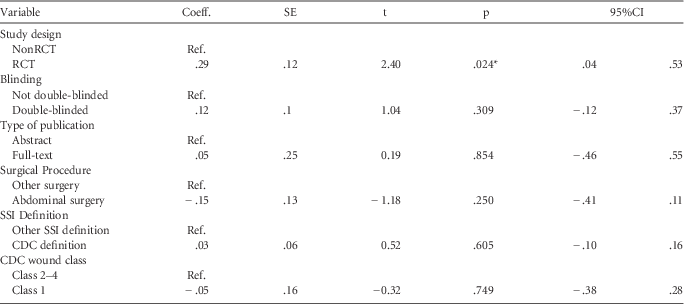
The results of the meta-regression analyses identified study design as a possible explanatory variable for heterogeneity of results (P=.03) (Appendix C). This meta-analysis found no evidence of publication bias, as the distribution of the studies in the funnel plot was symmetrical (Egger’s test P=.87) (Appendix D). Sensitivity analysis did not show any change in predominant effect when any of the studies were excluded.
DISCUSSION
The overall RR of acquiring an SSI based on the random-effects meta-analysis of 29 controlled trials was 0.65 (95% CI: 0.55–0.77; I2=42.4%; P=.01) in favor of the group that utilized TCSs. The reduction in RR was particularly observed among patients who underwent abdominal surgery (RR: 0.56; 95% CI: 0.41–0.77). The pooled RRs for subgroup meta-analysis for RCTs and non-RCTs were 0.74 (95% CI: 0.61–0.89) and 0.53 (95% CI: 0.42–0.66), respectively. SSIs cause financial burdens that include prolonged length of stay, readmission to the hospital, and additional costs to the patient.Reference Yokoe, Anderson and Berenholtz 42 Since the introduction of TCSs, some studies and meta-analyses have evaluated the efficacy of TCSs in reducing the incidence of SSIs, but no definitive conclusions could be drawn due to limitations in the methodologies that were used.
The first systematic review that investigated the benefits of TCSs reported no reduction in the rate of SSI or wound dehiscence among triclosan-impregnated sutures.Reference Chang, Srinivasa and Morton 5 This review included 7 studies only, and these studies have been documented to have been of poor quality based on the risk of bias tool.Reference Chang, Srinivasa and Morton 5 More recent systematic reviews documented a decrease in risk of SSI following TCS use.Reference Wang, Jiang and Cao 6 – Reference Daoud, Edmiston and Leaper 8 A systematic review and meta-analysis by Wang et alReference Wang, Jiang and Cao 6 showed that TCS use has a 30% advantage in reducing SSI risk. The subgroup analysis in this study revealed consistently significant results in adult patients, abdominal surgery, and clean or clean-contaminated incision, whereas, in pediatric patients, contaminated/dirty incisions, breast or cardiac surgery, such beneficial effect was not clear.Reference Wang, Jiang and Cao 6 Another systematic review by Edmiston et alReference Edmiston, Daoud and Leaper 7 also revealed a 31% reduction of risk associated with the use of TCSs for prevention of SSIs compared with non-antimicrobial-coated sutures. Daoud et alReference Daoud, Edmiston and Leaper 8 published an updated meta-analysis that showed evidence of robustness of the conclusion that use of TCSs reduced the risk of SSI by 33% after clean, clean-contaminated, and contaminated surgeries. Daoud et al utilized a rigorous protocol to test for robustness.Reference Daoud, Edmiston and Leaper 8 Tests for heterogeneity, subgroup analysis, and sensitivity analysis for the current quantitative synthesis were based on the protocol of Daoud et al, and the results are similarly robust to sensitivity analysis.
The present meta-analysis provides a comprehensive and updated review of available literature by including non-RCTs, with 14 more studies (7 RCTs and 7 non-RCTs) than the latest systematic review.Reference Daoud, Edmiston and Leaper 8 One of the most recently published RCTs included in this meta-analysis was a multicenter trial with 1,185 subjects reported by Diener et al.Reference Diener, Knebel and Kieser 17 The results of this study showed no difference in SSI rate between TCS and non-TCS groups.Reference Diener, Knebel and Kieser 17 The inclusion of this RCT in this current meta-analysis, however, did not change the predominant effect of the pooled estimate.
The use of TCSs may significantly influence outcomes following surgery. The substantial reduction in the risk of SSI after surgical procedures, based on data pooled from a total of 11,942 patients, may consequently decrease the burden of this complication in terms of morbidity, mortality, healthcare consumption, and other patient-related outcomes. Recently, a compilation of strategies to prevent HAIs, including SSI, was published.Reference Yokoe, Anderson and Berenholtz 42 , Reference Anderson, Podgorny and Berríos-Torres 43 This compendium aimed to provide practical guidance for acute-care hospitals and was not intended to replace existing guidelines or provide a comprehensive systematic literature review.Reference Yokoe, Anderson and Berenholtz 42 Several strategies, such as proper instrument sterilization, antibiotic prophylaxis, and the use of the safe surgery checklist, have been suggested to reduce SSIs. However, the routine use of TCSs in surgery was not endorsed by this expert guidance document.Reference Anderson, Podgorny and Berríos-Torres 43 This recommendation was based on trials related to TCSs, and 3 studies published prior to 2013 were cited.Reference Anderson, Podgorny and Berríos-Torres 43 Several controlled trials, RCTs, and meta-analyses with larger sample sizes, however, were published starting in 2013, and they may have been beyond the search limits used for this guideline.
The present systematic review is limited by a number of factors. While this review included RCTs, non-RCTS, and abstracts, only 7 adhered to the diagnostic criteria developed by the CDC, and some subgroups contained <5 studies for comparison and analysis, particularly those based on publication type, surgical procedure, suture type, and blinding method. This factor may have underpowered the results of the statistical tests for the subgroup category.
Similar to other systematic reviews and meta-analyses, the quality of some of the included studies could not be determined with certainty due to lack of information provided, and others had methodological issues compromising the overall rigor or quality of the studies. Future well-designed RCTs should employ methods to control potential biases such as blinding of participants, personnel, and assessors to group allocation and protocol. Studies included in this review used varied criteria for defining SSI. Heterogeneity may be improved if future studies utilize the CDC diagnostic criteria such that assessors follow a standard protocol in identifying SSIs.
Several nonrandomized clinical studies, which were excluded in previous reviews, have also documented lower SSI risk in TCS groups than non-TCS groups, according to our subgroup analysis. Although the potential for bias is greater in non-RCTs, the included studies are of good methodological quality based on the NOS. The inclusion of non-RCTs increased the sample size, which increased the precision of effect estimates compared to those of previous meta-analyses.Reference Chang, Srinivasa and Morton 5 – Reference Daoud, Edmiston and Leaper 8 However, our meta-regression analysis revealed that study design contributes to heterogeneity. This finding supports the use of RCTs as the study design for future research to control unmeasured confounders.
Acknowledgement
Financial support. None reported.
Potential conflicts of interest. A.A. was supported by the National Research University Project of the Thailand Office of Higher Education Commission. G. M. is a consultant of Johnson and Johnson Medical.
APPENDIX A

APPENDIX B
Meta-regression analysis

APPENDIX D