Introduction
This project aimed to describe the individual care package (ICP), a relatively new form of supported accommodation for people with severe mental illness. This is a co-ordinated, individualised and flexible method to support people with complex mental health problems in the community. We evaluated the implementation of ICPs in Gloucestershire, an English County, between 2002 and 2007.
The ICP
The principle of the ICP is that an individual has a tenancy, usually in their own flat or less often in a shared house. A package of care is provided by a care provider organisation, offering practical and emotional support to the service user in their home, which is intended to support recovery from severe mental illness and to enable progress such that, over time, the care package can be reduced as the individual becomes more independent. The care package often includes support for domestic activities such as cooking, cleaning and shopping, and also helps to access therapeutic activities and to prompt or supervise the taking of medication. Funding is agreed and paid for through the local special needs of Health and Social Services funding panel, and is generally split between the local Social Services department and the National Health Service (NHS) Primary Care Trust, although the proportion contributed by each varies. In addition to their duties under the care programme approach, specialist community mental health services are expected to monitor the quality and effectiveness of the ICP. There is, however, an understanding that the bulk of the support is provided through the ICP, with statutory services having a mainly monitoring role. A difference between the ICP and traditional forms of supported housing is its deployment within a standard tenancy, promoting choice of housing and access to standard housing stock.
Policy background
The policy background to this project relates to the programme of deinstitutionalisation, which led to a closure of more than 100 000 NHS psychiatric beds in England and Wales, between 1954 and 1996 (Lelliott, Reference Lelliott1996). Care in the Community (Department of Health and Social Security, 1981) moved the responsibility for managing residential care from Regional Health Authorities to Local Authorities, whereas the NHS and Community Care Act (1990) enabled and encouraged non-statutory agencies to operate residential facilities. Provision of supported housing in the United Kingdom has been found to vary greatly and to be largely determined by historical patterns (Lelliott, Reference Lelliott1996). At best, imprecise norms for local need for differing forms of supported housing have been proposed (Johnson etal. Reference Johnson, Thornicroft and Stathdee1996), and there is no simple system to assess housing needs at a local or individual level (Strathdee & Jenkins, Reference Strathdee and Jenkins1996).
Against this background, a complex, mixed economy of supported housing provision has arisen in the United Kingdom. Long-stay NHS wards have largely been closed. Twenty-four-hour nursed care units provided directly through the NHS or social services, or via the private and voluntary sector, were found to successfully provide an alternative to longer term inpatient care, with an active rehabilitation function (Shepherd, Reference Shepherd1998a). A recent survey (Killaspy etal. Reference Killaspy, Harden, Holloway and King2005) of UK rehabilitation services showed that most localities still provided short-term units (up to 12 months) and about half had longer term rehabilitation units. However, in a major UK urban area, long-stay patients were consistently found to occupy 20% of acute beds (Commander & Rooprai, 2008). Recent international literature has shown a trend from traditional, ‘institutional’ models of supported housing, in favour of models linking housing to support, which can change according to need (Fakhoury etal. Reference Fakhoury, Murray, Shepherd and Priebe2002). It has been suggested that modern methods of community psychiatric provision such as assertive community treatment may facilitate this type of housing initiative, enabling the use of normal social housing, with domiciliary support (Mueser etal. Reference Mueser, Bond, Drake and Resnick1998) as supported housing.
Research evidence in supported housing
One form of residential care that has been widely studied is the psychiatric hostel, often referred to as ‘24-hour nursed care’. These services support service users within a modified ward setting, generally provided in a normal residential house in the community and with a mix of trained and untrained staff. Outcomes (from mainly UK studies) in these units were reviewed by Macpherson & Jerrom (Reference Macpherson and Jerrom1999), with data from one random controlled trial and a number of matched controlled trials and uncontrolled follow-up studies, suggesting that such units are effective in improving the functioning of up to 40% of those referred sufficiently for them to be resettled into the community after an average of 2–3 years. Residents generally made more progress than controls in social functioning; they showed increased contact with the community and higher levels of satisfaction. A key element was the explicitly transitional nature of these units, many operating within a 6–24 month time frame with each service user.
The research in general supported housing for people with mental health problems was reviewed by Fakhoury etal. (Reference Fakhoury, Murray, Shepherd and Priebe2002), who summarised the results of 28 largely descriptive studies from the United States, Canada and Europe. The authors noted that research has been of variable quality and that problems of definition, design and methodology make it difficult to draw firm conclusions. Chilvers etal. (Reference Chilvers, MacDonald and Hayes2002) carried out a Cochrane systematic review of outcome studies comparing the effectiveness of self-contained flats within specially designed supported housing schemes, against dispersed ordinary housing with outreach support. There were no randomised controlled studies and overall limited evidence was reported. The authors advised that choice of accommodation type should take account of three factors: local resources, service user choice, and professional judgement.
ICPs and the local context
Following closure of the county asylums, Gloucestershire had a well-developed network of 24-hour nursed care units, which has over the last decade been decommissioned in favour of ICPs. These units provided a longer term, rehabilitative role working with severely disabled service users (Macpherson etal. Reference Macpherson, Williams and Elliott2004b).
Before local development of ICPs within the mentally ill population, local learning disability (LD) services had used this model with some success to place and support a number of complex cases. Development of ICPs within psychiatric services was ‘pump-primed’ when the Primary Care Trust decided to disinvest from two eight-bedded rehabilitation hostels in 2003, with the explicit intention that reprovision should be in alternative models of care such as ICPs. Early contracts were generally made with provider organisations in the LD sector, but subsequently specific mental health providers have emerged.
Objectives
The project aimed to identify all ICPs in the county, and to describe characteristics of the service users who were receiving care and the nature and progress of the ICPs. We aimed to assess the quality of care in the ICPs, as assessed by Trust community staff working with the service users, against standards of care agreed in the project group. It was intended to triangulate the assessment, by using the same questionnaire among ICP staff. Initial plans to include a direct assessment of service user experience were deferred, owing to issues of feasibility. This study was an audit registered with 2gether Foundation NHS Trust and did not require ethics committee approval.
Method
In 2007, a project group formed, with senior NHS and Primary Care Trust staff, and with support from the Trust audit department and local research and development support unit, to collaborate on developing the project methodology. In the project group, six care standards (which were partly based on the ICP contract developed by the Primary Care Trust) were agreed, as follows:
1. Statutory community mental health staff should be aware of the level of support provided by the ICP.
2. Statutory community mental health staff should regularly review the level of support needs in the ICPs.
3. Service users should be able to maintain their place in the community and not require acute psychiatric admission.
4. Service users should retain their accommodation and not have to move.
5. Service users in ICPs should continue to be supported through statutory mental health services.
6. Levels of support should reduce over time, as the service user develops community living skills.
There was no specific funding for this project, which was led by clinicians and managers in 2gether NHS Foundation Trust, with support from the Trust audit department. Project workers (N.H., A.K., G.R.) arranged to interview Trust and ICP organisation key workers between April and June 2008, and information about the progress of the ICP was gathered by means of direct structured interviews, on a standard proforma. They also asked statutory community mental health staff to rate their satisfaction with the quality of care provided by the ICP staff and ICP staff to report their satisfaction with statutory services support. Anonymity was guaranteed and it was explained that all data would be amalgamated with no means to identify individual respondents. ICD 10 diagnosis was made by the Trust key worker or, if in doubt, by reference to the consultant psychiatrist responsible for the case. The Gloucestershire Research Support Service advised on statistical analysis, which was carried out using the Statistical Package for Social Sciences, version 18.
Results
Between 2002 and 2007, 35 ICPs were developed. We are not aware of any ICP that was subsequently been terminated, and the study group includes all 35 packages. The total cost of the packages in spring 2005 was ∼£1 470 000 PA (personal correspondence, Chair of the Heath/Social Services funding panel).
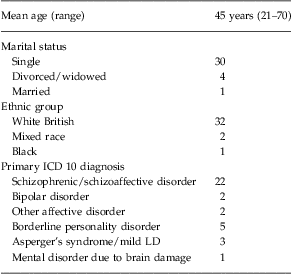
The characteristics of the service users are shown in Table 1. Although the majority of primary diagnoses were severe mental illness, there were also cases where the primary diagnosis was learning difficulty or personality disorder. Significant secondary diagnoses included learning difficulty (11 cases), affective disorder (four cases) and substance misuse (three cases).
Characteristics of individuals receiving individual care packages
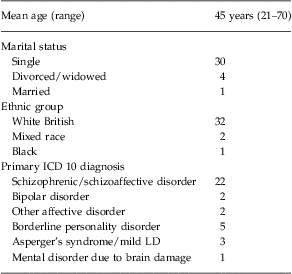
ICD, International Classification of Diseases (version10); LD, learning Disability.
Packages were provided by 10 different providers, with three organisations providing about two-thirds of the total. In two cases, care packages were made up by extra support being funded within the local supported lodging scheme. Support provided by ICP organisations ranged from 3 hours per week to continuous one-to-one support, with mean 71 hours support per week.
Service uptake among service users receiving ICPs
Of the trust key workers, 21 (60%) were aware of the contracted level of care. Most service users were receiving about one visit from a Trust key worker per week, ranging from three per week to 3 monthly. Ten service users were under assertive outreach care, 24 under the recovery team.
Seven (20%) service users were attending regular day care at seven different centres, with most attending once or twice weekly. Ten (29%) had additional support provided by family, estimated mostly 1–2 hours per week.
ICPs were initiated: 3 in 2004; 5 in 2005; 15 in 2006; 9 in 2007.
Of the service users, 18 (51%) service users were transferred to their ICP from a psychiatric hospital, eight from 24-hour nursed care units, two from homelessness, one from private nursing home and two from supported lodgings. In three cases, it was not known where they came from.
Progress of the ICP
After being placed in ICPs, there were no informal admissions among service users; however, between four of them, there were eight formal admissions (one service user admitted twice, one four times). Eight clients had one relapse, six had two relapses and one had three relapses of acute mental illness, which were managed within the ICP unit, without requiring admission in hospital.
Four service users had moved once, four moved twice and one moved three and four times, respectively, following the ICP being developed. Reasons for moving were largely for better accommodation, in one case owing to behaviour difficulties, and one having difficulty living with other residents.
The level of ICP care provision had increased in five (14%) cases; stayed the same in 24 (69%) cases; and decreased in six (17%) cases. The ICP had been reviewed by key workers from the Trust in 23 (66%) cases.
Trust key workers’ views of the ICP, ICP key worker satisfaction with Trust support
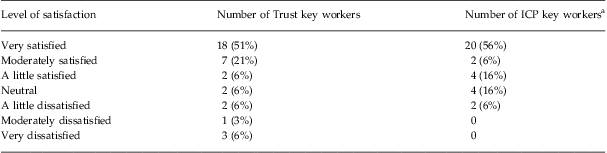
Trust and ICP staff ratings of satisfaction are seen in Table 2. It can be seen that the same proportion (78%) of Trust and ICP workers reported a level of satisfaction and there was no statistically significant difference in ratings between Trust and ICP staff (Mann–Whitney U test for unpaired data, Z = 0.85, p = 0.40). More ICP workers expressed a neutral view, regarding perceived support from Trust staff (16% versus 6%) and 9% of Trust staff expressed an overall level of dissatisfaction with the ICP, whereas no ICP staff was dissatisfied with Trust support.
Trust key workers reported satisfaction with ICP support provided; ICP key workers’ satisfaction with support from Trust staff
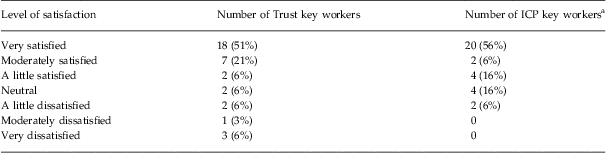
ICP, individual care package.
aTwo responses missing.
Trust key workers reported that the package of care was implemented: fully, 21 (61%); partially, eight (24%); don't know, six (18%).
They reported examples of good practice, many of which related to specific forms of support (10) and good communication (2). In one case, it was felt that there was good risk management within the ICP organisation. They reported concerns about inexperienced, poorly trained staff (3), poor monitoring of service user needs (2), inconsistent staffing and that ICP staff were felt to be overprotective at times. There was one concern about the management of a service user's finances.
ICP key worker levels of satisfaction with the ICP placement are also seen in Table 2. ICP key workers reported concerns about the support from the Trust staff, including: not receiving care plans; not enough reviews; lack of qualified staff/medical input resulting in relapse of symptoms; and medicine not arriving on time.
Discussion
The main findings of this study were: ICPs had enabled a substantial group of service users with complex needs to develop their own tenancies and maintain their placement within the community over a number of years. There appeared to be a relatively low rate of formal and informal readmission to hospital, following placement in ICPs. When relapse occurred, it appeared that this was managed largely within a community setting. Results suggested that, although there was an expectation that Trust key workers would monitor and oversee ICPs, some key workers were unaware of the ICP contract and showed little awareness of the level of support being provided by the ICP organisation. There was some discrepancy between Trust and ICP key workers, regarding the level and adequacy of care provided in the ICP, but no overall difference in satisfaction levels between Trust and ICP staff. Most Trust key workers were satisfied with ICP placements, although significant concerns were reported, regarding the experience and quality of training among ICP staff and consistency of staffing. ICP staff reported some concerns about communication and practical aspects of support from the Trust staff.
It is important to note the limitations of this audit. The sample was small and localised and results may not be generalisable. The data were collected by staff and did not allow any assessment of the experience and views of service users (or carers). In the future, it will be important to assess service user experience and attitudes to ICPs among individuals being supported in this way, and this could be carried out by means of satisfaction surveys, assessment of quality of life or ideally measures that assess the extent to which the ICP promotes service user recovery [e.g. the use of the DREEM rating instrument in a recovery residential unit by Dinniss etal. (Reference Dinniss, Roberts, Hubbard, Hounsell and Webb2007)].
There does not appear to be any literature relating to the effectiveness of ICPs, and it is therefore difficult to judge the data presented here. A theoretical advantage of the ICP model over previously described forms of supported housing is that domiciliary care is provided within a community setting and around an individual's tenancy. However, it was interesting to note that, even after several years within ICPs, there was little evidence that the level of care being provided by the ICP organisations had reduced. We have noted that care staff providing ICPs have tended to be largely unqualified and relatively untrained, as compared with NHS staff. This has led us to question whether the ICP supported the rehabilitation and recovery of the service user, or provided more of a supportive and ‘maintenance’ role. The statutory mental health teams working alongside the ICP workers could address this issue, but this would require a different form of working and perhaps even a different contractual arrangement, enabling the community teams to supervise and advise on the work of ICP staff. On the basis of our experience of the development of this new model of supported housing, we would argue that strong managerial/supervision arrangements for staff and good links with statutory services are essential.
If there is no throughput and no reduction in the level of care over time, there is likely to be an ever-increasing financial cost to this form of care provision. In this study, the current rate of financial growth is ∼10%, or ∼£140 000, per year. This developing Health/Social Services expenditure should be associated with evidence of good outcomes for service users.
In summary, our findings lend some support for the ICP model; however, further studies, ideally comparing ICPs with different models of supported housing and describing the experience of service users in ICPs, are needed.
Acknowledgements
The authors acknowledge the support of Julie Bundy, in preparing this manuscript. They thank members of the project group, Trust and ICP key workers for their support. They also thank Chris Foy, medical statistician with the Gloucestershire Research Support Service, for his help with statistical analysis.
Disclosures
The authors certify that they have no conflicts of interest and accept full responsibility for the manuscript.