INTRODUCTION
Irish nemerteans (ribbon worms) have been recorded for over a century. Early records include: (1) pioneering reports by Thompson (Reference Thompson1856); (2) Haddon (Reference Haddon1886) for south-west Ireland; (3) Jameson (Reference Jameson1898), Beaumont (Reference Beaumont1900), and references therein around Valencia Harbour (County Kerry); and (4) Southern (Reference Southern1913) and Farran (Reference Farran1915) from Clare Island and Blacksod Bay (County Mayo). Estimates of species richness ranged from 20 to 37 species. Gibson (Reference Gibson1994, Reference Gibson, Howson and Picton1997), a nemertean specialist, increased the Irish species list to 39 and the British Isles list to 79 marine species. An intriguing question is whether Irish nemerteans are less diverse than British ones or just insufficiently studied.
The benthic ecology of Lough Hyne Marine Reserve in County Cork, south-west Ireland has been studied intensively for the last century. Nemerteans were recorded by Renouf (Reference Renouf1931), Sheppard (Reference Sheppard1935), Norton (Reference Norton1971), Kitching & Thain (Reference Kitching and Thain1983), Kay (Reference Kay2011) and Trowbridge et al. (Reference Trowbridge, Little, Stirling, Pilling and Dlouhy-Massengale2013b). Given that Lough Hyne is at the interface of two biogeographic regions (cold, boreal and warm, Lusitanian water masses), we would predict that the marine sea lough would have a rich nemertean fauna, paralleling those of other taxonomic groups. Preliminary estimates based on these references are 5–6 nemertean species in Lough Hyne.
Starting in 1994, ten of the 20 historical monitoring sites of Ebling et al. (Reference Ebling, Sleigh, Sloane and Kitching1960) were resurveyed every August/September and the most common marine seaweeds and invertebrates were recorded. In 2001, we started to record the orange nemertean Paradrepanophorus crassus (Quatrefages, Reference Quatrefages1846) whilst turning over low-shore and shallow-subtidal rocks; in 2004, we added Lineus longissimus (Gunnerus, 1770) to our list of target species. With the rapid changes occurring in the lough due to the (1) mass mortality of the purple sea urchin Paracentrotus lividus (Trowbridge et al., Reference Trowbridge, Little, Pilling, Stirling and Miles2011), (2) increased nutrient levels and phytoplankton blooms (Jessopp et al., Reference Jessopp, McAllen, O'Halloran and Kelly2011), and (3) species incursions of warm-water biota (Trowbridge et al. Reference Trowbridge, Little, Pilling, Stirling and Miles2011, Reference Trowbridge, Little, Dlouhy-Massengale, Stirling and Pilling2013a, Reference Trowbridge, Little, Stirling, Pilling and Dlouhy-Massengaleb, unpublished data), we investigated the under-rock nemertean guild more comprehensively in 2012 and 2014, with supplementary records in 2015. The Lusitanian nemertean Paradrepanophorus crassus had increased substantially from 2009 to the present and a second warm-water species, Punnettia splendida, was recorded in the lough photographically (Trowbridge et al., Reference Trowbridge, Little, Stirling, Pilling and Dlouhy-Massengale2013b). Our major objectives of the present paper were: (i) to determine whether there were simultaneous temporal increases in other nemerteans; and (ii) to generate a nemertean species list for Lough Hyne, Europe's first marine reserve.
MATERIALS AND METHODS
Study region
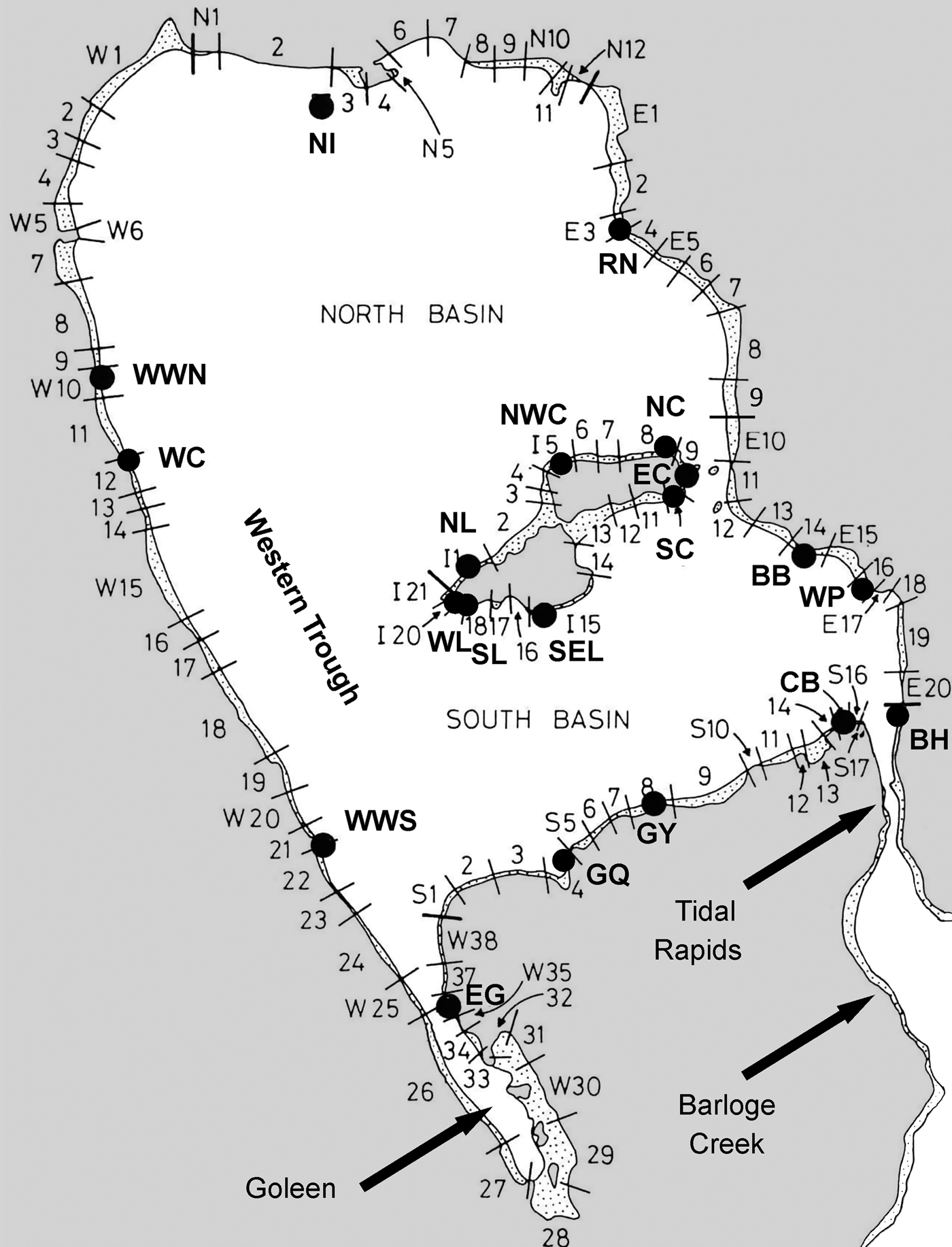
Lough Hyne Marine Reserve (51.8°30′N 98.1°7′W) is a semi-enclosed, fully marine sea lough in County Cork, south-west Ireland. The lough is ~1 km long and ~0.5 km wide (Figure 1) and is connected to the Atlantic Ocean by a shallow, narrow (25 m wide at high tide, 12 m at low tide) channel called the Tidal Rapids. The tidal range is ~1 m within the lough and the low-shore to shallow-subtidal habitat is composed of rock boulders and slabs for much of the lough shoreline. Although there are freshwater seeps and a small creek that enter the lough and locally dilute the surface water, there is almost no dilution of the main body of the lough below a salinity of ~34 (Kitching, Reference Kitching1987). At times of exceptionally high rainfall, a localized thin freshwater lens may form at the surface (Little, personal observation).
Lough Hyne Marine Reserve, Skibbereen, County Cork in south-west Ireland. Monitoring sites from Ebling et al. (Reference Ebling, Sleigh, Sloane and Kitching1960) and Little et al. (Reference Little, Morritt and Stirling1992): historical ones were surveyed in 1955, 1991 and 2014, whereas, annual ones were surveyed in 1955, 1991 and 1994–2014. Renouf sectors, topographically distinct sections of shoreline, are indicated by number and letter (W, west; N, north; E, east; S, south; I, island). NI, North Island; WWN, Westwood North; WC, West Concrete; WWS, Westwood South; EG, East Goleen; GQ, Glannafeen Quay; GY, Graveyard; CB, Codium Bay; BH, Bohane Harbour; WP, Whirlpool Point; BB, Boundary Bay; RN, Rookery Nook; NWC, North-West Castle; NC, North Castle; EC, East Castle; SC, South Castle; SEL, South-East Labhra; SL, South Labhra; WL, West Labhra; NL, North Labhra. Map modified from Map 4 of Myers et al. (Reference Myers, Little, Costello and Partridge1991).
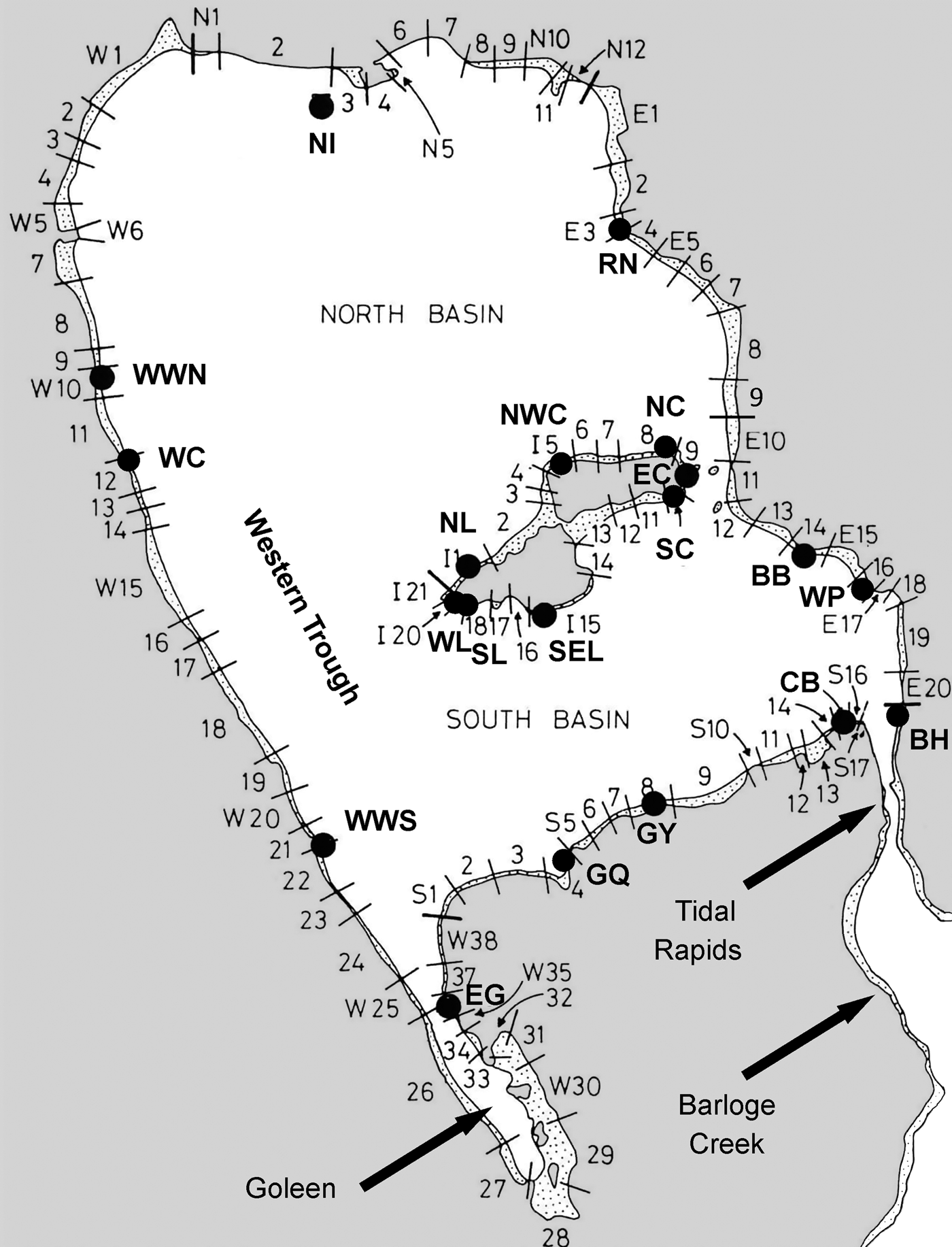
There are five major shorelines within the lough: east, west, north, south and along the island. The shoreline was historically designated into topographically distinct areas or sectors by Renouf (Reference Renouf1931); these are referred to as Renouf sectors and are designated based on the shore and sector (e.g. E5 is the fifth sector on the eastern shore).
Lough Hyne was designated a statutory marine reserve in 1981 – Europe's first – but has been studied by marine ecologists for over a century. Despite the long tradition of experimental study, a basic species list of the marine reserve is notably lacking and numerous taxonomic groups (such as nemerteans) have been largely overlooked.
Historical monitoring sites
For the past decade (2004–2013), we have consistently quantified all the nemerteans under low-shore rocks in Lough Hyne. During a two-week period in late August to early September, we surveyed ten of the 20 monitoring sites of Ebling et al. (Reference Ebling, Sleigh, Sloane and Kitching1960). In 2014, we resurveyed all 20 sites during a five-week period in August and September. The rocky shore sites were distributed around the lough (Figure 1) and encompassed 10 m sections of the shoreline. We turned over all the low-shore and shallow-subtidal rocks at each site (total of 1289 rocks in 2014) and recorded the number and species of nemerteans and extensively photographed them. To ensure non-destructive sampling of the monitoring sites, we did not collect or disturb nemerteans from these locations.
Other sites
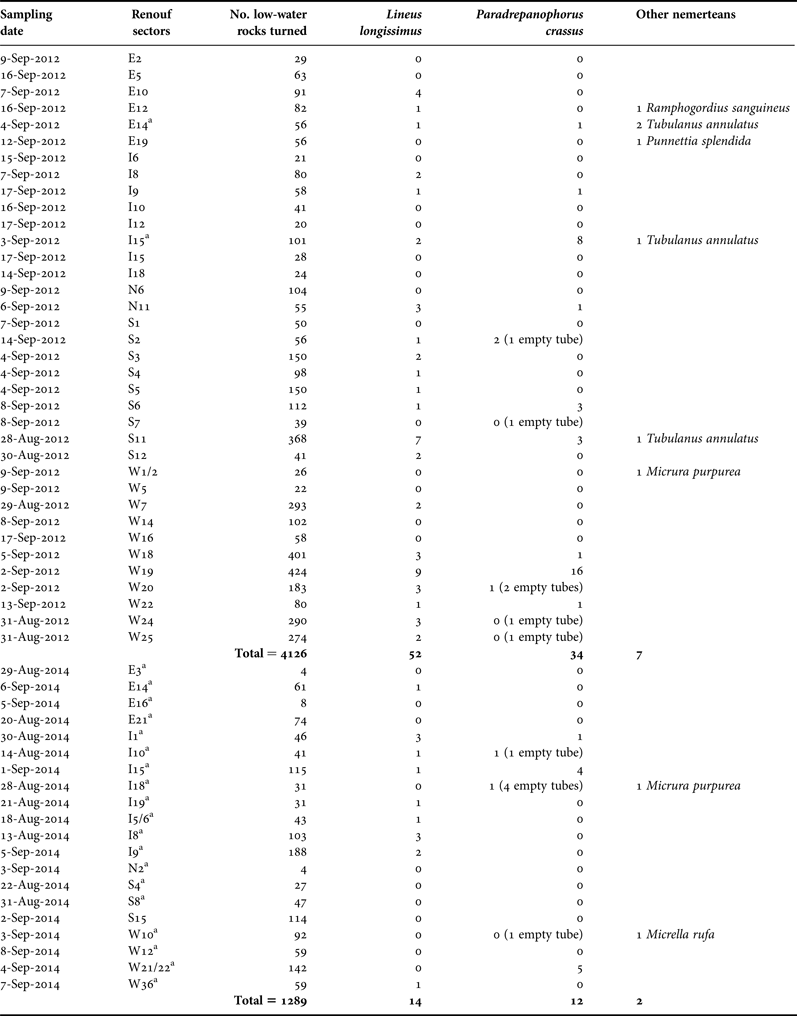
From 28 August to 17 September 2012, we turned over low-shore rocks at 36 sites (Table 1) within the lough to characterize the nemertean fauna. In August 2012, nemerteans were also collected in larval settlement collectors and in Van Veen grabs. Nemertean specimens were collected (except those from the annual monitoring sites) and keyed out, using Gibson (Reference Gibson1994) and Hayward & Ryland (Reference Hayward and Ryland1995). Specimens were examined microscopically, using a squash mount with two microscope slides pressed together to visualize internal anatomy clearly. We photographed most of the specimens in detail, recording presence/absence of lateral cephalic grooves, placement and number of cephalic ocelli, location of the proboscis pore, shape and size of proboscis stylets, number of accessory stylet pouches, coloration patterns (dorsal and ventral surfaces) and markings (particularly on head or dorsum), and presence/absence of caudal cirri. In March 2015, we turned numerous rocks at the top of the Tidal Rapids in sectors S17 and E20.
Nemertean results for comprehensive survey in 2012 and 2014 at Lough Hyne Marine Reserve in County Cork, Ireland.
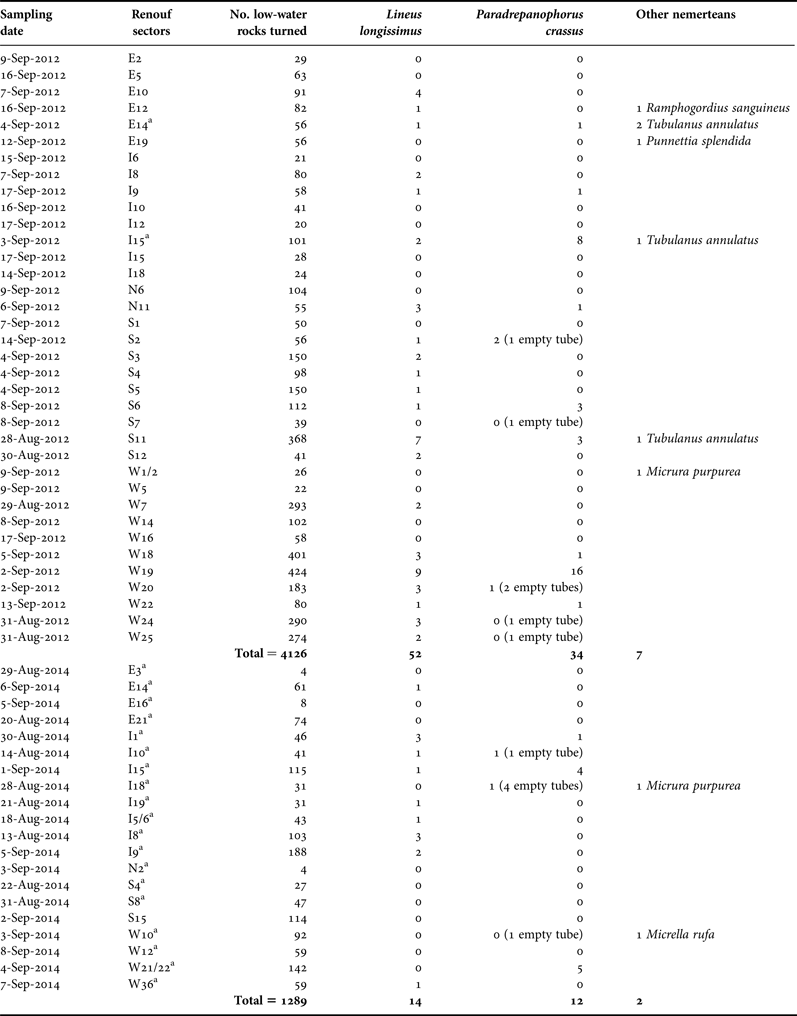
a Monitoring sites.
RESULTS AND DISCUSSION
Thirteen species of nemerteans were found in Lough Hyne during our study. Eleven of these species were identified; two others were identified to probable genus and/or species. Individual species accounts follow, including our results and published accounts. Nemertean higher-order classification is based on Thollesson & Norenburg (Reference Thollesson and Norenburg2003).
Class PALAEONEMERTEA Hubrecht, 1879
Cephalothrix rufifrons (Johnston, 1837)
One specimen was found on 27 August 2012 (Figure 1A, B) when we examined an urchin settlement collector (scrub brush), deployed in the shallow subtidal habitat on the south-eastern shore of the lough in June; one small nemertean was found among the bristles. The anterior tip of the head was pigmented reddish orange (hence rufifrons) whereas the general body coloration was whitish to translucent. The specimen did not form a spiral when disturbed.
Southern (Reference Southern1913) recorded this small species from Ireland in Clew Bay and Blacksod Bay (both in County Mayo); it was found on kelp haptera, corallines, other seaweed and under rocks on the shore and subtidally (dredged from 5 to 35 m). Farran (Reference Farran1915) reported it as very abundant in Blacksod Bay. Gibson (Reference Gibson, Howson and Picton1994) reported the species as common (on European shores) intertidally beneath boulders, in clean sand and among corallines (Corallina) in rock pools; it has been dredged to depths of 39 m. The recognized range is the British Isles, Scandinavia, Netherlands, Atlantic Spain and the Mediterranean Sea (Southern, Reference Southern1913; Brunberg, Reference Brunberg1964; Anadón, Reference Anadón1980; Saiz Salinas, Reference Saiz Salinas1987; Vernet & Anadón, Reference Vernet and Anadón1991a; Gibson, Reference Gibson1994; Hayward & Ryland, Reference Hayward and Ryland1995; Faasse, Reference Faasse2003; Junoy & Herrera-Bachiller, Reference Junoy, Herrera-Bachiller, Ramírez and Asensio2010; Herrera-Bachiller et al., Reference Herrera-Bachiller, Fernández-Álvarez and Junoy2014).
Tubulanus annulatus (Montagu, 1804)
This species was newly recorded for Lough Hyne Marine Reserve. One specimen was recorded (Figure 2C) in a tube on 28 August 2012 on the southern shore of the lough in Renouf sector S11 (Figure 1). The long-term monitoring team found five additional specimens of this species. Two specimens were found at south-east Labhra on the island (sector I15, Figure 1) in September 2012 and 2014, and two at Boundary Bay (sector E14, Figure 1) on 4 September 2012. A single specimen was found – in a delicate mucous sheath – at Boundary Bay on 4 September 2013. All the records are in the south basin and three of the six specimens were found at Boundary Bay, in close proximity to the Tidal Rapids where oceanic water enters the lough.
Nemerteans found in Lough Hyne Marine Reserve in August/September 2012. A, B, Cephalothrix rufifrons; C, Tubulanus annulatus; D, E, Micrura purpurea; F, G, Ramphogordius sanguineus; H, I, Micrella rufa; J, Lineus longissimus; K, Tetrastemma coronatum; L–N, Emplectonema gracile; O, Amphiporus lactifloreus; P, Q, Paradrepanophorus crassus; R, S, Punnettia splendida.

The specimens had four transverse white stripes encircling a generally brownish body as well as three longitudinal white stripes: two laterals plus one dorsal line. The broad, rounded head had black marks anterior to the first white stripe. In Ireland, this species was collected by dredge in Valencia Harbour (County Kerry) on ‘shell beds’ and ‘Ascidian ground’ (Southern, Reference Southern1913). It was reputedly not uncommon in 1895 but only one specimen was collected in 1896; however, because the duration and area sampled were not specified, it is not possible to evaluate Southern's abundance estimates. Farran (Reference Farran1915) reported the species as rare. Gibson (Reference Gibson1994) reported Tubulanus annulatus intertidal (under rocks and in soft sediment) as well as subtidal (to 40 m or more). The geographic distribution includes the northern hemisphere: North-East Pacific, North-East Atlantic and Mediterranean coasts of Europe (Southern, Reference Southern1913; Brunberg, Reference Brunberg1964; Anadón, Reference Anadón1980; Saiz Salinas, Reference Saiz Salinas1987; Vernet & Anadón, Reference Vernet and Anadón1991a; Gibson, Reference Gibson1994; Hayward & Ryland, Reference Hayward and Ryland1995; Herrera-Bachiller et al., Reference Herrera-Bachiller, Fernández-Álvarez and Junoy2014).
Class PILIDIOPHORA Thollesson & Norenburg, Reference Thollesson and Norenburg2003
Micrura purpurea (Dalyell, 1853)
A single specimen (Figure 2D, E) was recorded on 17 September 2012 at Renouf sector I9 under a low-shore rock inside a parchment tube with Paradrepanophorus crassus. The pointed head had a bright yellow anterior band with a clearish tip and lacked ocelli. The lateral cephalic slits with sensory structures were distinctive as was the ventral mouth. The general body coloration was reddish/brown. The presence/absence of a caudal cirrus was not noted. In 2014, two additional specimens were recorded on the island: one at I18 on 29 August and one at I8 on 5 September. One record was from the south basin and two from the channel between basins.
During the Clare Island Survey, Southern (Reference Southern1913) dredged Micrura purpurea on six different occasions from Clew Bay and on 11 occasions from Blacksod Bay. This species has been reported from (1) kelp haptera and empty serpulid tubes, and (2) sand, mud and gravel from low water to 40 m subtidally (Farran, Reference Farran1915; Hayward & Ryland, Reference Hayward and Ryland1995). The geographic range includes Scandinavia, British Isles, Atlantic Spain and the Mediterranean Sea (Brunberg, Reference Brunberg1964; Saiz Salinas, Reference Saiz Salinas1987; Vernet & Anadón, Reference Vernet and Anadón1991a; McDermott, Reference McDermott1993; Hayward & Ryland, Reference Hayward and Ryland1995; Junoy & Herrera-Bachiller, Reference Junoy, Herrera-Bachiller, Ramírez and Asensio2010; Herrera-Bachiller et al., Reference Herrera-Bachiller, Fernández-Álvarez and Junoy2014).
Ramphogordius sanguineus (Rathke, 1799)
This species was recorded on 16 September 2012 from Renouf sector E12 (Figure 2F, G). The elongate specimen has a reddish-brown body, several pairs of eyes in approximate rows. Southern (Reference Southern1913) found specimens on the upper portion of the shore (near high water neap tide). Gibson (Reference Gibson1994) reported the species from under rocks, intertidally and subtidally, as well as among mussels, barnacles and algae. The geographic range is circumpolar in the northern hemisphere: North Atlantic, Mediterranean and North Pacific shores (Vernet & Anadón, Reference Vernet and Anadón1991a, Reference Vernet and Anadónb; Gibson, Reference Gibson1994; Hayward & Ryland, Reference Hayward and Ryland1995; Faasse, Reference Faasse2003; Junoy & Herrera-Bachiller, Reference Junoy, Herrera-Bachiller, Ramírez and Asensio2010; Herrera-Bachiller et al., Reference Herrera-Bachiller, Fernández-Álvarez and Junoy2014).
Micrella rufa Punnett, 1901
A single specimen (Figure 2H, I) was recorded on 3 September 2014 at Renouf sector W10. It was larger than Micrura purpurea with a uniformly reddish-brown body. The blunt head had a clearish to whitish tip and lacked ocelli. The lateral cephalic slits with sensory structures were distinctive as was the ventral mouth. The specimen coiled when disturbed and had a caudal cirrus. Although there are few published records of this species, it was previously found at the Yealm shore near Plymouth, UK (Gibson, Reference Gibson1994).
Lineus longissimus (Gunnerus, 1770) – bootlace worm
This species is one of the most common nemerteans in Lough Hyne (Figures 2J & 3). There were, on average, 23.3 specimens found each year across ten sites. This mean corresponds to approximately 2 nemerteans site−1 year−1 or 0.2 nemerteans m−2 of low-shore rocks surveyed. Furthermore, this species occurred at most monitoring sites (other than the steep shore at North Island) and on every shoreline of the lough (Figure 3; Table 1). Specimens were frequently intertwined with conspecifics, although our records did not include the frequency of this behaviour.
Abundance of the bootlace nemertean Lineus longissimus over the last decade. A, Temporal abundance (ten sites pooled); B, spatial abundance (11 years pooled).
Specimens were black to brown with an almost iridescent sheen. Small individuals were lighter with distinctive longitudinal markings (Figure 2J). Southern (Reference Southern1913) described that juveniles have six dark-purple longitudinal bands alternating with six pale ones. Although Lineus longissimus is often well over a metre long, our low-shore specimens were mostly <1 m.
Beaumont (Reference Beaumont1900) reported this species as abundant and broadly distributed in Valencia Harbour (County Kerry), on the shore as well as subtidally in the areas dredged. Farran (Reference Farran1915) reported the species as common in Blacksod Bay. This species has been recorded in two previous studies of Lough Hyne: Norton (Reference Norton1971) collected this species in Renouf's Bay (sector S17) and Kitching & Thain (Reference Kitching and Thain1983) collected it within sectors E10–12 and S6. The species occurred under low-intertidal to subtidal rocks or on soft sediment (Gibson, Reference Gibson1994: references therein; this study). The geographic range includes Iceland and the North-East Atlantic, the North Sea and the Baltic coasts of Europe, including the British Isles (Anadón, Reference Anadón1980; Saiz Salinas, Reference Saiz Salinas1987; Vernet & Anadón, Reference Vernet and Anadón1991a; Gibson, Reference Gibson1994; Hayward & Ryland, Reference Hayward and Ryland1995; Faasse, Reference Faasse2003; Junoy & Herrera-Bachiller, Reference Junoy, Herrera-Bachiller, Ramírez and Asensio2010; Herrera-Bachiller et al., Reference Herrera-Bachiller, Fernández-Álvarez and Junoy2014).
Class HOPLONEMERTEA Hubrecht, 1879
Subclass MONOSTILIFERA Brinkmann, 1917
Tetrastemma coronatum (Quatrefages, Reference Quatrefages1846)
This species was recorded on 30 August 2012 from a scrub brush (three-month experiment on urchin settlement) deployed in Renouf sector E18. The tiny (<1 cm) specimen's body was yellow with a distinctive black crescent marking on the head (Figure 2K). The presence of four small ocelli on the head indicated it belonged to the genus Tetrastemma.
The species identity of several Tetrastemma species has been challenging. Beaumont (Reference Beaumont1900) considered the most common species in Valencia Harbour was the Tetrastemma coronatum of Hubrecht (but not the species as recognized by some other authors). While the body coloration and head pigmentation pattern varied considerably among individuals, the small yellowish nemertean had a distinctive black crescent (hence coronatum) of pigmentation with anteriorly pointing tips. Congeners have different cephalic pigmentation patterns. The geographic range includes Scandinavia, Netherlands, British Isles, Mediterranean and Black Sea shores (Saiz Salinas, Reference Saiz Salinas1987; Gibson, Reference Gibson1994; Faasse, Reference Faasse2003; Herrera-Bachiller et al., Reference Herrera-Bachiller, Fernández-Álvarez and Junoy2014).
Emplectonema gracile (Johnston, 1837)
One specimen was recorded on 13 March 2015 from the south shore in sector S17 at the top of the Tidal Rapids. The dorsal surface was lightly pigmented pinkish, particularly posteriorly (Figure 2N), whereas the ventral surface was pale white to grey. The body was extremely elongate relative to the body width and the head was slightly spatulate. The pair of pink cephalic ganglia was highly distinct. There was a row of eyes on the anterior margin of the head with more scattered posterior ones (Figure 2L), making a distinctive cephalic pattern. In a squash mount, the central simple stylet and lateral pouches of accessory stylets were highly distinctive (Figure 2M).
Southern (Reference Southern1913) stated that this species was not encountered during the Clare Island Survey, although it was present elsewhere in Ireland. The geographic range includes the British Isles, Atlantic Europe, Mediterranean Sea, North-West Atlantic, North-East and North-West Pacific shores, and Chile (Brunberg, Reference Brunberg1964; Vernet & Anadón, Reference Vernet and Anadón1991a, Reference Vernet and Anadónb; Gibson, Reference Gibson1994; Hayward & Ryland, Reference Hayward and Ryland1995; Junoy & Herrera-Bachiller, Reference Junoy, Herrera-Bachiller, Ramírez and Asensio2010; Herrera-Bachiller et al., Reference Herrera-Bachiller, Fernández-Álvarez and Junoy2014).
Amphiporus lactifloreus (Johnston, 1828)
One specimen was recorded on 13 March 2015 from the south shore in sector S17 at the top of the Tidal Rapids. The dorsal surface was lightly pigmented pinkish red (Figure 2O), particularly posteriorly, whereas the ventral surface was pale white to grey. There was a row of eyes on the anterior margin of the head with more scattered posterior ones, making a distinctive cephalic pattern. The head was slightly pointed anteriorly. Our specimen was consistent with the redescription of Amphiporus lactifloreus by Berg (Reference Berg1972). Although our specimen was identified as A. lactifloreus based on two taxonomic keys (Gibson, Reference Gibson1994; Hayward & Ryland, Reference Hayward and Ryland1995), the stylets were not clearly observed; thus, the specimen was preserved in 100% ethanol for future sequencing for verification.
Norton (Reference Norton1971) reported this species from the North Rapids Quay which is extremely close to our collection. Norton's specimen was part of the epifauna of the large brown alga Saccorhiza polyschides (furbellows) attached within the Rapids. Elsewhere in Ireland, Jameson (Reference Jameson1898) reported the species from Cultra in County Down; Beaumont (Reference Beaumont1900) recorded this species from Valencia Harbour; Southern (Reference Southern1913) and Farran (Reference Farran1915) reported the species from Blacksod Bay. The geographic range includes the British Isles, Atlantic Europe, Mediterranean Sea and North-West Atlantic north of Cape Cod (Brunberg, Reference Brunberg1964; Vernet & Anadón, Reference Vernet and Anadón1991b; Gibson, Reference Gibson1994; Hayward & Ryland, Reference Hayward and Ryland1995; Junoy & Herrera-Bachiller, Reference Junoy, Herrera-Bachiller, Ramírez and Asensio2010; Herrera-Bachiller et al., Reference Herrera-Bachiller, Fernández-Álvarez and Junoy2014).
Subclass POLYSTILIFERA Brinkmann, 1917
Order REPANTIA Brinkmann, 1917
Paradrepanophorus crassus (Quatrefages, Reference Quatrefages1846)
The species was somewhat flattened with well-defined lateral edges; the bulky body tapered at both ends (Figure 2P, Q). The small head was demarcated by white cephalic furrows with brown secondary slits. The only habitat in which we have noted the species was under low-shore rocks where the nemerteans produce parchment tubes.
This large, bright orange species was first observed by our group in 2001 (not seen 1994–2000 during the annual rock turning of our long-term monitoring of ten historical sites). Details about this appearance were previously reported by Trowbridge et al. (Reference Trowbridge, Little, Dlouhy-Massengale, Stirling and Pilling2013a). In the present account, we report that the species was most frequently found in the south basin of the lough, particularly in the southern region (except not in the Goleen, though near the mouth at Renouf sector S2).
According to Hayward & Ryland (Reference Hayward and Ryland1995), Paradrepanophorus crassus grows to 16 cm long and 9 mm wide. It occurs under rocks from low intertidal to 5 m as well as in microhabitats between worm tubes and rocks. Although the tubes have been referred to for Lough Hyne specimens (reviewed by Trowbridge et al., Reference Trowbridge, Little, Stirling, Pilling and Dlouhy-Massengale2013b) and Atlantic Spanish ones (Vernet & Anadón, Reference Vernet and Anadón1991a), they do occur on Mediterranean shores as well (Juan Junoy, personal observation).
The species range was Lough Hyne, Ireland (Renouf, Reference Renouf1931; Sheppard, Reference Sheppard1935; Trowbridge et al., Reference Trowbridge, Little, Stirling, Pilling and Dlouhy-Massengale2013b), Atlantic Spain (Anadón, Reference Anadón1980; Saiz Salinas, Reference Saiz Salinas1987; Vernet & Anadón, Reference Vernet and Anadón1991a; Junoy & Herrera-Bachiller, Reference Junoy, Herrera-Bachiller, Ramírez and Asensio2010; Herrera-Bachiller et al., Reference Herrera-Bachiller, Fernández-Álvarez and Junoy2014) and Mediterranean shores (Quatrefages, Reference Quatrefages1846; Herrera-Bachiller et al., Reference Herrera-Bachiller, Fernández-Álvarez and Junoy2014).
Punnettia splendida (Keferstein, 1862)
We have recorded this species twice: on 3 September 2011 in Renouf sector S15 (Codium Bay) and on 12 September 2012 in sector E19; both locations are near the Tidal Rapids. The body was large, flattened, reddish brown to orange dorsally with five longitudinal stripes and pale ventrally; the spatulate head had lateral cephalic furrows with secondary slits (Figure 2R, S). When disturbed the nemertean actively swam or crawled away from the provocation.
Gibson (Reference Gibson1994) recorded this species in Ireland, subtidally to 40 m with algae or soft sediments. There are four European records listed in GBIF.org (1 Guernsey, 2 western England, 1 Outer Hebrides, north-west Scotland), at least two photographic records (Lough Hyne: Trowbridge et al., Reference Trowbridge, Little, Stirling, Pilling and Dlouhy-Massengale2013b; Baie de Concarneau, South-Brittany, France: Wilfried Bay-Nouailhat, http://www.european-marine-life.org/13/photo-punnettia-splendida-wb01.php), and two literature records from Ireland (Gibson, Reference Gibson1994; Trowbridge et al., Reference Trowbridge, Little, Stirling, Pilling and Dlouhy-Massengale2013b). Saiz Salinas (Reference Saiz Salinas1987) and Herrera-Bachiller et al. (Reference Herrera-Bachiller, Fernández-Álvarez and Junoy2014) included this species in the Iberian region.
Unknown taxa
UNKNOWN SP. 1
One large nemertean was collected in a Van Veen grab sample in 20–25 m near the north basin buoy in mud on 30 August 2012. Although the specimen was lost en route to the laboratory, numerous photographs were taken on the boat (Figure 4A, B). The nemertean was >10 cm long, flattened posteriorly, had a distinct lateral groove (cephalic slits) and very pointed head. No caudal cirrus was seen in the photographs (although it could have been dislodged during sampling). Based on all these features, we keyed the specimen out to either a lineid or cerebratulid species. The nemertean was pinkish orange to coral in colour on dorsal and ventral surfaces. The anterior end was more highly pigmented (brighter) than the posterior end. For a video of this specimen, please refer to Supplementary Material.
A–D, Unknown nemerteans found in Lough Hyne Marine Reserve, Ireland in August/September 2012.
The species may be the elusive Lineus acutifrons Southern, Reference Southern1913 described based on two incomplete specimens (anterior ends) from sand during the Clare Island Survey in County Mayo and County Connemara, Ireland. No definite Irish records exist beyond the type description and Farran (Reference Farran1915) (species identified by Southern, Reference Southern1913). The species was re-described by Puerta et al. (Reference Puerta, Andrade and Junoy2010) for Atlantic Spain. Junoy & Herrera-Bachiller (Reference Junoy, Herrera-Bachiller, Ramírez and Asensio2010) and Herrera-Bachiller et al. (Reference Herrera-Bachiller, Fernández-Álvarez and Junoy2014) reported L. acutifrons from sandy beaches in Atlantic Spain and the Iberian Peninsula. The redescribed species was cylindrical anteriorly and dorso-ventrally compressed posteriorly (as was our specimen). No other lineid species in Gibson (Reference Gibson1994) or Hayward & Ryland (Reference Hayward and Ryland1995) was distinctly flattened. Furthermore, no cerebratulid listed met the other morphological and colour attributes we observed. Both the original description and redescription comment on the similar colour on dorsal and ventral surfaces, distinctive cephalic slits and acutely pointed head; these details were consistent with our specimen.
UNKNOWN SP. 2
One specimen was photographed in 2012 (Figure 4C, D) but no specimen was collected. Although the photographs were not adequate to key out the specimen definitely, the tapered ends, flattened posterior and speckled or mottled colouration indicated the species may be Cerebratulus fuscus (McIntosh, 1873–1874) that has been recorded from Ireland during the Clare Island Survey, County Mayo by Southern (Reference Southern1913). Unfortunately, the presence/absence of cephalic slits could not be ascertained from the photographs.
Cerebratulus fuscus was described as 5–10 cm long, tapered anteriorly and posteriorly, body flattened at edges, speckled with brownish grains on head and anterior region. The species has been collected from the British Isles, Scandinavia, France, Portugal and Spain (Atlantic and Mediterranean shores) (Saiz Salinas, Reference Saiz Salinas1987; Vernet & Anadón, Reference Vernet and Anadón1991a; McDermott, Reference McDermott1993; Herrera-Bachiller et al., Reference Herrera-Bachiller, Fernández-Álvarez and Junoy2014).
Taxa reported from lough but not seen
There are three additional species reported from the lough but not seen by us. First, the palaeonemertean Cephalothrix linearis (J. Rathke, 1799) was recorded for Renouf sector E10 (Kitching & Thain, Reference Kitching and Thain1983). Second, the pilidiophoran Lineus viridis (O.F. Müller, 1774) was recorded for sector E12 (Kitching & Thain, Reference Kitching and Thain1983). Intriguingly, no Irish records of these two species were included by Gibson (Reference Gibson1994) despite the fact he reportedly verified both species for Lough Hyne. Third, Kay (Reference Kay2011) published a colour photograph of a swimming nemertean in Lough Hyne with the species tentatively identified by Bernard Picton (Ulster Museum) as the hoplonemertean Nipponnemertes pulcher (Johnston, 1837), which has been previously reported in Ireland (Gibson, Reference Gibson1994).
The cephalothrid may easily have been overlooked by us, given its small size. Furthermore, N. pulcher typically feeds on amphipods (the peracarid crustaceans were uncommon in the under-rock habitat sampled) so encountering this species on rocky shores was not expected. If adequate sampling effort were concentrated in other habitats (kelp haptera, seagrass roots, mudflats) and tidal levels (intertidal and deep subtidal), we predict that the Irish species list of nemerteans would be considerably longer.
Supplementary material and methods
The supplementary material for this article can be found at http://www.journals.cambridge.org/MBD
ACKNOWLEDGEMENTS
We are grateful to D. O'Donnell and P. Graham of the National Parks and Wildlife Service for permission to carry out scientific research in the Lough Hyne Marine Reserve. We are grateful to the following colleagues for their taxonomic or field assistance: S. Maslakova, T. Hiebert, K. Kachmarik and C. Plowman. CDT, LH, CL and RM were supported in part by the NSF grant INT-1130978 awarded to CDT. Any opinions, findings and conclusions or recommendations expressed in this material are those of the authors and do not necessarily reflect the views of the National Science Foundation. We thank J. Nunn for her valuable help locating past nemertean records of the lough.