

The Chair (Mrs K. A. Morgan, F.I.A.): Welcome to the sessional research event this evening, here at Staple Inn.
We are going to have the presentation of the IFRS Working Party paper: “Insurance Accounting: A New Era?” This is a work by quite a large group of people. For the next 25–30 minutes, Kamran Foroughi and Anthony Coughlan are going to present an overview of the paper. We will then seek comments from the floor.
Kamran is a senior consultant with Towers Watson in London, and has been with the firm and its predecessor, Tillinghast Towers Perrin, for over 13 years. For the last eight years he has held a number of financial reporting responsibilities in his firm and he was appointed Global Life Financial and Regulatory Reporting Leader at the start of this year.
In the last decade, Kamran has taken an active role in helping companies, industry bodies and various actuarial professions develop their thinking on financial reporting measurement and management, authoring many papers and presentations on the subject. He chairs the UK Actuarial Profession's IFRS Working Party, which produced the paper being presented today.
I will now hand over to Kamran and later I will introduce Anthony.
Mr K. Foroughi, F.I.A. (introducing the paper): Thank you. I would like to start by thanking a number of individuals.
Thank you to the staff at the International Accounting Standards Board (IASB) working on the insurance contracts project. The publication of the Insurance Contracts Exposure Draft on 30 July 2010 was a significant achievement and has helped engage the global insurance industry. The staff have shown the ability to listen to well thought through industry points of view, and incorporate these in their recommendations to the Board.
Thank you to the reviewers of our paper who provided helpful comments on an earlier draft. Derek Wright, our UK representative at the International Actuarial Association (IAA), the insurance accounting sub-committee, also helped draft the IAA response to the IASB. Peter Wright and Nick Dexter, two members of our Life Practice Executive Committee, have taken an active role in keeping our members informed of accounting developments, with a series of notes posted on the actuaries.org.uk website. These three, plus Nigel Masters, were all actively involved in the drafting of the Institute and Faculty of Actuaries’ official response to the IASB. We have quoted from several parts of the Institute and Faculty's response in our paper.
And finally, thank you to all 13 members of this working party. Developing the paper was a team effort with all members contributing at a time when they were busy with their day jobs. I am delighted that 10 of the working party are here today.
The rest of this presentation will cover an overview of the paper, for those of you who have not yet had a chance to read it.
In a moment Mr Coughlan will summarise where we are today with International Financial Reporting Standards and the main IASB proposals affecting insurance companies. He will then consider the implications, focusing on UK life insurers, but you will see that a number of issues go wider, extending to companies from all countries, and to non-life insurers.
The paper summarised the contents of the Exposure Draft published in July 2010, and took into account subsequent developments up to the end of January 2011, including a number of the responses that were received by 30 November 2010.
In certain areas there have been significant developments in just the last month or two, with new tentative decisions by the IASB, as it digests the comments. Mr Coughlan will be updating us on these latest developments throughout his presentation.
At the end, I will briefly summarise our working party's conclusions, and consider a possible future role for supplementary reporting.
The Chair: Anthony Coughlan is an Associate Director in the PricewaterhouseCoopers’ UK life actuarial practice. He has over a decade of experience in the life insurance industry and has spent the last four years providing technical support to the European Insurance CFO Forum across Solvency II, IFRS and Embedded Value.
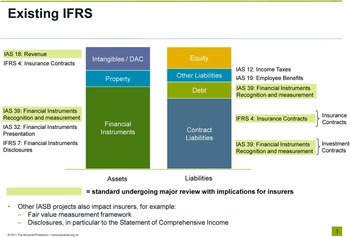
Mr A. J. Coughlan, F.I.A. (also introducing the paper): We first consider the existing IFRS framework. The simplified diagram in Figure 1 illustrates the balance sheet for an insurer together with some of the most relevant IFRS accounting standards that are currently effective.
Summary of existing IFRS applying to UK life insurers

IAS 39 is currently the key standard on the asset side of the balance sheet. Financial assets are classified into a variety of categories. The classification determines how the assets are measured – fair value or amortised cost – and how changes in the measurement are reflected in the financial statements, for example, through the income statement or through equity on the balance sheet. For many UK-based insurers, most financial assets are at fair value with all changes in measurement reflected through the income statement.
Moving to the contract liabilities, IFRS 4 represents the culmination of “Phase I” of the IASB insurance contracts project. It applies to contracts that transfer significant insurance risk and contracts with a discretionary participation feature whether they transfer significant insurance risk or not. Consequently, IFRS 4 is applicable to most with-profits business.
IFRS 4 permits the continuation of many existing accounting practices. Hence there is substantial variation throughout the world, which is one of the drivers for the “Phase II” project.
For UK-based life insurers (excluding bancassurers), the measurement model can be summarised as two components.
For non-profit business, the FSA regulatory regime is followed, removing “contingency” reserves and setting up a deferred acquisition cost (DAC) asset to reduce new business strain. For with-profits funds, the FSA realistic regime is currently followed, removing shareholder transfers, holding a VIF asset for non-profit business within that fund and setting up an unallocated divisible surplus liability for funds whose allocation between policyholders and shareholders has not yet been determined. For contracts that do not meet the criteria for IFRS 4, IAS 39 and/or IAS 18 are relevant. For example, UK unit-linked investment contracts are separated into two components: a financial liability under IAS 39 measured at fair value with a deposit floor (which typically is the bid value of units), and an investment management services component under IAS 18 where acquisition costs and front-end fees are deferred and recognised as services are provided. Only acquisition costs incremental at the contract level are deferrable.
The three key standards (IFRS 4, IAS 39 and IAS 18) are all undergoing a major review, which we now consider.
Moving to the proposed future IFRS, the Insurance Contracts Exposure Draft is proposed to replace IFRS 4. We will come onto the Exposure Draft in a moment.
IFRS 9 will replace IAS 39 and will affect the classification and measurement of financial assets and liabilities on the balance sheet. There is a lot in this new standard. Notably, at a high level, the measurement of financial assets is simplified to either fair value or amortised cost, and the deposit floor remains for investment contracts.
The Revenue Recognition Exposure Draft is proposed to replace IAS 18 and will have an impact on investment contracts for life insurers. Most notably, it proposed that acquisition costs will no longer be eligible for deferral. This would significantly increase new business strain from writing such contracts. Recent IASB meetings, and, in particular, the meeting on 2 February 2011, have started to reconsider this proposal following comments received during the exposure period.
In addition, there is a new standard being developed which will define how to determine the fair value of financial assets and liabilities; and so will have an impact on the measurement of insurers’ assets and investment contract liabilities. There are two notable points here. First, the core principle for fair value is the price that would be received to sell an asset or transfer a liability in an orderly transaction between market participants at the measurement date. Second, the fair value of a liability should reflect the effect of non-performance risk. We will return to these two points later.
We now focus for the remainder of the presentation on the Insurance Contracts Exposure Draft as published in July 2010, which is the primary topic of our working party paper.
A single measurement model for all insurance contracts is proposed. This consists of three components.
The first component is the discounted probability-weighted estimate of the fulfilment cash flows. The concept of “probability-weighted” means that stochastic techniques may be required to capture material asymmetries, perhaps similar to the current or expected requirements of Solvency II and the current FSA realistic regime for with-profits funds. Current and entity-specific assumptions are used for non-market variables. Importantly, unlike for investment contracts, there is no deposit floor. The discount rates are to be consistent with observable market prices for instruments with cash flows whose characteristics reflect the liability. There is explicit reference to including an illiquidity premium.
The second component is an explicit risk adjustment defined to be the maximum amount the insurer would rationally pay to be relieved of the risk that the ultimate fulfilment cash flows exceed those expected. The Exposure Draft permits only three measurement techniques – a cost of capital approach, similar to Solvency II, a confidence interval, and a conditional tail expectation. The risk adjustment is calculated at the portfolio level and so excludes the effect of diversification between portfolios.
And finally, there is the residual margin, which, importantly, is separate from the risk adjustment. The residual margin is set to eliminate an accounting gain at the inception of an insurance contract. A negative residual margin is not permitted and, in such an event, a loss at inception of the insurance contract is immediately recognised. The residual margin is determined at the cohort level, with those in the cohort having a similar date of inception and period of coverage. The residual margin is earned over the coverage period with no subsequent re-measurement, so all changes in experience from day 2 onwards go directly through the income statement. In other words, there is no use of the residual margin as a shock absorber.
We note that for short duration contracts, that is, contracts where the coverage period is approximately one year or less, the Exposure Draft mandates an unearned premium approach for the pre-claim liabilities, while post-claim liabilities follow the building block approach.
We now move from the mechanics of the building blocks to review the proposed measurement model.
Many existing insurance accounting models have elements of both a deferral-and-matching and an economic value approach. A deferral-and-matching approach allocates revenue and expenses in accordance with the provision of risk coverage or services, and is more focused on the income statement, as a general rule. An economic value approach measures the value generation to shareholders arising from the sale of contracts, and is more focused on the balance sheet.
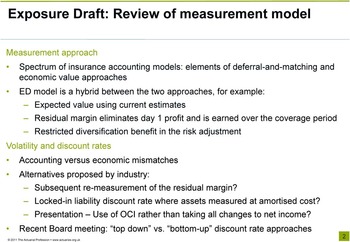
The fulfilment value model of the Exposure Draft is a hybrid between the two approaches as illustrated by the three examples listed in Figure 2. As it is a hybrid model, care will be required by users to interpret the results.
Review of the Exposure Draft measurement model proposal

The most common concern expressed on the Exposure Draft is that its adoption would lead to unrepresentative short-term fluctuations or volatility in reported IFRS profits which does not reflect the fundamentals of long-term insurance business. Volatility can broadly be considered as a mix of accounting and economic mismatches. Accounting mismatches can arise from different asset and liability measurement approaches under IFRS. Economic mismatches are perhaps “truer” mismatches between assets and liabilities, reflecting risks taken by the insurer, which could be addressed by additional disclosure to explain them or by reducing the mismatches in practice. However, the dividing line between these two types of mismatch is often not clear cut.
A number of potential approaches have been put forward by the industry to mitigate some of the observed volatility in the Exposure Draft. We have four examples in Figure 2.
The first one is subsequent re-measurement of the residual margin for non-economic assumptions. Clearly, this would reduce volatility to the extent that the residual margin exists. There are accounting precedents for such a model, in particular in Australia.
Secondly, a “cost” option would permit a locked-in discount rate for certain defined liabilities. The locked-in discount rate would be set at inception, and for consistency the assets backing the liabilities would be valued on an amortised cost basis.
Thirdly, there is a possible use of presentation; in particular, using other comprehensive income (OCI) on the balance sheet rather than taking all changes in the contract liabilities through to net income. This approach would remove volatility from certain key performance indicators.
And finally there is the discount rate. The Exposure Draft was interpreted by many observers as permitting only a “bottom up” assessment – that is, a risk free rate plus an illiquidity premium. However, a “top down” approach based on a replicating portfolio of assets allowing for expected credit default risk and potentially a credit risk premium could reduce some of the mismatches between assets and liabilities.
All four potential approaches have been discussed in recent IASB meetings with only the “cost” option at this stage being tentatively rejected.
Our working party paper also discusses four further mismatches.
Firstly, as noted earlier, for the fair value measurement, the Exposure Draft has a core principle that market prices need to be from an “orderly transaction”. The Insurance Contracts Exposure Draft requires calibration to observable market prices, but does not mention the concept of an “orderly transaction”. Therefore, there would appear to be the potential for an accounting mismatch between insurers’ assets and liabilities in certain circumstances. This could be resolved by aligning the two proposals.
Secondly, the Exposure Draft explicitly does not permit insurance contract liabilities to reflect own credit risk while full allowance is possible in the measurement of supporting assets (at fair value) and reinsurance assets. This is a particularly challenging subject and both points of view are put forward in section 5.6 of the paper. We note that some respondents to the Exposure Draft raised this as a subject for further work. Our paper recognises that it is debateable whether this is an accounting or an economic mismatch.
Thirdly, in extreme market conditions, when the illiquidity premium is large, the impact on the discount rate and the measurement of liabilities will be significant. Insurers who do not own illiquid assets may be forced to recognise the accounting benefit without being able to capture the illiquidity premium in practice. This is the issue that forced a number of pension schemes to show a much reduced deficit, or even a surplus, in 2008, which appears a slightly odd accounting result in the midst of a financial crisis. It is debateable whether this is an accounting or an economic mismatch.
And, finally, there remain potential inconsistencies between the IAS 12 approach to measuring deferred tax assets and the Exposure Draft approach to contract liabilities. For example, there is no discounting permitted in IAS 12 and the historic issues in the context of UK unit-linked business remain as noted by the Profession's response to the Exposure Draft.
Moving to the risk adjustment, the core principle described earlier appears to imply an exit value rather than a fulfilment value concept. The IASB appears to have accepted this point and has tentatively revised the principle. In addition, excluding the effect of diversification between portfolios is not consistent with how such business is valued and managed; and is at a lower level than permitted in QIS 5.
Moving to the residual margin, the low level of granularity increases the likelihood and potential level of day one losses. In addition, the complexity is significantly increased as all other components of the contract liability (most notably, the risk adjustment) will need to be measured at that level of granularity. The residual margin is earned over the insurance coverage period either on the basis of the passage of time or, if significantly different, the expected timing of incurred claims and benefits. This amortisation pattern has the potential to be significantly different to the provision of service, and there are other unintended consequences as considered in our paper.
We now move from a review of the measurement model to consider a number of other issues for UK life insurers.
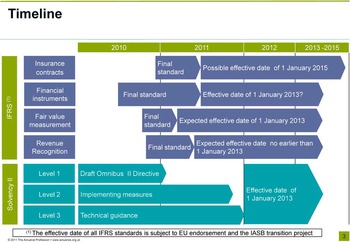
Figure 3 contains the current known timeline and, in particular, the interactions between IFRS and Solvency II over the next 4 years.
Timeline of expected IFRS developments as at March 2011 Source: IASB
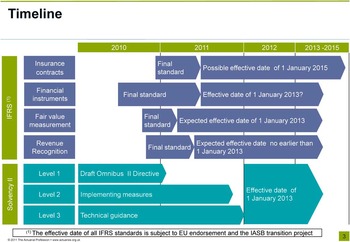
As you can see, 2011 is a crucial year with the finalisation of various IFRS standards. It will be important that the effective dates of all these standards are synchronised to avoid the requirement for multiple transitions and restatements. The IASB is currently undertaking a project on this matter.
The IASB staff recently provided a tentative recommendation to the Board that the date of mandatory adoption of the Insurance Contract standard should not be before 1 January 2015. With the publication of the draft Omnibus II Directive setting the effective date of Solvency II to be 1 January 2013, it is highly likely that Solvency II will be effective before a new Insurance Contract standard.
This will present a range of practical challenges and considerations for insurers during the interim period; most notably because IFRS 4 is often based, in the UK on the FSA return valuation, which will be redundant in a Solvency II world. There would appear to be a number of options for insurers during that interim period. They could maintain the current approach (i.e. the parallel running of two sets of models); or they could, maybe, adopt Solvency II (adjusted or unadjusted) under IFRS 4. Alternatively, they may be permitted to adopt early the new insurance contracts standard (be that the standard itself or under IFRS 4 as an improvement to the existing accounting policy).
In addition, the changes by HMRC to the taxation regime during the interim period and beyond would be a consideration for insurers.
Moving back to technical matters, on the next two figures we cover a few issues to which we are not going to be able to do full justice this evening.
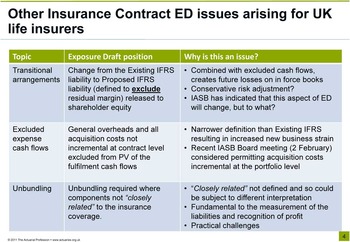
Figure 4 relates to the arrangements at the point of transition to the new insurance standard. The contract liability is defined to be the best estimate plus the risk adjustment without a residual margin. The change from the existing IFRS contract liability (net of intangibles) is released to shareholder equity. Consequently, the amount will never be recognised through the income statement. The ‘loss’ of these future profits could be substantial.
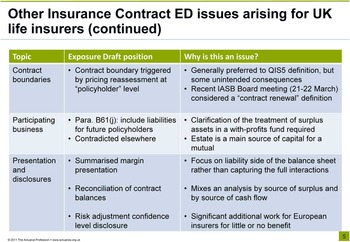
Other Exposure Draft issues arising for UK life insurers

There has been much industry comment on the transitional arrangements and the IASB has indicated that this aspect of the Exposure Draft is likely to change. Our working party welcomes this indication. The most common suggestion during the comment period was to permit full retrospective application (perhaps on a best efforts basis).
Moving to the cash flows, in the Exposure Draft, the following expenses are excluded from the cash flows used to determine the liability: acquisition costs that are not incremental at the contract level and general overheads.
Incremental acquisition costs are included in the initial contract liability assessment. Such costs act to reduce the initial residual margin and so can be thought of as an implicit ‘DAC asset’, there to reduce new business strain. In recent IASB meetings, it has been proposed that only acquisition costs that are not incremental at the portfolio level should be excluded. This represents a change from the Exposure Draft which was at the contract level and would move the model closer to current UK practice under IFRS 4. Our working party welcomes this development.
An insurance contract is required to be unbundled into different components where there are components of the contract which are not “closely related” to the insurance coverage. Three examples are provided in the Exposure Draft. The unbundled components are then valued under the relevant IFRS standard.
There are three issues to note. First, the term “closely related” is not defined and so it is open to interpretation. For example, does the principle of “closely related” take precedence over the three examples? Second, the scope of unbundling is fundamental as it affects the measurement of the contract liabilities and the consequent recognition of profit. In particular, one only has to consider an IFRS 9 or IAS 39 valuation under amortised cost to observe the difference. Third, there are practical challenges from unbundling, for example, allocating charges and expenses when unbundling a unit balance.
The next issue is contract boundaries, as set out on Figure 5. In the measurement model, cash flows are included only to the extent that they are within the boundary of the contract. In the Exposure Draft, the contract boundary was triggered by a pricing reassessment at the “policyholder” level. This was generally preferred to the QIS 5 definition where the reassessment was interpreted to be at the “portfolio” level. In recent IASB meetings, the contract boundary definition was reconsidered reflecting comments from health insurers on the Exposure Draft.
Other Exposure Draft issues arising for UK life insurers (continued)

There is a wide range of impacts on participating contracts from the Exposure Draft. One in particular was noted by our Profession's response: paragraph B61(j) of the Exposure Draft makes reference to cash flows in respect of future policyholders being included in the contract liability. However, this is contradicted in a number of places elsewhere. If, as a consequence of paragraph B61(j), the estate is to be treated as a liability, then this would affect the mutual business model as it is the main source of capital. More generally, further clarification on the treatment of surplus assets in with-profits funds is required to avoid inconsistency across the industry.
Finally, we come to presentation and disclosures. We will not able to do this important section of the Exposure Draft justice due to time constraints, but we draw to your attention the following three remarks from our paper.
The income statement is proposed to be presented using a summarised margin analysis rather than the current traditional revenue account. There will be no volume information. The approach is more akin to an embedded value (EV) earnings analysis. However, the minimum standard appears to be more focused on the liability side of the balance sheet rather than capturing the full interactions between assets and liabilities.
Reconciliation between the opening and closing contract liabilities is required. The minimum standard for this reconciliation appears to mix two distinct approaches to such an analysis: an analysis by source of surplus and an analysis by source of cash flow.
In addition, as observed earlier, the risk adjustment can be determined through one of three permitted techniques. To aid comparability, there is a requirement to disclose the confidence level to which the risk adjustment corresponds. For European insurers, this is likely to result in significant additional work, and the benefit is questionable given the theoretical weaknesses in the confidence level method.
We now move from technical to commercial implications and consider the impact of IFRS on new business earnings.
Our working party paper provides illustrative pre-tax projected earnings for existing and proposed IFRS for two products: an immediate annuity and a term assurance. A simple profit test model was used.
For the immediate annuity, we observe that there is no day 1 profit due to the residual margin. There is the possibility of a day 1 loss given the potential differences between the Exposure Draft discount rate and the pricing discount rate. Non-incremental acquisition costs are expensed at inception. Profit is deferred and released with the residual margin over the life of the contract. Overall, only the timing of profit recognition is altered.
I now pass you back to Mr Foroughi to consider the collective conclusions of our working party and the potential future role of supplementary reporting.
Mr Foroughi (also introducing the paper): So, what are our conclusions about the IASB's developments?
The development of a single insurance liability accounting standard and measurement model, applicable globally, is a major achievement. Even the Financial Accounting Standards Board (FASB) is on board, with a similar model being proposed to replace US GAAP.
We welcome that the measurement model includes expected cash flows with assumptions consistent with current market prices and up-to-date entity-specific best estimates. We note that the Exposure Draft proposals, combined with other IASB developments, provide a framework that can lead to far fewer accounting mismatches than we observe today.
But there are a number of issues. The hybrid nature of the Exposure Draft measurement model will be challenging for users to understand.
Significant volatility may arise. There is nothing wrong with measuring and understanding economic volatility. The insurance industry is about taking risks, and with taking risks comes economic volatility. But there are a number of aspects of the Exposure Draft and wider IFRS developments where we will end up with volatility and it will not be clear whether this volatility is economic or accounting related. There is also a debate to be had about whether the primary profit and loss account is the right place to show all the economic volatility.
And finally, while we could support the principle of having a risk adjustment, we do not support the specific risk adjustment principle as put forward by the Exposure Draft. We describe a number of issues in the paper, and, to be fair, the IASB is addressing several of them with its latest proposals.
So where does this leave us in relation to communicating with investors?
Section 8 of the paper recognises the great work insurance companies have been doing in recent years: better explaining the sources of their IFRS earnings; allowing users to consider how earnings may arise in the future; and providing increased focus on the amount and timing of expected cash flows using existing embedded value models. This allows companies to communicate wider metrics such as implied discount rates, internal rates of return and payback periods.
Both IFRS and Solvency II proposals will improve existing practices and disclosures. However, a number of items that provide useful insight into aspects of an insurance company's business are missing from both IFRS and Solvency II proposed disclosures. Our working party conclusion is clear: there will be an important role for supplementary reporting in the future.
Professor R. Macve, Hon F.I.A. (opening the discussion): As some of you know, I am not a real actuary. I am a chartered accountant but I have the honour of being an Honorary Fellow of your Profession.
It is a particular honour to have been invited to open this evening's discussion. This paper kept me absorbed for most of my five hour train ride back home to Aberystwyth last week. I congratulate Mr Foroughi and his 12 colleagues on what is indeed an impressive survey and analysis of the IASB's Insurance Exposure Draft and the proposed changes to related accounting standards, as well as of the developments in Solvency II, in taxation, and in EV reporting.
The last time I gave a formal address here at Staple Inn was at the inauguration of the Equitable's archive, which contains William Morgan's first valuation in 1776 when he determined the distributable surplus by a reckoning of the difference between the liabilities (the present value of the sums assured) and the assets (the present value of future premiums together with the investments). But it was not until nearly a century later that the 1870 Life Assurance Companies Act accepted that such actuarial valuations were the only way to produce meaningful life company accounts. Before then they had been described in one House of Commons debate as “mere puffs”.Footnote 1
Inaugurating a new era in life insurance accounting has always been a long process, and actuaries have often patiently had to go over basic arguments to non-actuarial sceptics. The IASB's predecessor, the International Accounting Standards Committee (IASC), started the current review in 1997.Footnote 2 Since then your Profession has been faced with repeated exposure of ever-changing proposals.Footnote 3
As the paper discusses in section 5.3, before the latest Exposure Draft, the IASB's 2007 Discussion Paper had proposed a different approach to that now put forward, where the proposed current exit value for life insurance liabilities appeared indistinguishable from fair value, now that fair value is defined as an exit price to transfer a liability.Footnote 4
This new proposal in the Exposure Draft for “fulfilment value” is much closer to the approach that has now been adopted by both FASB and IASB in their 2010 Exposure Draft on revenue recognition for contracts in general. This has retained a more traditional deferral and spreading of the initial contract consideration and matching with costs, as the FASB and IASB members were “uncomfortable” with the “day-one profit” on contract inception that would arise if fair value were adopted.Footnote 5
The paper, in sections 5.2 to 5.3, discusses how the approach now proposed to life insurance liability measurement seems to fall between a wholly “deferral-and-matching” approach and an economic value approach. It suggests alternative ways to resolve this, which the Boards are considering (section 5.10). Because of the focus just on the liabilities, the risk of accounting mismatch with investment valuation still seems high.Footnote 6
Moreover, while noting that there has been an increased emphasis – in the recent years of great financial uncertainty – on the need for triangulation of EV results, IFRS results and cash flow results, the paper, in section 8, sees a continuing role for the supplementary EV information.
Here, it is interesting to note the results of some recent international empirical research by George Serafeim, at Harvard,Footnote 7 which finds that firms that adopt EV reporting exhibit a decline in information asymmetry (as measured by bid/ask spreads and via trading volumes). This improvement in information has increased as EV reporting itself has evolved (through European EV and market-consistent EV) in order to address methodological deficiencies and permit more comparability across firms. This decrease in information asymmetry is contingent on a number of factors, including some audit certification (whether by an actuarial firm or one of the big four accounting firms), and is larger for firms that commit to providing EV reports, for example, through CFO Forum membership.
Differing country characteristics, including hostile mergers and acquisitions activity, financial reporting practices and analysts’ incentives, and industry regulation, are found to be associated with differential adoption of EV disclosures. EV reporting is also associated with what in accounting research is called “value relevance”. In other words, the EV results are more closely correlated with stock market returns than are GAAP profits and losses.
So why is there a continuing lack of enthusiasm among US insurers for giving these disclosures, despite evidence that they are using EV internally for performance measurement and compensation arrangements? It may be that US GAAP has addressed insurance directly for much longer and mitigated the severity of solvency-based reporting by spreading deferred acquisition costs; and it also provides disclosure on the roll-forward of reserves. However, it may be that it has more to do with the situation that, following the wave of anti-takeover laws and charter amendments at the end of the 1980s, most US corporations are nowadays well protected against hostile takeovers. But it does remain an intriguing question why in Europe and elsewhere in the world EV seems to be regarded as important but apparently is not in the US, at least for public disclosure.
Perhaps, correspondingly, the FASB's proposals, which came out shortly after the IASB's 2010 Exposure Draft, have a different treatment for the residual margin (as noted at section 3.17). If this difference between the two boards’ proposals is not resolved we will still not have harmony in the “new era”.
Finally, like the authors (in section 7.3), I have concerns about the proposed changes in presentation, and the loss of traditional “premiums less claims” revenue accounts. I suspect this is, maybe, a largely unnecessary hangover from the previous (2007) Discussion Paper when the proposed basis for liability measurement was very different.Footnote 8
My personal concern with the welter of regulatory requirements from different sources, which are set out clearly in the paper, and that somehow have to be reconciled, is that “box ticking” purely for external requirements seems unlikely to produce the most useful information.
Naïvely perhaps, based on my own auditing experiences of long ago, and in particular the audit of the DTI returns that insurers had to file, my behavioural premise is that information that is useful for and used by managers is more likely to be reliable than information that is only produced to satisfy external formal reporting requirements.Footnote 9 The role of EV in management must be one of the main arguments for regarding it as particularly useful and informative. I am remembering here Jeremy Goford's classic paper on the control cycle back in 1985.Footnote 10
There is clearly much to discuss in this excellent paper, and I am sure that the comments will gain sharply in focus now that I will make way for the real actuaries. I am glad to know that the IASB and FASB are still listening.
Mr J. A. Jenkins, F.I.A.: The new standard is, in my view, developing along sensible lines, although clearly there are many areas of uncertainty.
I am quite happy with the principles-based approach being followed. I see this as being comparable with the principles and the level of detail set out within the market-consistent EV guidelines, or within the current FSA realistic balance sheet rules.
We are currently seeing elsewhere the difficulties which one can get into if one seeks to prescribe the full details of a market-based valuation approach. I am of course referring to the various Solvency II papers and the QIS 5 specifications, which are extremely voluminous, almost impossible to digest, and often contain inconsistencies. I would not advocate that approach for this IFRS development.
For a profit reporting standard, I think one has to accept that there should be no profit recognised on inception. While this seems an unnecessary restriction from a purely actuarial viewpoint, I think we have to accept that this does need to be the case for an international profit reporting standard. The Australians recognised this when they introduced their margin on services (MOS) methodology several years ago, and both their industry and their actuarial profession is similar to ours. The US GAAP approach also eliminates profits on inception and recognises profit over the policy term.
I have an issue with the Exposure Draft as currently drafted in terms of the highly restricted level of margin which can be recognised at outset to meet what companies themselves reasonably class as acquisition costs. However, I understand that, since the Exposure Draft was published, things have moved on positively and the current IASB thinking is to allow a more sensible definition of acquisition costs, and hence of the margin that can be released on inception to match such costs. I also understand that there are positive signs of development since the Exposure Draft was published in the area of “unlocking”, or the “shock absorber”, as it was referred to earlier, in the residual margin to counter any changes in non-financial best estimate assumptions. This again seems sensible to me.
One aspect which clearly needs to be addressed is that of the existing business. It does not make sense to have no emerging residual margin here, and some practical approach is needed, such as that which took place in Australia when the MOS method was brought in to introduce a margin to emerge on existing business.
I think that actuaries and accountants will need to work together more closely than hitherto in order to understand each other properly and to cope with the various different terminologies being used.
On acquisition expenses, I personally find some of the terminology confusing – such as the use of the expression “in the cash flows” when referring to acquisition costs. To me, cash flows happen in the future, and acquisition costs have happened in the past. I am sure that many accountants have similar issues in relation to actuarial terminology.
Coming back to the issue of principles-based versus detailed rules, the principles-based approach will require further guidance, if only informal guidance, as well as more description and codification of the different approaches that can be followed. There is much scope for the actuarial profession, and for actuaries working in life companies and professional services firms, to provide this in the future.
Mr A. Black, F.I.A.: Mr Coughlan showed us, in Figure 3, a slide of the IFRS and Solvency II timelines, and I would like to comment on what some of the differences between IFRS Phase II and Solvency II mean in practical terms for system development, and the preparation work needed over the next few years.
Let's start with the simplest: parameter differences. For example, the risk-free rate is prescribed in Solvency II, whereas in IFRS we will need to follow the principle that the discount rate should be consistent with the nature of the liabilities. If insurers choose to use a different discount rate, this should be a simple parameter change in the models and will just involve a new run on existing systems on an IFRS basis.
Methodology differences present potentially far harder issues. IFRS Phase II, being genuinely principles-based, gives more flexibility on the calculation of the risk adjustment, than on the related risk margin in Solvency II. Even those planning to use internal models may wish to use a separate approach for IFRS Phase II, where the guidance for the calculation will be just a few paragraphs, not the few thousand pages of Level 2 and 3 rules.
Contract boundaries may, or may not, end up in the same place in the two standards – so there will need to be flexibility as to which cash flows are included in the liability models. On the asset side, the IASB's fair value project, as discussed, will give a slightly different meaning to “fair value” in stressed markets compared to Solvency II, where deviation from strict market values is currently hard to justify. This is something to prepare for now so that in the next financial crisis, where transactions are not “orderly”, we already have a system in place to allow for using something other than market values for IFRS.
The residual margin presents an entirely new methodology problem (not to mention a communication problem). Insurers will need to determine the residual margin in the year of sale, and then keep track of its run-off over time. Systems will need to identify policies within a portfolio by those with similar start dates and similar coverage periods, and then calculate the residual margin using the premium received and direct expenses for those policies. This may be possible through careful choices of model points, but we should be aware that our current model point choices may need refining. Transitional arrangements could also throw up tricky modelling challenges.
Once we are able to calculate results on both these bases, we will need to report and explain them. So there will be similar challenges for reporting templates and presentation in the accounts, plus a clear need for reconciliation.
To conclude, there are many modelling and systems implications arising from the introduction of IFRS Phase II. We are all currently sprinting to keep up with the deadlines and shifting requirements of Solvency II. However, it is vital that we plan now for IFRS. Solvency II plans need to consider IFRS requirements. Even if there is no spare capacity to put in IFRS functionality, as an absolute minimum the system architecture needs to have the flexibility to add easily IFRS functionality later. Otherwise, much of the large investment in Solvency II modelling will need to be repeated, and our new efficient well-documented Solvency II systems will need to have messy coding changes and manual end-piece adjustments. This will lead to inefficient use of time, money and other resources, and ultimately systems that are hard to use, and output that is hard to interpret.
Mr P. M. Whitlock, F.I.A.: Life insurers continue to struggle to engage with investors due in no small part to the industry's failure to communicate its dividend-paying capability. The industry has struggled with accounting, regulatory and embedded value metrics that many argue give an inconsistent and confusing picture.
Will this be resolved with Phase II of the IASB's Insurance Contracts project? Unfortunately not. As has been discussed, the IASB's Exposure Draft puts forward a hybrid measurement model combining elements of both a deferral-and-matching approach and an economic value approach which will make the results difficult to interpret. This hybrid approach will provide neither an allocation of revenue and expenses to future periods in accordance with the provision of risk coverage or services nor a measure of the value generation to shareholders.
The accounting results are therefore unlikely to be sufficient to communicate the underlying performance of life insurers to investors. Instead, what is required is a balanced scorecard of performance metrics.
A company's dividend-paying capability is significantly driven by its capital position as demonstrated in its regulatory returns. Therefore, the movement in the regulatory surplus and an indication of how it will develop are critical information. Preparing this information requires an understanding of how capital recycles between the releases from the in-force book and the capital requirements of new business.
However, as we are all aware, the movement in the regulatory surplus is not a good measure of life company performance and profitability. And, as the authors note in Appendix A of the paper, Solvency II will not change this because the focus of Solvency II is to demonstrate solvency to regulators and not to provide a measure of equity and performance over time to investors.
There therefore remains a key role for supplementary reporting, including a realistic measure of the economic value that represents the realistic value today of future earnings available for distribution to shareholders. Supplementary reporting should also provide a realistic measure of the value added by writing new business, including additional simple new business metrics familiar to investors, such as the internal rate of return and capital payback periods. Projections of free cash flows can be used to demonstrate the dividend-paying capabilities of insurers and could also be included. A balanced scorecard should include the IFRS and Solvency II results, but also these supplementary results and their sensitivity to changes in circumstances. These sensitivities can be used by management to understand better the risks in the business. Management can then articulate and manage its risk appetite expressed in terms of these metrics and sensitivities, and communicating this will help investors better understand the nature of their investment.
Only if we can get the presentation and communication of such a balanced scorecard right will we start to see the life industry re-engaging with investors.
Mr J. P. Ryan, F.I.A.: I am coming to this from a different angle. I was an investment analyst for a significant part of my career. Also, I am an investor in shares. As an investor and as an investment analyst, I want information that I can use to make my own judgements. I do not want anything that contains subjective judgements.
I appreciate that these involve subjective judgements, but it is important that the disclosure of the assumptions is such that an outsider can make approximate adjustments.
Whether you should recognise profit on inception or not is one of the issues which has been discussed. I want to know, as a user of accounts, what has been done and how can I unwind it, not necessarily precisely. I concede that if I were a chief executive of a life company I would want something much more precise with everything spelt out, because I could then ask for the numbers to be re-worked. As an investor I cannot.
The accountants say that any change in assumptions needs to be recognised in the profit and loss account. I can see why that argument is made, but I want to be able to quantify it as an outsider. One change in assumptions can make a huge difference. It gives you an indication of the ongoing likely estimate of the earnings per share. I do not want somebody else's opinion of what this is. I want to be able to form that opinion myself.
I think that most outside investors want to do this. There are smaller investors who rely on others to do the analysis, but market prices are made by people who are either expert in these matters or have access to expert advice.
The principles approach is great, but it needs to be spelt out clearly what changes it might make. It is the disclosure of those aspects that, in my view, is more important than the precise definition.
The same issues arise with risk discount rates. What is an appropriate risk discount rate? Different risk discount rates make enormous differences to various numbers. I do not care, as a user of accounts, what rate is used so long as I can unwind it, even approximately.
There has been some comment also on Solvency II versus the other accountancy approaches. Solvency II is about solvency, not about accounting standards. What you want for solvency can be very different.
If you are doing your own internal management accounts, you can do it that way, which makes sense. But think of third party users. Let us have something that is objective so that a third party, even if they do not have all the information disclosed that they would like, can use it to make approximations. I was able to do so 30 years ago. It should not be impossible now.
Mr A. H. Silverman, F.I.A.: I work as an investment analyst following the insurance sector. I want to make three points. They are ones that I have made before but I think they bear repetition on this occasion.
In paragraph 5.2.4, as Mr Coughlan mentioned, there is an attempt to categorise approaches to accounting between a deferral-and-matching and an economic approach. The deferral-and-matching was presented as more focused on the profit and loss account, and the economic approach as more focused on the balance sheet. That is correct and is what we have seen in the past. I suggest that what needs to be done is to have a truly economic approach to the profit and loss account. One of the things missing from life insurance company reporting at the moment is a profit number to which people can meaningfully attach a price/earnings multiple. A residual margin, which may seem non-actuarial, helps in that direction.
The second point I want to make relates to paragraph 5.2.9 where the downside of an economic approach is mentioned. I would add to that paragraph that, for most of the policies on the books of a life insurer, the profits that emerge from an embedded value in any one year have nothing to do with the premium that is charged. I would characterise them as the profits that you would have made if you had charged the economically correct premium as now calculated, which is almost never going to be the premium that you are charging. That is a fundamental drawback of embedded value. And indeed it has to be reconciled with any economic approach that is ultimately taken.
The third and final point that I want to make is to do with paragraph 5.4.6 where there is the beginning of a discussion on own credit risk. This is a knotty problem that often will give rise to differences of opinion. I think it needs to be clear that the initial reaction of most investors and analysts is that they do not want own credit risk, however minimal, affecting the profit number, although banks have it in various places. It usually is removed from any numbers that are used for price/earnings multiples. It is an irritation in this respect. The point is that shareholders are not interested in scenarios fundamentally where the company is going to default because these companies are zeroed out in those scenarios. They are really only interested in what is happening in the other scenarios. It may be that own credit risk eventually is appropriate. I think that it will be intimately connected with the framework for any “bail-in” mechanism for debt issued by the insurer, if that should emerge. That will determine what people do with it.
The Chair: I would be particularly interested to hear contributions about how users of these accounts will find them. Personally, I think insurance company accounting is at a self-inflicted competitive disadvantage when the industry is trying to attract investors. Insurance company accounts have so many caveats, descriptions and notes. It is hard to look at them and to understand what is going on and how to compare them.
I would be interested in people's views on whether the proposed standard would help.
Mr R. K. Mumford, F.I.A.: From a third party point of view, I think disclosure would be enhanced greatly if we included expected future cash flows on an aggregate, say annual, basis. That way any arguments over, for instance, discount rates would be null and void because investors could just choose what discount rates they wanted to apply in addition to the proposed ones in, say, the EV disclosure. I think that would greatly enhance communication.
Mr P. W. Wright, F.I.A.: There are two areas on which I would like to make a few unscripted remarks. One is the process used by the IASB to draft its standards. They use, it seems to me, a project-based approach, and there are separate projects on insurance accounting, financial instruments and service contracts, and to an outside observer little coordination is obvious among these three.
Insurance companies are big issuers of financial investment contracts and, hinging on the exact interpretation of the definition of an insurance risk, there can be differences in accounting treatment. I think unbundling, as proposed under the Exposure Draft, would exacerbate this difference because different sections of the contract are more likely to be unbundled than under IFRS 4.
A good example of my concern is that we have an allowance for acquisition costs in the insurance standard; but under the service standard, as exposed, there was no capitalisation of acquisition costs permitted. So immediately a huge difference will have occurred between accounting for an insurance contract and a similar financial instrument.
I understand that it is possible that the IASB may reconsider their views on service contracts. But it is not obvious that this is because of the problems caused for insurance companies in having a vast difference in accounting treatment for similar contracts.
I would therefore put in a plea for the IASB to have a more holistic overview of their standard setting process. I think the European Financial Reporting Advisory Group (EFRAG) have asked for comments on how standards are produced, so it is quite likely that this comment will be formally made to the IASB.
The other area is the future of supplementary reporting. Previous speakers have been keen that this should continue; and certainly if the only alternative accounting was the IFRS, I would agree with them. With the sole and big exception of with-profits contracts, where there is a need to split any free estate between a policyholder element and a shareholder element, using well-understood burn-through costs, etc, the differences between the Solvency II and market-consistent value could be quite small. This, of course, depends on the fund rules for Solvency II.
A number of companies would be keen to look at only two sets of accounts, instead of three. I think some of our non-actuarial non-executive directors’ eyes glaze over when they have to look at all three in a short space of time. There is not enough time to think about what is going on.
I would hope that, under Solvency II, this will be the principal focus of even group reporting, subject to tweaking substantially the with-profits 90:10 element to bring out the shareholder value.
I accept that Solvency II is not designed as a reporting standard, and we want something that produces reasonable profits and values of new business. I am not suggesting that the presentation will not change, but the sums on which it is based can be the same. I think that the industry will gain credibility if it can make that happen, notwithstanding that the cost of capital might, as a second order, differ from the frictional costs that you might like to have under a European EV. We ought to accept some less-than-pure results to achieve greater credibility.
Mr M. G. White, F.I.A.: As the paper says, the IASB has been working to encourage consistency in accounting standards for many years. The insurance project, presenting so many difficult challenges, has been tackled later than most other projects.
My area of expertise these days is non-life, as opposed to life, so there are some complications covered in the paper which do not concern me.
I was a supporter of the IASB project from the beginning, the most important aspect for me being to raise the standard of reserving around the world. As time has passed, however, I have become increasingly concerned with the principles and motivations behind the entire project. I may now not be in the mainstream; but the crux of my concern is prudence or, more precisely, the disappearance of prudence, as a fundamental and driving feature.
What is the purpose of accounts? One of the reasons I find thinking about accounting so difficult is that one set of numbers can be used, or is trying to be used, for many different things, which is doomed to fail. My understanding of the UK Companies Act for any type of company is that prudence is required to protect the company from over-distribution to ensure that the company remains a going concern after any dividends, and to protect creditors from the abuse of the limited liability put option. This principle completely overrides, in my view, what the accounting profession might wish the world to be. If anyone is interested in exploring this further, they should read the evidence sessions from, and the written evidence to, the House of Lords Economic Affairs Committee's inquiry into auditing.
The problem in banking, which was what prompted the House of Lords committee, is arguably much starker than insurance. IASB was effectively used in UK banks in spite of its not conforming to the UK law. The accounting standard in respect of bad debt was not to look ahead properly, with the result that some banks were signed off as a going concern and then suddenly, with some of the previously unrecognised losses now recognised, were going concerns no longer.
Coming back to insurance, the imprudence principle keeps rearing its head. Own credit risk is a case in point, as Tony Silverman has already explained.
As I get older, I become more and more interested in the impact of culture and institutional environment within an organisation, and what it makes people do. A significant part of the industry's motivation appears to me to do with how the industry is perceived and with a wish to see higher share prices. I think this is more to do with interest in share options than with the creation of long-term value for shareholders.
That sounds like I am ending on a negative note, but my remarks have been hastily prepared. I believe that human nature needs to be taken into account and technical aspects sometimes need to be put slightly to one side.
Mr R. Seward (a visitor from the FSA): In the comments that have been raised so far, there has been an emphasis on messages going back to the IASB about the proposals and perhaps areas where it needs to refocus or reconsider.
Personally, I support where the IASB has come out with its insurance contracts work. It is consistent with reporting in other areas, and I think consistency for insurance accounts with the accounts in other sectors is important.
By focusing too much on the insurance side we might perhaps lose that comparability. This is perhaps a warning against deviating too far from the principles that are applied elsewhere.
In addition, I think that, once we have a standard in the middle of this year, the emphasis will turn back upon accountants and actuaries to see how best those proposals can be implemented.
I found the working party paper informative and interesting, but I would have been interested to see more views about where the Actuarial Profession can help improve a regime. If this is an area on which the working party members have some views, it would be interesting to hear them now.
Mr P. Clark (a visitor from the IASB): I should like to congratulate the authors on a well-written paper which is going to provide us with useful input over the next two or three months as we try and finalise this standard. What I have most appreciated from the discussion we have heard this evening is the focus on users and the need for clear information that users can understand and from which they can gain some insight into what insurance companies are doing.
I should like to pick up one aspect that two or three of the speakers have mentioned, which is the need for consistency. Ensuring consistency is not something we do perfectly at the moment, but I think we do it more than people outside realise.
What you hated most about the Exposure Draft, and what some of you hated even more about some of the previous proposals, were the areas where the Board was trying to be consistent with other areas, for example, the treatment of acquisition costs. The deposit floor was mentioned a few times. If we were trying to be completely consistent, we would undoubtedly have a deposit floor in this standard.
We have taken a long time to arrive at this point and part of the reason for this has been the attempt to understand where we need to be consistent and where we need to be legitimately different. In discussing this issue over a number of years with the Board, we have constantly been asked, “Is this special pleading from insurance? If you want something different, justify why it is different.”
I think we need to bring insurance accounting into the mainstream so that mainstream investors can understand it, not just the specialists and the people in this room. We need the right balance between consistency and what is appropriate for insurance.
Again, thank you to the working party. It was a useful paper and we look forward to continued dialogue with you.
The Chair: Would anyone like to respond to Mr Seward's challenge to the Actuarial Profession about how we are going to take this forward?
Mr Ryan: I should just like to say something about Peter Clark's point about consistency across different industries. The challenge I should like to throw out to him is to give us more information as to why there are differences, which might help people who are not experts in this area.
The construction industry – long-term construction projects – used to have some similarity with life insurance contracts, although there are other differences involved.
We do not see this discussed in the accounting literature. The investment community and the Actuarial Profession would help with this and indeed the Actuarial Profession would have some input into accountancy.
Mr Clark: I think that is a valid point. We have not done a particularly good job in the past in getting these messages over to the users so that they can better understand. We are starting to improve gradually but we will obviously do more. I am heartened by your encouragement to do so.
Professor Macve: This is an academic comment. The point that was made by Peter Clark, about the need for consistency across different areas of accounting, is obviously something that investors, among others, would support. In your investment portfolio you have, say, Aviva together with BP and many other different kinds of companies, so how do you weigh up how much you should have of each? Obviously, in an ideal world you would want similar information from each type of company, albeit reflecting the particularity of its business, so that you can balance your own portfolio.
Therefore, the argument was made that the IASB has a right to say that insurers must join in as far as they can with what everybody else does.
But I think the question could also be asked the other way round: maybe there are aspects of the way insurers have thought about doing their accounting that would be good lessons for how to do other areas of accounting, given that the underlying model of William Morgan's 1776 valuation of the Equitable was that you need to think about what the future cash flows are going to be. I think he said famously, when he produced the first valuation, something like: “I have given you all the assumptions. If you do not like the numbers, rework them”, which has been suggested here as the best approach.
This is quite a powerful aspect of the actuarial tradition which has not really been part of the accounting tradition, where there has been a view that we work out what the best number is and then everybody simply uses it.
My colleague at LSE, Mike Power, knows more about this than I do. But I think that one could argue that the IASB, for a long time, had a view that what was going to achieve consistency was fair value for everybody, and everybody would be driven towards valuing everything fairly. At one stage that was even floated for revenue recognition on long-term contracts.
But the IASB and FASB have had to draw back because this is not acceptable to people who are familiar with other ways of doing things, particularly, in the US perhaps. In a sense, it is the fallout from this that we are now seeing in the insurance arena. Whereas, maybe in 2007, the IASB was moving towards a “current exit value”, which was almost indistinguishable from fair value, now we are back to something which is much more like where they have had to go back to on revenue recognition: that, basically, you have to spread the initial consideration (here the premiums) over the life of the contract.Footnote 11
That conclusion does not offer a coherent guide to what to do next, but I think it does bring out the fact that the consistency objective is always going to be important. I think one could argue that for a long time the accounting standards boards were pinning their hope on fair value to get the consistency. Now that they have had to retreat from that, it is causing all sorts of unwinding problems in other areas – such as insurance – which had been led to think that fair value was the way it was going to go.
Mr Jenkins: I can follow up on the comment that Peter Wright made just a moment ago. Up until a few months ago I was of the same view as Mr Wright that Solvency II and the market-consistent based balance sheet would effectively replace embedded value in the supplementary information.
I am not so sure about this now because the latest development in Solvency II is that they are introducing some significant non-economic aspects, such as how future premiums are treated. So, based on where Solvency II is currently going, my view is that supplementary reporting will still remain in some shape or form.
If we have residual margins for good reasons within IFRS profit reporting, then somebody will want to know what the present value of the release of those margins is. Solvency II was going to do that for us. I am not sure it will. I suspect Mr Wright will still be faced with three sets of numbers to explain to his non-executive non-actuarial colleagues.
Mr D. C. Martin (a visitor from Prudential): I am not an actuary, but an accountant who has spent a long time in the life insurance industry.
It seems to me that the transition to the new Phase II standard is going to be a long period of internal and external education. Compared to the Phase I change, back in 2005, which was comparatively modest for insurers because it affected assets and liabilities other than insurance contract liabilities, this is going to be a pretty fundamental change. I think there is a danger, in the debate about the individual ingredients of the Phase II standard, that we lose sight of some of the broader aspects of how we communicate this to an external audience.
For example, for UK with-profits business, currently it is a statutory transfer basis of profit recognition. Under Phase II, as it currently stands, we will lose that as being the profit recognition basis. We will have the movement on the 10% share of the fund – a completely different way of looking at the numbers.
In annuity business, currently, there is a profit on inception and comparatively small amounts over subsequent periods. Under the Phase II standard, there will be no profit at inception. There will be an amortisation of a residual margin for which there is currently no formula, if the IASB chooses to change its proposals.
For businesses with guarantees and options, currently under the accounting framework we have a mixed approach. We have for some contracts no guarantee valuation, particularly for US fixed annuity business. For some contracts there is a partial valuation under US Rule 3-01, and some are required to be “fair-valued” as embedded derivatives. So if we move to a new Phase II standard, the first problem is getting people accustomed to what the guarantee measurement basis is. The second problem is trying to achieve some level of consistency as to how it is done.
On, for example, contract boundaries, obviously there will be differences between Solvency II and the IFRS Phase II standard as it currently stands. All of this will create an educational issue.
In terms of disclosure, it seems to me that a large number of reconciliation notes will be required to be issued to an external audience. It is not just a numeric exercise. People need to understand the dynamics and logic of companies’ voluntary differences from Solvency II, and of involuntary differences required by the two sets of rules.
More broadly, in terms of investor needs, one observation is that the life insurance industry under current IFRS has been moving to a source-of-earnings style voluntary disclosure. This is aimed towards the “buy side” analysts, who are not used to insurance as a specific industry, trying to help them with where we broadly make our money.
That market requirement will not disappear, yet the Phase II standard comes at this from more of an embedded value style way of presenting the numbers. For an external buy side analyst, used to investing in the chemical industry – pharmaceuticals, for example – it is not so intuitive. We are going to have to work hard to somehow bridge the gap.
On embedded value reporting, it seems to me that, if we go towards a Phase II standard and we have Solvency II at or around the same time, analysts will be crying out for some level of stability and they will say, “Give us your embedded value numbers, whether it is market-consistent EV or European EV, just something I am used to seeing.” There will also be some requirement for IFRS Phase I numbers at least for some time.
Somebody mentioned earlier the fact that we might have to use FSA-based rules on the Solvency II basis numbers in a framework before IFRS 2 has come into being. I would just mention that for with-profits funds there is a memorandum of understanding between the ABI and the major insurers to use the FRS 27 realistic liability basis. I think people would understand that that would move to be the Solvency II basis of measuring liabilities on policies in force. However, FRS 27 also says that you should not recognise the shareholders’ share of future accrued bonuses built into that realistic liability. Currently, under the Phase II Exposure Draft, there is a difference of view there, which would need to be managed. At some stage the major insurers and the ABI will need to tackle the problem with the IASB.
The Chair: Any more comments on the previous comments on the paper, or about whether shareholders and potential shareholders will be better informed about what the Profession can do, particularly in the light of our speaker's comments about the need for education around financial statements?
Do people think that is an area where the Profession could play a role, perhaps working with the accounting profession? Please raise your hand if you think that the Actuarial Profession should work more closely with the accounting profession in developing these standards.
(Most hands raised.) That is good. The accountants in the audience know they have people to work with.
Please raise your hand if you think that the Actuarial Profession has a role to play in communicating these new standards better to boards and to other users of this information.
(Most hands raised)
Should we be having more exams in communication? Should we be having more exams on accounting standards?
Miss M. Lanari-Boisclair, F.I.A.: Having been working with accountants for the last few years, I think that working more closely with accountants would benefit both professions. We use different vocabularies. I have learnt a lot from accountants, and I hope the accountants that I work with have learnt from me and my colleagues.
I think that the Actuarial Profession can help users of accounts understand better the information reported. We understand the risks underlying the cash flows, and we can help users better understand those risks.
It could be through more communication exams, but also through gaining a wider understanding of insurance accounting, not just the actuarial reserves and the technical aspects of our actuarial work. We need to understand more broadly what is happening in the accounting world of insurance.
It is hoped that the paper is a start with the summary of all the accounting standards that apply to us.
Mr F. Nagari (a visitor from Deloitte, closing the discussion): Ladies and gentlemen, it is a great pleasure to be here this evening to talk to you. I believe that what we have heard is indeed the sign that a new era for insurance accounting is about to begin. But will it be a golden age or one that will make the understanding of insurance profit drivers even more impenetrable than they are today?
Call me an incurable optimist, but I believe that there will be a positive change for the insurance sector. I am convinced that the new IFRS model will make investors come back with confidence to an industry whose shares used to be in every fund manager's portfolio. Achieving this important change will not be pain-free. The Actuarial Profession plays a key role to ensure that this opportunity is converted into reality efficiently.
The esteemed colleagues of the working party have illustrated with great insight and detail the fundamental planks of the new accounting model and highlighted areas where flaws exist and must be fixed.
Let me draw your attention to a couple of features of the new IFRS that would, by themselves, warrant great attention for their potential benefits to the quality of insurance accounting and the IFRS. The first is the consistency of accounting that the new IFRS will bring and the second is the unprecedented degree of transparency.
IFRS today is just a label covering every possible accounting basis and it is contrary. The compromise of the Phase I IFRS back in 2005 simply preserved the diversity of accounting bases that characterised the EU insurance sector but with a misleading IFRS label on top of it. What a life insurer in the UK calls IFRS profit is significantly different from what a French competitor, for example, using the same definition, would be reporting in its financial statements.
This lack of comparison will be over for good when the new IFRS is adopted. The real transition to IFRS for the insurance sector was not in 2005; it is the one that comes with a Phase II standard.
The uniformity of a single accounting regime would in itself be a great benefit for the whole European insurance market, but the drive to transparency would make it even more revolutionary. The presentation of a best estimate with an explicit measure of in-force unexpired risk, and the profit yet to be earned, will be a fundamental set of disclosures that can explain clearly how money is made in the insurance business. The margin presentation emphasises the characteristics of the accounting model, translating them into sources of profit that trace back to hard cash information.
Two weeks ago I participated in a debate on Phase II and the group CFO of a major international insurance business stated that the model that comes from Phase II is more like the management reports that are used to run the business, and so it is not fit for the purpose of general financial reporting. An investor in the audience approached me at the end of the debate and said to me, “I was not sure if I would support Phase II; but having heard the CFO's statement, I now believe that Phase II must be a good thing for the markets.”
Ladies and gentlemen, the new IFRS is not perfect but the IASB is working hard to adjust it. I am confident that the research presented tonight will be a key contribution to its proper completion. With all the necessary improvements, I believe it will deliver what the insurance market has needed for a long while: a consistent, credible and transparent form of profit reporting that can put the insurance sector on a level playing field with the rest of the market.
Mr Foroughi (responding): It has been an excellent turnout today from both the accounting and actuarial communities – thank you all for coming. It is great to see such an interest in insurance accounting these days.
And thanks to all of you who have taken the time to read the paper and provide comments. You have given useful feedback on the paper and accounting developments, and demonstrated the value of holding this meeting.
In response, and starting with the measurement model, I would portray my views as somewhere between Professor Macve's and the incurable optimist Mr Nagari's. We must not forget what progress we have already made in the insurance contracts project when compared with current practice. Phase II insurance accounting will be a big step forward compared with existing IFRS.
Nevertheless, the hybrid measurement model as put forward in the Exposure Draft is untested throughout the world. Thank you to Mr Jenkins for providing helpful comments on the measurement model as described in the Exposure Draft. I would say that the working party paper is aligned with your suggestions on acquisition costs, unlocking the residual margin and transitional arrangements. I would expect movement from the IASB on all these issues.
I would like to touch on the thorny subject of own credit risk in the context of the measurement model, and in particular in the context of considering an economic value. Mr Silverman and Mr White have made it clear that they do not like the concept of own credit risk coming into accounting. We immediately heard the phrase – and I wrote it down – “self-inflicted competitive disadvantage” in the context of the insurance industry from the Chair. I am sure she was talking about something else!
Then we heard from Mr Clark and Mr Seward about the need for consistency of insurance accounting with wider accounting developments. We must not forget it is clear that own credit risk is a concept that is recognised in other accounting standards, in particular financial instrument liabilities and pension scheme accounting.
I think this is an area where we have to be careful not to be too dogmatic in one direction or the other, and refer the audience to section 5.6 of our working party paper where both points of view are put forward. There are potential unintended consequences of no own credit risk.
For example, we have seen recently in the Swiss market, following the introduction of the Swiss Solvency Test this last year end, strange movements in the government bond market – the drying-up of the medium to long-term government bond market. We saw similar issues at year-end 2008, looking at swap spreads over government bond yields. These are, in my view, examples of unintended financial instability consequences of having zero own credit risk rules in the accounting or regulatory framework definitions of the discount rate, with consequential requirements to calibrate the discount rate to any one particular financial instrument perceived to be lowest credit risk at that point in time.
But, more widely, the hybrid measurement model will be challenging for investors to understand. And it took them a few years to get comfortable with Phase I.
I welcome Mr Ryan's comments to think about the external users. This desire to consider the perspective of investors is fundamental to the IASB's philosophy; witness the objective of financial reporting set out in the recent draft Conceptual Framework and quoted in section 2.2.6 of our paper.
And this leads to three topics which I believe we must work hard to get right, to enter into a new era of positive engagement with investors: the statement of performance; the link with Solvency II; and supplementary reporting.
First, let us consider the statement of performance. A number of UK and continental European-headquartered multinationals already publish supplementary IFRS earnings using something close to the margin analysis approach. This has helped investors better understand the sources of these earnings and improve their forecasting models. But this supplementary information was always intended to complement the premiums and other cash flow information found in current accounting as well as the embedded value analysis and movement, and I hope such information does not disappear entirely in a Phase II world. In the context of the cash flow information, a clear table in the Notes would, in my view, be fine.
Moving on, it is not at all clear to me how the margin analysis, combined with the Phase II measurement model, will allow users to link IFRS earnings with distributable earnings in anything more than an approximate manner.
I share the views of Professor Macve and Mr Whitlock that it is the regulatory returns more than the primary accounts that drive an insurance company's dividend paying ability, both currently and in Solvency II. So any link with distributable earnings has to bear in mind the solvency position.
This brings us to the link with Solvency II. We have heard a number of speakers discuss this topic in the context of IFRS developments. I agree with Mr Ryan that Solvency II is, in principle, about solvency: but the framework directive does put forward an economic balance sheet approach to measure the available capital and to stress it to work out required capital. Solvency II appears to be driving a greater need for transparency about where the prudence lies.
But, picking up the response of Mr Jenkins to Mr Wright, I agree with Mr Jenkins that the actual detailed rules and application of Solvency II, particularly in the QIS 5 specifications and the level of work done to date, does appear to be going in a more prudential direction even in the context of the valuation and measurement of assets and liabilities. I refer the audience to section 8.3.5 and Appendix A of the paper, where a number of significant issues are identified with current QIS 5 developments in the context of a more realistic valuation.
It would be great if IFRS and Solvency II were fully aligned. That is highly unlikely to happen given the different purposes and target audiences, but we could at least try to minimise differences.
Mr Black sees a day where Solvency II may force companies to come up with a different fair value of financial instrument assets than IFRS, mirroring the developments we have seen to date in other areas, such as the definition of the contract boundary and the measurement of debt liabilities. I agree with his conclusion that we have to develop our Solvency II systems sufficiently flexibly to be able to cope with different IFRS positions, but I hope that we never get to the position where the two frameworks use different so-called fair values in the measurement of the assets. That would not go down well with investors.
I know many of you work in Solvency II projects where you or your colleagues are involved in lobbying on the Level 2 implementing measures. Paragraph 46 of the Solvency II Framework Directive, unchanged in the draft Omnibus II Directive, instructs the Solvency II standard setters to try and maintain compatibility with international accounting developments to the extent possible. Please feel free to remind your colleagues of this steer, particularly those of you who have direct contact with the people who set the standard.
The third point was supplementary reporting. I am glad Professor Macve noted the recent research by George Serafeim, showing how embedded value reporting reduces information asymmetries. This reminds us of the value of publishing embedded values, at a time when it is unfashionable in some quarters to make this point.
Insurance companies have become much more transparent in their dealings with investors in recent years, showing investors the information they are using in business planning and day-to-day decision making, including embedded values and wider cash flow metrics. Noting Mr Martin's comments, it would seem to me perverse to even consider dropping such information at a time when primary accounts and regulatory returns are undergoing such change. And to respond to one of Mr Silverman's comments, in my view, EV new business profits are driven by the actual premium charged.
We should be looking to improve supplementary reporting, in particular communicating projected cash flows, as requested by Mr Whitlock and Mr Mumford, and as a number of life and non-life insurers have already started publishing, but I hope and trust we are planning for evolution and not abandonment. Otherwise, I fear we will disengage, and not re-engage, with investors.
To combine these three topics and enter into a new era of communication with investors, I believe we need a supplementary performance statement presentation which reconciles IFRS earnings and the Solvency II analysis of surplus, showing the analysis of free surplus or free cash flows. Remember, most companies publishing under either the EEV or MCEV principles today show a useful analysis of free surplus, but this format does not automatically provide a direct link with IFRS earnings.
One possible solution to this supplementary reporting challenge was set out in section 6.2 of the paper “Market-consistent valuations and Solvency II: Implications of the recent financial crisis”, presented here at Staple Inn last September and referenced in our paper. I encourage you to familiarise yourself with this proposal and consider whether it suffices, or whether it can be improved. Feel free to get in touch with your thoughts.
The way that working parties work means that this particular working party will be automatically disbanded after this sessional event and the one in Edinburgh on 11 May. Just to bring you all up to speed, there is a new Financial Reporting Group in the process of being formed which will be cross-practice. The Group will look at the Actuarial Profession working closely with international accounting developments and providing feedback to the IAA and, where appropriate, the IASB. I think this will ensure that the Actuarial Profession remains engaged. This is a group that I have recently been asked to lead and I welcome all your feedback afterwards on some of the ways that we can potentially keep this engagement in future, and any ideas you may have.
And finally, it is refreshing to see the comments provided on the Exposure Draft make such an impact on the IASB's recent deliberations and tentative decisions. Keep up the good work! Please continue to provide feedback on developments between now and the finalisation of the Standard. I believe that the IASB is listening, and that it is worth us going the final mile to make this Standard serve us well for years to come.
The Chair: Thank you. It remains for me to express my own thanks and the thanks of everybody here to the working party authors, the opener, the closer and all those who contributed to the debate in this evening's discussion.