IntroductionFootnote 1
While the influence of the European Union (EU) on Central and Eastern European (CEE) countries during Eastern enlargement has attracted much scholarly attention (e.g. Schimmelfennig and Sedelmeier, Reference Schimmelfennig and Sedelmeier2005a; Grabbe, Reference Grabbe2006; Haughton, Reference Haughton2007), research has tended to neglect the analysis of parallel and interrelated processes on the level of political parties. This is particularly true for the process of Eastern enlargement of the European party federations (hereafter ‘Europarties’). Even though, in general, Europarties are relatively weak players in the EU political system, they play a crucial role in integrating CEE parties into EU party politics in the process of EU enlargement. Similar to what happens between the EU and nation-states, Europarties exert influence on CEE partners in the wake of their Eastern enlargement in which they include new parties into their ranks. Between the collapse of the Soviet bloc and 2008, a total of 29 parties from CEE countries that are EU members today joined the two major Europarties, the EPP (European People's Party) and the PES (Party of European Socialists) – 18 entered the EPP and 11 the PES (Gagatek, Reference Gagatek2008: 247–257). In addition, further parties from other (South) Eastern European countries that are not (yet) EU members established organizational contacts with these Europarties as ‘observer parties’ or ‘associated members’.Footnote 2 This is undoubtedly a unique case in the history of supranational party politics, which, from the perspective of organizational behaviour and comparative research on political parties, needs theoretical explanation and empirical investigation. While there is some scattered empirical evidence on this topic, an integrated theoretical framework is still wanting. This article aims to fill this gap by presenting a theoretical model of Europarty influence on CEE partner parties. Even though this model has been developed in this specific context it can, in principle, also be applied to similar processes of party enlargement in other national and supranational contexts. Furthermore, we will review existing and present new evidence on Europarty influence in the light of this theoretical model.
Immediately after the fall of communism, many Western actors were heading East in order to exert influence on political and economic processes (Freise, Reference Freise2004; Zaborowski, Reference Zaborowski2005). So did the Europarties, which were searching for CEE partner parties to position themselves in this newly formed political market (Õispuu, Reference Õispuu2006: 74). Since then the Europarties have sought to integrate CEE parties into their structures in order to strengthen their respective European party families.Footnote 3 With a view to the future allocation of seats in the European Parliament (EP; von Gehlen, Reference von Gehlen2005: 344) they want to be present through member parties in all (prospective) countries of the EU. The relatively poorly funded CEE parties (Lewis, Reference Lewis1996: 6–15), which need to meet the simultaneous demands of system transformation and European integration, benefit from a privileged relationship with Europarties in several ways, for example, through receiving financial and material resources, expertise and legitimacy. As Europarties consist of a considerable number of national member parties, they are forced to maintain a certain degree of internal homogeneity, which is particularly at risk during Eastern enlargement, which includes numerous parties from other cultural and political contexts (Delsoldato, Reference Delsoldato2002: 272; Aguilera de Part, Reference Aguilera De Part2009: 37). We maintain that this is a major reason why Europarties seek an approximation of CEE partner parties to West European member parties. Obviously, ideological affinity plays an important role here but, as we will show below, Europarties also need to consider aspects of intra-party democracy and the configuration of party systems in the new member states. In CEE Europarties meet with structurally favourable conditions for exerting influence, as parties and party systems in the region are still fluid and unstable (Lewis, Reference Lewis2006: 8–12). To be sure, the Europarties also undergo a certain degree of transformation in the process of Eastern enlargement. However, the focus of this article is on the impact of Eastern enlargement on the partner parties in CEE.
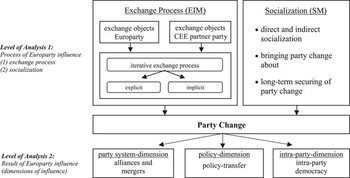
Our model brings together two well-known concepts in that Europeanization provides the overall theoretical framework while the object of analysis is party change. It is divided into two levels of analysis. (1) On the first level we address the precise process of Europarty influence. Here we answer the question of ‘how Europarties exert influence’. We distinguish between two modes of Europarty influence, whereby the first has its conceptual roots in rational choice institutionalism and follows a ‘logic of consequences’ and the second is inspired by sociological institutionalism and refers to a ‘logic of appropriateness’ (March and Olsen, Reference March and Olsen1989, Reference March and Olsen1998; Hall and Taylor, Reference Hall and Taylor1996). (a) Based on a rationalist bargaining model, we argue that both sides exchange certain resources and that these exchange processes lead to a party change on the side of the CEE partners due to the, in most cases, asymmetric resource ratio in favour of Europarties. (b) Furthermore, Europarties ‘socialize’ their CEE partner parties and persuade them of the appropriateness of party change. (2) On the second level, our model focuses on the result of Europarty influence on the side of CEE partner parties and we argue that, depending largely on the resource ratio, this will lead to varying degrees of adaptation towards the West European model (Westeuropeanization) by the CEE partners. This may occur on the ‘party system dimension’, the ‘policy dimension’, and the ‘intra-party dimension’.
The next section will briefly review the literature. Following this, we discuss our two core concepts, namely Europeanization and party change before we develop a general model of Europarty cooperation with CEE parties. Finally, we present some empirical evidence on the topic that is mainly based on material obtained by research in the archives of the EPP and the PES.
The impact of European integration on national parties and party systems
Regarding the influence of European integration on West European party systems, Mair (Reference Mair2000: 28) argues that ‘there is very little evidence of any direct impact.’ Poguntke et al. (Reference Poguntke, Aylott, Carter, Ladrech and Luther2007a, Reference Poguntke, Aylott, Ladrech and Lutherb) and Ladrech (Reference Ladrech2009) arrive at a similar conclusion concerning the influence of European integration on individual West European parties even though they find a shift of power towards party elites (Carter and Poguntke, Reference Carter and Poguntke2010). When it comes to CEE parties and party systems, however, scholars agree that the leeway for European integration influence is much larger than in the West (e.g. Lewis, Reference Lewis2006: 8–13; Enyedi, Reference Enyedi2007: 65; Ladrech, Reference Ladrech2008: 145). This is largely due to very favourable conditions for European influence in CEE countries. Essentially, these conditions can be regarded as ‘facilitating factors’ (Börzel and Risse, Reference Börzel and Risse2003: 58, 63, 73) of Europarty influence. First, there are the enormous challenges and the great ‘uncertainty’ regarding ‘double’ or even ‘triple’ transitions, which make CEE societies in general more open to external assistance and influence (Elster, Reference Elster1990; Offe, Reference Offe1994; Pridham, Reference Pridham2005: 6). Second, turning specifically to the party level, the ‘simple’ transformation of the political system and the process of European integration also place high demands on young democratic parties. Among other things, they need to gather knowledge on the functioning of modern democratic systems and the political system of the EU, and also on the role of political parties within them. Furthermore, CEE parties need the material resources (e.g. money, equipment) necessary to fulfill their role as central actors in the new democracies. Third, CEE party systems are potentially more open to external influences as they possess a lower degree of institutionalization and are more fluid and unstable compared with their West European counterparts (Lewis, Reference Lewis2006: 8–12). Fourth, at least in the first years after communism, the ‘return to Europe’ was the order of the day (Pridham, Reference Pridham2005: 173; Lewis, Reference Lewis2006: 10), and implied a general openness vis-à-vis influence from the West and a willingness to join ‘Europe’ on the party level too by becoming a Europarty member.
There is already some empirical evidence for Europarty influence on CEE parties. Day (Reference Day2004) and Delsoldato (Reference Delsoldato2002) deal with both major Europarties, the EPP and the PES, as well as several CEE countries. Other authors focus on just one Europarty and different CEE countries (Holmes and Lightfoot, Reference Holmes and Lightfoot2011) or on one Europarty and one CEE country (Johansson, Reference Johansson2008; Öhlén, Reference Öhlén2008). Still others concentrate on both main Europarties but on just one CEE state (Spirova, Reference Spirova2008; Stoychev, Reference Stoychev2008). There are also scholars who emphasize the influence of Europarties on CEE parties, but without conducting their own empirical studies (Enyedi, Reference Enyedi2007: 67, 69–71; zur Hausen, Reference zur Hausen2008: 250, 305; Mittag and Steuwer, Reference Mittag and Steuwer2010: 133). Timus (Reference Timus2009, Reference Timus2011: 92–11) detects Europarty influence on national parties in the Eastern non-EU member states Ukraine, Moldova, and Georgia. Finally, Pridham (Reference Pridham1996, Reference Pridham2005, Reference Pridham2006a, Reference Pridham2008: 164–174) examines the general ‘transnational party cooperation’ between Eastern and Western European players, including the globally active Party Internationals on the side of the latter. In their vast majority these studies arrive at the conclusion that the Europarties have a large impact on the development of political parties in post-communist accession countries (zur Hausen, Reference zur Hausen2008: 265) and that ‘the Europarties are the most crucial vehicles for standardization [of CEE parties]’ (Enyedi and Lewis, Reference Enyedi and Lewis2006: 245). However, it should not be ignored that Holmes and Lightfoot (Reference Holmes and Lightfoot2011) find only a relatively minor influence of the PES on CEE parties.
Yet, as Pridham (Reference Pridham2008: 201) rightly points out, the modest empirical evidence on the impact of European integration on national parties and party systems in the old member states of the EU should not be taken as a valid indicator of developments in new member states. Nevertheless, this area of research has long been neglected (Lewis, Reference Lewis2005: 175) and with respect to Europarty influence it has not been guided by an integrated theoretical framework. We turn our attention to this in the following paragraphs.
Europeanization: the overarching framework
The influence of Europarties on their CEE partner parties is conceptualized as an example of ‘Europeanization’, which, in this context, refers to the impact of European integration on the national level of European states in a top-down manner (e.g. Ladrech, Reference Ladrech1994: 69; Eising, Reference Eising2003). This top-down mode is, in general, typical for Europeanization processes in Eastern Europe (Schimmelfennig and Sedelmeier, Reference Schimmelfennig and Sedelmeier2005a; Lewis, Reference Lewis2006: 7–14). More precisely, in our case it is a top-down process that is characterized by a European-level actor exerting influence on national actors who simultaneously need to adapt to a changing environment as a result of European integration. Therefore, we can distinguish between indirect and direct impacts of European integration on national parties in CEE (see also Pridham, Reference Pridham2008: 187f.).
With indirect effects we refer to the impact of European integration on the political environment in which parties are active. Changes in the environment create adaptive pressures on political parties (Harmel and Janda, Reference Harmel and Janda1994). In this case, CEE parties receive the European stimulus via its effect on the national system (see also Ladrech, Reference Ladrech2008: 149; Lefkofridi, Reference Lefkofridi2008: 13). To be sure, Western European parties are exposed to the same mechanism. However, their environment changes much slower because their countries have been EU members for a considerable period of time. Hence, Europeanization for Western European parties, by and large, means adaptation to the gradual changes of the EU process of governance, which tends to generate gradual party change. CEE parties, on the other hand, experience the effect of European integration as an ‘external shock’ because their countries underwent fundamental transformation in the course of joining the EU. No doubt, they experienced adaptive pressure on a much higher level (Carter et al., Reference Carter, Luther and Poguntke2007: 9; Ladrech, Reference Ladrech2008: 141f.). Even though this appears to be counter-intuitive at first sight, we conceptualize the fact that EU membership adds an additional level to national political systems (Hix and Goetz, Reference Hix and Goetz2000: 12) as an indirect effect. This is because, from the perspective of national political parties, the addition of a further layer of political activity represents an environmental change to which they need to adapt. This also applies if this environmental change is not mediated through national legislative or executive institutions.
With direct Europeanization impacts we refer to the effects of Europarty activity on CEE parties. This kind of influence does not take a detour via the national environment. Hence, direct Europeanization effects are more important than indirect effects (see also Pridham, Reference Pridham2008: 189–200), because they are better suited to cause abrupt and extensive changes on the side of CEE parties. In fact, Europarties function as amplifiers that intensify the pressures of indirect Europeanization effects by appearing as active physical actors exerting direct influence on CEE parties, and this may lead to abrupt and extensive change. Therefore, Europarties can be regarded as party political ‘agents of Europeanization’ in CEE countries.
At the same time, Europarties need to preserve a certain degree of internal organizational and programmatic coherence for their own survival (and for the efficiency of their respective EP groups). This internal homogeneity is endangered in the course of Eastern enlargement through the inclusion of new actors with a highly different background in terms of mentalities, attitudes, needs, policies, and institutions (Delsoldato, Reference Delsoldato2002: 272; Bardi, Reference Bardi2004: 318; Aguilera de Part, Reference Aguilera De Part2009: 37). In a nutshell, Europarties cannot tolerate too much variation in their own ranks, because this would unduly complicate daily interaction and therefore increase transaction costs (Jansen, Reference Jansen1998b; Day, Reference Day2004: 226). Hence, we argue that the influence of Europarties needs to aim at an approximation of CEE partners to West European member parties from the very beginning of cooperation (see also Holmes and Lightfoot, Reference Holmes and Lightfoot2011: 32), and this ‘Westeuropeanization’ should become visible on all three principal dimensions of party politics, namely the structure of the party system, the policy orientations, and the intra-party dimension. Therefore, Westeuropeanization implies, ideally, that CEE partner parties are willing to change on all three dimensions. On the party system dimension we expect Europarties to have an interest in promoting alliance formations and mergers between national parties of the same ideological family. This reduces the number of member parties (in one country), which helps to contain heterogeneity within the Europarty. On the policy dimension we argue that Europarties need to demand a minimum level of programmatic adaptation from their CEE partners because they have to take care about their internal programmatic homogeneity. On the intra-party dimension Europarties are supposed to require a minimum of intra-party democracy, because they regard themselves as promoters of democracy (Day, Reference Day2004: 223f.; Pridham, Reference Pridham2008: 200) and, equally important, undemocratic membership parties would undermine the legitimacy of the Europarty.
Party change: the theoretical core
While the Europeanization process forms the broader theoretical framework, ‘party change’ constitutes the specific theoretical core. In other words, party change is the specific change component of the overall Europeanization process. More precisely, we deal with an overarching Europeanization process whose precise result is a Westeuropeanization that is brought about by a party change. Figure 1 depicts the core elements of Europarty influence on CEE parties. Both partners are engaged in an iterative exchange process that is complemented by on-going processes of socialization. Analytically, our model of Europarty influence is divided into two levels of analysis: (1) The first level deals with the question ‘how Europarties exert influence’ and (2) the second level investigates ‘what the precise result of Europarty influence’ is.
Model of Europarty influence. EIM = external incentives model; SM = socialization model; CEE = Central and Eastern European.

In general, external actors find it hard to influence national political parties (Carothers, Reference Carothers2006: 182). Thus, they need a coherent and comprehensive strategy if they want to be successful (Pridham, Reference Pridham2008: 179). To be sure, the above-mentioned ‘facilitating factors’ suggest that CEE parties are, in principle, more susceptible to change but Europarties are still up against the natural conservatism of their CEE partners. After all, they are independent national political parties that resist change to a large extent just like other organizations and institutions (Panebianco, Reference Panebianco1988: 42–44, 241; Harmel and Janda, Reference Harmel and Janda1994: 261, 278; Poguntke, Reference Poguntke2000: 62; Harmel, Reference Harmel2002: 119). More specifically, parties are conservative organizations and resist change because of its high human and material costs (Harmel and Janda, Reference Harmel and Janda1994: 278). ‘In fact, decisions to change a party's organization, issue position or strategy face a wall of resistance common to large organizations’ (Harmel and Janda, Reference Harmel and Janda1994: 261). We assume that Europarties pursue a double strategy to induce party changes on the side of their CEE partners (see Figure 1). (1) Within the scope of exchange processes Europarties offer their CEE partners incentives for party change and, at the same time, (2) they socialize their CEE partners into their families and persuade them of the appropriateness of party change.
Strategy 1: exchange process [external incentives model (EIM)]
Our conceptualization of the exchange process follows the EIM, which is used by Schimmelfennig and Sedelmeier (Reference Schimmelfennig and Sedelmeier2005b: 10–12) to explain Europeanization processes in the CEE context on the nation-state level, to a large extent. The EIM is a rationalist bargaining model, which is actor-centered and based on conditionality as well as on a ‘logic of consequences’. In a bargaining process, actors exchange several resources (also in the form of promises and threats) according to their preferences. The result of the bargaining process depends highly on the relative bargaining power of the actors.
In our model Europarties attempt to influence their CEE partners by engaging in a negotiation-based exchange process. More precisely, they offer material and immaterial resources as incentives for required party change. At the same time, CEE partner parties also have a range of resources to trade and the exact nature of the exchange relationship depends on the balance of resources. In any case, party change will only come about if the additional resources exceed the costs of change; otherwise party change is very unlikely (Harmel and Janda, Reference Harmel and Janda1994: 278). Furthermore, a party tends to change if this increases its chances of achieving specific party goals, which are usually policy, office, and vote goals (Strøm, Reference Strøm1990). As CEE parties may use the resources offered by Europarties to reach their individual goals, this Europarty activity increases the probability of party change.
The point of departure: the exchange objects
Before discussing the exchange process itself, we need to consider the precise exchange objects that result from the more general goals and interests of both sides presented in the introduction and which are traded in the exchange process. The exchange objects are the starting point of the entire exchange process.
CEE parties can offer the following exchange objects (resources and party change) to Europarties: (1) first of all, Europarties benefit from new CEE partner parties through (additional) seats in the European Parliament (Delsoldato, Reference Delsoldato2002: 274; Spirova, Reference Spirova2008: 295f.). After the redistribution of parliamentary seats in 2007 (after the accession of Bulgaria and Romania), the new accession countries were entitled to obtain 216 out of 785 seats in the EP (zur Hausen, Reference zur Hausen2008: 253). Since this is the main interest of Europarties (von Gehlen, Reference von Gehlen2005: 344), it provides the partner parties a significant blackmail potential to enforce their own interests in the exchange process. This obviously applies all the more to parties with a large share of votes. (2) Partners in CEE countries provide the Europarties access to national policy-making (Delsoldato, Reference Delsoldato2002: 274; Spirova, Reference Spirova2008: 796). After a country accedes to the EU, its national policy-making also has an impact on policy-making within the EU. Therefore, Europarties are especially interested in governing parties as they are represented in the Council of Ministers and frequently also in the European Council. Consequently, the government participation of a partner party means a huge strengthening of its bargaining position. (3) Finally, Europarties gain legitimacy through their engagement in CEE, as their activities are identified by the media and Europarties appear relevant and important in this context (Dakowska, Reference Dakowska2002: 285; Spirova, Reference Spirova2008: 796). (4) In addition to these resources, the CEE partner parties offer party change in the exchange process, in order to make themselves more compatible with the West European mode of party politics. As we have argued above, Europarties are particularly interested in such change in order to preserve a certain degree of internal homogeneity.
Europarties, in turn, can offer a range of exchange objects (only resources) to their CEE partner parties: (1) Europarties deliver material resources in the form of equipment (computers, fax machines, etc.) and financial grants to their CEE partners (Spirova, Reference Spirova2008: 796; Stoychev, Reference Stoychev2008: 18). Needless to say that these resources are gratefully received by the relatively poorly funded CEE parties. (2) They also gain legitimacy at home and abroad through public and official cooperation with a Europarty (Delsoldato, Reference Delsoldato2002: 275, 278; Day, Reference Day2004: 224–227). This was especially important for social democratic and socialist parties who needed to distance themselves from the communist past through collaboration with the PES. (3) CEE parties benefit through know-how and expertise, which is provided by Europarties (Dakowska, Reference Dakowska2002: 280, 289; Delsoldato, Reference Delsoldato2002: 281). Of special importance are several course-like events such as training seminars and workshops on topics like the functioning of modern democracies, the role and organization of political parties as well as EU processes, and the role of national parties in the political system of the EU. (4) Through cooperation with Europarties CEE parties gain easy access to powerful Western European party politicians and the European level (Delsoldato, Reference Delsoldato2002: 275; Pridham, Reference Pridham2008: 186f., 192). This is especially relevant before the EU accession of the respective countries, since CEE parties could already acquire a certain position within the Europarties at this time. In addition, CEE party elites used transnational party cooperation as a networking mechanism to improve the chances of their countries’ EU accession. (5) Finally, there is full membership of the respective Europarty. This is the most important exchange object of Europarties. In the course of their accession to the major Europarties, CEE partners usually pass through a three-step process: (a) informal contacts, (b) different degrees of formal cooperation, usually in the form of observer and/or associate status, and (c) full membership. To obtain the various stages, the candidate parties have to accept significant influences on all dimensions within the scope of ‘accession conditionality’ (Day, Reference Day2004). Arguably, each stage is connected to considerable benefits for the partner parties as they are accompanied by an increase in the above-mentioned resources. Although the partners receive these resources before full membership, it is likely that the attainment of that status increases their scope considerably: full membership means additional legitimacy for the partner parties (domestically and abroad), full participation in intra-party decision-making in the Europarty, professionalization of CEE party leaders (especially in EU affairs), easier access to Western European political leaders and additional material resources (see also Delsoldato, Reference Delsoldato2002: 275f.). Moreover, after the country concerned accedes to the EU, full membership means participation in the decision-making process of the EU via the respective group in the EP. Furthermore, it is assumed that full membership promises a long-term supply of resources as exclusion from a Europarty is less likely for full members than for observers or associate members, linked as it is to higher political costs for the Europarty. Thus, full membership is to be understood as a very special exchange object, which can potentially lead to substantial party change on the side of the partner party.
Party change through exchange processes: how it works and what happens
The exchange process is based on negotiations in which both sides discuss party change and its conditions. The negotiation results depend essentially on the relative distribution of power between the bargaining actors, whereby the more powerful negotiator can push through its interests against the less powerful one, according to its degree of superiority (Moe, Reference Moe1990; Sened, Reference Sened1991). In our case, the given distribution of power between both actors is equivalent to the distribution of resources. Hence, whether or not the exchange process leads to a change on the side of the CEE partners (and if so, how strong this change is) depends on the given ratio of resources between both actors (March and Olsen, Reference March and Olsen1996: 248).
In theory, the resource ratio may be in favour of either, the Europarty or its CEE partner. However, just as it has been the case between the EU and accession countries (see e.g. Schimmelfennig and Sedelmeier, Reference Schimmelfennig and Sedelmeier2005b: 10; Axt et al., Reference Axt, Milososki and Schwarz2007), Europarties are usually in a stronger position than individual national parties wanting to join (Day, Reference Day2004: 225–227). This suggests that, in most cases, the Europarty will be able to induce change in the CEE partner. This can be illustrated as follows: if both players control the same amount of exchangeable resources, the resources neutralize each other and there is no party change. However, the more likely scenario is that the Europarty possesses more resources than its respective CEE partner, which means that it can use these surplus resources to demand party change of its CEE partner, or, in other words, exchange these surplus resources against party change. Essentially, this variant of Europarty influence leads to party change on the side of the CEE partner following the logic of ‘resources against desired behaviour (i.e. party change)’. From the perspective of party change theory, this represents an abrupt change which is the result of conscious strategic decisions by the party's dominant coalition (Harmel, Reference Harmel2002).
There may be cases, however, where a CEE party is in an exceptionally strong position vis-à-vis a given Europarty. This may be because it controls a large share of the seats in the national parliament or because it is an important party of government. In such cases, the resource ratio may be in favour of the CEE party, which means that the Europarty may be willing to accept a difficult, that is, not very compatible, partner among its ranks. As a result, such an entry would shift the nature of the Europarty somewhat towards the joining CEE party. As this means pulling a large number of Europarty members in an unwanted direction, a possible outcome of such a configuration is that the partnership or even membership will eventually be terminated after long-lasting conflicts with these parties.
Evidently, our conceptualization of the exchange process is inspired by the concept of conditionality. In the context of transnational party cooperation conditionality works on the basis of reward and membership, with both depending on the willingness to fulfill required criteria, which is usually a certain kind of behaviour (Pridham, Reference Pridham2008: 178). The Europarties give (material or immaterial) assistance and/or membership to their CEE partners and in return they demand party change. But even if conditionality is undoubtedly the main component in this exchange process, it is not the only one. A rational decision may also be induced by the desire to attain a ‘direct benefit’. In other words, it is also a rational decision if the partner party is convinced (or persuaded by the Europarty) that the implementation of a certain Europarty guideline for party change helps to reach its individual goals, for example, with a view to national party competition. This is the simplest form of exchange process: the Europarty provides the idea and the know-how for the precise implementation of party change and the partner follows this guideline without further negotiations. In the following, the EIM is understood as consisting of ‘conditionality’ and ‘direct benefit’ with a clear dominance of conditionality.
Finally, the exchange process is conceptualized as an iterative process. This is also reflected by the different stages of accession (informal contacts, observer/associate status, full member) as each step requires different changes by the partner parties. Furthermore, this exchange may be explicit or implicit. Thus far we have concentrated on the explicit mode where both sides negotiate in a direct manner. In contrast, an implicit exchange process proceeds more subtly, by emitting signals that suggest to the partners that something ought to be changed; this may apply, for example, to certain policy positions during the joint drafting of a paper. Take, for example, the obvious: a CEE partner intending to join the EPP knows that this will require purging explicit anti-EU positions from its party programme. While this will be the implicit precondition of entering into official cooperation, other aspects, like more concrete policy positions, may be less obvious to the CEE partner party and will only become apparent during joint policy discussions.
Strategy 2: the socialization model (SM)
Another, more subtle way to Europarty influence is based on the ‘socialization model’ (SM; see Dakowska, Reference Dakowska2002; Schimmelfennig and Sedelmeier, Reference Schimmelfennig and Sedelmeier2005b: 18–20). We conceptualize socialization as a strategy because it involves intentional action to create arenas of encounter in which normative convictions might be changed. This rather long-term influence follows the ‘logic of appropriateness’ and leads primarily to relatively slow and gradual changes in CEE partner parties. More importantly, processes of socialization generate a durable internalization of new norms and values, because the target-object becomes convinced about them (Checkel, Reference Checkel2005; Õispuu, Reference Õispuu2011: 41). While changes which are the result of negotiations may be mainly strategic because they are primarily motivated by reasons of interest maximization (Õispuu, Reference Õispuu2011: 42), socialization helps to secure these changes. Furthermore, this strategy is independent of the resource ratio between a Europarty and a CEE partner party. While Europarties may sometimes deal with partners that are so strong that they cannot be influenced via exchange processes, these parties will not be able to entirely escape the socialization that is an integral part of interacting with the Europarty. To be sure, this is no guarantee of success, as the example of the British Conservatives shows, but even here Members of the European Parliament (MEP) were often accused of ‘going native’. From the perspective of the SM, Europarties appear as actors who represent a certain collective identity and a set of common norms and values at the European level (Dakowska, Reference Dakowska2002). In this context, various get-togethers of both actors such as training sessions, seminars, and courses organized by Europarties, mutual visits as well as invitations for meetings and congresses are of particular importance (Delsoldato, Reference Delsoldato2002: 281; Spirova, Reference Spirova2008: 796).
The SM consists of two mechanisms, namely of ‘indirect’ and ‘direct’ socialization (see Hoy, Reference Hoy2008: 647). Beginning with the first, ‘indirect socialization’ on the side of the CEE partners is assumed to take place rather casually through regular, frequent, and personal interactions with Europarties and West European member parties in a long-term perspective and is indeed intended by Europarties. In this case, CEE partners change themselves on the party system-, policy-, and intra-party dimensions when they are sufficiently ‘socialized’, that is, when their identities, norms, and values are ‘Westeuropeanized’ and they therefore regard a party change as ‘appropriate’. Here, the Europarties are more indirectly involved as they (and their West European member parties) socialize CEE parties simply through interaction. In this context, Europarties do not set specific guidelines for party change. Arguably, the primary effect of indirect socialization is not so much bringing about major, abrupt party change but rather to support, strengthen, and secure party changes towards Westeuropeanization, which are already ongoing.
In contrast, Europarties are more actively involved in processes of ‘direct socialization’, or, to put it more precisely, ‘normative persuasion’. In this case, Europarties attempt to socialize their CEE partners through ‘teaching’ (‘persuasion’) in specific seminars. Here, from the perspective of sociological institutionalism, Europarties are to be seen as ‘norm entrepreneurs, which persuade their partners to redefine their identities and interests by engaging in a social learning process’ (Dakowska, Reference Dakowska2002: 288). On the one hand, this may be done to amplify the indirect socialization processes in general. It is particularly targeted at younger party activists (Jansen, Reference Jansen2006: 190) where it is expected that they will become persuaded of the appropriateness of West European identity, norms, and values. Once they follow the old guard this should lead to more Westeuropeanized party leaderships in CEE. On the other hand, Europarties may set specific guidelines for party change in these seminars and try to persuade their partners of the appropriateness of these changes. In this case, a CEE party adopts Europarty guidelines for party change (or just parts of these) if it regards them as appropriate in respect to its identity, norms, and values. In a process of normative persuasion the CEE partner will consider the Europarty guidelines for change as appropriate and implement them with conviction only after it has sufficiently internalized the associated identity, norms, and values. Therefore, persuasion of the appropriateness of party change also requires a considerable period of time.
Additionally, it needs to be mentioned that not all socialization takes place as a result of Europarty initiative. Some of it may be demand-driven because CEE parties are themselves eager to learn lessons from the Europarties in training seminars, and also from West European member parties in general (Johansson, Reference Johansson2008).
A general model of Europarty cooperation in Central Eastern Europe
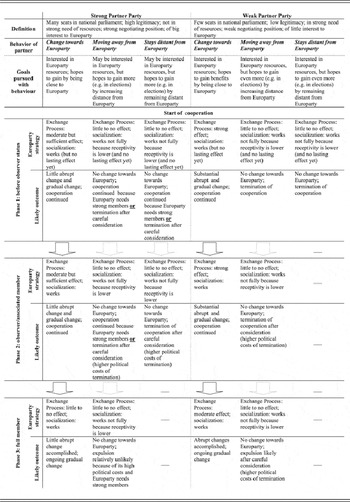
In the previous, we discussed individual mechanisms at work in the process of Eastern enlargement of Europarties. Now, we will turn our attention to the likely cooperation outcomes that largely depend on the concrete configurations of interests and resources between Europarties and parties in CEE countries, which enter into cooperation with a Europarty (see Table 1). Here we can distinguish between two types of partner parties and three different scenarios, which lead to different outcomes depending on the specific phase of cooperation and the type of partner party. Essentially, we can distinguish between strong and weak partner parties, whereby we conceptualize strength as a multi-dimensional concept, which is mainly composed of the mentioned resources (share of votes and seats in parliament, governmental incumbency, legitimacy, and financial resources). These factors determine the CEE party's negotiating position on the one hand and its attractiveness vis-à-vis the Europarty on the other.Footnote 4 In addition, there are three different scenarios of CEE party behaviour: they are willing to adapt to the Europarty mode, they begin to move away from the Europarty for reasons of domestic politics, or they remain distant from the Europarty. As we have explained above, ‘closeness’ is a multi-dimensional concept, comprising the party system, policy, and intra-party dimensions, which may vary in importance according to political contexts. Finally, we need to distinguish between three phases of cooperation, which are marked by the differential impact of exchange and socialization processes. While socialization needs time to have a lasting effect, exchange-based interaction becomes less important after full membership is acquired because the lever of conditionality is limited to the threat of expulsion, which, as we have argued above, involves a high political price.Footnote 5
Integrated model of Europarty cooperation

The common point of departure is that a partner party must have reasonable ideological proximity to a given Europarty. Otherwise, there will be no initial contact. Also, if a partner party is very close to a Europarty from the outset, very little change will be required. Joining a Europarty will be fast and relatively easy and the existing proximity will be stabilized through socialization processes. Hence, there is no need to elaborate further on this variant. This leaves us with the three scenarios of party behaviour mentioned above. Depending on the strength of partner parties, cooperation outcomes will vary considerably. (1) Parties that are open to change will need to change more if they are weaker (see columns 1 and 4, Table 1). Yet, both types of party will eventually accomplish full membership and on-going effects of socialization will stabilize their membership when the effects of conditionality are no longer very important since full membership has already been accomplished. (2) Parties may, in different phases of cooperation, begin to move away from the Europarty, most likely because domestic politics may suggest that there is political hay to be made by mobilizing on anti-EU, populist or more extremist positions (see columns 2 and 5, Table 1). Here, the likely cooperation outcomes vary substantially depending on the strength of the partner party. When the partner is strong, Europarties may tolerate such moves even though there is already an official link below full membership status (observer/associate membership). Also, in cases of full membership a strong partner may get away with fairly substantial violations of Europarty principles.Footnote 6 In both cases, political opportunity costs will determine whether or not the Europarty will terminate cooperation or even seek the expulsion of the dissident partner party (which may, of course also decide to leave eventually). Weak partner parties, on the other hand, will be much more easily threatened with the termination of contacts or even expulsion. (3) A different logic applies if a CEE party remains distant from the outset (see columns 3 and 6, Table 1). Here, the Europarty may still hope that the CEE partner may eventually begin to change and is therefore likely to tolerate a substantial distance during the phase of initial contacts. However, once we move into the phase of official contacts, connections to a weak party will most likely be terminated while the Europarty will seek to maintain contacts with a stronger partner for reasons of political opportunity. As the example of the British Conservatives exemplifies, however, strong parties will most likely not become full members. Again, this may be due to the political will of either side.
Party change in the real world: some empirical evidence of Europarty influence
In the following pages we will present evidence on how Europarties influence CEE partner parties. It is mainly based on material obtained by work in the archives of the EPP and the PES in Brussels and focuses primarily on phases 1 and 2 of Europarty influence. The analysis is complemented by evidence from published sources and concentrates on providing empirical insights into the actual process of Europarty influence and some examples of specific results. At present there is not sufficient systematic evidence to test the different cooperation outcomes suggested by our general model of Europarty cooperation.
Exchange processes
In both the EPP (and EUCD)Footnote 7 and the PES new parties from CEE usually had to go through a hierarchical three-step process: informal contacts, observer/associate status, and full member.Footnote 8 As the former EPP/EUCD Secretary General Thomas Jansen explains, these phases were established to influence incoming parties on the party system, policy, and intra-party dimension through the application of accession conditionality (Jansen, Reference Jansen1998a: 153). Parties from CEE had to meet formal ‘accession criteria’ when applying for a certain membership status in the EPP (EUCD) or PES (Jansen, Reference Jansen1998a: 152f.; Gagatek, Reference Gagatek2008: 155; Öhlén, Reference Öhlén2008: 13),Footnote 9 which formulated requirements on all three dimension of party politics (EPP, 1992, 1996). The formal accession criteria of the EUCD state that if two or more parties from one country apply for membership, the EUCD may make accession conditional on the formation of a ‘national Equipe’ (Jansen, Reference Jansen1998a: 152f.). Similarly, the PES criteria require that in countries where more than one party has applied to be a full member of the PES these parties should not compete against one another in national or European elections (Gagatek, Reference Gagatek2008: 155). Similarly, the implementation of minimum levels of intra-party democracy and the acceptance of policy fundamentals are requested in the process of admitting new member parties (EPP, 1997: 46f.; 2009; Jansen, Reference Jansen1998a: 152f.; Dakowska, Reference Dakowska2002: 281; Gagatek, Reference Gagatek2008: 155). As the attainment of a specific membership status depended on the fulfillment of these criteria, this corroborates our expectation that party change was induced by Europarties by means of an exchange process following the logic ‘membership against desired behaviour’.
Furthermore, there is some circumstantial evidence that material resources were used to induce desired behaviour, in that the Europarties offered their CEE partners broad material assistance (EPP, 1990a, b; PES, 1990a, b).Footnote 10 There are also examples where CEE partner parties requested material support from Europarties (PES, 1991). It seems reasonable to assume that the Europarties expected something in ‘exchange’ for the extensive support they gave to parties in CEE.
Socialization
In the context of their enlargement both Europarties organized various gatherings like mutual visits, conventions, conferences, and training seminars (Dakowska, Reference Dakowska2002: 281, 288; Delsoldato, Reference Delsoldato2002: 281; Spirova, Reference Spirova2008: 796). On the one hand, EPP and PES supported the integration of their observer and associated parties through letting them attend meetings of various Europarty bodies on a regular basis (PES, 2002: 97; 2009; EPP, 2009). It is reasonable to assume that this was very supportive for processes of ‘indirect socialization’. On the other hand, we find ample evidence for activities aiming at ‘normative persuasion’ (direct socialization) such as training sessions organized by both Europarties (Jansen, Reference Jansen1998a: 150, Reference Jansen2006: 190; European Forum for Democracy and Solidarity (EFDS), 2009). The intention driving these activities is exemplified by a statement of a leading Europarty functionary who points out that the EPP/EUCD has a ‘pedagogical responsibility […] toward parties which want to join. Such parties should be given the chance to learn by taking part in events’ (Jansen, Reference Jansen1998a: 153). These sessions dealt with general expertise on topics such as the organization and role of political parties, national minorities, civil society, EU, and campaigning (Jansen, Reference Jansen2006: 190; Johansson, Reference Johansson2008: 175) but also involved very specific themes concerning possible party mergers, specific policy positions and matters of internal party organization (PES, 1990c; EPP, 1995a; EFDS, 2009: 37, 93). A telling example is the aftermath of the electoral disaster of the Slovak Social Democratic parties in 2002, when the PES largely successfully pursued the strategy of influencing the policy development of its Slovak partner parties (PES, 2003c) and promoting the formation of electoral alliances and mergers among them, which was to be achieved (among other ways) through the organization of training workshops (PES, 2003a). Furthermore, Dakowska (Reference Dakowska2002) also shows in the case of the EPP and Polish parties that the Europarty socialized its partners through teaching (‘persuasion’) in specific seminars.
Specific results of Europarty influence
We have argued above that Europarty influence should lead to changes in national party systems, policy change and intra-party reforms. When it comes to party system change it is well documented in the archives of the EPP and PES that they attempted to bring about fusions and alliances of like-minded parties in CEE (e.g. EPP, 1995a, b). In Bulgaria, for example, the EPP threatened to deprive its smaller partners of their observer status should they not merge with the two major parties BANU (Bulgarian Agrarian National Union) and DP (Democratic Party; EPP, 1994). In general, Spirova (Reference Spirova2008) shows that the EPP and PES promoted several mergers and electoral alliances in Bulgaria. Similarly, the Slovak Social Democrats united in 2005 following substantial persuasion by the PES, which initiated and promoted this merger intensively since the 2002 elections (PES, 2003a, b).
Several scholars argue that Europarties have influenced the policy positions of CEE partners, mainly on general aspects like the commitment to democracy, the rule of law, European integration, federalism, the social market economy, and minority rights (Dakowska, Reference Dakowska2002: 282f.; Pridham, Reference Pridham2005: 169). However, we have seen in the archive material that Europarties also work towards the transfer of more specific policies on subjects such as energy supply and environment (PES, 1990c; EPP, 1995a). While systematic evidence of the effects is still missing, Europarties always require that applicant parties eventually subscribe to the policy fundamentals of the Europarty, which, in some cases, amounts to substantial policy change (EPP, 1997: 46f.; Jansen, Reference Jansen1998a: 152f.; Gagatek, Reference Gagatek2008: 155).
While the attempts by Europarties to influence the way their new partners organize internally are well documented (Dakowska, Reference Dakowska2002: 281; Pridham, Reference Pridham2008: 199; EFDS, 2009: 37, 93), relatively little is known about the precise effects of these efforts. However, it is evident that Europarties attach high significance to the aspect of internal party organization. The EPP, for example, always requests that each applicant party attaches its statutes to the application (EPP, 2009), which implies that internal rules play a decisive role in the admission process (Gagatek, Reference Gagatek2008: 155).
Conclusion
This paper presents a theoretical model to explain the influence of Europarties on their CEE partner parties. This influence takes place within the process of Europarty Eastern enlargement in which numerous new parties from CEE are included. It is the result of a specific configuration of interests: while Europarties primarily strive for presence through member parties in all (future) EU countries, CEE parties need material resources, expertise, and international recognition.
Our model combines the insights of the literature on Europeanization with theories on party change and argues that Eastern enlargement of Europarties needs to be understood as a process of (mainly) asymmetric exchange accompanied by processes of socialization. The most likely result of this is that the West European model of party politics is exported to CEE countries. In other words, our model predicts and explains a process of Westeuropeanization in that CEE parties become more like West European parties which, after all, moulded the Europarties in the first instance. This is a main Europarty goal in order to secure a sufficient degree of internal homogeneity, necessary to maintain their capacity to act cohesively and therefore ensure organizational survival. To be sure, within the process of Europarty influence strong partner parties will be able to resist such pressures to some degree, and our model accounts for this. It also explains how different stages of collaboration and eventually full membership lead to a shift in the relative importance of exchange-based change and socialization-based change. Furthermore, it also explains different outcomes of the process of cooperation in that it specifies why, and under which circumstances, the termination of contacts between a Europarty and a CEE partner becomes likely. After all, some CEE parties may re-position themselves in their national party system and this may make the continuation of cooperation with a given Europarty unlikely.
We have provided preliminary empirical evidence on the actual process of Europarty influence, and we show that its results have left their mark on the configuration of national party systems, the policy positions of CEE parties and the way they organize internally. However, there are still many research lacunae here, and our integrated model still awaits systematic empirical testing. To be sure, many of its insights could easily be adapted for application to other processes of party enlargement, even on the national level. After all, our reference to Europeanization serves mainly as an explanation of the asymmetric power relationship between Europarties and parties wishing to join. Similar scenarios can be found elsewhere, for example, in the wake of German unification when West German parties merged with East German partner parties or when other transnational party organizations like the Socialist International (SI), the Centrist Democrat International (CDI), or the International Democrat Union (IDU) admit new members.
Clearly, Europarties are not the sole party political actor in the process of integrating CEE parties into a common European political space. Other components of the European party families are also more or less active in CEE (Pridham, Reference Pridham1996; Pridham, Reference Pridham2008) including the West European member parties (and their foundations) and the groups in the EP. Regarding the empirical testing of our model, the activities of national parties (and their foundations) should only be taken into account if their activities are coordinated by the Europarty and insofar as they possess a Europarty mandate. Even if we can distinguish Europarties from their EP groups analytically, this was hardly possible in the past when it came to real-life activities because of the very close cooperation and connection between both components. This is primarily true for the 1990s when Europarties were in general much more dependent on their EP groups. It holds less after the turn of the millennium when they secured more independence, in particular through several legal regulations (Lightfoot, Reference Lightfoot2006; Johansson, Reference Johansson2009). It follows from this that the empirical analysis of Europarty influence on CEE partners also needs to consider the role of the respective EP groups adequately. Nevertheless, only the extra-parliamentary Europarties are able to include entire party organizations as observer and associated member parties a long time before the actual EU accession of their respective countries.
To conclude, our model provides the theoretical and analytical tools to proceed in the analysis of arguably the largest extension of transnational party organizations, which provides ample testing ground for theories on party change and, more generally, the change of complex organizations in modern societies. Furthermore, it also has implications for the analysis of party system development in the new European democracies (e.g. Tavits, Reference Tavits2008; Vachudova, Reference Vachudova2008; Vachudova and Hooghe, Reference Vachudova and Hooghe2009) as it shows that the organizational strategies of Europarties are significant factors that need to be taken into account when we want to understand how parties and party systems in the CEE countries evolved, why they succeeded and, equally importantly, why a significant number of them failed.