Introduction
Welfare regime modelling remains a popular endeavour and has yielded voluminous and extensive contributions to comparative welfare and social policy research (Abrahamson, Reference Abrahamson1999; Powell and Barrientos, Reference Powell and Barrientos2015). The use of classifications and typologies provided a platform for social policy scholars to comparatively explore historical and contemporary welfare developments (Aspalter, Reference Aspalter2011). The purposefulness of the typologies expanded beyond the OECD welfare regimes and systems to Africa, Latin America, East Asia and South East Asia (Gough and Wood, Reference Gough and Wood2004; Rudra, Reference Rudra2007; Haggard and Kaufman, Reference Haggard and Kaufman2008; Seekings, Reference Seekings2012), with scholars either adopting OECD-based statist frameworks (e.g. Esping-Andersen, Reference Esping-Andersen1990) to new cases or opting to provide more spatially nuanced and bottom up approaches (e.g. Jones, Reference Jones and Jones1993; Papadopoulos and Roumpakis, Reference Papadopoulos and Roumpakis2013).
The increasing interest of comparative and international social policy scholarship in explaining the dynamic development of welfare regimes in the Global South was often accompanied by attempts to apply normative criteria for how welfare regimes (new cases) fare, and consequently how far do they resemble Esping-Andersen’s ideal types (Aspalter, Reference Aspalter2006, Reference Aspalter2011). The shift marked a particular form of conceptual imperialism (Gupta, Reference Gupta, Sharma and Gupta2006; Kim, Reference Kim2015) both in terms of theoretical tools and approaches. As Midgley (Reference Midgley, Midgley, Surender and Alfers2019) argues, comparative social policy remains inherently statist with welfare regimes that lack comprehensive, effective and universal state mechanisms for organising welfare provision often depicted as rudimentary. Recent scholarship in comparative social policy argues non-statutory practices do not indicate a rudimentary form of welfare – instead they represent key sites in the reproduction of welfare capitalism both in the Global South and Global North (see Papadopoulos and Roumpakis, Reference Papadopoulos and Roumpakis2017).
On the other hand, social development scholars have been focusing on non-statutory practices including multi-scalar strategies to combat poverty and illiteracy, and often review the effect of conditional or unconditional cash transfers on empowering those on the intersections of horizontal (e.g. race, ethnicity, gender) and vertical (e.g. income) inequalities (Kabeer, Reference Kabeer2015). The recent expansion of social assistance programmes, often condoned by global actors such as the World Bank, to contain social tensions (van Gils and Yörük, Reference van Gils and Yörük2017) has attracted much attention both in developing (Barrientos, Reference Barrientos2013) and developed countries (Seekings, Reference Seekings2012; Barrientos, Reference Barrientos2013); enough for scholars to suggest that social assistance could be the unifying dimension, a common denominator of sorts, for comparing Global North and South welfare regimes (Böger and Öktem, Reference Böger and Öktem2019; Yörük et al., Reference Yörük, Öker, Yıldırım and Yakut-Çakar2019).
One of the first attempts that aimed to extend the analytical and methodological tools of comparative welfare research to Global South regimes and incorporated, among others, the importance of non-statutory provisions, was the work of Gough and collaborators, reviewed next.
Global welfare regime and insecurity
The edited volume of Gough and Wood (Reference Gough and Wood2004) signalled a breakthrough in mapping the diversity of welfare arrangements across African, Asian and Latin American countries as they aimed to bridge social policy and development studies. The contributors to the edited volume analysed the interplay between public, private, household and community provision across different levels and spaces of governance and exposed the limitations of the established explanatory theories of Global North (OECD) welfare states at the time. Their work stands out as an attempt to integrate and embed insights that a) human needs are universal and there is great variation across time and place in meeting them, b) informal practices play an extensive role in meeting human needs and protecting against insecurity and c) transnational forms of financial support, including foreign aid and remittances, play a key role in promoting well-being. These three dimensions remained largely neglected at the time within the then mainstream comparative social policy literature, and opened up the playing field to incorporate more insights from development studies such as the importance of strategies to combat poverty (e.g. social assistance), the importance of transnational forms of support such as remittances and foreign aid, and finally the importance of informal and non-statutory provision.
Among the contributions to the edited volume, the work of Gough (Reference Gough, Gough and Wood2004a) offered a more nuanced attempt to categorise global welfare regimes. His argument aimed to diverge from focusing on welfare states as the latter play a weaker role in offering security to their citizens in Global South. Instead he prioritised the term welfare regimes to indicate that security in Global South is achieved in conjunction with kin, family and community ties. Building from Esping-Andersen’s (Reference Esping-Andersen1990) typology, Gough suggested that a global welfare regime comparison could be developed by focusing on institutional forms of solidarity and welfare outcomes. By taking into account welfare outcomes (e.g. poverty, literacy, Human Development Index- HDI) and the welfare mix (e.g. domestic and international spending), he identified three main categorisations of welfare provisions and dynamics: namely, welfare state regimes, which are identified by high public welfare spending and high scores in the HDI; informal security regimes, which are identified by relatively high HDI score but with modest, if not low, public spending; and finally insecurity welfare regimes, which rely heavily on international aid and achieve modest to low HDI scores.
At the same time, Gough’s classification of global welfare regimes exposed the limitations of typologies especially for Large-N cross-case comparisons in developing countries as they could not theoretically account for and explain the vast diversity and political history within each country and region (see also Kim, Reference Kim2015). The identification of “the 5 I’s” (industrialisation, interests, institutions, international influences, ideas) attempted to provide an answer to this gap (Gough and Abu Sharkh, Reference Gough and Abu Sharkh2011), but did not really aim to serve as theory for the causal properties of each regime identified. One could suggest that with the exception of international influences, the concepts on “the 5 I’s” resemble established comparative social policy theoretical approaches from the Global North (see Ehmke, Reference Ehmke and Scherrer2019). Wood and Gough (Reference Wood and Gough2006) did highlight the need to take into account particular histories for groups of countries (e.g. colonialism), but again did not materialise this thread themselves.
Empirically, the utilisation of public social expenditure for welfare regime categorisations is not without analytical problems (see Esping-Andersen, Reference Esping-Andersen1990) and the use of the HDI does not really capture the welfare effort or the longevity of structures in place. Methodologically, cluster analysis as a data reduction technique (Gough, Reference Gough, Gough and Wood2004a; Abu Sharkh and Gough, Reference Abu Sharkh and Gough2010; Gough and Abu Sharkh, Reference Gough and Abu Sharkh2011) is not grounded in theoryFootnote 1. Hierarchal Cluster Analysis (HCA) is very sensitive to outliers while k-means (KCA) clustering is also affected by the order of the data and the strength of the initial seeds. The mapping therefore of the clusters has more validity in terms of how far the countries differed in time given the particular set of variablesFootnote 2. Abu Sharkh and Gough (Reference Abu Sharkh and Gough2010) revisited the original classification and identified that welfare regimes remain largely path dependent with the exception of the ‘informal security’ regime. In their attempt to explore how welfare regimes cluster in relation to public revenue composition and social outcomes, Gough’s and Abu Sharkh’s (Reference Gough and Abu Sharkh2011) findings question even more the rigidity of the informal welfare regime cluster.
Finally, the global welfare regime classification becomes more perplexing once one adds the distinction the authors make between species within the same category (Wood and Gough, Reference Wood, Gough, Gough and Wood2004). The implications of this critique are more apparent in the work of Wood and Gough (Reference Wood and Gough2006), who, following Barrientos (Reference Barrientos, Gough and Wood2004), depicted Latin American welfare regimes in transition from conservative-informal to liberal-informal, with some of these countries (e.g. Argentina, Brazil, Costa Rica) along with Central Eastern European depicted later as proto-welfare states (Gough and Abu Sharkh, Reference Gough and Abu Sharkh2011). In a similar fashion, East Asia was transitioning into productivist welfare regimes, with South Korea and Taiwan displaying a dynamic towards a welfare state while Southeast Asia (e.g. Thailand, Malaysia, Indonesia) was well anchored in informal security regimes depicting productivist elements. In turn, Africa depicted informal security welfare regimes with the exemption of Sub-Saharan countries which exemplified insecurity welfare regimes.
In Gough’s work the classifications are largely identified empirically. Taking into consideration that informal and insecure welfare regimes are more exposed than welfare state regimes to internal and external shocks, this brings the question of whether empirical analysis should be measured against welfare regime ideal-types (e.g. membership of a particular cluster), or whether empirical analysis should be capturing the internal homogeneity and external heterogeneity of these ideal-types (see also Yu, Reference Yu2012). Additionally, what criteria should apply to explain the transition of, e. g. Korea and Taiwan, into a welfare state regime? Would this transition have to be monitored empirically and in time? What are the causal properties that allow, e. g. Korea and Taiwan, to transition?
Next, we take advantage of the time lapsed since the original publication and explore how far the premises for global welfare regimes’ classification put forward by Gough and Wood (Reference Gough and Wood2004) have been applied, developed and challenged. The next section details the search strategy of this review.
Search strategy
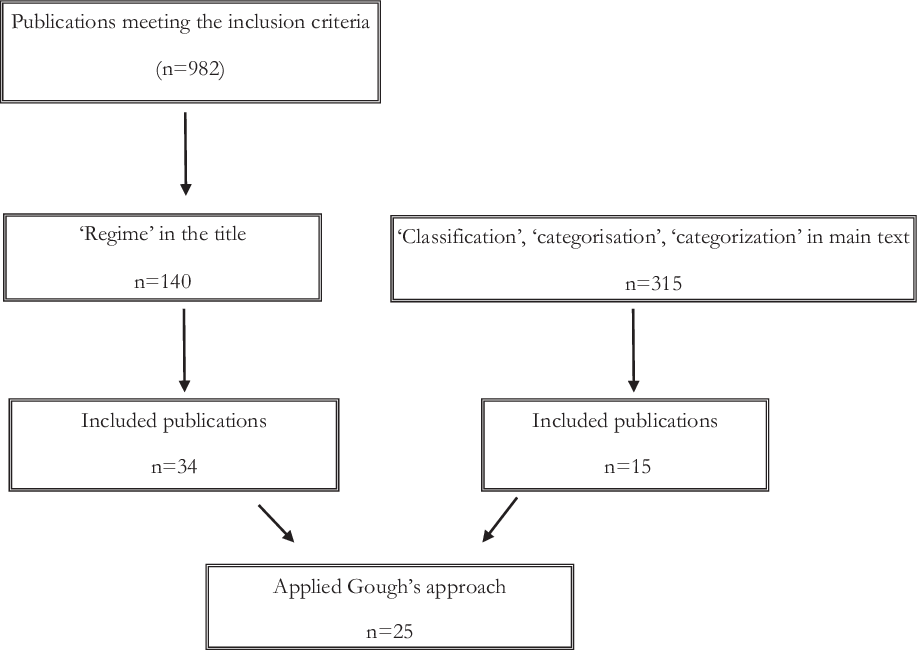
The article adopts a purposeful literature review, i.e. a literature review of all texts that meet the criterion of citing Gough and Wood (Reference Gough and Wood2004) or Gough (Reference Gough, Gough and Wood2004a, Reference Gough, Gough and Wood2004b). At the time of writing this review article, 590 publications cite the work of Gough and Wood (Reference Gough and Wood2004), 218 cite Gough (Reference Gough, Gough and Wood2004a) and 174 cite Gough (Reference Gough, Gough and Wood2004b). In total, the search resulted in 9823 outputs (see Figure 1)Footnote 3. The first inclusion criterion was that results should include ‘regime’ in the title (140 outputs). The next step involved a back and forth examination of each output as single case studies (e.g. Babajanian, Reference Babajanian2008; Kim, Reference Kim2008; Sumarto, Reference Sumarto2017, Ehmke, Reference Ehmke and Scherrer2019) and theoretically focused outputs that did not engage with classification debates (e.g. Plagerson and Patel, Reference Plagerson and Patel2019) were omitted. Articles that focused on one country but compared sub-national levels and policy areas were included in the review (e.g. Cruz-Martínez, Reference Cruz-Martínez2018; Satyro and Cunha, Reference Satyro and Cunha2019). Additionally, book review articles were omittedFootnote 4. As a result, the number of articles was reduced to thirty-four. However, it was clear that restricting the search to ‘regime’ in the title, key publications would be omitted from the final list. Therefore, in addition to the thirty-four outputs, another search was made of all outputs citing Gough and Wood (Reference Gough and Wood2004) or Gough (Reference Gough, Gough and Wood2004a, Reference Gough, Gough and Wood2004b) with the inclusion criteria applying the search terms ‘classification’, ‘categorisation’, ‘categorization’ in the main text. The total number of citations was 315 and after a cross check which omitted duplicates, reviews, single case studies, fifteen more outputs were identified which brought the total up to forty-nine outputs. In the end, only 25Footnote 5 of these publications applied Gough and Wood (Reference Gough and Wood2004) and Gough’s (Reference Gough, Gough and Wood2004a, Reference Gough, Gough and Wood2004b) arguments and classification in comparative welfare regime research.
Diagram of search strategy

The review examines the causal properties for capturing the diversity of welfare regime classifications, empirical data, methodologies applied to classify welfare regimes, cases selected, groupings identified and finally how transitions to different welfare regime memberships are explained. In the conclusion, the article discusses findings and implications for global welfare regime classification debates.
Revisiting the global welfare regime classification
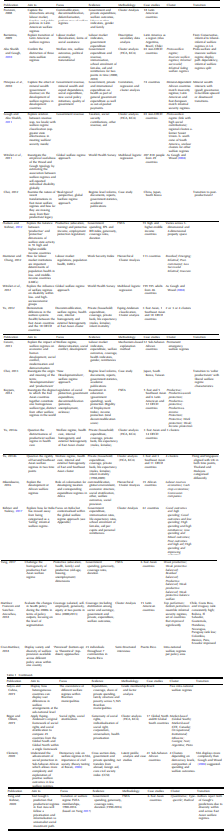
The review of the available literature is presented next and is split into two sections, one that has a global focus and one that has a regional one. The regional focus is then also broken down into Asia, Africa and Latin America. The results that meet the inclusion criteria are listed in Table 1Footnote 6.
A comparison of studies using Gough and Wood (Reference Gough and Wood2004), Gough (Reference Gough, Gough and Wood2004a, Reference Gough, Gough and Wood2004b), 2004-2020

Global focus
Hinojosa et al. (Reference Hinojosa, Bebbington, Barrientos and Addison2010) utilised Gough’s welfare regime conceptualisation in order to capture the effect of mineral wealth as government revenue for the development of welfare regimes in the Global South. The authors explored how wealth from minerals has transformed key aspects of the welfare mix in relation to health provision. Similar to Gough (Reference Gough, Gough and Wood2004a), they applied a cluster analysis on state, private (including households) and international organisations’ expenditure for health provision. Their clusters resembled to a large extent Gough’s (Reference Gough, Gough and Wood2004a) classification highlighting that state provision is predominant in welfare state regimes, the market in informal security regimes and finally international organisations in insecurity regimes. Their analysis also considered how wealth from mineral sources can allow countries to transition towards more state involvement in welfare provision (e.g. Bolivia, Chile), reinforced their existing informal welfare security practices (e.g. patronage, corruption) and finally, where institutions are weak, undermined environmental standards and natural resources upon which rural livelihoods relyFootnote 7.
A substantive volume of health studies also incorporated Gough and Wood (Reference Gough and Wood2004) global welfare regime classification. In an attempt to identify the interplay between welfare regimes, disability and mental health, Witvliet et al. (Reference Witvliet, Kunst, Stronks and Arah2012) analysed World Health Survey (WHS) data to estimate how far employment and educational attainments interact with disability. Through the application of multilevel logistic modelling, they discerned that European welfare states and the East Asian productivist regime provided better protection while insecure regimes offered the least protection especially to those with low education and the unemployed. There were two exceptions though as disability prevalence for the most vulnerable groups is not highest in insecure welfare regimes like Sub-Saharan Africa (SSA) but instead in informal security Indian sub-continent countries. The latter cluster has been identified as the ‘failing informal security regime’ (Abu Sharkh and Gough, Reference Abu Sharkh and Gough2010), and therefore indicates that despite similar welfare mix characteristics within the informal security regime, in terms of welfare outcomes there is a separate grouping which displays worse welfare outcomes (Witvliet et al., Reference Witvliet, Arah, Stronks and Kunst2011).
In their research for non-medical determinants of population health, Muntaner et al. (Reference Muntaner, Chung, Benach and Ng2012) built on the global welfare regime approach to explore how far labour market regulations act as social determinant for population health in the Global South. Their research utilised the Work Security Index (WSI) to group middle- and low-income countries and explore cross-national distributions of population health. The cluster analysis results matched Wood and Gough’s (Reference Wood and Gough2006) findings with the weakest levels of labour market regulation and poorest health outcomes found in insecure welfare regimes. It is perhaps not surprising to suggest that the focus on health outcomes and educational variables of the aforementioned studies matches the clusters identified by Gough (Reference Gough, Gough and Wood2004a) given that his original classification included Disability Adjusted Life Expectancy and literacy rates.
On other hand, Hudson and Kühner (Reference Hudson and Kühner2012) questioned both the methodological attributes of cluster analysis employed by Gough and collaborators and the rigidity of the East Asian cluster. Instead, they utilised a fuzzy set ideal type analysis (FSITA) across fifty-five cases including twenty-five non-OECD middle-high income countries. For their analysis they explored productive and protective dimensions including education spending as the percentage of total welfare spending for education, training investment (productive expenditure of active labour market policies), employment protection legislation and finally unemployment support (accounting for coverage, qualifying period, duration and benefit level). From their analysis, they found little evidence of any geographical similarities. Their findings displayed a great diversity across all regional groups including Europe, East Asia, Latin America and the Caribbean.
Following Hudson and Kühner, Kuypers (Reference Kuypers2014) compared OECD, Latin American, East and Southeast Asian countries and applied an FSITA based on income protection (measured as total decommodification score), work protection and investment in education (government spending) to demonstrate that the majority of East and Southeast Asian cases are categorised as productive, with Indonesia and Japan only displaying more protective characteristics. Therefore, Kuypers (Reference Kuypers2014) argued that discounting the rigidity of East Asian welfare regime might be premature.
In exploring India’s emergent social policy paradigm, Kühner and Nakray (Reference Kühner and Nakray2017) review the effectiveness of social policy innovations to conclude, among other points, that the existence of individual (local) state governments in India undermines the effectiveness of implementing and administering social programmes, explaining thus the significant variation of welfare outcomes. Kühner and Nakray (Reference Kühner and Nakray2017) also focus on how far India has moved away from being categorised as a ‘failing informal welfare regime’. In their Appendix, they update much of Gough’s (Reference Gough, Gough and Wood2004a) cluster analysis of sixty-one countries with more recent data (2014 or latest available). Their findings suggest that India, along with Bangladesh, Indonesia, the Philippines and Sri Lanka continue to form a separate welfare regime characterised by relatively low public expenditure on education and healthcare services with mixed welfare outcomes.
More recently, Böger and Öktem (Reference Böger and Öktem2019) incorporated in their analysis social rights and social stratification indicators to compare across Global North and South welfare regimes. Applying a cluster analysis, they identified nine groupings with many matching those identified by Esping-Andersen (Reference Esping-Andersen1990), while one cluster comprising Costa Rica, Greece, Turkey, Uruguay and United States is categorised as a potential welfare state (Gough, Reference Gough, Gough and Wood2004a) or proto-welfare state (Abu Sharkh and Gough, Reference Abu Sharkh and Gough2010) as these welfare regimes displayed low degree of individualisation of social rights with the state not fully assuming responsibility for the well-being of individuals. Their argument highlights the importance of taking into account the interaction not just among classes (Esping-Andersen, Reference Esping-Andersen1990) but also welfare actors who are involved in managing and delivering welfare provision as there can be remarkable differences within welfare regimes. It is not clear however from their data reduction technique and selected variables how the latter could engage in theoretical discussions if a single country (e.g. Argentina, Lithuania) represents its own cluster.
Regional focus – Latin America
Franzoni (Reference Franzoni2008) offered one of the first attempts to integrate gender into the global welfare regime debate as she incorporated variables that are similar to Gough but also extended her research to include (extensive) indicators of decommodification, stratification and defamilisation. The findings of the cluster analysis demonstrated that Latin American welfare regimes display the generic characteristics of informal welfare regimes; however, there was also significant variation insofar as citizens are able to fully decommodify and have access to public service provision. Franzoni identified three groupings: first, state-targeted, where public programmes target the poor while middle classes rely on the market for welfare provision; state-stratified, where middle and upper classes rely on public provisions (with those in informal jobs however receiving less support); and finally the informal-familialist group, which relies heavily on the family and community. Franzoni explicitly suggested that the latter grouping is similar to Gough and Wood’s ‘informal security welfare regime’ while one could argue that the other two groupings represented hybrids of proto-welfare states, with liberal and corporatist characteristics respectively.
Barrientos (Reference Barrientos2009), who was one of the original contributors to the edited volume (Gough and Wood, Reference Gough and Wood2004), relied both on Esping-Andersen and the global welfare regime approach for mapping the changes in Latin American welfare regimes. His research contributed much to the transition from conservative-informal to liberal-informal welfare regimes in Latin America, displaying how the neoliberal attack on social insurance in the 1990s was not even replaced with an extensive in coverage and comprehensive in provision network of support. Barrientos argued that the labour market liberalisation that took place in the 1990s and until the mid 2000s undermined the security that many workers accessed via formal employment and the social stratification effects that formal employment was able to offer in terms of access and generosity of benefits. By expanding on social assistance programmes, the truncated division of insiders and outsiders within Latin American welfare regimes rendered the former as susceptible to similar growing insecurities as the latter. At the same time the expansion of social assistance was not extensive enough to move recipients out of poverty and replicate the effect of means-testing interventions in liberal welfare regimes.
Together with Barrientos (Reference Barrientos2009), Martínez Franzoni and Sánchez-Ancochea (Reference Martínez Franzoni and Sánchez-Ancochea2018) offered one of the few studies to explore transition in time. In their work they evaluated the changes in health policy during 2000 and 2013 in terms of policy outputs, focusing on the level of segmentation in health care. By applying cluster analysis in coverage among salaried and self-employed, generosity and equity at two points in time, they were able to identify three separate clusters; one that displayed significant improvement over time, top performers and finally bottom performers who align closer with Gough’s informal security welfare regimes. The authors then utilised case studies to unpack whether there are any similarities among the ‘improvers’ cluster with their findings suggesting that there is no single causal pathway. They conclude that there is more diversity in health care provision across Latin American welfare regimes than ideal-type approaches assume.
Recently, Satyro and Cunha (Reference Satyro and Cunha2019) argued against the adoption of stereotyped configurations (e.g. classifications) especially as the latter cannot account for diverse settings and provisions displayed within single welfare regime. The authors argued that, in Brazil, the level of informality is high but does not extensively penetrate welfare provision; while at the same time market penetration is higher in few regions but not extensive enough to substantiate labelling the regime as ‘liberal’ (Esping-Andersen, Reference Esping-Andersen1990). Through a multi-varied statistical analysis, comprising grade of membership technique and factor analysis, they analysed an extensive range of indicators on social expenditure, welfare programmes’ coverage (including social assistance), the role of the private sector, family structure and poverty indicators, and identified a great diversity of at least six sub-national regimes within a single welfare regime. The two most important substantive types of latent factors were welfare outcomes and institutional arrangements which echoes Gough and Wood’s (Reference Gough and Wood2004) analytical focus. However, Satyro and Cunha identify that often global welfare regimes’ classifications are keener to verify or categorise nations as units of analysis based on configurations that are not theoretically or empirically nuanced to account for complexity within a welfare regime.
Similarly, Cruz-Martínez (Reference Cruz-Martínez2018), focussing on Puerto Rico alone, attempted to unpack how far different types of welfare-mixes co-exist within one national welfare regime. By conducting semi-structured interviews in marginalised communities, he points to the variety and diversity of welfare provision available within one country alone and how residents experience welfare regimes. In doing so, he highlights the diversity of welfare arrangements by policy area and social class, and how ‘perceived’ welfare regimes might differ from existing theoretical (top-down) approaches, adding thus strength to the argument for the existence of nuanced intra-national welfare regimes.
Regional focus - Africa
Cerami’s (Reference Cerami2013) study on sub-Saharan Africa (SSA) explored the importance of structural and institutional mechanisms and their path dependencies for welfare regime change. In contrast to Gough and Wood (Reference Gough and Wood2004), Cerami adopted the concept of welfare regime not as an end point but instead as a determinant for social conflict and the consolidation of modernisation and democratisation. He opted for the term ‘permanent emergency’ instead of insecure welfare regimes to depict the critical instability of institutional mechanisms for the production and reproduction of welfare outcomes. In his research, he utilised descriptive analysis of macro and micro data along with case studies to differentiate between successful (e.g. Botswana) and unsuccessful (e.g. Democratic Republic of Congo) cases based on how far government institutions and path dependencies have constrained or reproduced conflict and social exclusions respectively.
Mkandawire focused on the role of colonisation for developing taxation and corresponding expenditure regimes in Africa: namely, ‘labour reserve economies’ (which are predominantly found in Southern Africa); ‘cash crop economies’; and finally regimes that are closely associated with the concession companies (Mkandawire, Reference Mkandawire, Fitzgerald, Heyer and Thorp2011). In his research he aimed to identify how far colonisation can also determine social policy regimes. The selection of the variables is much influenced by Gough’s (Reference Gough, Gough and Wood2004a) research on global welfare regimes as they focused on welfare outcomes, welfare mix, institutional variables and global environment. Using cluster analysis, the results identify that ‘cash crop economies’ and ‘labour reserve economies’ clustered with ‘insecurity welfare regimes’ and ‘informal security regimes’ respectively. The importance of this finding is that colonisation can offer a ‘consistent and historically grounded’ (Mkandawire, Reference Mkandawire2016: 20) explanation for the classification of African welfare regimes.
At the same time Clement (Reference Clement2020) has questioned the rigidity of the regional classifications, especially when it comes to SSA. Gough (Reference Gough, Gough and Wood2004a) identified SSA welfare regimes as members of the ‘externally dependent insecurity regime’ as they displayed low welfare outcomes and increasing reliance on international aid and remittances. In a more recent publication, where Gough (Reference Gough and Kennett2013) attempted to replicate the original research, SSA welfare regimes were no longer part of one rigid classification. Clement, similarly to Gough, explored recent data on welfare outcomes, welfare mix variables including domestic and international expenditure and measurements of civil society engagement and democracy. Clement also to put to the test Bevan’s (Reference Bevan, Gough and Wood2004) assertion that civil society is not playing an important role for welfare provision in SSA by taking into account how far aid is used corruptly. The application of latent analysis identified that membership of SSA welfare regime displays substantial diversity of welfare mixes and outcomes, with civil society interacting with positive welfare outcomes in one cluster. With her research, Clement was able to test existing theoretical approaches and also account for transition over time by using similar variables to Gough. Still the four clusters of social protection among SSA are only determined empirically with no causal properties for these clusters identified.
Regional focus –Asia
Gough’s (Reference Gough, Gough and Wood2004b) dedicated chapter to East Asia has much influenced welfare regime debates in the region, not least because he expanded from Holliday (Reference Holliday2000) a set of criteria for defining productivist welfare regimes: subordination of social to economic policy, focus on social investment (health and education), state involvement in regulation and not provision and finally social policy linkages with nation building and regime legitimation. Drawing on the insights of his chapter, the contributions in this regional welfare regime literature are at least threefold. First, scholars would explore the homogeneity of the welfare regime cluster (insofar as cases meet the criteria). Second, much attention has been devoted to the ‘limits’ of the productivist logic, including how far and which East and Southeast Asian welfare regimes have transitioned from informal security to welfare state regime (insofar as cases break away from the criteria). Finally, few researchers have also attempted to test Gough’s (Reference Gough, Gough and Wood2004b) prediction that in the aftermath of the Asian Financial Crisis (AFC) their path would become bifurcated between a more market-led or redistributive state-led welfare regime.
Many authors have questioned the rigidity of productivism as the underlying principle of Asian welfare regimes (Kamimura, Reference Kamimura2010; Choi, Reference Choi2012, Reference Choi and Izuhara2013; Hudson and Kühner, Reference Hudson and Kühner2012). In his work Choi (Reference Choi2012) adopts Gough’s (Reference Gough, Gough and Wood2004b) classification and identifies South Korea, Japan and China as essentially productivist welfare regimes. Choi followed a case study method and used a historical institutionalist analysis that focused on regime level reforms to assess the developmental path of the respective welfare regimes and how far they are transitioning towards a comprehensive network of public provision able to alleviate post-productivism social risks. He concluded that China and South Korea show a different path from Japan; but at the same time only Japan and South Korea satisfy the criteria of comprising a welfare state regime. It is important to mention here that Choi (Reference Choi and Izuhara2013) identified that the transitioning of the East Asian welfare regimes out of their productivist legacies is accompanied with an increasing role of the market and for-profit provision that resembled the liberal welfare state regime.
Yu (Reference Yu2012, Reference Yu2014a) placed East and Southeast (Yu, Reference Yu2014b) Asian economies in comparison with OECD countries and applied a set of different classification approaches to explore how far East Asian cases display similarities between them and whether cases, that belong to different ideal types, do in fact display differences. Yu focused on health as a key testing ground for the productivist argument. He used data on health outcomes, private expenditure, coverage and public-private mix of provision. Yu applied Esping-Andersen’s classification methods as well as clusters analysis with his findings questioning that East and Southeast welfare regimes cluster together (internal homogeneity). At the same time, he shows that East Asian welfare regimes are not laggards or rudimentary as in a few instances they outperform OECD countries (e.g. health outcomes, coverage). His research also shows that the application of different data reduction techniques can also often lead to different classifications (see also Barrientos, Reference Barrientos2015).
Following Hudson and Kühner (Reference Hudson and Kühner2012), Yang (Reference Yang2017) challenged the homogeneity of a productive East Asian welfare regime and highlighted the emergence of divergent patterns of welfare development across both protective and productive dimensions. Yang applied FSITA and examined six policy areas: education, health care services, family, old-age pensions, housing and unemployment across six East Asian cases. Her results identified that Korea (along with Japan) can qualify as welfare state regimes due to their comprehensive interventions while Hong Kong and Taiwan displayed more protective rather than productive characteristics. By paying attention to historical legacies (colonisation) but also economic integration to global markets Yang concluded that, while East Asian welfare regimes do display productivist logic, there is little evidence that it is their defining characteristic.
Yang and Kühner (Reference Yang and Kühner2020) explored specifically the transition of these six East Asian welfare regimes and whether there is a continuity or change in terms of their paths. Building and expanding from Yang’s (Reference Yang2017) empirical data, they apply FSITA to three temporal points (1990s, 2000s, 2016) to map the transition. After calculating the FSITA scores for each temporal point, they then devise three models of welfare transitions capturing change. Their findings, supported with mini case studies, do not provide any confirmation to Gough’s (Reference Gough, Gough and Wood2004b) prediction that East Asian welfare regime will bifurcate between a more market-led or redistributive state-led welfare regime. Their results are consistent with Yang (Reference Yang2017) insofar as Korea displays a clear trajectory towards a balanced and comprehensive welfare model, which combines both productive and protective elements for the period explored (1990-2016).
Reflections on ongoing research agenda
This review article has identified a high and rich volume of contributions from those who incorporated and directly engaged with the global welfare regimes approach by Gough and collaborators. Next, the review reflects on debates relating to the causal properties for capturing the diversity of welfare regime classifications, empirical data, methodologies applied to classify welfare regimes, cases selected, groupings identified, and, finally, how transitions to different welfare regime memberships are explained.
From the review, there is little evidence of a direct attempt to engage or explain the causal properties of global welfare regimes’ development. For example, none of the articles has explicitly adopted “the 5 I’s” – instead few have picked up on the importance of colonialism for global welfare regime classification (Wood and Gough, Reference Wood and Gough2006). The only exception is the work of Mkandawire who focused on how differential colonial experiences interacted and formulated particular tax regimes in Africa with his findings matching to a large extent Gough’s original classification. In this respect, the focus on colonisation as a ‘consistent and historically grounded’ (Mkandawire, Reference Mkandawire2016: 20) explanation for the development of welfare regimes regionally and globally can be a fruitful research direction as it allows to comparatively account for historical particularities and allow more informed and in-depth explanations of welfare regime development (see also Yang, Reference Yang2017).
It is perhaps not a coincidence that a majority of attempts to explain welfare regime transitions adopt a regional focus (Barrientos, Reference Barrientos2009; Choi, Reference Choi2012, Reference Choi and Izuhara2013; Martínez Franzoni and Sánchez-Ancochea, Reference Martínez Franzoni and Sánchez-Ancochea2018; Clement, Reference Clement2020; Yang and Kühner, Reference Yang and Kühner2020). While the number of cases varies significantly, reflecting perhaps different methodological choices and data availability, the criteria for establishing transitions are not similar. For example, Barrientos (Reference Barrientos2009) and Choi (Reference Choi2012, Reference Choi and Izuhara2013) explore welfare regime-level reforms as well as official government data to determine the nature and direction of the transition. Other scholars map transitions as a temporal shift against either pre-determined ideal types (Yang and Kühner, Reference Yang and Kühner2020) or by applying data reduction techniques (Yu, Reference Yu2014b; Martínez Franzoni and Sánchez-Ancochea, Reference Martínez Franzoni and Sánchez-Ancochea2018; Clement, Reference Clement2020).
Suffice to say that there is no clear answer to the ‘dependent variable problem’ in the literature. This is also reflected on the evidence used and clusters produced. The identified clusters refer to pre-determined, by the theory, groupings (Hudson and Kühner, Reference Hudson and Kühner2012; Kuypers, Reference Kuypers2014; Yang, Reference Yang2017), empirically driven exercises that do not name and therefore attribute any properties to their groupings (Yu, Reference Yu2012, Reference Yu2014a, Reference Yu2014b; Clement, Reference Clement2020Footnote 8) and ones that capture change (Martínez Franzoni and Sánchez-Ancochea, Reference Martínez Franzoni and Sánchez-Ancochea2018; Yang and Kühner, Reference Yang and Kühner2020). The evidence utilised ranges from interviews, government reports and official statistics to international cross-sectional data. The review identified a strong preference in favour of variables on expenditure and welfare outcomes with few attempts incorporating political variables, such as the quality of government (Hinojosa et al., Reference Hinojosa, Bebbington, Barrientos and Addison2010) and civil society (Clement, Reference Clement2020), and with even fewer incorporating out-of-pocket-payments data (Franzoni, Reference Franzoni2008; Hinojosa et al., Reference Hinojosa, Bebbington, Barrientos and Addison2010; Yu, Reference Yu2012, Reference Yu2014a, Reference Yu2014b).
Recent global welfare regime scholarship criticised the extensive use of development outcomes as proxies for global welfare regime classification as they do not capture ‘welfare variables’ per se. Instead, Yörük et al. (Reference Yörük, Öker, Yıldırım and Yakut-Çakar2019) argue in favour of combining social security and assistance (expenditure) variables for capturing the diversity of welfare arrangements globally and for establishing an analytical and empirical ‘level playing field’ for capturing the diversity of both Global North and SouthFootnote 9. Putting aside views on what should represent the ‘variable orthodoxy’ or a more faithful to Esping-Andersen typology for global welfare regimes, Yörük et al’s. (Reference Yörük, Öker, Yıldırım and Yakut-Çakar2019: 642) suggestion that ‘students of the welfare regime literature must confine themselves to the exclusive use of welfare policy variables in operationalizing welfare state regimes, […] especially for non-OECD countries’, ignores the fact that actually many scholars have already incorporated, and often at great detail, expenditure variables (see Table 1). Additionally, the focus on social security and social assistance alone does not sufficiently break with statist approaches and continues to overlook the role of informal and non-statutory provisions, as well as the importance of transnational relationships and historical legacies (e.g. colonialism).
Interestingly, few of the articles included in this review focused on the role of international and global actors and how the latter can drive or distort welfare regime development (Gough and Abu Sharkh, Reference Gough and Abu Sharkh2011; Mkandawire, Reference Mkandawire2016). The findings are not conclusive and often relate to questions of how transnational governance interacts with national governments and particular policy areas (Room, Reference Room, Gough and Wood2004; Hinojosa et al., Reference Hinojosa, Bebbington, Barrientos and Addison2010; Kwon and Kim, Reference Kwon and Kim2014). Additionally, with the exception of Gough and collaborators, few studies that focus on global welfare regimes incorporate in their analysis the role of remittances (Cerami, Reference Cerami2013; Kühner and Nakray, Reference Kühner and Nakray2017; Clement, Reference Clement2020). From a theoretical perspective, both the role of global actors as well as remittances are not adequately picked up to theorise and explain global welfare regime. This is partly explained as the majority of publications reviewed remain engraved in a methodological nationalism with few only disaggregating the level of analysis to local areas (Cruz-Martínez, Reference Cruz-Martínez2018; Satyro and Cunha, Reference Satyro and Cunha2019)Footnote 10.
Reflecting on these findings, the article concludes with at least two potential research directions emerging for the study of global welfare regimes. First, to better understand the development of global welfare regimes, comparative social policy scholars need to learn from the insights of development studies by incorporating both relations of dependence but also the importance of informal and non-statutory provisions. As the work of Mkandawire (Reference Mkandawire, Fitzgerald, Heyer and Thorp2011) shows, there are relationships of power (colonialism) between nation states and welfare regimes. Similarly, welfare regimes are not isolated crystallisations but are in a continuous politico-economic interaction with each other, including, among others, relationships of competition, partnership and politico-economic dependence (Papadopoulos and Roumpakis, Reference Papadopoulos and Roumpakis2018). These relationships cross-cut class, race and gender divisions which are in turn manifested in both statutory provisions but also in cultural (often informal) terms.
At the same time, we need to consider informal and non-statutory provisions not in isolation but in conjunction with statutory ones. Comparative social policy scholars should openly reflect on the fruitfulness of imposing Northern or Western conceptual tools (Gupta, Reference Gupta, Sharma and Gupta2006; Kim, Reference Kim2015). The review has identified that many scholars have identified differences and imbalances that exist both across and within global welfare regime classification questioning thus whether typologising Large-N cases is actually still useful. Instead of increasing the number of typologies, I would argue that we need to create nuanced conceptual and analytical tools, which for example pay attention to how non-statutory provisions, including family and community relationships, interact with and are often conditioned by statutory (or lack of thereof) provisions.
The emerging literature focusing on the role of transnational families, including migration and domestic care (Douglass, Reference Douglass2010; Abrahamson, Reference Abrahamson2017), is a really promising research direction as it allows to take into account the role of migration and gender which remain largely underutilised as analytical categories among global welfare regime classifications, but also highlights the transnational relationships that welfare regimes are part of (see also Kim and Kilkey, Reference Kim and Kilkey2018). Additionally, recent scholarship (Papadopoulos and Roumpakis, Reference Papadopoulos, Roumpakis, Rees, Heins and Needham2019) has attempted to extend the conceptualisation of family, beyond its traditional role as welfare provider, and instead analyse it as a collective economic actor who is (re)defined by its interaction with both state and market and who at the same time employs various economic (householding, redistribution, reciprocity, market exchange) practices, to secure the well-being of its members.
If anything, Gough’s contributions have opened up the discussion within comparative and international social policy and less so with development studies. The improvements in data availability (World Bank, International Labour Organisation, United Nations) can continue to support these research endeavours. Future research should be tempted to withhold the conceptual imperialism that might apply categorising global welfare regimes not only between Global North and South but also across disciplines.