Addiction to amphetamines, including 3,4-methylendioxymethylamphetamine (ecstasy), is associated with numerous biological effects characterised by a wide spectrum of symptoms.Reference Szukalski1, Reference Robson2 Although amphetamines rarely cause simple poisoning, they constitute an important element in complex poisonings, including those with fatal outcomes. Amphetamines have a significant role in criminal cases, as their presence in blood samples originating from motor vehicle drivers may be a contributing factor in causing traffic accidents,Reference Kała, Adamowicz and Chudzikiewicz3 as well as initiate violent behaviour leading to robbery, homicide, and suicide.Reference Kłys, Bystrowska, Bujak-Giżycka, Konopka and Rojek4–Reference Derlet, Rice, Horowitz and Lord6 Prolonged abuse of amphetamines may cause health problems both of the mental and somatic nature.Reference Alsabagh and Vadstrup7–Reference Raviña, Quiroga and Raviña9
A pharmacological property of amphetamine is its potent sympathomimetic activity manifested as the contraction of peripheral blood vessels and accelerated cardiac activity, which may lead to cardiac disturbances,Reference Brennan, Shurmur and Elhendy10–Reference Yeo, Wijetunga and Ito14 and in extreme cases even to the formation of intracerebral haematomas.Reference Mcevoy, Kitchen and Thomas15, Reference Kłys, Konopka and Rojek16
In addition to amphetamines, also cannabinoids (Cannabis) may lead to cardiac disturbances. Although cannabinoids are commonly regarded as compounds characterised by a very low toxicity, in the past two decades, several communications have been published describing serious cardiovascular conditions associated with abuse of these substances, and presenting the essence of pathophysiological mechanisms that trigger such disturbances. Isolated deaths have been also observed, most likely being the consequence of severe cardiovascular disturbances.Reference Bach and Morland17
A particularly difficult problem is posed by diagnosing young individuals who present with significant changes not only in their behaviour and personality, but also in their general health. Suspicions harboured by parents and teachers that the adolescent may possibly abuse narcotic substances are often difficult or outright impossible to confirm, especially when the patient denies taking narcotics and when urinalysis is negative; further, attention is directed towards cardiovascular diseases. In such cases a solution may be found in hair analysis, which in numerous instances may allow for determining the profile of narcotic abuse. At present the investigators believe that the majority of xenobiotics, including narcotics and pharmaceuticals, introduced into the body via various routes become incorporated into hair. Xenobiotics remain in the hair shaft for a very long time, and thus the “window of detection”, that is, the time when they can be detected, is much more extensive (months, years) in comparison with analyses performed in blood and urine samples (hours and days). Segmental (sequential) hair analysis allows for a retrospective evaluation of psychoactive substance abuse both for medicinal and non-medicinal purposes.Reference Kintz, Tracqui and Mangin18–23
Assumptions and objective
The objective of the present study is evaluation of validity of toxicological hair analysis as a diagnosis-aiding tool for detection of amphetamines and cannabinoids in children with cardiac complaints of unclear aetiology.
Material and methods
Hair samples – approximately 100 milligrams each and length of strands 1.5–2 centimetres – were collected from the occipital region from three adolescent boys in the age group of 15–17 years, following obtention of consent from the patients themselves and their parents. The boys were referred to Department of Pediatric Cardiology in Katowice, because of acute chest pain and other complaints. Subsequently, the hair strands were segmented and further processed, and the samples were analysed by liquid chromatography–mass detection method using procedures described in previous works.Reference Kłys, Rojek, Kulikowska and Bożek24–Reference Rojek and Kłys26
All urine samples taken from the subjects were routinely tested for amphetamines, cannabinoids, opiates, and cocaine by enzyme-linked immunosorbent assay using kits provided by Neogen Corporation (USA).
Case histories
Patient A. A 17-year-old boy was admitted owing to three episodes occurring within 24 hours, and involving acute retrosternal crushing pain on the left side of the chest, intensified during respiration and after exercise. The patient reported that he had never before had such complaints. He denied taking narcotics. A urine sample was collected to analyse for psychoactive substances, but the result was negative. Emergency biochemical blood tests showed C-Reactive Protein positivity and high enzyme values in the cardiac muscle including creatinine kinase – 1610 international units per litre and its isoenzyme creatine kinase-muscle type and brain type – 70 international units per litre, as well as aspartate aminotransferase – 128 international units per litre, and lactate dehydrogenase – 316 international units per litre. Electrocardiogram showed elevated ST segment (2 millimetres) in limb leads and in precordial leads. Echocardiography did not demonstrate any abnormalities in global cardiac muscle contractility; no dyskinesis was noted and the only finding was the presence of a small amount of pericardial effusion. In view of confusing symptoms, coronary angiography was performed, with no lesions demonstrated. Supplementary history of the patient revealed that the boy came from the so-called “dysfunctional family”, did not avoid the company of his peers, attended discotheques, and returned home late. As reported by the mother, his psyche and his attitude towards school had changed recently. In view of the unclear causes underlying the etiopathogenesis of cardiac and psychological disturbances, an analysis was performed of two 1.5-centimetre-long hair segments.
Patient B. A 16-year-old boy was admitted owing to tachycardia – 118–122 beats per minute – elevated blood pressure – 149/92 millimetres of mercury – headaches, as well as general weakness and apathy. Both the referring physician and the physician who admitted the boy to the Department attributed these symptoms to hypertension, especially in view of the positive family history, that is the father had been treated for hypertension for 10 years and the grandfather also suffered from hypertension and died of cerebral stroke. The boy denied taking psychoactive substances. Physical examination did not demonstrate any abnormalities. Standard electrocardiogram, echocardiography, and exercise test did not indicate a structural cardiac defect. A 24-hour blood pressure monitoring did not demonstrate significant hypertension, although single blood pressure measurements were still above normal range – 137/88 millimetres of mercury. This suggested incidental hypertension. A urine sample was collected and tested positive for amphetamine. In view of the unclear causes underlying the etiopathogenesis of cardiac and mental disturbances, an analysis was performed of two 2-centimetre-long hair segments in order to extend the scope of diagnostic management.
Patient C. A 17-year-old boy was referred to the Department presenting with acute chest pain radiating to the neck, and general discomfort combined with changes of behaviour. The patient also reported significantly decreased exercise efficiency and palpitations. He denied taking psychoactive substances. Nevertheless, urine immunochemistry was performed on an outpatient basis to test for the presence of narcotics, but the result was negative. This prompted the physicians to admit the boy for further diagnostic management to a cardiology ward rather than to an acute poisoning ward. At the Department, the boy presented with constant pain located at the left sternal border that did not exacerbate during respiration. No exacerbation was also seen following chest compression. Electrocardiography did not demonstrate cardiac muscle ischaemia.
Basic biochemical tests (including troponin) were also performed, but no abnormalities were demonstrated. In view of the deteriorating mental state of the patient, he was consulted by a psychologist and a psychiatrist; the consultations revealed depression and anxiety disturbances. In view of the unclear causes of the etiopathogenesis of cardiac and mental disturbances, in spite of his urine testing negative for narcotics, an analysis of two 1.5-centimetre-long hair segments was performed.
Results
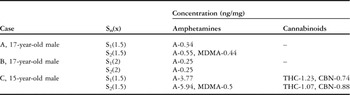
Toxicology of the urine sample collected from Patient A by immunochemistry yielded a negative result; on the other hand, segmental analysis of two 1.5-centimetre-long hair segments demonstrated the presence of amphetamine in the first segment, and amphetamine and 3,4-methylendioxyethylamphetamine in the second. Thus, it was proven that for the period of previous three months, the boy had been taking psychoactive drugs from the amphetamine group. Hair analysis allowed for ruling out the possibility of classifying the symptoms as cardiogenic and directing the diagnostic management towards toxic damage.
In Patient B, urine immunochemistry for the presence of narcotics was positive for amphetamine. Segmental analysis of two 2-centimetre-long hair segments demonstrated amphetamine in both hair strands and thus confirmed the preliminary suspicion that the boy had been taking amphetamine over at least 4 months before the test. Similarly, as in the case of Patient A, hair analysis allowed for indicating toxic damage to the circulatory and nervous systems.
On the other hand, in Patient C, initial immunochemistry of the urine sample was negative for substances of abuse. Nevertheless, a decision was reached to extend the diagnostic panel, and a hair analysis was performed. Both hair segments demonstrated the presence of amphetamine; in addition, the second revealed 3,4-methylendioxyethylamphetamine and agents belonging to the cannabinol group Δ9-tetrahydrocannabinol and cannabinol. Amphetamine and Δ9-tetrahydrocannabinol concentration values in the hair segments were relatively high, which might have indicated frequent use of the psychoactive substances.
High concentration levels of amphetamine, Δ9-tetrahydrocannabinol, and cannabinol in the hair of the patient confirmed the profile of the substances of abuse; on the other hand, hair analysis confronted with negative urine testing may indicate that the observed symptoms could be a consequence of narcotic withdrawal syndrome, possibly associated with the boy's attempt at combating his addiction.
The results of toxicological analysis of hair samples collected from the three adolescent boys are summed up in Table 1.
Toxicological findings in hair of adolescents.

A = amphetamine; CBN = cannabinol; MDMA = 3,4-metylendioxymethamphetamine; Sn(x) = segment of hair close to head skin with length x (centimetres); Δ9-THC = tetrahydrocannabinol
Discussion
In keeping with reports presented in the literature on the subject, addictive usage of amphetamines has various consequences. As a result of the effect of amphetamine and 3,4-methylendioxyethylamphetamine, the addict may develop tachycardia, palpitations, or even typical angina-like chest pain, arrhythmia, hot flushes, sudden elevation of blood pressure, intracerebral extravasation, or cardiovascular collapse. Among neuropsychotic symptoms observed in amphetamine users, various sources report anxiety, sense of mental fatigue, emotional tension, flight of ideas, confusion states, status epilepticus, visual hallucinations, paraesthesia, panic attacks and bouts of aggression, memory disturbances, depressive states, flashbacks, depersonalisation, or derealisation. Abstinence-related symptoms include depression, feelings of uneasiness, and anxiety.Reference Szukalski1, Reference Kłys, Bystrowska, Bujak-Giżycka, Konopka and Rojek4, Reference Kłys, Rojek, Woźniak and Rzepecka-Woźniak5, Reference Berman, O'Neill, Fears, Bartzokis and London8
Amphetamine usage is especially popular among adolescents at school age, as the psychoactive substance evokes a sense of facilitation of learning and memorising abilities. Addiction develops promptly and the adolescent experiences a very powerful need to continue taking the narcotic.Reference Szukalski1, Reference Robson2
Complaints associated with the circulatory system, such as acute chest pain, palpitations, and disturbances in vascular regulation were observed in all the patients described here. Synthetic narcotics, the activity of which is similar to that of amphetamine or 3,4-methylendioxyethylamphetamine, exert a similar potent negative effect on the circulatory system that is associated with cardiac automatism and regulation of blood vessel width. Similarly, as in the case of amphetamine, taking 3,4-methylendioxyethylamphetamine results in arrhythmias, ischaemic foci in the myocardium, or even foci of myocardial infarction with necrosis. Development of aneurysms in the coronary vessels and the aorta has been described, as well as hypertension. These very symptoms resulted in Patient A being referred for invasive examinations – coronarography – to rule out lesions involving the coronary vessels.Reference Alsabagh and Vadstrup7, Reference Brennan, Shurmur and Elhendy10, Reference Smith, Roche, Jausch and Herdson12–Reference Yeo, Wijetunga and Ito14, Reference Diercks, Kirk, Turnipseed and Amsterdam27–Reference Marks29
Amphetamine usage is often accompanied by taking preparations of Cannabis, generally believed to be narcotics of a very low toxicity, although in the past 20 years, several reports have been published on severe cardiovascular complications associated with marijuana smoking and on pathophysiological mechanisms underlying such disturbances. Isolated deaths were also noted, most likely as a consequence of severe cardiovascular disturbances.Reference Bach and Morland17 Drug addicts taking high doses of Cannabis over a prolonged time were observed to demonstrate psychotic problems, constituting a form of extended toxic reaction. It is believed that Δ9-tetrahydrocannabinol is capable of triggering recurrent disease or exacerbating symptoms in individuals with sensitive psyche, or in patients who have earlier suffered from mental diseases. Another problem associated with marijuana usage is represented by chronic apathy, passivity, and laziness, also known as “amotivational syndrome”.Reference Robson2
A paediatric cardiologist is often confronted in his practice with the problem of chest pain in children. Such complaints, however, in the majority of cases do not cause changes in enzyme concentration levels, and the reported pain is not intensified during exercise. On the other hand, myocardial infarctions do occur in children with congenital cardiac defects – for example, abnormal origin of the right coronary artery from the pulmonary trunk, acquired defects – for example, post-inflammatory aortic valve stenosis – myocarditis, congenital hyperlipidemia, or Kawasaki disease. A significant cause of myocardial infarction in children may be arrhythmias in patients with Q wave and T wave interval prolongation syndrome or cardiomyopathy. This is why, apart from the above-mentioned causes, a paediatrician, family physician, or a paediatric cardiologist must always take into consideration a possibility of toxic lesions involving the cardiac and cardiovascular system in every adolescent presenting with unexplained chest pains. As it follows from the present report, in spite of the fact that a urine sample collected on admission may test negative for narcotic substances, hair analysis may help in establishing an appropriate diagnosis, facilitate and accelerate solving narcotics-associated problems in the child. It is even more important in situations in which both the parents and the very patient as a rule maintain that the reason of cardiac complaints does not lie in psychoactive substance abuse.
In the presented group of adolescents hospitalised at Department of Pediatric Cardiology, hair analysis explained the reason underlying the cardiovascular complaints, as well as depression and anxiety-associated disturbances. The available literature does not present reports on segmental hair analysis as applied in diagnostic management of patients presenting with cardiac or depressive or anxiety disturbances in consequence of using psychoactive substances. However, as it follows from investigations carried out in a group of 20 adolescent German nationals – frequent patrons of techno discotheques, who declared sporadic or regular use of amphetamines including ecstasy and speed, determination of amphetamines in segmental hair strands revealed the concentration range of 0.1–4.8 nanograms per milligram, with the values of 3,4-methylendioxyamphetamine ranging from 0.05 to 0.89 nanogram per milligram, 3,4-methylendioxyethylamphetamine – 0.1–8.3 nanograms per milligram, and 3,4-methylendioxyethylamphetamine – 0.12–15 nanogram per milligram;Reference Rothe, Pragst, Spiegel, Harrach, Fischer and Kunkel30 the results presented in this report lie within a similar range of values.
Conclusions
Although the investigations carried out by the present authors were performed in a small number of subjects, they set a direction to be followed in specific cases in paediatric practice. Segmental hair analysis, as compared with screening urine tests, allows for a broader retrospective assessment of the type of abused psychoactive substances. In view of the increasing problem of mind-altering substance abuse, hair analysis should be included in the diagnostic canon used in unclear clinical cases, especially in adolescent patients.