Introduction
Attention deficit hyperactivity disorder (ADHD) is now increasingly recognized as a developmental disorder with impaired cognitive functions (Brown, Reference Brown2006). While cognitive deficits are reported in children with ADHD in many studies, they are found relatively less often in adults with ADHD. As symptoms of attention deficit, disinhibition and deficits of executive functions (such as set shifting and verbal fluency) are prominent in aADHD, neuropsychological research had largely been directed toward these domains of cognitive function (Boonstra, Oosterlanaan, Sergeant, & Buitelaar, Reference Boonstra, Oosterlanaan, Sergeant and Buitelaar2005; Seidman, Reference Seidman2006).
Attention is the cognitive function that allows a person to focus on particular features of the environment at a particular moment in time (Young & Bramham, Reference Young and Bramham2007). In some prior studies, attention was found to be weaker in patients with aADHD compared to healthy controls (Biederman, Mick, & Faraone, Reference Biederman, Mick and Faraone2000; Hervey, Epstein, & Curry, Reference Hervey, Epstein and Curry2004; Schoechlin & Engel, Reference Schoechlin and Engel2005). Psychomotor speed is a related function that is important for several cognitive abilities, but prior studies have produced inconsistent results with some finding it to be intact and others suggesting it to be impaired in aADHD (Epstein, Conners, Sitarenios, & Erhardt, Reference Epstein, Conners, Sitarenios and Erhardt1998; Fischer, Barkley, Smallish, & Fletcher, Reference Fischer, Barkley, Smallish and Fletcher2005; Hervey et al., Reference Hervey, Epstein and Curry2004; Seidman, Reference Seidman2006).
Inhibition functions have been proposed to be a fundamental domain that is impaired in ADHD (Barkley, Reference Barkley1997). One such function, inhibition of prepotent response is a response for which immediate reinforcement is available or with which reinforcement has been previously associated. Another kind of inhibition function is interference control, which is defined as a self-directed response that protects the period of delay from disruption by competing events and responses (Barkley, Reference Barkley1997). Some studies support the idea that these functions are weaker in aADHD patients (Barkley, Murphy, & Fischer, Reference Barkley, Murphy and Fischer2008; Boonstra, Kooij, Oosterlaan, Sergeant, & Buitelaar, Reference Boonstra, Kooij, Oosterlaan, Sergeant and Buitelaar2010; Halperin, Trampush, Miller, Marks, & Newcorn, Reference Halperin, Trampush, Miller, Marks and Newcorn2008) while others found no difference between aADHD and healthy controls (Boonstra et al., Reference Boonstra, Oosterlanaan, Sergeant and Buitelaar2005; Marchetta, Hurks, Krabbendam, & Jolles, Reference Marchetta, Hurks, Krabbendam and Jolles2008).
Set-shifting (e.g., mental flexibility) is an executive function that involves the adaptation of behavior to varying demands in an appropriate manner (Pennington & Ozonoff, Reference Pennington and Ozonoff1996). Some studies have demonstrated that this function is weakened in individuals with aADHD (Boonstra et al., Reference Boonstra, Kooij, Oosterlaan, Sergeant and Buitelaar2005, Reference Boonstra, Oosterlanaan, Sergeant and Buitelaar2010; Seidman, Reference Seidman2006). Verbal fluency is another executive function that involves the rapid production of words in response to specific criteria (e.g., tell all words that begin with letter A) (Strauss, Sherman, & Spreen, Reference Strauss, Sherman and Spreen2006). There have been reports confirming that this function is impaired in aADHD (Boonstra et al., Reference Boonstra, Kooij, Oosterlaan, Sergeant and Buitelaar2010; Woods, Lovejoy, Stutts, Ball, & Fals-Stewart, Reference Woods, Lovejoy, Stutts, Ball and Fals-Stewart2002), while others have not supported such deficits in aADHD (Marchetta et al., Reference Marchetta, Hurks, Krabbendam and Jolles2008).
Research shows that ADHD persist into adulthood (persisters) in approximately half of individuals who were diagnosed with ADHD in childhood, whereas, for some, it remains limited only to childhood (remitters) (Kessler, Adler, Barkley, et al., Reference Kessler, Adler, Ames, Delmer, Faraone, Hiripi and Walters2005b). Consequently, the relationship between cognitive impairment and diagnostic status is an unresolved issue. There is limited research that has compared remitters and persisters in terms of cognitive functions to demonstrate such a relationship (Barkley et al., Reference Barkley, Murphy and Fischer2008; Carr, Nigg, Henderson, Reference Carr, Nigg and Henderson2006; Fischer et al., Reference Fischer, Barkley, Smallish and Fletcher2005; Halperin et al., Reference Halperin, Trampush, Miller, Marks and Newcorn2008). Three studies longitudinally followed participants (Barkley et al., Reference Barkley, Murphy and Fischer2008; Fischer et al., Reference Fischer, Barkley, Smallish and Fletcher2005; Halperin et al., Reference Halperin, Trampush, Miller, Marks and Newcorn2008), but two of the studies were limited as they used different neuropsychological tests at the different follow-up testing time points in the same group (Barkley et al., Reference Barkley, Murphy and Fischer2008; Fischer et al., Reference Fischer, Barkley, Smallish and Fletcher2005). Fischer et al. (Reference Fischer, Barkley, Smallish and Fletcher2005) found no differences in attention-related performances, such as word reading and color identification, between persisters and remitters. However, both groups showed poorer performance relative to the healthy control group. Barkley et al. (Reference Barkley, Murphy and Fischer2008) found that interference control was worse in persisters relative to the remitters and controls. In another longitudinal study, Halperin et al. (Reference Halperin, Trampush, Miller, Marks and Newcorn2008) reported that higher order cognitive functions (e.g., processing memory, inhibition) were more impaired in persisters. Interestingly, the authors found no differences between the persisters and remitters with regard to simple cognitive functions that require less effort (such as simple attention and psychomotor speed). The researchers proposed that these simple cognitive functions represent core symptoms of ADHD. In the only cross-sectional study on this topic, both persisters and remitters exhibited ADHD-related deficits in motor response inhibition, suggesting that this deficit is a core deficit for ADHD. On the other hand, they proposed that attention errors are mainly associated with diagnostic status (Carr et al., Reference Carr, Nigg and Henderson2006).
This study had two aims. First, to investigate which cognitive functions are inefficient in aADHD, and second, to investigate the cognitive differences between persisters and remitters. We hypothesized that aADHD is associated with inefficient cognitive abilities, and that some cognitive inefficiencies continue into adulthood, even in remitters.
Methods
Participants
Biological parents of children diagnosed with ADHD, treated and followed during the study period by the Mayis University School of Medicine, Department of Child and Adolescent Psychiatry comprised the study sample. The rationale for working with parents of these children with ADHD as a sample was to identify a group of adults with high heritability of ADHD, who would comprise both persisters and remitters. Selecting a group of adults referred for aADHD could be biased toward the persisters group.
Inclusion criteria for the parents with aADHD were age under 50, having at least primary school graduation, and formal diagnosis of ADHD in childhood or adulthood. Exclusion criteria included problems leading to difficulty in comprehending information, difficulty in reading, impaired color differentiation, other active Axis I psychiatric disease, mental retardation, history of psychotic disorders, bipolar disorder, or substance abuse disorder, neurological disease that might impair cognitive performance, and use of psychotropic drugs within the previous 6 months.
A healthy control group consisted of the hospital staff and their relatives who were informed about and agreed to participate in the study. Inclusion criteria for the individuals in the healthy control group were age under 50, having at least graduated from primary school, having at least one child above six years of age, and having no children diagnosed with ADHD. The purpose of this last criterion was to decrease the possibility of genetic load in terms of ADHD, and thereby lessen the likelihood of ADHD-related cognitive impairment in the control group. The exclusion criteria for the healthy control group were the same as the study group, except for the lifetime diagnosis of ADHD.
All subjects were informed of the purpose and design of the study and before participation, provided written informed consent. The study was conducted in accordance with the Helsinki Declaration and with approval from the Ethics Committee of Ondokuz Mayis University.
Procedure of Study
The faculty of Child and Adolescent Psychiatry referred 178 parents for study screening, and 134 met requirements to be included in the study. Forty-four parents refused to participate in the study, with the most common reason being inadequate time to complete study procedures. Parents who accepted or refused to participate the study were similar in terms of demographic characteristics.
The study procedures were carried out in three phases on different days. In the first phase, parents underwent a psychiatric assessment with the Turkish version of Structured Clinical Interview for the DSM-IV-TR (SCID-I), that lasted approximately 45 min and was conducted by a psychiatric specialist. In this phase, 16 parents were excluded from the study. The reasons for exclusion included current major depressive disorder (n = 4), current anxiety disorder (n = 6), history of bipolar disorder (n = 3) and substance use disorder (n = 2), and history of neurosurgery (n = 1). Following the first phase, 118 parents were included in the second phase.
At the beginning of the second phase, we used three self-report measures to assess ADHD symptoms. The Turkish version (Öncu, Günay, & Şentürk, Reference Öncu, Günay and Şentürk2005) of the “Wender-Utah Rating Scale-25 (WURS-25),” a 5-point Likert scale based on Utah criteria (Ward, Wender, & Reimherr, Reference Ward, Wender and Reimherr1993) was used to retrospectively evaluate childhood ADHD symptoms. The Turkish versions (Aycicegi, Dinn, & Harris, Reference Aycicegi, Dinn and Harris2003; Doğan, Öncü, Saraçoğlu, & Küçükgöncü, Reference Doğan, Öncü, Saraçoğlu and Küçükgöncü2009) of the Current Symptom Scale (CSS) (Barkley & Murphy, 1998) and Adult ADHD Self Report Scale (ASRS) (Kessler, Adler, Ames, et al., Reference Kessler, Adler, Barkley, Biederman, Conners, Faraone and Zaslavsky2005a) were used to evaluate current adulthood ADHD symptoms. These two self-report scales each contain 18 items based on DSM-IV diagnostic criteria. Higher scores on these scales represent greater ADHD symptoms. These measurements were used only as supportive material at the assessments and were not used for diagnostic purposes. A diagnostic assessment based on DSM-IV was subsequently performed by a psychiatric specialist, which included the adult ADHD diagnostic criteria recommended by Barkley and Brown for the DSM-V (Reference Barkley and Brown2008). These new criteria address problems unique to aADHD and they define “ADHD in remission.” In this phase, retrospective information was mainly obtained from participants, and from some participants’ first degree relatives where possible. The second phase lasted approximately 90 min (30 min to complete forms, and 60 min of clinical assessment). Participants not diagnosed with aADHD, as defined by the ADHD scales, were excluded from the study. At the end of this process, 73 parents were included in the analyses and divided into two groups based on ADHD diagnostic status: remitters (n = 37) and persisters (n = 36).
Finally, in the third phase, parents were administered the short form of the Wechsler Adult Intelligence Scale-Revised (WAIS-R; Crawford, Allan, & Jack, Reference Crawford, Allan and Jack1992), which included the Verbal (Similarities and Comprehension sub-tests), and Performance (Part Assembly and Block Design subtests) composites. We used the Verbal IQ, Performance IQ, and Total IQ scores in the analyses. Neuropsychological tests were administered by a psychologist trained in test administration and blinded to the various groups. The tests were administered equally in three different sittings in both groups to prevent fatigue. The testing sessions lasted approximately 90 min.The data of four participants (two remitters, two persisters) was excluded since they were not available for analysis (excessive values).
The healthy control group (n = 38) underwent the diagnostic procedures described for the study groups; one individual met study criteria for aADHD diagnosis, and two had a current psychiatric diagnosis (major depressive disorder and obsessive compulsive disorder). As a result, data of 35 remitters, 34 persisters, and 35 healthy controls were included in the data analysis.
Neuropsychological Tests
Turkish version of verbal and non-verbal Cancellation Test (CT)
This test was originally developed by Mesulam (Reference Mesulam1985). We used the Turkish version of the test developed and standardized by Karakaş (Reference Karakaş2004) in our study. This test includes four sub-tests (organized letters, organized figures, random letters, and random figures) and each sub-test contains 60 target items. Participants are required to circle the target stimuli.
Continuous Performance Test (CPT)
Originally developed by Rosvold, Mirsky, Sarason, Bransome, and Beck (Reference Rosvold, Mirsky, Sarason, Bransome and Beck1956), the version used in this study was developed by Delongis (Reference Delongis1991). Participants view a computer screen and are required to hit the space bar when they see sequentially presented target stimuli among randomly presented alphabet letters (“Z” followed by “A”); target stimuli constituted 36% of total stimuli. Completion of the test took for 7 min.
Turkish version of Stroop test
The Turkish version is based on the original version developed by Stroop (Reference Stroop1935). The study analyzed the score representing the interference between word reading and color naming where participants are required to name the color of the ink rather than the written word. This interference is observed as an increase in the reaction time and in the errors in incongruent tasks compared to congruent tasks. The Turkish version of this test was developed and standardized by Karakaş (Reference Karakaş2004). The test contains five sub-tests including (1) reading color words that are printed in black, (2) reading colored words that denote different colors, (3) naming the color of colored circles, (4) naming the color of colored neutral words, and (5) naming the color of colored words where color and meaning are incongruent for some of the words. We included all five subtests in our study.
Trail making test (TMT):
We used the test manual developed by Reitan and Wolfson (Reference Reitan and Wolfson1985). The test has two parts. In Part A (TMT-A), the participant is asked to connect numbers (1,2,3 etc.) in, ascending order, and in Part B (TMT-B) to alternate between numbers and letters in consecutive order (1–A–2–B, etc.).
The Controlled Word Association Test (COWAT; Spreen and Benton, Reference Spreen and Benton1997)
The participant is asked to say words beginning with three letters within the span of 1 min. We used the letters K, A, and S in our study.
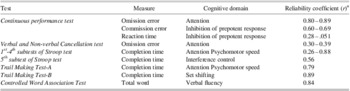
The neuropsychological tests and measured cognitive domains that were analyzed for this study are listed in Table 1.
The neuropsychological tests used and measured cognitive domains

Note. References for reliability coefficients: Strauss et al., Reference Strauss, Sherman and Spreen2006; Karakaş, Reference Karakaş2004.
aTest-retest reliability.
Data Analysis
Significance was set at p < .05 for all analyses. As test score measurements were normally distributed, we used one-way analysis of variance (ANOVA) for continuous variables and χ2 test analysis for categorical variables. Due to equal variances for the post hoc analyses, we used Tukey's test. Excessive values (defined as values that deviated more than three standard deviations from the upper or lower edge of the box in a box plot) were excluded from analysis.
Effect size index (as partial eta-squared, η 2 ) for one-way ANOVA test was computed by using a general linear model procedure. For this index, cutoffs of 0.01, 0.06 and 0.14 were, by convention, interpreted as small, medium, and large effect sizes, respectively.
Results
Socio-demographic Characteristics, Self-report Tests (WURS, CSS, ASRS), and Intelligence Test Scores
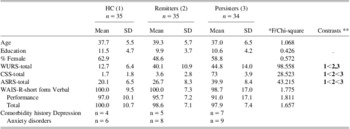
No significant differences were found among the three groups in terms of age, sex, years of education and WAIS-R scores (verbal, performance, total).
The control group had lower scores than the other two groups in all ADHD self-report tests (p < .05 for all tests). The persisters had higher ASRS and CSS scores than the other groups (p < .05). No significant difference was found in WURS scores between the persisters and the remitters, though both were higher than the controls (p > .05) (Table 2). In addition, the persisters had higher total ASRS and CSS scores than the remitters (p < .05).
Comparison of sociodemographic characteristics and psychometric test and intelligence scores among groups

Note. The contrasts in bold had a statistical significance level of p < 0.05, the sign “>” in contrasts is used to mean “have higher scores.”
WURS = Wender-Utah rating scale; CSS = Current symptom scale; ASRS = Adult ADHD self-report rating scale; WAIS-R-SF = Short form of the Weschler Adult Intelligence Scale-Revised.
* Chi-square test or one-way analysis of variance (ANOVA) test.
**Post hoc Tukey test.
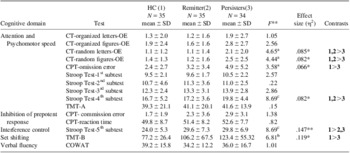
Comparison of neuropsychological test scores among groups

Note. The contrasts in bold had a statistical significance level of p < .05 and the sign “>” in contrasts is used to mean “exhibits a better performance.”
CT = Cancellation Test; CPT = Continuous Performance Test; TMT = Trail making test; COWAT = Controlled word association test; OE = omission error; CE = commission error; η 2 = partial eta-squared; partial eta-squared for analysis of variance (ANOVA) results.
*Medium effect size.
**Large effect size.
ap < .05.
bp < .01.
cp < .001.
Neuropsychological Tests
A significant difference was found among the three groups in tests of attention; omission error scores of CT-random letters ([F (2−102) = 4.65], η 2 = 0.085), of CT-random figures ([F (2−102) = 4.44], η 2 = 0.082); omission error score of CPT ([F (2−103) = 3.58], η 2 = 0.066) and the 4th subtest score of Stroop Test ([F (2−102) = 4.44], η 2 = 0.082). On three of these four measures, persisters showed worse performance than both healthy controls and remitters, while in omission error score of the CPT, there was a significant difference only between persisters and healthy controls. We found no significant difference among groups in other tests or subtests (omission error scores of CT-organized letters and of CT-organized figures scores; 1st, 2nd, and 3rd subtest scores of Stroop Test; TMT-A score) that measure attention functions. Also, we found no significant difference between groups in most tests and subtests (with the exception of 4th subtest score of Stroop Test) that evaluate psychomotor speed function.
Considering the tests that measure inhibition function, groups showed similar performance on tests of inhibition of prepotent responses (commission error of CPT and reaction time of CPT). Although both persisters and remitters underperformed relative to healthy controls on the measure of interference control (5th subtest of the Stroop Test) ([F (2−103) = 8.69], η 2 = 0.147), no significant difference was found between persisters and remitters.
Regarding other executive function tests, performance on the TMT-B was different among patient and control groups ([F (2−101) = 6.81], η 2 = 0.119), but there was one difference between groups on the COWAT.
Overall, attention, interference control, and set shifting functions were weaker in patients with aADHD (persisters) compared to healthy controls, whereas no difference was found for psychomotor speed, inhibition of prepotent response, and verbal fluency abilities. On the other hand, specifically, interference control scores differentiated those with ADHD diagnosis at any time (remitters or persisters) from the healthy control group. All other tests and sub-tests significantly differentiated the persisters from the other two groups.
Discussion
We aimed to investigate those cognitive functions in aADHD, specifically attention, psychomotor speed, inhibition (inhibition of prepotent response and interference control), set-shifting, and verbal fluency.
Attention was measured with several neuropsychological tests in our study. The aAHDH group exhibited worse performance compared to the healthy control group on some measures (omission error scores of CT-random letters, of CT-random figures, omission error score of CPT and 4th subtest score of Stroop Test), which showed that attention is impaired in aADHD. These tests have been reported separately in earlier studies with the consensus that attention is indeed impaired in aADHD (Epstein et al., Reference Epstein, Conners, Sitarenios and Erhardt1998; Schoechlin & Engel, Reference Schoechlin and Engel2005; Seidman, Reference Seidman2006; Young & Gudjonsson, Reference Young and Gudjonsson2005). On the other hand, the relative impairment in attention functions was not observed on some of the sub-tests. This may be due to the less cognitive effort required for completion of certain tests (e.g., 1st, 2nd, and 3rd subtests of Stroop test and TMT-A). In this case, it can be interpreted that attention function weakness in aADHD may be limited to more effortful tests. In terms of psychomotor speed, our results did not differentiate aADHD patients from the healthy control group in a consistent manner in all tests and sub-tests that measured this function. This finding is consistent with prior literature that suggested that psychomotor speed is not impaired in aADHD (Hervey et al., Reference Hervey, Epstein and Curry2004). However, our study did not include a “pure” measure of psychomotor speed (e.g., finger tapping test), as such, this finding requires further confirmation.
A common finding in aADHD is impaired inhibition of prepotent response (Barkley et al., Reference Barkley, Murphy and Fischer2008; Boonstra et al., Reference Boonstra, Kooij, Oosterlaan, Sergeant and Buitelaar2005, Reference Boonstra, Oosterlanaan, Sergeant and Buitelaar2010; Hervey et al., Reference Hervey, Epstein and Curry2004). In our study, however, we found no difference between patients with aADHD and the healthy control group with regard to proponent response ability. Interestingly, with regard to interference control, we found that the patient groups exhibited worse performance compared to the healthy control group on the 5th subtest of the Stroop, which is designed to measure a different aspect of inhibition. Interference control deficit, which some authors suggest is one of the basic ADHD deficits, is not consistently reported in adult patients (Barkley et al., Reference Barkley, Murphy and Fischer2008; Boonstra et al., Reference Boonstra, Kooij, Oosterlaan, Sergeant and Buitelaar2005, Reference Boonstra, Oosterlanaan, Sergeant and Buitelaar2010; Hervey et al., Reference Hervey, Epstein and Curry2004; Marchetta et al., Reference Marchetta, Hurks, Krabbendam and Jolles2008). One important reason for this is the different measures and calculations of this deficit (Van Mourik, Oosterlaan, & Sergeant, Reference Van Mourik, Oosterlaan and Sergeant2005). The set-shifting function also differentiated the aADHD group from the healthy control group. This finding is in agreement with prior findings (Boonstra et al., Reference Boonstra, Kooij, Oosterlaan, Sergeant and Buitelaar2005, Reference Boonstra, Oosterlanaan, Sergeant and Buitelaar2010; Hervey et al., Reference Hervey, Epstein and Curry2004). Set shifting ability requires alternating attention from one task to another, inhibition of the previous attentional focus, and initiating orientation to the new focus. Thus, set-shifting is a kind of interference control that is similar to 5th subtest of Stroop test, and can be regarded as an indicator of mental flexibility capacity (Boonstra et al., Reference Boonstra, Oosterlanaan, Sergeant and Buitelaar2005). Unlike some previous studies, in our study individuals with aADHD and healthy controls showed similar verbal fluency ability. Collectively, our results suggested that attention, interference control, and set shifting are compromised in aADHD.
Halperin and Schulz (Reference Halperin and Schulz2006) suggested that ADHD originated from early-phase-associated neural dysfunctions, and that as the symptoms of disease decrease, some cognitive deficits may remain relatively static throughout the adult lifespan. In our study, we compared patients whose ADHD diagnosis continued into adulthood (persisters), those in whom it did not (remitters), and the healthy control group. We aimed to identify the cognitive differences between persisters and remitters. Our analysis showed that, similar to the healthy control group, remitters exhibited better performance on measures of basic attention functions compared to persisters. On the other hand, both ADHD groups (persisters and remitters) exhibited worse interference control function compared to healthy controls. Fischer et al. (Reference Fischer, Barkley, Smallish and Fletcher2005) found no differences between persisters and remitters in terms of their cognitive abilities. The results of a next assessment of the same patients showed that interference control was poorer in persisters compared to the other two groups (remitters and healthy controls) (Barkley et al., Reference Barkley, Murphy and Fischer2008). However, our results suggest that both ADHD groups (persisters and remitters) exhibited worse performance in measure of interference control compared to healthy controls. Similar to our study, Barkley et al. (Reference Barkley, Murphy and Fischer2008) used the Stroop Test and the mean age of the study sample was 27. In contrast to our results, Halperin et al. (Reference Halperin, Trampush, Miller, Marks and Newcorn2008) found that cognitive functions requiring less effort were poorer in both persisters and remitters relative to controls. Therefore, they suggested that these cognitive functions were central deficits in ADHD. In that study, the CPT and Stroop Tests were used and the mean age of the study sample was 18, but no comparisons were made between the remitters and persisters. Consequently, whether there is actually a difference between these groups in terms of interference control remains unclear.
Perhaps the main difference between prior studies and ours is that our study was cross-sectional, whereas prior studies were longitudinal. While the main objective of those studies was to show the course of cognitive functions as children with ADHD matured, our purpose was to establish the difference in cognitive functions between persisters and remitters.
In the studies by Fischer et al. (Reference Fischer, Barkley, Smallish and Fletcher2005) and Barkley et al. (Reference Barkley, Murphy and Fischer2008), the participants were diagnosed with ADHD in childhood and later followed and treated. They accommodated their diseases by persisting in acquiring follow-up over years into adulthood, and appeared to have adapted to a certain extent and benefitted from treatment. However, our participants consisted of parents of children diagnosed with ADHD. These parents were individuals who had not sought treatment for their symptoms and were untreated before entering the study. Their symptoms of ADHD might have different properties and severity. In this respect, our study population is different from those in other reports in terms of both the effects of treatment on disease and disease characteristics. Thus, this factor may be another reason for the difference between the findings of previous studies and our results.
Another difference is that while participants in those longitudinal studies (Barkley et al., Reference Barkley, Murphy and Fischer2008; Fischer et al., Reference Fischer, Barkley, Smallish and Fletcher2005; Halperin et al., Reference Halperin, Trampush, Miller, Marks and Newcorn2008) and follow-up evaluations at the end of the process were in early adulthood (respectively, 21, 27, 18 years), our participants (average 38) were more advanced in age. There may be differences in terms of adaptation to disease between an 18-year-old persister and a 38-year-old persister. On the other hand, it is possible that a 40 year old remitter in our study could have been considered a persister if assessment had been done 20 years ago (at the age of 20). An 18-year-old persister in the study by Halperin et al. (Reference Halperin, Trampush, Miller, Marks and Newcorn2008) could become a remitter 20 years later, as well. Therefore, persisters (or remitters) in those studies and our persisters (or remitters) may have different properties and severity of ADHD. According to current information, it is unclear whether there is a critical age after which someone with ADHD will be permanently a persister or remitter. In this respect, it is critical to determine the age of the person at time of diagnosis and future assessments as this factor may play a role in the discordant study results.
A prior study (Carr et al., Reference Carr, Nigg and Henderson2006) with a similar design to ours showed that both persisters and remitters exhibited ADHD-related deficits in motor response inhibition, suggesting that this deficit is a core deficit for ADHD. The authors proposed that attention errors are most associated with diagnostic status, a finding that is similar to our study results. However, since the mean age of patients in that prior study was 24, age again is a confounding factor when compairing study results.
Our second hypothesis was that some cognitive deficits continue in remitters despite that an individual is no longer considered to have the ADHD diagnosis. The results of our study showed that more basic cognitive deficits are aligned with ADHD diagnostic status, whereas the interference control deficit, regardless of diagnostic status, is an existing deficit in remitters. An interference control-related deficit may be a core deficit that is an etiological cause for ADHD and a vulnerability factor for this disorder.
Our study has some advantages in that we were able to control for complicating factors (active comorbid psychiatric or neurological disease, use of psychotropic drugs, education level, age, intelligence level) that could have affected the neuropsychological tests results. Another strength of this study is that we used contemporary and more specific criteria to diagnose aADHD, which increased our diagnostic reliability.
Limitations
There are various limitations to our study. The main limitation concerns the retrospective analysis of the ADHD diagnosis. Although a psychometric self-report tool (WURS-25) with a high childhood predictability was used and anamnesis was taken from close relatives whenever possible, there is still a difficulty involved with the accurate analysis of childhood behaviors for various reasons (e.g., failure or bias of memory). The second limitation is that there was a historical diagnosis of depressive disorder or anxiety disorder in some participants, even if mood disorder was not actively present. We were unable to evaluate the likely long-term effects of these psychiatric disorders on current cognitive functions. However, reducing this limitation is that we would expect that there would be an approximately equal distribution among all groups. Third, since the great majority of diagnoses were of the compound type, no sub-type differentiation was performed for the aADHD group. Therefore, it might be more accurate to evaluate our results as being particular to general aADHD. Lastly, the small size of the study sample may have imposed a statistical limitation, in addition to possible Type I error due to multiple analyses.
Conclusions
Our study design permitted analysis regarding two issues that are important to the understanding of ADHD as a lifespan, developmental disorder. Our data demonstrated that attention, interference control and set shifting functions are impaired in aADHD, and that these weaknesses may be identified only on relatively more effortful tasks. We also found that persisters and remitters have different cognitive deficit profiles. The deficit related to interference control is independent from the diagnostic status. For this reason, it can be thought that impairment in interference control-associated attention may have a causal effect for ADHD, and thus may be a core deficit independent of diagnostic status (as persister or remitter).
It remains unclear why in some cases ADHD is limited to childhood, whereas in others it persists into adulthood. A cognitive predictor for the persistence of ADHD can be determined with neuropsychological studies that take into account the subtype of ADHD. Future studies with larger samples may provide clarifying information about this topic.
Acknowledgments
We thank Associate Professor Carol L. Armstrong (from The Children's Hospital of Philadelphia, University of Pennsylvania School of Medicine) and Assistant Professor Shawn M. McClintock (from UT Southwestern Medical Center, Dallas, TX and Columbia University/New York State Psychiatric Institute, New York, NY) for English editing of manuscript. We also thank all residents in Department of Psychiatry, Ondokuz Mayis University, School of Medicine, Samsun, Turkey, who kindly provided the outpatient facilities, where the study took place. All authors disclose that they do not have any personal or other relationships with other people or organizations within three (3) years of beginning the work submitted that could inappropriately influence, or be perceived to influence, their work. There are no conflicts or financial disclosure for all authors.