Introduction
Recent scholarship of comparative authoritarianism has underscored the importance of political parties as the institutional foundation of regime resilience. Institutionalized mech- anisms of succession, leadership selection, and rent distribution alleviate internal conflicts and facilitate power-sharing among the party elites. Collective decision-making bodies allow the party elites to better monitor the actions of the paramount leader, preventing the lat- ter's abuse of power which undermines regime stability. In short, party institutions help the dictator credibly commit to sharing power with other elites and avoid the regime's internal break-ups – the primary cause of authoritarian downfall.
Broadly speaking, the theory of credible power-sharing in one-party states has two sets of observable implications. First, regimes that have established formal party institutions should survive longer and/or deliver better socioeconomic outcomes than those deprived of such institutions. This implication stems from the claim that the peaceful coexistence of ruling elites will bolster regime survival and overall performance. Second, in regimes with robust party institutions, the paramount leader should claim a significantly smaller share of spoils such as political offices and financial resources than in the scenarios where he exercises unlimited power. If formal institutions are indeed effective in enhancing power-sharing, the dictator should be constrained to share benefits of power with regime insiders.
While the first set of implications has received a substantial amount of treatment in the literature, empirical studies of the second are few and far between. This is unfortunate because the constraining effects of party institutions constitute an essential part of the theory's causal mechanism. The asymmetry in the literature is partly due to the diffculty of measuring the degree to which the dictator's power is circumscribed, especially in cross-national quantitative studies. Current efforts have mostly focused on the existence of formal institutions without capturing how these institutions actually affect the inner workings of leadership selection and decision-making. Indeed, in non-democratic regimes where political elites are prone to manipulate formal institutions, it would be a significant overlook to take the binding effects of institutions for granted.
The concept of neopatrimonialism is especially useful for analyzing the gap between pre- scribed institutional rules and actual operation of the political system. At its core, neopatri- monialism describes hybrid regimes where the formally constructed political institutions are permeated by the informal logic of patrimonialism. Under this mixture, some political and administrative decisions follow fixed procedures, rules, and laws, while others are dictated by various kinds of informal rules. The delicate balance between the legal–rational form of dominance and patrimonial rule has major implications for the dynamics of institutionalized power-sharing in authoritarian regimes. In so far as leadership discretion, personal depen- dence, and patronage twist the logic of formal institutions, power-sharing between regime elites becomes precarious and unsustainable.
In light of the current imbalance in the authoritarian literature, this paper examines the potency of formal institutions in constraining elite behavior in a single case of one- party autocracy – China. We offer a close look at the appointment of provincial leaders that functions under the formal institution of cadre management. In the post-Mao period, the ruling Chinese Communist Party (CCP) has developed a collective leadership system that would supposedly vest the power of appointing provincial leaders in the Politburo and its Standing Committee. The emphasis on deliberation and collective decision-making is meant to prevent the abuse of power by a despotic ruler, which wreaked havoc on the political system during the Mao era. The power-sharing arrangement, however, is constantly threatened by the paramount leader's personal agenda to pack provincial leadership with his loyal supporters.
We argue that the degree to which the CCP's paramount leader is constrained in distribut- ing important provincial posts to his key supporters provides a stress test of the regime's power-sharing system. Using a unique dataset of provincial leadership composition from 1992 to 2014, we test several hypotheses that shed light on the extent of the paramount leader's appointment power. Our empirical analysis reveals that China's appointment sys- tem exhibits the features of a neopatrimonial polity: the paramount leader manages to boost his own position by providing favorable treatment to key supporters, but the formal arrangement of collective decision-making seems to constrain rampant reward of patronage that would unsettle the balance of power among the regime's top elites.
The close analysis of the CCP's appointment system at once corroborates the fundamen- tal insight of authoritarian power-sharing and exposes the difficulty of capturing the inner workings of authoritarian politics with broad, cross-national indicators of regime type. On the one hand, the party institutions and procedures developed during the reform period have set the broad parameters of personal power. These formal institutions have likely enhanced transparency and predictability in an oligarchic decision-making system and contributed to authoritarian stability. On the other hand, the paramount leader's impulse to bypass or manipulate formal procedures in distributing important positions to his personal followers remains strong. The existing measures of regime type in comparative authoritarianism, how- ever, can barely account for the subtle influences of personal dependence and informal groups that lie beneath the formal institutions. Recognizing that cross-national, quantitative stud- ies inevitably need to use proxy variables that simplify the details of individual countries, our findings nonetheless underscore the importance of coding regimes in a way that best captures the true relevance of formal institutions in political life. We therefore advocate for the usefulness of single-country studies that carefully examine how informal rules might re- place, undermine, or reinforce the operation of authoritarian institutions (Grzymala-Busse, Reference Grzymala-Busse2010).
The rest of the paper will proceed in the following order. The next section reviews the literature linking authoritarian power-sharing institutions to regime stability. It shows that the field can greatly benefit from empirical analyses that demonstrate the constraining effects of formal institutions on elite behavior. The third section discusses the formal institutions set up by China's ruling Party to check the paramount leader's appointment power and formulates several hypotheses with the purpose of gauging the efficacy of these institutions. The fourth section describes data sources and various details of the empirical strategy, and the fifth section presents the key findings. The final section concludes the paper.
Party institutions and credible power-sharing
The relationship between party institutions, credible power-sharing, and regime resilience has recently drawn considerable attention from students of authoritarian politics. This line of inquiry was in part inspired by the intellectual contribution of Barbara Geddes, who was among the first to investigate how different features of authoritarian regimes led them to break down in systematically different ways (Geddes, Reference Geddes1999, Reference Geddes2003). Classifying non- democratic polities into personalist, military, single-party, and hybrid regimes, and using data of authoritarian survival during the post-war period, Geddes finds that single-party autocracies tend to survive longer than other regime types. The longevity of single-party regimes, however, was attributed less to any institutional arrangement than to the self- interest of party cadres.
The implications of party institutions for elite power-sharing were taken more seriously in later studies. To minimize the threat of being deposed by other members of the ruling coalition, dictators must credibly promise to exercise self-restrain and share substantial power with the potential rivals. This promise of power-sharing will only be credible when the dictators delegate some authority of appointment and policy-making to the impersonal rules of the political party (Magaloni, Reference Magaloni2008). Moreover, the party's decision-making bodies such as politburos, councils, and committees increase the transparency and predictability of elite interactions, making it easier for the allies to detect and punish the dictator's unilateral power grab (Svolik, Reference Svolik2012). Put differently, the formal party institutions promote the capacity of collective actions by the regime's insiders that serve to constrain the opportunistic behavior of the dictator (Gehlbach and Keefer, Reference Gehlbach and Keefer2012).
Thus, recent theoretical developments in comparative politics make a compelling case that strong institutions can stabilize authoritarian rule by moderating elite conflicts. Empirically, previous studies have shown that the existence of formal institutions is associated with regime resilience or desirable socioeconomic outcomes. Magaloni's classification of au- tocracies, for instance, designates regimes as single-party dictatorships if access to political office is mainly controlled by dominant parties rather than military or royal families (Magaloni, Reference Magaloni2008: 731), while Svolik distinguishes among ‘authoritarian regimes that ban political parties, sanction the existence of only a single party, or allow multiple parties to operate’ (Svolik, Reference Svolik2012: 186). Both studies find that single-party regimes survive longer than other types of autocracies. Gehlbach and Keefer (Reference Gehlbach and Keefer2012) measure the party's organizational ca- pacity with various indicators, showing that more institutionalized ruling parties tend to attract more private investment. Morse (Reference Morse2015) demonstrates that African authoritarian regimes with robust party organizations can win elections comfortably without resorting to massive fraud or repression.
By comparison, less attention has been devoted to examining whether formal party in- stitutions indeed limit the discretion of authoritarian rulers. When such limits do exist, we should observe that the share of regime spoils claimed by the paramount leader is smaller than in the case where these limits are absent. Evidence of the constraining effects of formal institutions is highly valuable, considering that in non-democratic regimes actual elite be- havior is often shaped more by informal rules than formal regulations (Böröcz, Reference Böröcz2000; Helmke and Levitsky, Reference Helmke and Levitsky2004; Grzymala-Busse, Reference Grzymala-Busse2010). The way most authoritarian regimes operate in practice is best characterized by neopatrimonialism, a concept that describes the coex- istence of formally constructed institutions and patrimonial types of authority relationships (Engel and Erdmann, Reference Engel and Erdmann2006). Under neopatrimonial rule, there is no shortage of codified procedures, official chains of command, and legal constraints on political behavior, but the actual functioning of the system tends to revolve around personal patronage or competition between informal groups.
Bratton and Van de Walle (Reference Bratton and Van de Walle1994), for example, show that in many African countries loyalty is maintained through personal dependence rather than ideology or law. There, the essence of politics is the reward by public officials of persona favors in the form of public sector jobs, projects, and contracts, making a mockery of formally prescribed official duties. Scott (Reference Scott1972) paints a similar picture of contemporary Thailand where, despite the existence of a National Assembly and citizen associations, the unit of political competition remained ‘the personal clique organized according to the patron-client model’ (p. 59). The imperatives of clique leaders to distribute ‘high posts, financial opportunities, and government-controlled privileges’ often clashed with formal regulations and bred rampant corruption (p. 61).
In short, the field of comparative authoritarianism has made some major breakthroughs in identifying the empirical association between formal party organizations and regime re- silience, but it remains unclear whether this association can be explained by successful power- sharing promoted by institutional constraints. Despite Geddes’ exhortation that researchers should classify authoritarian regimes based on their ‘actual rules for selecting leaders and making allocative decisions rather than formal designations of regime type’ (Geddes, Reference Geddes2003: 72–3), it is difficult to ascertain the congruence between ‘actual rules’ and formal institutions in cross-national analysis. As Pempsky points out, institutions are attractive to students of comparative politics because they are ‘relatively easy to identify, making sophisticated cross-national studies feasible’ (Pepinsky, Reference Pepinsky2014: 649). Demonstrating the causal effects of in- stitutions on elite behaivor, though, is a challenging undertaking, and single-country studies that convincingly link institutions to power-sharing dynamics can help illustrate the foun- dations of broader theoretical claims. In this spirit, we delve into the appointment system of China's ruling party to examine whether key political decisions in authoritarian regimes – in our case, the distribution of valuable provincial positions – are controlled by formal rules to contain the dominance of individual leaders and further the regime's collective goals.
Appointment and elite power-sharing in China
Personnel appointment as a Janus-faced institution
In every regime, access to influential government office is synonymous with political power and often invites cut-throat competition between different institutional actors. The importance of political appointments is amplified in authoritarian countries for the simple fact that most valuable positions are subject to top–down assignments rather than elec- toral competition. In the case of China, it is a consensus among scholars that the ruling Communist Party's monopoly over personal appointment constitutes the linchpin of its po- litical control and success with decentralized authoritarianism (Manion, Reference Manion1985; Burns, Reference Burns1994; Chan, Reference Chan2004; Landry, Reference Landry2008). The CCP's control over leadership selection is nothing less than all-encompassing: nearly every position with any substantive importance in the Party bu- reaucracy, government, military, public-owned financial and corporate institutions, and mass organizations are included in the Party-managed ‘Job Title List’ (Burns, Reference Burns1994).
In this paper, we analyze the appointments of key provincial positions to gauge the efficacy of formal rules on successful authoritarian power-sharing. The provincial posts are placed in the center of analysis for two main reasons. First, since China embarked on market-oriented reform in the late 1970s, the central government has entrusted a great deal of policy-making and implementation responsibilities to the provincial leaders (Oi, Reference Oi1992; Montinola et al., Reference Montinola, Qian and Weingast1995). The devolution of authority, which touched upon the control over state-owned enterprises, the ability to attract foreign investment, and the retention of local revenues, was a conscious decision by the center to elicit the support of provincial leaders for reform (Shirk, Reference Shirk1993). During the post-Mao period, provincial leaders have taken center stage in China's political landscape, playing a critical role in the country's economic and social development (Cheung et al., Reference Cheung, Chung and Lin1998). Second, provincial-level administrative experience has become an increasingly important stepping-stone for entering the national leadership. Ambitious CCP officials have to first broaden their experience and prove their governing skills before being slated for the most important central posts (Li, Reference Li2008). The distribution of top provincial positions, therefore, has major implications for the dynamics of regime resilience in China.
Managing the selection, promotion, and transfer of provincial officials plays a critical role in the CCP's overall strategy to govern the country. For our purposes, it is important to recognize the cadre management system as a Janus-faced institution that can be used to serve both regime-wide interests and the agenda of individual CCP leaders. From the regime's perspective, the power to appoint provincial officials accomplishes several political and developmental purposes. Firstly, tight grip over officials’ career mobility can prevent the emergence of independent power bases that might challenge the center's authority. When officials are routinely transferred to positions in unfamiliar provinces, they are denied the opportunity of forming close ties with local elites and building their own personal followings. As such, provincial leaders will be less inclined to side with local interests at the expense of central priorities (Huang, Reference Huang2002). Another goal of the personnel system is to train Party cadres by exposing them to diverse local environments and responsibilities. Much like a royal prince whose grooming will require serving in different regions of the kingdom and across multiple functional areas, CCP's leaders-in-the-making are also expected to be equipped with broad experiences. Finally, provincial positions can be allocated to reduce regional inequalities that has grown to dangerous proportions under the reform era. By transferring officials from the center and economically advanced provinces to less developed regions, new ideas and successful governing experiences might be disseminated to achieve more equitable development (Eaton and Kostka, Reference Eaton and Kostka2014).
A discussion of the cadre management policy that treats the CCP leadership as a unitary actor and considers only the regime's collective interests, however, will be incomplete and even naive. For individuals sitting at the top of the Party hierarchy, the frequent reshuffing of provincial leaders offers a rare opportunity to expand their personal influence through the distribution of much-coveted positions. Political clientelism, defined as the distribution of public resources in the form of public jobs and economic rents by the patron to consolidate personal rule, is often considered a central aspect of neopatrimonial rule (Snyder, Reference Snyder1992; Bratton and Van de Walle, Reference Bratton and Van de Walle1997; von Soest, Reference von Soest2010). Because leadership positions in the provinces come with enormous power and various perquisites, top CCP rulers have strong temptations to reward these posts to individuals with whom they share particularistic ties. In Chinese politics, clientelist ties with patrons are usually formed on the basis of kinship, native place, educational background, or common work experience (Nathan, Reference Nathan1973; Dittmer and Wu, Reference Dittmer and Wu1995). By rewarding provincial posts to people whose loyalty is not based on ideologies or laws but on intimate personal connections, the patrons can secure better responsiveness from their local agents; more importantly, they can mobilize more robust support from the provinces in their power struggles with rivalling elites.
The power of appointment thus poses significant challenges to authoritarian power- sharing: the dictators face the tempting option to personalize power by packing key posts with their loyal supporters (Slater, Reference Slater2003: 88–9). In post-Deng China, the concern of overly concentrated power has largely centered on the General Secretary of the Central Committee, the official paramount leader of the CCP.Footnote 1 When the General Secretary's ability to domi- nate the selection of provincial leaders surpasses other ruling elites by a large margin, the oligarchic form of rule runs the risk of, in the words of Svolik, degenerating into personal dictatorship. Indeed, each of the three CCP General Secretaries that took power after the 1989 Tiananmen Incident has been accused of rewarding important positions to their clients. Jiang Zemin, the CCP's top leader from 1989 to 2002, promoted a large number of officials who had advanced their careers in Shanghai, where Jiang served from 1985 to 1989 as mayor and then Party Secretary (Li, Reference Li, Naughton and Yang2004b; Miller, Reference Miller2010: 1). Jiang's successor, Hu Jintao, is said to have consolidated his power by promoting leaders of the Communist Youth League (CYL), a CCP-sponsored mass organization that Hu led between 1982 and 1985 (Li, Reference Li2005b). Xi Jinxing, who took over from Hu in 2012, seems to have implemented personnel policies that favor officials with whom he developed close personal contacts during his long tenures in Fujian and Zhejiang provinces (Li, Reference Li2014). The question, then, is whether the CCP's formal rules can curb the distribution of patronage by the Party's paramount leader and maintain a working balance within the ruling coalition.
Party institutions and the sharing of appointment power
During the Mao period, institutional constraints on the power of the Party's paramount leader were all but non-existent. Authority was ascribed not to any institution but to Mao as a charismatic individual, and purges and mass campaigns were arbitrarily employed to remove Mao's real and imaginary rivals. After Mao's passing, the CCP leaders undertook numerous reforms to avoid the recurrence of absolutist dictatorship and disastrous policies that led to the Great Famine in the late 1950s and the Cultural Revolution. At the heart of these reforms was the consolidation of the Politburo Standing Committee, composed of five to nine members, as the Party's highest collective decision-making body. In addition to the General Secretary, the Standing Committee would include the heads of the major hierarchies in the political order – the government apparatus, the legislature, umbrella united front body, and so forth (Miller, Reference Miller2011: 4). The Standing Committee began to meet regularly during the reform period and, according to Party norms, major decisions were to be made based on consultation and deliberation. Formal procedures were established that required the General Secretary to report the work of the Standing Committee to the full Politburo, enhancing vertical accountability among the Party elites. Overall, the structure and process of the Standing Committee reflected the goal of ‘reinforcing consensus-based decision-making under oligarchic collective leadership’ and ‘limiting the ability of the general secretary to acquire dictatorial powers over the rest of the leadership’ (Miller, Reference Miller2011: 5).
With regard to the appointment of provincial leaders, formal rules have also been enacted to ensure that personnel decisions will be conducted according to set criteria and procedures. During the post-Mao period, the Party center has promulgated several authoritative docu- ments to regulate the promotion, transfer, and removal of cadres. These regulations require that the selection of provincial officials must follow a complicated process of bottom-up rec- ommendation, organizational vetting, deliberation, and final decision-making. They have also provided that officials should serve with term limits, be promoted one level at a time, and be regularly transferred across localities and functional departments.Footnote 2
More important for limiting the personnel authority of individual leaders is the require- ment that provincial-level appointments should be made collectively by the Politburo Stand- ing Committee. In this discussion, we focus on the appointment to the CCP's Provincial Standing Committees (PSC), a decision-making body composed of ten to fifteen most impor- tant provincial officials. These PSC members are on the ‘job title list of cadres managed centrally’, meaning that the authority to appoint and remove them rest with the CCP's Central Committee (Burns, Reference Burns1994). Because the full Central Committee only meets once or twice every year, the Party Constitution delegates its day-to-day responsibilities to the Politburo and its Standing Committee.Footnote 3
According to the CCP's personnel regulations, when the Standing Committee holds a meeting to discuss the appointment of provincial leaders, an official from the Central Orga- nization Department will first introduce the candidate(s)’ information gathered in the initial nomination and screening stages. The Standing Committee members would then deliberate before taking a simple majority vote to decide on the appointment. During the deliberation, each member should be given ‘sufficient time to be briefed of the candidate(s)’ information and fully express his or her views’.Footnote 4 Then, the members present must clearly state their positions of approving, disapproving, or postponing the appointment decision.Footnote 5 Throughout the entire process, the General Secretary does not seem to have more formal influence than other Standing Committee members except the privilege of convening and presiding over the meeting.Footnote 6
The robustness of these formal institutions depends on whether the General Secretary can manipulate existing procedures to favor his close associates. Because the selection of important CCP leaders still operates behind a thick curtain of secrecy, there are many aspects of the appointment process that remain outside the public's scrutiny. For example, we know very little about how the candidates for provincial posts are generated except that some bargaining usually occurs between the central and provincial authorities (Burns, Reference Burns1994: 471). If the General Secretary exerts disproportionate influence on the selection of candidates, he will have significant edge over other Standing Committee members prior to the meeting. We also know next to nothing about the proportion of appointments that actually go through the deliberation and voting process prescribed in formal regulations, or whether votes were cast anonymously to save the members from openly defying the General Secretary. All these unknown details of the selection process could allow the paramount leader to circumvent the constraints posed by formal rules and procedures.
Although we cannot directly observe CCP leaders’ compliance with decision-making rules, the actual outcomes of personnel appointment can shed important light on the vitality of Party institutions. If the influence of patrimonialism within the CCP is such that the General Secretary can radically expand his personal power by sidestepping or manipulating formal institutions, then his clients should be favored systematically in the distribution of PSC positions. Conversely, if the consensus-based, collective decision-making process can effectively check the unilateral power of the paramount leader, the dominance of his loyal supporters should be trivial or non-existent. In that case, the danger of personal dictatorship is minimized and robust power-sharing is maintained.
Specifically, if the General Secretary can promote the influence of his key supporters with little constraint, two implications might be observed. First, during the General Secretary's term in office the number of PSC posts occupied by his personal supporters should expe- rience a substantial increase. This seems to be the most blunt and yet effective channel of asserting one's dominance: the more provincial leaders that share personal ties with the paramount leader, the greater his power. A corollary of this proposition would be that, once a General Secretary steps down, the presence of his supporters in provincial leadership should start to decline. Second, compared with other officials, supporters of the General Secretary should be assigned to more ‘important’ provinces, either in an economic or political sense. By controlling provinces that are critical for extracting tax revenue or maintaining political stability, the paramount leader can tighten his grip on power without increasing the sheer number of appointments.
Thus, to the extent that the balance of power within the ruling coalition is vulnerable to personal control over political institutions, empirical data of provincial appointment should be consistent with the following hypotheses:
H1: During tenure as the CCP's General Secretary, the number of PSC positions taken by his supporters should increase significantly.
H2: During tenure as the CCP's General Secretary, the likelihood that his supporters are appointed to economically important provinces will increase.
H3: During tenure as the CCP's General Secretary, the likelihood that his supporters are appointed to politically important provinces will increase.
Data and method
A formidable challenge to the testing of the foregoing hypotheses is the identification of key supporters of the Party's paramount leaders. Recall that the influence of the CCP General Secretary depends upon a group of clients who share personal ties with the patron, owe their career advancement to the patron, and can be counted on to rally behind the patron during a power struggle. Formed around patron–client relationships, these groups are highly informal and usually cut across boundaries of bureaucratic units. In the absence of formally organized groupings as the basic unit of political competition, Chinese leaders tend to build their support groups based on previous professional ties. In this paper, we focus on one particular paramount leader, Hu Jintao, and his supporters to gauge the degree to which personal power is restricted by power-sharing institutions.
Taking office in 2002, Hu Jintao served as the CCP's General Secretary for a decade and stepped down in 2012 after finishing his second term. Like his predecessors, Hu owed his political success to a robust support network forged during a rich political career that spanned decades. Leadership experiences in Guizhou province, Tibet, and the Central Party School allowed Hu to make broad political contacts and cultivate an informal constituency (Ewing, Reference Ewing2003). The backbone of Hu's support network, however, consisted of officials who rose through the ranks of the Chinese Communist Youth League (CCYL). With a hierarchical structure that resembles the CCP, the CCYL was designed as a ‘reserve army’ that prepared young activists for Party leadership positions. Hu's long connection with the CCYL dated back to 1982–1985, when he served as the secretary and later First Secretary of the CCYL's central secretariat. After Hu became a Politburo Standing Committee member in 1992, managing the CCYL was also part of his portfolio (Wang, Reference Wang2006: 105). It is widely believed that officials with CCYL backgrounds constituted the pillar of Hu's influence, and that ‘the further advancement of these CCYL cadres who have become provincial leaders and the consolidation of Hu's power are closely interrelated’ (Li, Reference Li2002: 1).
Building on previous works on the so-called ‘CCYL faction’ (Li, Reference Li2002, Reference Li2004a, Reference Li2005a; Wang, Reference Wang2006), we operationalize Hu's key supporters as those who have served posts in the CCYL's central or provincial apparatus (hereafter CCYL officials). These officials are considered an approximation of Hu's support network because they either had direct working contacts with Hu when the latter headed CCYL or identified Hu as a patron who would distribute benefits to those hailing from the youth organization. Cadres who only have CCYL experiences below the provincial level are too distant from the organization's core to be considered Hu's supporters.
Hu Jintao and his supporters provide an ideal case for analyzing empirically the extent of the paramount leader's power. Although the supporters of top national leaders are always scattered across a wide array of geographical and bureaucratic units, Hu's support network comes closest to displaying some organizational boundaries. The common usage of the term ‘CCYL faction’ by China watchers and regime insiders has probably strengthened the sense amongst CCYL officials that their fortunes are closely linked. Thus, the identification of Hu's followers based on CCYL connections is reasonable and relatively straightforward. Moreover, Hu's retirement in 2012 allows researchers to compare power dynamics during his tenure to the years before and after he served as the General Secretary. Observing changes in provincial leadership before, during, and after Hu's reign is critical for making inferences about the General Secretary's influence.
Previously, scholars have relied heavily on shared working experience to identity the per-sonal ties between Chinese politicians: a paramount leader's followers are those who used to be the leader's colleagues in a certain bureaucratic unit (Shih et al., Reference Shih, Adolph and Liu2012; Keller, Reference Keller2014; Ma, Reference Ma2016). This approach, sensible as it might be, does not suit the purpose of this study. Recall that we intend to evaluate the degree of the General Secretary's power by tracking how his personal supporters have fared before, during, and after his tenure. If we define Hu's supporters as his former colleagues, then an increased presence of Hu's supporters in provincial posts could indicate Hu's growing influence, but it could also be due to the co-hort effects. In other words, most of Hu's former colleagues are around the same age and might have entered the prime of their life cycles during Hu's ten-year reign. After 2012, this cohort might have departed the scene simply because they reached retirement age. The approach used in this paper, which measures Hu's supporters based on associations with a permanent organization, can arguably better separate the General Secretary's influence over appointment from the cohort effects. Over the studied period, the CCYL as a Party-sponsored mass organization has not seen drastic changes in its core features or role in the political system. Therefore, it is most likely the shifting clout of Hu Jintao as a patron, rather than the changing status of a formal organization, that explains any major fluctuation in the number of provincial leaders with CCYL background.
As noted earlier, this paper focuses on the appointment of the General Secretary's supporters to the principal provincial decision-making body, the Provincial Standing Committees (PSC). The provincial equivalent of the Politburo Standing Committee, the PSC brings together 10 to 15 most powerful provincial leaders, such as the Provincial Party Secretary, the Governor, the heads of the most important functional departments, and so on. We collected data on PSC membership in all of China 31 provincial units from 1992 to 2014. After obtaining the rosters of PSC members from the provincial yearbooks and supplementary materials, we read the CV of each PSC member to determine whether he/she has CCYL experiences at the provincial level or above to be coded as a Hu's supporter. The panel dataset includes about 700 provincial-year observations. The uniqueness of our dataset lies in its coverage of the entire PSC while other datasets of China's local leadership usually include only the Party Secretary and head of government (Governor, Mayor, etc.). We started the analysis in the early 1990s because prior to this point, revolutionary veterans like Deng Xiaoping exerted enormous influence even without holding formal positions. It is only after those senior figures gradually left the scene that General Secretaries became genuine paramount leaders and formal rules designed to enhance collective leadership became increasingly institutionalized.
The main dependent variable of the analysis is the proportion of PSC members accounted for by CCYL officials (propCCYL). In addition to examining the presence of Hu's supporters within the PSC, it is also informative to assess the sway that the General Secretary holds over the two most important PSC posts: the Provincial Party Secretary and Governor. These two figures are accorded full-ministerial rank in the national administrative system, whereas other PSC members are only ranked at vice-ministerial level. We use the proportion of Provincial Party Secretaries and Governors accounted for by CCYL officials (propCCYL_key) as a measure of Hu's control over the most critical provincial positions. Finally, CCYL officials differ in their centrality to Hu's support network: those who have served in the CCYL's central apparatus are probably more at the heart of the network than CCYL officials at the provincial level. Therefore, we use the number of PSC members with central CCYL experiences (CCYL_center) as a third measure of Hu's personnel power.Footnote 7
Regression analysis of panel data is used to explain the temporal and cross-provincial variations in the proportion of CCYL officials. To test hypothesis 1, we generate a dummy variable that equals one for the period during which Hu Jintao served as the General Secretary (2002–12) and zero otherwise. The hypothesis will receive support if the coefficient for the dummy variable is significantly positive. To avoid spurious correlation, we control for some basic features of the provinces such as total population and level of economic development, with GDP per capita serving as a proxy for the latter. The analysis also takes into account the special political statuses of some provincial units. Four metropolises – Beijing, Tianjin, Shanghai, and Chongqing – have been granted the status of Centrally Administered Municipality (CAM), which places them under the direct control of the central government.Footnote 8 Being selected as a CAM signifies a city's pivotal role in China's overall development and national security (Su and Yang, Reference Su and Yang2000), so much so that the Party Secretaries of these four megacities are guaranteed a seat in the Politburo, a privilege denied to most other provincial leaders. Moreover, five provincial units (Inner Mongolia, Xinjiang, Guangxi, Ningxia, and Tibet) have been designated as ‘autonomous regions’ owing to the concentration of a particular ethnic minority group. The delicate issue of ethnic tension and separatism means that these minority regions must be managed with additional astuteness and caution. Because the Youth League's work is heavily associated with organizational and propaganda matters, it is possible that CCYL officials are well-prepared for the governance of politically important provinces. Therefore, we create a dummy variable that indicates whether a provincial-unit is a CAM and another that indicates whether it is a autonomous region.
Before 2016 there did not seem to be a central regulation specifying the size of PSC, although the number of PSC members usually ranges from 10 to 15. Considering that CCYL officials might get more representation when there are more spoils to distribute, we control for the number of posts in each PSC. Finally, to account for the possibility that the proportion of CCYL officials has a tendency to increase over time due to unobserved factors, a trend variable is included that takes the value of 1, 2, 3 . . . up to the last year for which we have observation.
Hypotheses 2 and 3 state that one's assumption of the office of General Secretary will increase the likelihood that his supporters are appointed to provinces with great economic and political importance, respectively. A province's GDP per capita in a given year is used as a proxy for its economic weight. The political influence of a province can be indicated by whether it is a CAM or autonomous region (for reasons outlined above), and by its total population. The assumption is that the General Secretary can maintain a tighter grip on national power when his supporters are controlling CAMs, autonomous regions, or provinces with larger populations. To test the second and third hypotheses, we interact the dummy variable ‘Hu era’ with different indicators of a province's economic and political importance (GDP per capita, CAM, autonomous regime, population size), generating four interaction terms. Positive and statistically significant coefficients for the interaction terms will provide evidence in favor of hypotheses 2 and 3.
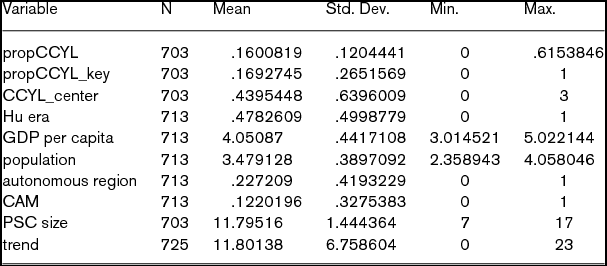
The summary statistics for key dependent and independent variables are presented in Table 1.
Summary statistics

Empirical analysis
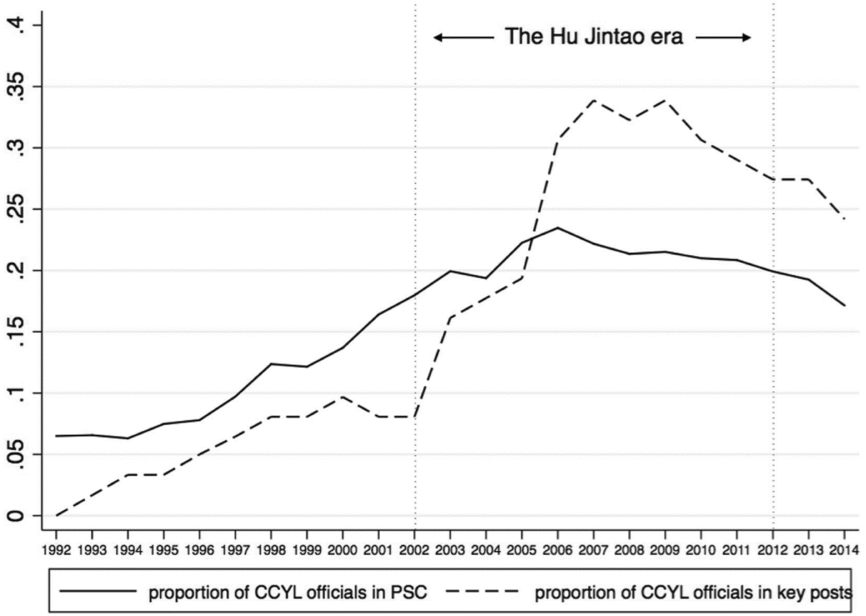
In this section, we test the three hypotheses regarding the General Secretary's upper hand in influencing provincial appointments. To the extent that these hypotheses receive support from empirical data, it would suggest that formal power-sharing institutions are ineffective in constraining the paramount leader, and vice versa. To begin with, we examine whether during Hu's tenure as the General Secretary, the number of provincial positions taken by CCYL officials increased significantly. Figure 1 shows the changing influence of CCYL officials in provincial leadership posts from 1992 to 2014, with the solid line representing the average proportion of PSC members that are CCYL officials, and the dotted line representing the average proportion of Provincial Party Secretaries and Governors that are CCYL officials. With regard to the entire PSC body, it can be seen that the proportion of CCYL officials has followed a trend of gradual increase since as early as 1995, peaked in 2006 when roughly one in four PSC members came from CCYL background and stagnated for a few years before experiencing a period of decline between 2012 and 2014. This trend is partly consistent with hypothesis 1 because the proportion of CCYL officials increased from around 18% to 23% during Hu's first term and started to dip as Hu prepared to leave o ffice. The interpretation of the data is complicated, however, by the fact that the rise of CCYL officials did not coincide with Hu's taking over as the General Secretary in 2002. Rather, Hu's supporters had begun to claim an increasing number of PSC posts when he was serving as the widely accepted heir apparent between 1992 and 2012. Quite possibly, Hu was already exerting substantial personnel influence as he waited patiently to take over, and this influence further expanded after he assumed the paramount leadership.
CCYL officials in provincial leadership positions: 1992–2014

Tracking the movement of the dotted line, which displays the proportion of CCYL officials among the top two provincial positions, gives a similar picture with some unique features. Like the PSC as a whole, these two critical posts had been increasingly assigned to CCYL officials up until 2007, with the trend reversing since the last few years of Hu's tenure. What distinguishes the dotted line from the solid line, however, is that its increase after Hu's coronation and decrease during the waning years of his reign have both occurred at a much faster rate. Thus, CCYL officials accounted for about 8% of Provincial Party Secretaries and Governors across China in 2002, but five years into Hu's tenure the share soared to 34%. The decline of CCYL representation was similarly abrupt: between 2009 and 2014 the share changed from 34% to 24%.
Viewing these two trends together sheds additional light on the extent to which a politician's personnel power is elevated by the position of CCP's General Secretary. In 1992, Hu Jintao was installed by revolutionary veterans as a leading candidate to become the future paramount leader. As the heir apparent and a member of the Politburo Standing Committee overseeing personnel affairs, Hu was already able to influence provincial appointments in favor of his supporters, but this influence was largely limited to secondary positions in the PSC as the top two positions were still controlled by the then General Secretary Jiang Zemin (Nathan and Gilley, Reference Nathan, Gilley, Nathan and Gilley2003; Wang, Reference Wang2006). It was only when Hu succeeded Jiang as the paramount leader in 2002 that his supporters started to receive the rewards of top positions in great numbers, which explains the precipitous rise of the dotted line after 2002. Likewise, the decline of Hu's power was more conspicuous in the share of the top positions than ordinary PSC members, indicating that Hu's successor wasted little time in assigning his supporters to Provincial General Secretaries and Governors.
An alternative explanation for the growing number of CCYL officials in provincial lead ership points to the cadre renewal policy initiated by Deng Xiaoping in the 1980s, which involved a systematic search for younger, better educated officials to replace an older generation of Party veterans (Manion, Reference Manion2014; Nathan and Gilley, Reference Nathan, Gilley, Nathan and Gilley2003). Since a major mission of the CCYL is to train future CCP leaders, it could be hypothesised that the increasing CCYL representation in the provinces during the studied period was simply the continuation of a trend of cadre renewal that started in the 1980s rather than a result of Hu's personal power. Although we do not have access to full PSC personnel data of the 1980s to test this hypothesis, the identities of the Provincial Party Secretaries and Governors are publicly available and can be used for a tentative examination of this alternative theory.
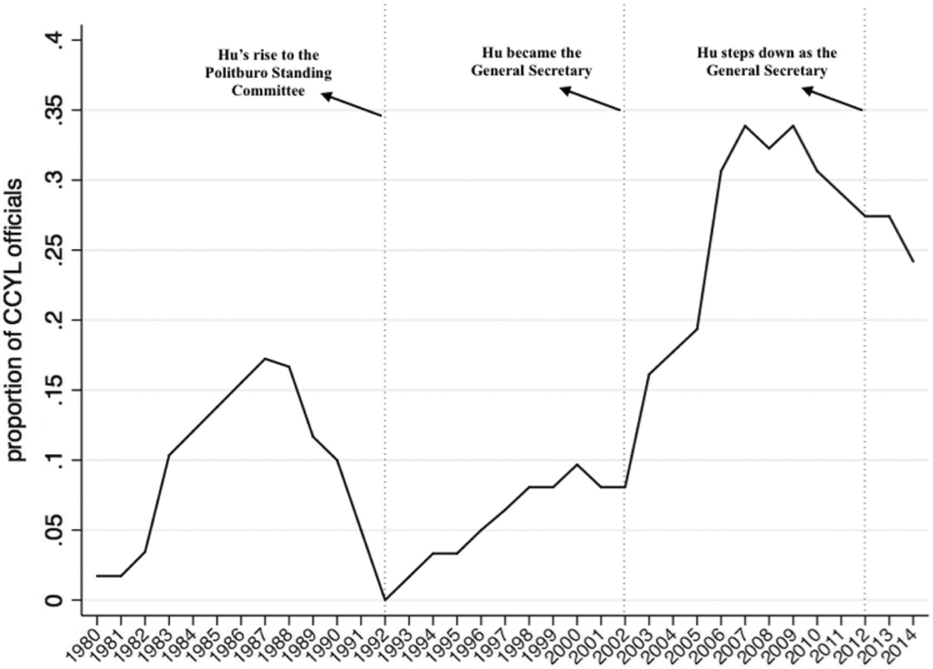
Figure 2 displays the the average proportion of CCYL officials among the top two provincial posts. Consistent with the cadre renewal thesis, from 1980 to 1987 there was indeed a steady increase of CCYL officials in provincial leadership, but the trend was reversed abruptly between 1987 and 1992. The reversal could be plausibly attributed to the purge of Hu Yaobang in 1987, another CCP General Secretary with CCYL background, and his supporters in the following years. It is hardly a coincidence that the revival of the CCYL officials’ fortunes started in 1992, the same year Hu ascended to the Politburo Standing Committee. While the gradual rise of CCYL representation between 1992 and 2002 could reflect a natural organizational resurgence after a heavy purge, the dramatic rise (and fall) of CCYL officials at the beginning (and the end) of Hu's tenure as the General Secretary cannot be explained without resorting to Hu's personal influence. In short, the cadre renewal hypothesis can at best partly account for the temporal trend of CCYL influence, which seems deeply tied to the the shifting status of individual patrons.
CCYL officials among Provincial Party Secretaries and Governors: 1980–2014

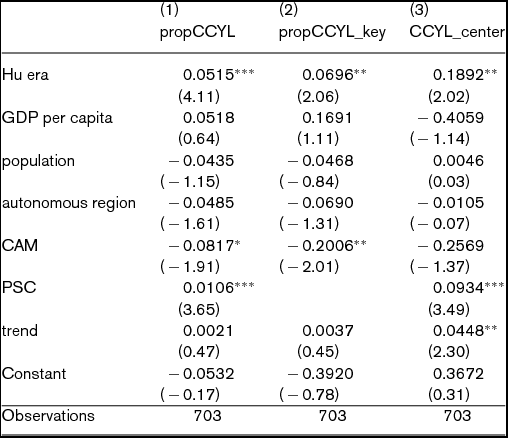
Results of a systematic test of hypothesis 1 using multivariate regression are presented in Table 2. Models 1–3 correspond to the three different dependent variables: the proportion of CCYL officials in the PSC, the proportion of CCYL officials among the top two positions, and the number of PSC members with central CCYL experiences. The analysis uses random effect models to account for unmeasured factors associated with each cross-sectional unit, and robust standard errors clustered around provinces are reported. As shown in the table, coefficients for the variable ‘Hu era’ are significantly positive across the models, lending support to hypothesis 1. Holding other factors constant, Hu's status as the General Secretary is expected to increase the proportion of CCYL officials in the PSC by 0.05 in a given year. Meanwhile, the larger coefficient for ‘Hu era’ in model 2 is consistent with the earlier observation that CCYL representation in the top two positions is more sensitive to the beginning and end of Hu's tenure. Regarding the control variables, it is noteworthy that there are significantly fewer CCYL officials serving the top two positions in CAMs than in other provinces (model 2), suggesting that Hu's supporters are generally disadvantaged when more critical slots are distributed.
Explaining variation in the presence of CCYL officials in the provinces

t statistics in parentheses
* p<0.10, ** p<0.05, *** p<0.01
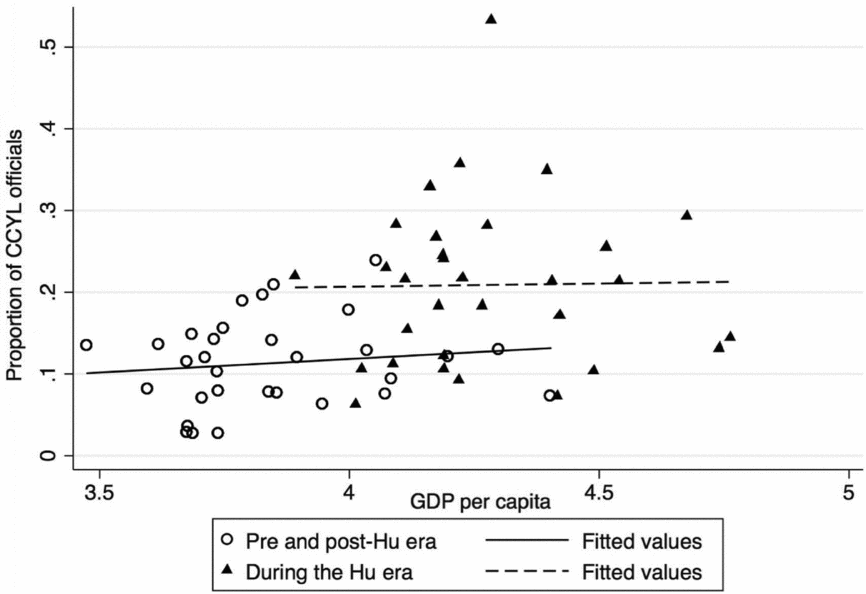
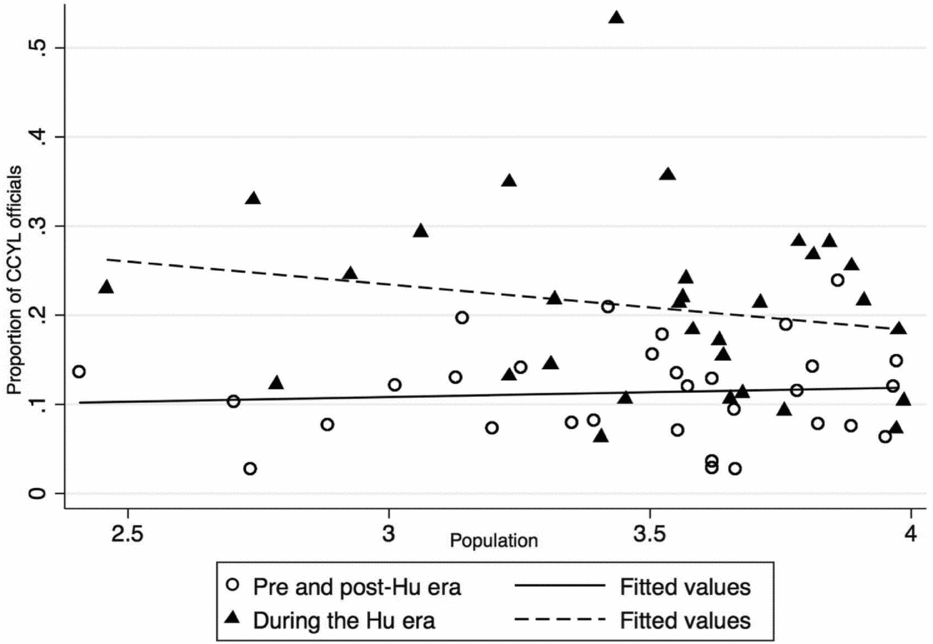
Moving on to test hypotheses 2 and 3, we first provide a bivariate analysis to see if Hu's supporters became more likely to receive posts in more wealthy and populous provinces during Hu's tenure. Figure 3 plots the relationship between the average GDP per capita of each province and its average proportion of CCYL officials in the PSC, with the triangles representing observations from the Hu era and the circles representing those from the pre-Hu and post-Hu years. Clearly, there is no strong relationship between a province's economic weight and the proportion of CCYL officials in either period, contradicting hypothesis 2 that supporters are more likely to land in wealthy provinces during his tenure. In a similar manner, Figure 4 plots the proportion of CCYL officials against the population of each province. Here a curious pattern is observed: whereas the two variables are largely independent of each other during the pre- and post-Hu years, there exists a negative relationship between the outcome variable and a province's population size during the Hu era. Against the prediction made in hypothesis 3, during Hu's tenure as the paramount leader, the likelihood that his supporters are appointed to politically important provinces actually declined. Put differently, although CCYL officials received more PSC posts under Hu's watch, most of the increase occurred in provinces with less political importance as measured by population size.
Relationship between GDP per capita and proportion of CCYL officials

Relationship between population and proportion of CCYL officials

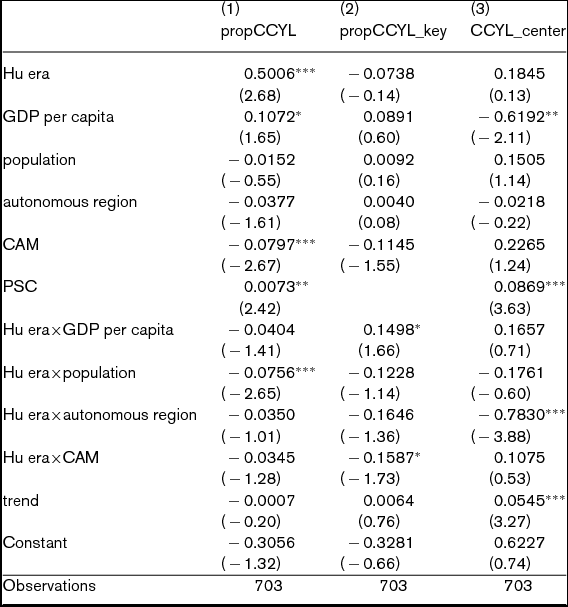
Table 3 reports results from three models that include all the interaction terms, which are designed to test hypotheses 2 and 3. As mentioned earlier, the coefficients for the four interaction terms need to be positive and statistically significant to lend support to the two hypotheses. Starting with the interaction between the Hu era and GDP per capita, its coefficients fail to reach statistical significance in the models, confirming the patterns observed in Figure 3. Consistent with the visual illustration in Figure 4 but going against hypothesis 3, the interaction term between the Hu era and population has a significantly negative coefficient in model 1. Meanwhile, across the three models Hu's tenure has no significant effect on the likelihood that CCYL officials are appointed to autonomous regions, and it actually reduces the number of CCYL official with central experiences that are assigned to CAMs (model 3). Overall, hypotheses 2 and 3 receive little support from empirical evidence: Hu's tenure as the official paramount leader did little to bolster his supporters’ chances of acquiring the most valuable provincial posts.
Explaining variation in the presence of CCYL officials in the provinces

t statistics in parentheses
* p<0.10, ** p<0.05, *** p<0.01
Taken as a whole, the evidence paints a complicated picture of the degree to which the General Secretary faces constraints on his personnel power. On the one hand, the position of General Secretary clearly confers substantial power on its occupant to increase the number of provincial posts awarded to his loyal supporters. While Hu's ability to promote CCYL officials was mainly limited to ordinary PSC members during his decade-long apprenticeship as heir apparent, his control over the top two positions surged once he took the throne. On the other hand, the likelihood that Hu's supporters were assigned to important provinces did not rise during his reign; indeed, the largely negative coefficients of the interaction terms show that such likelihood dropped instead under the Hu era. In other words, although Hu used the General Secretary's prerogative to insert more supporters to leadership positions, it is in those provinces with less economic and political clout that he managed to exert most influence. On this evidence, we can infer that Hu's colleagues in the Politburo Standing Committee and other Party elites were vigilant in preventing CCYL officials from dominating the heavyweight provinces. It is therefore appropriate to describe the General Secretary's status as ‘constrained supremacy’: the paramount leader can boost his own position by providing favorable treatment to his supporters, but formal power-sharing institutions seem to have constrained rampant reward of patronage that would unsettle the balance among the regime's top elites.
Conclusion
The global spread of one-party autocracies has sparked a heated discussion about the effect of party institutions on authoritarian durability. In this debate, a prevailing school of thought contends that parties promote equitable distribution of power among the ruling elites, reducing the danger of destructive, destabilizing conflicts among regime insiders. It is argued that impersonal decision-making rules embedded in authoritarian parties afford different factions an opportunity to participate in the political process; regular meetings of collective bodies makes it easier for the ruling elites to monitor and contain the dictator's unilateralism. The sense of collective security encourages power-holders to pursue their interests within the party organizations rather than challenge the regime from without.
But can one-party regimes really establish institutional rules to meaningfully constrain the dictators? The policy-making process in authoritarian countries is widely known to be highly informal, with the supreme leaders often bypassing laws and regulations to benefit their inner circle. Existing analyses tend to focus on the empirical association between the presence of party organizations and regime resilience, whereas the actual effects of formal institutions on the dynamics of power-sharing are concealed behind a thick curtain. In this paper, we utilized an in-depth study of China's appointment system to examine whether the CCP's collective decision-making rules can rein in the paramount leader's personal agenda of patronage distribution.
Our analysis reveals a complicated relationship between formal institutions, informal rules, and the distribution of political influence that was rarely captured in previous studies. Once a leader becomes the CCP's General Secretary, his ability to assign provincial posts to loyal supporters grows substantially. As the Party's formal rules confer no greater amount of decision-making power to the General Secretary than other members of the Politburo Standing Committee, it can be reasonably inferred that the paramount leader has accomplished this feat by manipulating or circumventing existing procedures. Meanwhile, the rise of CCYL officials is less evident in those provinces with great political or economic influence, suggesting that the General Secretary's hand is tied by formal personnel procedures and collective deliberation inside the Politburo. On this evidence, it is possible that other ruling elites recognize the need to grant the ‘first among equals’ a certain amount of supremacy, as long as the General Secretary's power is exercised within tolerable limits.
In a seminal work on elite power-sharing in China, Victor Shih and his coauthors show that the power of the CCP's General Secretary is not absolute, as the number of his factional supporters within the Central Committee is often closely matched by that of his main rival (Shih et al., Reference Shih, Shan and Liu2010). My study complements this finding in two ways. First, Shih's methodology rests on the assumption that the General Secretary's putative successor is also his main rival, which may not hold during the entirety of the Party's history. My approach, which tracks the temporal and cross-regional variation in the influence of the paramount leader's supporters, does not make this strong assumption. Second, while Shih's paper examines the personnel of the Central Committee, my focus on the provincial officials significantly increases the number of observations and allows for an assessment of the General Secretary's power based on regional variation.
While institutional constraint on despotic power is a question of great substantive im portance, empirical studies on this topic must confront enormous methodological challenges and it is important to be forthright about this article's limitations. To begin with, while the ability to measure a complex concept such as the distribution of power with greater accuracy is a distinctive strength of single-country analyses, these studies cannot explore important cross-sectional variations in national-level institutions and how these variations affect political outcomes. Once researchers identify a universal measurement of the dictator's share of power that reaches an acceptable level of validity, cross-national inquiries should be conducted to produce more generalizable knowledge regarding the effects of formal institutions on authoritarian power-sharing.
For students of Chinese politics, the focus on one paramount leader inevitably raises questions about the generalizability of the main findings: will the characterization of constrained supremacy hold for Hu's predecessor Jiang Zenmin and, more importantly, the current paramount leader Xi Jinping? Since his rise to power in 2012, there have been numerous signs showing that Xi might be attempting to consolidate personal power at the expense of existing Party norms of collective rule (Economy, Reference Economy2014; Mizner, Reference Mizner2016). The claim that China is moving towards personal rule, however, is currently more based on sensational news headlines than hard evidence, and a systematic approach similar to the one used in this article will shed much light on whether power-sharing norms can survive into the third decade of the post-Deng era. Suppose that convincing evidence is found that Xi's assertion of authority has rendered institutional checks largely ineffective, the findings of this paper will still serve as a useful starting point for analyzing why hard-won progress in institutionalization could be easily reversed by a political strongman. Hopefully this study will constitute an early step in a series of fruitful research on party institutions and power-sharing in authoritarian regimes.
About the author
Qingjie Zeng is an assistant professor at the Department of Political Science, Fudan University. His research focuses the cadre management system in China and the politics of hegemonic party regimes around the world. His works have been published or are forthcoming in The China Quarterly, The Journal of East Asian Studies, China, an International Journal, and Chinese Political Science Review.