INTRODUCTION
The current methodological study reexamined the second language (L2) knowledge type that nonnative English speakers draw on to perform grammaticality judgment tests (GJTs). Previous factor-analytic validity studies on GJTs employed elicited imitation (EI) and/or oral narrative (ON) tasks as measures of implicit knowledge (IK). Their authors concluded that manipulating GJTs’ time conditions or the grammaticality of the sentences renders them distinct measures of IK and explicit knowledge (EK). Several studies yielded findings indicating that untimed GJTs measure EK, whereas timed GJTs measure IK (e.g., Bowles, Reference Bowles2011; R. Ellis, Reference Ellis2005; R. Ellis & Loewen, Reference Ellis and Loewen2007). It has also been shown that, regardless of time condition, participant responses to different GJT stimulus types (i.e., grammatical and ungrammatical sentences) tap into IK and EK, respectively (Gutiérrez, Reference Gutiérrez2013).
Unlike previous studies, the current study employed two new psycholinguistic measures of IK. More specifically, EI and ON were replaced by a word-monitoring task (WMT) and a self-paced reading task (SPRT), as these have been shown to be more valid measures of IK (Jiang, Reference Jiang2004, Reference Jiang2007; Jiang, Novokshanova, Masuda, & Wang, Reference Jiang, Novokshanova, Masuda and Wang2011; Suzuki, Reference Suzuki2015; Suzuki & DeKeyser, Reference Suzuki and DeKeyser2015). For this reason, it was hypothesized that, by including WMT and SPRT measures in a test battery, the results and conclusions pertaining to the construct validity of GJTs would be different from previous studies. In addition, a metalinguistic knowledge test (MKT), a well-established measure of EK, was included in the current study.
Through the comparison of the performance of learners on the WMT, SPRT, and MKT measures, as well as on several types of GJTs, it was possible to ascertain whether manipulating time conditions and/or grammaticality in GJT sentences can transform GJTs into distinct measures of IK and EK.
To foreshadow the results and conclusions yielded by this research, the aforementioned comparisons, carried out through confirmatory factor analysis (CFA), revealed that GJTs are too coarse to be measures of IK, and that manipulating their time conditions and sentence grammaticality does not render them distinct measures of IK and EK. Rather, we concluded that, as behavioral measures such as GJTs are not pure measures of IK or EK, on a continuum from being more explicit to more implicit, GJTs fall closer to the explicit end.
To provide the background to the current study, the following section situates the significance of the current study within a broader context of SLA research. It explains why more rigorous validation studies on GJTs are needed. Then, a critical review of previous validation studies on GJTs is presented. This section motivates the research questions and design of the current study. Finally, to justify the use of the WMT and SPRT in the current study, a section on measuring IK through online processing tasks is presented.
Explicit and Implicit Knowledge and the Interface Issue
The constructs of IK and EK are central to SLA theory construction and evaluation. There is a consensus that SLA draws on both implicit and explicit learning mechanisms (Bley-Vroman, Reference Bley-Vroman1991; DeKeyser, Reference DeKeyser, Doughty and Long2003; N. C. Ellis, Reference Ellis2005; R. Ellis, Reference Ellis2004), which in turn may result in IK and/or EK (Williams, Reference Williams, Ritchie and Bhatia2009). Explicit knowledge is knowledge we are consciously aware of, whereas IK is the knowledge that we have but are not aware of (DeKeyser, Reference DeKeyser, Long and Doughty2009; Hulstijn, Reference Hulstijn2005; Williams, Reference Williams, Ritchie and Bhatia2009). These two kinds of knowledge also differ in the extent to which one can or cannot verbalize them (R. Ellis, Reference Ellis2004, Reference Ellis2005). Our conscious access to EK allows us to verbalize it; Footnote 1 however, because IK is beyond awareness, it cannot be verbalized (DeKeyser, Reference DeKeyser, Long and Doughty2009).
It is currently believed that IK underlies the ability to use a L2 fluently and confidently; therefore, development of IK should be the ultimate goal of SLA (N. C. Ellis, Reference Ellis1993; R. Ellis, Reference Ellis2005; Hulstijn, Reference Hulstijn and Robinson2001). Footnote 2 Although there is solid evidence showing that implicit and explicit representations are neurologically distinct (Paradis, Reference Paradis2009; Ullman, 2011), the interaction between the two and how they influence each other are still subjects of controversy. In SLA research, this controversy is referred to as the interface issue. Central to the interface issue is to what extent explicit learning and instruction impact implicit learning and the development of IK (N. C. Ellis, Reference Ellis2011). There are three positions with regard to the interface issue—the noninterface, strong-interface, and weak-interface positions.
The noninterface position is often associated with Krashen (e.g., Reference Krashen and Ellis1994), who contended that conscious learning about L2s and subconscious acquisition of L2s are two completely different phenomena that result in distinct sources of knowledge (EK and IK, respectively) with no interface between them. According to this position, subconscious acquisition dominates L2 performance, learning can never convert into acquisition, and conscious learning can only be used as a monitor (editor) for performance. Proponents of the noninterface position believe that EK and IK are located in different areas of the brain and are thus accessed by different processes (Paradis, Reference Paradis and Ellis1994). Footnote 3
The strong-interface position, which is usually associated with DeKeyser (e.g., Reference DeKeyser and Williams2007), offers an opposite view. His strong-interface position should be understood within the models of skill acquisition, such as ACT-R (Anderson & Lebiere, Reference Anderson and Lebiere1998). Within these models, a distinction is made between declarative and procedural knowledge. According to DeKeyser (Reference DeKeyser, Long and Doughty2009), “Declarative knowledge is knowledge THAT something is,” and procedural knowledge is “knowledge HOW to do something” (p. 121). According to skill-acquisition models, learners first develop a declarative encoding, whereby extensive practice is required to ensure that declarative knowledge leads to procedural knowledge. Further practice leads to automatized knowledge, which may not require any conscious processing (DeKeyser & Criado, Reference DeKeyser, Criado and Chapelle2012). This strong-interface position implies a causal relationship between declarative knowledge and proceduralization and automatization of the knowledge. In other words, EK forms a prerequisite for the generation of IK (Segalowitz & Hulstijn, Reference Segalowitz, Hulstijn, Kroll and de Groot2005).
The main claim of the weak-interface position is that EK does not have a causal relationship with IK and only triggers or speeds up the implicit learning process, which subsequently leads to the generation of IK. For example, N. C. Ellis (e.g., Reference Ellis2005, Reference Ellis2008) contended that EK contributes indirectly to the acquisition of IK by promoting some implicit learning processes. According to the author, EK can make relevant linguistic features salient, thus enabling learners to notice them and recognize the gap between the input and the linguistic knowledge they possess (N. C. Ellis, Reference Ellis1994). N. C. Ellis (Reference Ellis2008) further suggested that explicit and implicit processes work in tandem and that there is a dynamic interaction between them for consolidating IK.
The interface issue has been debated for decades and remains important to SLA research for theoretical and pedagogical reasons (Hulstijn, Reference Hulstijn2005). However, dealing with EK and IK constructs and testing rival interface hypotheses is challenging for several reasons. One of these challenges is the lack of reliable and valid measurement tools, which is particularly significant when attempting to measure IK. As both IK and EK sources are involved in L2 performance, it is almost impossible to devise pure behavioral measures of these two constructs (DeKeyser, Reference DeKeyser, Long and Doughty2009; R. Ellis, Reference Ellis2004, Reference Ellis2005). In addition, in constructing measures of IK, the operationalization of the concept of awareness and other challenges may be encountered. Consequently, researchers have been using a variety of imperfect measures (e.g., metalinguistic tests for EK and timed GJTs for IK). For this reason, rigorous validation studies on these measures are required.
Thus far, GJTs have been among the most extensively used measures in research on L2 acquisition. They have been subjected to several validation studies. However, due to several methodological limitations affecting previous studies, the construct validity of GJTs remains open to scrutiny. The following section highlights the limitations of previous studies and explains the motivation for the current project.
Extant Validity Research on GJTs
Previously, it was thought that GJTs provide a direct window into the learners’ linguistic competence. However, it is currently acknowledged that GJTs only provide a measure of linguistic performance (R. Ellis, Reference Ellis, Burmeister and Rounds1991). Many researchers have attempted to establish the type of linguistic knowledge—whether implicit, explicit, or a combination of both—learners draw on in their performance on GJTs. Earlier studies of this type yielded the conclusion that the nature of learners’ knowledge, whether explicit or implicit, affects their judgment on GJTs (Chraudron, Reference Chraudron1983). In other words, GJTs potentially lead participants to draw on both IK and EK, depending on what source of knowledge they mostly have at their disposal (R. Ellis, Reference Ellis2005).
Further research on GJTs aimed to investigate whether manipulating GJT designs leads to differential participant performance. For instance, it was hypothesized that if GJTs only ask participants to discriminate between well-formed and deviant sentences, it is possible that they evoke the use of pure intuition. On the other hand, the use of EK is very likely if GJTs require locating the error and even editing/correcting or describing the rule for judgment (R. Ellis, Reference Ellis, Burmeister and Rounds1991). In addition, it was hypothesized that the kind of knowledge GJTs prompt learners to rely on to make their judgment depends on time conditions (i.e., whether the test is timed or untimed). Time pressure may encourage test takers to respond on the basis of their IK, whereas unlimited time may allow them to rely on their EK (Bialystok, Reference Bialystok1979). Moreover, it has been hypothesized that the grammaticality of GJT sentences may induce differential performance because learners rely on IK and EK for judging grammatical and ungrammatical sentences, respectively (Gutiérrez, Reference Gutiérrez2013).
Several factor-analytic validity investigations tested these hypotheses. This series of factor-analytic studies commenced with the psychometric work of Rod Ellis. R. Ellis (Reference Ellis2005) conducted a psychometric study to design several measures of EK and IK and evaluated their construct validity with respect to EK and IK constructs. For operationalizing the two constructs and distinguishing between them, Ellis proposed seven criteria: degree of awareness, time available, focus of attention, systematicity and certainty, metalanguage, and learnability. He subsequently created five measures: namely, a timed GJT, an untimed GJT, an ON task, an EI task, and a MKT. Based on the seven criteria, Ellis predicted that the ON task, the EI task, and the timed GJT would tap into IK, whereas the untimed GJT and the MKT would evoke the use of EK.
R. Ellis (Reference Ellis2005) submitted his test battery data to exploratory factor analysis (EFA). The results yielded a two-factor structure that confirmed his predictions. More specifically, the ON task, the EI task, and the timed GJT loaded on the first factor, whereas the untimed GJT and the MKT loaded on the second. Ellis labeled the two factors IK and EK, respectively. However, as Isemonger (Reference Isemonger2007) explained, Ellis’s (2005) approach suffered from a few major flaws from a methodological and analytical perspective. As a result, the inferences and interpretations drawn were not well supported. For example, from a methodological and analytical point of view, because Ellis approached the factor analysis with an a priori hypothesis, the use of EFA was not acceptable. Instead, CFA should have been used because the prior hypothesis implied that the measures would measure the distinct constructs of EK and IK.
To overcome the analytical flaws of the approach employed by R. Ellis (Reference Ellis2005), R. Ellis and Loewen (Reference Ellis and Loewen2007) reanalyzed the data used in that study through a CFA. In the CFA, they tested the two-factor model from the original EFA against a decision and production model, as a rival model. This is also a two-factor model, with EI and ON tasks loading on the production, and the two GJTs and the MKT loading on the decision factor. The results yielded by this approach showed that only the first hypothesized model produced adequate fit. However, whereas the CFA approach is indeed a better option than EFA, the authors’ execution of the CFA could have been more thorough.
Confirmatory factor analysis is regarded as a process involving several stages—namely, (a) initial model specification, (b) parameter identification and estimation, (c) data-model fit assessment, (d) possible model modification, and (e) rival model identification (which may jeopardize causal inferences made from the original hypothesized model). However, the research conducted by R. Ellis and Loewen (Reference Ellis and Loewen2007) lacked a final CFA process—an adequate rival model identification. In addition, either alternative models were not specified in the GJT validation studies conducted to date or the tested alternative models were irrelevant to the main purpose of the study. When rival CFA models are not specified, conclusions about specific sets of measures can be highly compromised. As Isemonger (Reference Isemonger2007) explained, “It is important that rival models are tested because the fit of a particular model does not preclude the possibility that other untested models fit better” (p. 109).
The only rival model R. Ellis and Loewen (Reference Ellis and Loewen2007) tested was the decision and production model. The constructs in this rival model were, however, irrelevant to the main constructs of the study. One important rival model that could have provided a rebuttal to R. Ellis and Loewen’s claims is a one-factor model, which enables directly testing whether the measures can actually distinguish the two constructs. Had this model been tested and had it fit the data as well as their two-factor model, it would not be possible for the researchers to conclude that their measures tapped into two distinct constructs of IK and EK.
More recently, Kachinske and Vafaee (Reference Kachinske and Vafaee2014) set out to examine a one-factor model as the alternative model to R. Ellis and Loewen’s (Reference Ellis and Loewen2007) original model. They reanalyzed R. Ellis and Loewen’s data and found that the one-factor model, which also accounted for the method effect (by correlating the error terms between similar tasks), fit the data as well as the authors’ original model. As this finding suggests that the one-factor model is statistically as acceptable as R. Ellis and Loewen’s two-factor model, the construct validity of the latter could not be supported. Kachinske and Vafaee further pointed out similar flaws in the factor-analytic approach adopted in several subsequent GJT validation studies (i.e., Bowles, Reference Bowles2011; Gutiérrez, Reference Gutiérrez2013).
Bowles (Reference Bowles2011) created a battery of five tests of Spanish as a second language by closely following R. Ellis’s (Reference Ellis2005) guidelines. Among other analyses, Bowles conducted a CFA to examine the factorial structure of her test battery and reported results that concurred with those obtained by R. Ellis and Loewen (Reference Ellis and Loewen2007). However, Bowles did not examine any rival CFA models against her two-factor model. Furthermore, the fitted two-factor model indicated high correlation between the two hypothesized factors (r = .87). With such a high correlation between the factors, it is hard to claim that the two factors are distinct. This reemphasizes the importance of testing rival models. If a single-factor model had been tested, results could have shown a good model fit, and the interpretations of the study could have changed.
Gutiérrez (Reference Gutiérrez2013) employed a similar test battery for a different L2 population—that is, Spanish learners in the United States. Gutiérrez followed the guidelines proposed by R. Ellis (Reference Ellis2005) and created a battery of tests consisting of a timed GJT, an untimed GJT, and an MKT. The only test in the battery hypothesized to be a measure of IK was the timed GJT, whereas the untimed GJT and the MKT were considered measures of EK. The author simultaneously examined the role of time pressure on GJTs (timed and untimed) and the types of test items (grammatical and ungrammatical) in order to scrutinize GJTs as measures of IK and EK. It was hypothesized that, irrespective of time conditions, judging the grammatical sentences in GJTs taps into IK, and judging ungrammatical sentences engages EK. Gutiérrez conducted both an EFA and a CFA to test his hypotheses.
In the CFA, Gutiérrez (Reference Gutiérrez2013) tested two rival models. In the first, both the grammatical and ungrammatical sentences of the timed GJT loaded on the construct of IK, and the grammatical and ungrammatical sentences of the untimed GJT and the MKT loaded on the construct of EK. In the second model, the grammatical sentences of both the timed and untimed GJTs loaded on the construct of IK, and the ungrammatical sentences of both types of GJTs and the MKT loaded on the EK construct. The analyses yielded a better fit for the second model, implying that, regardless of time pressure, grammaticality of the stimulus is what distinguishes between the use of IK and EK in performing GJTs. However, Gutiérrez’s study was not free from limitations.
First, having different types of GJTs as the only measures of IK, and a MKT as the sole measure of EK, limited Gutiérrez’s ability to test important rival models. Second, bivariate correlations revealed statistically significant coefficients between the MKT and all types of GJTs, irrespective of stimulus type and time condition. Although the correlations between the MKT and the ungrammatical sentences of both types of GJTs were the greatest, the correlations between the MKT and the other measures cannot be ignored. Therefore, a one-factor model that accounted for method effects could have been a plausible rival model.
In summary, factor-analytic studies, including those conducted by Bowles (Reference Bowles2011), Ellis (Reference Ellis2005), Ellis and Loewen (Reference Ellis and Loewen2007), and Gutiérrez (Reference Gutiérrez2013), suffer from methodological issues, especially the failure to test rival models. This omission in the approach compromises any conclusions about the structural relations among measures and the factors in a model. Therefore, in future studies, several important rival models (e.g., one-factor models) should be tested.
Measuring IK through Online Processing
Psycholinguistic research has revealed how L2 learners process grammatical structures in real time (e.g., Clahsen & Felser, Reference Clahsen and Felser2006; Kaan, Reference Kaan2014). Online grammatical processing has often been examined through reaction time (RT) measures, such as self-paced reading tasks (e.g., Jiang, Reference Jiang2004; Roberts & Liszka, Reference Roberts and Liszka2013) and word-monitoring tasks (Granena, Reference Granena2013; Jiang, Hu, Lukyanchenko, & Cao, Reference Jiang, Hu, Lukyanchenko and Cao2010; Suzuki & DeKeyser, Reference Suzuki and DeKeyser2015). These tasks can examine whether L2 learners are sensitive to grammatical violations while they are reading or listening for comprehension. In the self-paced reading task, for instance, participants read a sentence containing a target grammatical structure word by word, and the RT to each word read is recorded. Researchers examine whether participants slow down to read the word(s) once they encounter a grammatical error. For instance, when participants read a sentence with a subject-verb agreement violation like “The boy in the room enjoy reading many books,” they will slow down when reading the word after the violation (i.e., reading), compared to their performance on the grammatical version of the same sentence (The boy in the room enjoys reading many books). By computing the RT difference between the grammatical and ungrammatical sentences, the sensitivity to grammatical violation can be estimated.
These online sentence-processing tasks are promising measures for tapping into IK (Suzuki & DeKeyser, Reference Suzuki and DeKeyser2015). First, the tasks can capture sensitivity to grammatical violation as the sentence unfolds in real time. This minimizes the possibility that participants access their linguistic knowledge consciously, that is, that they rely on EK (Paradis, Reference Paradis2009). Second, they can direct attention to meaning, as each sentence is followed by a comprehension question asking about the content of the sentence. This second feature contrasts with the design of GJTs because GJTs of any kind draw participants’ attention to form. When learners are instructed to decide whether a sentence is grammatical or ungrammatical, they inevitably pay attention to the form, which potentially invokes the use of EK. Although time pressure makes using EK harder, it does not rule out the possibility that EK is accessed. Therefore, the validity of GJTs can be further scrutinized if online processing measures that draw learners’ attention to meaning are included in the current study.
The present investigations hold promise for scrutinizing the validity of GJTs because recent evidence suggests that online processing measures tap into IK. Suzuki and DeKeyser (Reference Suzuki and DeKeyser2015) compared the word-monitoring task and the EI (a previously attested measure of IK) as measures of IK. The tasks employed in their study—along with a MKT as a measure of EK and a probabilistic serial reaction time (SRT) task, which served as a measure of aptitude for implicit learning—were administered to Japanese L2 learners who live in Japan. The study results showed that the word-monitoring performance was related to the SRT scores only, whereas the EI performance was associated with the MKT scores only. This pattern was found only among the learners who had lived in Japan longer than a certain number of years. This finding suggests that the word-monitoring task can serve as an implicit processing measure among learners with sufficient naturalistic L2 exposure.
The findings reported by Suzuki and DeKeyser also provide some implications for participant selection. Participants in the validation studies may need to have had sufficient naturalistic learning experience. For example, participants in the studies conducted by Gutiérrez (Reference Gutiérrez2013) and Zhang (Reference Zhang2015) were classroom learners with limited exposure in L2 environments. As noted earlier, behavioral measures potentially prompt learners to draw on both IK and EK, depending on what source of knowledge they (mostly) have at their disposal (R. Ellis, Reference Ellis2005). Therefore, more rigorous validation studies on GJTs should at least recruit participants that are typically exposed to naturalistic, as well as classroom-based, learning opportunities.
THE STUDY
The current study investigated the construct validity of GJTs. By keeping modality constant, in the written mode, the study employed GJTs with combinations of different stimulus types and time conditions. Grammaticality judgment tests with two stimulus types (grammatical vs. ungrammatical sentences) and two time conditions (timed vs. untimed) were developed.
In order to advance the current understanding of the methodological problems in measuring EK and IK, the study incorporated two new psycholinguistic measures, along with the GJTs. They were a SPRT and a WMT, which should draw on IK to a greater extent. Explicit knowledge was operationalized as the use of linguistic knowledge with attention to form, requiring the use of metalinguistic knowledge. On the continuum of implicit to explicit linguistic processing, a MKT was employed as the most explicit test form.
RESEARCH QUESTIONS AND HYPOTHESES
The current study sought to address the following research questions:
-
Question 1. What is the relationship among performance on different types of GJTs, a SPRT, a WMT, and a MKT?
-
Question 2. Does manipulating the time condition and stimulus type in GJTs result in two distinct measures of EK and IK?
It was hypothesized that because GJTs draw attention to form, manipulating their time condition or stimulus type does not transform them into measures of implicit knowledge. Rather, online sentence-comprehension tasks—such as WMTs and SPRTs, which draw attention to meaning—are more valid measures of IK. It was further hypothesized that the ungrammatical sentences of both GJTs are more valid measures of knowledge of the target structures under examination. Therefore, it was posited that a CFA model—which includes (a) only ungrammatical sentences from both GJTs, as well as the MKT, as measures of explicit knowledge and (b) the WMT and SPRT as measures of implicit knowledge—would provide the best fit to the study data. Given the need to answer the research questions and test the hypotheses, CFA was chosen as the most suitable data analysis method.
METHOD
Participants
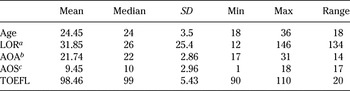
The main study participants were 79 learners of English as a second language, who started learning English after about the age of 10 Footnote 4 in a formal setting and subsequently moved to the United States. These learners were Chinese international students who had lived in the United States for a minimum of 1 year. Chinese international students were chosen as study participants as this ensured that they all shared a common first language (i.e., this element was constant). These participants had scored a minimum of 90 on the TOEFL iBT test (or 6.5 on IELTS). According to the ETS website, 90 is the minimum score of the TOEFL iBT for the advanced level. In addition, according to ETS, an IELTS score of 6.5 is equivalent to the TOEFL iBT score of 90. In terms of the gender distribution of the sample, 52 of the participants were female, whereas the remaining 27 were male. Their educational attainment was mostly similar: 16 participants were undergraduates, whereas the remaining 63 were graduate students enrolled in various degree programs at a U.S. mid-Atlantic university. Table 1 presents descriptive statistics pertaining to students’ demographic background.
Descriptive statistics for background information

a Length of residence in the United States in months.
b Age of arrival in the United States in years.
c Age of starting to learn English in China in years.
In addition, the language tests employed in the study were piloted with a group of English native speakers (NSs), all of whom were undergraduate students, on two separate occasions. First, 20 NSs took part in the initial item analyses. In light of the results of the first phase, some of the materials and test items were modified, and the revised version was offered to 10 further NSs.
Target Structures
Four English target structures—present hypothetical conditional, third-person s, simple past/present perfect, and mass/count nouns—were used to construct the GJTs and the SPRT, WMT, and MKT measures. The reasons for choosing these four structures were twofold. First, past research (e.g., R. Ellis, Reference Ellis2009) suggested that these four target structures are among the most difficult structures in the English language for EFL and ESL learners to master. In addition, these structures could easily be incorporated into SPRT and WMT items.
Instruments
Before describing the details of each of the tasks, it should be mentioned that four parallel sets of sentences (Set 1, 1', 2, and 2') were created for each of the following tasks: the untimed GJT, the timed GJT, the SPRT, and the WMT. The sets were equal in terms of length (length of sentences was kept between 9 and 13 words) and complexity (all sentences were simple in structure, with no embedded clauses), as well as in the frequency and density of their lexicons (the frequency of the words was checked in a corpus). Footnote 5 The following samples targeting mass/count nouns illustrate how sentences in these four sets were constructed. In Set 1 and 1', the sentences were very similar, with minimal changes to some of the words:
-
1: Mary added a lot of sugar(s) to her coffee. Footnote 6
-
1': Tom added a lot of sugar(s) to his tea.
The same level of similarity existed between Set 2 and 2`:
-
2: Mary likes to put a lot of sugar(s) to her coffee.
-
2': Tom likes to put a lot of sugar(s) in his tea.
However, when the differences between the sets were compared, the difference between Set 1 and Set 2 was found to be greater than that between 1' and 1 and 2 and 2', respectively. Thus, Sets 1 and 2 were used for the SPRT and WMT, whereas Sets 1' and 2' were employed in the untimed and timed GJTs. By using less similar sentences (e.g., Sets 1 and 2) for more similar tasks (e.g., the SPRT and WMT), spurious correlations between scores on the measures were avoided. In other words, relationships between the scores, if found, should indicate the commonality of the task designs (and constructs measured) rather than the similarity among the sentences used in each task. The tests were programmed and delivered through DMDX (Forster & Forster, Reference Forster and Forster2003).
Timed and Untimed GJTs
Each of the timed and untimed GJTs were composed of 96 sentences. Sixteen items were presented for each target structure, half of which were grammatical and the other half ungrammatical. Similarly, among the 32 filler sentences (testing other target structures) included, 16 were grammatical and 16 ungrammatical. The results pertaining to the filler items were not included in the analyses. For each of the GJTs, two counterbalanced lists of sentences were created. In List 1, half of the target sentences were grammatical, and half ungrammatical. The grammaticality of the sentences was reversed in List 2, to ensure that no target sentence was presented twice in the same condition in one list.
For the untimed GJT, participants were instructed to decide whether the sentences were correct or incorrect and were reminded that there was no time constraint. Sentences in the timed GJT appeared on the screen for 2–5.5 s. Footnote 7 The time limit for each item for the main part of study was established based on the reaction time (RT) of the NSs in the pilot. More specifically, the time limit for each of the sentences of the GJTs was equal to 1.2 × NSs’ RT.
SPRT
The SPRT assessed online grammatical sensitivity while participants were reading sentences for comprehension. In this task, participants were asked to read a sentence word by word as quickly and accurately as possible. The first word in a sentence appeared on the left-hand side of the screen, and when the keyboard button was pressed, the next word appeared to the right of the preceding word, which disappeared on the presentation of the following word (moving-window presentation). When participants read the final word followed by the period, they pressed a second key to continue to a comprehension question.
To develop the SPRT, two lists of stimulus sentences were constructed, each consisting of 64 target sentences (16 for each structure). The two lists were counterbalanced, whereby one half of the target sentences were grammatical and the other half ungrammatical in List 1. In List 2, the grammaticality of the sentences was reversed, so that no target sentence was presented twice in the same condition in one list. As before, 32 grammatical sentences were also included in each list as filler sentences. All the sentences were followed by a comprehension question that required a simple yes/no response. The ratio between yes and no responses was kept equal. Once again, RT on the filler sentences was excluded in the analyses.
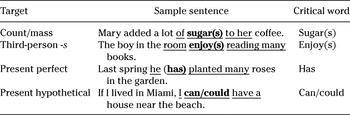
As in the study conducted by Jiang (Reference Jiang2007), the region of interest, where RTs were compared between grammatical and ungrammatical sentences, was set at three different word positions (see the underlined words in Table 2): at the critical word (i.e., where the error occurred in the ungrammatical sentences) and at the two words immediately following the critical word (to capture spillover effects). The word preceding the critical region was also used as a baseline in order to ascertain that the reading time of the word before the critical region did not differ between grammatical and ungrammatical sentences. If participants were sensitive to the grammatical error that preceded the critical region, their reading time would be delayed at (some of) these three positions. Table 2 shows some examples of each of the target structures.
Sample sentences with critical regions

WMT
Similarly to the SPRT, the WMT also assessed online grammatical sensitivity during reading comprehension. Instead of self-paced reading, in this test participants were instructed to read a sentence presented automatically word by word on the screen. Their task was to respond to a target word or a monitoring word that appeared at one of the locations within the sentence. First, they were presented with a monitoring word in the center of the screen for 2 s. Next, each word in the sentence appeared on the screen for 1 s. The respondents were instructed to press the keyboard button as soon as they saw the target word in the sentence.
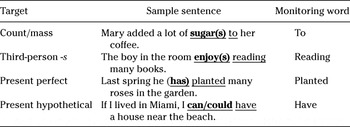
The monitoring word was always placed after the relevant target structure in the critical stimulus sentences. The difference in the RT to the target word between grammatical and ungrammatical sentences provided the index for online grammatical sensitivity. The monitoring word was located in the same position as the critical word in the SPRT, allowing the effects to be compared fairly between the WMT and the SPRT. Table 3 provides some examples of each of the target structures.
Sample sentences with critical words and monitoring words

As in the SPRT, two lists of stimulus sentences were constructed for the WMT. Each list consisted of 64 target sentences (16 for each structure). The two lists were counterbalanced, whereby List 1 was composed of an equal number of grammatical and ungrammatical target sentences, and the grammaticality of the sentences was reversed in List 2. Once again, no target sentence was presented twice in the same condition in one list. Similarly, 32 grammatical sentences were also included in each list as filler sentences. All sentences were followed by a comprehension question requiring a yes/no response, with an equal ratio between the two. Reaction times for the filler sentences were excluded in the analyses.
MKT
The MKT was constructed with 20 items pertaining to the same target structures as in the GJTs, the SPRT, and the WMT. Five sentences were used for each target structure. All sentences in this task were ungrammatical and were similar to the ungrammatical sentences used in the GJTs. For each item, a sentence appeared on the screen. Participants were informed that the sentences were all ungrammatical, and their task was to state the reason for the ungrammaticality and then provide the correct form. There was no time constraint in this task. A rubric (Appendix A) was developed for rating the learners’ performance on the MKT. The rubric detailed all of the possible acceptable and unacceptable responses. According to this rubric, partial credit could be assigned to each response, with 1 point for correct explanation and 1 point for correction. A total score of 2 was assigned for a response that included both a correct explanation and correction. Two researchers used the rubric and rated the responses independently. Their ratings were subjected to Rasch analysis, and the ability logit produced by Rasch was used as MKT data for further analyses.
Procedure
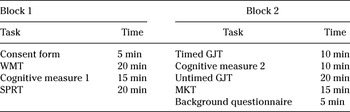
The five linguistic measures (timed GJT, untimed GJT, SPRT, WMT, and MKT) were administered, starting with more implicit tasks and progressing to more explicit tasks. Although other cognitive measures were administered in the study, the results are not reported here. The participants took these cognitive tests between the linguistic measures to delay exposure to the target structures and to minimize any practice effect. All the measures were administered in a 2-hr session. However, the battery was divided into two 1-hr blocks with a 15-min break between the two. Learners were paid $25 for their participation. Table 4 shows the order and time for each of the measures.
Order and time of the measures in each of the two blocks

ANALYSES
Pilot Study Involving NSs
All linguistic measures employed in the study were piloted with English NSs. As noted previously, the pilot consisted of two separate assessments. In the first phase, 20 NSs were asked to check the test items for ease of comprehension and correctness. Item and reliability analyses were subsequently conducted to diagnose the problematic items in the GJTs and MKT. The RTs of the NSs on the timed GJT items were also computed, to set the time limit for individual sentences in the task for the main study. The SPRT and WMT data were then analyzed to ensure that the tasks captured NSs’ sensitivity to the incorrect target structures. The first phase of the pilot study identified some problematic items in the timed GJT, the untimed GJT, and the SPRT, prompting appropriate revisions. The revised tasks were subsequently administered to another group of the NSs (n = 10), who took part in the second phase of the pilot study. Because the WMT and MKT data from the first phase showed that the task functioned as expected, they were not given to the second group of NSs.
GJTs
All the items from both GJTs were scored dichotomously, and the results were recorded as zero or one. Through item and reliability analyses, items with error rates higher than 25% were flagged for revision. These items were revised to ensure that grammatical and ungrammatical sentences clearly functioned in the expected manner. When the second phase of the pilot, with 10 NSs, was carried out, the results revealed that none of the items had an error rate higher than 25%. The NSs’ RTs in the second round were used to set the time limit for the individual sentences for the learners. Following the work of R. Ellis (Reference Ellis2005), the NSs’ RT to each individual sentence was increased by 20% to set the time limit. Depending on the length and complexity of the sentences, the time limit varied across items. The average RT for the entire test was 3.39 s, and RTs ranged from 2 to 5.5 s.
SPRT
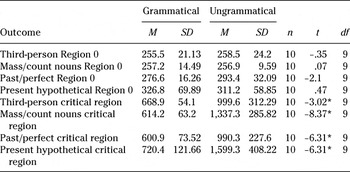
After the first phase of the pilot (n = 20), some items on the SPRT were revised. Based on the statistical results and the NSs’ feedback, several sentences were revised to make them sound more natural or unambiguously grammatical or ungrammatical. The revised SPRT was then given to another group of NSs (n = 10), and their RTs to the word prior to the target structure (Region 0) and the average RT in the critical region (the target word and the following two words) for both grammatical and ungrammatical sentences were measured. Two assumptions were tested for the SPRT as a linguistic measure—namely, for the NSs (a) the average RT to Region 0 should be statistically the same across grammatical and ungrammatical sentences, and (b) the average RT to the critical region for the ungrammatical sentences should be statistically greater than that measured for the grammatical sentences. The results showed that (a) participants read the words prior to the target structure similarly in both grammatical and ungrammatical sentences, and that (b) NSs, who have IK of the target structures, slowed down when they came across the incorrect use of target structures. Through four separate sets of paired-samples t-tests, RTs to Region 0 and the critical region for the four target structures in the grammatical and ungrammatical sentences were compared. Table 5 summarizes the results from the second phase of the pilot, with 10 NSs.
Results of the paired-samples t-tests and descriptive statistics for the SPRT (NS data, second phase of the pilot)

* p < .05.
The results revealed that there was no statistically significant difference in RTs to Region 0 across grammatical and ungrammatical sentences. On the other hand, for all four target structures, the RTs to the critical region were statistically greater in the ungrammatical sentences than in the grammatical sentences.
WMT
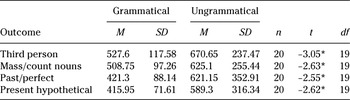
In order to establish whether NSs showed online sensitivity to the target structures, the RTs obtained by the group of NSs in the first phase of the pilot (n = 20) were analyzed. Through four separate sets of paired-samples t-tests, RTs to the target word across grammatical and ungrammatical items were compared, and the results are summarized in Table 6.
Results of the t-tests and descriptive statistics for the WMT

* p < .05.
The results revealed that RTs to the target word in the ungrammatical sentences were statistically greater than RTs in the grammatical sentences. These results confirm that the WMT captured the online sensitivity.
Main Study on L2 Learners
After the two-stage pilot testing, the revised test battery was administered to the 80 L2 learners. Even though 80 learners took all the tasks, the data pertaining to one of the participants had to be excluded because the computer failed to record the required information for several tasks. Thus the following analyses were conducted on a sample size of 79.
Item and Reliability Analysis
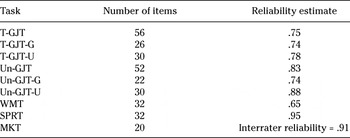
To begin with, item analyses were conducted on all the items in both the timed and untimed GJTs, and analyses were repeated for the grammatical and ungrammatical sentences separately. Henceforth, for brevity, the following acronyms will be used for different combinations of GJTs: total timed GJT (T-GJT), timed GJT grammatical sentences (T-GJT-G), timed GJT ungrammatical sentences (T-GJT-U), total untimed GJT (Un-GJT), untimed GJT grammatical sentences (Un-GJT-G), and untimed GJT ungrammatical sentences (Un-GJT-U). For each of the GJTs, items with a zero or negative item discrimination (ID) index (item-total correlation) were deleted to improve the reliability. Eight items were deleted from the timed GJT, and twelve from the untimed GJT. Next, reliability was estimated (Cronbach’s alpha) for the aforementioned GTJ measures, the SPRT, and the WMT. The interrater reliability of the two raters for the MKT was also computed. Two independent ratings for the MKT were subjected to a Rasch analysis, and the ability logit for individual learners was computed to generate data for subsequent analyses. Table 7 summarizes the reliability estimates for all the tasks of the study. The reliability estimates for the GJTs and the MKT in the current study were within the acceptable range (above .70, as suggested by Nunnally, Reference Nunnally1978), and they all were within the ranges reported in the previous research (Bowles, Reference Bowles2011; R. Ellis, Reference Ellis2005; Gutiérrez, Reference Gutiérrez2013; Zhang, Reference Zhang2015). Cronbach’s alpha for the SPRT was high, whereas the WMT’s internal consistency was lower but close to .70.
Reliability estimates

Descriptive Statistics
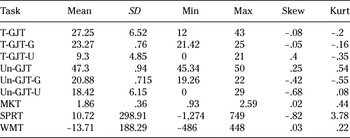
Following item analysis and exclusion of items with an inappropriate ID index, descriptive statistics were computed for all measures. Using multiple sources, such as statistical tests (Kolmogorov–Smirnov and Shapiro–Wilk tests) and graphs, the univariate normality of the measures was assessed. Depending on the severity of the skewness, two types of transformation are usually conducted. A square root transformation is carried out for data that differ moderately from the normal distribution, whereas a log transformation is more appropriate for data exhibiting substantial deviation (Tabachnick & Fidell, 2001). The T-GJT, T-GJT-U, Un-GJT-U, SPRT, and WMT data did not require any transformation. A square root transformation was carried out for the remaining measures because they differed from the normal distribution moderately. No log transformation was conducted. Table 8 summarizes descriptive statistics for all the measures. As can be seen, the univariate skewness and kurtosis values for all measures were within the acceptable range of +/− 1, with the exception of kurtosis for SPR. However, when a multivariate normality test was conducted, the assumption of multivariate normality was met (skewness: z score = .76, p value = .447; kurtosis: z score = 1.31, p value = .19; skewness and kurtosis: chi-squared = 2.3, p value = .32).
Descriptive statistics

Correlational Analysis
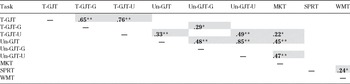
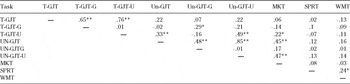
Before conducting CFA, in order to explore the relationships among the measures of interest for the present study, a Pearson product moment correlation analysis was conducted. Table 9 summarizes the results, presenting only the statistically significant correlations, for clarity. For the complete table of correlations, see Appendix B.
Correlational matrix for all the measures

** Correlation is significant at the 0.01 level (two-tailed).
* Correlation is significant at the 0.05 level (two-tailed).
As can be seen in Table 9, the WMT and SPRT correlated with each other, but not with any other measures. The T-GJT correlated only with the grammatical and ungrammatical sentences contained within. The Un-GJT also correlated with the grammatical and ungrammatical sentences it was composed of, as well as with the MKT. The T-GJT-G correlated with the Un-GJTG only, but the T-GJT-U correlated with the Un-GJT, Un-GJT-U, and MKT. Finally, the Un-GJT-U correlated not only with the Un-GJT and T-GJT-U but also with the MKT.
Confirmatory Factor Analysis
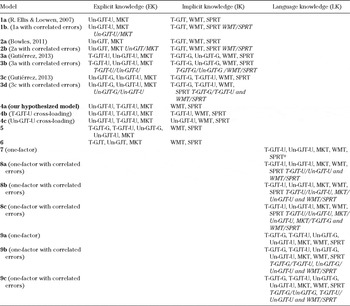
Confirmatory factor analysis was chosen as the main method of data analysis in order to test the prior hypotheses. Unlike in previous studies, 20 different CFA models were tested. These models included the model hypothesized in this study and models employed in previous studies (i.e. Bowles, Reference Bowles2011; R. Ellis & Loewen, Reference Ellis and Loewen2007; Gutiérrez, Reference Gutiérrez2013; Zhang, Reference Zhang2015), as well as several other rival models. Table 10 summarizes information pertaining to all tested models. It also shows which measured variables loaded on which factors, as well as the relationship between error terms for models in which method effect was accounted for. LISREL Version 9.1 (Jöreskog & Sorbom, Reference Jöreskog and Sorbom2012) was used for running CFA.
Summary of the tested CFA models

Note. Correlated errors are italicized.
a No correlated errors.
The models labeled 1a to 3d tested the models adopted in previous studies (i.e., Bowles, Reference Bowles2011; R. Ellis & Loewen, Reference Ellis and Loewen2007; Gutiérrez, Reference Gutiérrez2013; Zhang, Reference Zhang2015). The details of these models are not explained here but are available in Table 10. The table provides all immediately necessary information about each of these models. Regarding models from previous studies, a version of each with correlated error terms for the measured variables was also tested. In CFA, the specification of correlated errors is made on the basis of source or method effects, which explains the additional indicator covariation that resulted from common assessment methods (Brown, Reference Brown2006). In other words, in correlating errors, the aim was to account for the method effect and to improve the model fit indices. The models from previous studies were alternative models to the model hypothesized in the present study.
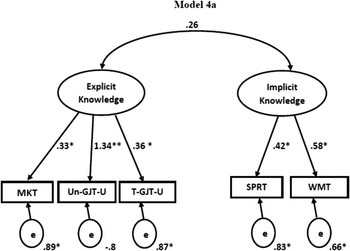
The next stage of the analysis involved testing Model 4a, developed as a part of this study. In this case, the T-GJT-U, Un-GJT-U, and MKT loaded on the EK factor, and the SPRT and WMT loaded on the IK factor. Next, rebuttals to Model 4a were examined by testing rival models (Models 4b–9c). In Models 4b and 4c, the T-GJT-U and Un-GJT-U cross-loaded on both factors, respectively. In Model 5, all combinations of GJTs loaded on the EK factor, and in Model 6, the total score from both the grammatical and ungrammatical sentences of both GJTs loaded on the EK factor. In Models 5 and 6, the SPRT and WMT loaded on the IK factor.
Models 7–9c allowed testing rival models to Model 4a. In these models, all the measured variables loaded on a single factor, labeled language knowledge (LK). As can be seen in Table 10, in order to account for the method effect, the error terms of various measured variables were also correlated. Several versions of Model 4, in which the error terms of various measures were correlated, were subsequently tested. However, as these models did not improve Model 4 significantly, the related findings are not reported here (see Appendix C for the covariance matrix used for the preceding analyses).
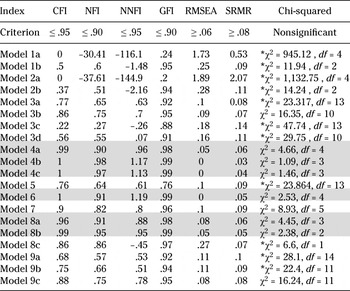
To evaluate and compare the plausibility of the CFA models, a profile of model fit indices recommended by Hu and Bentler (Reference Hu and Bentler1999) and Mueller and Hancock (Reference Mueller, Hancock and Osborne2008) was used and reported: (a) the chi squared (χ2), with its degrees of freedom and p-value; (b) the standardized root mean square residual (SRMR); (c) the root mean square error of approximation (RMSEA); the comparative fit index (CFI); (d) the normal fit index (NFI); (e) the nonnormed fit index (NNFI); and (f) the goodness-of-fit statistic (GFI). For a model to be deemed a good fit to the data, it had to meet the following criteria: the chi-squared should not be statistically significant at a .05 level; the SRMR and RMSEA should be lower than .08 and .06, respectively; and values greater than .95 for the CFI and NNFI and .90 for the NFI and GFI indicate a good model fit. Table 11 summarizes the model fit indices for all CFA models examined.
Summary of the model fit indices for the tested CFA models

* χ2 is significant at the .05 level.
As can be seen in Table 11, in terms of model fit indices, only six of the models (4a, 4b, 4c, 6, 8a, and 8b) fit the data well. Fit indices for the remaining models were outside the acceptable range.
Model 4a was the model hypothesized in this study and was compared to the other models with acceptable fit indices. These models are nested models (with the exception of Model 6, which employs different measures from the rest), and, therefore, a formal chi-squared difference test was conducted by
 $\Delta \chi _{\left( {d{f_1} - d{f_2}} \right)}^2\, = \,\chi _{d{f_1}}^2\, - \,\chi _{d{f_2}}^2$
and was distributed as a chi-squared distribution with df = df
1 − df
2 (Mueller & Hancock, Reference Mueller, Hancock and Osborne2008). Table 12 presents the results yielded by the chi-squared difference tests.
Chi-squared difference formal test results

As can be seen in Table 12, the chi-squared difference test was not statistically significant for any of the comparisons. These results suggest that no model is statistically different from any other. It should be noted that Model 6 could not be statistically compared to the other models because it utilizes different sets of measured variables.
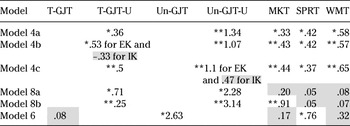
In the next step, the factor loadings in Model 4a were compared to those in all the other models (except for Model 6) that provided a good fit to the data. The model with higher and significant factor loadings is considered to fit the data better. Table 13 summarizes the factor loadings for these six models.
Factor loadings for Models 4a, 4b, 4c, 8a, 8b, and 6

** Loading is significant at the .01 level.
* Loading is significant at the .05 level.
The examination of the factor loadings revealed that only Model 4a had significant loadings for all the measured variables. In Models 4b and 4c, the T-GJT-U and Un-GJT-U did not load on the IK factor significantly. Therefore, Model 4a, a more parsimonious model, is superior to the others. In Model 8a and 8b, SPRT and WMT did not load on the LK factor significantly. In Model 8a, the loading of the MKT was not statistically significant either. Finally, in Model 6, the T-GJT, MKT, and WMT did not load on their corresponding factors significantly. The only issue with Model 4a that needs further explanation is that, at 1.34, the loading of the Un-GJT-U exceeded 1, indicating that the error variance for this measured variable was negative. However, according to Jöreskog (Reference Jöreskog1999), standardized coefficients (loadings) that are greater than 1, especially if they are not significant and are smaller than 2.8, are not an issue. In addition, in Model 4a, the correlation between the two factors was not statistically significant. These results lead to the conclusion that Model 4a, which was the hypothesized model of the study, provides the best fit to the data. Figure 1 illustrates the best fitting Model 4a.
The best fitting CFA model (Model 4a).
Note. MKT = metalinguistic knowledge test, Un-GJT-U = ungrammatical sentences of the untimed GJT, T-GJT-U = ungrammatical sentences of the timed GJT, SPRT = self-paced reading task, and WMT = word-monitoring task.

DISCUSSION
Construct Validity of the GJTs
The current study aimed at investigating whether manipulating the time condition and/or stimulus type transforms GJTs into distinct measures of EK and IK. Unlike the previous validation studies (Bowles, Reference Bowles2011; R. Ellis, Reference Ellis2005; R. Ellis & Loewen, Reference Ellis and Loewen2007; Zhang, Reference Zhang2015), in this work it was hypothesized that GJTs of any kind are too coarse to be measures of IK. Grammaticality judgment tests draw attention to form, and applying time pressure does not necessarily prevent L2 learners from accessing EK (Suzuki & DeKeyser, Reference Suzuki and DeKeyser2015). In addition, contrary to what Gutiérrez (Reference Gutiérrez2013) proposed, here it was hypothesized that the ungrammatical sentences of GJTs would provide a more valid measure of (explicit) L2 knowledge of the target structures.
To test these hypotheses, four different types of GJTs were developed: grammatical sentences in a timed GJT, ungrammatical sentences in a timed GJT, grammatical sentences in an untimed GJT, and ungrammatical sentences in an untimed GJT. In the tests, participants’ total scores for the timed and untimed GJTs were calculated as well. Next, the learners’ performance on the GJTs was compared with their performance on two other online processing measures (the WMT and SPRT), on one hand, and a well-established measure of EK (the MKT) on the other. Several CFA models were tested, including the ones adopted in previous studies, in which good fit indices were reported.
The CFA produced the best fitting two-factor model consisting of EK loaded onto the ungrammatical sentences of both the timed and untimed GJTs and the MKT and of IK loaded onto the WMT and SPRT. All models similar to those adopted in previous studies failed to achieve acceptable fit to the data, suggesting that the prior findings are of questionable validity. The bivariate correlation coefficients also showed that the grammatical sentences of both GJTs only correlated with each other, and not with any other measures. This finding may suggest that grammatical sentences in GJTs behave differently from the remaining measures employed in this work.
The correlation between the two factors in the best fitting model hypothesized in the current study (Model 4a) was small in magnitude and not statistically significant (r = .26). As noted by Brown (Reference Brown2006), “The size of the factor correlations in multifactorial CFA solutions should be interpreted with regard to the discriminant validity of the latent constructs. Small, or statistically non-significant, factor covariances are not usually problematic and are typically retained in the solution” (p. 131). The small, nonsignificant correlation between the factors in the current study can thus serve as evidence that the measures employed tapped into two distinct constructs. Previous studies, such as those conducted by Bowles (Reference Bowles2011) and Zhang (Reference Zhang2015), yielded large and significant correlations between the two factors in the models reported to have the best fit to the data. More specifically, Bowles (Reference Bowles2011) reported a correlation of .87 between the two factors, whereas Zhang (Reference Zhang2015) obtained .86. These high correlations weaken their argument that timed and untimed GJTs are distinct measures for EK and IK. This is consistent with Kachinske and Vafaee’s (Reference Kachinske and Vafaee2014) conclusion that the data from the previous validation studies fit well in the one-factor model accounting for the method effect as well as in the two-factor models.
Given the small sample size in the current study, further post hoc analysis was conducted to assess whether the two factors in the best fitting model (Model 4a) can be recovered with the current sample size. MacCallum, Widaman, Zhang, and Hong (Reference MacCallum, Widaman, Zhang and Hong1999) and Velicer and Fava (Reference Velicer and Fava1998) provide a thorough review of studies investigating the role of sample size in factor analysis. They demonstrated that the minimum sample size required largely depends on several factors, among which communalities were the most influential. According to MacCallum, Widaman, Preacher, and Hong (Reference MacCallum, Widaman, Preacher and Hong2001), “The level of communality has an especially strong interaction with N such that when communalities are high, good recovery of population factors can be achieved with relatively small samples” (p. 612). It has been suggested that low communalities in particular pose a serious problem in small sample sizes. The average communality was thus computed Footnote 8 for Model 4a, and it was .51. The value is above the low communality level (.35), as suggested by MacCallum et al. (Reference MacCallum, Widaman, Preacher and Hong2001), and this lends some support for the adequacy of this sample.
In sum, the present findings challenge the prior claims that timed and untimed GJTs are distinct measures of EK and IK constructs. Thus, based on the findings of the extant studies, it cannot be concluded that timed GJTs are measures of IK. If behavioral measures are considered to lie on a continuum from more explicit to more implicit, GJTs are probably considered closer to the explicit end of the continuum.
Using Online Processing Measures to Capture IK
The current study demonstrated that the online psycholinguistic measures (the WMT and SPRT) are tapping into a different construct than the one the GJTs are drawing on. This suggests that those newer tasks probably lie closer to the implicit end of the continuum relative to the GJTs. As delineated previously, online sentence-processing tasks can minimize the involvement of EK by capturing the online sensitivity to violations while attention is directed to meaning. Self-paced reading tasks and WMTs have been primarily utilized in psycholinguistic investigations (e.g., Clahsen & Felser, Reference Clahsen and Felser2006) and have not been explicitly employed for addressing the issues of measurements of EK and IK until recently (Suzuki, Reference Suzuki2015). The current findings corroborate those reported by Suzuki and DeKeyser (Reference Suzuki and DeKeyser2015), who noted that real-time grammatical processing can index IK. In the work of Suzuki and DeKeyser (Reference Suzuki and DeKeyser2015), the WMT was the only linguistic measure for IK and was not contrasted with the results of any other processing measure, such as a SPRT. The WMT adopted by Suzuki and DeKeyser (Reference Suzuki and DeKeyser2015) was administered in the auditory modality, Footnote 9 whereas the WMT and the SPRT in the current study were given in the visual modality. Despite the modality difference, the critical design of the task was shared, and their performances converged. Combined, these results suggest that online comprehension tasks are good candidates for IK measures.
Recently, in SLA studies on implicit “learning,” researchers have also started to apply RT-based online measures to assess to what extent implicit learning took place (e.g., Leung & Williams, Reference Leung and Williams2011; Paciorek & Williams, Reference Paciorek and Williams2015). Processing measures are more advantageous for capturing how L2 learners access linguistic knowledge in real time and can potentially reveal implicit learning processes. The recent applications of online measures in implicit learning research support the current finding that online comprehension measures draw on IK. Online processing measures offer great promise for further validation of EK and IK measures, as this study demonstrated that they can be employed to further scrutinize the validity evidence for the GJTs.
Suggestions for Further Research
The current study is not without limitations and offers several venues for further research. First, in order to investigate the construct validity of behavioral measures hypothesized to measure IK, the issue of awareness remains central. If the key definition of IK is that it definitively does not involve awareness, measures of awareness should be included in the validation studies. The current study did not employ any such measure of awareness.
Second, a test may be valid for certain purposes, such as a particular learning context or population of test takers, but not for others (Henning, Reference Henning1987). The participants in the current study were learners with both classroom-based and naturalistic learning experience. The validity of GJTs may be assessed in different ways, depending on the specific context of the study in which GJTs are used. For instance, heritage learners with less formal instruction may perform on GJTs differently from the sample recruited for the present study, as they are posited to be less likely to possess EK compared to classroom learners.
Third, the current test battery only targeted four target structures. The original research by Rod Ellis targeted seventeen structures, with a similar number used in the subsequent studies. The smaller number of types of target structures tested in the current study may limit the generalizability of the present findings.
In addition, the current study focused only on Chinese L2 learners, whose L1 is typologically different from English. If the same test battery were administered to another L1 group, the results would likely be different. Because the explicit and implicit learning processes may be interactively influenced by the target structures to be acquired and learners’ prior knowledge, including their L1 (e.g., DeKeyser, Reference DeKeyser, Doughty and Long2003; Leung & Williams, Reference Leung and Williams2014; Williams, Reference Williams2005), it may be worth expanding the current research to a different population and/or testing other linguistic structures.
Finally, in the model (Model 4a) that provided the best fit to the data, as well as in the remaining models, the factor loadings of the measured variables were relatively low. However, for stable latent variables to be measured, models are usually required to achieve higher factor loadings. Obviously, more rigorous further studies on the validity of GJTs are urgently needed.
CONCLUSION
The current study set out to investigate the validity of GJTs as measures of EK and IK. The data analyses were extremely stringent and included a thorough execution of CFA. Thus it was possible to reveal the limitations of the previous research. Specifically, the study provided evidence that challenged conclusions from previous studies that time pressure renders GJTs measures of IK. The claim that timed GJTs are measures of IK no longer holds when online comprehension tasks that can capture grammatical sensitivity are employed. Given the nature of GJTs—they involve focus on form—GJTs may be considered to be located closer to the explicit, rather than the implicit, end of the continuum (DeKeyser, Reference DeKeyser, Doughty and Long2003). Endorsing the recent call for the use of processing measures for capturing implicit processes (Andringa & Curcic, Reference Andringa and Curcic2015; Suzuki & DeKeyser, Reference Suzuki and DeKeyser2015), the current study demonstrated the potential of online comprehension tasks as measures of IK.
APPENDIX A
MKT RUBRIC
-
1. Third-person -s
-
a. Full explanation should consist of = because the noun/subject/“the name of the word appearing in the sentence” is singular, you should use the verb + s/’s should be added to the verb/not plural.
-
b. Participants will have to mention the singular noun or third-person singular and verb form.
-
-
2. Present perfect/simple past
-
a. Full explanation should consist of = mention of simple past/an event occurring at a specific time in the past.
-
-
3. Countable/uncountable
-
a. Full explanation should consist of = mention of specific terminology, such as countable/uncountable or can be plural/cannot be plural.
-
-
4. Hypothetical/second conditional
-
a. Full explanation should consist of = the modal/the verb should be in the past tense to agree with the tense of the verb in the first sentence, or because the sentence describes a hypothetical situation/unreal past/hypothesis/assumption/supposition, or subjunctive mood.
-
APPENDIX B
CORRELATIONAL MATRIX

APPENDIX C
COVARIANCE MATRIX