Introduction
Single-sided deafness is severe to profound sensorineural hearing loss in one ear with normal hearing in the other. Unlike unilateral sensorineural hearing loss, which is mild hearing loss with a prevalence of approximately 3.0 per cent, single-sided deafness is a relatively rare form of hearing loss in the paediatric population.Reference Dewyer, Smith, Herrmann, Reinshagen and Lee1 Even though hearing in one ear may be preserved, children suffering from single-sided deafness often experience difficulties in school, leading to cognitive deficits.Reference Thomas, Neumann, Dazert and Voelter2 Additionally, single-sided deafness can present safety hazards in traffic and in noisy settings because of the difficulty of noise separation and localisation, leading to a lack of spatial awareness in these patients.Reference Deep, Gordon, Shapiro, Waltzman, Roland and Friedmann3,Reference Cushing, Gordon, Sokolov, Papaioannou, Polonenko and Papsin4 The difficulties in sound localisation and hearing processing are largely because of both the head shadow effect as well as the lack of proper binaural sound processing. For these reasons, prompt diagnosis and treatment are critical for proper neurocognitive development of these children and to avoid the risk of developing permanent deficiencies that can affect learning and daily function.
Currently, there is not a ‘gold-standard’ treatment for single-sided deafness in children. The treatments have traditionally consisted of unilateral hearing aids, such as the contralateral routing of signal hearing aids or bone-anchored hearing aids (BAHA), or simply observation. More recently, unilateral cochlear implantation has been a chosen treatment by some medical professionals, and recently the Food and Drug Administration approved cochlear implantation in single-sided deafness for patients over the age of five years.5 Cochlear implantation for single-sided deafness has been studied more extensively in adult patients, but the perceived benefits in children have not been explored to the same degree. In order to maximise benefits of treatment for children with single-sided deafness and avoid learning difficulties and social struggles, the outcomes for these treatment modalities must be compared.
The objective of our study was to compare the individual modalities used for the management of single-sided deafness, with a focus on BAHA and cochlear implantation hearing aids. Both differences in performance, including speech perception and hearing in both quiet and in noise, as well as subjective benefit and preference from the perspective of the patients, require consideration. Our goal was to provide evidence available from the literature to help healthcare providers recommend the best practice treatment options to patients and their families.
Materials and methods
The study was exempt from institutional review board approval. A systematic review of the literature was performed using methods intended to minimise any biases or exclusions of relevant data. This review was conducted using PubMed, Cochrane Review and Cinahl databases. The search of these databases was performed on 21 February 2022. Studies that were published after the year 2000 and written in English were selected, and only studies with paediatric patients were considered. Case reports looking at single patients were excluded. The inclusion criteria were checked by three independent reviewers to determine which papers could be utilised. Any disagreements regarding study inclusion were resolved with a vote between the three reviewers.
This clinical question was addressed using the Population, Intervention, Comparison and Outcomes methodology. The desired patient population was paediatric patients 18 years or younger. The interventions being assessed were BAHA and cochlear implantation. The outcomes being investigated were improvements in speech perception and quality of life (QoL) measures. This review includes various clinical trials and case studies analysing these treatments and their outcomes.
Search terms
The search terms were: ((Single-sided OR one-sided OR unilateral OR monoaural) AND (Deafness OR hearing loss OR loss of hearing)) AND ((cochlear implant* OR “Cochlear Implants”[MAJR] OR bone anchored hearing aid OR BONE ANCHORED HEARING AIDS OR (bone conduction AND hearing aid))).
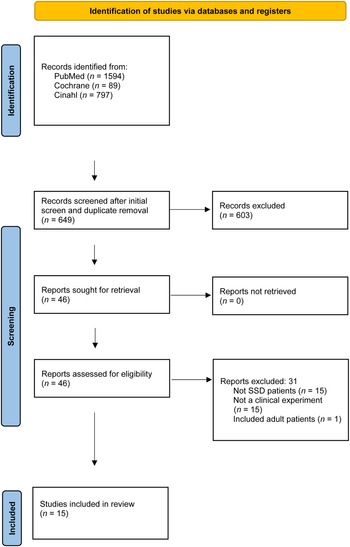
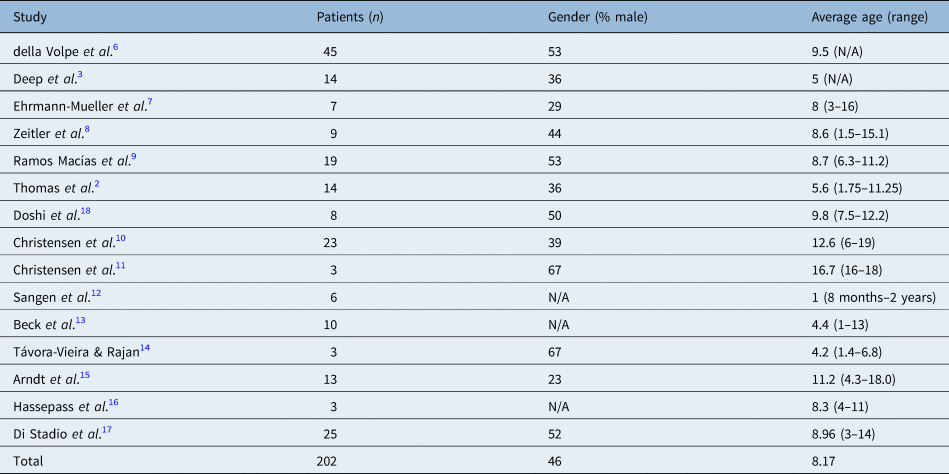
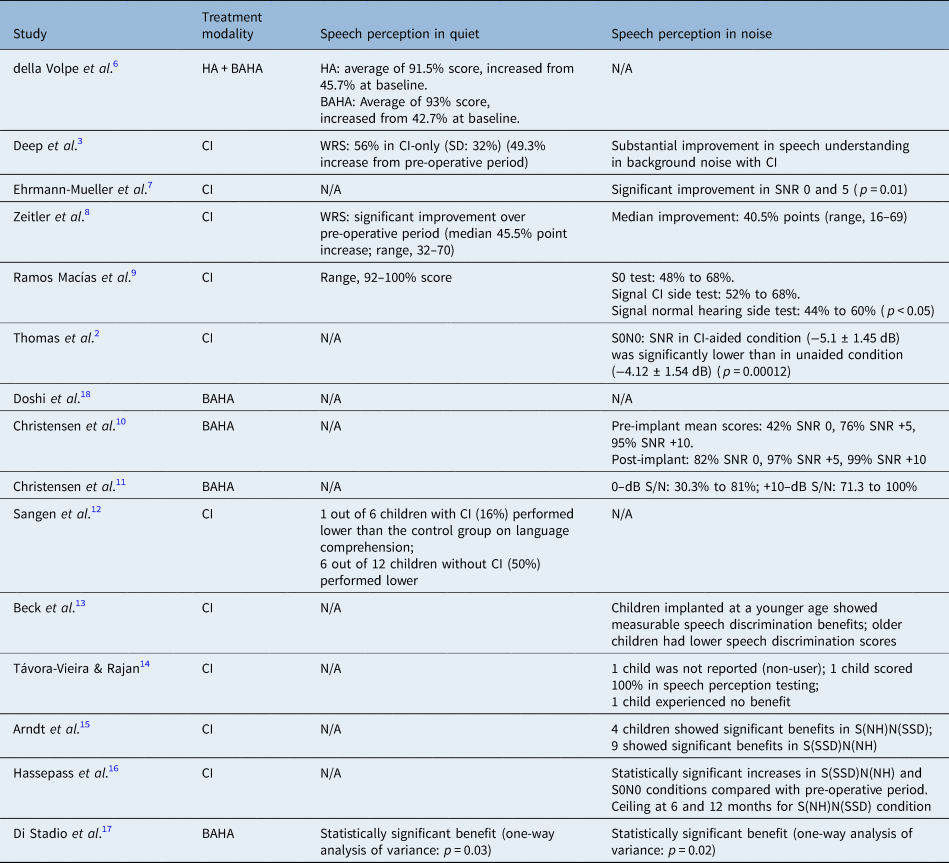
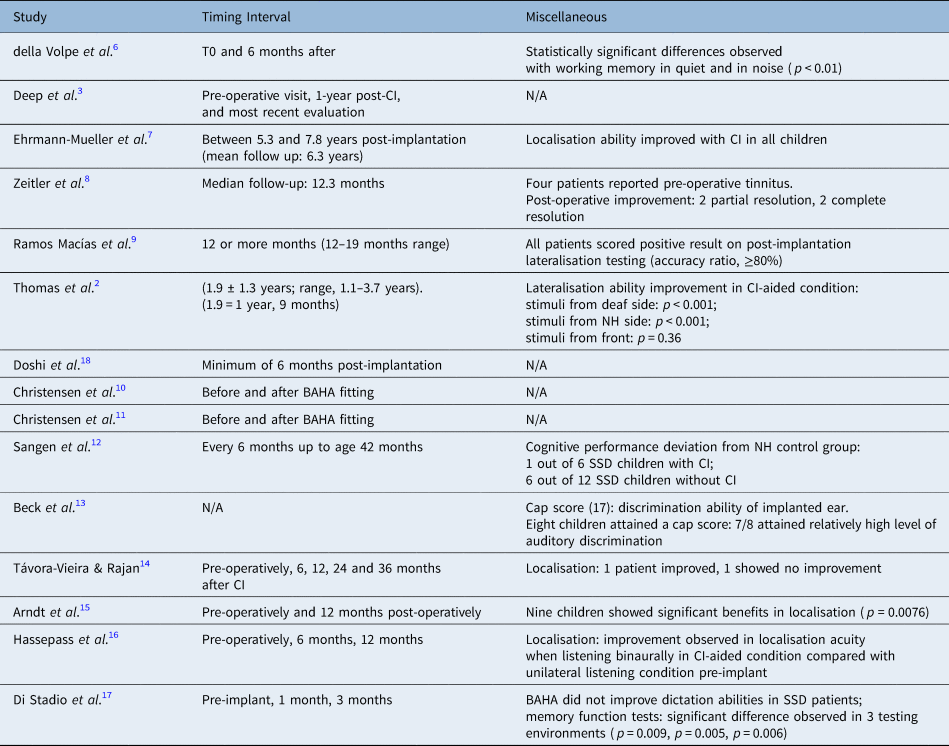
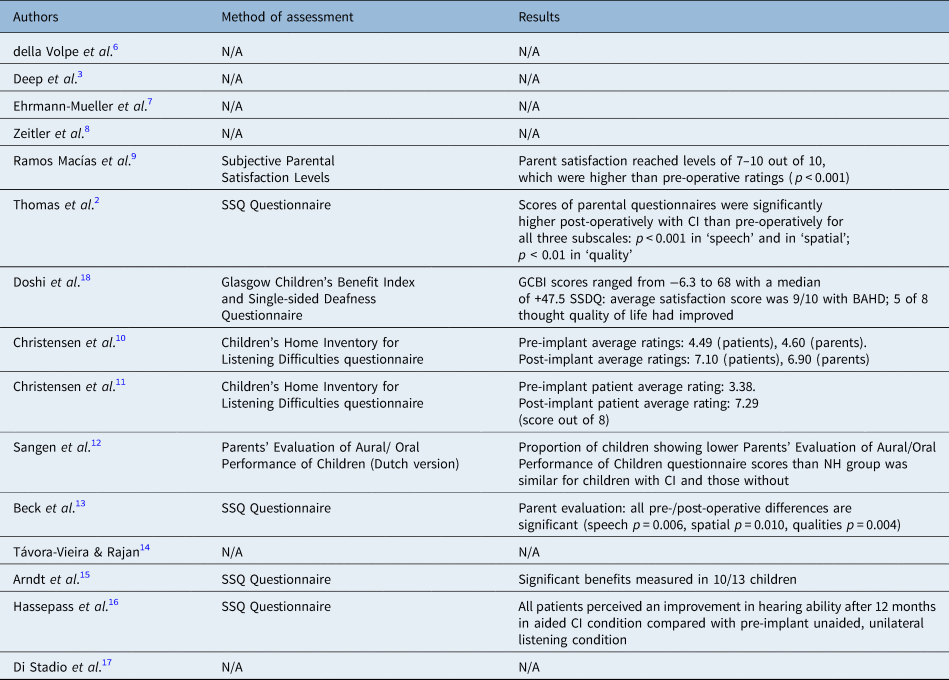
Our initial search resulted in 2480 results in total before duplicates were removed and our inclusion criteria were applied to the gathered studies. Our search was limited to studies performed on humans, studies written in English, those published within our search dates, studies that observed patients under 19 years of age and studies that fulfilled criteria for a clinical diagnosis of single-sided deafness. Fifteen studies remained to use for final review. The studies that fit our inclusion criteria were further examined, and the desired experimental data was extracted. The data was transferred to three tables. These tables summarised demographic information, the results that were reported and the information surrounding the QoL of the patients and their families (Tables 1–3). A Preferred Reporting Items for Systematic reviews and Meta-Analyses (‘PRISMA’) diagram summarising our selection process is shown in Figure 1.
Preferred Reporting Items for Systematic reviews and Meta-Analyses (‘PRISMA’) Flow Diagram showing article selection process. SSD = single-sided deafness

Demographic information

N/A = not available
Speech perception results

HA = hearing aid; BAHA = bone-anchored hearing aid; N/A = not available; CI = cochlear implantation; WRS = word recognition scores; SD = standard deviation; SNR = signal to noise ratio; S0 = azimuth; S0N0 = noise and sound presented from the front; S/N = speech/noise ratio; S(NH)N(SSD) = speech from the normal-hearing side, noise from the deaf/implanted side; S(SSD)N(NH) = speech from the deaf/implanted side, noise from the normal-hearing side
Additional findings

T0 = time of recruitment; CI = cochlear implantation; N/A = not available; NH = normal hearing; SSD = single-sided deafness
Results
In our review, we studied a total of 202 patients across the 15 studies. The ages of the patients included ranged from 8 months to 19 years. There were 83 males and 100 females (46 per cent male). There were not sufficient data regarding the ethnicity of the patients to be used for analysis. The demographic results from examination of the 15 studies included in the quantitative analysis are shown in Table 1.
The results of the papers included in the analysis are shown in Table 2; this shows hearing in quiet and noise. Six studies (n = 118) reported positive improvements when testing speech perception in quiet. Of these studies, two consisted of BAHA patients, and four tested cochlear implantation patients. Twelve studies (n = 143) reported beneficial improvements when testing in noise. Of these studies, three studied BAHA patients and nine tested cochlear implantation patients. These results are reviewed further in the Discussion. The majority of patients (53 per cent of studies) were followed for at least one year after initiation of the respective treatment (summarised in Table 3). Because of the heterogeneity of the data, Table 3 included other potentially useful outcome measures to better understand the effects of the treatment type on patients. These included working memory, tinnitus and sound localisation.
Several studies (9 papers, 99 patients) reported on QoL measures, which are summarised in Table 4. Several more commonly used QoL measures were utilised, including the Speech, Spatial, and Qualities of Hearing questionnaire, Children's Home Inventory for Listening Difficulties questionnaire, and Parents’ Evaluation of Aural or Oral Performance of Children questionnaire. The Speech, Spatial, and Qualities of Hearing questionnaire was the most frequently used measure (5 papers, 59 patients). All the studies showed an improvement in QoL regardless of the intervention used.
Quality of life results

N/A = not available; SSDQ: Single-Sided Deafness Questionnaire; NH: normal hearing; BAHD: bone-anchored hearing device ; CI = cochlear implantation; GCBI = Glasgow Children's Benefit Index; SSQ = Speech, Spatial, and Qualities of Hearing Scale
Discussion
The results indicate that both cochlear implantation and BAHA have shown to be beneficial regarding the perception of sound in both quiet and in noise in patients with single-sided deafness. Significant differences were observed between the unaided condition and the aided condition with these treatment modalities in the examined studies.
There are many considerations to address when attempting to support which treatment is the most effective. Although the Di Stadio et al. study indicated a significant benefit in speech perception in both quiet and in noise, their tests focused on dictation did not show any significant benefits with the BAHA treatment compared with the unaided condition.Reference Di Stadio, Dipietro, Toffano, Burgio, De Lucia and Ippolito17 The dictation tests incorporated hearing ability as well as short-term and working memory to examine the effectiveness of the treatment in everyday situations, such as in a school setting. The lack of a significant benefit seen from these tests could be a result of the inability of the BAHA treatment to restore binaural hearing, which can result in worse signal-to-noise ratios when noise is directed at the deaf ear.Reference Deep, Gordon, Shapiro, Waltzman, Roland and Friedmann3 Therefore, while BAHA treatment did appear to aid in speech perception, it may not show the same benefits in other settings.
Treatment through cochlear implantation showed significant benefits from all of the studies examined in paediatric single-sided deafness. Cochlear implantation displays the unique benefit of restoring the benefits of binaural hearing.Reference Thomas, Neumann, Dazert and Voelter2 Binaural hearing separates treatment by cochlear implantation from other options as it better allows for restoration of sound localisation and speech comprehension in noise. The benefit of binaural hearing was supported by a study performed by Arndt et al. in which cochlear implantation demonstrated improvements in these areas when compared with BAHA and contralateral routing of signal treatments.Reference Arndt, Aschendorff, Laszig, Beck, Schild and Kroeger19 Another benefit that appears to be exclusive to cochlear implantation treatments is the capability of this treatment method to allow for the reversal of cortical cross-modal plasticity, even after many years of unilateral deafness.Reference Zeitler, Sladen, DeJong, Torres, Dorman and Carlson8 The auditory pathway changes, experienced by those with unilateral deafness to compensate for a lack of hearing in one ear, can be corrected with cochlear implantation. This aids the restoration of binaural hearing capabilities.
Although the literature is limited in terms of the role of early intervention and long-term outcomes in children with single-sided deafness, the authors of this paper believe any intervention is crucial, regardless of the treatment type chosen by the practitioner. Early intervention can provide benefit outside of simple noise recognition. The timing of intervention can alter the effect that the maladaptive compensation has on the patient's neurocognitive development.Reference Deep, Gordon, Shapiro, Waltzman, Roland and Friedmann3 This can affect how the patient is able to respond to the treatment. The use of devices such as cochlear implants can provide benefit in speech reception, which translates to improvement in both word and sentence production metrics.Reference Zeitler, Sladen, DeJong, Torres, Dorman and Carlson8
In children, language is developed in an exposure-based manner during what is defined as the critical period, which is maximal until 3.5 years and decreases after 7 years.Reference Zeitler, Sladen, DeJong, Torres, Dorman and Carlson8,Reference Patton, Blundon and Zakharenko20 As such, our colleagues in paediatric neurology suggest that intervention implementation should be applied during these sensitive periods of development that create windows of opportunity not commonly seen in adult brains.Reference Ismail, Fatemi and Johnston21 Taking advantage of these chances may provide greater success in neuromodulatory interventions and overall improve clinical outcomes.
Quality of life
In addition to assessing hearing in quiet and noise, nine of the studies used in the analysis included more subjective questionnaires used to examine the impact of the treatments on the patients’ QoL. The results from these observations were overwhelmingly positive, leaving little room to draw any meaningful conclusions when comparing the treatment types. Because of the lack of studies making direct comparisons between cochlear implantation and BAHA treatments, the benefits in this area for each treatment become difficult to weigh against one another. In one study outside of our quantitative analysis performed by Devi et al., the researchers used a five-point scale to assess QoL.Reference Devi, Chatni, Ramadevi and Baba Fakruddin22 Bone-anchored hearing aid implants were compared with contralateral routing of signal treatments in areas including loudness of sound, clarity, naturalness and overall fidelity. In all five categories tested comparing the BAHA treatments to the contralateral routing of signal treatment (loudness, fullness, clarity, naturalness and overall fidelity), the BAHA treatments scored significantly higher (p < 0.05). Although these studies offer insight into the treatments’ effects on the daily lives of the patients, additional research on this area specifically would yield more conclusive evidence.
Limitations
There were several limitations when conducting this literature review that hindered the data collection process. Most notably, the lack of research in children with single-sided deafness resulted in both a low number of available studies or patients to use in this review as well as a heterogeneous data pool. The experiments performed used different assessment measures, such as the Hearing in Noise Test, the Multisyllabic Lexical Neighborhood Test, and the Common Evaluation Protocol in Rehabilitative Audiology, among others. The heterogeneity of the dataset limited the comparisons that were able to be made across the different studies because different methods and data collection techniques were utilised by the researchers. Increased use of standardised methods of hearing assessment would allow for more direct comparisons between treatments. Because cochlear implantation has only recently become an accepted treatment for single-sided deafness in children, comparisons with the other treatments have not yet been properly explored. Additionally, the lack of research studies performed also limited the scope of the review, as the available studies were skewed more toward cochlear implantation investigations. The specific criteria of this review excluded most available studies, so increased research on single-sided deafness in children would allow for a more in-depth analysis and comparison of the treatment modalities.
It has also been noted that many children who are offered treatment prefer to only use their device in certain environments. Single-sided deafness is a condition that is situational in its impact on the patient because it is dependent on factors such as where sound is coming from and the level of background noise present.Reference Deep, Gordon, Shapiro, Waltzman, Roland and Friedmann3 This is a consideration that needs to be accounted for when recommending treatments because more expensive and invasive treatments, such as cochlear implantation, may not be viewed as necessary for some patients when these considerations are taken into account.
Bias
Some studies used in this review may have had inherent biases directed toward a specific treatment modality being tested. Any bias that was present in these studies may have affected the inclusion or exclusion of certain patient data. This could skew the data to more heavily favour a treatment modality. This is important to note when observing the data in these studies and the resulting conclusions that were formed.
Conclusion
Our review of the literature suggests that cochlear implantation may be a more effective treatment for children with single-sided deafness. The restoration of binaural hearing, tinnitus symptom improvement and cortical reorganisation for hearing gives these patients the greatest benefit. Although BAHA remains an effective treatment, cochlear implantation treatments seem to be superior in hearing in noise and sound localisation capabilities and may better address the learning deficits and social struggles of these patients. However, direct individual comparisons are difficult to support because of the heterogeneity of testing. It should be noted that BAHA also rated well in the QoL measures. It is imperative that proper screening is performed, and treatment is initiated early while in the critical period of development. This will limit some of the long-term sequelae for these children in their learning and everyday environments. Additional research with more direct comparisons is needed to provide more decisive results.
Competing interests
None declared