Introduction
Injury is responsible for nearly five million annual deaths, accounts for 11% of the global burden of disease,Reference Enumah, Scott, Maine, Uwitonze, Nyinawankusi, Riviello, Byiringiro, Kabagema and Jayaraman 1 and remains the leading cause of mortality for young adults throughout most of the world.Reference Murray, Vos and Lozano 2 Over 90% of injury-related deaths happen in low- and middle-income countries (LMICs),Reference Patton, Coffey and Sawyer 3 and existing research estimates that 1.7 to 1.9 million lives could be saved with implementation of functioning trauma systems in LMICs.Reference Peden, McGee and Sharma 4 Unlike high-income countries, many LMICs lack established emergency systems to deliver care for the injured and to collect accurate data on injury epidemiology and outcomes. Prehospital care is integral to emergency systems and includes proper management and timely transport of patients to an appropriate care facility.
Unfortunately, prehospital care is not available in many resource-limited settings,Reference Mock, Joshipura, Arreola-Risa and Quansah 5 despite recent evidence that prehospital systems can reduce mortality substantially in LMICs.Reference Hsia, Thind, Zakariah, Hicks and Mock 6 The Lancet Commission on Global Surgery (Lancet; London, UK) described the importance of collecting accurate data on the burden of surgical conditions in order to allocate specific resources, institute preventative services, and measure program effects.Reference Henry and Reingold 7 To have functioning prehospital and trauma systems, reliable local data are needed about injured patients. However, local injury-related data often are based on modeling from population-level estimates or household surveysReference Meara, Leather and Hagander 8 instead of accurate clinical data.
In Rwanda, injury is responsible for 11% of annual deaths.Reference Petroze, Joharifard and Groen 9 Rwanda is a Central African country with a gross national per capita income of US $630 and a population of 12 million people, more than 60% of whom are under 25 years of age. 10 , 11 Despite financial challenges, Rwanda has made remarkable progress in the last two decades, particularly in the health sector, due to strong central leadership. 12 In 2007, the Rwandan Ministry of Health (Kigali, Rwanda) created the only publicly funded prehospital emergency system in the region—Service d’Aide Medicale Urgente (SAMU)—in the capital, Kigali. Currently, Rwanda does not have a formal prehospital Emergency Medical Services training program. Therefore, SAMU recruits trained nurses and anesthetists to provide prehospital clinical care. Since its inception, SAMU has meticulously recorded details about every patient encounter with the goals of understanding the patterns of injury and subsequently improving the delivery of patient care. While there are estimates of injury-related mortality in Kigali,Reference Farmer, Nutt and Wagner 13 a detailed description of injuries in the prehospital setting is lacking.
In an effort to understand the prehospital injury patterns in Kigali, all traumatically injured patients managed by SAMU were analyzed over two years. The aim was to describe patient demographics, injury characteristics, and geographic and temporal trends to better understand injury patterns in this setting.
Materials and Methods
Data
An electronic prehospital registry in REDCap (Vanderbilt University; Nashville, Tennessee USA) had been created previously in collaboration with the authors. REDCap is a secure web-based application that supports data capture for research studies providing validated data entry, audit trails, and automated export procedures.Reference Kim, Byiringiro and Ntakiyiruta 14 This de-identified registry contained two years of clinical records, from December 2012 through November 2014, abstracted from paper ambulance run sheets (eFigure 1; available online only). Service d’Aide Medicale Urgente screens roughly 1,200 ambulance requests each month through their national call center, and a determination to send an ambulance is made based on severity of the patient’s condition, as determined by trained providers, and on the availability of equipped vehicles. At the end of each clinical encounter, SAMU completes a clinical run sheet. Each patient record contains demographics, initial field assessment, and management during transport. Each record is of a unique encounter, not an individual. Thus, a patient who was injured four times over the study period would be captured in four unique encounters. The study population was restricted to only injured patients transported by SAMU within Kigali and excluded encounters that were due to obstetrical, gynecologic, or medical emergencies.
Variables
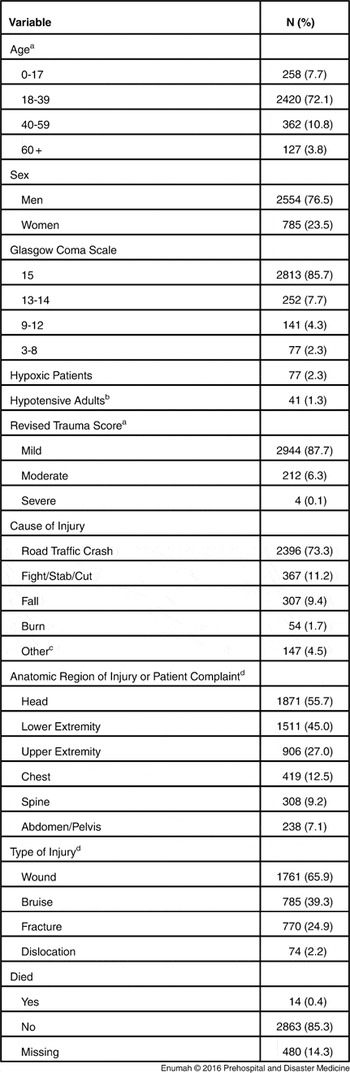
Variables collected are presented in Table 1. Demographic data included patient’s age, sex, and location of injury. Hypoxia was defined as an oxygen saturation less than 90%. Hypotension was not defined for children, and in adults was defined as patients 18 years and older with a systolic blood pressure of less than 90 mmHg. The Revised Trauma Score (RTS) is a physiologic scoring system that has demonstrated accuracy in predicting death and maintains high inter-rater reliability.Reference Harris, Taylor, Thielke, Payne, Gonzalez and Conde 15 The RTS was calculated for each patient encounter based on the field values for Glasgow Coma Scale (GCS), systolic blood pressure, and respiratory rate to have a metric of injury severity. The RTS was categorized as mild (>7.2), moderate (3.4-7.2), or severe (<3.4).Reference Champion, Sacco, Copes, Gann, Gennarelli and Flanagan 16 Injury characteristics included causes (ie, road traffic crash [RTC], fall, burn, or fight/stab/cut), anatomic regions (ie, head, chest, upper extremity, lower extremity, spine, abdomen/pelvis, or other), and mechanisms of injury (ie, motorcycle, vehicle, bicycle, or pedestrian). A RTC was defined as an event that involved at least one vehicle (eg, bus/car), motorcycle, or bicycle. Death was defined as the combination of encounters where a person was found dead upon arrival of the ambulance or died in transport to a care facility. Urgency was defined as “absolute,” “relative,” or “no urgency” according to the severity of the patient’s condition, as assessed by SAMU providers. Health facility type includes “Referral” hospitals (designated teaching hospitals with the highest clinical capabilities), “District” hospitals (generally equipped with basic medical and surgical capacity), “Health Centers” (local clinics with general practitioners), and “On-site Care” (treated by ambulance providers at scene of injury event).
Demographics and Injury Characteristics

a For variables with more than 5% missing, the percentages may not add up to 100%.
b Excludes patients under 18 years of age.
c Includes landmines, animals, and non-specific injury.
d Patients can have multiple injuries. Variables are coded as binary so total percentages in a category can exceed 100.
Analysis
The feasibility of using the SAMU run sheet as a registry tool was assessed with field completion rates, which were defined as proportion of available data points out of all possible data fields for each variable included in the analysis. Descriptive analysis was then conducted of patients’ age, sex, causes and mechanisms of injury, locations of RTCs, and dates of events. Sub-groups of injuries were analyzed further among children (0-17 years) and adults (18+ years). The STATA 13.1 (College Station, Texas USA) was used to calculate chi-squared analysis, binomial probability test, student’s t-test, and Wilcoxon ranked-sum analysis, where appropriate. A P value ≤.05 was considered statistically significant. Ethical approval was obtained from University Teaching Hospital-Kigali Ethics Committee, Rwanda National Health and Research Council (Kigali, Rwanda), and Institutional Review Board of Partners Health Care (Boston, Massachusetts USA) prior to the conduct of this project.
Results
Of 6,557 records available in the REDCap database, a total of 3,357 (51.2%) patients (eFigure 2; available online only) met inclusion criteria for this analysis. Analysis of field completion rates demonstrated that 17 of the 18 variables included in these analyses had field completion rate of ≥90% (eFigure 3; available online only). The variable with least consistent recording was death (85.6%).
Patient Demographics
The median age of the population was 29 years (IQR=23-35) with those ages 18-39 years most commonly injured (72.1%), and the group was predominately male (76.5%; Table 1). Children represented 7.7% (n=258) of the study population. For all injured patients, only 14.3% of patients had a GCS below 15. For patients with any head injury or subjective complaint of head pain (n=1,871), the breakdown of GCS ranged from 15 (78.4%), to 13-14 (11.1%), to 9-12 (6.7%), to 3-8 (3.8%). For all injured patients, 2.3% were hypoxic and 1.3% were hypotensive. When RTS was applied, a majority of patients in the dataset (87.7%) had “mild” injury. In this study population, 14 patients (0.4%) died before ambulance arrival or during transport to a health care facility.
Mechanisms and Causes of Injury
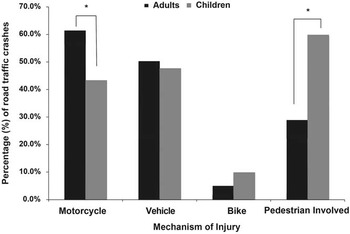
The most common causes of injuries were RTCs (73.4%), stabbings/cuts (11.1%), and falls (9.4%; Table 1). Anatomic locations of injuries commonly included the head (55.7%), lower (45.0%) extremities, and upper (27.0%) extremities. More than one-half of the injuries involved a wound (65.8%) and nearly one-fourth of all injuries involved a fracture (24.9%). The most common mechanism of injury for adults was motorcycle-related RTCs (61.4%), whereas children were most commonly injured when struck as pedestrians (59.8%; Figure 1).
Mechanisms of Injury for Adults and Children. Legend: Motorcycle includes 2-wheel motorized vehicles. Vehicle includes cars, buses, and other motorized vehicles with four or more wheels. Bike includes standard 2-wheel manual bicycles. * P value less than .05 for the comparison of proportion between adults and children by mechanism of injury.

Temporal and Geographic Trends
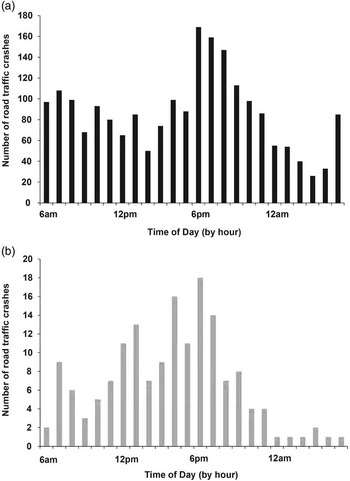
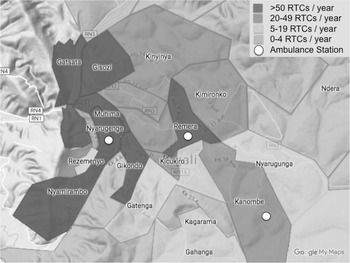
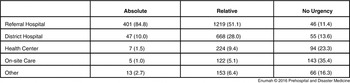
In the dataset, RTCs occurred more commonly on weekends than on weekdays (P<.001), with Sunday being the most common (eFigure 4; available online only). For adults, most RTCs occurred between the hours of 6:00 pm and 10:00 pm, whereas RTCs involving children commonly occurred in two peaks – between 12:00 pm and 2:00 pm and between 4:00 pm and 7:00 pm (Figure 2). The most common geographic locations for RTCs represented in this dataset included the sectors of Gisozi (90 RTCs/year), Nyamirambo (89 RTCs/year), and Muhima (84 RTCs/year; Figure 3). Injured patients with conditions designated as “absolute” by SAMU were most commonly transported to a referral hospital (84.8%), and those patients categorized as “relative” also were commonly transported to a referral hospital (51.1%; Table 2). More than one-third of “no urgency” cases were managed with on-site care (35.4%).
Number of Road Traffic Crashes by Time of Day for (a) Adults (n=2071) and (b) Children (n=161).

Heat Map of Road Traffic Crashes in Kigali, by Sector. Abbreviation: RTC, road traffic crash.

Transport to Types of Health Facilities by Urgency of Patient Condition

Note: Urgency is categorized as “absolute,” “relative,” or “no urgency” according to SAMU providers’ assessment of each patient’s condition as “severe,” “moderate,” or “mild.”
Discussion
These data represent one of the largest analyses of prehospital injury care in Central or East Africa. This is one of a few studies describing prehospital injury patterns in this region.Reference Ahun, Koksal, Sigirli, Torun, Donmez and Armagan 17 This study offers a unique modality for describing injury epidemiology in the prehospital setting of a LMIC. The majority of the reported variables were entered consistently into the SAMU database. These findings suggest that injury in Kigali commonly involves two major groups: young men who suffer head and extremity injuries, probably related to motorcycle crashes, and children who may be struck while walking back from school in the afternoons. Understanding these patterns of injury can help augment ongoing injury prevention strategies designed to reduce injury-related morbidity and mortality.
Injured patients in Rwanda’s capital are most commonly young, male adults. A recently published report of injury in Kigali estimated that injuries were responsible for 22% of reported mortality and identified young males as common victims.Reference Farmer, Nutt and Wagner 13 Additional reports have documented a higher risk of transport-related injuries among young males in high- (Switzerland),Reference de Ramirez, Doll and Carle 18 middle- (South Africa and Iran),Reference Heim, Bosisio and Roth 19 , Reference Nicol, Knowlton and Schuurman 20 and low-income countries (Tanzania and Cameroon).Reference Modagheg, Saremi and Mohamadian 21 , Reference Zimmerman, Mzige, Kibatala, Museru and Guerrero 22 Additionally, previous studies have argued that RTCs disproportionally affect poor urban populations.Reference McGreevy, Stevens and Ekeke Monono 23 , Reference Naci, Chisholm and Baker 24 Thus, in Rwanda, like other LMICs, young urban men appear to represent a particularly vulnerable population at risk for motorcycle-related injury.
This study also identified a second vulnerable population of children struck by cars and motorcycles while walking on the roads. This finding is consistent with a Tanzanian study,Reference Modagheg, Saremi and Mohamadian 21 which reported that 93% of children involved in RTCs were pedestrians, and with a survey study in Ghana that found 78.5% of children involved in a road traffic injury were injured as pedestrians.Reference Nantulya and Reich 25 In this study, children were more likely to be involved in a crash in the early afternoon and evening, which are times consistent with Ghanaian reports on pediatric road injury. These data suggest that the times of day when children are struck may align with times when children are walking to and from school.
In this study, the most common causes of injury were RTCs, stabbings, and falls, which are findings consistent with reports from Sierra Leone and South Africa.Reference Heim, Bosisio and Roth 19 , Reference Guerrero, Amegashie, Obiri-Yeboah, Appiah and Zakariah 26 In one public referral hospital in Rwanda, RTCs and falls accounted for roughly one-half and one-fifth, respectively, of the causes of injury presenting to the emergency department.Reference Stewart, Groen and Kamara 27 Additionally, these findings indicate that injured people commonly suffered from superficial wounds and fractures, often involving the anatomic regions of the head and extremities. Similar types and anatomic locations of injuries have been reported previously in other low-income countries.Reference Zimmerman, Mzige, Kibatala, Museru and Guerrero 22 , Reference Petroze, Byiringiro and Ntakiyiruta 28 , Reference Oluwadiya, Kolawole, Adegbehingbe, Olasinde, Agodirin and Uwaezuoke 29 In contrast, while previous work has reported a significant burden of moderate to severe traumatic brain injury among injured patients in sub-Saharan Africa,Reference Jayaraman, Ozgediz and Miyamoto 30 , Reference Hyder, Wunderlich, Puvanachandra, Gururaj and Kobusingye 31 this study found that only 70 (3.8%) of the 1,871 patients with head pain or any head injury had a GCS of 8 or lower. This low proportion of severe head injury may be the result of Rwanda’s effective enforcement of its mandatory helmet law for motorcyclists, an effort that appears unique in this region. Further inquiry into inpatient outcomes for injured patients in Rwanda may provide insight into these differences and offer better data for comparison.
These data identify RTCs as a significant cause of injury in Kigali and highlight road traffic injury prevention as a public health priority in Rwanda. Previous reports in other LMICs (Nigeria,Reference Petroze, Byiringiro and Ntakiyiruta 28 Cameroon,Reference Zimmerman, Mzige, Kibatala, Museru and Guerrero 22 and MalaysiaReference Tran, Fuller and Kiryabwire 32 ) suggest that investments in road traffic injury prevention may reduce injury-related morbidity and mortality and are cost-effective.Reference Tran, Hyder, Kulanthayan, Singh and Umar 33 While this study offers a novel detailed description of injury in Rwanda, this work aims to contribute to Rwanda’s ongoing effort to curb road traffic injury-related morbidity and mortality. In the late 1990s, Rwanda introduced new road safety regulations (speed limits, vehicle inspections, and helmets for motorcyclists) and endorsed community awareness programs about road traffic injuries. Together, these efforts seem to have led to a 30% decline in road deaths.Reference Bishai and Hyder 34 While Rwanda has made tremendous progress in reducing RTCs and injuries, continued injury prevention efforts might target motorcycle drivers and pedestrians and support the creation of a severity-based national model for appropriate triage of injured patients. Further research on prehospital care and clinical outcomes are now starting and may help identify appropriate prehospital indicators to track in resource-limited settings.
Limitations
This study has a number of limitations. First, these data were not initially designed for research purposes and thus are limited to retrospective data collected on clinical run sheets. Second, the SAMU database does not contain a validated measure of anatomic severity. Service d’Aide Medicale Urgente providers assign each patient one of three designations for the required urgency of clinical care with most being given a “relative” designation. These findings suggest that when SAMU providers believe that a patient’s condition requires more urgent and immediate care, they commonly transport these patients to referral hospitals equipped with the capacity to care for these patients. However, the providers’ assessment of “urgency” is not a validated measure for appropriate facility designation. With its recent revision of the ambulance run sheet, SAMU plans to calculate the Kampala Trauma Score, an injury score that has been used widely in other LMICs, for future validation studies.Reference Brown 35 Third, the number of injury-related deaths or RTCs that occur when ambulances are not requested were not able to be quantified, nor were the patients able to be followed beyond arrival at the hospital; these findings require further validation with hospital and police registries. Fourth, the SAMU database lacks final diagnoses derived from a full clinical and radiographic evaluation in the emergency department, upon which existing standardized diagnostic abbreviated injury scores and injury severity scores are based. Rather, diagnoses consist of in-field assessments by highly trained anesthetists and nurses. This is true of all prehospital data where the clinical priorities are patient stabilization and rapid transport to a definitive care facility.
In light of the current paucity of nationally organized prehospital care systems and subsequent lack of prehospital data analysis in LMICs, the creation of SAMU and the analysis of prehospital services demonstrate the tremendous vision of the Rwandan Ministry of Health in leading the region in creating formal emergency systems. As the Rwandan government moves towards scaling up emergency care services, continued and critical analyses of the services will be necessary to create evidence-based policies and implement context-specific solutions.
Conclusion
Rwanda has one of the only publicly-sponsored prehospital Emergency Medical Services in the region, and this study provides a detailed description of injury patterns in the prehospital setting of a LMIC. Injured patients in Rwanda are predominantly young adult males involved in a RTC, often related to motorcycle use. Children struck by motor vehicles represent an additional and important risk group. Pedestrians and passengers alike are at high risk for injuries, including head injuries and fractures, as a result of RTCs. This analysis confirms the need for focused injury prevention strategies, many of which are already underway in Rwanda.
Supplementary Material
To view supplementary material for this article, please visit http://dx.doi.org/10.1017/S1049023X16000807