Introduction
Plasma membrane integrity of sperm is of crucial importance for optimal sperm function. Only a sperm with an intact plasma membrane can undergo a series of complex changes in the female reproductive tract and can acquire the ability to fertilize an oocyte (Yanagimachi, Reference Yanagimachi1994). Therefore, plasma membrane is one of the most relevant spermatological parameters. During cryopreservation, the plasma membrane is exposed to sudden changes in osmotic pressure that exerts stress on the plasma membrane and can cause irreversible damage to its integrity (Jeyendran et al., Reference Jeyendran, Van Der Van, Perez-Pelaez, Crabo and Zaneveld1984; Hammerstedt et al., Reference Hammerstedt, Graham and Nolan1990). Thus, along with other semen-quality parameters (concentration, pH, motility), osmotic pressure plays a key role during the cryopreservation of sperm and eventually affects the quality of the frozen semen.
Several assays have been used to evaluate plasma membrane integrity of bovine sperm based on either permeability of the membrane to different dyes (supravital stain) or the ability of sperm cell to respond to stress (hypo-osmotic swelling test, HOST) (Petrunkina et al., Reference Petrunkina, Petzoldt, Stahlberg, Pfeilsticker, Beyerbach, Bader and Töpfer-Petersen2001). Although both tests are subjective, they evaluate different aspects of plasma membrane integrity. The supravital stain measures the physical intactness of plasma membrane and exhibits dead sperm as stained (Hancock, Reference Hancock1951). However, HOST differentiates between sperm cells with functionally active and inactive plasma membrane (Correa and Zavos, Reference Correa and Zavos1994).
The response of sperm plasma membrane to various hypotonic solutions in cattle has been monitored along with supravital tests (Correa and Zavos, Reference Correa and Zavos1994). Nevertheless, although both tests have been used to evaluate sperm plasma membrane integrity (Rasul et al., Reference Rasul, Ahmad and Anzar2001) in buffalo (average semen volume: 3.0 ml/ejaculate; pH ranges from 6.7 to 7.5 and sperm concentration/ml: 600 × 106 to 1200 × 106) (Vale, Reference Vale1994), little is known about the effect of varying osmotic pressure (hypotonic solutions) on sperm plasma membrane and the actual osmotic pressure of the Nili-Ravi buffalo semen. Determining the normal values of osmotic pressure of buffalo bull semen and the effect of varying osmotic pressure on plasma membrane integrity and viability in spermatozoa may help in understanding the changes encountered during freezing and thawing procedures. This precise knowledge about semen may assist in developing a compatible extender for buffalo semen and improving semen preservation to ensure minimum sperm loss during freezing. This, in turn, leads to harvest maximum volume of semen from genetically superior sires to be used for artificial insemination and to get an optimum success rate.
Therefore, the first objective of this study was to determine the normal osmotic pressure of freshly collected buffalo semen and seminal plasma. The second objective was to monitor the effects of osmotic pressure exerted by various hypotonic solutions on motility, plasma membrane integrity and viability in fresh and frozen-thawed buffalo spermatozoa.
Material and methods
Semen collection and initial evaluation
In the first experiment, osmotic pressure of semen and seminal plasma in a semen sample from each of the 20 mature Nili-Ravi buffalo bulls was determined. This was done in order to rationalize the treatments (hypotonic solutions). In the second experiment, effects of osmotic pressure on motility (%), plasma membrane integrity (%) and viability (%) in fresh and frozen-thawed semen samples from each of the seven mature Nili-Ravi buffalo bulls were determined. These bulls were kept under uniform managerial conditions at the Semen Production Unit (SPU), Karaniwala, District Bahawalpur, Pakistan. Semen samples were collected using artificial vagina under standardized conditions. Immediately after collection, semen samples were evaluated for volume, color, sperm concentration and motility (%). Ejaculates having less than 60% motile spermatozoa were discarded.
Preparation of hypotonic solutions
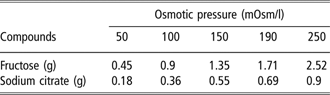
Hypotonic solutions of 50, 100, 150, 190 and 250 mOsm/l were prepared by dissolving Tri-sodium citrate dihydrate (6432; Merck®, Darmstadt, Germany) and D (−) fructose (F-0127; Sigma®, St Louis, MO, USA) in 100 ml of de-ionized distilled water (Table 1). Later, serial dilutions with 5% sodium citrate solution were carried out to obtain the desired strength of solution. The osmolarity of solutions was confirmed using a cryoscopic osmometer (Osomat® 030; Gonotech, GmbH, Berlin, Germany) (Correa and Zavos, Reference Correa and Zavos1994).
Composition of experimental hypotonic solutions
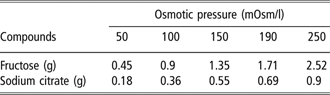
Hypotonic solutions were prepared by dissolving respective weights (g) of the fructose and sodium citrate in 100 ml of de-ionized distilled water and final osmotic pressure was obtained through serial dilution with 5% sodium citrate solution. Osmotic pressure was confirmed with cryoscopic Osmometer (Osomat® 030; Gonotech).
Preparation of supravital stain
Supravital stain was prepared by dissolving 1% eosin B (wt/vol, Art.1343, Merck®) and 5% nigrosin (wt/vol, Art.10172, Merck®) in 3% tri-sodium citrate dihydrate solution (Art. 6432; Merck®) (Bloom, Reference Bloom1950).
Experiment 1: determination of osmotic pressure of fresh semen and seminal plasma
Osmotic pressure of fresh semen and seminal plasma (1 ml each) was determined using an osmometer (Osomat® 030). Seminal plasma was harvested by centrifugation at 400 × g for 10 min at 37°C. Sixteen samples of seminal plasma were available for further processing as four samples were discarded due to low volume. The mean of three observations for each sample was taken as a single data point.
Experiment 2: effects of osmotic pressure on motility (%), plasma membrane integrity (%) and viability (%) in fresh and frozen-thawed semen
Effects of osmotic pressure on motility (%), plasma membrane integrity (%) and viability (%) in fresh and frozen-thawed semen samples was determined. Freezing of semen was carried out by extending fresh semen with Tris-egg yolk citrate (20% egg yolk and 7% glycerol). Extended semen was cooled slowly (approximately in 2 h) to 4°C and equilibrated for 4 h. French straws (0.5 ml) were filled with semen and sealed at 4°C. After holding in liquid nitrogen vapors (4 cm above the level of liquid N2) for 7 min, the straws were dipped in liquid nitrogen and stored at −196°C for further use (Ahmad and Chaudhry, Reference Ahmad and Chaudhry1980).
Evaluation of sperm motility (%)
Motility (%) in fresh and frozen-thawed semen samples was assessed using a phase-contrast microscope (×400) prior to the determination of the effect of osmotic pressure on plasma membrane integrity and viability. For frozen semen, three straws from each bull were thawed (37°C for 30 s), pooled and assessed for motility (%) within 1–2 min after thawing. The mean of three observations was considered as a single data point.
Evaluation of plasma membrane integrity (%)
Fresh and frozen-thawed semen samples, 50 μl each, were subjected to different osmotic pressures by mixing with 500 μl solution having an osmotic pressure of 50, 100, 150, 190 or 250 mOsm/l. Plasma membrane integrity of fresh and frozen-thawed spermatozoa and the magnitude of osmotic pressure were judged by the number of sperm tail swellings. Total of 200 sperms were counted under a phase-contrast microscope (×400). The mean of three observations was considered as a single data point.
Evaluation of viability (%)
Viability (%) in fresh and frozen-thawed semen samples was determined before and after challenging them to the varying osmotic pressure (hypotonic treatments) using supravital stain under a phase-contrast microscope (×400). A total of 200 sperms were counted for unstained (live) and stained/partially stained (dead) heads of spermatozoa. The mean of three observations was considered as a single data point. Loss of sperm viability at each osmotic pressure (hypotonic treatments) was determined by the following formula:

The same formula was used to determine the loss of sperm viability in frozen-thawed semen samples.
Statistical analysis
In both experiments, data were presented in the form of mean ± s.e. In the second experiment, effects of osmotic pressure (hypotonic treatments) on plasma membrane integrity and viability in fresh and frozen-thawed spermatozoa were analyzed using analysis of variance (ANOVA). Duncan’s multiple range test was applied for multiple means comparisons where ANOVA revealed significant effects (Quinn and Keough, Reference Quinn and Keough2002). Correlation coefficient of viability (before treatment) to plasma membrane integrity (at each osmotic pressure) was computed. Similarly, correlation coefficient of motility (%) to viability (at each osmotic pressure) was computed. Loss of sperm viability (%) at each osmotic pressure in fresh and frozen-thawed semen was analyzed by the Z-test. All statistical procedures were carried out using statistical computer software package Minitab Inc.® (1993; State College, PA, USA).
Results
Experiment 1: determination of osmotic pressure of fresh semen and seminal plasma
The mean ± s.e. osmotic pressures of buffalo semen and seminal plasma were 268.8 ± 1.17 mOsm/l (range 246 to 281 mOsm/l; n = 20) and 256 ± 1.53 mOsm/l (range 231 to 272 mOsm/l; n = 16), respectively.
Experiment 2: effects of osmotic pressure on motility (%), plasma membrane integrity (%) and viability (%) in fresh and frozen-thawed semen
Evaluation of sperm motility (%)
The mean ± s.e. motilities (%) of fresh and frozen-thawed semen samples from each of the seven Nili-Ravi buffalo bulls were 81 ± 1.57% and 60.1 ± 1.34%, respectively. Frozen semen samples showed decreased (P < 0.05) motility (%) as compared with fresh semen samples.
Evaluation of plasma membrane integrity (%)
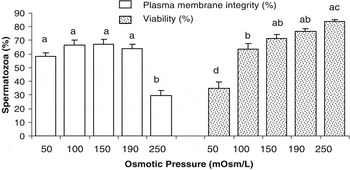
Plasma membrane integrity (%) of spermatozoa in fresh semen samples at each osmotic pressure is shown in Figure 1. The plasma membrane integrity (%) and magnitude of osmotic stress was higher (P < 0.05) at 50, 100, 150 and 190 mOsm/l than that at 250 mOsm/l. Values for correlation coefficient between sperm motility (%) and plasma membrane integrity (%) in fresh semen at 50 mOsm/l (0.349), 100 mOsm/l (0.42), 150 mOsm/l (0.41), 190 mOsm/l (0.13) and 250 mOsm/l (0.39) were non-significant (P > 0.05).
Effect of osmotic pressure, i.e. 50, 100, 100, 150, 190 and 250 mOsm/l on plasma membrane integrity (%) and viability (%) in fresh semen. Plasma membrane integrity (%) and viability (%) are shown in columns at each osmotic pressure. Columns with different superscripts indicate differences (P < 0.05) within a given variable. Data are mean ± s.e. Higher (P < 0.05) level of plasma membrane integrity (%) was observed in fresh semen at 50, 100, 150 and 190 mOsm/l as compared with 250 mOsm/l while viability (%) decreased (P < 0.05) at 50 mOsm/l as compared with 100, 150, 190 and 250 mOsm/l.

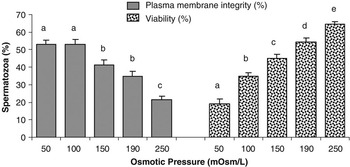
Similarly, plasma membrane integrity (%) in frozen-thawed semen samples at each osmotic pressure is shown in Figure 2. The plasma membrane integrity (%) in frozen-thawed semen and magnitude of osmotic stress was higher (P < 0.05) at 50, 100, 150 and 190 mOsm/l as compared with 250 mOsm/l. However, plasma membrane integrity (%) in frozen-thawed semen samples decreased non-significantly (P > 0.05) from 41.3 ± 2.99 at 150 mOsm/l to 34.8 ± 2.75 at 190 mOsm/l and significantly (P < 0.05) to 21.3 ± 2.04 at 250 mOsm/l. Values for correlation coefficient between sperm motility (%) and plasma membrane integrity (%) in frozen-thawed semen at 50 mOsm/l (0.54), 100 mOsm/l (0.10), 150 mOsm/l (0.14), 190 mOsm/l (0.66) and 250 mOsm/l (0.62) were non-significant (P > 0.05).
Effect of osmotic pressure, i.e. 50, 100, 100, 150, 190 and 250 mOsm/l on plasma membrane integrity (%) and viability (%) in frozen-thawed semen. Plasma membrane integrity (%) and viability (%) are shown in columns at each osmotic pressure. Columns with different superscripts indicate differences (P < 0.05) within a given variable. Data are mean ± s.e. Higher (P < 0.05) level of plasma membrane integrity (%) was observed in frozen-thawed semen at 50, 100, 150 and 190 mOsm/l as compared with 250 mOsm/l while viability (%) decreased (P < 0.05) at 50 mOsm/l as compared with 100, 150, 190 and 250 mOsm/l.

Evaluation of viability (%)
The mean ± s.e. viabilities (%) of spermatozoa in fresh and frozen-thawed semen before challenging them to varying osmotic pressure were 87.2 ± 3.66% and 71 ± 4.84%, respectively. Viability (%) of spermatozoa in fresh semen samples decreased (P < 0.05) at 50 mOsm/l as compared with other osmotic pressures (Figure 1). However, the viability (%) was higher (P < 0.05) at 250 mOsm/l as compared with 50 or 100 mOsm/l. Values for correlation coefficient between viability (%) (before treatment) and plasma membrane integrity (%) in fresh semen at 50 mOsm/l (−0.27), 100 mOsm/l (0.02), 150 mOsm/l (0.12), 190 mOsm/l (0.41) and 250 mOsm/l (−0.09) were non-significant (P > 0.05).
Similarly, the viability (%) in frozen-thawed semen decreased and differed significantly (P < 0.05) among varying osmotic pressures. The minimum viability (19 ± 2.78%) of spermatozoa was found at 50 mOsm/l while maximum viability (64.2 ± 1.93%) was at 250 mOsm/l (Figure 2). Viability (%) (before treatment) and plasma membrane integrity (%) in frozen-thawed semen at 50 mOsm/l (0.42), 100 mOsm/l (0.45), 150 mOsm/l (0.53), 190 mOsm/l (0.42) and 250 mOsm/l (0.50) were non-significant (P > 0.05).
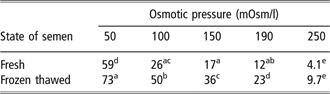
Loss of sperm viability (%) in fresh and frozen-thawed semen at each osmotic pressure is shown in Table 2. Maximum damage to viability of fresh (59%) and frozen-thawed (73%) sperm was observed at 50 mOsm/l, while the lowest damage (4.1% and 9.7%, respectively) was recorded at 250 mOsm/l.
Loss of viability (%) at each hypotonic solution in fresh and frozen-thawed buffalo bull semen
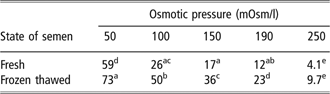
a,b,c,d,eDenote differences (P < 0.05) within rows. The loss in viability (%) was calculated in fresh and frozen-thawed semen samples by subtracting the total live spermatozoa at each osmotic pressure (hypotonic treatments) from total live spermatozoa before challenging them to osmotic pressure (hypotonic treatments) and then dividing with total live spermatozoa before challenging them to osmotic pressure (hypotonic treatments).
Discussion
The first objective of this study was to determine the osmotic pressure of buffalo semen and seminal plasma. The results of the first experiment showed that osmotic pressures of whole semen (269 mOsm/l) and seminal plasma (256 mOsm/l) in buffalo are lower than that of cattle (300 and 285 mOsm/l, respectively). The lower value of osmotic pressure of seminal plasma as compared with whole semen may be due to the concentration of spermatozoa in a sample, different rates of metabolism of spermatozoa and the time interval between collection of semen and determination of osmotic pressure (Rao et al., Reference Rao, Skies and Merilan1966). The basis of variation in osmotic pressure between cattle and buffalo semen is not known, as the exact composition of buffalo semen has not been investigated in detail. However, information on osmotic pressure of semen and seminal plasma of buffalo may be used to improve the cryopreservation of semen by developing a compatible extender to protect sperm from sudden changes in osmotic pressure (osmotic shock) during freezing and thawing procedures. Further, insight of the basic physiology of buffalo bull may help in understanding the effects of osmotic pressure on structural components of the sperm.
The second objective of the study was to determine the effects of osmotic pressure on motility (%), plasma membrane integrity (%) and viability (%) in fresh and frozen-thawed semen. Results showed that motility (%) significantly decreased in frozen-thawed semen as compared with fresh semen. This indicates that during freezing and thawing processes, sudden changes in osmotic pressure (osmotic shock) account for damage to spermatozoa (∼50%) and result in loss of motility (Blach et al., Reference Blach, Amann, Bowen and Franz1989; Hammerstedt et al., Reference Hammerstedt, Graham and Nolan1990).
In our experiment, plasma membrane integrity (%) indicated the extent of spermatozoa to tolerate changes in osmotic pressure. In fresh semen, the higher plasma membrane integrity (%) observed at 50, 100, 150 and 190 mOsm/l than that at 250 mOsm/l showed that as osmotic pressure approaches the actual osmotic pressure of semen, plasma membrane integrity (%) decreases or remains the same (Drevius, Reference Drevius1972). The findings are in agreement with the fact that in most mammals, normal sperms respond linearly to changes in the external osmolarity (Drevius and Erikson, Reference Drevius and Erikson1966).
The viability (%) decreases as osmotic pressure is lowered below 250 mOsm/l during cryopreservation. This depicts that the plasma membrane of spermatozoa is compromised at osmotic pressures lower than 250 mOsm in both fresh and frozen-thawed sperms (Figures 1 and 2). This finding confirms that lower osmolarity increases the swelling rate and results in premature membrane rupture (Nie and Wenzel, Reference Nie and Wenzel2001). Therefore, viability (%) in fresh and frozen-thawed semen was lower (P < 0.05) at 50 mOsm/l than at other hypotonic treatments (Correa and Zavos, Reference Correa and Zavos1994). The viability (%) recorded at each osmotic pressure in fresh and frozen-thawed semen despite the hostile osmotic pressure shows that some population of spermatozoa has the ability to resist minor changes in osmotic pressure as resistance to anisosmolarity is essential to prevent cell lysis and death (Meyers, Reference Meyers2005).
In the second experiment, frozen-thawed semen samples extended with Tris-egg yolk citrate buffer were used to judge the role of buffer in masking the sudden changes in osmotic pressure. This is contrary to the method of Correa and Zavos (Reference Correa and Zavos1994), in which buffer was removed and spermatozoa were suspended in modified sodium citrate medium with 2% fetal bovine serum albumin. However, the pattern of gradual decrease in plasma membrane integrity (%) in frozen-thawed spermatozoa from 150 to 250 mOsm/l is in agreement with Correa and Zavos (Reference Correa and Zavos1994).
A non-significant correlation between viability (%) (before treatment) and plasma membrane integrity (%) in fresh and frozen-thawed spermatozoa may be indicative of less damage to sperm plasma membrane (Pratap et al., Reference Pratap, Vishwanatha Reddy, Sarma and Honnappa2000). Similarly, a non-significant correlation between motility (%) (before treatment) and plasma membrane integrity (%) in fresh and frozen-thawed spermatozoa may be because sperm motility depends partly on ion transport (plasma membrane functional integrity) and partly on other biochemical activities such as sperm metabolism (Jeyendran et al., Reference Jeyendran, Van Der Van, Perez-Pelaez, Crabo and Zaneveld1984; Mandal et al., Reference Mandal, Nagpaul and Gupta2003). Further, these correlations could be non-significant due to biological variation as single ejaculate from each of the seven bulls was used in this study. This variation may be masked if more than two ejaculates from each of the seven bulls were studied.
On the basis of these findings, it is concluded that variation in osmotic stress below 250 mOsm/l is not favorable for sperm plasma membrane of fresh and frozen-thawed buffalo semen. However, it is suggested that the exact composition of plasma membrane of buffalo sperm should be determined because the capacity of sperm to respond with cell volume adjustment is also determined by membrane phospholipids composition, water permeability, lipid-phase transition temperature, Na+/K+ ATPase activity, water channels and ion channels (Meyers, Reference Meyers2005). Further research is needed to identify osmotic tolerance limits of buffalo sperm to understand the capabilities of sperm during freezing and thawing processes.
Acknowledgement
The authors are thankful to Dr Nasim Ahmad, Professor, Department of Theriogenology, Faculty of Veterinary Science, University of Veterinary and Animal Sciences, Lahore, Pakistan, and Dr Nazir Ahmad, Professor, Department of Animal Reproduction, Faculty of Veterinary Sciences, University of Agriculture, Faisalabad, Pakistan, for their help and advise in improving the manuscript and making it reader friendly.