Introduction
Growing evidence of the positive impact of fathers’ involvement on child outcomes has generated significant policy interest in identifying ways of supporting fathers to contribute to their children's development (Ball and Moselle, Reference Ball and Moselle2007; Lamb and Lewis, Reference Lamb, Lewis and Lamb2004; Flouri and Buchnan, Reference Flouri and Buchanan2003; Cabrera et al., Reference Cabrera, Tamis-LeMonda, Bradley, Hofferth and Lamb2000). In the UK, such thinking informed the 1998 government consultation paper, Supporting Families (DH, 1998), and associated interventions such as Sure Start and Children's Centres, aimed at supporting fathers and families, particularly those in disadvantaged neighbourhoods.
The intervening years have seen a steady stream of policy, guidance and practice documents highlighting the importance of enhancing fathers’ involvement. For instance, The Children's Plan: Building Brighter Futures (DfE, 2007a: 23) stresses the ‘need for public services to engage with both father and mother except where there is a clear risk to the child to do so’, while Every Parent Matters (DfE, 2007b) specifies that irrespective of the degree of involvement that fathers have in the care of their children, they should be offered the support and opportunities they need to play their parental role effectively. Aiming High for Children: Supporting Families (HM Treasury and DfES, 2007) committed new funding for work with fathers in Children's Centres, and the more recent government review Supporting Families in the Foundation Years (DfE & DoH, 2011: 37) stated that ‘government and the [foundation years] sector have a role to play in setting the right tone and expectation, and helping professionals to think about how better to engage fathers in all aspects of their child's development and decisions affecting their child’. Several performance management frameworks have been explicit about the need for services to systematically engage both fathers and mothers to improve children's wellbeing, and to consult with both parents over service planning and design (DfES, December 2006; DfES and DH, 2004). DfES (December 2006) guidance further specified that Children's Centres in the 30 per cent most disadvantaged areas must have ‘specific strategies and activities which increase the involvement of fathers’, and guidance documents have been produced that seek to share ideas about how to engage fathers and increase their confidence in relation to fathering (DfES, 2004).
Despite this apparent upsurge of policy interest in fathers, recent reviews have expressed concern that explicit recognition of fathers remains ‘partial and uneven’ (Page et al., Reference Page, Whitting and Mclean2008: 2), and that interventions on the ground have had disappointing results. A number of studies have identified a range of barriers to fathers accessing services, including: services being perceived to be for women or ‘problem fathers’, inconvenient timings and undesirable activities (Ghate et al., Reference Ghate, Shaw and Neal2000; Craig, Reference Craig2007; Page et al., Reference Page, Whitting and Mclean2008). Additional issues that have been found to undermine the effectiveness of fathering interventions include: a lack of clarity around the purpose of involving fathers, service insensitivity to fathers’ needs and the failure of practitioners to recognise the significance of fathers’ involvement when they are invisible to services (Page et al., Reference Page, Whitting and Mclean2008). While these problems relate to supporting fathers across the board, particular concern has been voiced regarding the unmet needs of minority ethnic and working-class fathers. It has been argued that policy and practice grounded in White middle-class values and experiences is often inappropriate for fathers from other, less privileged, backgrounds (Gillies, Reference Gillies2009; Lloyd et al., Reference Lloyd, O'Brien and Lewis2003; Gewirtz, Reference Gewirtz2001; Edwards and Gillies, Reference Edwards and Gillies2004). A number of reviews and evaluations highlight the poor uptake by minority ethnic and low income fathers of available services, including Sure Start facilities (DfES, 2006; Page et al., Reference Page, Whitting and Mclean2008; Lloyd et al., Reference Lloyd, O'Brien and Lewis2003), suggesting a mismatch between the dominant understandings and expectations of fathering and the lived realities of many UK men. Similarly, professionals who have direct contact with families, such as health visitors, doctors, teachers, language support workers, youth workers and prison staff, can undermine the involvement of fathers if their practice is based on inadequate understanding of the socio-cultural context of fathering (Ghate et al., Reference Ghate, Shaw and Neal2000; Tett, Reference Tett2001; Gillies, Reference Gillies2005; Gillies, Reference Gillies2006; Gewirtz, Reference Gewirtz2001; Evans, Reference Evans2006).
Until recently, there had been little research involving minority ethnic or working-class fathers in the UK or elsewhere (Marsiglio et al., Reference Marsiglio, Amato, Day and Lamb2000; Shears, Reference Shears2007; Lewis and Lamb, Reference Lewis and Lamb2007; Braun et al., Reference Braun, Vincent and Ball2011). This situation is changing with a small but growing body of work now offering the possibility of more adequately informed social policy. Adopting a fluid and complex notion of fatherhood, research is now providing greater appreciation of the cultural diversity that exists in fathering practices (Cabrera et al., Reference Cabrera, Ryan, Shannon, Brooks-Gunn, Vogel, Raikes and Tamis-LeMonda2004; Miller and Maiter, Reference Miller and Maiter2008; Gillies, Reference Gillies2006; Chuang and Tamis-LeMonda, Reference Chuang and Tamis-LeMonda2009; Shears, Reference Shears2007) as well as the contextual factors that can influence fathers’ inputs into, and priorities for, their children (Roer-Strier et al., Reference Roer-Strier, Strier, Este, Shimoni and Clarke2005; Roopnarine, Reference Roopnarine, Tamis-LeMonda and Cabrera2002; Behnke and Allen, Reference Behnke, Allen, Brotherson and White2006). For instance, Lareau (Reference Lareau2002) and Gillies (Reference Gillies2009) note that unstructured and less visible inputs may be more common among poorer and minority ethnic fathers than organised leisure activities that may be associated with better-off, White fathers (Braun et al., Reference Braun, Vincent and Ball2011; Miller and Maiter, Reference Miller and Maiter2008). This emerging body of work is beginning to demonstrate some of the ways in which fathering differs across cultural and socio-economic circumstances. There is now a need to further expand this understanding through more detailed investigation of fathering practices and experiences among minority and disadvantaged groups, and to translate this understanding more clearly into appropriate policy and practice responses.
The present paper contributes to this agenda by drawing on a qualitative study involving fathers and mothers with a range of Asian/British Asian religio-ethnic identities resident in two English cities. We chose to focus on Asians/British Asians both because fatherhood is a key component of identity for the majority of these men (Shaw, Reference Shaw2000; Modood et al., Reference Modood, Beishon and Virdee1998), and because fathers from these ethnic backgrounds have to date received little research attention, despite making up a large proportion of Britain's minority ethnic population. In Britain, the terms ‘Asian’, ‘British Asian’ and sometimes ‘South Asian’ are used to collectively identify people who trace their origins to the Indian sub-continent. Significant immigration to Britain from India, Pakistan and later Bangladesh has occurred since the 1950s, and these populations have formed established communities in many parts of the country. Recognising the significant heterogeneity within this aggregate term, the census and other state data collection systems usually allow individuals to self-identify as Indian/British Indian, Pakistani/British Pakistani, and Bangladeshi/British Bangladeshi separately, though these finer categories also conceal important religious, linguistic, caste and other socio-economic differences.
While detailed project findings have been reported elsewhere (Salway et al., Reference Salway, Chowbey and Clarke2009), the aim of the present paper is to highlight key dimensions of diversity in family form, parental expectations, fathering practices and constraints that warrant attention by policy-makers and practitioners. The aim is not to suggest that patterns of fathering are homogenous within minority groups, or that similarities of experience do not transcend ethno-cultural boundaries, but rather to promote better appreciation of the varied nature and context of fathering in our multi-ethnic society. This recognition should prompt us to question the underlying assumptions that shape current policy and practice interventions, and encourage the development of more flexible, sensitive and effective responses. The findings presented here will have relevance beyond the UK to the large number of other Western societies experiencing ethno-cultural diversification.
Method
The study upon which this paper is based aimed to understand: forms of father involvement, the ways in which fathering is constructed and negotiated through interactions between fathers and other actors, the role of wider societal and community-level structures in the construction of fathering and the use of child and family support services. The study focused on fathers of children aged three to eight years who self-identified as belonging to one of four religio-ethnic groups: Bangladeshi Muslims, Pakistani Muslims, Gujarati Hindus and Punjabi Sikhs. Fieldwork took place in a number of neighbourhoods across two English cities, London and Sheffield, during 2006–08.
We drew on the principles of critical ethnography (Wainwright, Reference Wainwright1997), giving a central place to the ways in which men described their experiences of fathering, while also seeking to situate these accounts within an understanding of the broader social structures that constrain and direct people's behaviours. A grounded approach was important so as not to limit our investigation, particularly since so much prior research on fathers has been conducted in dissimilar social settings. Our methods and approach also attempted to create ‘space’ in which minority ethnic respondents could express their own experiences and concerns (Pollack, Reference Pollack2003).
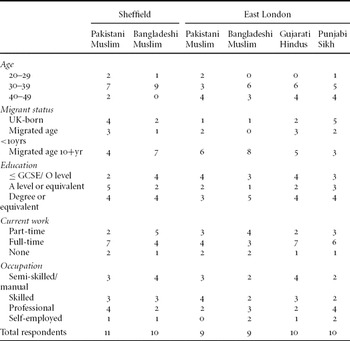
There were two phases of data generation. Phase One gained a broad understanding of: social and economic context and understandings of family, parenting and fatherhood. A series of data generation methods were used involving over eighty informants: key informant interviews with a wide range of individuals with detailed knowledge of the communities of interest including community development workers, teachers, school liaison officers, local business people and religious leaders (n = 34); focus group discussions with mothers and fathers (n = 11 involving over thirty respondents); and open-ended interviews with fathers (n = 8). In addition, informal observations (n = 8) were conducted at religious places, schools and community centres. This phase also informed interview guideline development for Phase Two and identification of respondents. In Phase Two, fifty-nine in-depth interviews were conducted with fathers recruited through a range of community networks (rather than clinical/service settings). Respondents were recruited to represent a wide range of socio-economic, educational and migratory circumstances. In addition, thirty-three interviews were conducted with paired mothers (since mothers clearly play a significant part in shaping fathering). Respondents were interviewed in the language and location of their choice by bi-lingual researchers. Interviews were digitally recorded, transcribed and, where necessary, translated into English in full with a focus on retaining conceptual equivalence. Our research team included four female professional researchers supported by a number of community researchers – predominantly fathers who identified themselves as members of one of the four religio-ethnic groups. Table 1 below provides the profile of the fathers who took part in this study.
Summary characteristics of fathers

Analysis of findings was ongoing during data collection. Researchers kept field diaries and held regular meetings and analysis workshops in which emerging findings and ideas were shared. A combination of a code−search−retrieve and a holistic thematic analysis approach was adopted. The code−search−retrieve involved coding sections of each transcript and compiling them using a standardised framework. In the holistic thematic analysis, each father's transcript was analysed as a whole, together with field notes and the mother's transcript. Emphasis was on identifying both explicit and implicit themes running through the transcripts, which may or may not have been clearly expressed in the interviews, to avoid over-reliance on respondents’ spoken words, since there was significant variation in articulacy among respondents.
Our theoretical approach to ethnicity acknowledged the dynamic and contested nature of ethnic boundaries and cultural formations (Hall, Reference Hall, Hall, Held and McGrew1992; Gunaratnam, Reference Gunaratnam2003; Modood, Reference Modood1988; Nazroo, Reference Nazroo2006). At the same time, however, we recognise that identity formation remains ‘deeply rooted in the organisation of society’ (Ville and Guerin-Pace, Reference Ville and Guerin-Pace2005: 237), so that there are limits to the ways in which individuals, and communities, can fashion their identities. In particular, holding a racialised identity remains a central element in the experience of minority ethnic individuals in the UK (Jenkins, Reference Jenkins1994; Modood, Reference Modood1988, Reference Modood1998; Karlsen, Reference Karlsen2004). Family and wider ethnic structures may also constrain individual identity formation both directly through sanctions and indirectly via the potential loss of rights and claims. Thus, we recognise the importance of ‘sameness’, identification and belonging (Mac an Ghaill, Reference Mac an Ghaill and Mac an Ghaill1999); in other words, the processes of inclusion as well as those of exclusion. We therefore suggest that ethnic groups are ‘neither an essence nor a fiction’ (Modood, Reference Modood2007: 115), and subscribe to Bhavnani and Phoenix's notion of (ethnic) identity as the ‘site where structure and agency collide’ (Reference Bhavani, Phoenix, Bhavani and Phoenix1994: 6). We seek to avoid the reification of ethno-cultural difference, while nevertheless drawing attention to the particular experiences of minority ethnic fathers in the UK context.
Findings
Our findings demonstrate the great diversity that exists within the religio-ethnic ‘groups’. No single, typical model of Asian/British Asian fatherhood stood out, and across all four religio-ethnic communities we found great variety in fathering practices. Furthermore, many of the themes highlighted in our study echo those reported in prior research with White majority fathers, including a persistent emphasis on fathers’ income-earning role, the constraining influence of gendered stereotypes and the widespread expectation that fathers will be ‘involved’ with their children (see, for example, Lewis, Reference Lewis2000).
At the same time, however, the context, practice and experience of fathering among our respondents highlighted a number of dimensions of diversity that are currently under-recognised within policy and practice. Below, we describe four key areas giving detailed illustrations from our fieldwork. We then describe the fathers’ engagement with services and how these link to these aspects of fathering. We draw heavily on the fathers’ own words but also use short vignettes to support claims where common themes were not necessarily clearly articulated in one place by respondents.
Recognising diversity in family forms and childrearing arrangements: fathers and mothers do not necessarily constitute an autonomous unit
While we found some autonomous father−mother diads, many respondents lived in households with varying degrees of involvement of other actors, particularly grandparents. A variety of family living arrangements were observed, including extended and joint households, relatives living on the same street with frequent interaction and sharing of some functions and also transnational families that involved frequent movement of members between the UK and the Indian sub-continent. Our empirical data illustrated the ways in which both the inputs to child-rearing (what and by whom) and the child outcomes that resulted had significant implications for actors apart from fathers and mothers. In other words, people aside from mothers and fathers had an important stake in children's upbringing, and, as such, households could be seen as sites of cooperation and conflict maintained through involvement of multiple actors. Furthermore, a need to ensure continued familial support often led to the expansion of household boundaries to include other actors, particularly grandparents, who also had claims on the father's time and resources. Another Punjabi Sikh mother described how she and her husband went ahead and had a second child for the sake of her mother-in-law, even though they would have preferred to have just one child. The inter-dependence of family members was also clearly evident in the following narrative of a Pakistani father:
When my grandmother was alive, we used to keep her for a month or two then my uncle in Birmingham then my other auntie in Leeds. They used to take it in turns a few months. This is the kind of family system we would want to have. (Pakistani Muslim father, 30–39 years, UK-born, low-skilled)
Such intergenerational interdependence was found to shape some men's relationship with their wife and fathering inputs:
My wife at the start resented my parents because I wasn't a very good husband because I was a very good son . . . I used to explain it to her; the way I am to my parents one day Rohan will be like that to us . . . he will grow up knowing to give his life for us. (Punjabi Sikh father, 30–39 years, UK-born, professional)
In many households grandparents were heavily involved in childcare, in some cases providing the whole range of inputs and in others having particular responsibilities such as teaching religion and culture. One father described how he relied on his parents to provide structure to his son's life.
I'm a bit of a boy . . . sometimes I mess around. But they [grandparents] always seem to have a control structure Kunal can see all the time. (Punjabi Sikh father, 30–39 years, UK-born, professional)
As well as having a stake in how children were raised, grandparents had a stake in the economic security of the household and made competing claims on fathers’ time. This had implications for a father's ability to be involved in children's lives, particularly when grandparents and other close relatives were living outside the UK. Several fathers reported making frequent trips to the Indian sub-continent to fulfil their felt obligations. Some grandparents, especially paternal ones, encouraged their sons to focus their attention on strengthening the household income and offered to help with childcare responsibilities, in some cases relieving them entirely of childcare responsibilities. A secure income was recognised as important for ensuring children's wellbeing, as well as the wellbeing of the wider family.
Financial support is the most important support needed in a family . . . If this is there, then, then the family situation would be good because of which child can be looked after in a proper manner. (Bangladeshi Muslim father, 40–49 years, Bangladesh-born, low-skilled)
Some fathers who had prioritised their caring role over-and-above their income-earning role reported receiving strong condemnation from other family members and there could be lasting repercussions on family relationships.
No, my parents actually give Satish more attention. Sanju [sick child] is usually ignored! My dad sees Sanju as being someone who has probably cost me financially a lot of because I took a year off to care for him. (Gujarati Hindu father, 30–39 years, UK-born, professional)
Reflecting the constitution and boundaries of the household, fathers were found to provide inputs to their children via other family members, particularly grandparents. For instance, fathers were found to access information about the child for monitoring purposes and to delegate tasks to be performed by others. This seemed to work well for one Gujarati Hindu father who had long working hours but still was heavily involved in his son's upbringing.
[vignette]
Amit works for six and a half days in a shop, leaving at 7am and returning home after 8pm. Amit says his boss is a nice man and from his community. He has never had a problem with him if he needs a day off. But he feels he is missing out a lot on his son's childhood. He is very glad that the grandparents are there to look after his son. He tells his in laws what needs to be done for his son and they do it. Amit says, ‘sometimes if the weather is good, I will ask my father-in-law to take my son to the park. So even if I am not there, he is able to go.’ (Gujarati Hindu father, 30–39 years, India-born, low-skilled)
Though the roles, responsibilities and entitlements of different family members were varied and often contested, our data clearly illustrate the potential to misunderstand the nature of fathering if we erroneously assume that fathers and mothers constitute an autonomous unit and fail to identify other actors and their influences over child-rearing and fathering inputs.
Appreciating diversity in fathers’ understandings of desirable child outcomes
The majority of the fathers in this study talked about providing a religio-ethnic identity to their children through teaching them their religion, language and culture. Knowledge of traditional food, clothing and appropriate greetings were considered important. Many fathers identified obedience, respect for elders and conformity as highly desirable qualities in children, suggesting a divergence from the dominant White middle-class perspective which may value inquisitiveness (as noted in professional key informant interviews).
Knowledge begins with respect your Mum and Dad and your teachers and you'll be ok. (Bangladesh Muslim father, 30–39 years, Bangladesh-born, low-skilled)
Parents who failed to inculcate a religio-ethnic identity were considered a poor example. Those who produced children who were confident and successful within mainstream UK society, but at the same time were adept and comfortable interacting within the private spaces of their religio-ethnic community, were held as role models.
He needs to be confident in walking into Gurudwara, he needs the harmonium lessons. They get it all in Gurudwara. It's got Punjabi language school. Our community's geared totally to educating our children and instilling Sikh values in them. (Punjabi Sikh father, 20–29 years, UK-born, professional)
Our language is Mirpuri, it is important that they learn it, because obviously they will need it! (Pakistani Muslim father, 30–39 years, UK-born, self-employed)
There is a need to recognise the competing priorities and conflicts that fathers face in providing inputs to their children which may not be compatible in terms of time and resources. While clearly all fathers face such compatibility issues, minority ethnic fathers appear to face some particularly difficult choices, given their marginalised position in society. In particular, since some of the inputs considered necessary for achieving particular desirable child outcomes are not well provided for by mainstream services (notably religious education), minority ethnic fathers may choose to make their own provision for these inputs with associated implications for other types of involvement. Indeed, while some professional key informants expressed concern about the adverse effect of long learning hours at the mosque following normal school hours, many of our fathers saw religious education as key to ensuring that children grow up to be a respected member of their religio-ethnic community. Though religious education was often achieved at the cost of reduced time in direct interaction with their children, it was considered an important input for the majority of our respondents. Abdul's situation illustrated this common conflict:
[vignette]
Abdul is an Imam in a local mosque. He picks up six-year old Hamid after school and takes him to mosque every day. Hamid's Koran lessons finish at 7pm. Abdul's wife, who volunteers at the mosque, does not feel confident taking three kids by bus at night, and so they all go home when Abdul finishes at 9:30pm. Sometimes Hamid falls asleep in the mosque. Abdul feels bad that Hamid is not able to read at bedtime or relax at home but does not know what to do. (Pakistani Muslim father, 40–49 years, Pakistan-born, religious leader)
Policy-makers and practitioners clearly need to be aware of ways in which particular inputs may be more or less compatible. Failure to provide particular inputs may not reflect a lack of understanding or a failure to value certain things on the part of fathers, but may rather result from constrained choices or different desired child outcomes. Though notions of desirable child outcomes are dynamic and contested – as illustrated by the sharply divergent ideas we found between some of our mother–father pairs – our data keenly illustrate the need to explore, rather than assume, the understandings that fathers have since these will have an important influence on the choices they make for, and the inputs they provide to, their children.
Appreciating and addressing additional obstacles to achieving similar outcomes
Our empirical data revealed some of the challenges that minority ethnic fathers face in order to achieve desired outcomes for their children. The majority of fathers reported providing inputs aimed at addressing additional obstacles faced by their children due to their minority ethnic status as part of their key responsibilities. For example, dealing with racism and the perceived hostile external environment was a priority for many fathers. Some respondents recognised these inputs from their own fathers as very significant and responsible for their own success in life.
That's want I want to instil in my son. It's just to have confidence and that's a vital role my Dad had on me. Just to give me a man's confidence to deal with things and issues [racism]. (Punjabi Sikh father, 30–39 years, UK born, professional)
A primary theme emerging from our empirical data was the need to adequately prepare their children for active and successful participation in UK society. Fathers – particularly those who were less financially well-off and were unemployed or in low-skilled employment – expressed this as: ensuring the child is fluent in English (including the use of idioms and so on); providing the child with experiences felt to be typical of the majority, e.g. holidays and trips; and building confidence and aspirations. With regard to producing a child who is a successful member of mainstream British society, a father stated:
My daughter] has got a private tutor to teach her English. I don't teach her English. The reason is my accent, because it will be deep. (Bangladeshi Muslim father, 30–39 years, Bangladesh-born, low skilled)
Another father felt that being a migrant and lacking the language and knowledge of the system to help children flourish at school meant that children do not get adequate support from their parents:
And that's sort of a disadvantage for us obviously going to schools, pre-schools going to secondary school there's certain things you'd be lacking you know as you can't really go to your parents and ask them to help you with your homework. (Punjabi Sikh father, 30–39 years, UK-born, professional)
Some fathers expressed their frustrations with the attitude of their children's school teachers. For instance, a first generation Bangladeshi respondent was considering moving to an area which had a smaller minority ethnic population as he felt the teachers in his son's school did not have high expectations for his educational achievement. Ali shared his story:
[vignette]
Ali was racially bullied in his childhood. He feels that things have improved, but racism is still out there. He wants to protect his son from being bullied. Ali behaves like a friend to his son, so that his son shares his experiences outside home and Ali can spot things if they start to go wrong. He also tries hard to establish his son as a member of the religio-ethnic community so that he is not isolated if he is discriminated against in school. Ali says he would rather talk to his son than read to him at bed time, because it is more important to know that his son is ok than focussing on the academic side of things. (Pakistani Muslim father, 40–49 years, Pakistan-born, unemployed)
The above examples illustrate the ways in which most of the fathers in our study were acutely aware of the social context in which their children were growing up and were actively engaged in providing inputs to their children that they felt were necessary to support their positive development. Greater understanding of the obstacles that fathers face in achieving similar outcomes for their children will enable policy-makers and practitioners to address fathers’ concerns and to design services which tackle exclusion at various levels.
Understanding that the boundaries and content of fathering are not universally recognised
Understandings of what fathers should and should not do were found to be reinforced by other actors in the family and wider community, leading to encouragement for certain types of behaviour and discouragement of others. Many fathers were actively discouraged from providing inputs that were socially not expected of them. For example, one father skipped bathing his four-year-old daughter for days when his wife was sick because it was considered inappropriate for him to do so. Another father who had earlier worked long hours but went part-time to look after his daughter had to face disapproval from his family and friends:
My friends still can't believe I went part time to look after A. I tended to stay away from Asian areas when I used to take A out because I knew people would talk. (Pakistani Muslim father, 30–39 years, UK-born, professional)
Other fathers reported concealing things that they did for their children from their relatives and friends for fear of being ridiculed or reprimanded. These included, in particular, those inputs which could be construed to be part of a wife's role, such as cooking, feeding and washing children's clothes, illustrating the ways in which the socially constructed boundaries of fathering are intimately connected to the gendered division of labour within households. These fathers were clearly contesting, albeit silently, the boundaries of fathering as constructed by other significant actors, reminding us that there is variation both within and between religio-ethnic groups that fathering support intervention should be alert to.
Further, childbirth and pregnancy were often considered to be shameful for men. Many respondents reported limited involvement in their wife's pregnancy or the birth of their child, and explained this in terms of pregnancy and childbirth being ‘ladies’ business’. However, these sorts of restrictions tended to occur where older relatives were more closely involved, reflecting both a stronger adherence to ‘traditional’ gendered norms and the fact that alternative, female support was available to the pregnant woman. In other cases, men did not appear to face these gendered restrictions. Dheeraj described his experience:
We believe in close family tie ups so I won't say I was much involved in the pregnancy but yes I would ask her what I should be doing . . . Because the way traditions work in [our culture], after seven months she goes to her parents place. I didn't want that to happen but after seven months she was almost with her parents. (Gujarati Hindu father, 30–39 years, Gujarat-born, low-skilled)
Clearly, fathering practices are socially embedded and our fathers faced constraints on breaking ranks and behaving in way which deviated from existing norms, despite their obvious desire in some cases to do so. Judging fathering through the dominant lens of the White middle class can lead to a failure to appreciate the different ways of arranging childcare and for some fathers’ lack of involvement in some aspects reflects both individual circumstances and culture-specific fathering practices. However, there are many fathers who want more involvement and could benefit from a more sensitive approach that recognises the need to build confidence, share experiences and legitimise more involved fathering. Working with community members to appreciate different ‘ways of being a father’ may help create a space for a broader range of fathering practices without necessarily undermining current contributions.
Engagement with services
The need for greater policy and practice appreciation of the four areas highlighted above was also reflected in the patterns of service uptake and experiences of services reported by our fathers. The fathers in our study knew little about the services on offer in their area and did not perceive them to be welcoming. Some fathers expressed their disappointment that much of the provision for young children and parents was female oriented.
In this area, you will find that there are a lot of clubs available for women . . . but there is nothing for men. The only thing is the local mosque or centre, who say . . . come let's sit and chat. (Bangladeshi Muslim father, 30–39 years, UK-born, low-skilled)
I personally take my children but stand aside and wait for them to finish their activities. (Bangladeshi Muslim father, 30–39 years, Bangladesh-born, low-skilled)
Only a handful of fathers had any experience with the family support services, and the majority had found them to be patronising, undesirable and inconvenient. Respondents said that they felt under scrutiny when they participated and found parenting skills-building courses unattractive.
My wife has been going there every Monday and that's no big deal. But one Monday I took my daughter and suddenly, as an Asian father, I was the centre of the attention. They took my photo and put it on their newsletter, I felt really uncomfortable. (Punjabi Sikh father, 30–39 years, India-born, professional)
To be honest with you I don't really think that helps. It's like we use psychologists to look at the whole aspect of behaviourism. I'm not sure how much of an impact that has on fathers . . . to have like a community of support, where you have social interactions every day . . . would probably be better. (Bangladeshi Muslim father, 30–39 years, UK-born, low-skilled)
With regard to sources of advice on parenting-related issues, the majority of the fathers reported relying on family and friends, especially their mothers and mother-in-laws.
When I talk to my family in India, we discuss about the education. How bring them up, which line they can go and those sorts of things. (Gujarati Hindu father, 40–49 years, Gujarat-born, low-skilled)
Some fathers had concerns that advice from ‘experts’ may not be useful as they needed information about ‘Asian’ ways of fathering rather than ‘English’ ways. In contrast, however, there were some fathers who wished they had the opportunity to learn about better parenting through experts.
I mean, that experience of parenting that you have, it's what your parents have taught you. You have seen them parenting yourself. I don't want to bring my child up that way. But what other way is there? (Punjabi Sikh father, 40–49 years, Africa-born, professional)
Interestingly, many fathers spoke positively about school teachers. Several fathers narrated positive interaction and support given by teachers to help children's academic performance, again suggesting that fathers often take an interest when they perceive the inputs from professionals to be relevant. Though some fathers expressed their inability to establish rapport with their children's teachers because of language issues, others had used interpreters to enable communication with school staff. The majority of the fathers emphasised the need to work together with teachers to achieve a common goal in their children's education.
Actually if we keep up the relationship with the teacher then . . . I know as to what are the difficulties the child is having in school. (Gujarati Hindu father, 30–39 years, Gujarat-born, low-skilled)
However, some fathers felt that teachers should do more to encourage and accommodate fathers’ needs, specifically in relation to work demands.
Fathers tended to express a preference for activities which were aimed at equipping children with desirable academic and religious educational outcomes. Many fathers were observed to be taking part in activities run by local religio-ethnic organisations which sought to enhance children's knowledge of the culture and religion, music and food, as well as those that focused on core academic skills, such as maths and language skills. Fathers accompanied their children and actively shaped these services. In addition, some fathers wanted to provide a counterpoint to mainstream culture.
I mean there's too much peer pressure . . . the things they need to buy . . . conform to what all the other children are doing. I'm worried about when she grows up and starts to finally be, not a girl, but more a lady. (Punjabi Sikh father, 40–49 years, Africa-born, professional)
Though the general belief is that minority ethnic fathers are difficult to engage with, our findings suggest a lack of engagement with formal family support services was not indicative of a lack of involvement in children's lives, but rather often reflected a perception that most of what is on offer is unhelpful or irrelevant. As one father said:
Support? . . . the way things are happening in our lives . . . is fine so I would not need any support. (Gujarati Hindu father, 30–39 years, Gujarat-born, low-skilled)
Conclusions
Previous work has raised concerns that current UK policy and practice are inadequate for supporting fathers from diverse cultural and socio-economic backgrounds (Gillies, Reference Gillies2009; Miller and Maiter, Reference Miller and Maiter2008; Page et al., Reference Page, Whitting and Mclean2008). It has been argued that a lack of understanding of minority cultures and religions can lead to both the pathologisation of minority family values and practices and a tendency to stereotype, leading to erroneous assumptions about individual needs and preferences (Atkin and Chattoo, Reference Atkin and Chattoo2007). The present paper adds to these general cautions by highlighting key issues that need to be appreciated and addressed for effective engagement with fathers from a range of socio-cultural backgrounds.
The study revealed a variety of family arrangements, but also highlighted the important role of grandparents and other family members in child-rearing processes and their significant claims on fathers’ time and resources in some households. Recognising that fathers and mothers do not necessarily constitute an autonomous unit alerts us to the need for policy-makers and practitioners to have knowledge about the context of specific parenting norms and practices in order to ask appropriate questions of fathering patterns and to provide effective support mechanisms. Previous research has noted the variety of family structures and functions across socio-cultural settings (Roopnarine, Reference Roopnarine, Tamis-LeMonda and Cabrera2002; Miller and Maiter, Reference Miller and Maiter2008). There is also a need to recognise the varied routes through which fathers can be involved in childrearing. Though not exclusive to minority fathers, the provision of inputs via other actors, particularly grandparents, was clearly shaped by household form as well as constraints imposed by a disadvantaged position in the labour market.
Providing children with an understanding of religion and culture and promoting interdependence between family members were viewed as important roles for fathers. These inputs sometimes competed with other inputs such as academic or extra-curricular activities. However, failure to provide any particular inputs may not reflect a lack of understanding or a failure to value certain things, but may rather result from constrained choices or particular priorities amongst desirable child outcomes. We need to be alert to choices that fathers make with regard to the provision of inputs, and the ways in which these may be constrained for minority ethnic fathers. Current fathering policies and practice are informed by understandings of desirable child outcomes commonly held by White middle-class parents (Evans, Reference Evans2006; Gewirtz, Reference Gewirtz2001). Earlier work has illustrated ways in which structural and cultural factors shape people's notions of an ideal child (Harwood et al., Reference Harwood, Handwerker, Schoelmerich and Leyendecker2001; Lareau, Reference Lareau2002), suggesting that it is unsatisfactory to assume that all parents share similar notions of desirable child outcomes.
Dealing with racism and with what they perceived as a hostile environment was a priority for many fathers. The need to adequately prepare their children for active and successful participation in UK society by providing them with experiences felt to be typical of the majority was felt to be a priority. Previous research has also noted parenting inputs aimed at countering hostile environments and discrimination (Gillies, Reference Gillies2006; Lareau, Reference Lareau2002; Archer, Reference Archer2011). Current policy and practice documents fail to recognise the significance of these additional sets of inputs that minority ethnic (and working-class) fathers may need to provide for their children to achieve similar outcomes to those of children from more privileged backgrounds.
The boundaries and content of fathering are socially and culturally constructed and variable over space and time. Many fathers were actively discouraged from providing inputs that were socially not expected of them (e.g. changing nappies, or bathing daughters) by mothers, grandparents or even members of the wider religio-ethnic community. An understanding of fathering therefore requires us to examine a range of socio-economic and cultural influences on fathering and not just specific fathering behaviours and practices, which can carry different meanings and implications in different socio-cultural contexts (Mahtani and Bond, Reference Mahtani Stewart and Harris Bond2002).
By carefully examining the form, content, meaning and context of father involvement among a sample of minority ethnic fathers, we have gone some way to enhancing understanding of aspects of ethno-cultural diversity in family forms and parenting practices. While we have chosen to focus here on issues that tended to cut-across our socio-economically diverse sample, and therefore have widespread relevance, it should be acknowledged that class does intersect with ethnic identity to pattern fathering experiences and practices. For instance, we found that some better-off fathers made provision for private religious education at home, thereby avoiding their child having to spend lengthy periods outside the house. Notwithstanding the potential for further analysis, the findings presented here should help to challenge the pathologising of alternative values and practices, promote better understanding and encourage a flexible and constructive approach to supporting fathers from diverse backgrounds. Policy-makers and practitioners need to appreciate, as Evans argues, that it is possible to have alternative parenting patterns and still lead a decent, prosperous and fulfilling life (2006). As suggested by the recent literature reviewed above, the issues highlighted in this paper are likely also to have relevance in relation to fathers from lower socio-economic groups (‘working-class’ fathers). We hope this paper encourages researchers, policy-makers and practitioners to gain a deeper understanding of the realities of fathering and to respond in ways that support, rather than undermine, fathers and their families.