


Introduction
The practice of medicine can be difficult in the ever-changing landscape related to emerging pathogens and infectious diseases. A prime example of this is the COVID-19 pandemic where healthcare teams needed to quickly adapt to a new disease and clarify aspects related to epidemiology, transmission, diagnosis, treatment, infection control, and prevention [Reference Falope, Nyaku and ORourke1]. Healthcare providers must continuously and rapidly adapt to provide the best care for their patients. Cutrer et al. [Reference Cutrer, Miller and Pusic2] propose the concept of a Master Adaptive Learner (MAL) as a metacognitive approach to learning based on self-regulation, helping individuals investigate new concepts and create new solutions.
A major challenge emerged in the Summer 2022 with the onslaught of Mpox, previously known as monkeypox, in North America [3]. Previously a zoonotic disease with prior cluster outbreaks related to travel or exposure to affected animals, a massive wave of infection arrived in the USA and other previously non-endemic areas, with transmission primarily sustained through sexual contact [4]. Mpox is a viral illness caused by the monkeypox virus, a species of the genus Orthopoxvirus, that is rarely fatal and characterized by fever, rash, painful skin lesions, and flu-like symptoms. Incubation time from exposure to onset of symptoms is approximately 1–2 weeks [Reference O’Shea, Daskalakis and Brooks5] with resolution of the illness in approximately 4 weeks [3].
Mpox disproportionately impacts people living with HIV infection [Reference Lima, Kroon and Campos6], with those with advanced disease and severe immunodeficiency at risk for more severe complications including higher risk of death. Clinical challenges, genomic advances, and prevention strategies are an important part of healthcare training and ongoing surveillance and treatment strategies. The Mpox outbreak prompted the need to develop a one-session program to ensure screening and treatment of patients in the clinic and appropriate infectious disease practices considering this new outbreak. This situation afforded an opportunity to explore how our learners adapted to both the COVID-19 pandemic and superimposed Mpox outbreak. Our guiding questions focused on the level of preparedness for this uncertainty. We applied the MAL framework to self-assess our approach to the training and mentorship of these learners so that they could respond with agility and competence in clinical practice amid uncertainty. Residency is typically understood as a transitional period from medical school to independent practice, during which residents develop clinical judgment and specialized knowledge through supervised, hands-on experience and structured, evidence-based education. Application of the MAL framework may extend conventional residency experiences to clearly target teaching of adaptive expertise that is needed amid times of continued uncertainty and complexity [Reference Sandelowski7], such as the Mpox outbreak of 2022.
This manuscript explores the concept of the MAL through a focus group of 5 Internal Medicine residents who provided care at a LGBTQIA+ health center during the spread of Mpox to the USA in 2022. The learners received multiple forms of prior education including formal didactics in medical school and residency, specifically assigned asynchronous self-study modules, experiences derived from clinical rotations, and lived experiences. We explored how the medical residents demonstrated characteristics of the MAL related to a willingness to learn and adapt to new environments, including caring for a stigmatized LGBTQIA+ population and people living with HIV, during the spread of the emerging Mpox outbreak.
Learners had previously completed two self-directed, one-hour, asynchronous online modules related to culturally specific clinical care. “Closing the Gap towards Sexual Orientation and Gender Identity (SOGI)” and “Cross-culture for Clinical Care” were administered through the didactic medical education program prior to immersion in the LGBTQIA+ clinical setting. The clinical setting discussed in this paper embraces a Pride Care clinic that exposes residents to LGBTQIA+ centric care and is an affirming space. Residents spent one day in the Pride Care clinic interacting with patients and staff and were exposed to the multidimensional aspects of various needs within this population, especially gender-based care. Learners gained varied education and experience related to didactic lectures in medical school and residency, specific education, role-modeling, and coaching from attending physicians on clinical rotations. Learners gained experience through their individualized self-lived experiences, which are uniquely based on race, sexual orientation, gender identity, culture, and socioeconomic class.
Methods
This was a quality improvement effort to explore how medical learners utilized their culturally specific clinical care training to address challenges associated with the Mpox outbreak superimposed on the COVID-19 pandemic in a Pride Care clinic. In the analysis of findings, an applied interpretive approach was utilized, as this is commonly used in the health sciences with a focus group [Reference Hsieh and Shannon8]. This was conducted in September 2022 by a trained facilitator and two co-investigators, using a semi-structured interview guide. The focus group was audio-recorded online using the Zoom platform and was transcribed verbatim. Participants were purposefully recruited and included internal medicine residents of various post-graduate years in clinical practice. Residents participated in the care of patients of the LGBTQIA+ community at the Pride Care clinic, including people living with HIV.
Data analysis
Data were analyzed using directed content analysis [Reference Morse9]. We created an a priori codebook based on characteristics, skills, and the adaptive expertise continuum outlined by Cutrer et al. [Reference Cutrer, Miller and Pusic2] for developing MALs. Three co-investigators individually coded the transcript using the codebook. The dependability of analysis was upheld with team meetings to discuss coding and to reach consensus on the final analysis [Reference Farkas, Allenbaugh, Bonifacino, Turner and Corbelli10].
Results
Five medical residents verbally consented to participate in the focus group. Formal consent was not required, as this was a quality improvement project. The medical learners interviewed included four (4) first-year internal medicine residents and one (1) third-year internal medicine resident.
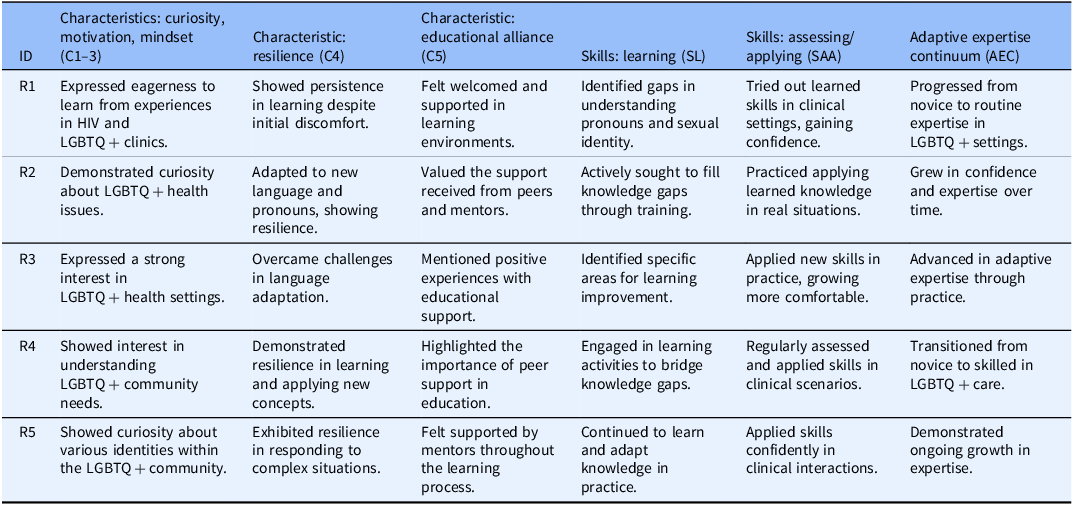
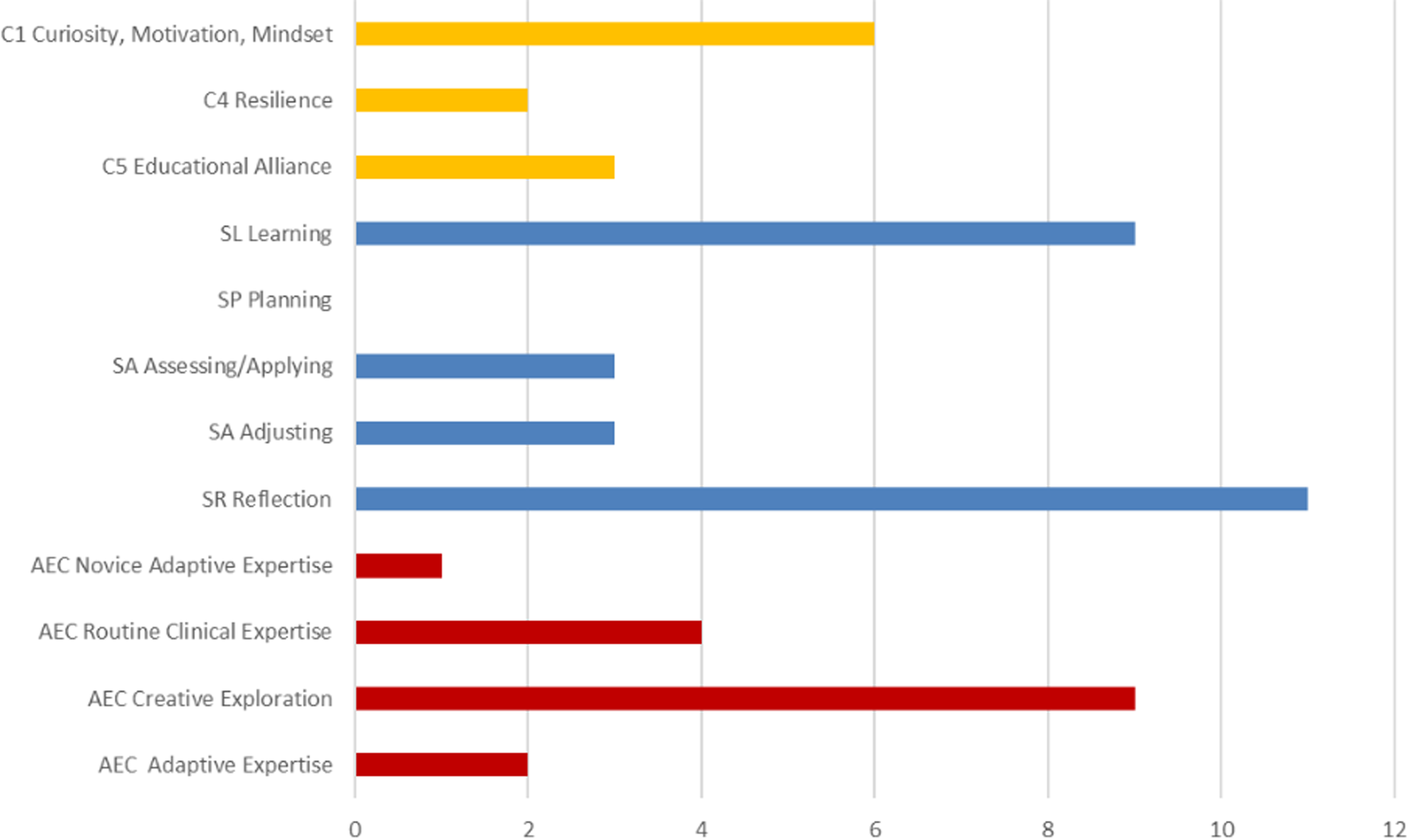
Table 1 provides a summary overview of the coding for each medical resident targeting the skills and adaptive expertise continuum within the MAL framework. Figure 1 illustrates the frequency of coding.
Results of coding using the Master Adaptive Learner (MAL) framework[Reference Cutrer, Miller and Pusic2]

R = resident; C = characteristic. SL = skills learning. SAA = skills assessing/applying. AEC = advanced expertise continuum.
Frequency of counts in coding using Master Adaptive Learner (MAL) Framework [Reference Cutrer, Miller and Pusic2]. C = characteristics; S = skills; AEC = advanced expertise continuum.

Medical residents demonstrated characteristics of a strong desire to learn and adapt, demonstrating curiosity and motivation as they engaged in new environments and language. For example, one resident stated, “And obviously, they [clinic staff] underwent all the proper PPE precautions and all of that, and they were really eager to dive into the most up-to-date research about it [Mpox]. So we pulled up the [higher education institution training] guidelines on how to treat that and we all kind of read through it and we all like after reading through it, you know, all of us together, actually even providers who weren’t directly involved just because they wanted a better understanding of what to do if they were to experience it.”
Despite initial discomfort, they showed resilience by persisting in their learning. The educational alliance was evident as residents expressed feeling supported by staff peers, facilitating their learning process. One resident stated, “[the LGBTQIA+ clinic staff and patients] … weren’t judgmental towards me at all.” Another stated, “The PAs and physicians and NPs are professional, they understand…let’s make sure if we’re approaching something really novel like this…we’re properly protecting ourselves and undergoing all the…sanitary treatments…I wasn’t particularly worried, but it was something that was in the back of my mind.”
Skills in learning were highlighted as residents identified gaps in their knowledge, particularly regarding patient pronouns and gender identity, and sought to fill them through training and practice. They applied their learning in clinical settings, initially feeling uncomfortable and gradually gaining confidence and skill. One resident stated, “with the Mpox, it didn’t seem as scary as it would have been if it wasn’t for the COVID pandemic, but I also feel like it kind of got brushed under the rug a little bit…That was an interesting experience, because when COVID came out, everybody knew everything about COVID because of the news, but with Mpox it was different.” The medical residents all showed evidence of adaptive expertise on the continuum, and some progressed from novice to routine expertise as they became more comfortable and efficient. One resident stated, “we [physicians] meet them where they are and without judgment, and we do what we can to work with them to make sure that they’re getting whatever they need from us.”
Discussion
This manuscript explored the concept of MAL through a focus group of five (5) internal medicine residents who provided care at a LGBTQIA+ health center during the spread of Mpox to the USA in 2022. The MAL was a useful framework to help illustrate learner agility in a novel diagnosis that challenged behavior, including best clinical practices with a stigmatized population and the need for adherence to infection control guidelines. Learners appeared to have a curiosity mindset, significant motivation, and willingness to grow within uncertainty. While the training was short and mentorship was ongoing, the ability to advance through the MAL framework is noted in the results, evidenced by the diverse narratives of the learners.
Mentoring programs can positively impact learning, improve career development, and result in optimizing patient care through various models across the medical curriculum [Reference Wagner, Carlberg-Racich and Linsk11]. Mentorship is key in a positive educational alliance which is necessary for the evolution of the adaptive learner. In our qualitative study, residents were able to have didactic and clinical experiences to evolve new skills, especially during a changing healthcare landscape with a new infectious disease encounter. Competence of residents through mentorship and didactic learning may include unique models that may result in various outcomes [Reference Ssemata, Gladding, John and Kiguli12,Reference Streed, Lunn, Siegel and Obedin-Maliver13].
The Pride Care clinic is fully immersive, allowing learners to ask questions, seek information, and adapt in real-time with educational support and interpersonal collaboration. Focus on improved clinical care and incorporating education training and research with LGBTQIA + patients into the core mission can dramatically impact the healthcare educational trajectory for medical residents [Reference Stringer, Gruppen and Ryan14].
The MAL framework supports the development of physicians who can continuously learn, reflect, and adapt within complex healthcare environments. These skills are essential for clinical excellence and improving quality of life for residents and patients. Stringer et al. [Reference Regan, Hopson, Gisondi and Branzetti15] developed and evaluated a novel instrument to measure the characteristics of the MAL including a conceptual framework describing how health professions learners engage in lifelong, self-directed learning through reflection, planning, learning, and assessment. Use of this instrument may guide curricular innovation and learner development by identifying areas of strength and growth in students’ self-regulated learning processes [Reference Regan, Hopson, Gisondi and Branzetti15].
By cultivating habits of self-regulation, metacognition, and adaptability, the MAL model empowers residents to respond more effectively to clinical uncertainty, workload stress, and patient complexity, reducing burnout and enhancing professional fulfillment. Studies have shown that when residents engage in adaptive learning and reflection, they are more resilient, experience greater career satisfaction, and are better equipped to deliver patient-centered care [Reference Cutrer, Miller and Pusic2,Reference Regan, Hopson, Gisondi and Branzetti15]. Intrinsic traits associated with the MAL framework, such as motivation, resilience, metacognitive awareness, and self-regulation, are essential to this adaptive learning process. Qualitative studies further support that MALs exhibit structured approaches to learning, proactive gap identification, and resourcefulness, behaviors that can be recognized and nurtured in educational and clinical settings [Reference Regan, Hopson, Gisondi and Branzetti15–Reference Regan, Hopson, Gisondi and Branzetti16].
Conclusions
The MAL framework can be used to promote the development and assessment of adaptive expertise through structured, self-regulated learning. Medical residents showed evidence of adaptive expertise on the continuum and a strong desire to learn and pivot amid unfamiliar infectious diseases. They demonstrated curiosity and motivation and showed resilience and an educational alliance as peers and mentors facilitated their learning process. Future research may apply the MAL framework in the context of both mentorship and interprofessional training to promote resiliency in learners amid emerging pandemics and uncertain futures in healthcare.
Author contributions
Adrienne H. Simonds: Conceptualization, Data curation, Formal analysis, Investigation, Project administration, Visualization, Writing-original draft, Writing – review & editing, Mary Lou Galantino: Conceptualization, Data curation, Formal analysis, Investigation, Project administration, Visualization, Writing – original draft, Writing – review & editing, Todd Levin: Data curation, Resources, Supervision, Writing – original draft, Writing – review & editing, Pamela Rothpletz-Puglia: Formal analysis, Methodology, Resources, Writing – original draft, Writing – review & editing, James Scott Parrott: Methodology, Project administration, Supervision, Richard Ferraro: Writing – review & editing, Andrew Lynch: Writing – review & editing, Judith Barberio: Formal analysis, Writing – review & editing, David Kietrys: Project administration, Resources, Supervision, Writing – review & editing.
Funding statement
The authors did not receive financial support for this study.
Competing interests
The authors have no conflicts of interest to disclose.
Ethical standard
Participants consented to participate.

 Open access

