


Introduction
It is reported that 2.6 million people in the UK have diagnosed Type 2 Diabetes Mellitus (T2DM), with an estimated further 0.5 million currently undiagnosed. Poor glycaemic control (sustained high blood sugar levels) potentially leads to damage to essential organs including eyes, kidneys, and peripheral nerves. This can result in disability and a reduction of quality of life, or premature death reducing lifespan by 10–20 years. Recent research has also demonstrated increased mortality rates with low levels of glycated haemoglobin (HbA1c) (Currie et al., Reference Currie, Peters, Tynan, Evans, Heine and Bracco2010). Patient focused care and supporting self-management remains the central founding principle of optimizing diabetic control, with a current focus on markers of physical health and early detection of complications. This is achieved by medication reviews, including physical examination of the renal, podiatric and ophthalmological systems.
What is the role of depression and anxiety in self-management of T2DM?
There are a range of barriers to self-management, including mood. Anxiety and depression are common in people with T2DM; with an increased risk of experiencing depression, about twice that of the background rate (Anderson, Freedland, Clouse and Lustman, Reference Anderson, Freedland, Clouse and Lustman2001; Ali, Stone, Peters, Davie and Khunti, Reference Ali, Stone, Peters, Davies and Khunti2006) and a third of people with T2DM showing “mild to severe” anxiety (Collins, Corcoran and Perry, Reference Collins, Cocoran and Perry2009). Anxiety and depression can impact on a person's ability to self-care and self-manage their long-term condition (LTC), which in turn can increase complication rates and disability; decreases quality of life; increases healthcare use and cost; and increases risk of death (Lin et al., Reference Lin, Rutter, Katon, Heckbert, Ciechanowski and Oliver2010; Edege and Ellis, Reference Egede and Ellis2010).
Research suggests that recognizing psychological distress, and dealing with common mental health issues such as depression and anxiety are equally important but are unaddressed (Diabetes UK, Reference Diabetes2010; Snoek, Welch, Pouwer and Polonsky, 1995; Primary Care Diabetes Society, 2011). The General Practitioners Quality Outcome Framework no longer requires clinicians to ask about mental health during routine diabetic reviews, and there is no current national target for assessing psychological need. Nor is there a specific service designed to respond to this unmet need.
There is inconclusive evidence as to whether improving anxiety and depression leads to improvements in self-management, or whether interventions need to be focused specifically on self-management. Research evidence suggests that cognitive behavioural therapy (CBT) is effective for people with LTCs regarding both psychological and physical measures, e.g. in pain management (Gatchel, Peng, Peters, Fuchs and Turk, Reference Gatchel, Peng, Peters, Fuchs and Turk2007; Morley, Eccleston and Williams (Reference Morley, Eccleston and Williams1999); oncology (Hopko and Colman, Reference Hopko and Colman2010); and in diabetes management (Ismail, Winkley and Rabe-Hesketh, Reference Ismail, Winkley and Rabe-Hesketh2004). However, much of this work focuses on issues such as education of the condition, adjustment, adherence, relationship issues, as well as on depression/anxiety. Furthermore, interventions are often run by specialists in the long term condition, such as nurses; or by clinical health psychologists with expertise in working with this client group.
The main proposer of the argument that interventions focusing on depression and anxiety alone are inadequate is Lustman's group who concluded that “depression in diabetes cannot be managed as if it is an entity isolated from the medical illness” (Lustman and Clouse, Reference Lustman and Clouse2002). Lin et al. (Reference Lin, Katon, Von Korff, Rutter, Simon and Oliver2004) have also argued that depression is not associated with preventative behaviours such as home blood-glucose check and foot checks. It has been suggested that psychological interventions that are effective in improving blood markers, as well as psychological distress, include a range of approaches such as CBT, counselling, behaviour modification and relaxation training (Ismail et al., Reference Ismail, Winkley and Rabe-Hesketh2004; Alam, Sturt and Winkley, Reference Alam, Sturt and Winkley2009; van der Feltz-Cornelis et al., Reference Van der Feltz-Cornelis, Nuyen, Stoop, Chan, Jacobsen and Katon2010).
There is little research evidence supporting the argument that psychological work focusing specifically on depression and anxiety is effective in the management of T2DM. However, there have been some encouraging results from a few studies focusing on depression. For example, Lamers, Jonkers, Bosna, Knottnerus and van Eijk (Reference Lamers, Jonkers, Bosna, Knottnerus and van Eijk2011) demonstrated that nurse led CBT interventions were effective, in older adults, in reducing distress about diabetes, and showed significant differences in glycaemic control after 9 months. However, results were significant only for higher-educated people, and were run by nurses with expertise in diabetes. In a recent meta-analyses, Van Straten, Garaedts, Leeuw, Andersson and Cuijpers (Reference Van Straten, Garaedts, Leeuw, Andersson and Cuijpers2010) found that interventions focusing on depression are as helpful for people with physical health problems (including diabetes) as they are for healthy patients, when considering depression as an outcome measure. However, in a systematic review, Markowitz, Gonzalez, Wilkinson and Safren (Reference Markowitz, Gonzalez, Wilkinson and Safren2011) concluded that whilst showing improvements in depression, the efficacy of interventions focusing on depression (including CBT) in improving glycaemic control was mixed.
In summary, much of the research is inconclusive as to whether psychological interventions focusing specifically on depression and anxiety may also be helpful with respect to the self-management of diabetes. This raises questions around the Department of Health's recent 4-year plan to integrate the treatment of people with LTCs into the IAPT programme (Department of Health, 2011).
IAPT and work with people with LTC
The national IAPT programme, which focuses on depression and anxiety, has shown success in delivering efficient and cost effective psychological services on a large scale nationally. Interventions focusing on more severe and complex needs for this client group are usually seen outside IAPT. In the case of people with LTCs, issues such as coping, adjustment and adherence to medical regimens may be the focus of work by a specialist clinical health psychologist. If IAPT are to offer interventions for people with physical health conditions, it is crucial to understand whether interventions focusing specifically on depression and anxiety are helpful to people with long term physical health problems. The aim of this study is to develop a Step 2 IAPT intervention that is relevant to people with T2DM and to evaluate the pilot data as to whether it is effective in improving anxiety and depression and self-management among adults with T2DM, including overall glycaemic control (HbA1c).
A key objective for this study was to offer an evidence based, Step 2 intervention (NICE, 2009a,b; NICE, 2011a,b) provided by practitioners trained in treating common mental health difficulties, and in line with this objective used a locally developed Wellbeing Course for the treatment of depression and anxiety. The following report describes a systematic service development of this Step 2 intervention for people with T2DM. Developments of each phase were based on outcome measures, and feedback from clinicians and clients. The aim was to develop a Step 2 compliant intervention that demonstrates significant improvements in terms of depression and anxiety, as well as in relation to self-management of the condition.
Method
Participants
People with T2DM (n = 1740) were sent a letter in collaboration with their registered GP service (8 practices in total), inviting them to attend a Wellbeing Course for people who may struggle with low mood and/or worry. Individuals were asked to contact the IAPT service by telephone to opt in. During the service development, the intervention was adapted such that patients were asked to opt in to an initial “telephone triage”. Across all phases of the service development, 95 clients opted to attend the Wellbeing Course.
Measures
Outcome measures used included pre- and postintervention measures of general depression (PHQ9) (Kroenke, Spitzer and Williams, Reference Kroenke, Spitzer and Williams2001) and anxiety (GAD7) (Spitzer, Kroenke, Williams and Löwe, Reference Spitzer, Kroenke, Williams and Löwe2006). The PHQ-9 is a 9-item self-report questionnaire that evaluates symptoms of depression during the preceding 2 weeks. Scores can range from 0 (absence of depressive symptoms) to 27 (severe depressive symptoms). Cut-off scores for depressive symptoms are 5 (mild), 10 (moderate), 15 (moderate-severe) and 20 (severe). The GAD-7 is a 7-item self-report questionnaire that evaluates symptoms of anxiety during the preceding 2 weeks. Scores can range from 0 (absence of anxiety symptoms) to 21 (severe anxiety symptoms). Cut-off scores for anxiety symptoms are 5 (mild), 10 (moderate) and 15 (severe).
Additional outcome measures included physiological measures such as Glycosylated haemoglobin (HbA1c), which is the main predictor of complications in diabetes. As haemoglobin and glycosylated haemoglobin have a 90-day lifespan, there is a mandatory 3-month time lag between making any changes to diabetes management and changes in HbA1c measures. Physiological measures therefore refer to results 3 months after the end of each intervention.
The symptoms of depression and anxiety (such as feeling tired, moving slowly, as measured by the PHQ and GAD) can overlap with the symptoms of long term conditions; for these reasons, measures more specific to T2DM were introduced during the service development. Psychological measures specific to diabetes were assessed using Diabetes Health Profile (DHP) (Meadows et al., Reference Meadows, Steen, McColl, Eccles, Shiels and Hewison2006), which measures three factors described as Psychological Distress, Barriers to Activity and Disinhibited Eating; also the Summary of Diabetes Self-Care Activities’ questionnaire (SDSCA) (Toobert, Hampson and Glasgow, Reference Toobert, Hampson and Glasgow2000), which measures the numbers of days per week that people adhere to regimens around diet, exercise, sugar testing, not smoking, medication and foot care.
Statistical analyses
Analyses were conducted at each phase in order to make changes to improve the intervention offered to this client group. The data were analyzed using SPSS (v. 13.0) with an a priori alpha level of 0.05 used for all statistical tests. The outcome measures related to depression, anxiety, self-management of diabetes (all subfactors), and HbA1c for each phase met the test for normality. Regarding the DHP, all measures met the test for normality apart from preintervention measure of psychological distress in phase 3; and postintervention “Barriers to disinhibited eating” in phase 3. Where pre- and postintervention scores met the test for normality in each phase, data were analyzed using paired t-tests. Feedback from clients was evaluated by looking at the themes of the participants’ comments, and looking at the numbers of people who said that the course was helpful regarding the management of their diabetes.
Procedure
There were four phases of the service development, with adaptations made throughout regarding recruitment and the intervention offered. A key aim was that adaptations made would remain within the boundaries of IAPT Step 2 interventions. The practitioners therefore used only the following interventions: Goal setting; Behavioural Activation; Problem Solving; Cognitive Restructuring; Exposure Therapy; and Sleep Hygiene.
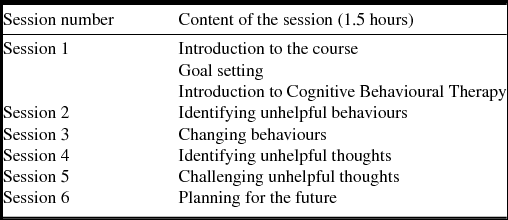
The intervention was run weekly and took place at the clients’ registered GP surgeries. The course was run by PWPs, who at the start of the service development had no specific training in working with people with LTC; and a PWP Lead who had specific training in working with people with LTC. The first phase involved the standard IAPT Step 2 intervention for depression and anxiety (see Table 1).
Content of the standard Step 2 IAPT Wellbeing Group for depression and anxiety
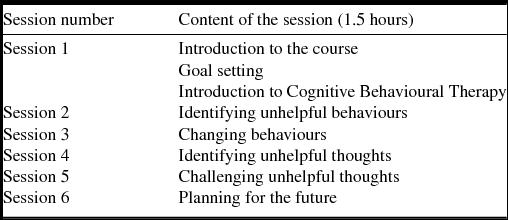
Each phase of the development involved running two courses, followed by analyses of the findings, including feedback from the facilitators and clients. Course facilitators were asked for general feedback (during clinical supervision sessions) as well as to consider issues around engagement; nonattendance; the extent to which clients were taking part in course work; and homework tasks, and the extent to which the clients appeared to grasp the concepts discussed in the sessions. Clients were asked to complete an anonymous “Patient Experience Questionnaire”, which asked them to state the most and least helpful things about the course. For phases 3 and 4, participants were also asked whether or not the course had been helpful regarding management of their diabetes (yes/no), and if so how. Courses run were then adjusted accordingly. The service development included four phases.
The National Research Ethics Service was contacted regarding this work and the authors were advised that ethical approval was not required.
Results
Analyses of preintervention measures
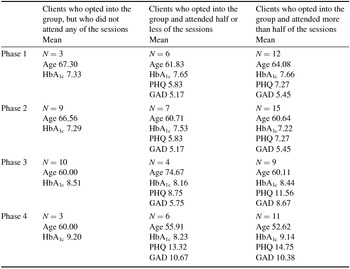
Preintervention measures between clients with different attendance rates are presented in Table 2 for visual analysis. Statistical analyses were not conducted due to the low numbers of participants. Visual analysis would suggest a trend for higher PHQ and GAD scores in phases 3 and 4 than in phases 1 and 2. This is likely due to a more accurate method of recruitment/selection of the participants.
Ages and pre-intervention levels of depression and anxiety in clients attending each phase of the service development

Findings from, and developments of, each phase
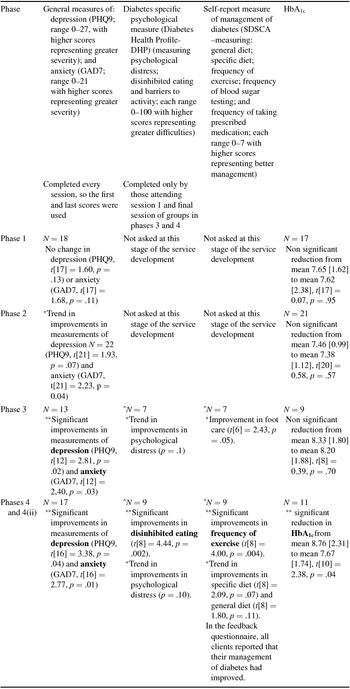
Table 3 provides a summary of the findings from psychological outcome measures and the findings regarding management of diabetes (self- report and HbA1). Patient feedback is discussed in each section. In phases 1 and 2, this was obtained only for those who attended the final session (a biased sample); its use for these phases was therefore limited. The development of the service was focused on outcome measures and feedback from the facilitators in supervision sessions with the clinical health psychologist.
Summary of the findings using paired t-tests (positive findings are in bold)

* mean changes in scores from pre- to postintervention show a trend;
** significant changes, p<.05
^The sample sizes for the DHP and SDSCA are lower than that of the PHQ and GAD; this is because PHQ and GAD were completed every session whereas DHP and SDSCA were completed only at first and last sessions. HbA1c scores were obtained for all who blood test results
Phase 1
The first two courses (Phase 1) were run as a standard Step 2 intervention focusing on depression and anxiety. Attendance was poor; there were no significant changes in mood (PHQ or GAD); there were no changes in HbA1c. Analysis of the patient experience questionnaire identified the theme of patients not understanding why they were on the course; or why the course was for people with diabetes, but focused on depression and anxiety. Some participants stated that the course was “interesting”, “particularly the session on worry”. Facilitators also reported that the course did not appear to be adequately tailored to the needs of people with T2DM.
Phase 2
In response to the findings from Phase 1, the following two courses (Phase 2) were adapted such that the work on depression and anxiety was more relevant to people living with diabetes. During the running of Phase 2, a specialist clinical health psychologist was introduced, to consider possible adaptations, as well as to offer weekly supervision to the facilitators. Attendance was poor; there was a trend in improvements in mood measures (PHQ and GAD); and there were no changes in HbA1c. Feedback suggested that clients found the course useful and interesting: “the material was useful and helpful for low mood”. However, clients also raised the theme of not understanding the purpose of the course, or why they were there. Some reported that they do not have low mood or worries. The facilitators reported that participants generally found it difficult to identify with the idea that mood can have an impact on management of diabetes.
Phase 3
A few adaptations were made at this point. Only clients currently prescribed anti-depressant medication were invited to the group. These clients also received an introductory phone call about the course from the GP involved in the project. The course protocol was developed further so that content was more relevant to mood and diabetes. Outcome measures were included: self-report measure of diabetes management, and diabetes specific mood questionnaire. Clinical Health Psychology supervision was offered to help the facilitators think about engaging clients in the intervention, and adapting the intervention so it is relevant to those attending. It is worth highlighting that a primary goal was that the interventions were within the boundaries of Step 2 interventions. The role of the clinical health psychologist was to help PWPs adapt their work so that it was relevant to people living with T2DM. Finally, the facilitators gained further knowledge of T2DM itself (from input from a GP).
Attendance was somewhat improved; there were significant improvements in mood measures (PHQ and GAD); there were trends suggesting improvements in management of diabetes, but no significant changes in HbA1c. Observation of feedback from the clients generated a theme around the course being helpful in thinking about how low mood affects the way people manage their diabetes, which was reported by about half the clients who completed the feedback form. Feedback from facilitators suggested that clients were more engaged with the work and were able to make the link between mood and management of diabetes.
Phase 4
Due to the difficulties with engagement in the work and attendance rates, some significant changes were made with respect to recruitment and the way in which the group was conducted. These are described below:
- Clients who were on anti-depressants were invited to course 7; the letter more clearly described the aim of the course;
- All individuals who responded to the letters received an introductory phone call from course facilitators.
- The course content was amended, so that it was immediately relevant to “living with diabetes” and, although work was contained in the standard step 2 IAPT intervention, work on depression and anxiety was continuously related to living with and managing diabetes.
- The workbooks were simplified.
- The facilitators used core CBT competences discussed in clinical supervision; in particular they used a more socratic, open, discursive approach as opposed to the didactic approach usually used in the Wellbeing Course.
- More clinical supervision was offered to facilitate this style of working.
Facilitators reported that clients engaged with the work and were able to make the link between mood and management of diabetes. All clients who completed the course made a comment on the form around the theme that the course was very helpful. For example, one participant said that she was doing more exercise to help her diabetes; another said that she had started going for more walks with her neighbour; and another had worked out how to leave her dog alone at home so she could go to gym. Three participants said that they were able to use the activities to socialize more, which helped improve their mood. All clients who completed the form stated “yes” to the question whether or not the course was helpful regarding their management of their diabetes. There were significant improvements in measures of mood, and in self-report management of diabetes, which were also reflected in improvements in HbA1c.
Conclusions
The findings suggest that the standard IAPT Step 2 intervention was not initially effective for this patient group. However, the findings suggest that it is possible to modify the Step 2 intervention in such a way that it used only IAPT Step 2 interventions, but was effective for people living with T2DM both in terms of mood and self-management. The adaptations focused on appropriately selecting individuals for the course and adapting Step 2 interventions to make links between mood and the way in which T2DM is managed. These findings support the argument that psychological work focusing specifically on depression and anxiety may be effective regarding diabetes management e.g. Lamers et al., Reference Lamers, Jonkers, Bosna, Knottnerus and van Eijk2011; Snoek et al., Reference Snoek, van der Ven, Twisk, Hogenelst, Tromp and van der Ploeg2008.
Summary of the service development
This paper describes the development of a Step 2 service that can be offered by IAPT to support people living with LTCs. The service development included four phases during which the course was modified reflecting feedback from clients and facilitators as well as outcome measures. The findings suggest that the standard Step 2 intervention was limited in terms of (i) engaging this client group; and (ii) helping clients understand the link between mood and bodily symptoms related to their T2DM. However, with careful analyses of feedback and outcome measures, the Step 2 intervention was adapted so that it was specifically tailored to the participants, but still remained in the boundaries of Step 2 interventions. The final phase demonstrated improvements in general measures of depression and anxiety; diabetes specific measures, self-report management of diabetes, as well as physiological measures including HbA1c which is the main measure of diabetic control. The dropout rates were considered throughout the pilot. In phase 4, 65% people who attended session 1 went on to complete 5 or 6 sessions. Although this figure appears low, it is comparable to previous findings in a general IAPT service. For example, in the IAPT demonstration site in Doncaster, Clark et al. (Reference Clark, Layard, Smithies, Richards, Suckling and Wright2009) found that of those offered low intensity treatments, 34% dropped out of treatment or discontinued.
The findings suggest improvements in engagement and outcome measures as the intervention developed. Results are encouraging. In the final phase, clients appear to engage with the work and appeared able to make the link between mood and management of diabetes. Outcome measures from this final course demonstrated some improvements in measures of depression and anxiety, as well as in psychological measures specific to diabetes (psychological barriers; and disinhibited eating); and in self-care measures, namely frequency of exercising. Furthermore there was a trend regarding self-care (specific diet; and frequency of taking prescribed medication). Encouragingly, there was also a significant improvement in medical measures (HbA1c). Furthermore, all clients who completed the course said that they found it helpful and reported that they had made changes resulting in improved mood and management of diabetes. It is possible, however; that there is a bias in the client feedback as, although the questionnaire was anonymous, clients may have felt that they wanted to “please” the facilitators. For this reason, and the fact that the form was completed only by those who attended the final session, greater emphasis was placed on the feedback from facilitators and the standardized outcome measures.
Limitations of the work
The numbers of participants in each phase was low, meaning that full statistical analyses were not conducted. In particular, it would be helpful to have more participants in Phase 4 of the service development, to allow a fuller evaluation of the effectiveness of this intervention. Due to the small number of participants, it is also not possible to evaluate mediators of any of the changes. A randomized control trial would also be helpful to evaluate the effectiveness of the specific intervention over treatment as usual. A further limitation is the lack of any follow-up; it is not possible to know whether improvements would continue, or decline. It is hoped that improvements may continue to be made over the following few months, as was demonstrated in a study by van der Ven et al. (Reference Van der Ven, Hogenelst, Tromp-Wever, Twisk, van der Ploeg and Heine2005), who showed no improvements in glycaemic control at 3 months and 6 months. However, the study was followed up by Snoek et al. (Reference Snoek, van der Ven, Twisk, Hogenelst, Tromp and van der Ploeg2008), and demonstrated improvements in glycaemic control at 1-year follow-up. It is possible that the reason that this intervention showed a more immediate effect is because it focused on mild to moderate depression and participants were ready to join a group in order to make changes to improve their mood.
Findings in relation to IAPT
The adaptations to the course protocol focused mainly on two aspects. First, engagement appeared paramount. In the generic course, the first sessions focuses on psychoeducation about anxiety and depression. In the modified version, the focus was more Socratic, and facilitated discussion about living with diabetes. The second main adaptation focused on helping clients to think about the ways in which their thoughts and behaviours, specifically about diabetes, formed a vicious cycle with mood and physiological symptoms related to diabetes. It seemed that encouraging clients to make this link helped them challenge less helpful coping strategies, such as “eating chocolate biscuits”, when feeling down, and as a result experiencing more critical thoughts about oneself regarding his/her ability to manage the diabetes. In phase 4, clients reported that they found this link easier to make, and therefore to make changes in ways that helped both mood and management of diabetes. This was also reflected in the outcome measures.
Conclusions and future directions
The main question addressed by this paper is whether IAPT interventions that are evidence-based for the treatment of mild to moderate depression and anxiety can be effective for people with long term medical conditions. The findings from this service development are encouraging. With the expansion of IAPT's involvement in working with people with LTCs (as well as Medically Unexplained Symptoms), the authors would like to highlight the need for the involvement of health professionals with specific expertise in working with this client group (in this case, the GP and specialist clinical health psychologist), who offered ongoing input and supervision to ensure that the intervention was appropriately tailored, but remained within the boundaries of Step 2 IAPT interventions for mild to moderate anxiety/depression. It is concluded that in order for standard IAPT interventions to be effective, adaptations need to be made such that the interventions are specifically tailored to the condition in question, with PWPs attending specific training in working with people with LTC and with input from health professionals with expertise in the medical condition, in this case a GP and a specialist clinical health psychologist.
The current group are extending this research by conducting a randomized control trial to systematically investigate the effectiveness of a specifically tailored intervention with respect both to measures of mood and physiological measures. Clearly, further research is also required to investigate whether the findings in offering interventions to clients with other long term medical conditions can be generalized to a wider client base.



Comments
No Comments have been published for this article.