Studies have demonstrated that healthcare personnel (HCP) have concerns about the potential side effects of trivalent inactivated influenza vaccine (IIV3).Reference Vasilevska, Ku and Fisman 1 – Reference Loulergue, Moulin and Vidal-Trecan 3 A recent meta-analysis of reasons HCP refuse IIV3 indicates the strongest predictors of vaccine acceptance are belief that the vaccine is safe and belief the vaccine does not cause the disease it is meant to prevent.Reference Vasilevska, Ku and Fisman 1
Timely vaccine safety information for each new seasonal IIV3 vaccine can be used to reassure HCP. In addition, the ability to provide real-time safety profiling of new vaccines should form part of emergency preparedness planning—for example, in the case of rapid development and rollout of vaccines in a pandemic.
Despite ready access to vaccines and concerted efforts to promote uptake, influenza vaccination coverage among HCP in Australia has historically been low, ranging from 18% to 66%.Reference Seale and MacIntyre 4 In a review of 32 studies from the United States (13), Canada (5), Europe (11), and others (3), Hofmann et al found influenza vaccine coverage of less than 50% in HCP in the majority (26 [81%]) of these studies.Reference Hofmann, Ferracin, Marsh and Dumas 5
In 2014, the Western Australian Department of Health developed the Follow-up and Active Surveillance of Trivalent Influenza Vaccine in HCP (FASTHealth) program. FASTHealth is a Short Message Service (SMS)-based, active influenza vaccine safety monitoring program intended to be implemented at the start of each season’s annual HCP vaccination program.
The Western Australian Department of Health provides free IIV3 for staff working in government health facilities and maintains a centralized record-keeping system for recording HCP influenza immunization. In 2014, HCP were asked at the time of vaccination to participate in the FASTHealth program to monitor adverse events following immunization (AEFIs). HCP who consented and provided a mobile phone number were sent a text message (or “SMS”) 7 days after vaccination querying whether they had experienced any “reaction, fever or illness” following vaccination.
A second SMS was sent 24 hours later to anyone who did not reply to the first message. HCP who responded “Yes” to either message were sent a link to a mobile phone survey to record the details of their AEFI. Those who opted not to complete the smartphone survey and those who did not reply to either SMS were telephoned to ascertain specifics of any AEFI via a standardized interview with a research nurse. Both surveys were identical in content and asked whether the participant experienced fever, headache, fatigue, vomiting, rash, rigors, convulsions, or swelling or pain at the injection site. Other reported potential adverse effects were recorded verbatim/as written.
From March 19 through May 20, 2014, a total of 1,624 HCP, including medical, administration, and support staff, were sent an SMS soliciting whether they experienced an AEFI. Most were women (81%) and 18-44 years of age (56%); 835 HCP received intradermal IIV3 (Intanza: 51.4%) and 789 received an intramuscular IIV3 (Vaxigrip: 48.3%; Fluvax: 0.3%).
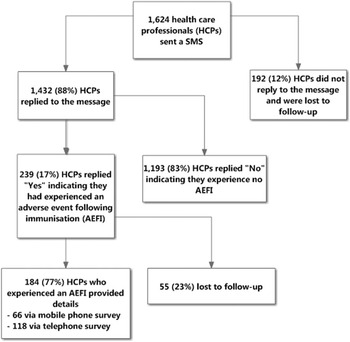
Of those who were sent an SMS message, 1,432 (88%) replied. A total of 239 (17%) of the respondents replied affirmatively that they had experienced one or more reactions to the vaccine. Of those reporting reactions, 184 (77%) provided details regarding the AEFI: 66 via the mobile phone survey and 118 by telephone. The remaining 55 HCP were lost to follow-up.
Among the 192 HCP who did not reply to the SMS, 65 (34%) were subsequently reached by telephone and 20 (31%) of these reported an event. In aggregate, 1,442 HCP provided complete information regarding the occurrence of AEFI, of which 204 (14.1% [95% CI, 12.2%-16.1%]) reported at least one reaction (Figure 1).
Responses to the FASTHealth program March 19-May 20, 2014.

No severe adverse events were reported. A total of 137 HCP reported at least one systemic symptom, most commonly fatigue (3.8% [95% CI, 2.8%–4.8%]), headache (3.7% [95% CI, 2.7%–4.7%]), or respiratory symptoms (3.7% [95% CI, 2.7%–4.7%]). One hundred fifteen HCP reported redness, pain, or swelling at the injection site (8.0% [95% CI, 6.5%–1.7%]). These results were in keeping with the documented safety profile of IIV3 vaccine.
Use of SMS technology in the FASTHealth program allowed rapid, active surveillance of the safety of IIV3 offered free to HCP as part of the annual influenza program. Consistent with previous vaccine safety investigations of seasonal IIV3 in HCP, the proportion reporting a potential adverse effect was low.Reference McEvoy 6 , Reference Ankrah, Mantel-Teeuwisse and De Bruin 7
Because the antigenic components of the influenza vaccine can change from season to season and safety profiles from previous seasons’ formulations may not be applicable to current vaccines, it is particularly important to monitor the safety of IIV3 each year. Our findings demonstrate the feasibility of implementing a timely, resource-conserving, vaccine safety monitoring system among HCP each year during influenza vaccination season.
Previous methods to capture AEFI following IIV3 in HCP mainly include self-report paper questionnaires, which require significantly more time to capture, record, and analyze the data.Reference McEvoy 6 – Reference Scheifele, Bjornson and Johnston 8 Smartphone penetration in Australia was reported at 65% in 2013, making it a suitable market for the use of such technology.Reference Scheifele, Bjornson and Johnston 8 In the same survey, smartphone use was reportedly less common in the United Kingdom (62%) and the United States (56%); however, overall there is increasing smartphone penetration globally, and in future the use of this technology has applications any time a new vaccine is introduced. 9
The information obtained can be used to reassure HCP regarding the reactogenicity of the vaccine and potentially used to improve uptake among HCP. Future studies should investigate communication strategies for informing HCP about the safety of IIV3. Considering the potential to prevent disease in HCP, their families, and their patients, opportunities to disseminate safety data to HCP in real time should be further explored.
Acknowledgments
We thank the research nurses at the Vaccine Trials Group, Telethon Kids Institute, for their work in telephone follow-up of the adverse events, and Sharon Gough, for her assistance in data management of the program.
Financial support. Western Australian Department of Health.
Potential conflicts of interest. All authors report no conflicts of interest relevant to this article.