INTRODUCTION
Burnout is defined as a syndrome typically occurring in work environments with continuous and chronic stress. A prolonged response to chronic stressors of an emotional and interpersonal nature requires strong emotional involvement with the people who are the subjects of the work (Maslach & Jackson, Reference Maslach and Jackson1981). According to Maslach and Jackson (Reference Maslach and Jackson1986), this syndrome is characterized by three dimensions—namely, emotional exhaustion, depersonalization, and personal accomplishment. The relationship between health professionals and burnout syndrome is already well known, as are the social, psychological, health, and work implications (Bría et al, Reference Bría, Baban and Dumitrascu2012; Dréano-Hartz et al., Reference Dréano-Hartz, Rhondali and Ledoux2015; Ostacoli et al., Reference Ostacoli, Cavallo and Zuffranieri2010; Sherman et al., Reference Sherman, Edwards and Simonton2006; Trufelli et al., Reference Trufelli, Bensi and Garcia2008).
The palliative care setting can lead to challenges that are multiple, stressful, and demanding. These challenges may include adaptation to highly scientific technical knowledge, specific relational and human competencies, the importance of complex ethical decisions, and continuous contact with human suffering, the end-of-life period, and death (Koh et al., Reference Koh, Chong and Neo2015; Parola et al., Reference Parola, Coelho and Cardoso2016). In Spain, palliative care units are currently integrated into the Spanish Health System. The principle that usually characterizes palliative care is that “every citizen with a terminal condition has the right to receive care,” the main aim being to relieve end-of-life suffering. However, there are significant variations within the country in terms of the historical development of these units from region to region. The lack of human resources (e.g., psychologists and social workers on the board of palliative care teams) is unfortunately well known (Herrera et al., Reference Herrera, Rocafort and De Lima2007; Ministry of Health Social Services and Equality, 2014).
There is evidence of burnout syndrome and existential distress in professionals caring for patients at the end of life (Koh et al., Reference Koh, Chong and Neo2015; Pereira et al., Reference Pereira, Fonseca and Carvalho2011; Pessin et al., Reference Pessin, Fenn and Hendriksen2015). Palliative care has characteristics in common with other health disciplines that report high levels of burnout syndrome (Kamal et al., Reference Kamal, Bull and Wolf2016; Ostacoli et al., Reference Ostacoli, Cavallo and Zuffranieri2010; Sherman et al., Reference Sherman, Edwards and Simonton2006). In the presence of the same risk factors, some subjects undergo “burnout,” whereas others learn how to cope with a stressful situation (Menezes et al., Reference Menezes, Fernández Calvo and Hernández Martín2006). Palliative care professionals usually have to implement such coping mechanisms as meditation, quiet reflection, potentiating physical well-being and personal and professional relationships, developing a passion for one's job, seeking clinical variety, establishing personal boundaries, and trying to have realistic expectations (Koh et al., Reference Koh, Chong and Neo2015). However, failure to cope with high levels of burnout can produce anxiety, disengagement, feelings of demoralization, negative attitudes toward palliative patients, poorer general health and well-being, and low job satisfaction (Pessin et al., Reference Pessin, Fenn and Hendriksen2015; Sansó et al., Reference Sansó, Galiana and Oliver2015). In such cases, an adaptive response may be harmful to one's mental health.
The specific risk factors for burnout have been reported by palliative care health professionals (Pereira et al., Reference Pereira, Fonseca and Carvalho2011). Some of the most important are the following: working long hours, frequently changing settings, working in smaller organizations, being under 50 years of age, working weekends, managing highly demanding clinical interventions with a small number of personnel, planning and managing the multiple and complex needs of palliative patients and caregivers, and participating in the resolution of conflicts between individuals and the healthcare system (Kamal et al., Reference Kamal, Bull and Wolf2016; Koh et al., Reference Koh, Chong and Neo2015; Pereira et al., Reference Pereira, Fonseca and Carvalho2011).
Nevertheless, palliative care does not necessarily lead to negative consequences since the workplace provides a series of protective factors to serve as a buffer against burden. Workers have the opportunity for introspection, for thinking about their own perspective on life and mortality, for enhancing personal growth, self-actualization, compassion, and meaning, and for reducing the fear of death (Pessin et al., Reference Pessin, Fenn and Hendriksen2015). Therefore, in palliative care both the perspectives on risk and the protective factors highlight the importance of examining the subjective and objective burden in these professionals. Although such personal variables as psychological and personality factors may be associated with burnout (Aydemir & Icelli, Reference Aydemir, Icelli and Bahrer-Kohler2013; Bakker et al., Reference Bakker, Van der Zee and Lewig2006), studies on psychopathology in relation to burnout are scarce. Moreover, to our knowledge, no studies on psychopathology and burnout have been carried out with palliative care health professionals.
On the other hand, adaptation to increased demands is regulated by the hypothalamic–pituitary–adrenal (HPA) axis, which helps the body maintain homeostasis during a stressful situation (Bellingrath et al., Reference Bellingrath, Weigl and Kudielka2008; Lennartsson et al., Reference Lennartsson, Sjörs and Währborg2015). Activation of the HPA axis is located in the adrenal cortex and produces the hormone cortisol. Chronic exposure to stressors can contribute to permanent HPA axis activation (Grossi et al., Reference Grossi, Perski and Ekstedt2005; O'Connor et al., Reference O'Connor, O'Halloran and Shanahan2000). However, exposure to chronic stress may cause a disruption in HPA axis regulation, which can be observed in the level and course of the daily release of cortisol (Bellingrath et al., Reference Bellingrath, Weigl and Kudielka2008; Langelaan et al., Reference Langelaan, Bakker and Schaufeli2006). A typical diurnal cortisol rhythm shows a marked increase during the first hour after waking up, followed by a gradual reduction throughout the day, with levels at their lowest before bedtime (Marchand et al., Reference Marchand, Durand and Juster2014a; Pruessner et al., Reference Pruessner, Hellhammer and Kirschbaum1999). The time of day is therefore important when evaluating cortisol profiles (Clow et al., Reference Clow, Hucklebridge and Stalder2010; Marchand et al., Reference Marchand, Durand and Juster2014a; Reference Marchand, Juster and Durand2014b; Pruessner et al., Reference Pruessner, Hellhammer and Kirschbaum1999).
Cortisol levels are considered to be different among subjects with burnout when compared to healthy people (Oosterholt et al., Reference Oosterholt, Maes and Linden2015). It has been reported that hyperactivity of the HPA axis during a stress-inducing situation may change to hypoactivity after long-term exposure to stressful circumstances (Heim et al., Reference Heim, Ehlert and Hellhammer2000; Lennartsson et al., Reference Lennartsson, Sjörs and Währborg2015). The percentage of patients suffering burnout who report hypocortisolism ranges from 20 to 25% (Marchand et al., Reference Marchand, Juster and Durand2014b). Nevertheless, there is no consensus on the relationship between this syndrome and daily cortisol secretion (Bellingrath et al., Reference Bellingrath, Weigl and Kudielka2008; De Vente et al., Reference De Vente, Olff and van Amsterdam2003; Grossi et al., Reference Grossi, Perski and Ekstedt2005; Langelaan et al., Reference Langelaan, Bakker and Schaufeli2006; Mommersteeg et al., Reference Mommersteeg, Keijsers and Heijnen2006a; 2006b; Pruessner et al., Reference Pruessner, Hellhammer and Kirschbaum1999). Since health professionals working in palliative care units may present with high levels of burnout (Parola et al, Reference Parola, Coelho and Cardoso2016), the levels of this syndrome could be related to daily cortisol secretion in this population. However, to our knowledge, there are no studies exploring the association between cortisol secretion and burnout levels in palliative care health professionals. According to Wingenfeld et al. (Reference Wingenfeld, Schulz and Damkroeger2009), since burnout is associated with chronic stress in the work environment, the study of daily cortisol secretion over a working day may be important in the field of palliative care. On the other hand, psychological functioning could also be an individual factor influencing burnout syndrome and vice versa.
Hence, the main aim of the present study was to verify the relationship between certain physiological and psychological parameters and burnout syndrome in health professionals working in palliative care units. The specific objectives were: (1) to evaluate the association between daily cortisol secretion and burnout syndrome in this sample, (2) to assess the relationship between level of perceived stress and burnout in these professionals, and (3) to study the connection between this syndrome and psychopathological symptoms in the health professionals working in these units.
METHODS
Study Group
Setting
After analyzing indicators for the development of European palliative care units, the European Association for Palliative Care reported that Spain occupies 11th place among the 52 countries evaluated. Spanish legislation describes the right of terminally ill patients to receive care through the National Health System. Palliative care in Spain is included as a basic service under the National Health System Cohesion and Quality Act and the common service of the Spanish National Health System. According to estimations of palliative care needs, specific palliative care teams in Spain should include 1,755 patients per million inhabitants per year. However, in previous years the percentage of patients cared for by palliative care teams, units, or hospital services in relation to the estimated population was below 31% (Ministry of Health Social Services and Equality, 2014).
Most autonomous communities in Spain have a specific plan for palliative care. The community of Andalusia has its own specific plan, known as the Plan Andaluz de Cuidados Paliativos (2008–2012). This highlights the need for optimizing the specific access of patients and relatives to psychological and socio-familial interventions. The palliative care system of the Andalusian autonomous community has 14 home support teams, 2 home hospitalization units, 1 hospital support team, 20 mixed support teams, 15 palliative care hospitalization units, and 232 beds in hospital palliative care units (Ministry of Health Social Services and Equality, 2014).
The studied sample came from the palliative care unit of a hospital that comprises palliative care hospitalization and a mixed support team. All the patients from this unit were diagnosed as terminally ill. The pathologies that were most prevalent in these patients were diagnoses of terminal and severe oncological disorders, stroke, and chronic obstructive pulmonary disease.
Participants
A total of 83 health professionals (actively employed) from the San Rafael University Hospital (Granada, Spain) were contacted as potential participants. They were selected personally and in a consecutive manner by a researcher after contact with all the professionals working on the unit.
Some 69 of those selected (83.13 %) met the inclusion criteria and took part in the present study, 58 of whom were women and 11 men. Their average age was 30.96 years (SD = 9.50). Some 32 were nursing assistants (3 men, 29 women); 30 were nurses (4 men, 26 women); and 7 were physicians (4 men, 3 women). The physicians were specialists in internal medicine (3), primary care (3), and geriatrics (1). Mental health professionals were not included in the sample since they were only present for specific cases. The mean (SD) job seniority in the palliative healthcare sample was 4 years (SD = 5.44).
The total sample was divided into three categories according to level of burnout, and these were classified as follows: (1) non-burnout group (with no complaints about burnout and no altered MBI dimension), (2) fulfilling one burnout criterion (with high scores in only one of the three MBI dimensions), and (3) fulfilling two or three burnout criteria (with high scores in two or more MBI dimensions). Those in the last subgroup were considered to be extreme cases of burnout, as if they had undergone a traumatic experience. The criteria for grouping the sample into different levels of burnout were in accordance with the classification published by Wingenfeld et al. (Reference Wingenfeld, Schulz and Damkroeger2009).
The inclusion criteria were as follows: (1) age over 18 years, (2) active in a palliative care unit as a health professional, and (3) working on a morning or afternoon shift. The exclusion criteria were as follows: (1) undergoing glucocorticoid treatment, (2) working on a nightshift, (3) being unable to meet the study protocol timing requirements for cortisol measurements, and (4) working simultaneously in another unit or units other than the palliative care unit.
All participants were given a document about the objectives and procedures of the study. They signed a written informed consent form, approved by the Committee on Human Bioethics at the Hospital Virgen de las Nieves. The study was conducted according to the principles of the Declaration of Helsinki, as revised in 2013.
Assessment Tools
Psychological Tests
The Maslach Burnout Inventory–Human Services Survey (MBI–HSS) consists of three subscales: (1) emotional exhaustion, (2) depersonalization, and (3) personal accomplishment. This instrument is currently the one most commonly used for evaluating burnout in healthcare professionals. The MBI–HSS consists of a 7-point Likert-type scale and 22 items, with scores based on the frequency of feelings related to the burnout construct (Maslach & Jackson, Reference Maslach and Jackson1981). This questionnaire has been validated in Spanish and presents high divergent, convergent, and discriminative validity and a high internal consistency, with a Cronbach's α of 0.90 for “emotional exhaustion,” 0.79 for “depersonalization,” and 0.71 for “personal accomplishment” (Gil-Monte & Peiró, Reference Gil-Monte and Peiró1999).
The Perceived Stress Scale (PSS) evaluates the level of perceived stress and the degree to which people find their health situation unpredictable, uncontrollable, or overcharged (Cohen et al., Reference Cohen, Kamarak and Mermeistein1983). These aspects have been repeatedly confirmed as major components of stress. The scale comprises 14 items with 4-point response alternatives. The highest score corresponds to the highest level of perceived stress. This self-report instrument has a Spanish version that demonstrates adequate reliability (internal consistency = 0.81, test–retest reliability = 0.73) and good concurrent validity and sensitivity (Remor, Reference Remor2006; Remor & Carrobles, Reference Remor and Carrobles2001).
The SCL–90–R Symptoms Inventory is a psychopathological assessment tool with a 90-item questionnaire (Derogatis, Reference Derogatis1994). This instrument comprises nine main dimensions (somatization, obsessive-compulsive symptoms, interpersonal sensitivity, depression, anxiety, hostility, phobic anxiety, paranoid ideation, and psychoticism), as well as three global indices (the Global Severity Index, Positive Symptom Total, and the Positive Symptom Distress Index). Participants were required to report their feelings during the previous seven days, including the day of evaluation. The SCL–90–R has been validated for the Spanish population (De las Cuevas et al., Reference De las Cuevas, González de Rivera and Henry-Benítez1991). The percentile score was utilized for statistical analyses.
Physiological Parameters
Salivary cortisol testing utilizes an in-vitro immunological test to determine the quantity of cortisol in the saliva (Laboratorio Cobas S.L., Reference Laboratorio Cobas2009). This test registers the functioning of the HPA axis and the cortisol response upon waking and every 30 minutes thereafter during the day (Clow et al., Reference Clow, Hucklebridge and Stalder2010; De Vente et al., Reference De Vente, Olff and van Amsterdam2003; Grossi et al., Reference Grossi, Perski and Ekstedt2005; Pruessner et al., Reference Pruessner, Hellhammer and Kirschbaum1999; Wüst et al., Reference Wüst, Federenko and Hellhammer2000). Cortisol levels were tested six times over a working day at 6:30–7:00 h (waking up), 10:00–10:30 h, 14:00–14:30 h, 17:00–17:30 h, 21:00–21:30 h, and 23–23:30 h (bedtime). To ensure correct sample administration and conservation, an instruction sheet with a chronogram was used for cortisol collection. A cortisol and habits questionnaire was employed to collect important data relating to cortisol levels, such as smoking, sleep disturbances, the use of contraceptives, and professional and extraprofessional activities. The samples were analyzed at the San Cecilio University Hospital (Granada, Spain). Measurements were taken with the Roche Elecsys Modular Analytics E170 (Elecsys module) device, using the electrochemiluminescence immunoassay (ECLIA) method.
Procedures
All health professionals from San Rafael University Hospital were invited to participate on a voluntary basis. First, the objectives and procedures of the study were explained in detail to potential participants. Second, sociodemographic information was obtained by a researcher in order to determine whether they met the inclusion criteria. Third, participants signed the written informed consent form and completed the self-administered evaluation and all the questionnaires abovementioned. Fourth, participants were given six Salivettes® with instructions on how to collect and conserve samples correctly by chewing a cotton swab for 60 seconds and placing it in the Salivette®. Participants were then required to collect samples and submit the questionnaires within 24 to 48 hours.
Statistical Analysis
Statistical analyses were conducted using SPSS software (v. 20.0). First, to identify the confounding variables, two correlation analyses were performed between age and hours of sleep and the rest of the variables. In addition, various ANOVAs were calculated, taking into account smoking habits, oral contraceptive use, relevant medication, and phase of the menstrual cycle. Second, a mixed-design ANOVA with repeated measures 3 × (6) was conducted to verify potential interactions between cortisol measurements and burnout syndrome. The first factor used to compare independent groups had three categories (non-burnout group, burnout group meeting one criterion, and burnout group meeting two or three criteria). The second factor was secretion of cortisol (intrasubject with repeated measures) with six levels (first level = 6:30–7:00 h; second = 10:00–10:30 h; third = 14:00–14:30 h; fourth = 17:00–17:30 h; fifth = 21:00–21:30 h; sixth = 23–23:30 h). A Greenhouse–Geisser statistical correction was performed for the repeated-measure factors to correct the degrees of freedom of the F distribution. For daily cortisol levels, the area under the total response curve was measured with respect to the ground (AUCg). AUCg was calculated using the trapezoidal formula according to Pruessner et al. (Reference Pruessner, Kirschbaum and Meinlschmid2003). After this, an ANOVA was run to verify if there was any difference in AUCg across the three groups (non-burnout group, burnout group meeting one criterion, and burnout group meeting two or three criteria). Third, several ANOVAs were conducted in order to verify whether burnout was related to a high level of stress or psychopathological symptoms. The dependent variables were the scores obtained for each of these instruments (Perceived Stress Scale and the subscales of the SCL–90–R). The independent variables were the three groups of burnout alteration. Fourth, in cases where an interaction was found in the ANOVA, several Bonferroni post-hoc tests were conducted to determine the three burnout groups in which these differences appeared. Finally, in accordance with research conducted by Melamed et al. (Reference Melamed, Ugarten and Shirom1999), Mommersteeg et al. (Reference Mommersteeg, Heijnen and Verbraak2006b), and Wingenfeld et al. (Reference Wingenfeld, Schulz and Damkroeger2009), the cortisol day-curve in the three burnout subgroups was then depicted.
RESULTS
Description of the Sample of Palliative Care Unit Health Professionals (Table 1)
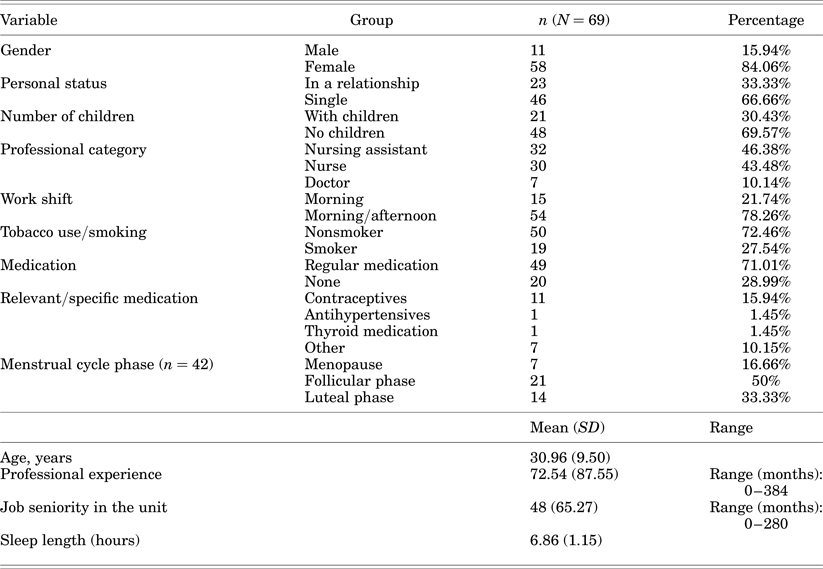
A total of 69 health professionals from palliative care units were included in our study, 5 of whom did not answer the PSS and SCL–90 correctly, which reduced the final sample to 64 participants. Of these, 84.06% were women and 15.94% men. The average age was 30.96 years (SD = 9.50), with an age range of 18–55 years. High scores on at least one dimension of burnout were found in 55.07% of the sample, whereas 44.93% showed non-burnout. Among those reporting burnout, 26.09% reported high scores on two or three dimensions of the MBI, and 28.98% had high scores on only one dimension. Regarding emotional exhaustion, 44.9, 29, and 26.1% of the sample showed low, medium, and high levels in this dimension, respectively. With respect to the depersonalization subscale, 50% of the sample showed a low level, 27.5% a medium level, and 21.7% a high level. In terms of personal accomplishment, 7.2% reported a low level, 23.2% a medium level, and 69.6% a high feeling of accomplishment. The mean (SD) scores were 17.03 (9.46) for emotional exhaustion, 5.15 (5.02) for depersonalization, and 41.57 (5.43) for personal accomplishment. The descriptive results of the sample in terms of sociodemographics and habits data are presented in Table 1.
Distribution of the sample according to the sociodemographic variables analyzed in our study

SD = standard deviation.
Cortisol and Possible Confounding Variables
The only significant differences between smokers and nonsmokers were observed in the sixth cortisol measurement (at 23:00–23:30 h) [F(1.67) = 5.55, p < 0.038], with a high level of cortisol reported in the “smokers” group (X = 3 nmol/L) versus the nonsmokers group (X = 1.9 nmol/L). No differences were found between other confounding variables and cortisol.
Burnout and Cortisol Secretion (Table 2, Figure 1)
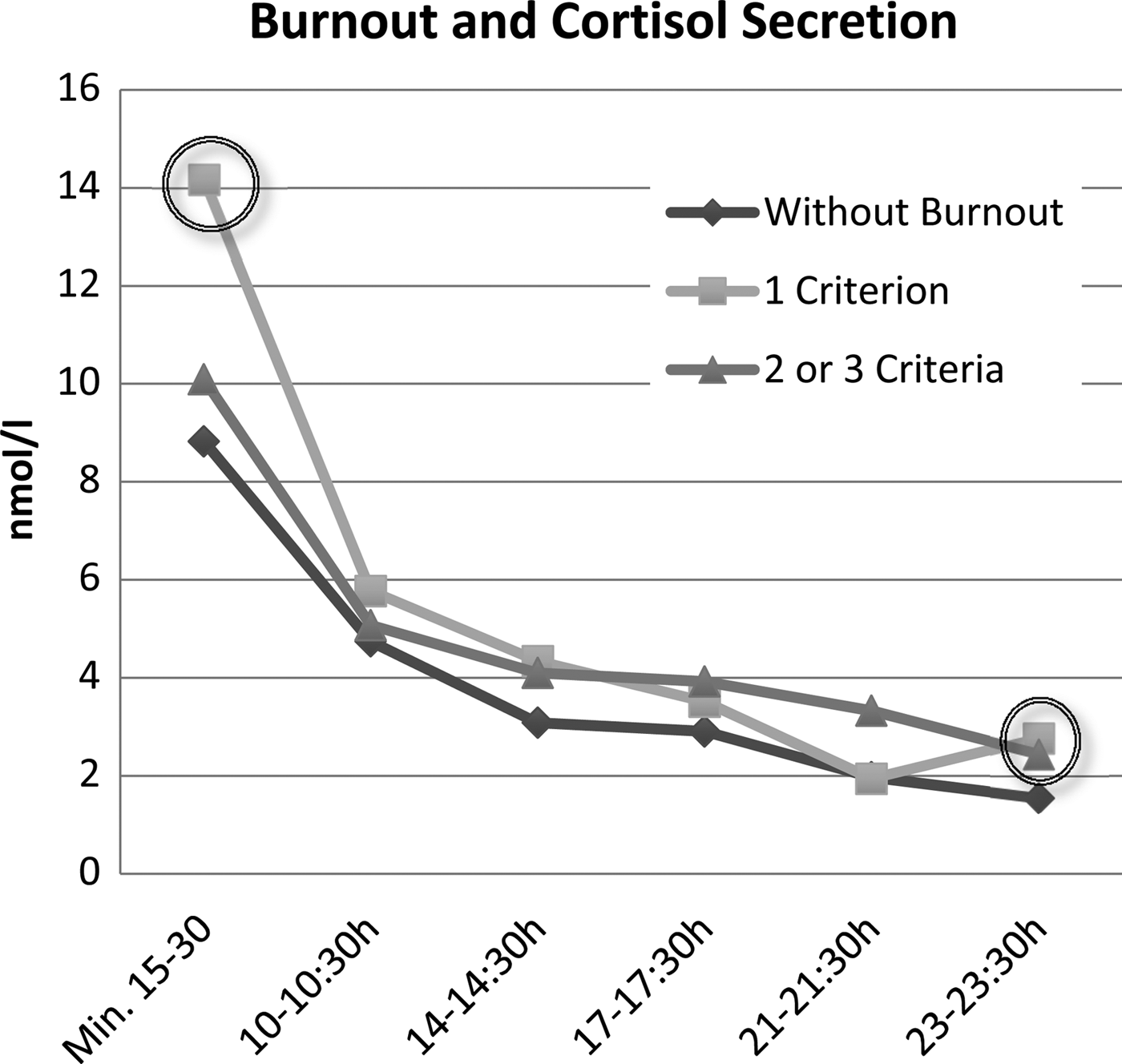
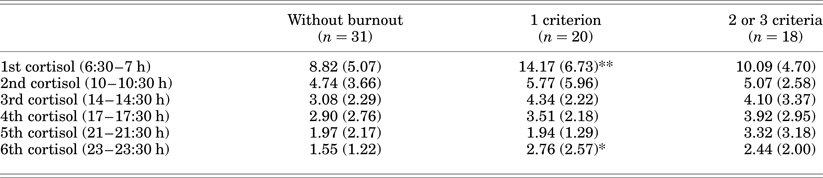
Our results revealed an interaction between the secretion of cortisol (measured six times a day) and the burnout groups [F(3.5) = 2.48, p < 0.031]. Significant differences in cortisol secretion were found between the non-burnout group and the one-criterion burnout group for the first cortisol measurement [F(2.66) = 5.857, p < 0.005]. Average cortisol secretion in the non-burnout group (8.83 nmol/L) was lower than that of the group with one dimension of burnout (14.17 nmol/L). Significant marginal differences were also found in the last cortisol measurement of the day [F(2.67) = 2.802, p < 0.068)]. The rate of cortisol secretion in the non-burnout group (1.55 nmol/L) was lower than that of the group with one dimension of burnout (2.76 nmol/L). No differences were found between the non-burnout group and the burnout group that met two or three criteria (Table 2, Figure 1). In addition, our results showed statistically significant differences in AUCg between the non-burnout group and the group with one dimension of burnout [F(2,67) = 3.12, p = 0.05], with AUCg being higher in the group with one dimension of burnout (M = 4937.5) than in the non-burnout group (M = 3789).
Dimensions (criteria) of burnout and salivary secretion of salivary cortisol (nmol/L) in health professionals throughout a workday (six measures).

Means, standard deviations, and deviations for ANOVA comparing individuals without burnout and individuals with burnout criteria in secretion of cortisol (nmol/L) depending on level of burnout

* Marginal significance of p < 0.07; ** significance of p < 0.02.
Group with one criterion and group with two or three criteria of burnout.
Burnout, Stress, and Psychopathological Variables (Table 3)
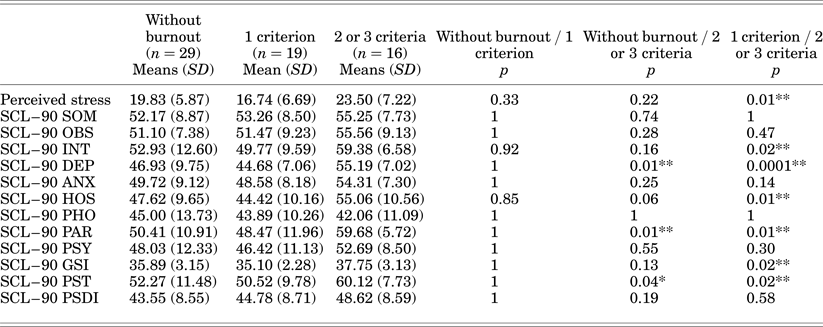
Our results revealed statistically significant differences among the three burnout groups in perceived stress scores [F(2.61) = 4.748, p < 0.012]. There were also significant differences between the burnout groups in four of the subscales of the SCL–90. Specifically, these differences can be observed in the interpersonal sensitivity subscale [F(2.61) = 3.749, p < 0.029], in the depression subscale [F(2.61) = 7.537, p < 0.001], in the hostility subscale [F(2.61) = 5.104, p < 0.009], in the paranoid ideation subscale [F(2.61) = 5.971, p < 0.004], in the Global Severity Index [F (2.61) = 5.040, p < 0.009], and in the Positive Symptom total [F(2.61) = 6.298, p < 0.003]. For each of these subscales, the burnout group that met two or three criteria reported higher scores than those of the non-burnout group (Table 3). The mean (SD) scores were 36.03 (3.01) points on the Global Severity Index, 53.40 (10.54) points for Positive Symptom total, and 45.05 (8.74) points on the Positive Symptom Distress Index.
Means, standard deviations, and comparison ANOVAs between individuals without and with burnout criteria in secretion of cortisol according to perceived stress (EP) and psychopathology (SCL–90)

* p < 0.05; ** p < 0.02.
SCL–90 SOM = somatization; SCL–90 OBS = obsession; SCL–90 INT = interpersonal sensitivity; SCL–90 DEP = depression; SCL–90 ANX = anxiety; SCL–90 HOS = hostility; SCL–90 PHO = phobic anxiety; SCL–90 PAR = paranoid ideation; SCL–90 PSY = psychoticism; SCL–90 GSI = Global Severity Index; SCL–90 PST = Positive Symptom Total; SCL–90 PSDI = Positive Symptom Distress Index.
DISCUSSION
The main aim of our study was to evaluate the relationship between levels of burnout and physiological and psychological parameters in palliative care unit health professionals. We found that the release of cortisol in the one-dimension burnout group was higher than that in the non-burnout group for cortisol response upon waking and at the bedtime measurement. However, over the course of a working day, the healthcare professionals with high levels of burnout in two or three dimensions reported similar cortisol secretion to that of the non-burnout group. On the other hand, individuals with high levels of one or more burnout dimensions showed higher average scores on perceived stress, interpersonal sensitivity, depression, hostility, paranoid ideation, the Global Severity Index, and the Positive Symptom Total compared to the non-burnout group.
In line with previous findings concerning the cortisol–burnout relationship, a higher secretion of daily cortisol is related to high levels of burnout (Bellingrath et al., Reference Bellingrath, Weigl and Kudielka2008; De Vente et al., Reference De Vente, Olff and van Amsterdam2003; Grossi et al., Reference Grossi, Perski and Ekstedt2005; Melamed et al., Reference Melamed, Ugarten and Shirom1999; Oosterholt et al., Reference Oosterholt, Maes and Linden2015; Wingenfeld et al., Reference Wingenfeld, Schulz and Damkroeger2009). Specifically, individuals with high levels of burnout in only one dimension of this syndrome presented an average level of cortisol almost double that of individuals without burnout. Therefore, individuals with this level of burnout, which is equivalent to undergoing an acute stress situation, may present with greater activation of the HPA axis. A recent study conducted among 279 nurses to investigate the association between burnout dimensions and cortisol secretion employed a similar method to that of the present study (Wingenfeld et al., Reference Wingenfeld, Schulz and Damkroeger2009). This research showed that the nursing staff, who presented alterations in two burnout dimensions, had a higher secretion of cortisol during the day, compared to those who only showed one altered dimension or none at all. An investigation by Grossi et al. (Reference Grossi, Perski and Ekstedt2005) reported that increased levels of cortisol occurred among participants with burnout, but not in healthy participants. De Vente et al. (Reference De Vente, Olff and van Amsterdam2003) also found higher salivary cortisol levels in individuals with burnout than in healthy subjects (De Vente et al., Reference De Vente, Olff and van Amsterdam2003; Grossi et al., Reference Grossi, Perski and Ekstedt2005). The fact that in our study individuals with a high burnout level had significantly higher cortisol secretion than those with lower burnout suggests that burnout is associated with high basal cortisol levels (Grossi et al., Reference Grossi, Perski and Ekstedt2005).
Nevertheless, individuals with no burnout or with high levels in two or three dimensions of this syndrome seem to present equal levels of cortisol release. Hence, burnout is probably associated with hypocortisolism, which explains the failure to produce the necessary amounts of cortisol (Lennartsson et al., Reference Lennartsson, Sjörs and Währborg2015). This can be justified because, when people suffer a high level of traumatic stress, cortisol release levels may decrease or remain unchanged (Heim et al., Reference Heim, Ehlert and Hellhammer2000; Sonnentag, Reference Sonnentag2006). According to Heim et al. (Reference Heim, Ehlert and Hellhammer2000), the initial hyperactivity of the HPA axis can turn into hypoactivity after a period of chronic stress (Sonnentag, Reference Sonnentag2006). In a study by Wingenfeld et al. (Reference Wingenfeld, Schulz and Damkroeger2009), cortisol secretion in subjects who showed impairment across all three dimensions was equal to that of those without burnout. These findings provide further evidence of HPA axis deregulation when nurses exhibit high levels of burnout in all dimensions. However, this study utilized a sample of only women nurses, which prevents the data from being generalized to all health professionals. The possible link between dysregulated cortisol profiles and manifestations of burnout has also been suggested in other research (Marchand et al., Reference Marchand, Durand and Juster2014a). Specifically, burnout could be negatively associated with cortisol secretion in the afternoon and evening (Marchand et al., Reference Marchand, Juster and Durand2014b). For these reasons, our present results shed light on the controversy regarding the relationship between burnout syndrome and the hyper/hypoactivation process of the HPA axis.
The present study also shows that psychological stress and several psychopathological dimensions are associated with levels of burnout in its different categories. In particular, health professionals suffering high levels of burnout in at least one dimension of this syndrome presented higher levels of interpersonal sensitivity, depression, hostility, and paranoid ideation, together with higher scores on the Global Severity Index and Positive Symptom Total, when compared to those without burnout. These data are consistent with studies that prove an association between burnout and psychological disorders (Bauer et al., Reference Bauer, Stamm and Virnich2006; Mingote et al., Reference Mingote, Moreno and Gálvez2004; Pedrero-Pérez et al., Reference Pedrero-Pérez, Puerta-García and Logares-Roibas2004). This population may therefore be more susceptible to developing psychopathological disorders. When this occurs, burnout syndrome may behave as a risk factor for these disorders. On the other hand, burnout could also be caused by previous psychopathological disorders in these professionals. A possible explanation could be that palliative care practitioners work in a special setting. They usually find that solutions to the daily problems in their work—which exposes them to suffering and death—are unclear, complex, and/or nonexistent. As Parola et al. (Reference Parola, Coelho and Cardoso2016) claimed, when the workplace is perceived as hostile and highly demanding, healthcare providers may find that their psychological, emotional, and spiritual well-being are diminished.
Additionally, when palliative care health professionals feel more burned out, there may be a decrease in the resources needed to cope with daily problems and to deal with their interior life. When palliative care providers detect that they have fewer personal resources, they may feel drained (emotional exhaustion) and distanced from their workmates or patients (depersonalization), or they may experience a sense of low personal accomplishment that impairs an adequate psychological state. These alterations may be reflected in negative thoughts, feelings, and actions that cause anger and irritation during the working day (hostility); a persistent, irrational, and disproportionate fear of death, dependency or disability (phobic anxiety); feelings of inferiority and inadequacy when comparing themselves with workmates from other units (interpersonal sensitivity); and clinical symptoms of depression, such as lack of motivation, low vital energy, dysphoric mood, feelings of hopelessness, and/or suicidal ideation (De las Cuevas et al., Reference De las Cuevas, González de Rivera and Henry-Benítez1991).
However, symptoms of somatization, obsession, anxiety, and psychoticism were no greater in the “burned” participants than in the “non-burned” ones. This could be because they also had opportunities for introspection and to reflect on their own perspective on life and mortality, thereby enhancing their personal growth, self-actualization, and capacity for compassion and life meaning, while at the same time reducing their fear of death (Pessin et al., Reference Pessin, Fenn and Hendriksen2015). These personal reflections could reduce the fusion of their negative, recurrent, and obsessive thoughts in the workplace and inhibit the presence of perceived discomforts related to different bodily dysfunctions and the existence of anxiety symptoms—such as nervousness, tension, panic attacks, or fears. Other aspects of the inner life of professionals—such as the compassion fatigue/satisfaction continuum—have also been related to palliative care professionals and burnout syndrome (Sansó et al., Reference Sansó, Galiana and Oliver2015). Compassion fatigue can lead to a sense of helplessness, isolation, and confusion, and, though professionals are capable of caring, the quality of that care may deteriorate. Conversely, compassion satisfaction can be a factor that protects against compassion fatigue and acts as a buffer against the possibly negative costs of high levels of burnout. In fact, compassion satisfaction is inversely associated with both compassion fatigue and burnout syndrome. These constructs could be a moderator of the psychopathological differences among healthcare practitioners with and without burnout (Chan et al., Reference Chan, Chan and Chuang2015; Sansó et al., Reference Sansó, Galiana and Oliver2015; Slocum-Gori et al., Reference Slocum-Gori, Hemsworth and Chan2011).
As previous authors have recommended, since a well-functioning HPA axis makes individuals engage with their work to a greater extent (Sonnentag, Reference Sonnentag2006), training programs should be put in place to prevent high levels of burnout in palliative care unit health professionals (Korczak et al., Reference Korczak, Wastian and Schneider2012; Moya-Albiol et al., Reference Moya-Albiol, Serrano and González-Bono2005). Health systems should introduce innovative models of palliative care in which a key element is the integration of healthcare professionals. Specific interventions, techniques, and skills that would be useful to palliative care teams could be: (1) recognizing that health professionals require time and support to adjust to their units; (2) increasing the time spent on the emotional aspects of patient care; (3) ensuring adequate preparation and maintenance of holistic care principles in faster-paced work settings; (4) enhancing emotional management through meditation and spiritual practice; (5) supporting meaningful personalized rituals to increase compassion; (6) ensuring that workers are continually made aware of major changes in present-day healthcare systems; (7) providing a structure for facilitated interactions with patients; (8) helping healthcare providers to be able to identify their boundaries of knowledge or skill; (9) recognizing the levels of psychological distress that require further help; (10) teaching them how to be able to find help; (11) equipping workers with basic skills for understanding and managing psychological distress; (12) combining teaching and supervision programs to improve practitioners' levels of confidence in their skills; (13) strategically including leaders to assist these professionals; (14) referring the more complex psychological interventions to mental health practitioners; and (15) including relaxation and cognitive training techniques (Clark et al., Reference Clark, Aitken and Watson2016; Griffiths et al., Reference Griffiths, Wilson and Ewing2015; Hill et al., Reference Hill, Dempster and Donnelly2016; Holland & Neimeyer, Reference Holland and Neimeyer2005; Michael et al., Reference Michael, Callaghan and Brooker2016; Montross-Thomas et al., Reference Montross-Thomas, Scheiber and Meier2016; Moorey, Reference Moorey2013; Sato et al., Reference Sato, Inoue and Umeda2014; Yoshida & Miyashita, Reference Yoshida and Miyashita2015).
LIMITATIONS OF THE STUDY
Our study has several limitations. First, although the results provide information about the response of the HPA axis in people with and without high levels of burnout, the total number of health professionals participating was relatively low. However, the sample was a representative number of health professionals working in the hospital units under study. Future studies should extend this sample to other professionals, such as social workers and psychologists. There was also a larger number of women than men, more nursing assistants compared to nursing staff, and more nurses compared to physicians. Nevertheless, this imbalance may reflect the normal distribution of professional categories in such units. In addition, the approach employed in our study considered factors that were potentially confounding, such as the personal characteristics and daily routines of participants and situation-specific aspects. Due to the cross-sectional nature of this study, interpretation of the results with regard to directionality cannot be confirmed. Only conclusions with a theorized direction can be suggested. Prospective designs are needed to confirm these interpretations. Finally, the saliva measurements were collected at six timepoints over the course of a workday. However, measurements of this parameter could had been collected over more than one working day to provide a more stable daily cortisol day-curve. Our results should therefore be interpreted with caution.
CONCLUSIONS
In conclusion, our study verifies that there are several physiological and psychological aspects related to burnout in health professionals working in end-of-life care. Our findings support the idea that cortisol levels seem to vary depending on level of burnout suffered by health professionals (and vice versa). These findings may indeed be relevant for furthering our understanding of the relationship between cortisol and levels of burnout in the health professionals who work in these units.
CONFLICTS OF INTEREST
The authors declare that they have no conflicts of interest to disclose.
FUNDING
The study is part of a doctoral dissertation and was supported by the I + D Project (no. PSI2010–15780) of the Spanish Ministry of Science and Innovation.
ACKNOWLEDGMENTS
The authors would like to thank all of the palliative care unit health professional from San Rafael University Hospital and Laboratorio Roche Diagnostics for their participation in our study.