


Introduction
Population ageing is a global phenomenon with profound implications for health and social care systems. Globally, the share of the population aged 65 and over is expected to double in the next few decades, from 9.3 per cent in 2020 to 16.0 per cent by 2050, reaching over 1.5 billion people (UNDESA 2020). Population ageing is especially relevant in the UK context where it is estimated that people aged 65 and over will compose almost 25 per cent of the population by 2042 (Lewis Reference Lewis2021). While an ageing population does not automatically increase the need for care, as many older adults are living longer in improved health, for others, age-related vulnerabilities and health deterioration often necessitate a higher level of care and support (Abdi et al. Reference Abdi, Spann, Borilovic, Witte and Hawley2019; National Audit Office 2021; Raymond et al. Reference Raymond, Bazeer, Barclay, Krelle, Idriss, Tallack and Kelly2021; Kingston et al. Reference Kingston, Wittenberg, Hu and Jagger2022). In fact, the prevalence of care needs among older adults is projected to increase, alongside a widening of inequalities in health outcomes (McMunn et al. Reference McMunn, Nazroo and Breeze2009; Guzman-Castillo et al. Reference Guzman-Castillo, Ahmadi-Abhari, Bandosz, Capewell, Steptoe, Manoux-Singh, Kivimaki, Shipley, Brunner and O’Flaherty2017; Kingston et al. Reference Kingston, Herrera-Comas and Jagger2018; Head et al. Reference Head, Birkett, Fleming, Kypridemos and O’Flaherty2024). In response to growing care needs, informal care, unpaid support typically provided by family members, has become increasingly important due to older adults’ preference to age at home and growing pressures on state funding for social care (Murphy et al. Reference Murphy, Martikainen and Pennec2006; Kasper et al. Reference Kasper, Wolff and Skehan2019; de Jong et al. Reference de Jong, Zeidler and Damm2022; Reeves et al. Reference Reeves, Islam and Gentry2024; Health and Social Care Committee 2025).
Kin relationships represent latent webs of support (Riley Reference Riley1983), highlighting that family networks form underlying structures of support that can be mobilized in times of need to ensure that individuals receive the care and support they require. Research has shown that the majority of older adults receive informal care from their spouse or adult children (Wolff and Kasper Reference Wolff and Kasper2006; Pickard Reference Pickard2013; Haberkern et al. Reference Haberkern, Schmid and Szydlik2015; Ho et al. Reference Ho, McGill, Malden, Wilson, Pearce, Kaner, Vines, Aujla, Lewis, Restocchi, Marshall and Guthrie2023). Adult children are an important element of the caring network for their older parents, serving as an immediate source of support and also forming part of a pool of potential care-givers in times of future need (Karantzas et al. Reference Karantzas, Evans and Foddy2010; Grundy and Read Reference Grundy and Read2012; Falkingham et al. Reference Falkingham, Evandrou, Qin and Vlachantoni2020; Liu et al. Reference Liu, Hu and Bai2023; De Poli et al. Reference De Poli, Wittenberg, Rehill, Stevens and Brimblecombe2024). While spouses often act as primary care-givers, adult children play a key role in stepping in to provide care, particularly when a parent is widowed or when a spouse is no longer able to provide care due to their own health decline (Larsson and Silverstein Reference Larsson and Silverstein2004; Pinquart and Sörensen Reference Pinquart and Sörensen2011; Carr and Utz Reference Carr and Utz2020; Lin and Wolf Reference Lin and Wolf2020). Adult children may also complement spousal care by assisting their parents with tasks that involve more physical capacity or that are conducted outside of the household, such as gardening or shopping (Tennstedt et al. Reference Tennstedt, Crawford and McKinlay1993; Szinovacz and Davey Reference Szinovacz and Davey2007, Reference Szinovacz and Davey2008; Evandrou et al. Reference Evandrou, Falkingham, Gómez-Leon and Vlachantoni2018). This highlights the importance of understanding the specific types of care older parents receive from their adult children for meeting both their current and their potential long-term care needs.
Existing research on older adults’ receipt of informal care has focused on several areas. Research has frequently examined the care networks available to older adults, considering both formal and informal support (Broese van Groenou et al. Reference Broese van Groenou, Glaser, Tomassini and Jacobs2006; Vlachantoni et al. Reference Vlachantoni, Shaw, Evandrou and Falkingham2015; Jacobs et al. Reference Jacobs, Broese van Groenou, Aartsen and Deeg2018; Giang et al. Reference Giang, Nguyen, Pham and Phi2023), and explored older adults’ unmet care needs (Vlachantoni et al. Reference Vlachantoni, Shaw, Willis, Evandrou, Falkingham and Luff2011, Reference Vlachantoni, Evandrou, Falkingham and Qin2024; Liu et al. Reference Liu, Chang and Huang2012). However, the majority of this research has investigated care for older adults from the perspective of care providers, rather than that of the recipients themselves (Keating et al. Reference Keating, Otfinowski, Wenger, Fast and Derksen2004; Vlachantoni Reference Vlachantoni2019; Huang et al. Reference Huang, Chau, Choi, Wu and Lou2020; Batur et al. Reference Batur, Vergauwen and Mortelmans2024). Additionally, some studies treat care receipt as a homogeneous experience, without distinguishing between different types of care received (Broese van Groenou et al. Reference Broese van Groenou, Glaser, Tomassini and Jacobs2006; Hu and Ma Reference Hu and Ma2018). As a result, relatively few studies have examined the types of care and support that older adults receive from their adult children (Evandrou et al. Reference Evandrou, Falkingham, Gómez-Leon and Vlachantoni2018; Gómez-Leon et al. Reference Gómez-Leon, Evandrou, Falkingham and Vlachantoni2019; Steele et al. Reference Steele, Zhang, Grundy and Burchardt2024). Building on and extending this body of work, our study contributes to the literature in three main ways: it focuses explicitly on the care recipient’s perspective, examines care received exclusively from adult children and distinguishes among the different types of care and support received by older adults. In doing so, our study provides a more nuanced and comprehensive understanding of how ageing parents are supported by their adult children.
Conceptualizing parental care receipt from adult children
This article takes the informal care model (ICM) (Broese van Groenou and Boer Reference Broese van Groenou and Boer2016) as its conceptual starting point for exploring the dynamics of informal care. The ICM was originally developed to investigate factors influencing the provision of care, theorizing that three elements (needs, dispositional factors and context) each play a role in shaping informal care-giving. With its analytical focus on informal care-giving, previous applications of the ICM have either emphasized the dispositional or contextual factors related to care-giving, or assessed the needs of care recipients indirectly from the perspective of the care provider (Vlachantoni Reference Vlachantoni2019; de Klerk et al. Reference de Klerk, de Boer and Plaisier2021; Raiber et al. Reference Raiber, Verbakel and de Boer2022; Cohen et al. Reference Cohen, Ezra-Shiovitz and Erlich2023; Di Gessa and Deindl Reference Di Gessa and Deindl2024; Pomeroy and Fiori Reference Pomeroy and Fiori2024, Reference Pomeroy and Fiori2025). As such, comparatively less attention has focused on the ‘needs’ component of the model from the perspective of the care recipients.
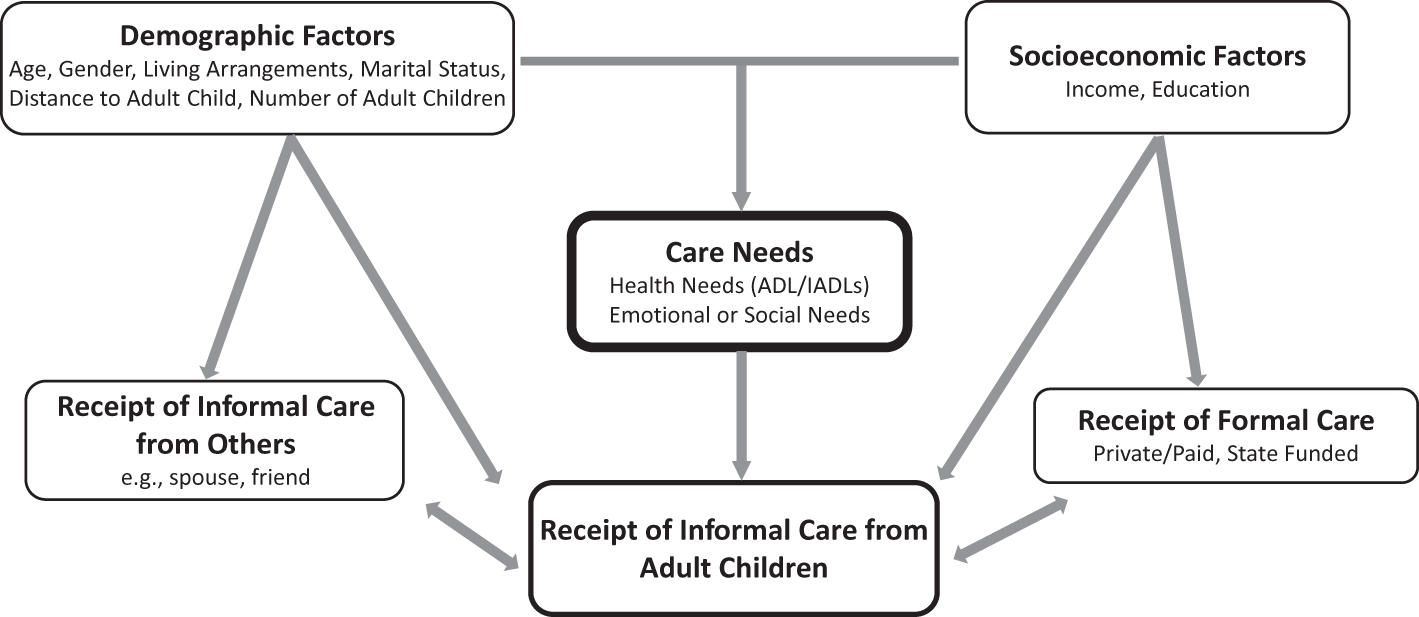
To address this gap, we shift our focus towards understanding informal care dynamics from the perspective of the care recipient. In doing so, we draw on the theoretical framework developed by Vlachantoni et al. (Reference Vlachantoni, Shaw, Evandrou and Falkingham2015) to derive our own conceptualization of older adults’ receipt of informal care from their adult children (Figure 1). In line with their framework, our conceptualization highlights three groups of factors (need, demographic and socio-economic) that may shape older adults’ receipt of informal care from their adult children. First, the recipients’ care needs are the central element in our framework, as they have been acknowledged by the ICM and Vlachantoni et al. (Reference Vlachantoni, Shaw, Evandrou and Falkingham2015) to be the trigger for the receipt of care. Previous research has typically operationalized older adults’ care needs through difficulties in performing activities of daily living (ADLs) or instrumental activities of daily living (IADLs). The ADLs are basic functional abilities, such as bathing or dressing, whereas IADLs, such as shopping or paying bills, are located at a higher level of cognitive functioning, and therefore may decline earlier than ADLs (Lawton and Brody Reference Lawton and Brody1969; Beltz et al. Reference Beltz, Gloystein, Litschko, Laag and van den Berg2022).
Conceptualizing parental care receipt from adult children.

Figure 1 Long description
The flowchart illustrates the factors influencing the receipt of informal care from adult children. It includes three main categories: Demographic Factors, Socioeconomic Factors and Care Needs. Demographic Factors include age, gender, living arrangements, marital status, distance to adult child and number of adult children. Socioeconomic Factors cover income and education. Care Needs are divided into health needs (ADL/IADLs) and emotional or social needs. Arrows connect these factors to the Receipt of Informal Care from Adult Children. Additionally, arrows show connections to the Receipt of Informal Care from Others, such as a spouse or friend and the Receipt of Formal Care, which can be private/paid or state-funded.
Second, our framework recognizes that care needs are interrelated with demographic and socio-economic factors, resulting in direct and indirect determinants of care receipt. For example, some demographic factors, such as age, act as indirect determinants of care receipt by shaping the recipients’ care needs; as parents grow older, their need for health-related care tends to become more pronounced (Smits et al. Reference Smits, Gaalen and Mulder2010; Reeves et al. Reference Reeves, Islam and Gentry2024). Gender also shapes older adults’ receipt of care, both directly and indirectly. For example, gender indirectly influences care receipt; for instance, women, while known to live longer than men, often experience more health problems in older age which may require greater levels of support (Crimmins et al. Reference Crimmins, Kim and Solé-Auró2011; Kwak et al. Reference Kwak, Kim, Lee and Jiaan2021). Additionally, gender can directly affect care receipt as mothers typically maintain stronger emotional and relational bonds with their adult children than fathers, potentially making them more likely to receive care and support from them in later life (Silverstein and Bengtson Reference Silverstein and Bengtson1997; Fingerman et al. Reference Fingerman, Huo and Birditt2020). This gendered pattern of care receipt may be particularly pronounced for older adults who are divorced, as following parental dissolution, mothers are more likely than fathers to sustain relationships with their children (Kalmijn Reference Kalmijn2007, Reference Kalmijn2013; Zilincikova and Albertini Reference Zilincikova and Albertini2022). Furthermore, women are more likely than men to experience widowhood and less likely to re-partner, which may increase their reliance on non-spousal sources of care, including adult children (Grunier et al. Reference Grunier, Forrester, Camacho, Gill and Bronskill2013; Dahlberg et al. Reference Dahlberg, Berndt, Lennartsson and Schön2017; Di Nallo Reference Di Nallo2019).
Older adults’ living arrangements and partnership status are also influential determinants of their care receipt, particularly in shaping who they receive care from (Broese van Groenou et al. Reference Broese van Groenou, Glaser, Tomassini and Jacobs2006; Noël-Miller Reference Noël-Miller2010). For example, research shows that while married individuals primarily receive care from a spouse, older adults without a partner or spouse are most likely to receive care from their adult children (Chappell Reference Chappell1991; Larsson and Silverstein Reference Larsson and Silverstein2004; Glaser et al. Reference Glaser, Stuchbury, Tomassini and Askham2008; Freedman et al. Reference Freedman, Agree, Seltzer, Birditt, Fingerman, Friedman, Lin, Margolis, Park, Patterson, Polenick, Reczek, Reyes, Truskinovsky, Wiemers, Wu, Wolf, Wolff and Zarit2023). Alternatively, older adults also report receiving care from other family members or non-kin, highlighting the diverse nature of informal care networks (Lapierre and Keating Reference Lapierre and Keating2012; Suanet et al. Reference Suanet, van Tilburg and Broese van Groenou2013; Schnettler and Wöhler Reference Schnettler and Wöhler2016; Zhang Reference Zhang2023). Moreover, the receipt of informal care also depends on its availability, which is often shaped by geographical proximity between the provider and the recipient (Bell and Rutherford Reference Bell and Rutherford2013; Rodríguez et al. Reference Rodríguez, Recover and Ballesta2017; Cornwell and Goldman Reference Cornwell and Goldman2020; Fihel et al. Reference Fihel, Kalbarczyk and Nicińska2022). In addition to proximity, the number of adult children also shapes the availability of care, as having more children is associated with a greater potential pool of support (Grundy and Read Reference Grundy and Read2012; Szinovacz and Davey Reference Szinovacz and Davey2013; Antczak et al. Reference Antczak, Quashie, Mair and Arpino2023).
Third, among socio-economic factors, income and education have been identified as key in determining care receipt. These factors can indirectly shape care receipt as higher socio-economic status is often associated with better health and therefore reduced or later onset of care needs (McMaughan et al. Reference McMaughan, Oloruntoba and Smith2020). Socio-economic resources can also directly shape care receipt as they are essential for accessing support from different sources, including formal care (Vlachantoni et al. Reference Vlachantoni, Shaw, Evandrou and Falkingham2015). Some studies have shown that higher socio-economic status is negatively related with the receipt of informal care and positively related to the receipt of formal or paid-for care (Kemper Reference Kemper1992; Larsson and Silverstein Reference Larsson and Silverstein2004). Thus, a key debate in the literature focuses on whether formal care acts as a substitute, with informal care receipt declining as formal care becomes more accessible (for example through higher socio-economic status), or whether it complements informal care (Penning Reference Penning2002; Geerlings et al. Reference Geerlings, Pot, Twisk and Deeg2005; Stabile et al. Reference Stabile, Laporte and Coyte2006; Bonsang Reference Bonsang2009; Saloniki et al. Reference Saloniki, Nizalova, Malisauskaite and Forder2024). This debate aligns with the ideas developed in Litwak’s (Reference Litwak1985) task specificity model, which argues that different types of individuals may be better positioned to perform certain caring tasks than others. For example, some studies show that the relationship between formal and informal care depends on the specific types of tasks for which care is received (Van Houtven and Norton Reference Van Houtven and Norton2004; Mentzakis et al. Reference Mentzakis, McNamee and Ryan2009). Despite Litwak’s (Reference Litwak1985) task specificity model being long acknowledged, few studies have explored the diversity of care tasks received by older adults, particularly from adult children (Evandrou et al. Reference Evandrou, Falkingham, Gómez-Leon and Vlachantoni2018; Gómez-Leon et al. Reference Gómez-Leon, Evandrou, Falkingham and Vlachantoni2019; Steele et al. Reference Steele, Zhang, Grundy and Burchardt2024). As a result, our first research question seeks to fill this gap by identifying latent classes of care receipt among ageing parents from their adult children:
Research question 1: What latent classes of care receipt from adult children can be identified among older parents?
Building on these classes and grounded in our conceptualization of care receipt, we draw on a range of factors measuring care need and demographic and socio-economic characteristics, with the aim to understand how they shape parents’ care receipt from their adult children. As our framework emphasizes that care needs are typically the first and most immediate trigger for the receipt of care, our second and third research questions explicitly distinguish between the recipients’ care needs and their demographic and socio-economic characteristics:
Research question 2: Do care needs differ among older adults classified into different classes of informal care receipt from adult children?
Research question 3: How do demographic and socio-economic factors shape the different groups of older adults’ informal care receipt?
We hypothesize that there are likely to be distinct groups of older adults receiving care from their adult children, which are shaped by a combination of the recipients’ care needs as well as their demographic and socio-economic characteristics. For example, older adults with greater care needs may be more likely to receive multi-dimensional support from their adult children, for both personal care and household tasks, while those with lower levels of need may receive more limited, task-specific help. Furthermore, the presence of other potential care providers, such as a spouse, may substitute for the care provided by adult children.
Data and variables
This article uses data from Wave 7 (data collection 2015–2017) of the UK Household Longitudinal Study (UKHLS) (University of Essex 2024), a nationally representative annual survey of the UK population. The UKHLS is a panel study of approximately 40,000 households, with adults aged 16+ in sampled households surveyed annually since 2009, with 15 waves of data currently available. Further information on the sampling strategy and data collection methods is available online (Institute for Social and Economic Research 2024). The sample was restricted to only include parents aged 65+ as the relevant questions regarding ADLs and IADLs are only asked to this age group. Furthermore, with the focus of this article being on informal care receipt from adult children, the sample was further refined to only include parents who had at least one adult child alive outside of their household and were therefore exposed to the possibility of receiving care from them. Individuals with any missing values from the variables of interest were removed (n = 94), resulting in a total analytical sample of 7,348 adult parents.
As with many social surveys, the reporting of difficulty with at least one ADL or IADL is a key threshold as it determines whether respondents will be asked further questions regarding their receipt of care from different sources, including informal and formal support. As a result, previous studies have frequently examined care receipt among older adults focusing exclusively on individuals who report difficulties with at least one ADL or IADL (Broese van Groenou et al. Reference Broese van Groenou, Glaser, Tomassini and Jacobs2006; Grundy and Read Reference Grundy and Read2012; Vlachantoni et al. Reference Vlachantoni, Shaw, Evandrou and Falkingham2015; Hu and Ma Reference Hu and Ma2018; Giang et al. Reference Giang, Nguyen, Pham and Phi2023). While this approach is useful for identifying individuals with established care needs, it overlooks a potentially important group of older adults who currently report no difficulties with ADLs or IADLs but nevertheless may receive support, including from their adult children. For example, Bui et al. (Reference Bui, Kim and Fingerman2022) find that older parents are more likely to receive care from their adult children for functional limitations if they received support from them preceding the onset of their care needs. In line with the latent kinship matrix (Riley Reference Riley1983), for this group of older adults, their adult children form a latent reserve of intergenerational care potential (Shen et al. Reference Shen, van Tilburg and van der Horst2025). Receiving support prior to the development of care needs means that older adult parents have an ongoing pool of support to draw on, with adult children then able to augment or adapt their care provision in response to emerging needs (Silverstein and Bengtson Reference Silverstein and Bengtson1997; Kim et al. Reference Kim, Bangerter, Liu, Polenick, Zarit and Fingerman2017). Additionally, the increased duration of co-survival between parents and their children has expanded the window during which intergenerational care can occur (Murphy et al. Reference Murphy, Martikainen and Pennec2006). Longer co-survival means that older parents may receive support from their children not only during periods of care need but potentially before traditional markers of care needs have developed. This highlights the importance of examining informal care receipt among older adults regardless of whether they have established care needs.
As a result, this article utilizes questions from the ‘family networks’ module relating to older adults’ receipt of care from their adult children, asked to all parents regardless of ADL or IADL limitations who have at least one non-co-resident adult child alive outside their household. Specifically asked is: ‘Do you regularly or frequently receive any of these things from your children aged 16 or older not living here?’ The range of answer options includes: getting lifts in their car; shopping; providing or cooking meals; help with basic personal needs like dressing, eating or bathing; washing, ironing or cleaning; dealing with personal affairs; decorating, gardening or house repairs; and financial help. While some of these tasks may not directly relate to health-care needs, they might help address social needs, which are vital for older adults’ wellbeing (Bruggencate et al. Reference Bruggencate, Luijkx and Sturm2018; Devkota et al. Reference Devkota, Cummings, Hunter, Maxwell, Shrestha, Dennett and Hoben2023). For example, parents may not report difficulties with tasks like shopping yet still receive help from their adult children due to factors such as loneliness or the need for companionship (O’Rourke et al. Reference O’Rourke, Collins and Sidani2018; Penning et al. Reference Penning, Wu and Hou2024). Considering a full range of care tasks is therefore essential to capture the diverse ways in which adult children support their ageing parents, beyond just addressing functional limitations.
Methods
We apply latent class analysis (LCA) to the set of variables from the family networks module to identify latent classes of parental care receipt from adult children. Latent class analysis is a statistical method within the family of mixture models which is used to uncover unobserved heterogeneity in a population and to identify qualitatively meaningful groups of individuals that are similar in their responses to observed indicator variables (Nylund et al. Reference Nylund, Asarouhov and Muthén2007; Nylund-Gibson and Choi Reference Nylund-Gibson and Choi2018; Aflaki et al. Reference Aflaki, Vigod and Ray2022). In our case, we include all eight types of support from the family network module as binary indicator variables in the LCA. Latent class analysis takes a person-centred approach to data analysis, with the goal to identify groups of individuals (i.e. latent classes) that have similar characteristics (Muthén and Muthén Reference Muthén and Muthén2000; Rosato and Baer Reference Rosato and Baer2012). A person-centred approach is particularly useful in this study as ageing parents represent a heterogeneous group who differ in their care needs, demographic profiles and socio-economic statuses, and may therefore receive different types of care from their adult children.
Latent class analysis produces two primary outputs that aid in interpreting the results: the class membership probabilities, which indicate the relative size of each class; and the conditional item probabilities, which describe the relationship between the observed indicator variables and the latent categorical variable, and are used to interpret each latent class (Porcu and Giambona Reference Porcu and Giambona2017; Nylund-Gibson and Choi Reference Nylund-Gibson and Choi2018; Weller et al. Reference Weller, Bowen and Faubert2020). To determine the appropriate number of latent classes to include in the model, known as class enumeration, statistical fit and substantive interpretability should both be considered (Weller et al. Reference Weller, Bowen and Faubert2020). Class enumeration includes fitting several LCA models, adding classes stepwise and calculating the model fit information (Nylund-Gibson and Choi Reference Nylund-Gibson and Choi2018). As there is no single fit index universally agreed upon for enumerating classes, the best practice is to use and report a range of fit statistics (Weller et al. Reference Weller, Bowen and Faubert2020), including the Bayesian information criterion (BIC), Akaike’s information criterion (AIC), the Pearson chi-square goodness of fit statistic (χ2), likelihood ratio chi-square (G2) and entropy. Parsimony criteria, including BIC and AIC, aim to balance model fit with complexity, introducing a penalty to the log-likelihood based on the number of estimated parameters (Linzer and Lewis Reference Linzer and Lewis2011). In fact, BIC is sometimes considered the most reliable indicator of model fit, with lower values indicating better fit (Nylund et al. Reference Nylund, Asarouhov and Muthén2007; Killian et al. Reference Killian, Cimino, Weller and Seo2019). The χ2 and G2 statistics assess model fit by comparing observed and expected frequencies, again with smaller values indicating better fit (Linzer and Lewis Reference Linzer and Lewis2011). Finally, entropy indicates how accurately the model classifies individuals into latent classes, with higher values (closer to 1) indicating better classification quality (Weiss and Dardick Reference Weiss and Dardick2016). Class assignment was based on the aforementioned fit statistics as well substantive interpretability. The LCA was conducted using the poLCA package in R, which estimates model parameters via maximum likelihood estimation (Linzer and Lewis Reference Linzer and Lewis2011, Reference Linzer and Lewis2022).
For the second part of the analysis, cross-tabulations and chi-squared tests are used to examine whether care needs significantly differ across the identified care receipt classes. For the purpose of this article, and in line with Grundy and Read (Reference Grundy and Read2012), older adults are considered to have established care needs if they report difficulty with at least one ADL or IADL. While ADLs and IADLs capture distinct dimensions of functional ability, we combine them into a single binary measure to represent the presence or absence of overall care needs. Building on the LCA, we then stratify the classes by care need to derive descriptive care receipt groups. We then employ a multinomial logistic regression model with the appropriate survey weights, with the outcome variable corresponding to the different combinations of care receipt and care need, enabling us to examine how older adults’ demographic and socio-economic characteristics are associated with these resulting groups. The results are presented as average marginal effects (AME), providing an estimate of the percentage points (pp) difference in the probabilities of an outcome event when the independent variable changes by one unit or category. In line with our conceptual framework and the literature review, the independent variables include the demographic characteristics of older adults (age, gender, living arrangements, geographical proximity to children and number of children) and their socio-economic status (self-reported individual income and education). The full information on how the explanatory variables were coded can be found in the supplementary materials (Table S1). For example, age was recoded from a continuous into a categorical variable, and de facto marital status and household composition were combined to form a new variable called living arrangements which aims to capture the broader living situation of the care recipient.
Results
Identifying latent classes of informal care receipt
Based on the model fit statistics (Table 1), the three-class solution was selected as the most appropriate latent class model. Compared to the two-class model, the three-class model demonstrated substantial improvement across all fit indices, except for a slight decrease in entropy. Despite this small reduction, the three-class solution maintains an entropy score above 0.80, commonly considered an acceptable threshold for classification quality (Weller et al. Reference Weller, Bowen and Faubert2020). The four- and five-class models exhibited higher BIC values and lower entropy scores compared to the three-class solution. Importantly, the three-class model also provided conceptually meaningful and interpretable classes of informal care receipt, striking an optimal balance between statistical fit and interpretability.
Measures of model fit to compare latent models with differing class numbers, and select which model is most suitable

Table 1 Long description
Model fit measures are listed for solutions with 2 classes, 3 classes, 4 classes, and 5 classes. For AIC, values are 31,877.6 for 2 classes, 31,354.46 for 3 classes, 31,303.21 for 4 classes, and 31,280.08 for 5 classes. For BIC, values are 31,994.94 for 2 classes, 31,533.91 for 3 classes, 31,544.78 for 4 classes, and 31,583.78 for 5 classes. For G squared, values are 850.0562, 308.9122, 239.6616, and 198.5359 from 2 through 5 classes. For X squared, values are 3,878.241, 424.3168, 334.8159, and 280.7578 from 2 through 5 classes. Entropy values are 0.84 for 2 classes, 0.82 for 3 classes, 0.73 for 4 classes, and 0.76 for 5 classes. Predicted class membership percentages are 79.2 per cent and 20.8 per cent for 2 classes; 2.8 per cent, 22.9 per cent, and 74.4 per cent for 3 classes; 16.2 per cent, 2.2 per cent, 14.7 per cent, and 66.8 per cent for 4 classes; and 64.9 per cent, 1.8 per cent, 10.6 per cent, 2.6 per cent, and 20.5 per cent for 5 classes.
Table 2 presents the conditional probabilities for each indicator variable for the three-class model. Class 1 is labelled ‘Comprehensive receivers’ as it is characterized by consistently high probabilities of receiving care across all tasks. Members of this class have a high probability of receiving types of domestic support from their adult children, including shopping (0.99), cooking meals (0.79) and washing, ironing or cleaning (0.76). Notably, they also have relatively high probabilities of receiving help with basic personal care tasks (0.46). Class 2 is labelled ‘Moderate receivers’ as it is characterized by moderate probabilities of receiving care. Individuals in this class have moderate probabilities of receiving support with domestic tasks such as receiving lifts (0.70), shopping (0.62) and decorating, gardening or house repairs (0.31), but markedly lower probabilities of receiving personal care (0.02). Class 3 is labelled ‘Low receivers’ and defined by very low (or zero) probabilities of receiving all care tasks.
Latent class conditional probabilities for the three-class model

Table 2 Long description
Conditional probabilities are listed for eight support activities across three columns labeled Class 1, Class 2, and Class 3. Receiving lifts is 0.81 in Class 1, 0.70 in Class 2, and 0.09 in Class 3. Shopping is 0.99 in Class 1, 0.62 in Class 2, and 0.02 in Class 3. Cooking meals is 0.79 in Class 1, 0.37 in Class 2, and 0.03 in Class 3. Help with basic personal needs is 0.46 in Class 1, 0.02 in Class 2, and 0.00 in Class 3. Washing, ironing or cleaning is 0.76 in Class 1, 0.09 in Class 2, and 0.00 in Class 3. Dealing with personal affairs is 0.71 in Class 1, 0.31 in Class 2, and 0.06 in Class 3, and Decorating, gardening or house repairs has the same values. Financial help is 0.19 in Class 1, 0.04 in Class 2, and 0.01 in Class 3.
Care need differences across care receipt classes
Results in Table 3 reveal a statistically significant association between the care receipt classes and care need (χ2 = 591.23, p < 0.001). Individuals in the comprehensive receivers class were overwhelmingly likely to also report care needs (90.2%). In contrast, the moderate receivers class displayed a more balanced distribution, with 53.6 per cent reporting care needs and 46.4 per cent reporting no need. This result highlights the importance of exploring why some individuals receive a moderate level of support despite not reporting an established care need. Therefore, we stratify the moderate receivers group into subgroups of ‘with need’ and ‘without need’ to better understand the underlying factors influencing informal care receipt.
Distribution of established care needs across care receipt classes

Table 3 Long description
Percentages are given for No need and Need across three care receipt classes, with X-squared and p-value also listed. Moderate Receivers show 46.4 percent No need and 53.6 percent Need. Low Receivers show 70.8 percent No need and 29.2 percent Need. X-squared is 591.23 and the p-value is less than 0.001.
The low receivers class was predominantly composed of individuals who reported no care needs (70.8%); however, a notable percentage (29.2%) do report care needs. Identifying these older adults, those who receive low levels of support from their adult children despite having care needs, represents an important subgroup for further examination. To better understand the demographic and socio-economic characteristics of this subgroup, we also stratify the low receivers class into ‘with need’ and ‘without need’ subgroups. Additional results in the supplementary materials (Table S2) provides a detailed breakdown of the specific ADL and IADL limitations for the care receipt groups. As expected, the comprehensive receivers group reported the highest prevalence of functional limitations, whereas both the moderate receivers with need and the low receivers with need groups exhibited comparatively lower levels of functional limitations, with no substantial differences observed between them. Overall, stratifying the three latent classes by care needs produced five care receipt groups, enabling a more nuanced examination of the factors associated with informal care receipt among individuals with varying levels of care need.
Descriptive variables for the total sample and each class

Table 4 Long description
Counts and percentages are reported for a total sample and five classes: Comprehensive Receivers, Moderate Receivers with Need, Moderate Receivers without Need, Low Receivers with Need, and Low Receivers without Need. Class sizes are 204, 900, 780, 1,595, and 3,869 respectively, with percentages 2.8, 12.2, 10.6, 21.7, and 52.7. Age groups are 65 to 74, 75 to 84, and 85 plus; in the total sample these are 4,323 at 58.8 per cent, 2,371 at 32.3 per cent, and 654 at 8.9 per cent, and in Comprehensive Receivers they are 65 at 31.9 per cent, 74 at 36.3 per cent, and 65 at 31.9 per cent. Gender totals are 4,069 female at 55.4 per cent and 3,279 male at 44.6 per cent; Comprehensive Receivers are 137 female at 67.2 per cent and 67 male at 32.8 per cent. Living arrangements in the total sample are 4,814 living with partner only at 65.5 per cent, 359 living with others not partner at 4.9 per cent, 721 living alone and divorced at 9.8 per cent, and 1,454 living alone and widowed at 19.8 per cent; Comprehensive Receivers are 40, 25, 28, and 111 respectively, with 54.4 per cent living alone and widowed. Number of children in the total sample is 1,266 with one child at 17.2 per cent, 3,338 with two children at 45.4 per cent, and 2,744 with three plus children at 37.4 per cent; Comprehensive Receivers are 31, 62, and 111 respectively. Distance to child in the total sample is 3,157 under 15 minutes at 43.0 per cent, 1,612 at 15 to 30 minutes at 21.9 per cent, 816 at 30 minutes to one hour at 11.1 per cent, and 1,763 more than one hour at 24.0 per cent; Comprehensive Receivers are 136, 45, 16, and 7 respectively. Income in the total sample is 2,454 low at 33.4 per cent, 2,447 middle at 33.3 per cent, and 2,447 high at 33.3 per cent; Comprehensive Receivers are 57 low at 27.9 per cent, 91 middle at 44.6 per cent, and 56 high at 27.5 per cent. Education in the total sample is 1,957 degree at 26.6 per cent, 2,109 A Level or GCSE at 28.7 per cent, 1,232 other qualification at 16.8 per cent, and 2,050 no qualification at 27.9 per cent; Comprehensive Receivers are 25 degree at 12.3 per cent, 25 A Level or GCSE at 12.3 per cent, 37 other qualification at 18.1 per cent, and 117 no qualification at 57.4 per cent.
Demographic and socio-economic characteristics of the care receipt groups
Table 4 presents the descriptive statistics of the total sample and the five care receipt groups, derived from the latent classes after stratification by care needs: comprehensive receivers (2.8%), moderate receivers with need (12.2%), moderate receivers without need (10.6%), low receivers with need (21.7%) and low receivers without need (52.7%). The majority of older adult parents in the sample are aged 65–74 (58.8%), followed by those aged 75–84 (32.3%) and 85+ (8.9%). Notably, the comprehensive receivers group has an older profile, with 31.9 per cent aged 85+, compared to only 3.1 per cent in the low receivers without need group. Females comprised approximately 55 per cent of the sample, with all groups, with the exception of the low receivers without need, having a higher proportion of females than males. Most older adults live with a partner only (65.5%), followed by those who live alone and are widowed (19.8%) and those who live alone and are divorced (9.8%). Only 19.6 per cent of the comprehensive receivers group live with a partner, compared to 74.3 per cent in the low receivers without need group, with the comprehensive receivers group having the highest proportion of those living alone and widowed (54.4%). The majority of older adults have two children (45.4%), and 43 per cent reported that the child they had the most contact with lived under 15 minutes away from them. Older adults receiving comprehensive or moderate levels of care were more likely to have children living nearby compared to the low receivers’ groups. For instance, 61.9 per cent of the moderate receivers without need group had a child living within 15 minutes, compared to 37 per cent in the low receivers without need group. As the income variable was constructed by dividing the sample into tertiles based on the sample’s income distribution, there are approximately equal proportions of individuals classified into low-, middle- and high-income categories. While the distribution of educational attainment across the sample is relatively balanced, with comparable proportions of individuals holding degrees (26.6%), A-Level/GCSE (28.7%) and no qualifications (27.9%), there is notable variation across the care receipt groups. For example, the comprehensive receivers group has the largest proportion with no qualifications (57.4%), whereas the low receivers without need group has the highest proportion with a degree (33.5%).
Multinomial logistic regression results for the care receipt groups
Results from the estimation of the fully adjusted multinomial logistic regression are reported in Table 5. For ease of interpretation, we break down the results based on each care receipt group in turn. In the comprehensive receivers group, individuals aged 85+ were 3.7 percentage points more likely to be classified here compared to those aged 65–74 (p < 0.001). Living arrangements and partnership status were strong predictors, with those living with others but not a partner being 3.9 percentage points more likely to be in the comprehensive receivers group (p = 0.002). Moreover, individuals living alone who were divorced (+4.2 pp, p < 0.001) or widowed (+4.2 pp, p < 0.001) were more likely to be in this group, relative to those living only with their partner. Having three or more children was associated with a slightly higher likelihood of belonging to the comprehensive receivers group, although this was only marginally significant (+1.2 pp, p = 0.053). Distance to children was another important factor: the farther away the child lived, the lower the likelihood of belonging to the comprehensive receivers group (30 minutes to 1 hour: −2.2 pp, p < 0.001; more than 1 hour: −3.3 pp, p < 0.001). Additionally, respondents with other (+1.3 pp, p = 0.023) or no (+2.7 pp, p < 0.001) educational qualifications were more likely to belong to this group. No significant gender or income differences were observed at the 5 per cent level, net of other covariates.
Average marginal effects from the fully adjusted multinomial logistic regression

Table 5 Long description
Average marginal effects and p values are reported for five outcome groups: Comprehensive Receivers, Moderate Receivers with Need, Moderate Receivers without Need, Low Receivers with Need, and Low Receivers without Need. Reference categories are 65 to 74 years, Female, Living with partner only, One child, Under 15 minutes, Low income, and Degree. For age, compared with 65 to 74, 75 to 84 has AMEs of 0.006 with p value 0.153 for Comprehensive Receivers, 0.087 with p value less than 0.001 for Moderate Receivers with Need, minus 0.022 with p value 0.011 for Moderate Receivers without Need, 0.089 with p value less than 0.001 for Low Receivers with Need, and minus 0.159 with p value less than 0.001 for Low Receivers without Need; 85 plus has 0.037 with p value less than 0.001, 0.192 with p value less than 0.001, minus 0.066 with p value less than 0.001, 0.223 with p value less than 0.001, and minus 0.387 with p value less than 0.001, respectively. For gender, Male has AMEs of 0.005 with p value 0.339, minus 0.046 with p value less than 0.001, minus 0.022 with p value 0.012, minus 0.016 with p value 0.194, and 0.078 with p value less than 0.001, respectively. For living arrangements, compared with living with partner only, living with others not partner has 0.039 with p value 0.002 for Comprehensive Receivers and minus 0.159 with p value less than 0.001 for Low Receivers without Need; living alone and divorced has 0.042 with p value less than 0.001 for Comprehensive Receivers, 0.044 with p value 0.001 for Moderate Receivers without Need, and minus 0.085 with p value less than 0.001 for Low Receivers with Need; living alone and widowed has 0.042 with p value less than 0.001 for Comprehensive Receivers, 0.076 with p value less than 0.001 for Moderate Receivers with Need, 0.092 with p value less than 0.001 for Moderate Receivers without Need, minus 0.102 with p value less than 0.001 for Low Receivers with Need, and minus 0.112 with p value less than 0.001 for Low Receivers without Need. For number of children, compared with one child, two children has 0.036 with p value less than 0.001 for Moderate Receivers without Need and minus 0.030 with p value 0.044 for Low Receivers with Need; three plus children has 0.012 with p value 0.053 for Comprehensive Receivers, 0.048 with p value less than 0.001 for Moderate Receivers without Need, and minus 0.048 with p value 0.006 for Low Receivers without Need. For distance to child, compared with under 15 minutes, 15 to 30 minutes has minus 0.058 with p value less than 0.001 for Moderate Receivers without Need and 0.063 with p value less than 0.001 for Low Receivers without Need; 30 minutes to one hour has minus 0.022 with p value less than 0.001 for Comprehensive Receivers, minus 0.043 with p value 0.002 for Moderate Receivers without Need, and 0.061 with p value 0.002 for Low Receivers without Need; more than one hour has minus 0.033 with p value less than 0.001 for Comprehensive Receivers, minus 0.096 with p value less than 0.001 for Moderate Receivers with Need, minus 0.101 with p value less than 0.001 for Moderate Receivers without Need, 0.090 with p value less than 0.001 for Low Receivers with Need, and 0.141 with p value less than 0.001 for Low Receivers without Need. For income, compared with low income, middle income has 0.017 with p value 0.073 for Moderate Receivers without Need and minus 0.047 with p value 0.002 for Low Receivers without Need; high income has no listed p values below 0.05 across the five outcomes. For education, compared with degree, A Level or GCSE has 0.045 with p value 0.001 for Low Receivers with Need and minus 0.059 with p value 0.001 for Low Receivers without Need; other qualification has 0.013 with p value 0.023 for Comprehensive Receivers, 0.072 with p value less than 0.001 for Low Receivers with Need, and minus 0.116 with p value less than 0.001 for Low Receivers without Need; no qualification has 0.027 with p value less than 0.001 for Comprehensive Receivers, 0.063 with p value less than 0.001 for Moderate Receivers with Need, 0.112 with p value less than 0.001 for Low Receivers with Need, and minus 0.200 with p value less than 0.001 for Low Receivers without Need.
In the moderate receivers with need group, those aged 75–84 were 8.7 percentage points more likely (p < 0.001), and those aged 85+ were 19.2 percentage points more likely (p < 0.001) to be classified here. Gender differences emerged, with men being 4.6 percentage points less likely than women to belong to this group (p < 0.001). Among living arrangements, individuals living alone who were divorced (+2.8 pp, p = 0.071) or widowed (+7.6 pp, p < 0.001) had higher likelihoods of belonging to this group. Parents’ distance to children also played a role: for example, those whose child lived more than one hour away were 9.6 percentage points less likely (p < 0.001) to belong to this group. Lastly, individuals with other qualifications (+2.4 pp, p = 0.072) or no qualifications (+6.3 pp, p < 0.001) were more likely to be in this group compared to those holding degrees.
In the moderate receivers without need group, those aged 75–84 (−2.2 pp, p = 0.011) and 85+ (−6.6 pp, p < 0.001) were less likely to belong to this group. Men were 2.2 percentage points less likely than women to be classified here (p = 0.012). Living alone, among those divorced (+4.4 pp, p = 0.001) and widowed (+9.2 pp, p < 0.001), increased the likelihood of being in this group. Those with two (+3.6 pp, p < 0.001) or three or more children (+4.8 pp, p < 0.001) were more likely to belong to this group. Geographic proximity was again important: greater distance decreased the likelihood of being in this group (15–30 minutes: −5.8 pp, p < 0.001; 30 minutes to 1 hour: −4.3 pp, p = 0.002; more than 1 hour: −10.1 pp, p < 0.001). No significant income or educational differences were observed in the moderate receivers without need group, net of other covariates.
In the low receivers with need group, those aged 75–84 (+8.9 pp, p < 0.001) and 85+ (+22.3 pp, p < 0.001) were more likely to belong to this group. Individuals living alone who were divorced (−8.5 pp, p < 0.001) or widowed (−10.2 pp, p < 0.001) had lower likelihoods of belonging to this group, whereas those who lived with others but not a partner had a higher likelihood (+8.5 pp, p = 0.005). Individuals with two (−3.0 pp, p = 0.044) or three or more children (−3.0 pp, p = 0.058) were less likely to belong to this group. Having a child living more than one hour away increased the likelihood of being in this group (+9.0 pp, p < 0.001). Educational attainment strongly predicted membership: those with A-Level/GCSE (+4.5 pp, p = 0.001), other qualifications (+7.2 pp, p < 0.001) or no qualifications (+11.2 pp, p < 0.001) were more likely than degree holders to be in this group. No significant gender or income differences were observed in the low receivers with need group.
Finally, in the low receivers without need group, those aged 75–84 (−15.9 pp, p < 0.001) and 85+ (−38.7 pp, p < 0.001) were less likely to belong to this group. Men were 7.8 percentage points more likely than women to be in this group (p < 0.001). Living with others but not a partner (−15.9 pp, p < 0.001) or being widowed and living alone (−11.2 pp, p < 0.001) decreased the likelihood of being in this group. Parents with three or more children were 4.8 percentage points less likely (p = 0.006) to be in the low receivers without need group. Geographic proximity was again a key factor: greater distance increased the likelihood of membership in this group (15–30 minutes: +6.3 pp, p < 0.001; 30 minutes to 1 hour: +6.1 pp, p = 0.002; more than 1 hour: +14.1 pp, p < 0.001). Middle income individuals were 4.7 percentage points (p = 0.002) less likely to be classified here. Educational attainment showed a strong gradient: lower qualifications were associated with reduced likelihood of belonging to the low receivers without need group, relative to those with degrees (A-Level/GCSE: −5.9 pp, p = 0.001; other qualifications: −11.6 pp, p < 0.001; no qualifications: −20.0 pp, p < 0.001).
Discussion and conclusion
To date, relatively few studies have explicitly examined the types of care and support that older adults receive from their adult children (Evandrou et al. Reference Evandrou, Falkingham, Gómez-Leon and Vlachantoni2018; Gómez-Leon et al. Reference Gómez-Leon, Evandrou, Falkingham and Vlachantoni2019; Steele et al. Reference Steele, Zhang, Grundy and Burchardt2024). To expand this literature, our analysis proceeded in three stages. First, LCA identified three classes of parental care receipt from adult children, based on multiple types of care tasks. Second, these classes were stratified by care need, resulting in five care receipt groups. Third, theoretically informed by our conceptual framework for the receipt of care from adult children, the article further investigated the demographic and socio-economic characteristics of each group.
First, the comprehensive receivers group captures a small, but distinct group of older adults who receive help with a range of care tasks from their adult children, including both domestic tasks and personal care. Consistent with our hypothesis, this group also had the highest prevalence of functional limitations, indicating high levels of care need (Table S2). Those aged 85+ were more likely to be in this group, supporting the findings that care needs tend to increase with age (Smits et al. Reference Smits, Gaalen and Mulder2010; Reeves et al. Reference Reeves, Islam and Gentry2024). Additionally, older adults in the comprehensive receivers group were more likely to live alone and be either divorced or widowed. As such, these individuals may receive more care from their adult children because their care network lacks alternative sources of support due to the absence of a co-residing partner or spouse. This highlights the important role adult children may play when other informal care-givers are unavailable (Larsson and Silverstein Reference Larsson and Silverstein2004; Pinquart and Sörensen Reference Pinquart and Sörensen2011). Geographical proximity to children was also influential, as older adults in this group were less likely to have children living farther away. This finding is consistent with research showing that close proximity increases the accessibility or availability of informal care (Bell and Rutherford Reference Bell and Rutherford2013). However, a limitation of this variable is that it only captures the travel time to the child with whom the parent has the most contact, who is not necessarily the one providing support. Older adults with no qualifications were more likely to belong to this group, potentially reflecting the positive relationship between educational attainment and health (Ross and Wu Reference Ross and Wu1995; Raghupathi and Raghupathi Reference Raghupathi and Raghupathi2020).
Second, the results for the moderate receivers with need group exhibit broadly similar demographic and socio-economic characteristics to the comprehensive receivers group. Individuals in this group are also more likely to be older, live alone and be divorced or widowed, reflecting comparable patterns of reliance on adult children due to the potential absence of alternative sources of support. Additionally, they are also less likely to have children living more than one hour away and have lower levels of education. However, compared to the comprehensive receivers group, women were more likely than men to belong to this group. This may reflect their higher likelihood of widowhood and lower likelihood of re-partnering, thereby reducing access to spousal care and increasing reliance on adult children for support (Dahlberg et al. Reference Dahlberg, Berndt, Lennartsson and Schön2017; Di Nallo Reference Di Nallo2019). Another distinction from the comprehensive receivers group is the notably lower prevalence of functional limitations (Table S2), which likely accounts for their lower probabilities of receiving various care and support tasks. This group highlights how differences in care need influence the types and extent of informal care older adults receive from their adult children.
Third, the moderate receivers without need group reflects older adults who receive some care and support from their adult children despite having no functional limitations. This group primarily comprises relatively younger older adults, reinforcing the relationship between age and care needs. Women were more likely than men to be classified in this group, again suggesting gender differences in care receipt. This result may reflect the closer emotional and relational bonds that mothers tend to maintain with their adult children compared to fathers (Silverstein and Bengtson Reference Silverstein and Bengtson1997; Fingerman et al. Reference Fingerman, Huo and Birditt2020), leading to greater informal support despite the absence of care needs. Similar to the previous groups, living alone, including those who were divorced or widowed, increased the likelihood of membership in this group. Additionally, older adults in this group were less likely to have children living farther away, indicating that geographical proximity facilitates intergenerational exchange of support from adult children to their parents. As individuals in this group receive care from their adult children despite not having any functional limitations, this suggests that the support received may serve social or practical purposes, such as maintaining regular contact or offering companionship, rather than responding to specific health-related limitations (Bruggencate et al. Reference Bruggencate, Luijkx and Sturm2018; O’Rourke et al. Reference O’Rourke, Collins and Sidani2018).
This subgroup of older adults, those who do not currently experience limitations in ADLs or IADLs but still receive support from their adult children, is of scientific as well as societal relevance. The fact that some older adults receive care from their adult children despite having no care needs suggests that informal care is potentially not only responsive to care needs but also anticipatory, helping to maintain older adults’ independence and prepare for future care demands. This aligns with the concept of the latent kinship matrix (Riley Reference Riley1983), whereby adult children constitute a latent reserve of intergenerational care potential (Shen et al. Reference Shen, van Tilburg and van der Horst2025). Receiving support before the onset of functional decline suggests that older parents may benefit from a sustained and adaptable support system, with adult children being well positioned to intensify or modify care as needs emerge (Kim et al. Reference Kim, Bangerter, Liu, Polenick, Zarit and Fingerman2017). In this context, for this subgroup of older adults, early and ongoing support from their adult children may act as a protective factor, potentially reducing their likelihood of having unmet needs or adverse outcomes later in life (Mavandadi et al. Reference Mavandadi, Rook and Newsom2007; Choi et al. Reference Choi, Schoeni, Langa and Heisler2015; Hu and Li Reference Hu and Li2020). In addition, this finding may reflect the blurred boundaries between care and social or emotional support. For this group of older adults, support from adult children may signify broader intergenerational solidarity, demonstrating how these relationships can operate on multiple levels including sustaining emotional closeness, providing practical assistance and contributing to wellbeing, even in the absence of explicit care needs (Silverstein and Bengtson Reference Silverstein and Bengtson1997; Katz Reference Katz2009). Therefore, although the subject is beyond the scope of this article, by examining those who receive support despite having no immediate care needs, we could gain valuable insight into how early care and support relationships may contribute to long-term wellbeing as parents continue to age. Further research is required to investigate whether early support may serve as a protective factor in helping older adults manage their future care needs and avoid adverse health outcomes.
Fourth, the low receivers with need group represents a subgroup of older adults who have care needs but receive little or no care from their adult children. Similar to the other groups characterized by care needs, individuals in this group tend to be older, reflecting the relationship between age and care needs. However, unlike the other groups characterized by care needs, these older adults are less likely to live alone and be divorced or widowed. This suggests that while these individuals are older and in need of care, many still have a living spouse or partner. This provides an alternative source of support and therefore could reduce the care they receive from their adult children (Pickard Reference Pickard2013; Haberkern et al. Reference Haberkern, Schmid and Szydlik2015). Although older adults in the low receivers with need and the moderate receivers with need groups report similar prevalences of ADL and IADL limitations (Table S2), in line with our expectations, their receipt of care from their adult children differs, likely because their needs are being met by other care-givers, such as a spouse. Additionally, it is possible that the care needs of these older adults are being met through formal sources of support, which may also reduce the care they receive from their adult children. Indeed, approximately 40 per cent of individuals in this group report receiving care from formal sources for their ADL/IADL needs, highlighting the complementary or substitutable nature of the two types of care (Geerlings et al. Reference Geerlings, Pot, Twisk and Deeg2005; Bonsang Reference Bonsang2009; Saloniki et al. Reference Saloniki, Nizalova, Malisauskaite and Forder2024). Older adults’ care receipt in the low receivers with need group may be further influenced by family structure, including the number of children. For example, older adults in this group are more likely to have only one child, compared to individuals in the moderate receivers without need group who are more likely to have two or more children. This difference could partly explain the variation in care receipt between these groups, as having more children is associated with a greater potential pool of support resources (Grundy and Read Reference Grundy and Read2012; Szinovacz and Davey Reference Szinovacz and Davey2013). At the same time, research suggests that only children are often more likely to provide care to their parents, indicating that trends towards smaller family sizes may have important implications both for the availability of support for older adults and for the caring responsibilities placed on only children (Chanfreau and Goisis Reference Chanfreau and Goisis2024).
The final group, low receivers without need, is empirically the largest group and is characterized by older adults who do not receive informal care from their children and also do not have care needs. Individuals in this group are more likely to be younger, male and live with a partner, indicating more independent living arrangements. Notably, compared to the other four groups, this group is more common among those with higher educational attainment, indicating that it is an important social determinant influencing informal care receipt among older adults. Higher levels of education are often associated with higher socio-economic status, improved health outcomes and increased access to formal support services, which affects both the need for care and the availability of informal care-givers (Broese van Groenou et al. Reference Broese van Groenou, Glaser, Tomassini and Jacobs2006; Weyers et al. Reference Weyers, Dragano, Möbus, Beck, Stang, Möhlenkamp, Jöckel, Erbel and Siegrist2008; Vlachantoni et al. Reference Vlachantoni, Shaw, Evandrou and Falkingham2015; Ilinca et al. Reference Ilinca, Rodrigues and Schmidt2017; Floridi et al. Reference Floridi, Carrino and Glaser2021). Interestingly, across most groups, education shows a significant association while income did not. One possible explanation is that education reflects broader long-term social (dis)advantages that remain relatively fixed, making it a more robust proxy for cumulative socio-economic (dis)advantage across the lifecourse (Grundy and Holt Reference Grundy and Holt2001; Lahelma et al. Reference Lahelma, Martikainen, Laaksonen and Aittonmäki2004; Kingston et al. Reference Kingston, Davies, Collerton, Robinson, Duncan, Kirkwood and Jagger2015). As a sensitivity check (results not shown), we re-estimated the models excluding education to assess whether its inclusion suppressed the effect of income. Results showed that income remained statistically insignificant, suggesting that income, independent of educational attainment, does not play a strong role in differentiating care receipt groups. In sum, this group reflects a profile of relatively healthy, independent older adults with social and demographic characteristics that support reduced care needs, and as a result limited informal care receipt.
This article has a few limitations that warrant acknowledgement. First, it is important to note that the indicator variables in the LCA aggregate care received from all adult children. Therefore, the reported level of care received may reflect combined contributions rather than care from any single child. For example, an older adult with several children each providing minimal help could report the same overall level of care as someone receiving more intensive support from a single child. Despite this limitation, controlling for the number of non-co-resident children is crucial in our analysis because the indicator variables in the LCA specifically focus on care received from non-co-resident children. By including this variable in our model, we account for differences in the number of children, ensuring that variations in care receipt more accurately reflect differences in the care receipt groups, rather than simply the number of available children. A second limitation, which also arises from the structure of the UKHLS data, is that information is collected only from one member of the parent–child dyad. In our case, data is collected only from the older adult’s perspective, and not from their adult children who may be providing care, meaning that we are unable to assess the characteristics of the potential care provider. This limits our ability to understand the full context of care provision including the broader family dynamics, such as competing demands faced by the care providers, which may shape the likelihood and extent of care being provided (Broese van Groenou and Boer Reference Broese van Groenou and Boer2016; Pomeroy and Fiori Reference Pomeroy and Fiori2025).
Despite these limitations, our findings reveal how demographic and socio-economic characteristics structure informal care dynamics between ageing parents and their adult children. Importantly, the results also demonstrate that informal care receipt is not solely determined according to care needs; some older adults receive care from their children despite having no care needs. To ensure the robustness of our care receipt groupings, we conducted sensitivity analyses using data from Wave 13, the most recent wave containing the relevant outcome variables. This analysis reproduced the same three latent classes (Table S3) and the five descriptive groups derived from stratifying by care needs as identified in Wave 7 (Table S4). Wave 7 was chosen as the main analytical wave for this article as it retained the largest and most representative sample of older adults, ensuring that even smaller classes, such as the comprehensive receivers group, are reliably identified.
While our analysis is cross-sectional, future research should aim to investigate the longitudinal patterns of care receipt among older parents. This is important as care needs among older adults are inherently dynamic; for example, they can change in response to fluctuations in health (Evandrou et al. Reference Evandrou, Falkingham, Gómez-León and Vlachantoni2022; Vlachantoni et al. Reference Vlachantoni, Evandrou, Falkingham and Qin2024). Similarly, older adults’ care networks are not static; they can adapt as the availability and capacity of care providers shifts due to various life circumstances (Szinovacz and Davey Reference Szinovacz and Davey2013; Ho et al. Reference Ho, McGill, Malden, Wilson, Pearce, Kaner, Vines, Aujla, Lewis, Restocchi, Marshall and Guthrie2023). By classifying older adults into meaningful subgroups based on patterns of care receipt, this article provides a foundation for future longitudinal research to explore how care receipt patterns change over time, and examine transitions between different types of care and the long-term outcomes associated with different informal care trajectories. For example, some older adults may move from receiving no care to informal support as health declines, while others might shift between different sources of support as the capacity of their care network changes over time due to various life events affecting both the care provider (for example parenthood or employment transition) and the care recipient (for example death of a spouse). Investigating these care trajectories requires a longitudinal approach that can capture the timing, duration and transitions between different types of care receipt, and will enable us to deepen our understanding of the mechanisms driving care dynamics.
In conclusion, this article advances our understanding of informal care dynamics in the UK by identifying distinct groups that capture the diverse patterns of care that older adults receive from their adult children. While we recognize that data constraints may have prevented previous studies from capturing the full complexity of care receipt patterns, our findings highlight the need to move beyond conceptualizations of informal care limited to simple measures. Importantly, this approach allows us to identify groups of older adults at potentially different risks of vulnerability in meeting their current or future care needs. For example, older adults in the low receivers with need group, who may currently rely on a spouse for support, could face substantial care gaps if that support is lost due to widowhood, which could be further heightened if they lack proximate children who could step in to meet their care needs. In contrast, older adults in the moderate receivers without need group may be better positioned to manage future care needs due to ongoing support from their adult children. Identifying these patterns of care receipt can inform tailored interventions recognizing the heterogeneity of care experiences among older adults and their families. For example, assessment of the need for formal care may be especially important for older adults in the low receivers with need group, particularly if their primary care-giver is also ageing or in declining health. Meanwhile, the moderate receivers without need group may benefit from policies designed to sustain early informal care arrangements, such as the Employment Relations (Flexible Working) Act 2023, which enables carers to request changes to working hours and locations. This highlights how flexible work options may enable adult children to balance the competing demands of work and family, helping to maintain continuity of care for their parents over time. Such targeted interventions may strengthen intergenerational support networks, which is of particular importance in the context of the UK ageing society.
Supplementary material
The supplementary material for this article can be found at https://doi.org/10.1017/S0144686X26101019.
Financial support
This work was supported by the Economic and Social Research Council (ESRC) and Scottish Graduate School of Social Science (SGSSS) under grant number ES/P000681/1; and by the ESRC Centre for Population Change Connecting Generations research programme, under grant number ES/W002116/1.
Competing interests
The authors declare none.
Ethical standards
The study is based solely on the analysis of anonymized secondary data. It does not involve human participants or interaction with vulnerable population groups. Ethical approval was obtained by the University of St Andrews. Individual-level data from the UKHLS was downloaded from the UK Data Service website upon submission of an application form detailing the project objectives and intended data usage and the acceptance of the user agreement’s terms and conditions. We abided by these strict rules, as defined in the user agreement. Outputs are presented in aggregate form and no information on individuals or individual households has been disclosed.




 Open access

