

Introduction
During the Nordic Bronze Age (1700–500 BCE), a particular tradition of rock art emerged in south Scandinavia. The motif repertoire is limited, mostly consisting of elemental motifs such as cupmarks, boats, anthropomorphs, zoomorphs, circles, and podomorphs, mainly produced along the coasts and water routes (Fahlander Reference Fahlander2024, 153; Goldhahn & Ling Reference Goldhahn, Ling, Harding and Fokkens2013; Nimura Reference Nimura2016, 46). Despite over 150 years of research, the role and meaning of the petroglyphs are still widely debated. Over time, research has fluctuated between social and ritual interpretations and questions of whether the petroglyphs represent real or supernatural worlds or if they are primarily associated with death cults or fertility rites (Almgren Reference Almgren1927; Goldhahn & Ling Reference Goldhahn, Ling, Harding and Fokkens2013; Goldhahn et al. Reference Goldhahn, Fuglestvedt and Jones2010; Malmer Reference Malmer1981). A common assumption across these perspectives is that the petroglyphs are representative or illustrative of life, cosmology, or myth (Goldhahn & Ling Reference Goldhahn, Ling, Harding and Fokkens2013; Kaul Reference Kaul1998; Kristiansen Reference Kristiansen, Fredell, Kristiansen and Criado Boado2010). In recent decades, however, researchers have questioned the view that rock art motifs mainly serve to depict or illustrate objects (e.g. Alberti & Fowles Reference Alberti, Fowles and Pilaar Birch2018; Fahlander 2018; Reference Fahlander2024; Jones & Cochrane Reference Jones and Cochrane2018). Drawing on new perspectives from art history, ethnography, and anthropology, it is argued that figurative expressions in small-scale societies are often created to ‘present rather than represent’ (Nakamura Reference Nakamura and Meskell2005, 22). Instead of illustrating something, imagery is rather made to actively affect both humans and other-than-humans (Gell Reference Gell1998; Morgan Reference Morgan2018; Nyord Reference Nyord2020). This view of rock art aligns with recent research that emphasises the ontological aspects of image production (Fahlander Reference Fahlander2019; Jones & Cochrane Reference Jones and Cochrane2018, 16; Moro Abadía & Porr Reference Moro Abadía and Porr2021). From this perspective, petroglyphs are not just pictures, but generative devices made to affect through their material qualities, aesthetics, scale, and method of creation (Fahlander Reference Fahlander2024; Morgan Reference Morgan2018).
Even though petroglyphs are a very physical type of art, that is, they have a three-dimensional form, are often pecked on areas of diverging minerals and where water regularly trickles down, there has been curiously little discussion about ontological aspects of the production process. Experimental trials of rock art production are generally focused on estimating efficiency by investigating the effects of tools and different techniques and measuring how long it takes to make a motif. The focus on efficiency leaves little room for discussing the process of ‘making’. Tim Ingold has criticised the hylomorphic view of making, in which an idea of a form is imposed on passive matter. Instead, he advocates a greater focus on the process of making that may overshadow the result (Ingold Reference Ingold2013). There are several aspects involved when enacting the rocks (e.g. sound, smell, and changes in colour and texture) that may potentially be of importance in order to understand the meaning of rock art. The other materials involved, such as water and the mineral powder resulting from pecking, may also be integrated parts of the practice. For example, in some cultures, the main reason for making cupmarks was to collect the powder to use in rituals, which has also been suggested for the Bronze Age tradition (Marstrander Reference Marstrander1963, 458). The importance of water is also indicated by small channels that sometimes connect cupmarks and the overall affinity to make petroglyphs in depressions of areas on the rock where water flows after rain (Fahlander Reference Fahlander2025). These questions are thus important to examine in greater detail to reach a more informed understanding of the purposes and functions of Bronze Age petroglyphs. To explore these issues further, I initiated a small exploratory test, which resulted in the production of three motifs: a cupmark, a circle, and a shallow boat motif. The point of the experiment is not to cover all aspects of production, but rather to serve as a basis for a broader discussion regarding the ontological status of petroglyphs, focusing on the interplay between their visual and material aspects.
Making rock art – a practical experiment
The experiment presented here aimed to evaluate these questions by making different types of motifs in granite bedrock. Besides the traditional goals – i.e. to measure the time expenditure, tools, and techniques, the impact of water on the process–, the aim was also to evaluate sensory aspects (e.g. sound, colour, and smell), and to discuss the visibility of the petroglyphs over time. The experiment was performed on an oval 1.6 x 1.6 x 0.65 m exposed part of granite bedrock situated in a cottage property in the county of Södermanland in southern Sweden (Figure 1). Ordinary, locally retrieved, stones with pointy edges were used with direct technique, that is, by repeatedly pounding the rock to create furrows and cavities.
The rock outcrop two months after the making of a circle, boat motif, and cupmark (indicated by red arrows). The pecking stones are in the lower right corner. Photo by the author.

The cupmark
The first attempt was to make a typical cupmark by repeatedly pecking on a small spot on the rock. Already after 20 seconds of pecking, a fair amount of white fine-grained powder, which could easily be blown away, covered the area (Figure 2a). This cleansing was repeated every 20 seconds to make the pecking more effective. After five minutes, a round and cup-shaped depression was discernible, which felt very smooth in structure. At this stage, I decided to try to flush away the remaining mineral dust with water. This darkened the pecked area significantly (Figure 2b), and when pecking continued for a minute, the rock was still wet; instead of the fine powder, the cup became filled with an emulsion of water and mineral dust. This slowed down the process and could not be wiped away as easily as the dry powder. Thus, I let the area dry before continuing the experiment.
(a) The amount of mineral powder after 20 seconds of pecking. (b) The cupmark after 12 minutes of pecking and after being doused with water. Note the difference in colour and texture in the deeper part. (c) A tilted (30°) 3D-view of the final cupmark created with photogrammetry. Photos and 3D image by the author.

Because the pecked area did not turn white when wet, a few unintended strikes occurred outside of the cup with the edge of the hammer stone. In addition, it became evident that it was not pointed enough to create a round cup and was therefore swapped for a smaller stone with a pointier end. Despite its lesser weight (159 g), it was as effective as the larger and heavier stone (354 g). After an additional six minutes of pecking, there was a clear cupmark in the granite, which was white in colour. The shape of the cupmark was cup-shaped and round, but because the first pounding rock was too broad, it accidentally hit the rock outside the cup and thus made the white area less round. The photogrammetry, however, shows a round and cup-shaped depression of 4 mm depth (Figure 2c). The difference between the white area and the actual depression in the rock is significant, as we can assume that it was the white colour that was visible in the first years, and only later the physical cavities we see today.
In all, it took 12 minutes to peck a 4 mm-deep cupmark in the granite with an ordinary, locally retrieved pointy stone. It is important to note that the texture and colour of the rock changed after the first 2 mm. The surface at the bottom of the cup is more greyish and speckled (Figure 2b). This is interesting, as it potentially can be understood as something ‘hidden’ in the rock ‘revealed’ by pecking (see e.g. Ouzman Reference Ouzman2001; Liebl et al. Reference Liebl, Peternell, Ling, Lindhé, Horn, Meijer and Moyano2023). As such, the main point of making cupmarks may have been either to expose the inner rock for manipulation or to gather mineral dust from beneath the surface (Fahlander Reference Fahlander2025). Either way, the inner layer of rock is normally harder to work than the more brittle outer layer, because of various physicochemical aspects of the environment. This means that the time and energy needed increase as the cup becomes deeper due to the kinetic energy metamorphosis (Bednarik Reference Bednarik2016, 905).
The circle
As an example of a more complex figurative motif, a 3 mm-deep circle of 150 mm diameter was pecked with direct technique on the other side of the slightly curved rock. This time, the small (0.12 x 0.6 m, 159 g) triangular pointed granite stone was used from the start. It became evident after the first minute of pecking that it was most efficient to pound the rock with the hammer stone slightly tilted 45–55 degrees, which combined the hammering with a bit of grinding (cf. von Arbin et al. Reference von Arbin, Dahnberg, Hellervik, Mellquist and Molander2004, 14). This approach minimised interference from the mineral dust, which became pushed forward along the furrow during pecking. Because the rock turned white immediately, it was easy to outline a circle with just a few rounds with the hammer stone. The pecking was, after the initial outline, continued in segments, pounding a little extra on the natural knobs in the rock to make a smooth groove. Hands were swapped regularly, although the majority of the work was performed with the right hand to ensure greater precision (I am right-handed). The whole process was divided into 20-minute sessions, and photos were taken every five minutes to document the progression. The sound from pecking was low and not uncomfortable to my ears, with an average of 32 dB with occasional spikes of 40–60 dB (measured with the Sound Level® app on an iPhone 15). The mineral dust was easy to blow off. The surface was at one point brushed by hand, causing a smeared white area that obscured the grooves of the circle and made it harder to identify the correct striking point. This was solved with water that was left to dry before the work continued (cf. Strifeldt Arntzen Reference Strifeldt Arntzen2023, 33). After 60 minutes of pecking, a fairly smooth and easily felt 3 mm-deep circular motif was made (Figure 3a) that shows up clearly in 3D (Figure 3b). The circle was still clearly white after a year.
(a) The resulting circle after 60 minutes. (b) A tilted (30°) 3D-view of the motif made by photogrammetry. Photo and 3D image by the author.

A swift boat motif
Realising how quickly the rock turned white with just a few minutes of pecking, a decision was made to make a quick boat motif with just as much pecking for it to turn clearly visible. The experiment aimed to measure how long a very shallow petroglyph remained white without pecking grooves in the rock. The same small (0.12 x 0.6 m) triangular-shaped pointed stone of granite was used with direct technique by slightly tilting and repeatedly pecking the contours of the lines. It took only seven minutes to peck the contours of a simple 0.4 m-wide boat motif without crew strokes (Figure 4a). It was clearly visible in white and continued to be so for at least two months (Figure 4b). After this period, it began to fade into the rock’s original colour but was still visible as a faint motif after a year. Interestingly, the photogrammetry of the area showed no visible traces in the rock (Figure 4c). Because the rock turned white almost immediately, there was no need to first outline the motif with other means. It was easy to peck the upper line with slightly inward turned prows and then the parallel keel line and the connecting aft and stern posts. Initially, the aft prow became a bit too wide because of my lack of precision. After a few minutes of practice, it was easy to hit the rock within a centimetre’s width even when swapping between left and right hands.
(a) The boat motif after seven minutes of pecking. (b) The motif is less striking but still visible after two months. (c) A 3D-view created with photogrammetry of the area showing little noticeable impact on the rock surface. Photos and 3D image by the author.

This motif is perhaps the most interesting result of the experiment for several reasons. First, the idea that motifs need to be outlined or marked before pecking is clearly unnecessary. Second, it turns the idea of rock art as a time-consuming practice on its head. Third, it emphasizes the enactment with the rock in a different way than usual. What we see today, cavities and furrows, was not the same as what Bronze Age people saw in the first years after they were made. For them, it was dots and figures of shining white lines contrasting with the grey rock. This begs the question: If it is possible to make a visible motif in just a few minutes, why not be satisfied with a shallow but white motif? Moreover, are we not seeing the full picture here? Were the outcrops crammed with a mixture of shallow and deeper motifs, of which only the deeper cups and furrows have survived? I will return to these questions and their implications later in the discussion.
Discussion
Even though issues of production time, technique, tools, materials, and the use of water do not necessarily have to be assessed in modern, rational terms, they are not uninteresting for discussing ontological aspects and the process of making in general. Starting with the numbers, there are curious differences in time between some of the experimental trials (Table 1). Some experiments took several hours to make a small motif, while others were made within a few minutes (von Arbin et al. Reference von Arbin, Dahnberg, Hellervik, Mellquist and Molander2004; Baird & Busby Reference Baird and Busby1974; Bednarik Reference Bednarik1998, 30; Krishna & Kumar Reference Krishna and Kumar2013; Lødøen Reference Lødøen, Stebegløkken, Berg, Lindgaard and Vangen Stuedal2015; Strifeldt Arntzen Reference Strifeldt Arntzen2023; Vourc’h Reference Vourc’h and Anati2011). For example, Anne-Sophie Hygen and Lasse Bengtsson (Reference Hygen and Bengtsson2000, 91) write, without reference to any particular trial, that it takes up to eight hours to produce a normal-sized boat motif in granite. A similar time frame was also arrived at during an experiment by Staffan von Arbin and colleagues carried out in 1995 (von Arbin et al. Reference von Arbin, Dahnberg, Hellervik, Mellquist and Molander2004). It took them 12 hours and 50 minutes to finish a 450 mm high and 90 mm wide, fully hammered-out archer figure with direct technique in Bohus granite (von Arbin et al. Reference von Arbin, Dahnberg, Hellervik, Mellquist and Molander2004, 16). In an experiment using indirect technique on a sandstone block, a shallow (1–2 mm) simple contour-lined zoomorph motif took 30 minutes and a more complex anthropomorph took 80 minutes (Lødøen Reference Lødøen, Stebegløkken, Berg, Lindgaard and Vangen Stuedal2015, 72–3). Another recent experiment, using a bronze chisel with indirect technique, took 15 minutes to peck a 50 mm-long furrow, 5–15 mm-wide and 1.2 mm-deep (Liebl et al. Reference Liebl, Peternell, Ling, Lindhé, Horn, Meijer and Moyano2023, 119, 121). It should be added, however, that the chisel needed repeated resharpening, which took 30 minutes each time.
Compilation of trials making figurative motifs in terms of time, technology, and type of rock. Estimated dimensions in italics

Table 1 Long description
A table comparing trials of creating figurative motifs. The table has 8 rows and 6 columns. Column headers are Trial, Technique, Size/depth (mm), Motif, Rock, Time (min), and Comments. Row 1: Trial, von Arbin et al. (2004); Technique, Direct; Size/depth (mm), L: 450, W: 90, D: Unknown; Motif, Anthropomorph; Rock, Bohus granite, bedrock; Time (min), 770; Comments, Fully hammered out, using small hammer stones. Row 2: Trial, Fahlander (current study); Technique, Direct; Size/depth (mm), L: 150, W: 150, D: 3; Motif, Circle; Rock, Granite, bedrock; Time (min), 60; Comments, Using a small 159 g hammer stone. Row 3: Trial, Lamdin-Whymark (2011); Technique, Direct; Size/depth (mm), L: 150, W: 15, D: 2; Motif, Circle; Rock, Epidiorite, small rocks; Time (min), 32.5; Comments, Using quartz hammerstones. Trial no. 7. Row 4: Trial, Liebl et al. (2023); Technique, Indirect; Size/depth (mm), L: 40, W: 15, D: 1.2; Motif, Furrow; Rock, Bohus granite, part of bedrock; Time (min), 15 (+30); Comments, Using a bronze chisel. Need repeated reshapening every 30 minutes. Row 5: Trial, Lodøen (2015); Technique, Indirect; Size/depth (mm), L: 180, W: 150, D: 1-2; Motif, Zoomorph; Rock, Devonian sandstone, small stones; Time (min), 30; Comments, Using a quartz chisel. Dimensions are estimated from photos. Row 6: Trial, Lodøen (2015); Technique, Indirect; Size/depth (mm), L: 230, W: 150, D: 1-2; Motif, Anthropomorph; Rock, Devonian sandstone, small stones; Time (min), 80; Comments, Using a quartz chisel. Dimensions are estimated from photos. Row 7: Trial, Strifeldt Arntzen (2023); Technique, Indirect; Size/depth (mm), L: 100, W: 50, D: >1; Motif, Anthropomorph; Rock, Metaphoric- sandstone and red mudstone, small blocks; Time (min), 10-25; Comments, Using quartz and chert chisels. Row 8: Trial, Vourc’h (2011); Technique, Indirect; Size/depth (mm), L: 120, W: 80, D: <1; Motif, Reindeer; Rock, Metaphoric-sandstone, isolated blocks; Time (min), 8-12; Comments, Using a quartz chisel. Dimensions estimated from photos. Row 9: Trial, Vourc’h (2011); Technique, Direct; Size/depth (mm), L: 120, W: 80, D: <1; Motif, Reindeer; Rock, Metaphoric-sandstone, isolated blocks; Time (min), 15; Comments, Using a quartz chisel. Dimensions estimated from photos.
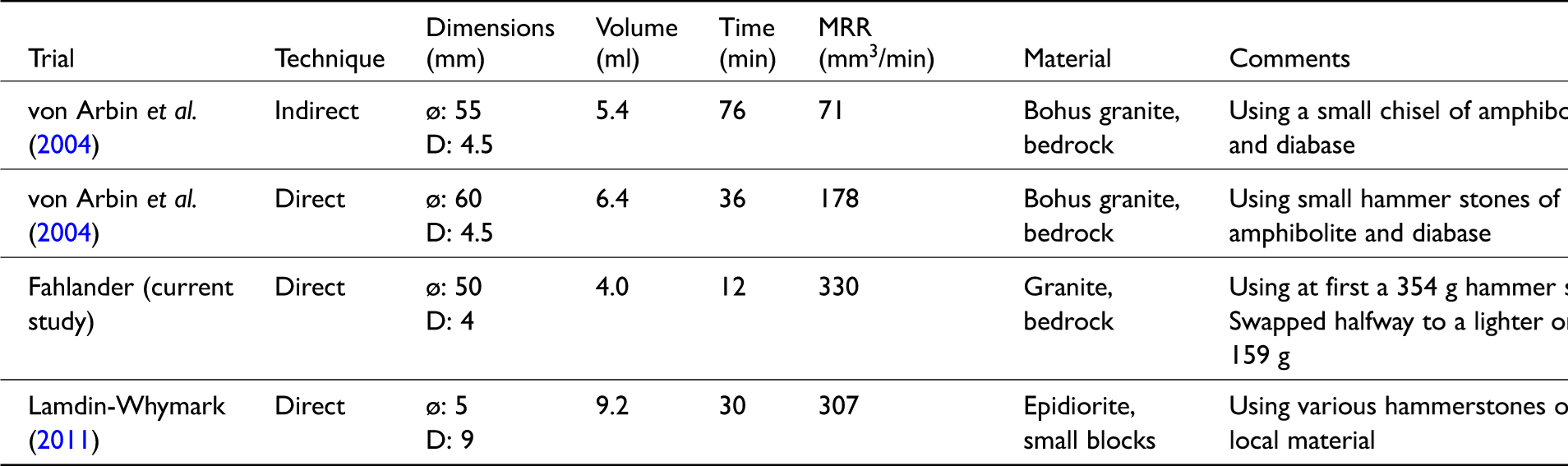
The attempts to make cupmarks show slightly less diversity in production time (Table 2). Hygen and Bengtsson (Reference Hygen and Bengtsson2000, 45) report that a cupmark of unknown diameter and depth would take 45 minutes. Von Arbin and colleagues tested both direct and indirect pecking in Bohus granite (von Arbin et al. Reference von Arbin, Dahnberg, Hellervik, Mellquist and Molander2004, 15). With direct technique, it took them 36 minutes to complete a 60 mm-diameter and 4.5 mm-deep cupmark. With indirect technique, it took 76 minutes to complete a slightly smaller cup (the exact dimensions of the cupmarks differ in their report, on page 12 both are indicated as 60 x 4 mm). The present trial took less time, only 12 minutes for a smaller, 50 mm-diameter and 4 mm-deep cupmark with direct technique. Hugo Lamdin-Whymark (Reference Lamdin-Whymark, Jones, Freedman, O’Connor, Lamdin-Whymark, Tipping and Watson2011, 185–6) made no less than eight 5–13 mm-deep cupmarks in Epidiorite rock, which took between 30–90 minutes to produce with direct technique. The most comparable cup, measuring 50 x 9 mm, took 30 minutes (Lamdin-Whymark Reference Lamdin-Whymark, Jones, Freedman, O’Connor, Lamdin-Whymark, Tipping and Watson2011, 186).
Compilation of trials making cupmarks in terms of time, technology, and type of rock. MRR stands for Material Removal Rate

Table 2 Long description
The table compares various trials of making cupmarks, focusing on technique, dimensions, volume, time, material removal rate, material, and comments. It has six columns: Trial, Technique, Dimensions, Volume, Time, MRR, Material, and Comments. The table contains five rows of data. Row 1: Trial, von Arbin et al. (2004); Technique, Indirect; Dimensions, 55 mm diameter, 4.5 mm depth; Volume, 5.4 ml; Time, 76 minutes; MRR, 71 mm^3/min; Material, Bohus granite, bedrock; Comments, Using a small chisel of amphibolite and diabase. Row 2: Trial, von Arbin et al. (2004); Technique, Direct; Dimensions, 60 mm diameter, 4.5 mm depth; Volume, 6.4 ml; Time, 36 minutes; MRR, 178 mm^3/min; Material, Bohus granite, bedrock; Comments, Using small hammer stones of amphibolite and diabase. Row 3: Trial, Fahlander (current study); Technique, Direct; Dimensions, 50 mm diameter, 4 mm depth; Volume, 4.0 ml; Time, 12 minutes; MRR, 330 mm^3/min; Material, Granite, bedrock; Comments, Using at first a 354 g hammer stone. Swapped halfway to a lighter one of 159 g. Row 4: Trial, Lamdin-Whymark (2011); Technique, Direct; Dimensions, 5 mm diameter, 9 mm depth; Volume, 9.2 ml; Time, 30 minutes; MRR, 307 mm^3/min; Material, Epidiorite, small blocks; Comments, Using various hammerstones of local material.
Other potential factors influencing production time may be the type and material of chisels and pounding stones. Lamdin-Whymark (Reference Lamdin-Whymark, Jones, Freedman, O’Connor, Lamdin-Whymark, Tipping and Watson2011), W. Sierts (Reference Sierts1968), Mari Strifeldt Arntzen (Reference Strifeldt Arntzen2023, 34), and Marie Vourc’h (Reference Vourc’h and Anati2011) all argue for quartzite tools. Von Arbin and colleagues found that naturally grounded, slightly angular stones made of dense, hard volcanic rock (amphibolite and diabase) proved to be the best (von Arbin et al. Reference von Arbin, Dahnberg, Hellervik, Mellquist and Molander2004, 12). Size and weight of the hammer stones do not appear to be significant factors. Consistent with my experiment, smaller stones proved to be as effective as larger, heavier ones (von Arbin et al. Reference von Arbin, Dahnberg, Hellervik, Mellquist and Molander2004, 14; see also Lamdin-Whymark Reference Lamdin-Whymark, Jones, Freedman, O’Connor, Lamdin-Whymark, Tipping and Watson2011, 189). To create a deeper motif, the hammer stone needs to have an elongated tip. If the point has a base that is too wide relative to its length, it becomes difficult to achieve depth without the stone’s edges striking the rock surface outside the furrow (as happened in my cupmark experiment). It should be noted that an occasional hit outside the furrow will not leave any lasting measurable mark, but it will disturb the clarity of the motifs while they are fresh (see Figure 3b). Either way, after compensation for size and depth, there is no significant difference in time expenditure between the experiments with direct technique and the ones using indirect technique with quartz chisels (Lødøen Reference Lødøen, Stebegløkken, Berg, Lindgaard and Vangen Stuedal2015; but see Liebl et al. Reference Liebl, Peternell, Ling, Lindhé, Horn, Meijer and Moyano2023).
The main factors affecting production time depend on the size and depth of the motifs, which make the trials difficult to compare. Depth seems to be an especially undervalued aspect because of the kinetic energy metamorphosis, which makes deeper furrows and cups exponentially longer in time to make. The type of rock is also a major factor affecting production time. In Mohs scale of mineral hardness, red mudstone is graded 2–4, feldspar 6, granite, gneiss, epidiorite, and Devonian sandstone register at 6 to 7 (metaphoric-sandstone is 7). Thus, except for the red mudstone, most of the discussed experiments worked on rocks of similar hardness. The Bohus granite, however, seems to be particularly homogeneous, fine-grained, and of high quartz content, and potentially harder than other granites (Åkesson et al. Reference Åkesson, Hansson and Stigh2004, 133; Eliasson Reference Eliasson1992). It is not possible to directly compare the results of the different trials, but they can be recalculated to approximate numbers. For example, Fahlander and Lamdin-Whymark both made a circle of the same diameter, which are similar in duration (c. 50–60 min) when compensating for Lamdin-Whymark’s slightly shallower depth (Table 1). These numbers differ significantly from the trials on Bohus granite. Recalculating the time it took for Carina Liebl and colleagues to make a 40 mm-long trial furrow made with a bronze chisel (Liebl et al. Reference Liebl, Peternell, Ling, Lindhé, Horn, Meijer and Moyano2023) suggests that it would take approximately 176 minutes to peck a circle of the same circular perimeter (470 mm), not compensating for shallower depth and the time for resharpening of the chisel.
The apparent greater resistance of Bohus granite is consistent with the results of the cupmark experiments. A rough estimate based on the material removal rate (MRR) at each trial shows that with direct technique, von Arbin and colleagues removed 178 mm3/min, Fahlander 330 mm3/min, and Lamdin-Whymark 307 mm3/min. Producing a standardized cupmark 50 mm-diameter and 4 mm-deep took 12 minutes for Fahlander, which would have taken c. 13 minutes for Lamdin-Whymark and c. 22 minutes for von Arbin and colleagues.
Additional factors discussed in the production process are the impact of water and the resulting mineral powder. Strifeldt Arntzen (Reference Strifeldt Arntzen2023, 39) experienced that the mineral powder from the Alta experiment made pecking harder. She used water to clear it away. Vourc’h (Reference Vourc’h and Anati2011, 479), on the contrary, found only modest help from water while pecking. She experienced that the resulting emulsion obfuscated the pecked lines. Von Arbin and colleagues are indifferent to the use of water, although they seem to advocate small amounts (von Arbin et al. Reference von Arbin, Dahnberg, Hellervik, Mellquist and Molander2004, 14). In their case, the outline was made with a red marker pen, which probably became covered by the powder and was probably more visible using water. In the current study performed in Södermanland, water proved inconvenient. The emulsion from the mineral dust made the pecking less effective, and it could not be easily wiped or blown away. On the contrary, the trial showed that while working with direct technique, a little dust in the furrows actually made pecking at a 45-degree angle more effective, as it involved a degree of grinding. If one wishes to collect the dust, it is fairly simple to scrape it up while dry and even easier if the area is moist and generates an emulsion. Pouring water on the area of pecking will, however, flush it away. A consequence of using water is that the shallow furrows in the early stage of pecking will be harder to see when they are not white. In addition, we may also need to consider the possible ritual aspects of water. That petroglyphs often tend to cluster at parts of the rocks where water has trickled down is considered by some deliberately to animate the motifs, make them visible, or that water was an active ritual substance (Bradley Reference Bradley2009, 136; Fahlander Reference Fahlander2024, 106–10; Malmer Reference Malmer, Janson, Lundberg and Bertilsson1989, 14). Thus, even though water makes production more difficult, an assumed generative aspect of water may also have been important in the process of making rock art.
To summarize, what seems evident from these experiments is that technique does not seem to be the main factor affecting the time it takes to make a petroglyph (only when making cupmarks). Size and depth are the most important factors, as well as the regional properties of the rock. The comparisons of the different trials show that, independently of technique, the traditional assertions of time expenditure based on experiments on Bohus granite are misleading for south Scandinavian Bronze Age rock art in general. The current experiment, as well as the others, shows that furrows, cups, and fully hammered-out motifs in sandstone or granites take significantly less time (although several hours depending on size, depth, and level of detail). There is also a question of detail and level of elaboration. A boat motif with crew strokes and prow ornaments, for instance, takes significantly longer to make than one without.
However, even though the time of production can be estimated, the exact numbers may not be that important. Time in small-scale societies is not necessarily a commodity as it is in capitalist modern societies, and is likely to be experienced, valued, and measured differently (Bailey Reference Bailey2006; Gell Reference Gell1992). Thus, the main point for the makers of rock art may not necessarily have been to use the most effective tools and methods, nor to find outcrops with softer mineral composition. As a ritual performance, the time devoted can be seen as a part of the offering; the longer the time, the greater the sacrifice. For example, it is striking that there are so many petroglyphs in the Bohus region despite the apparent greater difficulty to peck cups and furrows in the hard rock. Because this type of granite also preserves the rock art well from foliation, wear and tear, and these durable properties might actually have been a reason for choosing this particular smooth and durable medium – not because it was easy, but because it was hard.
Regardless, time is still an ontological and practical fact. It matters if a motif takes a whole day to produce or if it can be made within an hour under certain circumstances. Simply put, it must be possible to allocate the time it takes. Perhaps the most important point, however, is that production time separates petroglyphs from scribblings or doodles. If a boat has a long-drawn-out keel extension, then we know that someone put aside an additional 10–15 minutes to peck it. The design of a motif can still be partly improvised, but the details are not arbitrary. The same goes for the lack of details or lines. From my personal experience, the original aim of the current experiment was to produce a circle-cross, but after one hour of pecking, I was content with the circle. It would have taken approximately another 30–40 minutes to complete the motif with two crossing lines. The lesson here is that very little in Bronze Age rock art is likely to be random or chance; every furrow (or lack of one) is probably significant, as it involves both intentionality and time and also persistence during the production process.
Embodied, ambient, and sensory aspects in rock art production
From time to time, embodied and sensory aspects of rock art have been emphasised (Tilley Reference Tilley2008). This is usually discussed from the viewer’s point of view and is only occasionally discussed while making rock art. The most common are notions regarding sound as a part of making rock art. Lødøen (Reference Lødøen, Stebegløkken, Berg, Lindgaard and Vangen Stuedal2015, 74) and von Arbin and colleagues (von Arbin et al. Reference von Arbin, Dahnberg, Hellervik, Mellquist and Molander2004, 16), for example, suggest that music or chanting might have followed the rhythmic sound of pecking. However, as the current study indicates, the pecking is not necessarily that rhythmic; the swapping of hands results in pauses and a slightly different rhythm and sound. Others have emphasized the distant sound of pecking in ritual or social terms (Diaz-Andreau et al. Reference Diaz-Andreau, Mattioli, Rainsbury, Gjerde and Arntzen2021; Hauptman Wahlgren Reference Hauptman Wahlgren1998, 94; Moberg Reference Moberg, Fredsjö, Janson and Moberg1969, 13; Nordström Reference Nordström, Nordström and Svedin1999; Ouzman Reference Ouzman2001; Vergara Reference Vergara2019). Åke Hultkrantz (Reference Hultkrantz and Steinsland1986, 54), for example, refers to ethnographic accounts from North America where people who heard the sound of pecking and found new images in the rocks assumed that they were the works of spirits. Mats Malmer (Reference Malmer, Janson, Lundberg and Bertilsson1989, 15) has argued along similar lines that the rhythmic sound of pecking must have been familiar and had special meaning to ‘Bronze Age people’. We need, however, to consider that the number of motifs produced annually is small, mainly by the coasts and rarely close to settlements. The sound of pecking would thus only be a brief and infrequent matter of certain coastal milieus (Fahlander Reference Fahlander2024, 11, 139). Perhaps the most important auditory factor in petroglyph production is that it is difficult to perform in secret, especially since the majority of Bronze Age rock art sites were situated by water, with few obstacles to impede the sound over great distances. Trond Lødøen stresses the potential harm to the ears when pecking without using hearing protection (2015, 73). In my experiments, I found the sound from pecking quite low and not uncomfortable for the ears. With direct technique, it was normally around 30db with occasional spikes of 40–60 dB. In conclusion, sound is an unavoidable aspect of petroglyph production, immediately apparent for anyone enacting the rocks with hammerstones, but so are other, less ritualised practices such as chopping down trees and working with wood.
Besides sound, the process of making rock art may also involve embodied factors. Von Arbin and colleagues experienced the task as both physically and mentally tiring and took a toll on the hands and fingers (most likely due to the extensive time they spent pecking) (von Arbin et al. Reference von Arbin, Dahnberg, Hellervik, Mellquist and Molander2004, 15). Vourc’h (Reference Vourc’h and Anati2011, 179) noted that, if water was used to rinse the area, the amount needed would most likely make the creator wet.
Another sensorial aspect concerns the changing colour of the rock when pecking. That granite and gneiss turn white is a condition for petroglyphs to appear as images without oblique light, but this effect need not necessarily be about visibility only. As Sven Ouzman (Reference Ouzman2001) has argued, the changing colour of the rock can be understood as something hidden in the rock being exposed by pecking. Consequently, when the white petroglyphs become dull and gradually fade back into the natural colour of the rock, it is a tangible indication of a spiritual or animate agency. In the cupmark experiment, the rock also changed texture and colour beneath the outer layer, which may encourage ideas of something hidden in the rock that can be reached or released by pecking (cf. Tilley Reference Tilley2008, 177). A related, less discussed sensory aspect of production is also the smell that can occur while pounding the rock. During the current experiment, there was a distinct smell of sulphur, similar to that of an ignited safety match. This effect is normally caused by the release of fluid inclusions within quartz-rich granite (Brauns Reference Brauns1912, 272; Rankin Reference Rankin, Selley, Cocks and Plimer2004). Thus, the smell can actually be a tangible and simple indicator of the composition of the rock. This could have been perceived as a ‘response’, and the rock was considered effective and even efficacious in a Bronze Age ontology.
Efficacies of mineral dust
A final tangible aspect of rock art production is the residual mineral dust. It quickly becomes apparent that the pounding of the rock produces quite a lot of fine-grained mineral powder, regardless of whether cups or furrows are created. In the experiments, this is mainly discussed as a problem, as it obfuscates the furrows and is argued to make the pounding less effective. Sverre Marstrander (Reference Marstrander1963, 458), however, has pointed out the possibility that the mineral dust may have been an important outcome of rock art production (see also Evers Reference Evers1993, 43; Fahlander Reference Fahlander2025; Pettersson Reference Pettersson1977, 95). He suggested that it was spread on arable land to improve fertility. Such interpretations are strengthened by ethnographic accounts of rock art production. In Australia, for example, it was believed that the female cockatoos lay more eggs when the mineral powder from pecking cupmarks was released into the air (Flood Reference Flood1997, 146–7). In North America, powder from pecking cupmarks was employed to increase human fertility. Such and other uses of the mineral powder in Bronze Age rock art also finds support from the apparent preference for producing petroglyphs on areas of the rock outcrop characterized by diverging colours and mineral content, such as quartz veins or bands of different coloured minerals, as well as on outcrops of specific materials such as chalky limestone, red sandstone, or Bohus granite (Fahlander Reference Fahlander2024, 100–9). This indicates a keen interest in minerals generally, which suggests that the powder resulting from pecking was more than just a byproduct. Indeed, some minerals present in the rock art panels, such as quartz, rock crystal, chalk, and mica, possess real agentic properties like triboluminescence or medicinal benefits that may have encouraged a Bronze Age ontology in which other minerals were also deemed efficacious and generative (see Fahlander Reference Fahlander2025 for examples). This perspective forces us to reconsider the visual distinction between cupmarks and figurative motifs. To peck a cupmark is different from furrows. In a cupmark, the mineral dust needs to be removed as it fills the cup and dampens the effect of pecking, while in a furrow, a little powder is beneficial when using a tilted peck-and-grind technique. This general difference may, rather than the visual form, have been significant in distinguishing between making cups or furrows, depending on the potential importance of penetrating deep into the rock and the significance of mineral powder. It also forces us to accept the fact that 90% of all Bronze Age petroglyphs are cupmarks (Fahlander Reference Fahlander2024, 1). To peck cavities that produce mineral dust is, after all, the most common enactment with rock outcrops during the Bronze Age.
Required skills, experience, and equipment for making Bronze Age rock art
The experiment also provided a few indications of the requirements for making rock art. It has sometimes been argued that rock art was made by a group of ritual specialists (Ling et al. Reference Ling, Chacon, Chacon, Dolfini, Crellin, Horn and Uckelmann2018, 161; Goldhahn Reference Goldhahn2014; Moyano Di Carlo Reference Moyano Di Carlo2025). There have even been attempts to identify individual artists (Bengtsson Reference Bengtsson2004) as well as to explain similarities between regions as the work of travelling rock art producers (Broström & Ihrestam Reference Broström and Ihrestam2016). This is an open question for the Bronze Age, as ethnographic cases are diverse on this subject (Hultkrantz Reference Hultkrantz and Steinsland1986; Keithahn Reference Keithahn1940, 130). One common argument for a specialist practice is that the makers of rock art would have needed advanced knowledge of the properties of the rocks to identify which areas were suitable (i.e. easy to peck). This assumes that efficiency was an important factor, which, as argued above, was not necessarily the case for a ritualized practice. The repetition of mostly the same motifs (cupmarks, boats, anthropomorphs, zoomorphs, foot soles, and circles) might also indicate institutionalized supervision and restriction. However, such a degree of formalization was also the case for the Stone Age hunters’ rock art, which continued for several millennia longer than the Bronze Age. The variability in articulation of the motifs is also great, even in small areas and on individual outcrops: in the Boglösa parish, for example, the simple boat motif is found in almost a hundred different styles and designs (Fahlander Reference Fahlander2018, 70).
It is also interesting that the discussed trials show how easy it is to produce fairly Bronze Age-like petroglyphs without any previous experience besides having seen the originals. With the exception of Morten Kutschera’s experiment (described in Lødøen Reference Lødøen, Stebegløkken, Berg, Lindgaard and Vangen Stuedal2015), all of the discussed trials were performed by amateurs. This implies that many Bronze Age petroglyphs could have been the works of anyone using a locally retrieved, fairly pointy stone. The fact that the lion’s share of Bronze Age rock art consists of outcrops with only cupmarks or a handful of rather crude, asymmetrical, incomplete, and irregular motifs also points to a diverse category of rock art producers. However, although the actual process of making petroglyphs is relatively easy, some motifs are quite elaborate, complex, and detailed, which can be argued to require a certain level of aesthetic competence. Some concentric circles, for instance, are very symmetrical, which must have demanded both experience and skill to make. Nonetheless, because petroglyphs are made by repeatedly pecking the same grooves, it is often possible to adjust and fine-tune straight or curved lines along the way. Thus, it is perhaps not the elegant petroglyphs that should surprise us but rather the many irregular and fuzzy ones (Figure 5). If symmetry were considered important, it would have been easily achieved and adjusted during the repeated pecking.
Examples of boat motifs from ordinary outcrops with rock art in the Mälaren region compiled by Broström and colleagues (Broström et al. Reference Broström, Ihrestam and Wikell2021, 37–8). Three shades of grey indicate variation in pecking depth (black is deepest).

Figure 5 Long description
Panel A: A simple boat shape with a curved line and a small figure at the front. Panel B: A boat with a series of vertical lines along the sides and a small figure at the front. Panel C: A boat with a series of vertical lines along the sides and a small figure at the front, with additional lines inside the boat. Panel D: A boat with a series of vertical lines along the sides and a small figure at the front, with additional lines inside the boat and a curved line at the back. Panel E: A boat with a series of vertical lines along the sides and a small figure at the front, with additional lines inside the boat and a curved line at the back. Panel F: A boat with a series of vertical lines along the sides and a small figure at the front, with additional lines inside the boat and a curved line at the back. Panel G: A boat with a series of vertical lines along the sides and a small figure at the front, with additional lines inside the boat and a curved line at the back. Panel H: A boat with a series of vertical lines along the sides and a small figure at the front, with additional lines inside the boat and a curved line at the back. Panel I: A boat with a series of vertical lines along the sides and a small figure at the front, with additional lines inside the boat and a curved line at the back. Panel J: A boat with a series of vertical lines along the sides and a small figure at the front, with additional lines inside the boat and a curved line at the back. Panel K: A boat with a series of vertical lines along the sides and a small figure at the front, with additional lines inside the boat and a curved line at the back. Panel L: A boat with a series of vertical lines along the sides and a small figure at the front, with additional lines inside the boat and a curved line at the back. Panel M: A boat with a series of vertical lines along the sides and a small figure at the front, with additional lines inside the boat and a curved line at the back. Panel N: A boat with a series of vertical lines along the sides and a small figure at the front, with additional lines inside the boat and a curved line at the back. Panel O: A boat with a series of vertical lines along the sides and a small figure at the front, with additional lines inside the boat and a curved line at the back. Panel P: A boat with a series of vertical lines along the sides and a small figure at the front, with additional lines inside the boat and a curved line at the back.
Even though there was little need for specialized tools or extensive experience to make rock art, the practice may still comprise aspects of a ritual technology (cf. Fahlander Reference Fahlander2024; Gell Reference Gell1998) that entailed knowledge of, e.g. mineral content, water flows, and when and how to make rock art in particular designs. Potentially, there may also have been taboos and regulations on who was allowed to make rock art. Any such ‘unauthorized’ attempts would, however, be difficult to control, as many rock art sites are rarely found at settlements but are situated in semi-secluded inlets and small islets along the coasts and water routes (Fahlander Reference Fahlander2024, 153). This does not, however, imply that petroglyph production was a common activity practised by everyone during the Bronze Age. Judging from the restricted distribution of rock art, primarily along the coasts, islets, and water courses, it is more likely to be an issue for particular groups and individuals who inhabit and traverse these settings. Especially poignant are the many small islets with rock art that can only be reached by swimming or by boat. I have suggested elsewhere (2018, 119) that outdoor rock art along the coasts and waterways was likely to be produced by maritime communities of practice, moving about the former coasts involved in e.g. raids, fishing, hunting, trade, or exploration. The experimental trials show that such a scenario is a practical possibility, and, at least to me, is a more probable scenario than groups of travelling specialists that repeatedly visited all the remote bays and inlets of the Scandinavian peninsula to make the same types of petroglyphs over and over.
Petroglyphs or petrofacts?
Experiments show that petroglyphs are typically white when first pecked, but after two to three years, the rock returns to its original colour, making them hard to see without oblique light (Goldhahn Reference Goldhahn2014, 183). This, I would argue, is an important element in the practice with consequences that are rarely discussed in depth. For example, are the deep cavities of the figurative motifs merely a byproduct of repeatedly making bright white motifs? Surely the bright white colour of a freshly pecked petroglyph is the most striking visual element at the time they were made, which needed no oblique light to show. In fact, as illustrated by the experimental results, there was little visual difference between 1 mm and 3 mm depth of the circular motif. Thus, when freshly pecked, the depth is barely noticeable in relation to the white colour (Figure 3a). Moreover, even though the white colour is the most visible element of a fresh petroglyph, it is nonetheless temporary. Even the 3–4 mm-deep motifs will still slowly diminish into the rock (or be covered by lichen). To counter this process, it has been argued that some motifs from time to time were re-pecked and ‘activated’ (i.e. turned white again) on sites containing multiple petroglyphs (Hauptman Wahlgren Reference Hauptman Wahlgren, Milstreu and Henning2004). Such a practice would make the motifs deeper each time, although it is not likely to solely explain the general ‘unnecessary’ depth of Bronze Age petroglyphs.
The visual aspect also changes within a shorter time frame. For instance, the experiment with the shallow boat motif shows that clearly visible motifs can be produced fast and efficiently without resulting in lasting depressions in the rock. The possibilities are many if such an approach were used. Not only can individual motifs be created that last only a few months, but the technique can be employed to modify and add lines to existing motifs. The prow extensions of shallower depth added to some boat motifs indicate such a practice, although they still are visible furrows (Fahlander Reference Fahlander2024, 91–4; Milstreu Reference Milstreu, Bergerbrantd and Wessman2017). Another more explicit example is a zoomorph on the Swedish west coast with four legs, a tail, a neck, and a head, but who lacks a body (KMR no. L1960:2025). High-resolution laser scanning, however, shows faint pecking marks in the body area that are otherwise invisible to the naked eye (Fahlander Reference Fahlander2018, 38). In fact, many rock art sites also display seemingly random pecking marks between the motifs (e.g. Broström & Ihrestam 2013; Reference Broström and Ihrestam2017), as well as more complex lines and furrows not visible to the naked eye, even with oblique light. A recent project in Uppland documented 30 outcrops with three-dimensional photogrammetry as well as ocular and tactile methods (Fahlander Reference Fahlander2023). On most panels, the 3D-models showed additional faintly pecked motifs and patterns that were not always identified by a very experienced rock art surveyor. The possibility of both temporary modifications and additional motifs stresses interesting possibilities concerning Bronze Age rock art, which, depending on the extent, may ultimately question how much of the original enactments are left for us to see. However, as few traces of such activities have yet been identified, it remains a possibility only.
On an even shorter time frame, the experiment also shows how a fresh motif is ‘turned off’ when rain or waves splash the rock and ‘turned on’ again only when drying. Since water regularly trickles over many rock art panels, making petroglyphs in these locations seems counterproductive from a visual point of view. However, looking at the motifs in terms of ritualized artefacts, there might be a logic in the relation between the visible and the physical. For example, in other ontologies, such as in Ancient Egypt, water was believed to be enhanced by flowing over certain images and inscriptions (Koering Reference Koering2024, 128). It would thus make sense that the motif disappears when water flows over it (i.e. something is extracted from the rock and the motif) only to reemerge when dry.
Thus, the temporality of the white motifs has consequences for the ontological status of the petroglyphs. If the main object of Bronze Age rock art was to illustrate cosmologies or convey meanings during rituals, shallow pecking would have sufficed. The fact that many petroglyphs are deeper than necessary for visibility suggests that the cups and cavities had a purpose other than being primarily visual. It is telling that the cavity of furrows is only rarely understood in the same physical way as the cupmarks, but is it perhaps more viable to view cups and furrows as important for the function of petroglyphs? Such an inference can include the collection of mineral dust or reaching something within the rock, as well as the ability of furrows and cups to channel or hold water or other liquids. Thus, there is both a visual and a physical aspect to Bronze Age rock art. Hence, petroglyphs may be better understood as petrofacts (i.e. ritual tools or devices with both visual and physical properties), produced to do something (Fahlander Reference Fahlander2024).
Conclusions
This experimentally based study offers a critical re-evaluation of the production process of south Scandinavian Bronze Age rock art. It is argued that the time to produce a cupmark or normal-sized motif is considerably shorter than what older sources report: 11–15 minutes for a cupmark and 1–2 hours for a figurative motif of 3–4 mm-depth in granite (or other rock with similar hardness). Even though time in Bronze Age ontology may not be experienced similarly to modern industrialised societies, sufficient time still must be allocated. More importantly, however, is that size and details, and omitted parts, must be considered significant as the production of every furrow, short or long, entails plenty of time for reflection and reconsideration when produced. Petroglyphs differ in this respect from scribbling or painted motifs, which can be more improvised and sketchier. It is also concluded that the type of technique, the material of pounding stones or chisels, does not significantly affect the production time of motifs of the same type, size, and depth. The potential benefits of water are also inconclusive and more of a factor of the technique or whether the mineral dust was meant to be collected.
Besides issues of efficiency, the tangible and sensory aspects of production, like sound and smell, were also evaluated. Indeed, smell, the changing colour of the rock, and the sound of pecking may constitute meaningful aspects of the practice – either ritually or ontologically, as they may encourage particular views of the rock and its potential powers, efficacies, and constitution. It is, nonetheless, easy to overinterpret the sensory dimensions of the process. Despite the ambition to be attentive to the sensory and physical aspects of the work, my focus inevitably ended up on aiming correctly for each blow and, to some extent, on the amount of mineral dust that was created. Thus, potential aspects of smell and sound need to be discussed on a case-by-case basis in relation to other evidence to avoid mere speculation. The fine-grained mineral powder resulting from the pecking process is, however, an evident agentic substance, which may potentially have been collected for extended rituals.
Because the experiment focused on making and not copying original motifs, it revealed new information that has only rarely been discussed. The shallow boat motif is an important contribution, as it shows that it is possible to make clearly visible petroglyphs in just minutes. Despite the fact that the motif left no lasting traces on the rock, it continued to be clearly visible for months. This suggests that the primary purpose of making Bronze Age petroglyphs was not solely to communicate visually or illustrate meaning. The depth of most Bronze Age petroglyphs rather points toward a potential function as ritual devices. Indeed, a few millimetres-deep furrow ensures longer visibility over time (3–4 mm motifs can remain white for one or two years) but perhaps more importantly, it allows the cups and furrows to be utilised, e.g. for collecting potent mineral dust, channelling water, or to reach or affect something of the inner, ‘hidden’, qualities of the rock. Thus, the ‘unnecessarily’ deep furrows of Bronze Age petroglyphs indicate that they were meticulously crafted components of an ontology rooted in physical efficacy and tangible interaction with rocks and minerals.




 Open access

